
7 Key Benefits Data Analytics Brings to Businesses in 2026

Share on Facebook
Share on X
Share on LinkedIn

In 2026, the business world is rapidly shifting due to digital transformation, fierce competition, and an explosion of innovation rooted in data. Every day, organizations collect more information, yet a staggering 68% of business data remains untapped and full of potential.

The benefits data analytics offers are no longer a luxury but a vital necessity for any company aiming to stay ahead. By leveraging analytics, businesses unlock actionable insights that drive smarter decisions across all industries and sizes.

Imagine achieving real-world advantages such as cost savings, streamlined operations, stronger customer loyalty, and long-term resilience. This article highlights the seven key benefits data analytics delivers in 2026, from empowering leaders with evidence-based decisions to supporting employee well-being.

Are you ready to discover how embracing benefits data analytics can transform your organization and secure your competitive edge? Read on to see how analytics can turn raw data into your most valuable asset.

The Evolving Role of Data Analytics in 2026

The benefits data analytics provides are transforming how organizations operate in 2026. Businesses are using analytics to harness growing data volumes, drive smarter decisions, and stay ahead of competitors. As adoption accelerates, understanding the evolving landscape is crucial.
The Evolving Role of Data Analytics in 2026

The Growth of Data and Analytics Adoption

Organizations are generating and collecting unprecedented amounts of data, with global volumes projected to double by 2026. Data analytics solutions are now more accessible and affordable, helping both small businesses and large enterprises unlock hidden value. Cloud platforms and AI-driven tools are making analytics available to everyone.

Healthcare and retail sectors are leading the way, using data to improve operations and customer experiences. According to the U.S. Bureau of Labor Statistics, data analytics roles are expected to grow by 35 percent from 2022 to 2032. The benefits data analytics brings are further underscored by the market's rapid expansion, with projections estimating the industry will reach $503.62 billion by 2035, as detailed in Data Analytics Market Size and Growth.

Types of Data Analytics and Their Business Impact

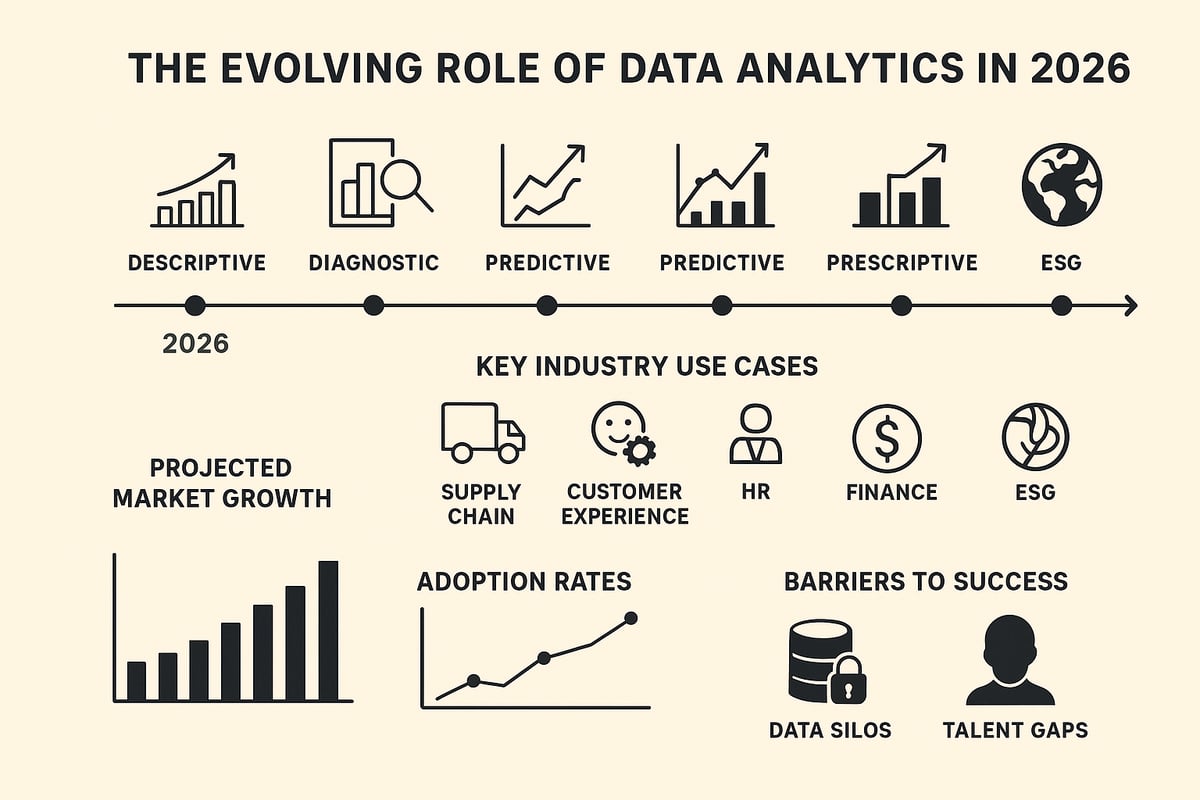
Businesses today leverage several types of analytics to maximize the benefits data analytics offers. Descriptive analytics helps organizations understand what happened through reports on sales or turnover rates. Diagnostic analytics uncovers why events occurred, such as analyzing causes for declining revenue.

Predictive analytics forecasts what could occur, enabling proactive planning. Prescriptive analytics guides actionable steps to optimize resources and outcomes. By integrating these approaches, leaders gain a holistic view, supporting informed decisions across departments. This comprehensive use of analytics supports sustainable performance and growth.

Industry Use Cases and Emerging Trends

The benefits data analytics delivers are evident across industries. In supply chain management, analytics drives inventory optimization and accurate demand forecasting. Retailers enhance customer engagement and retention through personalized recommendations.

Human resources teams use analytics to optimize benefits and improve employee well-being. In finance, analytics supports revenue management, cost control, and fraud detection. The integration of AI and machine learning enables real-time insights and automation. For example, many organizations now use analytics for ESG reporting to track sustainability goals effectively.

Overcoming Barriers to Analytics Success

Despite the benefits data analytics provides, organizations face challenges such as data silos, low data quality, and a shortage of analytics talent. Overcoming these obstacles requires investment in robust data governance, employee upskilling, and strategic partnerships with analytics vendors.

Executive buy-in and fostering a data-driven culture are essential for success. Automated data collection reduces manual errors and streamlines reporting, as seen in case studies where companies save hundreds of hours annually. Ultimately, addressing these barriers helps organizations realize the full potential of their analytics initiatives.

7 Key Benefits Data Analytics Brings to Businesses in 2026

Data analytics is transforming the way organizations operate and compete in 2026. The benefits data analytics delivers extend far beyond simple reporting, driving measurable change across every business function. Let’s explore how these seven advantages shape success for forward-thinking companies.
7 Key Benefits Data Analytics Brings to Businesses in 2026

1. Enhanced Decision-Making Through Data-Driven Insights

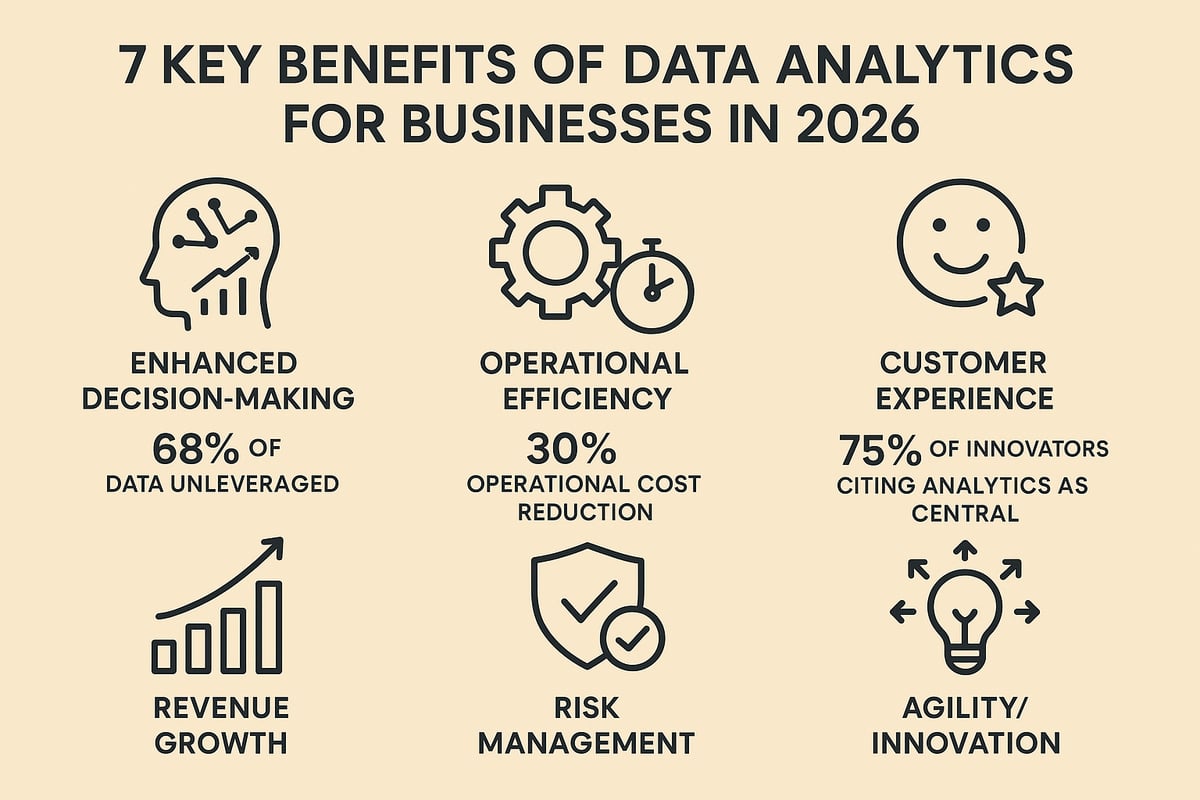
The most significant benefits data analytics offers are related to smarter, faster decision-making. Instead of relying on intuition, leaders can utilize evidence-based insights for every major business choice. Real-time dashboards and dynamic reports provide instant access to performance metrics, allowing executives to spot opportunities and react to challenges without delay.

  • Scenario modeling tools enable “what-if” analysis, supporting strategic planning and risk assessment.
  • For example, marketing teams can track engagement metrics to refine campaigns and allocate budgets more efficiently.
  • With 68% of business data still untapped, analytics is the key to unlocking hidden value.

Data-driven cultures foster alignment between departments, ensuring everyone works from the same accurate information. By reducing the risk of bias and costly errors, businesses using analytics consistently report higher ROI on strategic initiatives. The benefits data analytics brings to the decision-making process are now indispensable for organizations aiming to lead their industries.

2. Operational Efficiency and Cost Reduction

One of the most immediate benefits data analytics provides is the automation of routine processes. Manual tasks such as HR, payroll, and compliance reporting are streamlined, saving time and minimizing mistakes. Analytics platforms identify inefficiencies and operational bottlenecks, guiding managers to areas where improvements will have the greatest impact.

  • Predictive maintenance and process optimization reduce downtime and optimize resource allocation.
  • Manufacturers leverage analytics to maximize equipment uptime and minimize waste.
  • Automated data collection simplifies regulatory compliance and reporting.

By implementing these solutions, companies can reduce operational costs by up to 30%. These efficiency gains allow teams to focus on innovation and growth, rather than repetitive administration. For more in-depth strategies on streamlining operations, see Achieving operational efficiency. The benefits data analytics delivers in this area help organizations stay lean and competitive in a dynamic market.

3. Customer Experience Personalization and Retention

Understanding customer needs is essential for success, and the benefits data analytics brings here are game-changing. Businesses can track customer behavior, preferences, and pain points, then personalize products, services, and communications to boost loyalty and lifetime value.

  • Segmentation and targeting improve marketing ROI and conversion rates.
  • Retailers use purchase history and browsing data to make relevant product recommendations.
  • Real-time analysis of customer feedback enables proactive resolution of issues.

Companies using analytics for personalization report up to 20% higher customer satisfaction scores. Predictive models help anticipate customer churn and trigger retention strategies before it’s too late. By identifying unmet needs, analytics also drives innovation in product and service offerings. The benefits data analytics provides in customer experience are crucial for differentiating brands and building lasting relationships.

4. Revenue Growth and New Market Opportunities

The benefits data analytics unlocks for revenue growth are significant. By uncovering patterns and trends, organizations can identify new revenue streams and market segments. Analytics supports demand forecasting, allowing businesses to develop new products and expand strategically.

  • SaaS companies use analytics to discover upsell and cross-sell opportunities.
  • Data-driven pricing strategies maximize profitability across markets.
  • Competitive intelligence from analytics informs better positioning and targeting.

According to Bain & Company, businesses using advanced analytics are five times more likely to make faster, more informed decisions. Agile, data-informed go-to-market strategies and rapid experimentation enable companies to validate ideas and scale successful models quickly. The benefits data analytics brings to revenue generation are vital for growth and competitiveness in 2026.

5. Risk Management and Compliance Optimization

Risk management is another area where the benefits data analytics delivers are clear and measurable. Analytics solutions help identify and mitigate operational, financial, and cybersecurity risks by providing real-time monitoring and anomaly detection.

  • Financial institutions use analytics to flag suspicious transactions and prevent fraud.
  • Automated data tracking streamlines regulatory compliance and reporting.
  • Scenario analysis prepares organizations for disruptions in supply chain or markets.

Sixty percent of organizations report improved risk management after adopting analytics solutions. By reducing legal exposure and associated costs, analytics enhances resilience and crisis preparedness. The benefits data analytics provides in risk and compliance help organizations operate with greater confidence and stability.

6. Employee Well-Being and Workforce Optimization

The benefits data analytics brings to human resources are increasingly recognized in 2026. HR analytics offers insights into employee engagement, turnover, and well-being, enabling data-driven improvements in workplace culture.

  • Benefits programs informed by analytics improve health outcomes and reduce absenteeism.
  • Predictive analytics identifies at-risk employees, allowing for proactive interventions.
  • Benchmarking tools compare performance against industry standards.

Organizations using workforce analytics see up to a 25% reduction in turnover. Automated reporting also reduces the administrative burden on HR teams, freeing them to focus on strategy and employee development. The benefits data analytics delivers here foster transparency, continuous improvement, and a more engaged workforce.

7. Agility, Innovation, and Future-Proofing

Finally, agility and innovation are among the most transformative benefits data analytics provides. Businesses can adapt quickly to market and technology changes, using scenario planning and forecasting to stay ahead of trends.

  • Analytics supports digital transformation and the adoption of emerging technologies.
  • Data-driven insights fuel innovation and support cross-departmental collaboration.
  • Businesses leverage analytics to test new products and pivot based on real-time feedback.

Seventy-five percent of high-performing companies cite analytics as central to their innovation strategy. By sharing data and goals across the organization, companies create a collaborative environment that is resilient to disruption. The benefits data analytics brings in agility and future-proofing ensure organizations remain relevant and competitive as the landscape evolves.


Summary Table: 7 Key Benefits Data Analytics Brings to Businesses

Benefit Key Impact
Enhanced Decision-Making Evidence-based, faster, less biased choices
Operational Efficiency Cost savings, automation, streamlined processes
Customer Experience Personalization, higher retention, proactive support
Revenue Growth New markets, pricing optimization, faster launches
Risk Management Real-time monitoring, compliance, resilience
Employee Well-Being Engagement, reduced turnover, strategic HR
Agility and Innovation Adaptability, digital transformation, future-proof

The benefits data analytics offers in 2026 are not optional—they are essential for sustainable success. By embracing analytics, businesses will lead with confidence, efficiency, and resilience.

Building a Data-Driven Culture for Sustainable Success

Creating a data-driven culture is essential for organizations that want to realize the full benefits data analytics offers in 2026. This environment empowers every employee to use data in daily decision-making, supports sustainable growth, and positions businesses to outpace competitors.
Building a Data-Driven Culture for Sustainable Success

Leadership and Organizational Buy-In

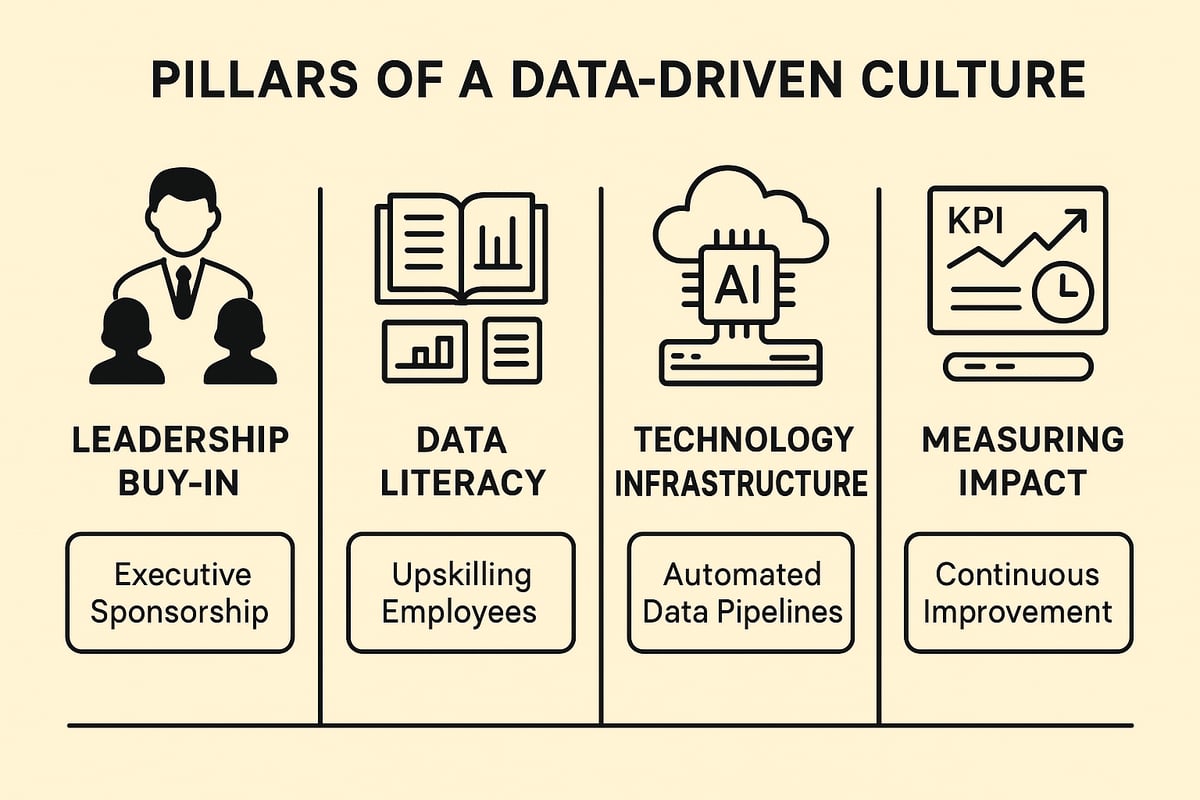
Executive sponsorship is the cornerstone of establishing a culture where the benefits data analytics can be fully realized. Leaders must champion data-driven decision-making, set expectations, and model these behaviors from the top down.

Cross-functional teams, including Chief Data Officers (CDOs), ensure analytics strategies align with business goals and drive faster returns on investment. Transparent communication about analytics value builds organizational trust and engagement.

For example, companies that prioritize analytics leadership often identify new growth opportunities faster. According to Maximizing B2B growth opportunities, leveraging insights can uncover hidden areas for expansion, directly tying to the benefits data analytics brings.

Data Literacy and Employee Empowerment

Upskilling employees in data literacy is critical for maximizing the benefits data analytics delivers across the organization. Training programs make analytics tools accessible, enabling staff at all levels to interpret and act on data with confidence.

Departments such as HR now use self-service dashboards to monitor real-time trends, fostering accountability and innovation. When employees can ask questions and experiment with data, they become active participants in driving improvement.

A workforce fluent in analytics reduces the burden on IT and creates a culture where the benefits data analytics are realized in everyday operations. Empowered teams are more engaged and responsive to new challenges.

Technology Infrastructure and Best Practices

Modern analytics platforms provide the backbone for harnessing the benefits data analytics at scale. Cloud-based, AI-enabled, and automated solutions enable real-time data collection and analysis, while robust data governance safeguards quality and compliance.

Automated data pipelines eliminate manual entry errors, ensuring accuracy and freeing staff for strategic work. Regular audits and updates keep infrastructure aligned with business needs.

For organizations seeking efficiency, tracking efficiency metrics in automation demonstrates how analytics and automation together drive measurable process improvements. This integration is essential for realizing the full benefits data analytics can provide.

Measuring Impact and Scaling Analytics Initiatives

To sustain the benefits data analytics brings, organizations must measure impact with clear KPIs and success metrics. Tracking outcomes like cost savings, revenue growth, and employee engagement helps quantify value and guide future efforts.

Continuous feedback loops support iterative improvement. Sharing analytics-driven success stories across departments builds momentum and organizational buy-in.

As analytics maturity grows, expanding initiatives organization-wide maximizes the benefits data analytics offers. Regularly reviewing strategies ensures long-term relevance and adaptability to changing business needs.

The Future of Data Analytics: Trends to Watch in 2026 and Beyond

In 2026, the future of business is being shaped by rapid innovation in data analytics. As organizations look ahead, understanding the evolving landscape is crucial to fully realize the benefits data analytics can deliver. Let us explore the most impactful trends that are set to redefine business success.
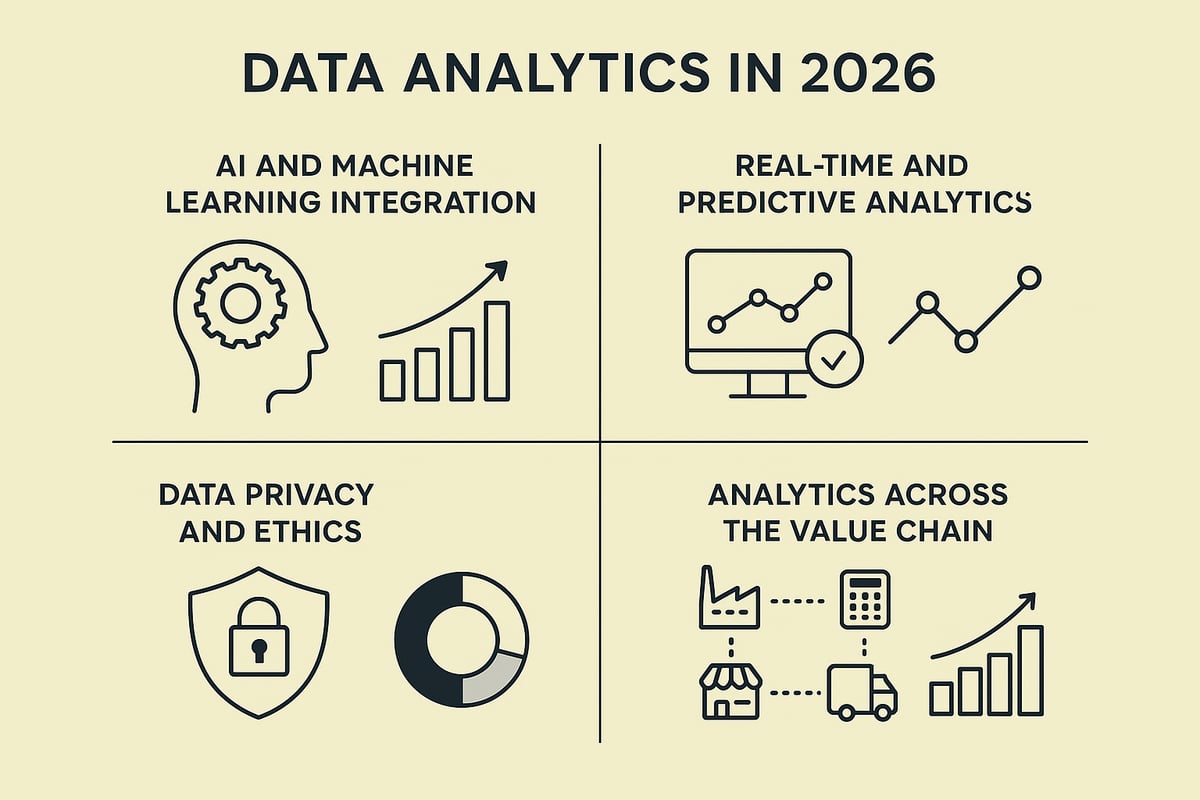
The Future of Data Analytics: Trends to Watch in 2026 and Beyond

AI and Machine Learning Integration

The benefits data analytics brings to businesses are expanding rapidly with the integration of artificial intelligence and machine learning. These technologies enable deeper insights, making it possible to automate complex analysis and uncover patterns previously hidden in large datasets.

AI-driven models enhance the accuracy of forecasts and recommendations. For instance, customer support is transforming through analytics-powered chatbots and virtual assistants. Automated anomaly detection tools are helping companies manage risk more effectively. According to AI and Data Analytics Trends in Business Research, 80 percent of new analytics solutions will include AI features by 2026. Embracing these advancements is essential for staying competitive.

Real-Time and Predictive Analytics

Real-time data analysis is now a necessity for organizations seeking the full benefits data analytics has to offer. Businesses are leveraging IoT devices and edge computing to collect, process, and act on information instantly. This enables rapid responses to market changes and customer needs.

Retailers, for example, adjust pricing and inventory based on live demand signals. Predictive analytics empowers organizations to anticipate trends and mitigate disruptions before they occur. Integration with business process automation ensures insights lead directly to action. Real-time analytics shortens the gap between data collection and decision-making, keeping companies agile.

Data Privacy, Ethics, and Governance

As the benefits data analytics become more pronounced, so do concerns around privacy and ethical use. Regulatory frameworks like GDPR and CCPA are shaping how companies handle sensitive information. Transparent data practices are critical to maintaining customer trust and meeting compliance requirements.

Organizations are adopting privacy-by-design principles in their analytics workflows. Ethical considerations for AI and algorithmic decisions are taking center stage. Data governance frameworks ensure responsible and secure usage of information. Seventy percent of businesses plan to increase investment in data privacy by 2026, reflecting its rising importance.

Expanding Analytics Across the Value Chain

The benefits data analytics are no longer limited to finance or marketing; adoption now extends across the entire value chain. Supply chain, HR, ESG, and other domains are leveraging analytics for greater efficiency and impact. Cross-industry collaborations are emerging as organizations share data for better outcomes.

Healthcare providers and insurers, for instance, are working together to improve patient care through shared analytics. Businesses are using insights to support sustainability efforts and social responsibility initiatives. Those that expand analytics across the value chain consistently outperform their competitors and are better positioned for future challenges.

7 Key Benefits Data Analytics Brings to Businesses in 2026

In 2026, the business world is rapidly shifting due to digital transformation, fierce competition, and an explosion of innovation rooted in data. Every day, organizations collect more information, yet a staggering 68% of business data remains untapped and full of potential.

The benefits data analytics offers are no longer a luxury but a vital necessity for any company aiming to stay ahead. By leveraging analytics, businesses unlock actionable insights that drive smarter decisions across all industries and sizes.

Imagine achieving real-world advantages such as cost savings, streamlined operations, stronger customer loyalty, and long-term resilience. This article highlights the seven key benefits data analytics delivers in 2026, from empowering leaders with evidence-based decisions to supporting employee well-being.

Are you ready to discover how embracing benefits data analytics can transform your organization and secure your competitive edge? Read on to see how analytics can turn raw data into your most valuable asset.

The Evolving Role of Data Analytics in 2026

The benefits data analytics provides are transforming how organizations operate in 2026. Businesses are using analytics to harness growing data volumes, drive smarter decisions, and stay ahead of competitors. As adoption accelerates, understanding the evolving landscape is crucial.

The Evolving Role of Data Analytics in 2026

The Growth of Data and Analytics Adoption

Organizations are generating and collecting unprecedented amounts of data, with global volumes projected to double by 2026. Data analytics solutions are now more accessible and affordable, helping both small businesses and large enterprises unlock hidden value. Cloud platforms and AI-driven tools are making analytics available to everyone.

Healthcare and retail sectors are leading the way, using data to improve operations and customer experiences. According to the U.S. Bureau of Labor Statistics, data analytics roles are expected to grow by 35 percent from 2022 to 2032. The benefits data analytics brings are further underscored by the market's rapid expansion, with projections estimating the industry will reach $503.62 billion by 2035, as detailed in Data Analytics Market Size and Growth.

Types of Data Analytics and Their Business Impact

Businesses today leverage several types of analytics to maximize the benefits data analytics offers. Descriptive analytics helps organizations understand what happened through reports on sales or turnover rates. Diagnostic analytics uncovers why events occurred, such as analyzing causes for declining revenue.

Predictive analytics forecasts what could occur, enabling proactive planning. Prescriptive analytics guides actionable steps to optimize resources and outcomes. By integrating these approaches, leaders gain a holistic view, supporting informed decisions across departments. This comprehensive use of analytics supports sustainable performance and growth.

Industry Use Cases and Emerging Trends

The benefits data analytics delivers are evident across industries. In supply chain management, analytics drives inventory optimization and accurate demand forecasting. Retailers enhance customer engagement and retention through personalized recommendations.

Human resources teams use analytics to optimize benefits and improve employee well-being. In finance, analytics supports revenue management, cost control, and fraud detection. The integration of AI and machine learning enables real-time insights and automation. For example, many organizations now use analytics for ESG reporting to track sustainability goals effectively.

Overcoming Barriers to Analytics Success

Despite the benefits data analytics provides, organizations face challenges such as data silos, low data quality, and a shortage of analytics talent. Overcoming these obstacles requires investment in robust data governance, employee upskilling, and strategic partnerships with analytics vendors.

Executive buy-in and fostering a data-driven culture are essential for success. Automated data collection reduces manual errors and streamlines reporting, as seen in case studies where companies save hundreds of hours annually. Ultimately, addressing these barriers helps organizations realize the full potential of their analytics initiatives.

7 Key Benefits Data Analytics Brings to Businesses in 2026

Data analytics is transforming the way organizations operate and compete in 2026. The benefits data analytics delivers extend far beyond simple reporting, driving measurable change across every business function. Let’s explore how these seven advantages shape success for forward-thinking companies.

7 Key Benefits Data Analytics Brings to Businesses in 2026

1. Enhanced Decision-Making Through Data-Driven Insights

The most significant benefits data analytics offers are related to smarter, faster decision-making. Instead of relying on intuition, leaders can utilize evidence-based insights for every major business choice. Real-time dashboards and dynamic reports provide instant access to performance metrics, allowing executives to spot opportunities and react to challenges without delay.

  • Scenario modeling tools enable “what-if” analysis, supporting strategic planning and risk assessment.
  • For example, marketing teams can track engagement metrics to refine campaigns and allocate budgets more efficiently.
  • With 68% of business data still untapped, analytics is the key to unlocking hidden value.

Data-driven cultures foster alignment between departments, ensuring everyone works from the same accurate information. By reducing the risk of bias and costly errors, businesses using analytics consistently report higher ROI on strategic initiatives. The benefits data analytics brings to the decision-making process are now indispensable for organizations aiming to lead their industries.

2. Operational Efficiency and Cost Reduction

One of the most immediate benefits data analytics provides is the automation of routine processes. Manual tasks such as HR, payroll, and compliance reporting are streamlined, saving time and minimizing mistakes. Analytics platforms identify inefficiencies and operational bottlenecks, guiding managers to areas where improvements will have the greatest impact.

  • Predictive maintenance and process optimization reduce downtime and optimize resource allocation.
  • Manufacturers leverage analytics to maximize equipment uptime and minimize waste.
  • Automated data collection simplifies regulatory compliance and reporting.

By implementing these solutions, companies can reduce operational costs by up to 30%. These efficiency gains allow teams to focus on innovation and growth, rather than repetitive administration. For more in-depth strategies on streamlining operations, see Achieving operational efficiency. The benefits data analytics delivers in this area help organizations stay lean and competitive in a dynamic market.

3. Customer Experience Personalization and Retention

Understanding customer needs is essential for success, and the benefits data analytics brings here are game-changing. Businesses can track customer behavior, preferences, and pain points, then personalize products, services, and communications to boost loyalty and lifetime value.

  • Segmentation and targeting improve marketing ROI and conversion rates.
  • Retailers use purchase history and browsing data to make relevant product recommendations.
  • Real-time analysis of customer feedback enables proactive resolution of issues.

Companies using analytics for personalization report up to 20% higher customer satisfaction scores. Predictive models help anticipate customer churn and trigger retention strategies before it’s too late. By identifying unmet needs, analytics also drives innovation in product and service offerings. The benefits data analytics provides in customer experience are crucial for differentiating brands and building lasting relationships.

4. Revenue Growth and New Market Opportunities

The benefits data analytics unlocks for revenue growth are significant. By uncovering patterns and trends, organizations can identify new revenue streams and market segments. Analytics supports demand forecasting, allowing businesses to develop new products and expand strategically.

  • SaaS companies use analytics to discover upsell and cross-sell opportunities.
  • Data-driven pricing strategies maximize profitability across markets.
  • Competitive intelligence from analytics informs better positioning and targeting.

According to Bain & Company, businesses using advanced analytics are five times more likely to make faster, more informed decisions. Agile, data-informed go-to-market strategies and rapid experimentation enable companies to validate ideas and scale successful models quickly. The benefits data analytics brings to revenue generation are vital for growth and competitiveness in 2026.

5. Risk Management and Compliance Optimization

Risk management is another area where the benefits data analytics delivers are clear and measurable. Analytics solutions help identify and mitigate operational, financial, and cybersecurity risks by providing real-time monitoring and anomaly detection.

  • Financial institutions use analytics to flag suspicious transactions and prevent fraud.
  • Automated data tracking streamlines regulatory compliance and reporting.
  • Scenario analysis prepares organizations for disruptions in supply chain or markets.

Sixty percent of organizations report improved risk management after adopting analytics solutions. By reducing legal exposure and associated costs, analytics enhances resilience and crisis preparedness. The benefits data analytics provides in risk and compliance help organizations operate with greater confidence and stability.

6. Employee Well-Being and Workforce Optimization

The benefits data analytics brings to human resources are increasingly recognized in 2026. HR analytics offers insights into employee engagement, turnover, and well-being, enabling data-driven improvements in workplace culture.

  • Benefits programs informed by analytics improve health outcomes and reduce absenteeism.
  • Predictive analytics identifies at-risk employees, allowing for proactive interventions.
  • Benchmarking tools compare performance against industry standards.

Organizations using workforce analytics see up to a 25% reduction in turnover. Automated reporting also reduces the administrative burden on HR teams, freeing them to focus on strategy and employee development. The benefits data analytics delivers here foster transparency, continuous improvement, and a more engaged workforce.

7. Agility, Innovation, and Future-Proofing

Finally, agility and innovation are among the most transformative benefits data analytics provides. Businesses can adapt quickly to market and technology changes, using scenario planning and forecasting to stay ahead of trends.

  • Analytics supports digital transformation and the adoption of emerging technologies.
  • Data-driven insights fuel innovation and support cross-departmental collaboration.
  • Businesses leverage analytics to test new products and pivot based on real-time feedback.

Seventy-five percent of high-performing companies cite analytics as central to their innovation strategy. By sharing data and goals across the organization, companies create a collaborative environment that is resilient to disruption. The benefits data analytics brings in agility and future-proofing ensure organizations remain relevant and competitive as the landscape evolves.


Summary Table: 7 Key Benefits Data Analytics Brings to Businesses

Benefit Key Impact
Enhanced Decision-Making Evidence-based, faster, less biased choices
Operational Efficiency Cost savings, automation, streamlined processes
Customer Experience Personalization, higher retention, proactive support
Revenue Growth New markets, pricing optimization, faster launches
Risk Management Real-time monitoring, compliance, resilience
Employee Well-Being Engagement, reduced turnover, strategic HR
Agility and Innovation Adaptability, digital transformation, future-proof

The benefits data analytics offers in 2026 are not optional—they are essential for sustainable success. By embracing analytics, businesses will lead with confidence, efficiency, and resilience.

Building a Data-Driven Culture for Sustainable Success

Creating a data-driven culture is essential for organizations that want to realize the full benefits data analytics offers in 2026. This environment empowers every employee to use data in daily decision-making, supports sustainable growth, and positions businesses to outpace competitors.

Building a Data-Driven Culture for Sustainable Success

Leadership and Organizational Buy-In

Executive sponsorship is the cornerstone of establishing a culture where the benefits data analytics can be fully realized. Leaders must champion data-driven decision-making, set expectations, and model these behaviors from the top down.

Cross-functional teams, including Chief Data Officers (CDOs), ensure analytics strategies align with business goals and drive faster returns on investment. Transparent communication about analytics value builds organizational trust and engagement.

For example, companies that prioritize analytics leadership often identify new growth opportunities faster. According to Maximizing B2B growth opportunities, leveraging insights can uncover hidden areas for expansion, directly tying to the benefits data analytics brings.

Data Literacy and Employee Empowerment

Upskilling employees in data literacy is critical for maximizing the benefits data analytics delivers across the organization. Training programs make analytics tools accessible, enabling staff at all levels to interpret and act on data with confidence.

Departments such as HR now use self-service dashboards to monitor real-time trends, fostering accountability and innovation. When employees can ask questions and experiment with data, they become active participants in driving improvement.

A workforce fluent in analytics reduces the burden on IT and creates a culture where the benefits data analytics are realized in everyday operations. Empowered teams are more engaged and responsive to new challenges.

Technology Infrastructure and Best Practices

Modern analytics platforms provide the backbone for harnessing the benefits data analytics at scale. Cloud-based, AI-enabled, and automated solutions enable real-time data collection and analysis, while robust data governance safeguards quality and compliance.

Automated data pipelines eliminate manual entry errors, ensuring accuracy and freeing staff for strategic work. Regular audits and updates keep infrastructure aligned with business needs.

For organizations seeking efficiency, tracking efficiency metrics in automation demonstrates how analytics and automation together drive measurable process improvements. This integration is essential for realizing the full benefits data analytics can provide.

Measuring Impact and Scaling Analytics Initiatives

To sustain the benefits data analytics brings, organizations must measure impact with clear KPIs and success metrics. Tracking outcomes like cost savings, revenue growth, and employee engagement helps quantify value and guide future efforts.

Continuous feedback loops support iterative improvement. Sharing analytics-driven success stories across departments builds momentum and organizational buy-in.

As analytics maturity grows, expanding initiatives organization-wide maximizes the benefits data analytics offers. Regularly reviewing strategies ensures long-term relevance and adaptability to changing business needs.

The Future of Data Analytics: Trends to Watch in 2026 and Beyond

In 2026, the future of business is being shaped by rapid innovation in data analytics. As organizations look ahead, understanding the evolving landscape is crucial to fully realize the benefits data analytics can deliver. Let us explore the most impactful trends that are set to redefine business success.

The Future of Data Analytics: Trends to Watch in 2026 and Beyond

AI and Machine Learning Integration

The benefits data analytics brings to businesses are expanding rapidly with the integration of artificial intelligence and machine learning. These technologies enable deeper insights, making it possible to automate complex analysis and uncover patterns previously hidden in large datasets.

AI-driven models enhance the accuracy of forecasts and recommendations. For instance, customer support is transforming through analytics-powered chatbots and virtual assistants. Automated anomaly detection tools are helping companies manage risk more effectively. According to AI and Data Analytics Trends in Business Research, 80 percent of new analytics solutions will include AI features by 2026. Embracing these advancements is essential for staying competitive.

Real-Time and Predictive Analytics

Real-time data analysis is now a necessity for organizations seeking the full benefits data analytics has to offer. Businesses are leveraging IoT devices and edge computing to collect, process, and act on information instantly. This enables rapid responses to market changes and customer needs.

Retailers, for example, adjust pricing and inventory based on live demand signals. Predictive analytics empowers organizations to anticipate trends and mitigate disruptions before they occur. Integration with business process automation ensures insights lead directly to action. Real-time analytics shortens the gap between data collection and decision-making, keeping companies agile.

Data Privacy, Ethics, and Governance

As the benefits data analytics become more pronounced, so do concerns around privacy and ethical use. Regulatory frameworks like GDPR and CCPA are shaping how companies handle sensitive information. Transparent data practices are critical to maintaining customer trust and meeting compliance requirements.

Organizations are adopting privacy-by-design principles in their analytics workflows. Ethical considerations for AI and algorithmic decisions are taking center stage. Data governance frameworks ensure responsible and secure usage of information. Seventy percent of businesses plan to increase investment in data privacy by 2026, reflecting its rising importance.

Expanding Analytics Across the Value Chain

The benefits data analytics are no longer limited to finance or marketing; adoption now extends across the entire value chain. Supply chain, HR, ESG, and other domains are leveraging analytics for greater efficiency and impact. Cross-industry collaborations are emerging as organizations share data for better outcomes.

Healthcare providers and insurers, for instance, are working together to improve patient care through shared analytics. Businesses are using insights to support sustainability efforts and social responsibility initiatives. Those that expand analytics across the value chain consistently outperform their competitors and are better positioned for future challenges.

Website developed in accordance with Web Content Accessibility Guidelines 2.2.
If you encounter any issues while using this site, please contact us: 215.526.5126