
Net Revenue Guide: Understanding Profits in 2026

Share on Facebook
Share on X
Share on LinkedIn

Did you know that 92% of business leaders rank accurate profit measurement as essential for long-term growth? Yet, as the financial world grows more complex, many executives find themselves confused by the differences between gross and net revenue. This confusion can lead to misleading reports and missed opportunities.

This guide will give you a clear, actionable path to understanding, calculating, and optimizing net revenue for 2026. Inside, you will find definitions, step-by-step formulas, practical examples, evolving industry trends, common mistakes to avoid, and advanced strategies for driving profits.

Net Revenue Defined: Core Concepts for 2026

Understanding net revenue is essential for any organization aiming to measure true business performance in 2026. As financial reporting evolves, distinguishing net revenue from other profit metrics is no longer optional—it is a strategic necessity.

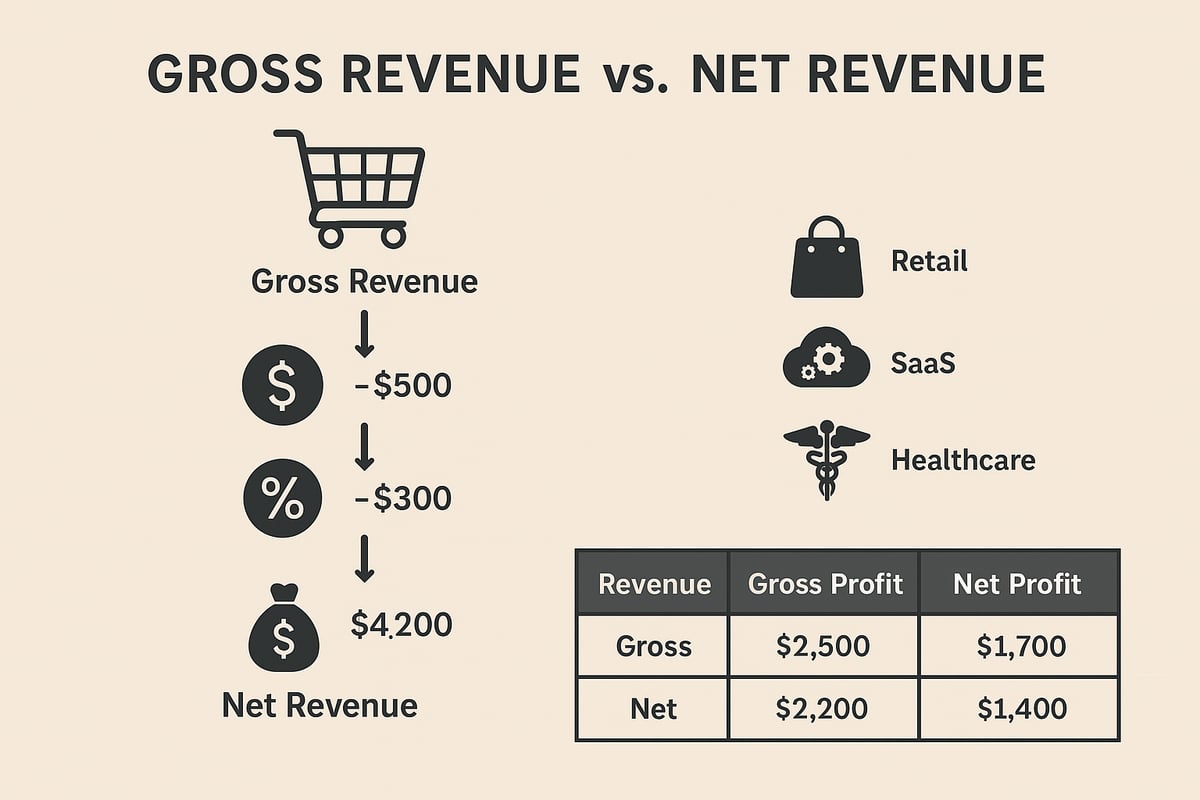
Net revenue represents the actual income a company retains from sales after deducting specific items. Unlike gross revenue, which reflects total sales before any deductions, net revenue subtracts returns, allowances for damaged goods, and sales discounts. This refined view provides a more accurate picture of what a business truly earns.

Why is net revenue so critical for decision-makers? It offers a transparent snapshot of operational health, helping leaders make informed choices about pricing, investments, and resource allocation. In fact, a 2024 survey found that 65% of Fortune 500 companies now report net revenue as their primary financial KPI. This shift highlights the metric’s growing role in strategic planning and investor communications.

The calculation of net revenue involves several components. Included are:

  • Total gross sales
  • Deductions for product returns
  • Allowances granted for issues like late deliveries or minor defects
  • Sales discounts used for promotions or early payments

Excluded from net revenue are operating expenses, taxes, and interest payments, which are typically accounted for further down the income statement.

The formula can be summarized as:

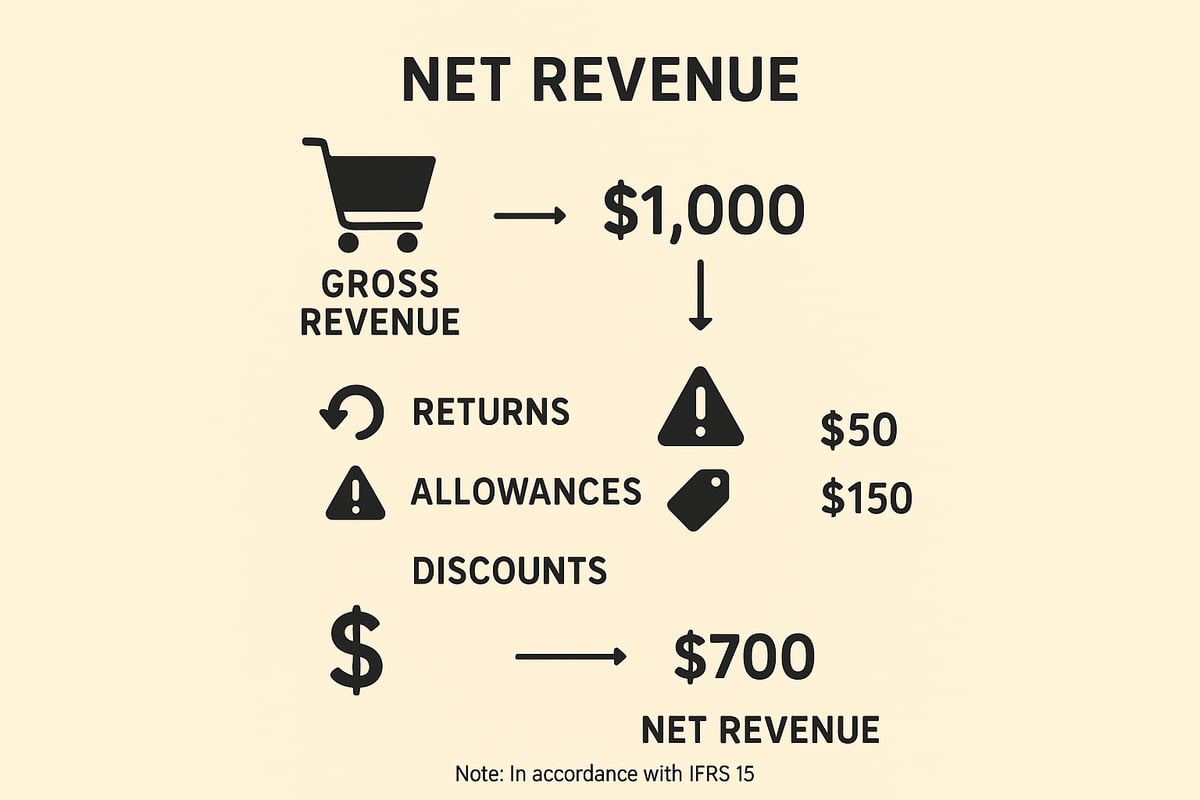
Net Revenue = Gross Revenue – Returns – Allowances – Discounts

To illustrate, consider a retailer with gross sales of $1,000,000. If customers return $50,000 worth of goods, receive $20,000 in allowances, and use $30,000 in discounts, the net revenue is $900,000. This calculation ensures leaders focus on money actually retained, not just sales volume.

Industry nuances shape net revenue calculations. In retail, returns and discounts are prominent, while SaaS companies must account for deferred revenue from subscriptions and churn rates. Healthcare organizations navigate complex billing adjustments, insurance denials, and regulatory deductions. Each sector applies the net revenue formula with unique considerations, often guided by updated standards like Net Revenue Calculation Methods 2026.

Regulatory changes for 2026, such as updates to the IFRS 15 and ASC 606 standards, have refined how businesses recognize revenue. These changes require organizations to align their reporting with stricter guidelines, ensuring net revenue accurately reflects contract performance and timing of sales recognition.

Comparing net revenue to other financial metrics brings further clarity. While EBITDA measures earnings before interest, taxes, depreciation, and amortization, and net income reflects total profit after all expenses, net revenue stands out for its focus on core sales performance. It bridges the gap between top-line growth and bottom-line profitability.

The following table summarizes key differences:

Metric What It Measures Key Deductions Used For
Gross Revenue Total sales before deductions None Sales volume, growth analysis
Net Revenue Sales after direct deductions Returns, allowances, discounts Operational health, KPIs
Net Income Profit after all expenses All expenses, taxes Profitability, shareholder value

In summary, net revenue is the foundation for evaluating true business performance in 2026. By understanding its components, industry variations, and regulatory context, leaders can unlock deeper insights for sustained growth.
Net Revenue Defined: Core Concepts for 2026

The Net Revenue Formula: Step-by-Step Calculation

Calculating net revenue accurately is vital for understanding your company’s true earning potential. In 2026, as businesses diversify sales channels and adopt new billing models, a robust grasp of the net revenue formula is more important than ever.
The Net Revenue Formula: Step-by-Step Calculation

Understanding the Net Revenue Formula

At its core, the net revenue formula is simple but powerful:

Net Revenue = Gross Revenue – Returns – Allowances – Discounts

Each part of this equation plays a critical role in determining financial health. Net revenue reflects what remains after adjusting gross sales for items that reduce actual income.

Breaking Down Each Component

Gross Revenue is the total sales generated before any deductions. It represents the starting point for the net revenue calculation.

Returns are products or services sent back by customers. Subtracting returns ensures revenue figures are not inflated by unsatisfied sales.

Allowances refer to price reductions for issues like damaged goods or delayed shipments. These adjustments prevent overstating net revenue.

Discounts include all price reductions, such as promotional offers or early payment incentives. Deducting discounts gives a more precise view of realizable income.

Step-by-Step Calculation Process

Follow these steps to calculate net revenue:

  1. Gather gross sales data from all channels and sources.
  2. Identify and subtract product returns for the period.
  3. Subtract allowances for items like damage or late delivery.
  4. Subtract sales discounts offered during the period.
  5. Arrive at net revenue, the amount reflecting true earned income.

This process ensures consistency and compliance, especially as standards evolve. For instance, the IFRS 15 Revenue Recognition Standard provides essential guidelines for recognizing and reporting revenue accurately.

Real-World Example

Let’s illustrate with a sample calculation.

  • Gross Revenue: $500,000
  • Returns: $20,000
  • Allowances: $5,000
  • Discounts: $10,000

Applying the formula:

Net Revenue = $500,000 – $20,000 – $5,000 – $10,000
Net Revenue = $465,000

This figure represents the company’s true income from sales, after all deductions.

Component Value
Gross Revenue $500,000
Returns $20,000
Allowances $5,000
Discounts $10,000
Net Revenue $465,000

Best Practices and Tools for 2026

Modern organizations often operate across multiple channels and geographies. This creates complexities such as currency conversion, local regulations, and varying return policies. Adopting AI-driven analytics and integrated ERP or CRM platforms streamlines net revenue tracking across diverse environments.

Competitor tools, like online net revenue calculators, help validate your figures and benchmark performance. Staying updated with global standards, such as IFRS 15, ensures accurate and compliant reporting.

In 2026, prioritizing precise net revenue calculation empowers leaders to make data-driven decisions, optimize profitability, and meet stakeholder expectations. By following these steps and leveraging the right tools, your business can confidently measure and maximize its net revenue.

Net Revenue vs. Gross Revenue: Key Differences and Strategic Implications

Understanding the distinction between net revenue and gross revenue is essential for any business leader aiming for sustainable growth in 2026. While both metrics reflect earnings, they serve different purposes and require careful analysis.

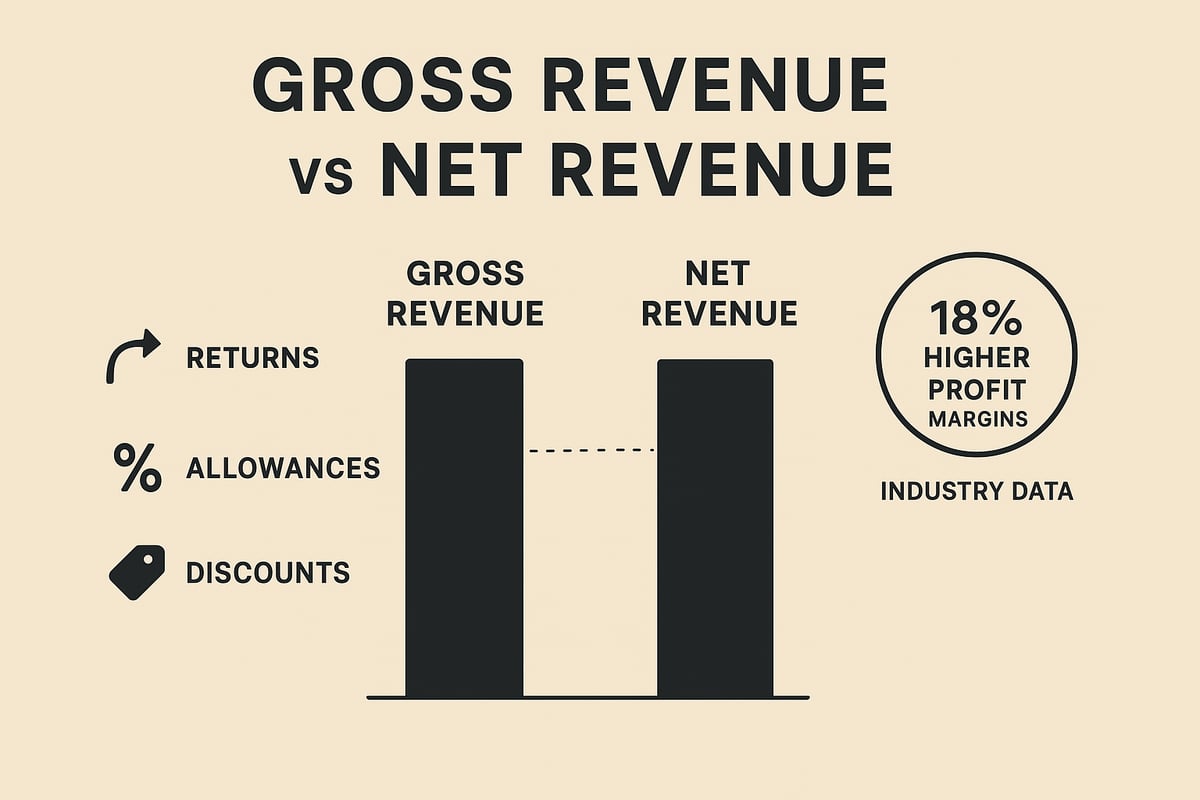
Gross revenue represents the total income generated from sales before any deductions. In contrast, net revenue is calculated after subtracting returns, allowances, and discounts from gross revenue. This makes net revenue a truer indicator of the actual financial gain from business activities.

Below is a table summarizing the differences between gross and net revenue for a sample retail company:

Metric Definition Example Amount Key Deductions
Gross Revenue Total sales before deductions $1,000,000 None
Net Revenue Gross revenue minus returns, allowances, discounts $920,000 Returns: $50,000
Allowances: $20,000
Discounts: $10,000

By focusing on net revenue, organizations gain a clearer picture of their real earnings. This clarity supports better pricing decisions, more accurate profitability analysis, and stronger operational planning. For instance, a business that tracks only gross revenue might overlook the financial impact of high return rates or aggressive discounting. Tracking net revenue ensures these critical factors are visible and actionable.

Strategically, prioritizing net revenue over gross revenue leads to smarter financial planning. Companies can identify revenue leakage and optimize their sales strategies to improve margins. As digital sales channels and subscription models become more prevalent, understanding net revenue dynamics is crucial for adapting to market shifts. For actionable approaches to profit optimization, many organizations are turning to Revenue Optimization Strategies 2026 to sharpen their techniques.

Industry research reveals the impact of this shift. According to a 2025 survey, companies that optimize net revenue report profit margins up to 18 percent higher than those focusing on gross revenue alone. Investors and board members increasingly demand net revenue reporting as a core performance metric, recognizing its value for long-term sustainability. Salesforce also emphasizes the importance of robust revenue lifecycle management to maximize both transparency and profitability.

In summary, distinguishing between gross and net revenue is more than an accounting exercise. It is a strategic imperative that shapes business decisions, investor confidence, and the ability to thrive in a competitive landscape.
Net Revenue vs. Gross Revenue: Key Differences and Strategic Implications

Factors Influencing Net Revenue in 2026

Understanding the diverse factors shaping net revenue is crucial for businesses aiming to thrive in 2026. As financial environments grow more complex, companies must recognize both internal and external elements that can impact their bottom line. Strategic awareness of these influences enables better forecasting and more resilient decision-making.
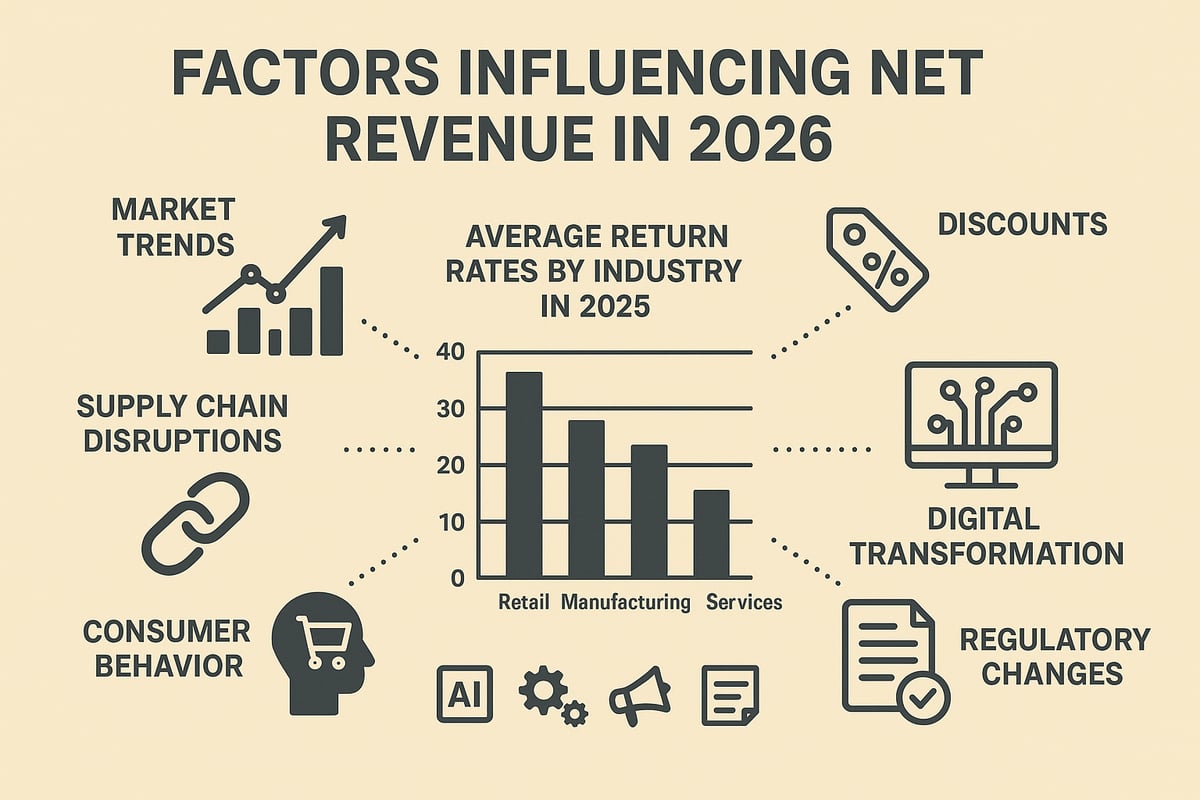
Factors Influencing Net Revenue in 2026

A variety of internal factors can significantly affect net revenue. Pricing strategies, discount policies, and customer loyalty programs all play vital roles. For instance, aggressive promotional campaigns may boost gross sales, but if not managed carefully, they can erode net revenue through excessive discounts and returns. Companies must strike a careful balance between attracting new customers and preserving profit margins.

External forces are equally influential. Market trends such as inflation, shifting consumer preferences, and global supply chain disruptions can all impact net revenue. In 2025, average product return rates varied widely by industry, with apparel at 12 percent and electronics at 8 percent. These fluctuations directly affect reported net revenue and require ongoing monitoring.

Digital transformation continues to reshape how businesses track and optimize net revenue. Automation, AI-driven analytics, and integrated platforms make it easier to identify revenue leaks, minimize manual errors, and adapt quickly to market changes. Companies adopting end-to-end revenue cycle management solutions often gain a competitive edge by streamlining processes and improving accuracy in net revenue reporting.

Regulatory compliance and data accuracy have never been more important. New revenue recognition standards, such as ASC 606 and IFRS 15, demand rigorous documentation and transparent reporting. Accurate data collection, regular audits, and cross-functional collaboration are essential to ensure that net revenue figures reflect true business performance. By staying vigilant and proactive, organizations can safeguard their financial health and position themselves for success in 2026.

Advanced Strategies for Maximizing Net Revenue

Unlocking the full potential of net revenue in 2026 requires a sophisticated blend of strategy, technology, and cross-functional collaboration. The landscape is more competitive than ever, making it essential for organizations to move beyond basic calculations and adopt advanced tactics that drive sustainable profitability.

Pricing Optimization and Dynamic Discounting

One of the most impactful ways to boost net revenue is through data-driven pricing strategies. Dynamic pricing models, powered by AI, allow businesses to adjust prices in real time based on demand, competition, and customer behavior. This approach not only protects profit margins but also adapts to market shifts quickly. To learn more about how these models safeguard profitability, explore Dynamic Pricing Models Protecting Margins 2026.

Dynamic discounting further enhances net revenue by offering tailored incentives to specific segments, encouraging faster purchases and improving cash flow. In 2026, companies leveraging these advanced pricing tools consistently outperform those relying on static pricing.

Reducing Return Rates and Preventing Revenue Leakage

Returns and revenue leakage can severely undermine net revenue if not managed proactively. Strategies to minimize returns include enhancing product quality, setting clear expectations, and offering robust after-sales support. Automated alerts for unusual return patterns help teams intervene early.

Revenue leakage, often caused by process gaps or billing errors, requires continuous monitoring. Regular audits, automated reconciliation tools, and clear policies for credits and refunds can plug profit drains before they impact the bottom line.

Personalized Promotions and Allowance Management

Net revenue optimization also relies on smart promotional tactics. Personalized promotions, informed by customer data, drive higher conversion rates while minimizing unnecessary discounting. Segmenting promotions by channel or customer type ensures that incentives align with profitability goals.

Managing allowances and credits efficiently is equally crucial. Establish clear criteria for issuing allowances due to damaged goods or late deliveries, and use automated approval workflows to maintain consistency. This approach helps organizations maintain tight control over deductions that impact net revenue.

Cross-Functional Collaboration for Revenue Optimization

Maximizing net revenue requires seamless collaboration between sales, finance, and operations. Cross-functional teams can identify process inefficiencies and develop unified strategies for revenue growth. Regular meetings to review KPIs and share insights foster a culture of accountability.

Consider the example of a manufacturing firm in 2025 that established a revenue optimization task force. By integrating sales forecasts, inventory management, and financial analysis, the company improved its net revenue margin by 12% within one year.

Leveraging Analytics and Technology

Advanced analytics play a pivotal role in maximizing net revenue. Predictive models identify emerging trends, flag anomalies, and forecast the impact of pricing or promotional changes. AI-driven dashboards provide real-time visibility into performance metrics, enabling rapid adjustments.

A 2024 industry report found that businesses using advanced analytics achieved revenue growth rates 22% faster than their peers. Integrating AI-powered tools with CRM and ERP systems streamlines data collection, reduces manual errors, and supports data-driven decision-making.

Continuous Monitoring and Improvement

Optimizing net revenue is not a one-time effort. Organizations must institute regular reviews of their pricing, promotion, and return policies. Use benchmarking data to compare performance against industry standards and identify opportunities for further gains.

Establish a feedback loop where insights from each quarter inform the next round of strategy adjustments. This commitment to continuous improvement ensures that net revenue remains resilient as market conditions evolve.

Net Revenue in Action: Real-World Examples and Industry Benchmarks

Understanding how net revenue works in practice is essential for businesses aiming to maximize profitability in 2026. Across industries, companies are refining their approaches and leveraging new tools to stay ahead. The following real-world examples and benchmarks illustrate how net revenue optimization drives measurable results.

Retail: Transforming Returns into Profits

In the retail sector, net revenue is often impacted by high return rates and frequent discounting. A leading global apparel chain implemented advanced analytics to analyze returns and promotional effectiveness. By refining return policies and personalizing discounts, the retailer improved its net revenue margin from 7% to 10% within one year.

The table below summarizes average net revenue margins by sector in 2025–2026:

Industry Avg. Net Revenue Margin (2025–2026)
Retail 9%
SaaS 23%
Healthcare 13%
Manufacturing 16%

These figures highlight the competitive advantage of strategic net revenue management.

SaaS: Subscription Growth and Revenue Resilience

Software-as-a-Service providers face unique net revenue challenges, especially around recurring billing and churn. One SaaS leader shifted focus from gross sales to net revenue, integrating AI-driven analytics to track downgrades, upgrades, and refunds in real time.

This approach allowed the company to anticipate revenue dips, reduce churn by 12%, and raise its net revenue retention rate to 120%. These metrics became critical for investor confidence and long-term planning.

Healthcare: Revenue Cycle Management in Focus

Healthcare organizations are under constant pressure to optimize net revenue despite regulatory complexity and insurance denials. A multi-hospital system adopted automated revenue cycle tools and trained staff to identify underpayments. As a result, net revenue increased by 15% in 2024, directly impacting patient care funding.

Industry reports show that healthcare providers who efficiently recover underpayments for healthcare providers consistently outperform peers in net revenue growth. Benchmarks indicate that denial rates below 5% are now achievable with modern solutions.

Manufacturing: Navigating Global Disruptions

Manufacturers must manage net revenue across multiple markets and currencies. A machinery producer responded to supply chain shocks by localizing pricing and renegotiating supplier contracts. This led to a 4% rise in net revenue margin, even as input costs fluctuated.

Close monitoring of allowances, warranty returns, and channel discounts helped the company maintain financial stability and adaptability.

Cross-Industry Insights: Collaboration and Best Practices

Top-performing companies share several best practices for net revenue optimization:

  • Integrating real-time analytics into revenue processes
  • Regularly benchmarking against industry peers
  • Investing in staff training and technology upgrades
  • Streamlining billing and collections for maximum cash flow

For example, organizations that focus on streamlining your billing process report fewer errors and improved cash flow, directly supporting better net revenue management.

Collaboration across finance, operations, and IT teams is essential for setting new benchmarks and adapting to economic shifts.

Key Takeaways

Net revenue optimization is not just a financial exercise; it is a strategic imperative across industries. By learning from sector leaders, using accurate benchmarks, and embracing technology, organizations can ensure robust net revenue growth and resilience in 2026.

The Future of Net Revenue: Trends and Predictions for 2026

As we approach 2026, the landscape of net revenue measurement is evolving rapidly. Businesses are navigating a complex environment shaped by digital transformation, changing regulatory frameworks, and shifting consumer behaviors. To remain competitive, organizations must anticipate and adapt to these changes, making net revenue more central than ever to strategic planning.

Emerging Trends in Net Revenue

Several trends are set to redefine net revenue measurement in 2026. Subscription-based business models continue to surge, driving predictable income streams while introducing new complexities in recurring revenue recognition. Digital marketplaces are expanding, with businesses leveraging platforms to reach global audiences and diversify revenue sources.

Global expansion is another major force. Companies are entering new markets, which requires adapting net revenue calculations to account for local currencies, taxes, and regulations. As cross-border commerce grows, accuracy in net revenue reporting becomes essential for compliance and investor confidence.

ESG and Compliance Shifts

Environmental, social, and governance (ESG) factors are gaining prominence in financial reporting. Investors and regulators are demanding greater transparency around how sustainable practices impact net revenue. In 2026, expect more businesses to integrate ESG metrics into their revenue disclosures, aligning financial performance with broader corporate responsibility goals.

Regulatory changes are also on the horizon. Updates to revenue recognition standards, such as ASC 606 and IFRS 15, will continue to influence how companies calculate and report net revenue. Staying current with these standards is crucial for audit readiness and stakeholder trust.

Technology’s Expanding Role

Advancements in artificial intelligence and automation are transforming how organizations manage net revenue. AI-powered analytics platforms enable real-time revenue tracking, identify trends, and detect anomalies that can affect profitability. Automation reduces manual errors and accelerates the closing process, freeing up teams to focus on strategy and growth.

Industry leaders are increasingly adopting integrated ERP and CRM systems to streamline net revenue management. These tools offer predictive insights, allowing companies to forecast revenue under different scenarios and respond proactively to market shifts.

Preparing for the Future: Action Steps

To stay ahead, organizations should regularly review their net revenue processes. This includes investing in advanced analytics, training teams on evolving standards, and fostering cross-functional collaboration between finance, operations, and compliance.

Reviewing expert forecasts and industry white papers helps decision-makers anticipate changes and benchmark performance. Companies that proactively adapt to new trends and leverage technology will be best positioned to optimize net revenue and sustain long-term growth.

As you’ve seen throughout this guide, understanding net revenue—especially in 2026’s fast-evolving landscape—can transform the way you approach profits, decision-making, and long-term growth. If you’re ready to move beyond theory and discover practical solutions tailored to your organization’s unique challenges, I invite you to take the next step. Let’s work together to eliminate inefficiencies, optimize your revenue processes, and empower your team for success. You don’t have to navigate these complexities alone—Book a Consultation and let’s unlock your full profit potential.

Net Revenue Guide: Understanding Profits in 2026

Did you know that 92% of business leaders rank accurate profit measurement as essential for long-term growth? Yet, as the financial world grows more complex, many executives find themselves confused by the differences between gross and net revenue. This confusion can lead to misleading reports and missed opportunities.

This guide will give you a clear, actionable path to understanding, calculating, and optimizing net revenue for 2026. Inside, you will find definitions, step-by-step formulas, practical examples, evolving industry trends, common mistakes to avoid, and advanced strategies for driving profits.

Net Revenue Defined: Core Concepts for 2026

Understanding net revenue is essential for any organization aiming to measure true business performance in 2026. As financial reporting evolves, distinguishing net revenue from other profit metrics is no longer optional—it is a strategic necessity.

Net revenue represents the actual income a company retains from sales after deducting specific items. Unlike gross revenue, which reflects total sales before any deductions, net revenue subtracts returns, allowances for damaged goods, and sales discounts. This refined view provides a more accurate picture of what a business truly earns.

Why is net revenue so critical for decision-makers? It offers a transparent snapshot of operational health, helping leaders make informed choices about pricing, investments, and resource allocation. In fact, a 2024 survey found that 65% of Fortune 500 companies now report net revenue as their primary financial KPI. This shift highlights the metric’s growing role in strategic planning and investor communications.

The calculation of net revenue involves several components. Included are:

  • Total gross sales
  • Deductions for product returns
  • Allowances granted for issues like late deliveries or minor defects
  • Sales discounts used for promotions or early payments

Excluded from net revenue are operating expenses, taxes, and interest payments, which are typically accounted for further down the income statement.

The formula can be summarized as:

Net Revenue = Gross Revenue – Returns – Allowances – Discounts

To illustrate, consider a retailer with gross sales of $1,000,000. If customers return $50,000 worth of goods, receive $20,000 in allowances, and use $30,000 in discounts, the net revenue is $900,000. This calculation ensures leaders focus on money actually retained, not just sales volume.

Industry nuances shape net revenue calculations. In retail, returns and discounts are prominent, while SaaS companies must account for deferred revenue from subscriptions and churn rates. Healthcare organizations navigate complex billing adjustments, insurance denials, and regulatory deductions. Each sector applies the net revenue formula with unique considerations, often guided by updated standards like Net Revenue Calculation Methods 2026.

Regulatory changes for 2026, such as updates to the IFRS 15 and ASC 606 standards, have refined how businesses recognize revenue. These changes require organizations to align their reporting with stricter guidelines, ensuring net revenue accurately reflects contract performance and timing of sales recognition.

Comparing net revenue to other financial metrics brings further clarity. While EBITDA measures earnings before interest, taxes, depreciation, and amortization, and net income reflects total profit after all expenses, net revenue stands out for its focus on core sales performance. It bridges the gap between top-line growth and bottom-line profitability.

The following table summarizes key differences:

Metric What It Measures Key Deductions Used For
Gross Revenue Total sales before deductions None Sales volume, growth analysis
Net Revenue Sales after direct deductions Returns, allowances, discounts Operational health, KPIs
Net Income Profit after all expenses All expenses, taxes Profitability, shareholder value

In summary, net revenue is the foundation for evaluating true business performance in 2026. By understanding its components, industry variations, and regulatory context, leaders can unlock deeper insights for sustained growth.

Net Revenue Defined: Core Concepts for 2026

The Net Revenue Formula: Step-by-Step Calculation

Calculating net revenue accurately is vital for understanding your company’s true earning potential. In 2026, as businesses diversify sales channels and adopt new billing models, a robust grasp of the net revenue formula is more important than ever.

The Net Revenue Formula: Step-by-Step Calculation

Understanding the Net Revenue Formula

At its core, the net revenue formula is simple but powerful:

Net Revenue = Gross Revenue – Returns – Allowances – Discounts

Each part of this equation plays a critical role in determining financial health. Net revenue reflects what remains after adjusting gross sales for items that reduce actual income.

Breaking Down Each Component

Gross Revenue is the total sales generated before any deductions. It represents the starting point for the net revenue calculation.

Returns are products or services sent back by customers. Subtracting returns ensures revenue figures are not inflated by unsatisfied sales.

Allowances refer to price reductions for issues like damaged goods or delayed shipments. These adjustments prevent overstating net revenue.

Discounts include all price reductions, such as promotional offers or early payment incentives. Deducting discounts gives a more precise view of realizable income.

Step-by-Step Calculation Process

Follow these steps to calculate net revenue:

  1. Gather gross sales data from all channels and sources.
  2. Identify and subtract product returns for the period.
  3. Subtract allowances for items like damage or late delivery.
  4. Subtract sales discounts offered during the period.
  5. Arrive at net revenue, the amount reflecting true earned income.

This process ensures consistency and compliance, especially as standards evolve. For instance, the IFRS 15 Revenue Recognition Standard provides essential guidelines for recognizing and reporting revenue accurately.

Real-World Example

Let’s illustrate with a sample calculation.

  • Gross Revenue: $500,000
  • Returns: $20,000
  • Allowances: $5,000
  • Discounts: $10,000

Applying the formula:

Net Revenue = $500,000 – $20,000 – $5,000 – $10,000
Net Revenue = $465,000

This figure represents the company’s true income from sales, after all deductions.

Component Value
Gross Revenue $500,000
Returns $20,000
Allowances $5,000
Discounts $10,000
Net Revenue $465,000

Best Practices and Tools for 2026

Modern organizations often operate across multiple channels and geographies. This creates complexities such as currency conversion, local regulations, and varying return policies. Adopting AI-driven analytics and integrated ERP or CRM platforms streamlines net revenue tracking across diverse environments.

Competitor tools, like online net revenue calculators, help validate your figures and benchmark performance. Staying updated with global standards, such as IFRS 15, ensures accurate and compliant reporting.

In 2026, prioritizing precise net revenue calculation empowers leaders to make data-driven decisions, optimize profitability, and meet stakeholder expectations. By following these steps and leveraging the right tools, your business can confidently measure and maximize its net revenue.

Net Revenue vs. Gross Revenue: Key Differences and Strategic Implications

Understanding the distinction between net revenue and gross revenue is essential for any business leader aiming for sustainable growth in 2026. While both metrics reflect earnings, they serve different purposes and require careful analysis.

Gross revenue represents the total income generated from sales before any deductions. In contrast, net revenue is calculated after subtracting returns, allowances, and discounts from gross revenue. This makes net revenue a truer indicator of the actual financial gain from business activities.

Below is a table summarizing the differences between gross and net revenue for a sample retail company:

Metric Definition Example Amount Key Deductions
Gross Revenue Total sales before deductions $1,000,000 None
Net Revenue Gross revenue minus returns, allowances, discounts $920,000 Returns: $50,000
Allowances: $20,000
Discounts: $10,000

By focusing on net revenue, organizations gain a clearer picture of their real earnings. This clarity supports better pricing decisions, more accurate profitability analysis, and stronger operational planning. For instance, a business that tracks only gross revenue might overlook the financial impact of high return rates or aggressive discounting. Tracking net revenue ensures these critical factors are visible and actionable.

Strategically, prioritizing net revenue over gross revenue leads to smarter financial planning. Companies can identify revenue leakage and optimize their sales strategies to improve margins. As digital sales channels and subscription models become more prevalent, understanding net revenue dynamics is crucial for adapting to market shifts. For actionable approaches to profit optimization, many organizations are turning to Revenue Optimization Strategies 2026 to sharpen their techniques.

Industry research reveals the impact of this shift. According to a 2025 survey, companies that optimize net revenue report profit margins up to 18 percent higher than those focusing on gross revenue alone. Investors and board members increasingly demand net revenue reporting as a core performance metric, recognizing its value for long-term sustainability. Salesforce also emphasizes the importance of robust revenue lifecycle management to maximize both transparency and profitability.

In summary, distinguishing between gross and net revenue is more than an accounting exercise. It is a strategic imperative that shapes business decisions, investor confidence, and the ability to thrive in a competitive landscape.

Net Revenue vs. Gross Revenue: Key Differences and Strategic Implications

Factors Influencing Net Revenue in 2026

Understanding the diverse factors shaping net revenue is crucial for businesses aiming to thrive in 2026. As financial environments grow more complex, companies must recognize both internal and external elements that can impact their bottom line. Strategic awareness of these influences enables better forecasting and more resilient decision-making.

Factors Influencing Net Revenue in 2026

A variety of internal factors can significantly affect net revenue. Pricing strategies, discount policies, and customer loyalty programs all play vital roles. For instance, aggressive promotional campaigns may boost gross sales, but if not managed carefully, they can erode net revenue through excessive discounts and returns. Companies must strike a careful balance between attracting new customers and preserving profit margins.

External forces are equally influential. Market trends such as inflation, shifting consumer preferences, and global supply chain disruptions can all impact net revenue. In 2025, average product return rates varied widely by industry, with apparel at 12 percent and electronics at 8 percent. These fluctuations directly affect reported net revenue and require ongoing monitoring.

Digital transformation continues to reshape how businesses track and optimize net revenue. Automation, AI-driven analytics, and integrated platforms make it easier to identify revenue leaks, minimize manual errors, and adapt quickly to market changes. Companies adopting end-to-end revenue cycle management solutions often gain a competitive edge by streamlining processes and improving accuracy in net revenue reporting.

Regulatory compliance and data accuracy have never been more important. New revenue recognition standards, such as ASC 606 and IFRS 15, demand rigorous documentation and transparent reporting. Accurate data collection, regular audits, and cross-functional collaboration are essential to ensure that net revenue figures reflect true business performance. By staying vigilant and proactive, organizations can safeguard their financial health and position themselves for success in 2026.

Advanced Strategies for Maximizing Net Revenue

Unlocking the full potential of net revenue in 2026 requires a sophisticated blend of strategy, technology, and cross-functional collaboration. The landscape is more competitive than ever, making it essential for organizations to move beyond basic calculations and adopt advanced tactics that drive sustainable profitability.

Pricing Optimization and Dynamic Discounting

One of the most impactful ways to boost net revenue is through data-driven pricing strategies. Dynamic pricing models, powered by AI, allow businesses to adjust prices in real time based on demand, competition, and customer behavior. This approach not only protects profit margins but also adapts to market shifts quickly. To learn more about how these models safeguard profitability, explore Dynamic Pricing Models Protecting Margins 2026.

Dynamic discounting further enhances net revenue by offering tailored incentives to specific segments, encouraging faster purchases and improving cash flow. In 2026, companies leveraging these advanced pricing tools consistently outperform those relying on static pricing.

Reducing Return Rates and Preventing Revenue Leakage

Returns and revenue leakage can severely undermine net revenue if not managed proactively. Strategies to minimize returns include enhancing product quality, setting clear expectations, and offering robust after-sales support. Automated alerts for unusual return patterns help teams intervene early.

Revenue leakage, often caused by process gaps or billing errors, requires continuous monitoring. Regular audits, automated reconciliation tools, and clear policies for credits and refunds can plug profit drains before they impact the bottom line.

Personalized Promotions and Allowance Management

Net revenue optimization also relies on smart promotional tactics. Personalized promotions, informed by customer data, drive higher conversion rates while minimizing unnecessary discounting. Segmenting promotions by channel or customer type ensures that incentives align with profitability goals.

Managing allowances and credits efficiently is equally crucial. Establish clear criteria for issuing allowances due to damaged goods or late deliveries, and use automated approval workflows to maintain consistency. This approach helps organizations maintain tight control over deductions that impact net revenue.

Cross-Functional Collaboration for Revenue Optimization

Maximizing net revenue requires seamless collaboration between sales, finance, and operations. Cross-functional teams can identify process inefficiencies and develop unified strategies for revenue growth. Regular meetings to review KPIs and share insights foster a culture of accountability.

Consider the example of a manufacturing firm in 2025 that established a revenue optimization task force. By integrating sales forecasts, inventory management, and financial analysis, the company improved its net revenue margin by 12% within one year.

Leveraging Analytics and Technology

Advanced analytics play a pivotal role in maximizing net revenue. Predictive models identify emerging trends, flag anomalies, and forecast the impact of pricing or promotional changes. AI-driven dashboards provide real-time visibility into performance metrics, enabling rapid adjustments.

A 2024 industry report found that businesses using advanced analytics achieved revenue growth rates 22% faster than their peers. Integrating AI-powered tools with CRM and ERP systems streamlines data collection, reduces manual errors, and supports data-driven decision-making.

Continuous Monitoring and Improvement

Optimizing net revenue is not a one-time effort. Organizations must institute regular reviews of their pricing, promotion, and return policies. Use benchmarking data to compare performance against industry standards and identify opportunities for further gains.

Establish a feedback loop where insights from each quarter inform the next round of strategy adjustments. This commitment to continuous improvement ensures that net revenue remains resilient as market conditions evolve.

Net Revenue in Action: Real-World Examples and Industry Benchmarks

Understanding how net revenue works in practice is essential for businesses aiming to maximize profitability in 2026. Across industries, companies are refining their approaches and leveraging new tools to stay ahead. The following real-world examples and benchmarks illustrate how net revenue optimization drives measurable results.

Retail: Transforming Returns into Profits

In the retail sector, net revenue is often impacted by high return rates and frequent discounting. A leading global apparel chain implemented advanced analytics to analyze returns and promotional effectiveness. By refining return policies and personalizing discounts, the retailer improved its net revenue margin from 7% to 10% within one year.

The table below summarizes average net revenue margins by sector in 2025–2026:

Industry Avg. Net Revenue Margin (2025–2026)
Retail 9%
SaaS 23%
Healthcare 13%
Manufacturing 16%

These figures highlight the competitive advantage of strategic net revenue management.

SaaS: Subscription Growth and Revenue Resilience

Software-as-a-Service providers face unique net revenue challenges, especially around recurring billing and churn. One SaaS leader shifted focus from gross sales to net revenue, integrating AI-driven analytics to track downgrades, upgrades, and refunds in real time.

This approach allowed the company to anticipate revenue dips, reduce churn by 12%, and raise its net revenue retention rate to 120%. These metrics became critical for investor confidence and long-term planning.

Healthcare: Revenue Cycle Management in Focus

Healthcare organizations are under constant pressure to optimize net revenue despite regulatory complexity and insurance denials. A multi-hospital system adopted automated revenue cycle tools and trained staff to identify underpayments. As a result, net revenue increased by 15% in 2024, directly impacting patient care funding.

Industry reports show that healthcare providers who efficiently recover underpayments for healthcare providers consistently outperform peers in net revenue growth. Benchmarks indicate that denial rates below 5% are now achievable with modern solutions.

Manufacturing: Navigating Global Disruptions

Manufacturers must manage net revenue across multiple markets and currencies. A machinery producer responded to supply chain shocks by localizing pricing and renegotiating supplier contracts. This led to a 4% rise in net revenue margin, even as input costs fluctuated.

Close monitoring of allowances, warranty returns, and channel discounts helped the company maintain financial stability and adaptability.

Cross-Industry Insights: Collaboration and Best Practices

Top-performing companies share several best practices for net revenue optimization:

  • Integrating real-time analytics into revenue processes
  • Regularly benchmarking against industry peers
  • Investing in staff training and technology upgrades
  • Streamlining billing and collections for maximum cash flow

For example, organizations that focus on streamlining your billing process report fewer errors and improved cash flow, directly supporting better net revenue management.

Collaboration across finance, operations, and IT teams is essential for setting new benchmarks and adapting to economic shifts.

Key Takeaways

Net revenue optimization is not just a financial exercise; it is a strategic imperative across industries. By learning from sector leaders, using accurate benchmarks, and embracing technology, organizations can ensure robust net revenue growth and resilience in 2026.

The Future of Net Revenue: Trends and Predictions for 2026

As we approach 2026, the landscape of net revenue measurement is evolving rapidly. Businesses are navigating a complex environment shaped by digital transformation, changing regulatory frameworks, and shifting consumer behaviors. To remain competitive, organizations must anticipate and adapt to these changes, making net revenue more central than ever to strategic planning.

Emerging Trends in Net Revenue

Several trends are set to redefine net revenue measurement in 2026. Subscription-based business models continue to surge, driving predictable income streams while introducing new complexities in recurring revenue recognition. Digital marketplaces are expanding, with businesses leveraging platforms to reach global audiences and diversify revenue sources.

Global expansion is another major force. Companies are entering new markets, which requires adapting net revenue calculations to account for local currencies, taxes, and regulations. As cross-border commerce grows, accuracy in net revenue reporting becomes essential for compliance and investor confidence.

ESG and Compliance Shifts

Environmental, social, and governance (ESG) factors are gaining prominence in financial reporting. Investors and regulators are demanding greater transparency around how sustainable practices impact net revenue. In 2026, expect more businesses to integrate ESG metrics into their revenue disclosures, aligning financial performance with broader corporate responsibility goals.

Regulatory changes are also on the horizon. Updates to revenue recognition standards, such as ASC 606 and IFRS 15, will continue to influence how companies calculate and report net revenue. Staying current with these standards is crucial for audit readiness and stakeholder trust.

Technology’s Expanding Role

Advancements in artificial intelligence and automation are transforming how organizations manage net revenue. AI-powered analytics platforms enable real-time revenue tracking, identify trends, and detect anomalies that can affect profitability. Automation reduces manual errors and accelerates the closing process, freeing up teams to focus on strategy and growth.

Industry leaders are increasingly adopting integrated ERP and CRM systems to streamline net revenue management. These tools offer predictive insights, allowing companies to forecast revenue under different scenarios and respond proactively to market shifts.

Preparing for the Future: Action Steps

To stay ahead, organizations should regularly review their net revenue processes. This includes investing in advanced analytics, training teams on evolving standards, and fostering cross-functional collaboration between finance, operations, and compliance.

Reviewing expert forecasts and industry white papers helps decision-makers anticipate changes and benchmark performance. Companies that proactively adapt to new trends and leverage technology will be best positioned to optimize net revenue and sustain long-term growth.

As you’ve seen throughout this guide, understanding net revenue—especially in 2026’s fast-evolving landscape—can transform the way you approach profits, decision-making, and long-term growth. If you’re ready to move beyond theory and discover practical solutions tailored to your organization’s unique challenges, I invite you to take the next step. Let’s work together to eliminate inefficiencies, optimize your revenue processes, and empower your team for success. You don’t have to navigate these complexities alone—Book a Consultation and let’s unlock your full profit potential.

Website developed in accordance with Web Content Accessibility Guidelines 2.2.
If you encounter any issues while using this site, please contact us: 215.526.5126