

Claims Auditing: Modernizing Healthcare Revenue Cycles

Share on Facebook
Share on X
Share on LinkedIn

Organizations processing thousands of healthcare claims annually face mounting pressure to maintain accuracy while controlling costs. Claims auditing has evolved from a purely reactive compliance measure into a strategic function that drives operational efficiency, revenue optimization, and risk mitigation. Modern approaches leverage automation and artificial intelligence to transform how businesses validate claim accuracy, identify billing errors, and ensure regulatory compliance across complex healthcare systems.

Understanding the Strategic Value of Claims Auditing

Claims auditing represents a systematic examination of healthcare claims to verify accuracy, appropriateness, and compliance before or after payment processing. This critical function protects organizations from financial losses while ensuring adherence to regulatory requirements.

Financial Impact and Risk Mitigation

The financial implications of inadequate claims oversight extend far beyond simple payment errors. Organizations without robust auditing processes face exposure to improper payments, regulatory penalties, and revenue leakage that compounds over time.

Key financial risks include:

  • Overpayments resulting from duplicate claims or incorrect coding
  • Underpayments that erode revenue and profitability
  • Fraud detection failures that expose organizations to legal liability
  • Compliance violations triggering government audits and penalties

Research indicates that manual claims processing errors cost healthcare organizations billions annually. Artificial intelligence can improve the accuracy, speed, and compliance of claims audits, addressing the inherent limitations of manual review processes.

Compliance and Regulatory Requirements

Healthcare claims auditing must align with multiple regulatory frameworks, each imposing specific documentation and validation requirements. Organizations navigate a complex landscape of federal regulations, state laws, and payer-specific guidelines.

The Centers for Medicare & Medicaid Services provides physicians with a framework for conducting self-audits, emphasizing the importance of reviewing claims for compliance with coding, billing, and documentation requirements. Understanding these frameworks helps organizations build comprehensive audit programs that address all regulatory touchpoints.

Claims compliance framework

Building Effective Claims Auditing Processes

Establishing a robust claims auditing infrastructure requires careful planning, clear protocols, and appropriate resource allocation. Organizations must balance thoroughness with efficiency to create sustainable processes.

Pre-Payment vs. Post-Payment Auditing

Organizations employ different audit timing strategies based on risk tolerance, resource availability, and operational priorities. Each approach offers distinct advantages and trade-offs.

Audit Type Timing Primary Benefits Key Challenges
Pre-payment Before claim payment Prevents errors before financial impact Slows processing time, requires more staff
Post-payment After claim payment Faster initial processing, identifies patterns Recovery complexity, financial exposure
Hybrid Strategic mix of both Balanced risk management Requires sophisticated targeting

Pre-payment auditing intercepts errors before funds leave the organization, providing immediate cost avoidance. However, this approach can create processing bottlenecks that delay legitimate payments and strain vendor relationships.

Post-payment auditing enables faster claim processing while building historical data that reveals systemic issues. Effective response strategies for payor audits become critical when organizations discover errors after payment has occurred.

Sampling Methodologies and Audit Scope

Auditing every claim proves impractical for most organizations, making strategic sampling essential. Effective sampling balances statistical validity with operational feasibility.

Common sampling approaches include:

  1. Random sampling – Provides unbiased overview of overall claim quality
  2. Targeted sampling – Focuses on high-risk areas, providers, or claim types
  3. Dollar-weighted sampling – Prioritizes claims with greatest financial impact
  4. Threshold-based sampling – Triggers audits when claims exceed predetermined values

Organizations should establish clear criteria for audit scope that align with organizational risk tolerance and available resources. Best practices for claims program management emphasize the importance of claim validation, accuracy, and consistency to prevent financial risks.

Leveraging Technology for Claims Auditing Excellence

Modern claims auditing increasingly relies on technological solutions that enhance accuracy, speed, and coverage. Organizations embracing automation and artificial intelligence gain significant competitive advantages.

Automation and Artificial Intelligence Integration

Manual claims review processes cannot match the speed, consistency, or analytical depth that automated systems provide. AI-powered solutions transform claims auditing from a labor-intensive bottleneck into a strategic asset.

Automated systems execute repetitive validation tasks with perfect consistency, flagging anomalies that might escape human reviewers. Machine learning algorithms identify subtle patterns indicating fraud, waste, or abuse across thousands of claims simultaneously.

Technology-enabled capabilities include:

  • Real-time claim validation against multiple rule sets
  • Predictive analytics identifying high-risk claims before payment
  • Natural language processing analyzing unstructured clinical documentation
  • Automated coding verification and suggestion
  • Pattern recognition detecting fraudulent claim clusters

Organizations implementing automation report dramatic improvements in audit coverage, error detection rates, and processing speed. Technology enables auditors to focus expertise on complex cases requiring human judgment rather than routine validation tasks.

Data Analytics and Pattern Recognition

Claims data contains valuable insights that become visible only through sophisticated analytics. Organizations leveraging advanced analytics uncover systemic issues, provider performance patterns, and process improvement opportunities.
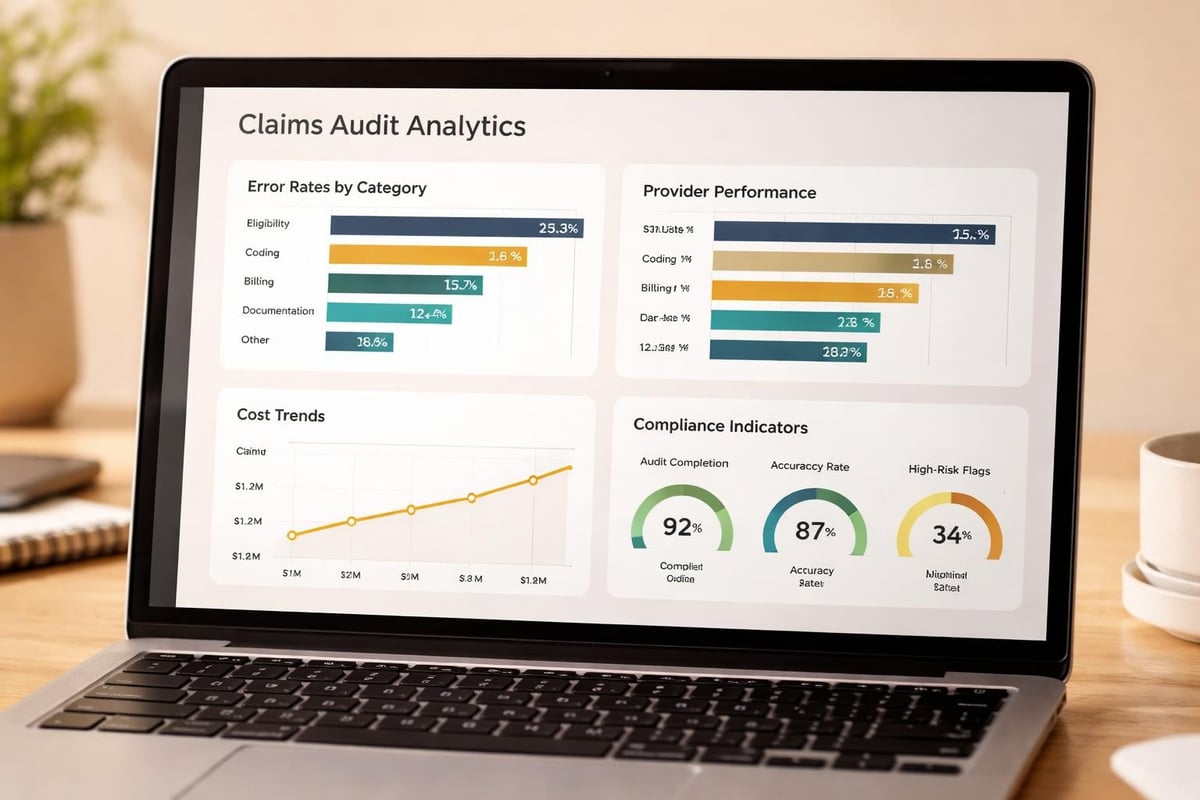
Claims data analytics

Comprehensive data analysis reveals correlations between specific providers, procedure codes, diagnosis combinations, and error frequencies. These insights enable targeted interventions that address root causes rather than individual claim errors.

Industry-Specific Claims Auditing Considerations

Different healthcare sectors face unique auditing challenges that require specialized approaches and expertise.

Pharmacy Benefit Claims Auditing

Pharmacy benefit management introduces complexity through formulary compliance, prior authorization requirements, and drug utilization review. Milliman outlines best practices for pharmacy benefit claims auditing, detailing various audit tests and the overall process to ensure compliance and financial accuracy.

Pharmacy claims auditing must validate appropriate drug selection, quantity limits, refill timing, and pricing accuracy against contracted rates. Automated systems excel at comparing dispensed medications against formulary guidelines and identifying potential drug interactions or therapeutic duplications.

Medical Claims in Revenue Cycle Management

Medical claims auditing requires deep understanding of CPT coding, ICD-10 diagnosis coding, and medical necessity documentation. Organizations must verify that services billed align with clinical documentation and meet payer coverage criteria.

Revenue cycle management solutions integrate claims auditing into broader financial workflows, ensuring clean claim submission that accelerates payment and minimizes denial rates. Professional services consulting helps organizations optimize these integrated processes.

Developing Audit Teams and Expertise

Technology enhances but does not replace human expertise in claims auditing. Organizations must develop skilled teams capable of interpreting complex regulations and making nuanced judgments.

Required Skills and Training

Effective claims auditors combine technical knowledge with analytical thinking and attention to detail. Core competencies include medical terminology, coding systems, regulatory requirements, and investigative skills.

Essential training areas include:

  • Current procedural terminology (CPT) and diagnosis coding
  • Medicare and Medicaid regulations
  • Commercial payer policies and contract terms
  • Healthcare privacy and security requirements
  • Fraud detection techniques

Organizations should establish ongoing education programs that keep audit teams current with regulatory changes, emerging fraud schemes, and evolving best practices. Claims compliance key regulations and requirements continue evolving, demanding continuous learning.

Organizational Structure and Reporting

Audit function placement within organizational structures significantly impacts effectiveness and independence. Leading organizations position claims auditing with direct reporting lines to executive leadership, ensuring findings receive appropriate attention.

Cross-functional collaboration between auditing, billing, clinical documentation, and compliance teams creates feedback loops that drive continuous improvement. Regular communication channels enable rapid response to identified issues.

Measuring Claims Auditing Performance

Organizations must establish clear metrics that quantify auditing effectiveness and demonstrate return on investment. Performance measurement drives accountability and enables data-driven process refinement.

Key Performance Indicators

Comprehensive performance measurement tracks multiple dimensions of audit effectiveness, efficiency, and impact.

Metric Category Example KPIs Target Benchmarks
Accuracy Error detection rate, false positive rate >95% accuracy, <5% false positives
Efficiency Claims audited per FTE, average audit time Industry-specific benchmarks
Financial Impact Dollars recovered, cost avoidance, ROI >3:1 ROI on audit investment
Coverage Audit penetration rate, risk coverage Risk-adjusted sampling goals
Quality Audit consistency, inter-rater reliability >90% agreement on findings

Organizations should establish baseline measurements before implementing new processes or technologies, enabling accurate before-and-after comparisons. The New York State Comptroller’s Office provides comprehensive strategies for enhancing the effectiveness of claims auditing processes, offering valuable benchmarking frameworks.

Continuous Improvement Methodologies

Leading organizations treat claims auditing as an evolving discipline requiring ongoing refinement. Regular process reviews identify bottlenecks, redundancies, and improvement opportunities.

Root cause analysis transforms individual claim errors into systemic corrections that prevent recurrence. When audits repeatedly flag similar errors from specific providers or departments, targeted education and process changes address underlying issues.

Addressing Common Claims Auditing Challenges

Organizations implementing or enhancing claims auditing programs encounter predictable obstacles that require strategic solutions.

Balancing Thoroughness with Processing Speed

The tension between comprehensive review and timely payment processing creates operational challenges. Organizations must determine optimal audit depth that provides adequate risk protection without creating unsustainable backlogs.

Tiered audit approaches allocate intensive review resources to high-risk claims while applying automated validation to routine submissions. This risk-based strategy maximizes effectiveness within resource constraints.

Managing Provider and Stakeholder Relationships

Claims auditing inevitably identifies errors that require provider education, payment adjustments, or corrective action plans. Maintaining constructive relationships while enforcing compliance standards requires diplomatic communication and transparent processes.

Audit communication strategy

Clear audit criteria, consistent application, and constructive feedback help providers view auditing as quality improvement rather than punitive enforcement. Modernizing claims auditing processes includes enhancing communication strategies that support collaborative correction.

Strategic Integration with Broader Business Objectives

Claims auditing delivers maximum value when integrated with organizational strategy rather than operating as an isolated compliance function.

Supporting Revenue Optimization

Beyond error prevention, strategic claims auditing identifies undercoding patterns where providers fail to capture legitimate reimbursement. Comprehensive review ensures organizations receive appropriate payment for services rendered.

Analytics comparing provider documentation patterns against benchmarks reveal opportunities for clinical documentation improvement initiatives. Enhanced documentation supports both compliance and optimal reimbursement.

Enabling Workforce Efficiency

Automated claims auditing eliminates thousands of hours spent on manual review, freeing skilled professionals for higher-value activities. Organizations redirecting audit staff toward denial management, payer negotiations, and process improvement initiatives amplify operational impact.

Human capital management solutions help organizations optimize workforce deployment as automation transforms traditional audit roles. Workforce planning must account for shifting skill requirements as technology assumes routine validation tasks.

Risk Management and Compliance Culture

Robust claims auditing programs demonstrate organizational commitment to compliance, potentially mitigating penalties when errors occur. Regulatory bodies view proactive audit programs favorably when evaluating organizational compliance efforts.

Internal audit findings enable voluntary self-disclosure of identified issues before external audits uncover them. This proactive approach typically results in more favorable resolution terms compared to reactive responses to external findings.

Future Trends Shaping Claims Auditing

The claims auditing landscape continues evolving as technology advances and regulatory requirements change. Organizations must anticipate emerging trends to maintain competitive positioning.

Predictive Analytics and Preventive Auditing

Next-generation systems move beyond detecting errors to preventing them through real-time validation at point of entry. Predictive models assess claim characteristics and flag potential issues before submission, enabling immediate correction.

Machine learning algorithms continuously refine validation rules based on historical patterns, creating increasingly accurate error prediction over time. This shift from retrospective detection to prospective prevention fundamentally transforms audit value proposition.

Blockchain and Distributed Ledger Applications

Emerging technologies promise enhanced transparency and traceability across claims lifecycle. Blockchain applications create immutable audit trails that simplify compliance verification and fraud investigation.

Distributed ledger systems enable real-time information sharing between payers and providers, reducing information asymmetries that contribute to claim errors. These technologies remain nascent but show significant promise for transforming claims administration.

Regulatory Evolution and Audit Adaptation

Healthcare regulatory frameworks continue expanding in complexity and scope. Organizations must maintain agile audit programs capable of rapidly incorporating new requirements.

Successful organizations establish regulatory monitoring processes that identify emerging requirements early, enabling proactive audit program adjustments. Claims auditing checklists provide structured frameworks for incorporating new validation requirements.


Strategic claims auditing transforms from a compliance burden into a competitive advantage when organizations embrace modern technologies and integrate audit functions with broader operational objectives. By implementing comprehensive audit programs that leverage automation, analytics, and skilled teams, healthcare organizations protect revenue, ensure compliance, and drive continuous improvement. Nero and Associates, Inc. helps organizations implement performance-based solutions that eliminate manual processes, optimize revenue cycles, and create measurable financial impact through artificial intelligence, automation, and strategic consulting services.

Claims Auditing: Modernizing Healthcare Revenue Cycles

Organizations processing thousands of healthcare claims annually face mounting pressure to maintain accuracy while controlling costs. Claims auditing has evolved from a purely reactive compliance measure into a strategic function that drives operational efficiency, revenue optimization, and risk mitigation. Modern approaches leverage automation and artificial intelligence to transform how businesses validate claim accuracy, identify billing errors, and ensure regulatory compliance across complex healthcare systems.

Understanding the Strategic Value of Claims Auditing

Claims auditing represents a systematic examination of healthcare claims to verify accuracy, appropriateness, and compliance before or after payment processing. This critical function protects organizations from financial losses while ensuring adherence to regulatory requirements.

Financial Impact and Risk Mitigation

The financial implications of inadequate claims oversight extend far beyond simple payment errors. Organizations without robust auditing processes face exposure to improper payments, regulatory penalties, and revenue leakage that compounds over time.

Key financial risks include:

  • Overpayments resulting from duplicate claims or incorrect coding
  • Underpayments that erode revenue and profitability
  • Fraud detection failures that expose organizations to legal liability
  • Compliance violations triggering government audits and penalties

Research indicates that manual claims processing errors cost healthcare organizations billions annually. Artificial intelligence can improve the accuracy, speed, and compliance of claims audits, addressing the inherent limitations of manual review processes.

Compliance and Regulatory Requirements

Healthcare claims auditing must align with multiple regulatory frameworks, each imposing specific documentation and validation requirements. Organizations navigate a complex landscape of federal regulations, state laws, and payer-specific guidelines.

The Centers for Medicare & Medicaid Services provides physicians with a framework for conducting self-audits, emphasizing the importance of reviewing claims for compliance with coding, billing, and documentation requirements. Understanding these frameworks helps organizations build comprehensive audit programs that address all regulatory touchpoints.

Claims compliance framework

Building Effective Claims Auditing Processes

Establishing a robust claims auditing infrastructure requires careful planning, clear protocols, and appropriate resource allocation. Organizations must balance thoroughness with efficiency to create sustainable processes.

Pre-Payment vs. Post-Payment Auditing

Organizations employ different audit timing strategies based on risk tolerance, resource availability, and operational priorities. Each approach offers distinct advantages and trade-offs.

Audit Type Timing Primary Benefits Key Challenges
Pre-payment Before claim payment Prevents errors before financial impact Slows processing time, requires more staff
Post-payment After claim payment Faster initial processing, identifies patterns Recovery complexity, financial exposure
Hybrid Strategic mix of both Balanced risk management Requires sophisticated targeting

Pre-payment auditing intercepts errors before funds leave the organization, providing immediate cost avoidance. However, this approach can create processing bottlenecks that delay legitimate payments and strain vendor relationships.

Post-payment auditing enables faster claim processing while building historical data that reveals systemic issues. Effective response strategies for payor audits become critical when organizations discover errors after payment has occurred.

Sampling Methodologies and Audit Scope

Auditing every claim proves impractical for most organizations, making strategic sampling essential. Effective sampling balances statistical validity with operational feasibility.

Common sampling approaches include:

  1. Random sampling – Provides unbiased overview of overall claim quality
  2. Targeted sampling – Focuses on high-risk areas, providers, or claim types
  3. Dollar-weighted sampling – Prioritizes claims with greatest financial impact
  4. Threshold-based sampling – Triggers audits when claims exceed predetermined values

Organizations should establish clear criteria for audit scope that align with organizational risk tolerance and available resources. Best practices for claims program management emphasize the importance of claim validation, accuracy, and consistency to prevent financial risks.

Leveraging Technology for Claims Auditing Excellence

Modern claims auditing increasingly relies on technological solutions that enhance accuracy, speed, and coverage. Organizations embracing automation and artificial intelligence gain significant competitive advantages.

Automation and Artificial Intelligence Integration

Manual claims review processes cannot match the speed, consistency, or analytical depth that automated systems provide. AI-powered solutions transform claims auditing from a labor-intensive bottleneck into a strategic asset.

Automated systems execute repetitive validation tasks with perfect consistency, flagging anomalies that might escape human reviewers. Machine learning algorithms identify subtle patterns indicating fraud, waste, or abuse across thousands of claims simultaneously.

Technology-enabled capabilities include:

  • Real-time claim validation against multiple rule sets
  • Predictive analytics identifying high-risk claims before payment
  • Natural language processing analyzing unstructured clinical documentation
  • Automated coding verification and suggestion
  • Pattern recognition detecting fraudulent claim clusters

Organizations implementing automation report dramatic improvements in audit coverage, error detection rates, and processing speed. Technology enables auditors to focus expertise on complex cases requiring human judgment rather than routine validation tasks.

Data Analytics and Pattern Recognition

Claims data contains valuable insights that become visible only through sophisticated analytics. Organizations leveraging advanced analytics uncover systemic issues, provider performance patterns, and process improvement opportunities.

Claims data analytics

Comprehensive data analysis reveals correlations between specific providers, procedure codes, diagnosis combinations, and error frequencies. These insights enable targeted interventions that address root causes rather than individual claim errors.

Industry-Specific Claims Auditing Considerations

Different healthcare sectors face unique auditing challenges that require specialized approaches and expertise.

Pharmacy Benefit Claims Auditing

Pharmacy benefit management introduces complexity through formulary compliance, prior authorization requirements, and drug utilization review. Milliman outlines best practices for pharmacy benefit claims auditing, detailing various audit tests and the overall process to ensure compliance and financial accuracy.

Pharmacy claims auditing must validate appropriate drug selection, quantity limits, refill timing, and pricing accuracy against contracted rates. Automated systems excel at comparing dispensed medications against formulary guidelines and identifying potential drug interactions or therapeutic duplications.

Medical Claims in Revenue Cycle Management

Medical claims auditing requires deep understanding of CPT coding, ICD-10 diagnosis coding, and medical necessity documentation. Organizations must verify that services billed align with clinical documentation and meet payer coverage criteria.

Revenue cycle management solutions integrate claims auditing into broader financial workflows, ensuring clean claim submission that accelerates payment and minimizes denial rates. Professional services consulting helps organizations optimize these integrated processes.

Developing Audit Teams and Expertise

Technology enhances but does not replace human expertise in claims auditing. Organizations must develop skilled teams capable of interpreting complex regulations and making nuanced judgments.

Required Skills and Training

Effective claims auditors combine technical knowledge with analytical thinking and attention to detail. Core competencies include medical terminology, coding systems, regulatory requirements, and investigative skills.

Essential training areas include:

  • Current procedural terminology (CPT) and diagnosis coding
  • Medicare and Medicaid regulations
  • Commercial payer policies and contract terms
  • Healthcare privacy and security requirements
  • Fraud detection techniques

Organizations should establish ongoing education programs that keep audit teams current with regulatory changes, emerging fraud schemes, and evolving best practices. Claims compliance key regulations and requirements continue evolving, demanding continuous learning.

Organizational Structure and Reporting

Audit function placement within organizational structures significantly impacts effectiveness and independence. Leading organizations position claims auditing with direct reporting lines to executive leadership, ensuring findings receive appropriate attention.

Cross-functional collaboration between auditing, billing, clinical documentation, and compliance teams creates feedback loops that drive continuous improvement. Regular communication channels enable rapid response to identified issues.

Measuring Claims Auditing Performance

Organizations must establish clear metrics that quantify auditing effectiveness and demonstrate return on investment. Performance measurement drives accountability and enables data-driven process refinement.

Key Performance Indicators

Comprehensive performance measurement tracks multiple dimensions of audit effectiveness, efficiency, and impact.

Metric Category Example KPIs Target Benchmarks
Accuracy Error detection rate, false positive rate >95% accuracy, <5% false positives
Efficiency Claims audited per FTE, average audit time Industry-specific benchmarks
Financial Impact Dollars recovered, cost avoidance, ROI >3:1 ROI on audit investment
Coverage Audit penetration rate, risk coverage Risk-adjusted sampling goals
Quality Audit consistency, inter-rater reliability >90% agreement on findings

Organizations should establish baseline measurements before implementing new processes or technologies, enabling accurate before-and-after comparisons. The New York State Comptroller’s Office provides comprehensive strategies for enhancing the effectiveness of claims auditing processes, offering valuable benchmarking frameworks.

Continuous Improvement Methodologies

Leading organizations treat claims auditing as an evolving discipline requiring ongoing refinement. Regular process reviews identify bottlenecks, redundancies, and improvement opportunities.

Root cause analysis transforms individual claim errors into systemic corrections that prevent recurrence. When audits repeatedly flag similar errors from specific providers or departments, targeted education and process changes address underlying issues.

Addressing Common Claims Auditing Challenges

Organizations implementing or enhancing claims auditing programs encounter predictable obstacles that require strategic solutions.

Balancing Thoroughness with Processing Speed

The tension between comprehensive review and timely payment processing creates operational challenges. Organizations must determine optimal audit depth that provides adequate risk protection without creating unsustainable backlogs.

Tiered audit approaches allocate intensive review resources to high-risk claims while applying automated validation to routine submissions. This risk-based strategy maximizes effectiveness within resource constraints.

Managing Provider and Stakeholder Relationships

Claims auditing inevitably identifies errors that require provider education, payment adjustments, or corrective action plans. Maintaining constructive relationships while enforcing compliance standards requires diplomatic communication and transparent processes.

Audit communication strategy

Clear audit criteria, consistent application, and constructive feedback help providers view auditing as quality improvement rather than punitive enforcement. Modernizing claims auditing processes includes enhancing communication strategies that support collaborative correction.

Strategic Integration with Broader Business Objectives

Claims auditing delivers maximum value when integrated with organizational strategy rather than operating as an isolated compliance function.

Supporting Revenue Optimization

Beyond error prevention, strategic claims auditing identifies undercoding patterns where providers fail to capture legitimate reimbursement. Comprehensive review ensures organizations receive appropriate payment for services rendered.

Analytics comparing provider documentation patterns against benchmarks reveal opportunities for clinical documentation improvement initiatives. Enhanced documentation supports both compliance and optimal reimbursement.

Enabling Workforce Efficiency

Automated claims auditing eliminates thousands of hours spent on manual review, freeing skilled professionals for higher-value activities. Organizations redirecting audit staff toward denial management, payer negotiations, and process improvement initiatives amplify operational impact.

Human capital management solutions help organizations optimize workforce deployment as automation transforms traditional audit roles. Workforce planning must account for shifting skill requirements as technology assumes routine validation tasks.

Risk Management and Compliance Culture

Robust claims auditing programs demonstrate organizational commitment to compliance, potentially mitigating penalties when errors occur. Regulatory bodies view proactive audit programs favorably when evaluating organizational compliance efforts.

Internal audit findings enable voluntary self-disclosure of identified issues before external audits uncover them. This proactive approach typically results in more favorable resolution terms compared to reactive responses to external findings.

Future Trends Shaping Claims Auditing

The claims auditing landscape continues evolving as technology advances and regulatory requirements change. Organizations must anticipate emerging trends to maintain competitive positioning.

Predictive Analytics and Preventive Auditing

Next-generation systems move beyond detecting errors to preventing them through real-time validation at point of entry. Predictive models assess claim characteristics and flag potential issues before submission, enabling immediate correction.

Machine learning algorithms continuously refine validation rules based on historical patterns, creating increasingly accurate error prediction over time. This shift from retrospective detection to prospective prevention fundamentally transforms audit value proposition.

Blockchain and Distributed Ledger Applications

Emerging technologies promise enhanced transparency and traceability across claims lifecycle. Blockchain applications create immutable audit trails that simplify compliance verification and fraud investigation.

Distributed ledger systems enable real-time information sharing between payers and providers, reducing information asymmetries that contribute to claim errors. These technologies remain nascent but show significant promise for transforming claims administration.

Regulatory Evolution and Audit Adaptation

Healthcare regulatory frameworks continue expanding in complexity and scope. Organizations must maintain agile audit programs capable of rapidly incorporating new requirements.

Successful organizations establish regulatory monitoring processes that identify emerging requirements early, enabling proactive audit program adjustments. Claims auditing checklists provide structured frameworks for incorporating new validation requirements.


Strategic claims auditing transforms from a compliance burden into a competitive advantage when organizations embrace modern technologies and integrate audit functions with broader operational objectives. By implementing comprehensive audit programs that leverage automation, analytics, and skilled teams, healthcare organizations protect revenue, ensure compliance, and drive continuous improvement. Nero and Associates, Inc. helps organizations implement performance-based solutions that eliminate manual processes, optimize revenue cycles, and create measurable financial impact through artificial intelligence, automation, and strategic consulting services.

Website developed in accordance with Web Content Accessibility Guidelines 2.2.
If you encounter any issues while using this site, please contact us: 215.526.5126