
Benefits Enrollment: Maximizing Employee Participation

Share on Facebook
Share on X
Share on LinkedIn

Navigating the complexities of benefits enrollment has become a critical function that directly impacts employee satisfaction, retention, and organizational performance. In 2026, companies face unprecedented challenges in communicating value, driving participation, and ensuring employees make informed decisions during enrollment periods. For organizations committed to operational excellence and employee wellness, transforming benefits enrollment from an administrative task into a strategic initiative creates measurable advantages across financial metrics, workforce engagement, and competitive positioning.

The Strategic Importance of Benefits Enrollment

Benefits enrollment represents far more than an annual compliance requirement. It serves as a critical touchpoint where organizations demonstrate their commitment to employee wellbeing while employees make decisions affecting their health, finances, and overall quality of life. Research demonstrates that effective benefits administration directly correlates with higher employee satisfaction scores and improved retention rates.

Organizations that approach enrollment strategically recognize it as an opportunity to educate employees about total compensation value. When employees understand the full scope of their benefits package, they perceive higher value from their employer relationship. This perception translates into tangible business outcomes, including reduced turnover costs and enhanced recruitment capabilities.

The financial implications extend beyond employee satisfaction. Companies that optimize their enrollment processes reduce administrative burdens, minimize errors requiring correction, and decrease the volume of post-enrollment questions consuming HR resources. These efficiency gains compound across multiple enrollment cycles, creating substantial cost savings over time.

Understanding Modern Benefits Enrollment Challenges

Communication Complexity

The average employee faces dozens of benefits decisions during enrollment periods, from health insurance plan selection to retirement contribution levels. Without clear guidance, decision fatigue sets in rapidly. Employees default to previous selections or make suboptimal choices that fail to align with their current life circumstances.

Benefits enrollment decision framework

Communication challenges intensify in organizations with diverse workforces spanning multiple generations, locations, and employment classifications. Messages that resonate with one demographic may completely miss another. According to open enrollment best practices, successful communication strategies employ multiple channels and formats to reach different employee segments effectively.

Technology Integration Issues

Many organizations struggle with disconnected systems that fragment the enrollment experience. Employees may need to access separate portals for health insurance, retirement planning, and supplemental benefits. This fragmentation creates frustration and increases the likelihood of incomplete enrollments.

Integration challenges also impact data accuracy. When systems fail to communicate seamlessly, HR teams spend excessive time reconciling information, correcting errors, and managing exceptions. These manual processes introduce compliance risks while consuming valuable resources that could drive strategic initiatives.

Timeline Pressures

Compressed enrollment windows create unnecessary stress for both employees and HR teams. Employees feel rushed to make important decisions without adequate time for research and consideration. HR departments field a surge of last-minute questions while managing technical issues and processing enrollments simultaneously.

Organizations often compound these pressures by delaying enrollment communications until weeks before the deadline. This approach leaves insufficient time for employees to assess their options, consult with family members, or seek additional information needed for informed decision-making.

Building an Effective Benefits Enrollment Strategy

Comprehensive Planning and Preparation

Successful enrollment begins months before the actual enrollment window opens. Forward-thinking organizations establish cross-functional planning teams that include HR, IT, communications, and finance representatives. These teams develop detailed project plans addressing every aspect of the enrollment process, from technology testing to communication schedules.

Planning should incorporate lessons learned from previous enrollment cycles. What questions did employees ask most frequently? Where did system bottlenecks occur? Which communication methods generated the highest engagement? Analyzing these patterns enables continuous improvement and proactive problem-solving.

Planning Phase Key Activities Timeline
Initial Strategy Define objectives, review prior year performance, establish budget 4-5 months before enrollment
Vendor Coordination Confirm systems integration, test platforms, finalize materials 3-4 months before enrollment
Communication Development Create messaging, develop educational content, design campaigns 2-3 months before enrollment
Pre-Launch Testing Conduct system testing, train support staff, pilot communications 1 month before enrollment

Multi-Channel Communication Approach

Effective benefits enrollment communication leverages multiple touchpoints to reach employees where they naturally consume information. Email remains a primary channel, but organizations should complement it with team meetings, webinars, printed materials, and mobile-friendly resources. Benefits enrollment communication templates provide structured frameworks for maintaining consistent messaging across channels.

Timing matters as much as content. Rather than overwhelming employees with all information simultaneously, staggered communications build awareness progressively. Initial messages should announce enrollment dates and highlight key changes. Subsequent communications can dive deeper into specific benefits categories, decision-support tools, and deadline reminders.

Personalization significantly enhances communication effectiveness. When possible, tailor messages to employee segments based on factors like age, family status, or current benefit selections. A 25-year-old single employee has different priorities than a 55-year-old approaching retirement, and communications should reflect these distinctions.

Education and Decision Support

Beyond basic communication, employees need robust educational resources supporting informed decision-making. This includes comparison tools helping employees evaluate plan options, calculators estimating costs under different scenarios, and educational content explaining complex concepts like deductibles, coinsurance, and out-of-pocket maximums.

  • Interactive decision tools guide employees through personalized recommendation engines
  • Video tutorials explain key concepts in digestible formats appealing to visual learners
  • Live Q&A sessions provide opportunities for employees to ask specific questions
  • One-on-one consultations offer personalized guidance for employees with complex situations
  • Mobile-responsive resources ensure accessibility regardless of device or location

Organizations increasingly recognize the value of decision support beyond health insurance. Retirement planning tools, for instance, help employees understand the long-term impact of contribution decisions. According to insights on retirement planning trends, employees who engage with planning tools demonstrate higher contribution rates and better retirement readiness.

Technology Solutions Enhancing Enrollment Efficiency

Modern HRIS systems have transformed benefits enrollment from paper-intensive processes to streamlined digital experiences. These platforms consolidate benefits information, automate eligibility determinations, and guide employees through enrollment workflows with intuitive interfaces.
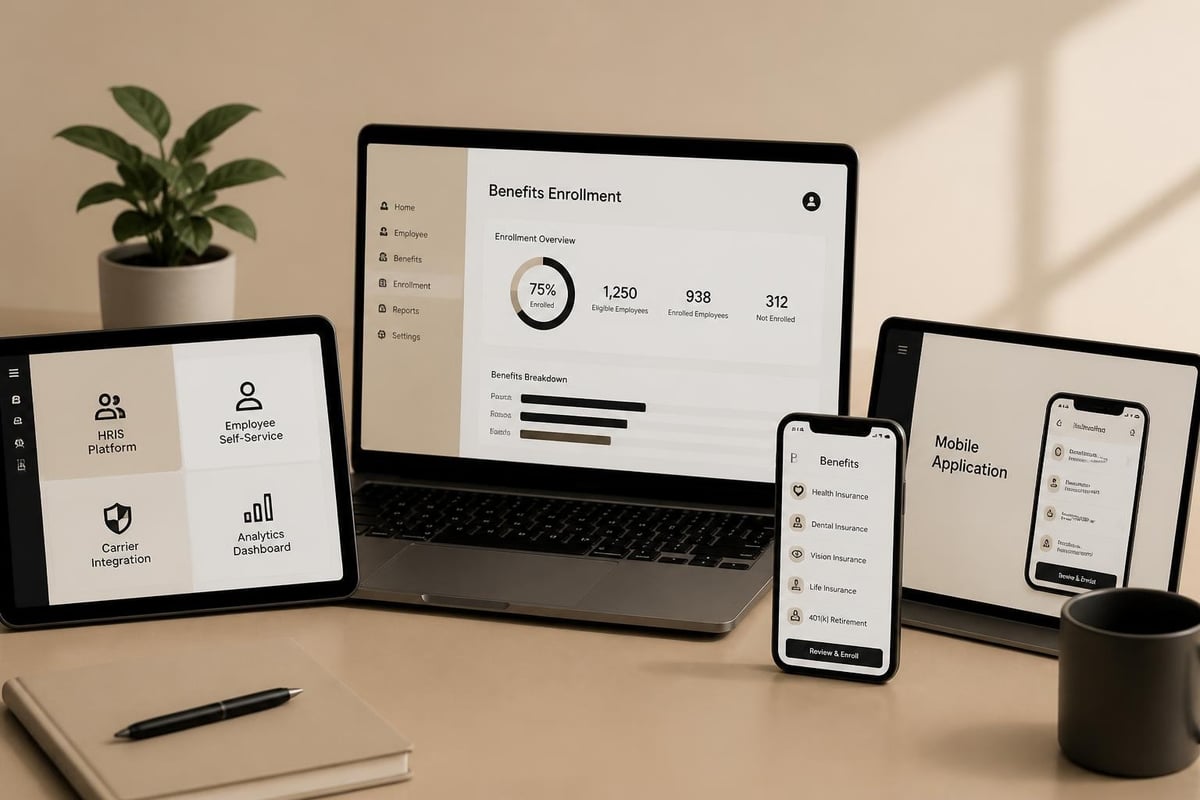
Integrated enrollment technology

The most effective solutions offer configurable rules engines that automatically apply eligibility criteria, prevent incompatible elections, and flag potential issues before submission. This front-end validation dramatically reduces post-enrollment corrections while ensuring compliance with plan rules and regulations.

Automation and Artificial Intelligence

Artificial intelligence capabilities are revolutionizing how organizations support employees during enrollment. Chatbots provide instant responses to common questions, available 24/7 without requiring HR staff intervention. These virtual assistants handle routine inquiries while escalating complex questions to human experts when necessary.

Predictive analytics help organizations identify employees at risk of making suboptimal choices. For example, algorithms can flag employees selecting high-deductible plans without adequate emergency savings, enabling targeted outreach with educational resources about health savings account benefits. Analysis of HDHP and HSA plan trends reveals significant variations in employee understanding and utilization patterns across generations.

Process automation extends beyond employee-facing experiences. Behind the scenes, automated workflows manage carrier file feeds, reconcile enrollment data, and trigger confirmation communications. These automations eliminate manual data entry, reduce error rates, and free HR teams to focus on strategic advisory roles rather than administrative tasks.

Mobile-First Design

With employees increasingly accessing information via smartphones, mobile optimization has shifted from optional enhancement to essential requirement. Mobile-responsive enrollment platforms enable employees to review options, compare plans, and complete enrollments from any device at their convenience.

Mobile capabilities prove particularly valuable for reaching frontline workers without regular computer access. These employees can complete enrollment during breaks or after shifts using personal devices, dramatically improving participation rates compared to desktop-only solutions.

Measuring Benefits Enrollment Success

Quantitative Metrics

Organizations should establish clear metrics for evaluating enrollment effectiveness. Participation rates represent the most fundamental measure, tracking the percentage of eligible employees completing enrollment within designated timeframes. Breaking down participation by employee segment reveals whether certain groups need additional support or targeted outreach.

Metric Target Range Significance
Overall participation rate 95-100% Indicates communication effectiveness and process accessibility
On-time completion rate 85-95% Reflects employee engagement and deadline awareness
Error rate <2% Measures system usability and validation effectiveness
Support ticket volume Declining year-over-year Shows improving self-service capabilities and communication clarity
Employee satisfaction score >4.0/5.0 Captures overall enrollment experience quality

Cost metrics provide equally important insights. Track the total cost of administering enrollment, including staff time, vendor fees, and communication expenses. Calculate cost per enrolled employee to benchmark efficiency and identify optimization opportunities. Organizations implementing operational excellence principles typically reduce per-employee enrollment costs by 30-40% within two years.

Qualitative Feedback

Numbers tell only part of the story. Post-enrollment surveys capture employee sentiment, identify pain points, and uncover improvement opportunities. Ask employees about communication clarity, decision-making confidence, system usability, and overall satisfaction with the process.

Focus groups or interviews with representative employee samples provide deeper insights into enrollment experiences. These conversations often reveal issues that quantitative metrics miss, such as confusing terminology, inadequate mobile functionality, or gaps in educational content.

Compliance and Risk Management Considerations

Benefits enrollment carries significant compliance obligations across multiple regulatory frameworks. The Employee Retirement Income Security Act (ERISA) mandates specific disclosure requirements and enrollment procedures. The Affordable Care Act (ACA) imposes reporting obligations tied to enrollment data. HIPAA creates privacy requirements affecting how organizations handle health information during enrollment.

Maintaining compliance requires meticulous attention to documentation, deadlines, and employee communications. Organizations must preserve records demonstrating that employees received required notices, had adequate opportunity to enroll, and made informed elections. These documentation requirements extend beyond initial enrollment to include qualifying life events and special enrollment periods.

Risk mitigation strategies should address common enrollment vulnerabilities. Strong internal controls prevent unauthorized changes to employee elections. Audit procedures verify that system configurations match plan documents. Regular compliance reviews ensure processes align with current regulations as laws evolve.

Enhancing Employee Wellness Through Strategic Enrollment

Forward-thinking organizations recognize benefits enrollment as a catalyst for improving employee health and financial wellness. Rather than treating enrollment as a transactional event, these companies use it as an educational opportunity promoting holistic wellbeing.

Health risk assessments integrated with enrollment processes help employees understand their health status and identify appropriate coverage options. Financial wellness tools demonstrate how benefit choices impact take-home pay, retirement savings, and overall financial security. These integrated approaches empower employees to make decisions aligned with both immediate needs and long-term goals.

Wellness program enrollment often occurs alongside benefits selection, creating natural synergies. Employees selecting high-deductible health plans with health savings accounts benefit from understanding how wellness incentives can help fund their HSAs. Those choosing dental coverage appreciate knowing about preventive care benefits available through wellness initiatives.

Wellness integration workflow

The research on maximizing workplace benefits during open enrollment emphasizes that employees who understand the wellness resources available through their benefits packages demonstrate higher utilization rates and better health outcomes.

Special Enrollment Scenarios and Considerations

While annual open enrollment receives the most attention, organizations must also manage qualifying life event enrollments occurring throughout the year. Marriages, births, adoptions, divorces, and other life changes trigger special enrollment rights requiring prompt processing and clear communication.

Special enrollment scenarios demand flexible systems and knowledgeable staff. Employees experiencing life changes often face emotional stress and tight timelines. They need straightforward guidance about eligibility, required documentation, and effective dates. Delayed processing or unclear instructions compound their stress while potentially creating coverage gaps.

Medicare eligibility adds complexity for organizations with aging workforces. Employees approaching Medicare eligibility need guidance about coordination of benefits, supplemental coverage options, and retirement implications. Understanding Medicare Advantage enrollment trends helps organizations anticipate employee needs and develop appropriate support resources.

Building Cross-Functional Collaboration

Successful benefits enrollment requires collaboration extending well beyond HR departments. IT teams ensure system reliability and integration. Finance departments provide budgetary guidance and cost projections. Communications specialists craft clear messaging. Legal counsel reviews compliance requirements.

Establishing a cross-functional enrollment committee creates accountability while leveraging diverse expertise. Regular committee meetings throughout the planning process enable proactive problem-solving and ensure all stakeholders remain aligned with enrollment objectives and timelines.

Leadership support proves critical for enrollment success. When executives communicate the importance of benefits participation and model engagement themselves, employees take notice. Executive videos explaining benefit changes or participating in enrollment webinars send powerful messages about organizational priorities.

Continuous Improvement and Innovation

The best enrollment processes evolve continuously based on employee feedback, technological advances, and industry best practices. After each enrollment cycle, conduct thorough post-mortems identifying successes, challenges, and improvement opportunities.

Stay informed about emerging trends and innovations in benefits administration. Attend industry conferences, participate in peer networks, and engage with benefits technology vendors to learn about new capabilities. Organizations that embrace innovation while maintaining focus on employee needs consistently deliver superior enrollment experiences.

Consider piloting new approaches with employee subsets before full-scale implementation. Test alternative communication strategies, new technology features, or different enrollment timeline structures. These controlled pilots generate valuable insights while minimizing risk.

The Role of Vendor Partnerships

Benefits carriers, third-party administrators, and technology providers play crucial roles in enrollment success. Strong vendor partnerships ensure smooth data exchange, timely materials delivery, and coordinated employee communications.

Establish clear service level agreements defining vendor responsibilities, response times, and escalation procedures. Regular check-ins throughout the year, not just during enrollment season, maintain relationship health and enable proactive issue resolution.

Evaluate vendor performance systematically using both quantitative metrics and qualitative assessments. Track file transmission accuracy, customer service responsiveness, and material quality. Incorporate vendor performance into annual contract renewal decisions.

Future-Proofing Your Enrollment Approach

The benefits landscape continues evolving rapidly. Regulatory changes, marketplace innovations, and shifting employee expectations require organizations to build adaptable enrollment processes capable of accommodating future developments.

Scalable technology platforms accommodate growth and change without requiring complete system overhauls. Modular designs enable adding new capabilities incrementally as needs emerge. Cloud-based solutions ensure access to continuous enhancements and updates.

Flexible communication frameworks support various benefit offerings and employee populations. Rather than creating rigid templates tied to specific plans, develop adaptable content structures easily customized for different scenarios. This flexibility accelerates deployment when introducing new benefits or adjusting existing programs.


Optimizing your benefits enrollment process creates lasting value through improved employee engagement, operational efficiency, and organizational performance. By implementing strategic planning, leveraging modern technology, and maintaining focus on employee needs, organizations transform enrollment from administrative burden into competitive advantage. Nero and Associates, Inc. partners with organizations to streamline benefits administration through integrated technology solutions and process optimization, reducing administrative hours while empowering employees to make informed decisions about their health and financial wellness.
Benefits Enrollment: Maximizing Employee Participation

Navigating the complexities of benefits enrollment has become a critical function that directly impacts employee satisfaction, retention, and organizational performance. In 2026, companies face unprecedented challenges in communicating value, driving participation, and ensuring employees make informed decisions during enrollment periods. For organizations committed to operational excellence and employee wellness, transforming benefits enrollment from an administrative task into a strategic initiative creates measurable advantages across financial metrics, workforce engagement, and competitive positioning.

The Strategic Importance of Benefits Enrollment

Benefits enrollment represents far more than an annual compliance requirement. It serves as a critical touchpoint where organizations demonstrate their commitment to employee wellbeing while employees make decisions affecting their health, finances, and overall quality of life. Research demonstrates that effective benefits administration directly correlates with higher employee satisfaction scores and improved retention rates.

Organizations that approach enrollment strategically recognize it as an opportunity to educate employees about total compensation value. When employees understand the full scope of their benefits package, they perceive higher value from their employer relationship. This perception translates into tangible business outcomes, including reduced turnover costs and enhanced recruitment capabilities.

The financial implications extend beyond employee satisfaction. Companies that optimize their enrollment processes reduce administrative burdens, minimize errors requiring correction, and decrease the volume of post-enrollment questions consuming HR resources. These efficiency gains compound across multiple enrollment cycles, creating substantial cost savings over time.

Understanding Modern Benefits Enrollment Challenges

Communication Complexity

The average employee faces dozens of benefits decisions during enrollment periods, from health insurance plan selection to retirement contribution levels. Without clear guidance, decision fatigue sets in rapidly. Employees default to previous selections or make suboptimal choices that fail to align with their current life circumstances.

Benefits enrollment decision framework

Communication challenges intensify in organizations with diverse workforces spanning multiple generations, locations, and employment classifications. Messages that resonate with one demographic may completely miss another. According to open enrollment best practices, successful communication strategies employ multiple channels and formats to reach different employee segments effectively.

Technology Integration Issues

Many organizations struggle with disconnected systems that fragment the enrollment experience. Employees may need to access separate portals for health insurance, retirement planning, and supplemental benefits. This fragmentation creates frustration and increases the likelihood of incomplete enrollments.

Integration challenges also impact data accuracy. When systems fail to communicate seamlessly, HR teams spend excessive time reconciling information, correcting errors, and managing exceptions. These manual processes introduce compliance risks while consuming valuable resources that could drive strategic initiatives.

Timeline Pressures

Compressed enrollment windows create unnecessary stress for both employees and HR teams. Employees feel rushed to make important decisions without adequate time for research and consideration. HR departments field a surge of last-minute questions while managing technical issues and processing enrollments simultaneously.

Organizations often compound these pressures by delaying enrollment communications until weeks before the deadline. This approach leaves insufficient time for employees to assess their options, consult with family members, or seek additional information needed for informed decision-making.

Building an Effective Benefits Enrollment Strategy

Comprehensive Planning and Preparation

Successful enrollment begins months before the actual enrollment window opens. Forward-thinking organizations establish cross-functional planning teams that include HR, IT, communications, and finance representatives. These teams develop detailed project plans addressing every aspect of the enrollment process, from technology testing to communication schedules.

Planning should incorporate lessons learned from previous enrollment cycles. What questions did employees ask most frequently? Where did system bottlenecks occur? Which communication methods generated the highest engagement? Analyzing these patterns enables continuous improvement and proactive problem-solving.

Planning Phase Key Activities Timeline
Initial Strategy Define objectives, review prior year performance, establish budget 4-5 months before enrollment
Vendor Coordination Confirm systems integration, test platforms, finalize materials 3-4 months before enrollment
Communication Development Create messaging, develop educational content, design campaigns 2-3 months before enrollment
Pre-Launch Testing Conduct system testing, train support staff, pilot communications 1 month before enrollment

Multi-Channel Communication Approach

Effective benefits enrollment communication leverages multiple touchpoints to reach employees where they naturally consume information. Email remains a primary channel, but organizations should complement it with team meetings, webinars, printed materials, and mobile-friendly resources. Benefits enrollment communication templates provide structured frameworks for maintaining consistent messaging across channels.

Timing matters as much as content. Rather than overwhelming employees with all information simultaneously, staggered communications build awareness progressively. Initial messages should announce enrollment dates and highlight key changes. Subsequent communications can dive deeper into specific benefits categories, decision-support tools, and deadline reminders.

Personalization significantly enhances communication effectiveness. When possible, tailor messages to employee segments based on factors like age, family status, or current benefit selections. A 25-year-old single employee has different priorities than a 55-year-old approaching retirement, and communications should reflect these distinctions.

Education and Decision Support

Beyond basic communication, employees need robust educational resources supporting informed decision-making. This includes comparison tools helping employees evaluate plan options, calculators estimating costs under different scenarios, and educational content explaining complex concepts like deductibles, coinsurance, and out-of-pocket maximums.

  • Interactive decision tools guide employees through personalized recommendation engines
  • Video tutorials explain key concepts in digestible formats appealing to visual learners
  • Live Q&A sessions provide opportunities for employees to ask specific questions
  • One-on-one consultations offer personalized guidance for employees with complex situations
  • Mobile-responsive resources ensure accessibility regardless of device or location

Organizations increasingly recognize the value of decision support beyond health insurance. Retirement planning tools, for instance, help employees understand the long-term impact of contribution decisions. According to insights on retirement planning trends, employees who engage with planning tools demonstrate higher contribution rates and better retirement readiness.

Technology Solutions Enhancing Enrollment Efficiency

Modern HRIS systems have transformed benefits enrollment from paper-intensive processes to streamlined digital experiences. These platforms consolidate benefits information, automate eligibility determinations, and guide employees through enrollment workflows with intuitive interfaces.

Integrated enrollment technology

The most effective solutions offer configurable rules engines that automatically apply eligibility criteria, prevent incompatible elections, and flag potential issues before submission. This front-end validation dramatically reduces post-enrollment corrections while ensuring compliance with plan rules and regulations.

Automation and Artificial Intelligence

Artificial intelligence capabilities are revolutionizing how organizations support employees during enrollment. Chatbots provide instant responses to common questions, available 24/7 without requiring HR staff intervention. These virtual assistants handle routine inquiries while escalating complex questions to human experts when necessary.

Predictive analytics help organizations identify employees at risk of making suboptimal choices. For example, algorithms can flag employees selecting high-deductible plans without adequate emergency savings, enabling targeted outreach with educational resources about health savings account benefits. Analysis of HDHP and HSA plan trends reveals significant variations in employee understanding and utilization patterns across generations.

Process automation extends beyond employee-facing experiences. Behind the scenes, automated workflows manage carrier file feeds, reconcile enrollment data, and trigger confirmation communications. These automations eliminate manual data entry, reduce error rates, and free HR teams to focus on strategic advisory roles rather than administrative tasks.

Mobile-First Design

With employees increasingly accessing information via smartphones, mobile optimization has shifted from optional enhancement to essential requirement. Mobile-responsive enrollment platforms enable employees to review options, compare plans, and complete enrollments from any device at their convenience.

Mobile capabilities prove particularly valuable for reaching frontline workers without regular computer access. These employees can complete enrollment during breaks or after shifts using personal devices, dramatically improving participation rates compared to desktop-only solutions.

Measuring Benefits Enrollment Success

Quantitative Metrics

Organizations should establish clear metrics for evaluating enrollment effectiveness. Participation rates represent the most fundamental measure, tracking the percentage of eligible employees completing enrollment within designated timeframes. Breaking down participation by employee segment reveals whether certain groups need additional support or targeted outreach.

Metric Target Range Significance
Overall participation rate 95-100% Indicates communication effectiveness and process accessibility
On-time completion rate 85-95% Reflects employee engagement and deadline awareness
Error rate <2% Measures system usability and validation effectiveness
Support ticket volume Declining year-over-year Shows improving self-service capabilities and communication clarity
Employee satisfaction score >4.0/5.0 Captures overall enrollment experience quality

Cost metrics provide equally important insights. Track the total cost of administering enrollment, including staff time, vendor fees, and communication expenses. Calculate cost per enrolled employee to benchmark efficiency and identify optimization opportunities. Organizations implementing operational excellence principles typically reduce per-employee enrollment costs by 30-40% within two years.

Qualitative Feedback

Numbers tell only part of the story. Post-enrollment surveys capture employee sentiment, identify pain points, and uncover improvement opportunities. Ask employees about communication clarity, decision-making confidence, system usability, and overall satisfaction with the process.

Focus groups or interviews with representative employee samples provide deeper insights into enrollment experiences. These conversations often reveal issues that quantitative metrics miss, such as confusing terminology, inadequate mobile functionality, or gaps in educational content.

Compliance and Risk Management Considerations

Benefits enrollment carries significant compliance obligations across multiple regulatory frameworks. The Employee Retirement Income Security Act (ERISA) mandates specific disclosure requirements and enrollment procedures. The Affordable Care Act (ACA) imposes reporting obligations tied to enrollment data. HIPAA creates privacy requirements affecting how organizations handle health information during enrollment.

Maintaining compliance requires meticulous attention to documentation, deadlines, and employee communications. Organizations must preserve records demonstrating that employees received required notices, had adequate opportunity to enroll, and made informed elections. These documentation requirements extend beyond initial enrollment to include qualifying life events and special enrollment periods.

Risk mitigation strategies should address common enrollment vulnerabilities. Strong internal controls prevent unauthorized changes to employee elections. Audit procedures verify that system configurations match plan documents. Regular compliance reviews ensure processes align with current regulations as laws evolve.

Enhancing Employee Wellness Through Strategic Enrollment

Forward-thinking organizations recognize benefits enrollment as a catalyst for improving employee health and financial wellness. Rather than treating enrollment as a transactional event, these companies use it as an educational opportunity promoting holistic wellbeing.

Health risk assessments integrated with enrollment processes help employees understand their health status and identify appropriate coverage options. Financial wellness tools demonstrate how benefit choices impact take-home pay, retirement savings, and overall financial security. These integrated approaches empower employees to make decisions aligned with both immediate needs and long-term goals.

Wellness program enrollment often occurs alongside benefits selection, creating natural synergies. Employees selecting high-deductible health plans with health savings accounts benefit from understanding how wellness incentives can help fund their HSAs. Those choosing dental coverage appreciate knowing about preventive care benefits available through wellness initiatives.

Wellness integration workflow

The research on maximizing workplace benefits during open enrollment emphasizes that employees who understand the wellness resources available through their benefits packages demonstrate higher utilization rates and better health outcomes.

Special Enrollment Scenarios and Considerations

While annual open enrollment receives the most attention, organizations must also manage qualifying life event enrollments occurring throughout the year. Marriages, births, adoptions, divorces, and other life changes trigger special enrollment rights requiring prompt processing and clear communication.

Special enrollment scenarios demand flexible systems and knowledgeable staff. Employees experiencing life changes often face emotional stress and tight timelines. They need straightforward guidance about eligibility, required documentation, and effective dates. Delayed processing or unclear instructions compound their stress while potentially creating coverage gaps.

Medicare eligibility adds complexity for organizations with aging workforces. Employees approaching Medicare eligibility need guidance about coordination of benefits, supplemental coverage options, and retirement implications. Understanding Medicare Advantage enrollment trends helps organizations anticipate employee needs and develop appropriate support resources.

Building Cross-Functional Collaboration

Successful benefits enrollment requires collaboration extending well beyond HR departments. IT teams ensure system reliability and integration. Finance departments provide budgetary guidance and cost projections. Communications specialists craft clear messaging. Legal counsel reviews compliance requirements.

Establishing a cross-functional enrollment committee creates accountability while leveraging diverse expertise. Regular committee meetings throughout the planning process enable proactive problem-solving and ensure all stakeholders remain aligned with enrollment objectives and timelines.

Leadership support proves critical for enrollment success. When executives communicate the importance of benefits participation and model engagement themselves, employees take notice. Executive videos explaining benefit changes or participating in enrollment webinars send powerful messages about organizational priorities.

Continuous Improvement and Innovation

The best enrollment processes evolve continuously based on employee feedback, technological advances, and industry best practices. After each enrollment cycle, conduct thorough post-mortems identifying successes, challenges, and improvement opportunities.

Stay informed about emerging trends and innovations in benefits administration. Attend industry conferences, participate in peer networks, and engage with benefits technology vendors to learn about new capabilities. Organizations that embrace innovation while maintaining focus on employee needs consistently deliver superior enrollment experiences.

Consider piloting new approaches with employee subsets before full-scale implementation. Test alternative communication strategies, new technology features, or different enrollment timeline structures. These controlled pilots generate valuable insights while minimizing risk.

The Role of Vendor Partnerships

Benefits carriers, third-party administrators, and technology providers play crucial roles in enrollment success. Strong vendor partnerships ensure smooth data exchange, timely materials delivery, and coordinated employee communications.

Establish clear service level agreements defining vendor responsibilities, response times, and escalation procedures. Regular check-ins throughout the year, not just during enrollment season, maintain relationship health and enable proactive issue resolution.

Evaluate vendor performance systematically using both quantitative metrics and qualitative assessments. Track file transmission accuracy, customer service responsiveness, and material quality. Incorporate vendor performance into annual contract renewal decisions.

Future-Proofing Your Enrollment Approach

The benefits landscape continues evolving rapidly. Regulatory changes, marketplace innovations, and shifting employee expectations require organizations to build adaptable enrollment processes capable of accommodating future developments.

Scalable technology platforms accommodate growth and change without requiring complete system overhauls. Modular designs enable adding new capabilities incrementally as needs emerge. Cloud-based solutions ensure access to continuous enhancements and updates.

Flexible communication frameworks support various benefit offerings and employee populations. Rather than creating rigid templates tied to specific plans, develop adaptable content structures easily customized for different scenarios. This flexibility accelerates deployment when introducing new benefits or adjusting existing programs.


Optimizing your benefits enrollment process creates lasting value through improved employee engagement, operational efficiency, and organizational performance. By implementing strategic planning, leveraging modern technology, and maintaining focus on employee needs, organizations transform enrollment from administrative burden into competitive advantage. Nero and Associates, Inc. partners with organizations to streamline benefits administration through integrated technology solutions and process optimization, reducing administrative hours while empowering employees to make informed decisions about their health and financial wellness.

Website developed in accordance with Web Content Accessibility Guidelines 2.2.
If you encounter any issues while using this site, please contact us: 215.526.5126