

Talent Retention: Strategic Solutions for 2026

Share on Facebook
Share on X
Share on LinkedIn

Organizations across professional services and consulting sectors face mounting pressure to retain their most valuable asset: talented employees. The cost of replacing a skilled professional can reach 200% of their annual salary when factoring in recruitment expenses, lost productivity, and institutional knowledge gaps. As we navigate 2026's competitive labor market, understanding and implementing effective talent retention strategies has become a business imperative rather than an HR checkbox.

The Financial Impact of Turnover in Professional Services

The true cost of employee turnover extends far beyond recruitment advertising and onboarding expenses. Professional services firms experience particularly acute pain points when senior consultants or subject matter experts depart, taking client relationships and specialized knowledge with them.

Direct costs include:

  • Recruitment agency fees (15-25% of annual salary)
  • Interview time and management resources
  • Onboarding and training investments
  • Technology and equipment provisioning

Indirect costs compound these expenses:

  • Decreased team productivity during transitions
  • Client relationship disruptions
  • Project delays and quality inconsistencies
  • Lowered morale among remaining employees

Research indicates that employee engagement and retention factors span six critical domains, from organizational culture to compensation structures. Organizations that address these interconnected elements systematically achieve measurably better outcomes.
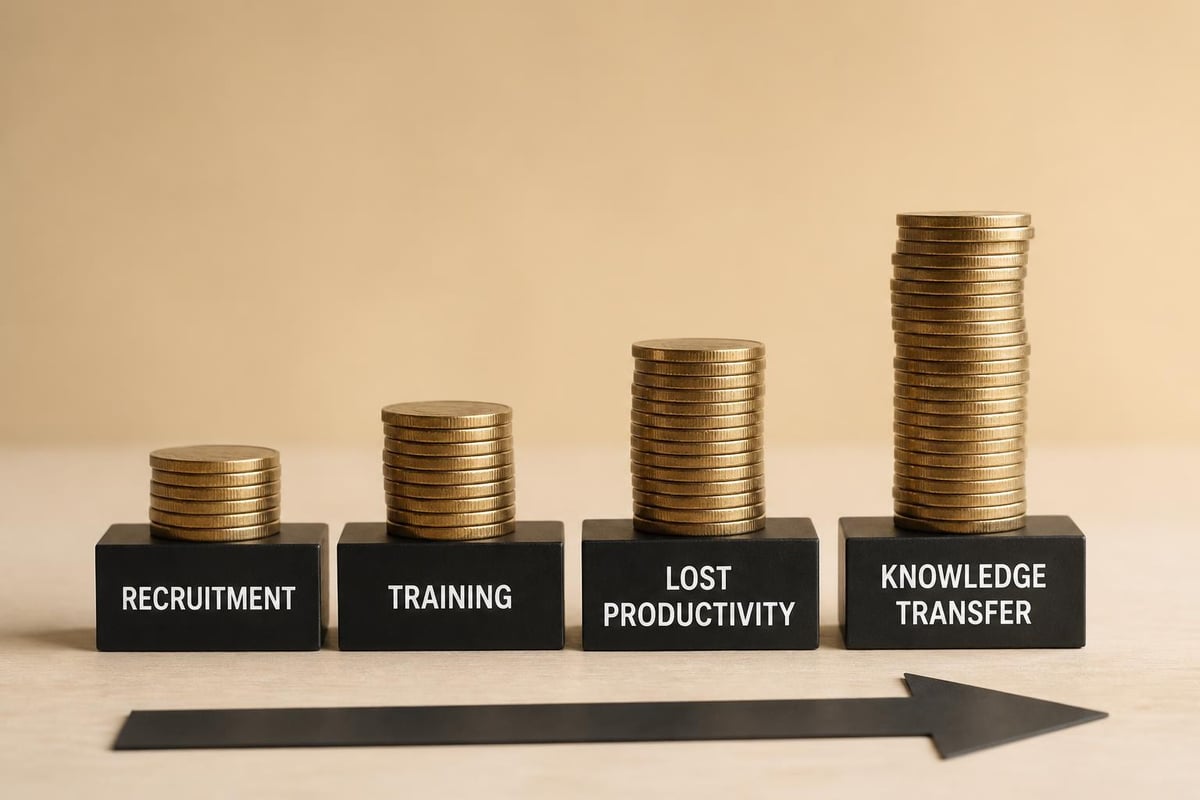
Cost analysis of employee turnover

Calculating Your Retention ROI

Before implementing retention initiatives, establish baseline metrics that allow measurement of program effectiveness.

Metric Calculation Target Benchmark
Turnover Rate (Departures / Average Headcount) × 100 <10% annually
Cost Per Hire Total Recruiting Costs / Number of Hires <$5,000
Time to Productivity Days Until Full Performance <90 days
First-Year Retention Employees Retained After 12 Months / New Hires × 100 >85%

These metrics provide quantifiable evidence of whether talent retention efforts deliver measurable business value. Organizations should track these quarterly and correlate improvements with specific interventions.

Competitive Compensation and Total Rewards Architecture

Compensation remains a foundational element of retention, but total rewards thinking has evolved significantly. Modern professionals evaluate opportunities through a holistic lens that encompasses financial, physical, and mental wellness.

Base salary competitiveness serves as table stakes. Organizations must benchmark against industry standards and adjust compensation bands annually to reflect market realities. However, proven talent retention strategies demonstrate that compensation alone proves insufficient without complementary programs.

Building a Modern Benefits Ecosystem

Forward-thinking organizations are reimagining benefits packages to address comprehensive employee needs. The traditional model of health insurance and 401(k) matching no longer differentiates employers in competitive markets.

Essential components for 2026 include:

  • Mental health support and therapy access
  • Financial wellness coaching and planning
  • Student loan repayment assistance
  • Childcare or eldercare subsidies
  • Earned wage access for cash flow flexibility

Strategic benefits administration platforms enable organizations to deliver personalized benefits experiences while maintaining administrative efficiency. Automation reduces enrollment errors by 78% and frees HR teams to focus on strategic initiatives rather than paperwork processing.

Professional services consultancies particularly benefit from offering tailored packages that acknowledge the demanding nature of client work. Providing wellness days separate from PTO, for instance, signals organizational commitment to sustainable performance rather than burnout culture.

Career Development and Growth Pathways

Talented professionals seek environments where they can expand capabilities and advance careers. Organizations that fail to provide clear growth trajectories lose high performers to competitors who offer those opportunities.

Career progression framework

Implementing Skills-Based Development Programs

Traditional career ladders have given way to lattice frameworks that recognize lateral moves and skill diversification as valuable growth paths.

Create individual development plans (IDPs) for each employee that outline:

  1. Current state assessment – Evaluate existing skills against role requirements
  2. Gap analysis – Identify specific competencies needed for desired career trajectory
  3. Learning pathway design – Select training, certifications, and experiential opportunities
  4. Milestone establishment – Set quarterly checkpoints for progress evaluation
  5. Resource allocation – Commit budget and time for professional development activities

Organizations that invest 4% of payroll in learning and development report 24% higher retention rates than those spending less than 1%. This correlation holds particularly strong among employees under 35, who prioritize growth opportunities when evaluating employers.

Mentorship and Knowledge Transfer Systems

Formal mentorship programs accelerate skill development while strengthening organizational culture. Pairing senior consultants with emerging talent creates reciprocal value-mentees gain expertise while mentors develop leadership capabilities.

Structured programs should include:

  • Monthly one-on-one sessions with documented discussion topics
  • Quarterly reverse mentoring where junior employees share fresh perspectives
  • Cross-functional pairings that expand business understanding
  • Executive sponsorship for high-potential individuals

Recognition and Appreciation Programs That Drive Engagement

Employee recognition significantly influences retention, with well-recognized employees being 73% less likely to seek new opportunities. Yet many organizations approach recognition sporadically or inauthentically, diminishing its impact.

Effective recognition programs operate on multiple levels:

Recognition Type Frequency Examples Business Impact
Peer-to-Peer Daily/Weekly Team shoutouts, collaboration awards Builds culture
Manager-to-Employee Weekly/Monthly Performance acknowledgment, spot bonuses Reinforces behaviors
Executive-Led Quarterly Innovation awards, client impact recognition Signals priorities
Milestone-Based Anniversary/Achievement Service awards, certification celebrations Honors commitment

The key to impactful recognition lies in specificity and timeliness. Generic "great job" messages carry minimal weight compared to detailed acknowledgment of specific contributions and their business outcomes.

Designing Recognition Systems That Scale

Technology platforms enable consistent recognition delivery across distributed teams. Digital systems allow employees to give and receive recognition instantly, creating visible appreciation that reinforces desired behaviors.

Effective platforms integrate with existing communication tools, require minimal administrative overhead, and provide analytics on recognition patterns. Organizations can identify which teams demonstrate strong recognition cultures versus those needing intervention.

Flexible Work Models and Operational Adaptability

The pandemic permanently altered workplace expectations. Professionals now demand flexibility in when and where they work, viewing it as fundamental rather than a perk.

Organizations resistant to flexible arrangements face talent retention challenges as competitors offer hybrid or remote options. However, flexibility requires thoughtful implementation to maintain collaboration, culture, and client service quality.

Flexible work framework

Structuring Flexibility Within Service Delivery Models

Professional services firms must balance employee flexibility with client commitments and team collaboration needs. Successful models establish core principles:

Define non-negotiables – Identify which activities require synchronous participation or physical presence. Client presentations, strategic planning sessions, and intensive collaboration sprints may demand in-person engagement.

Create team agreements – Allow teams to establish their own flexibility parameters within organizational guidelines. This autonomy increases buy-in and ensures arrangements support actual work patterns.

Invest in enabling technology – Remote and hybrid work requires robust collaboration platforms, secure access systems, and communication tools. Artificial intelligence and automation solutions can streamline workflows and reduce friction in distributed environments.

Measure outcomes, not activity – Shift performance evaluation from time-based metrics to deliverable-based assessment. This change fundamentally alters how managers approach talent retention and development.

Organizations implementing thoughtful flexibility report 32% higher retention among parents and caregivers, demographics that often include mid-career professionals with significant institutional knowledge.

Wellness Initiatives That Address Whole-Person Needs

Comprehensive wellness programs demonstrate organizational commitment to employee wellbeing beyond productivity extraction. As burnout reaches epidemic levels across professional services, proactive wellness initiatives become talent retention differentiators.

Modern wellness frameworks address four interconnected dimensions:

  • Physical health – Preventive care, fitness subsidies, ergonomic workspaces
  • Mental health – Therapy access, stress management training, workload monitoring
  • Financial wellness – Retirement planning, debt management, emergency savings programs
  • Social connection – Team building, employee resource groups, community engagement

The proven retention strategies that organizations implement in 2026 increasingly recognize that employee financial stress directly impacts engagement and retention. Offering financial wellness coaching and tools helps employees manage anxiety that otherwise distracts from work performance.

Measuring Wellness Program Effectiveness

Track leading and lagging indicators to assess whether wellness investments deliver retention benefits:

Leading indicators include:

  • Program participation rates
  • Employee Net Promoter Scores
  • Wellness resource utilization
  • Stress assessment trends

Lagging indicators include:

  • Healthcare cost trends
  • Absenteeism rates
  • Disability claims frequency
  • Retention rates among program participants

Organizations should survey employees quarterly about wellness needs and perceptions. This feedback loop ensures programs evolve with changing workforce demographics and external stressors.

Onboarding Excellence and First-Year Experience Design

Talent retention begins before an employee's first day. Comprehensive onboarding programs increase first-year retention by 82% and accelerate time to full productivity by six weeks on average.

Too many organizations treat onboarding as paperwork completion and system access provisioning. Strategic onboarding instead delivers structured integration into organizational culture, role expectations, and relationship networks.

The 90-Day Integration Framework

Effective onboarding extends well beyond the first week, following a structured timeline:

Days 1-30: Foundation Building

  • Complete administrative requirements and technology setup
  • Introduce organizational mission, values, and strategic priorities
  • Establish relationships with immediate team members
  • Clarify role responsibilities and success metrics
  • Assign an onboarding buddy for informal guidance

Days 31-60: Competency Development

  • Begin substantive project contributions with appropriate support
  • Participate in cross-functional introductions and shadowing
  • Complete role-specific training and certifications
  • Receive initial performance feedback and course corrections
  • Build client or stakeholder relationships as applicable

Days 61-90: Integration Completion

  • Take ownership of key responsibilities with decreasing oversight
  • Contribute ideas for process improvements
  • Participate in team planning and strategic discussions
  • Complete formal 90-day review with clear growth pathway
  • Celebrate integration milestones and early wins

Organizations serving enterprise clients or healthcare providers should tailor onboarding to address industry-specific complexity and compliance requirements that new employees must navigate.

Data-Driven Retention Through Predictive Analytics

Forward-thinking organizations leverage people analytics to identify talent retention risks before employees resign. Predictive models analyze patterns across performance data, engagement surveys, tenure, and external market signals.

Key retention risk indicators include:

  • Declining engagement survey scores
  • Reduced participation in development opportunities
  • Changes in work patterns or output quality
  • Extended time since last promotion or raise
  • Manager relationship deterioration signals

When analytics identify at-risk talent, proactive interventions can prevent departures. Stay interviews, targeted development opportunities, or compensation adjustments often resolve underlying issues before they drive resignation decisions.

Building Retention Dashboards for Leadership

Executives need visibility into talent retention metrics with the same rigor applied to financial performance. Monthly dashboards should surface:

Department Turnover Rate (12mo) Flight Risk Score Open Positions Time to Fill Engagement Index
Consulting 8.2% Medium 3 42 days 7.8/10
Operations 12.1% High 5 58 days 6.9/10
Client Services 6.5% Low 1 31 days 8.3/10

These metrics enable targeted interventions in departments showing elevated risk rather than one-size-fits-all retention programs that waste resources on areas with naturally high retention.

Manager Training and Leadership Development

The adage that "people leave managers, not companies" contains substantial truth. Managers directly influence daily work experience, growth opportunities, recognition, and workplace relationships that determine whether talented employees stay or go.

Many organizations promote individual contributors into management based on technical expertise without providing leadership training. This practice creates manager talent gaps that directly undermine talent retention efforts.

Essential Manager Competencies for Retention

Invest in developing these critical capabilities across your management population:

  1. Coaching and development conversations – Move beyond performance evaluation to ongoing growth dialogue
  2. Recognition and appreciation delivery – Provide specific, timely, authentic acknowledgment
  3. Difficult conversation navigation – Address performance issues and conflicts constructively
  4. Workload management and delegation – Prevent burnout through effective resource allocation
  5. Career pathway guidance – Help employees envision and pursue advancement opportunities

Organizations should evaluate managers on talent retention metrics alongside project delivery and revenue performance. This accountability shift signals that developing and retaining talent carries equal weight to client service.

Cultural Cohesion in Hybrid Environments

Maintaining strong organizational culture poses challenges when teams work across distributed locations and flexible schedules. Intentional culture-building becomes essential rather than allowing organic development.

Top talent retention strategies emphasize creating belonging and purpose regardless of physical location. This requires deliberate communication, inclusive meeting practices, and virtual connection opportunities.

Culture maintenance activities include:

  • Monthly all-hands meetings with interactive elements
  • Virtual coffee chats pairing employees across departments
  • Shared Slack channels for non-work interests
  • Quarterly in-person team gatherings when feasible
  • Transparent communication about business performance and strategy

Organizations should survey remote and hybrid employees specifically about inclusion perceptions and connection to culture. These populations often report feeling disconnected from organizational identity, which weakens retention over time.

Exit Interviews and Continuous Improvement Cycles

When talent retention efforts fail and employees depart, extract maximum learning from exit conversations. Structured exit interviews reveal systemic issues that anonymous surveys may miss.

Conduct exit interviews with departing employees within their final week, using consistent questions that enable trend analysis. Third-party facilitators often elicit more candid feedback than direct managers or HR team members.

Critical Exit Interview Questions

  • What factors most influenced your decision to leave?
  • What could we have done differently to retain you?
  • How would you describe our culture to outsiders?
  • Did you feel you had adequate growth opportunities?
  • How effective was your manager in supporting your success?
  • What did we do particularly well that you'll miss?
  • What advice would you give leadership about improving retention?

Aggregate exit interview data quarterly to identify patterns. If multiple departures cite inadequate growth opportunities or problematic manager behaviors, these themes demand immediate intervention.

Organizations serious about talent retention close the feedback loop by acting on exit interview insights and communicating changes to current employees. This demonstrates that leadership listens and evolves based on workforce input.


Effective talent retention requires coordinated strategies across compensation, development, recognition, flexibility, wellness, and culture. Organizations that address these elements systematically protect their investment in human capital while building competitive advantage through experienced, engaged teams. Nero and Associates, Inc. helps professional services organizations implement comprehensive retention solutions through human capital management expertise, automation that eliminates administrative burden, and employee wellness programs that address financial, physical, and mental health needs. Connect with our team to develop retention strategies that measurably improve your bottom line while creating workplaces where talented professionals choose to stay and grow.

Talent Retention: Strategic Solutions for 2026

Organizations across professional services and consulting sectors face mounting pressure to retain their most valuable asset: talented employees. The cost of replacing a skilled professional can reach 200% of their annual salary when factoring in recruitment expenses, lost productivity, and institutional knowledge gaps. As we navigate 2026's competitive labor market, understanding and implementing effective talent retention strategies has become a business imperative rather than an HR checkbox.

The Financial Impact of Turnover in Professional Services

The true cost of employee turnover extends far beyond recruitment advertising and onboarding expenses. Professional services firms experience particularly acute pain points when senior consultants or subject matter experts depart, taking client relationships and specialized knowledge with them.

Direct costs include:

  • Recruitment agency fees (15-25% of annual salary)
  • Interview time and management resources
  • Onboarding and training investments
  • Technology and equipment provisioning

Indirect costs compound these expenses:

  • Decreased team productivity during transitions
  • Client relationship disruptions
  • Project delays and quality inconsistencies
  • Lowered morale among remaining employees

Research indicates that employee engagement and retention factors span six critical domains, from organizational culture to compensation structures. Organizations that address these interconnected elements systematically achieve measurably better outcomes.

Cost analysis of employee turnover

Calculating Your Retention ROI

Before implementing retention initiatives, establish baseline metrics that allow measurement of program effectiveness.

Metric Calculation Target Benchmark
Turnover Rate (Departures / Average Headcount) × 100 <10% annually
Cost Per Hire Total Recruiting Costs / Number of Hires <$5,000
Time to Productivity Days Until Full Performance <90 days
First-Year Retention Employees Retained After 12 Months / New Hires × 100 >85%

These metrics provide quantifiable evidence of whether talent retention efforts deliver measurable business value. Organizations should track these quarterly and correlate improvements with specific interventions.

Competitive Compensation and Total Rewards Architecture

Compensation remains a foundational element of retention, but total rewards thinking has evolved significantly. Modern professionals evaluate opportunities through a holistic lens that encompasses financial, physical, and mental wellness.

Base salary competitiveness serves as table stakes. Organizations must benchmark against industry standards and adjust compensation bands annually to reflect market realities. However, proven talent retention strategies demonstrate that compensation alone proves insufficient without complementary programs.

Building a Modern Benefits Ecosystem

Forward-thinking organizations are reimagining benefits packages to address comprehensive employee needs. The traditional model of health insurance and 401(k) matching no longer differentiates employers in competitive markets.

Essential components for 2026 include:

  • Mental health support and therapy access
  • Financial wellness coaching and planning
  • Student loan repayment assistance
  • Childcare or eldercare subsidies
  • Earned wage access for cash flow flexibility

Strategic benefits administration platforms enable organizations to deliver personalized benefits experiences while maintaining administrative efficiency. Automation reduces enrollment errors by 78% and frees HR teams to focus on strategic initiatives rather than paperwork processing.

Professional services consultancies particularly benefit from offering tailored packages that acknowledge the demanding nature of client work. Providing wellness days separate from PTO, for instance, signals organizational commitment to sustainable performance rather than burnout culture.

Career Development and Growth Pathways

Talented professionals seek environments where they can expand capabilities and advance careers. Organizations that fail to provide clear growth trajectories lose high performers to competitors who offer those opportunities.

Career progression framework

Implementing Skills-Based Development Programs

Traditional career ladders have given way to lattice frameworks that recognize lateral moves and skill diversification as valuable growth paths.

Create individual development plans (IDPs) for each employee that outline:

  1. Current state assessment – Evaluate existing skills against role requirements
  2. Gap analysis – Identify specific competencies needed for desired career trajectory
  3. Learning pathway design – Select training, certifications, and experiential opportunities
  4. Milestone establishment – Set quarterly checkpoints for progress evaluation
  5. Resource allocation – Commit budget and time for professional development activities

Organizations that invest 4% of payroll in learning and development report 24% higher retention rates than those spending less than 1%. This correlation holds particularly strong among employees under 35, who prioritize growth opportunities when evaluating employers.

Mentorship and Knowledge Transfer Systems

Formal mentorship programs accelerate skill development while strengthening organizational culture. Pairing senior consultants with emerging talent creates reciprocal value-mentees gain expertise while mentors develop leadership capabilities.

Structured programs should include:

  • Monthly one-on-one sessions with documented discussion topics
  • Quarterly reverse mentoring where junior employees share fresh perspectives
  • Cross-functional pairings that expand business understanding
  • Executive sponsorship for high-potential individuals

Recognition and Appreciation Programs That Drive Engagement

Employee recognition significantly influences retention, with well-recognized employees being 73% less likely to seek new opportunities. Yet many organizations approach recognition sporadically or inauthentically, diminishing its impact.

Effective recognition programs operate on multiple levels:

Recognition Type Frequency Examples Business Impact
Peer-to-Peer Daily/Weekly Team shoutouts, collaboration awards Builds culture
Manager-to-Employee Weekly/Monthly Performance acknowledgment, spot bonuses Reinforces behaviors
Executive-Led Quarterly Innovation awards, client impact recognition Signals priorities
Milestone-Based Anniversary/Achievement Service awards, certification celebrations Honors commitment

The key to impactful recognition lies in specificity and timeliness. Generic "great job" messages carry minimal weight compared to detailed acknowledgment of specific contributions and their business outcomes.

Designing Recognition Systems That Scale

Technology platforms enable consistent recognition delivery across distributed teams. Digital systems allow employees to give and receive recognition instantly, creating visible appreciation that reinforces desired behaviors.

Effective platforms integrate with existing communication tools, require minimal administrative overhead, and provide analytics on recognition patterns. Organizations can identify which teams demonstrate strong recognition cultures versus those needing intervention.

Flexible Work Models and Operational Adaptability

The pandemic permanently altered workplace expectations. Professionals now demand flexibility in when and where they work, viewing it as fundamental rather than a perk.

Organizations resistant to flexible arrangements face talent retention challenges as competitors offer hybrid or remote options. However, flexibility requires thoughtful implementation to maintain collaboration, culture, and client service quality.

Flexible work framework

Structuring Flexibility Within Service Delivery Models

Professional services firms must balance employee flexibility with client commitments and team collaboration needs. Successful models establish core principles:

Define non-negotiables – Identify which activities require synchronous participation or physical presence. Client presentations, strategic planning sessions, and intensive collaboration sprints may demand in-person engagement.

Create team agreements – Allow teams to establish their own flexibility parameters within organizational guidelines. This autonomy increases buy-in and ensures arrangements support actual work patterns.

Invest in enabling technology – Remote and hybrid work requires robust collaboration platforms, secure access systems, and communication tools. Artificial intelligence and automation solutions can streamline workflows and reduce friction in distributed environments.

Measure outcomes, not activity – Shift performance evaluation from time-based metrics to deliverable-based assessment. This change fundamentally alters how managers approach talent retention and development.

Organizations implementing thoughtful flexibility report 32% higher retention among parents and caregivers, demographics that often include mid-career professionals with significant institutional knowledge.

Wellness Initiatives That Address Whole-Person Needs

Comprehensive wellness programs demonstrate organizational commitment to employee wellbeing beyond productivity extraction. As burnout reaches epidemic levels across professional services, proactive wellness initiatives become talent retention differentiators.

Modern wellness frameworks address four interconnected dimensions:

  • Physical health – Preventive care, fitness subsidies, ergonomic workspaces
  • Mental health – Therapy access, stress management training, workload monitoring
  • Financial wellness – Retirement planning, debt management, emergency savings programs
  • Social connection – Team building, employee resource groups, community engagement

The proven retention strategies that organizations implement in 2026 increasingly recognize that employee financial stress directly impacts engagement and retention. Offering financial wellness coaching and tools helps employees manage anxiety that otherwise distracts from work performance.

Measuring Wellness Program Effectiveness

Track leading and lagging indicators to assess whether wellness investments deliver retention benefits:

Leading indicators include:

  • Program participation rates
  • Employee Net Promoter Scores
  • Wellness resource utilization
  • Stress assessment trends

Lagging indicators include:

  • Healthcare cost trends
  • Absenteeism rates
  • Disability claims frequency
  • Retention rates among program participants

Organizations should survey employees quarterly about wellness needs and perceptions. This feedback loop ensures programs evolve with changing workforce demographics and external stressors.

Onboarding Excellence and First-Year Experience Design

Talent retention begins before an employee's first day. Comprehensive onboarding programs increase first-year retention by 82% and accelerate time to full productivity by six weeks on average.

Too many organizations treat onboarding as paperwork completion and system access provisioning. Strategic onboarding instead delivers structured integration into organizational culture, role expectations, and relationship networks.

The 90-Day Integration Framework

Effective onboarding extends well beyond the first week, following a structured timeline:

Days 1-30: Foundation Building

  • Complete administrative requirements and technology setup
  • Introduce organizational mission, values, and strategic priorities
  • Establish relationships with immediate team members
  • Clarify role responsibilities and success metrics
  • Assign an onboarding buddy for informal guidance

Days 31-60: Competency Development

  • Begin substantive project contributions with appropriate support
  • Participate in cross-functional introductions and shadowing
  • Complete role-specific training and certifications
  • Receive initial performance feedback and course corrections
  • Build client or stakeholder relationships as applicable

Days 61-90: Integration Completion

  • Take ownership of key responsibilities with decreasing oversight
  • Contribute ideas for process improvements
  • Participate in team planning and strategic discussions
  • Complete formal 90-day review with clear growth pathway
  • Celebrate integration milestones and early wins

Organizations serving enterprise clients or healthcare providers should tailor onboarding to address industry-specific complexity and compliance requirements that new employees must navigate.

Data-Driven Retention Through Predictive Analytics

Forward-thinking organizations leverage people analytics to identify talent retention risks before employees resign. Predictive models analyze patterns across performance data, engagement surveys, tenure, and external market signals.

Key retention risk indicators include:

  • Declining engagement survey scores
  • Reduced participation in development opportunities
  • Changes in work patterns or output quality
  • Extended time since last promotion or raise
  • Manager relationship deterioration signals

When analytics identify at-risk talent, proactive interventions can prevent departures. Stay interviews, targeted development opportunities, or compensation adjustments often resolve underlying issues before they drive resignation decisions.

Building Retention Dashboards for Leadership

Executives need visibility into talent retention metrics with the same rigor applied to financial performance. Monthly dashboards should surface:

Department Turnover Rate (12mo) Flight Risk Score Open Positions Time to Fill Engagement Index
Consulting 8.2% Medium 3 42 days 7.8/10
Operations 12.1% High 5 58 days 6.9/10
Client Services 6.5% Low 1 31 days 8.3/10

These metrics enable targeted interventions in departments showing elevated risk rather than one-size-fits-all retention programs that waste resources on areas with naturally high retention.

Manager Training and Leadership Development

The adage that "people leave managers, not companies" contains substantial truth. Managers directly influence daily work experience, growth opportunities, recognition, and workplace relationships that determine whether talented employees stay or go.

Many organizations promote individual contributors into management based on technical expertise without providing leadership training. This practice creates manager talent gaps that directly undermine talent retention efforts.

Essential Manager Competencies for Retention

Invest in developing these critical capabilities across your management population:

  1. Coaching and development conversations – Move beyond performance evaluation to ongoing growth dialogue
  2. Recognition and appreciation delivery – Provide specific, timely, authentic acknowledgment
  3. Difficult conversation navigation – Address performance issues and conflicts constructively
  4. Workload management and delegation – Prevent burnout through effective resource allocation
  5. Career pathway guidance – Help employees envision and pursue advancement opportunities

Organizations should evaluate managers on talent retention metrics alongside project delivery and revenue performance. This accountability shift signals that developing and retaining talent carries equal weight to client service.

Cultural Cohesion in Hybrid Environments

Maintaining strong organizational culture poses challenges when teams work across distributed locations and flexible schedules. Intentional culture-building becomes essential rather than allowing organic development.

Top talent retention strategies emphasize creating belonging and purpose regardless of physical location. This requires deliberate communication, inclusive meeting practices, and virtual connection opportunities.

Culture maintenance activities include:

  • Monthly all-hands meetings with interactive elements
  • Virtual coffee chats pairing employees across departments
  • Shared Slack channels for non-work interests
  • Quarterly in-person team gatherings when feasible
  • Transparent communication about business performance and strategy

Organizations should survey remote and hybrid employees specifically about inclusion perceptions and connection to culture. These populations often report feeling disconnected from organizational identity, which weakens retention over time.

Exit Interviews and Continuous Improvement Cycles

When talent retention efforts fail and employees depart, extract maximum learning from exit conversations. Structured exit interviews reveal systemic issues that anonymous surveys may miss.

Conduct exit interviews with departing employees within their final week, using consistent questions that enable trend analysis. Third-party facilitators often elicit more candid feedback than direct managers or HR team members.

Critical Exit Interview Questions

  • What factors most influenced your decision to leave?
  • What could we have done differently to retain you?
  • How would you describe our culture to outsiders?
  • Did you feel you had adequate growth opportunities?
  • How effective was your manager in supporting your success?
  • What did we do particularly well that you'll miss?
  • What advice would you give leadership about improving retention?

Aggregate exit interview data quarterly to identify patterns. If multiple departures cite inadequate growth opportunities or problematic manager behaviors, these themes demand immediate intervention.

Organizations serious about talent retention close the feedback loop by acting on exit interview insights and communicating changes to current employees. This demonstrates that leadership listens and evolves based on workforce input.


Effective talent retention requires coordinated strategies across compensation, development, recognition, flexibility, wellness, and culture. Organizations that address these elements systematically protect their investment in human capital while building competitive advantage through experienced, engaged teams. Nero and Associates, Inc. helps professional services organizations implement comprehensive retention solutions through human capital management expertise, automation that eliminates administrative burden, and employee wellness programs that address financial, physical, and mental health needs. Connect with our team to develop retention strategies that measurably improve your bottom line while creating workplaces where talented professionals choose to stay and grow.

Website developed in accordance with Web Content Accessibility Guidelines 2.2.
If you encounter any issues while using this site, please contact us: 215.526.5126