

Health Savings Accounts (HSAs) have become increasingly important tools for organizations seeking to provide meaningful benefits while managing costs effectively. As employers navigate the complexities of employee healthcare, understanding the nuances of hsa administration has become essential for HR departments and business leaders. Effective HSA management requires balancing compliance requirements, employee education, and operational efficiency. Organizations that master these elements can deliver significant value to their workforce while streamlining administrative burdens and reducing overall healthcare costs.
Understanding HSA Administration Fundamentals
HSA administration encompasses the operational, regulatory, and strategic activities required to manage Health Savings Accounts successfully. These tax-advantaged accounts allow employees with high-deductible health plans to save money for qualified medical expenses while enjoying triple tax benefits.
The administrative responsibilities extend far beyond simply opening accounts. Employers must coordinate with third-party administrators, manage contribution limits, ensure compliance with IRS regulations, and provide ongoing employee support. Benefits administration has evolved significantly, requiring organizations to adopt more sophisticated approaches to managing these programs.
Core Components of Effective HSA Management
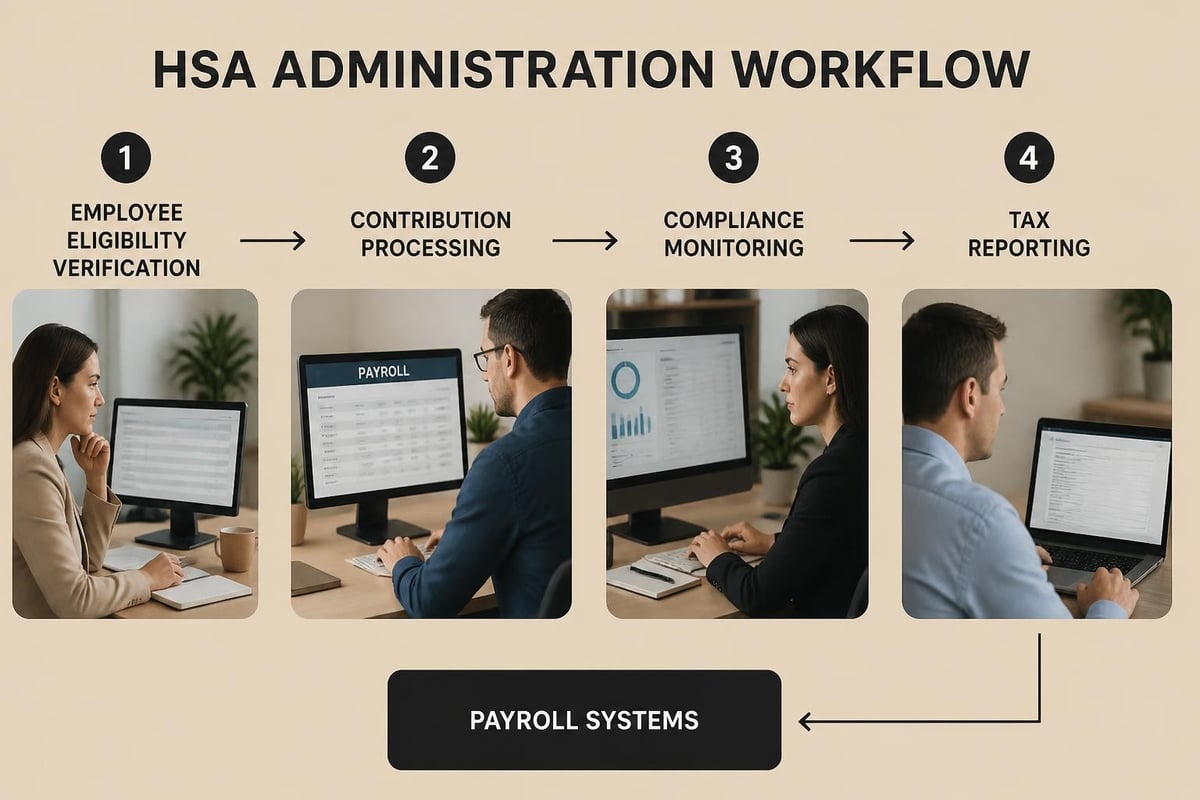
Successful hsa administration requires attention to several critical areas. First, organizations must verify employee eligibility based on their health plan coverage and ensure no disqualifying factors exist. Second, contribution tracking becomes essential for both payroll processing and tax reporting purposes.
Key administrative elements include:
- Payroll integration for pre-tax contributions
- Employer contribution management and timing
- Compliance monitoring for contribution limits
- Employee communication and education programs
- Record-keeping systems for documentation
- Coordination with health plan administrators
Many organizations underestimate the common misconceptions surrounding HSAs, which can lead to administrative challenges and employee confusion. Understanding these myths helps administrators design better communication strategies.
Selecting the Right HSA Administrator
Choosing an appropriate third-party administrator represents one of the most consequential decisions for hsa administration success. The right partner can transform what might be a complex administrative burden into a streamlined, value-adding benefit.
Organizations should evaluate potential administrators across multiple dimensions. Key qualities to look for in an HSA administrator include partnership orientation, technological capabilities, compliance expertise, and customer service quality.
| Evaluation Criteria | Questions to Ask | Impact on Organization |
|---|---|---|
| Technology Platform | Does the system integrate with our payroll and benefits systems? | Reduces manual processes and errors |
| Fee Structure | Are fees transparent and competitive? | Affects employee satisfaction and adoption |
| Compliance Support | How does the administrator stay current with regulations? | Minimizes risk exposure |
| Employee Experience | What tools exist for employee self-service? | Decreases HR inquiries and support needs |
| Reporting Capabilities | Can we access real-time data and customized reports? | Improves strategic decision-making |
The responsibilities of an HSA administrator extend beyond basic account management. These partners should provide educational resources, investment options, and responsive customer support that reflects well on your organization.
Integration with Human Capital Management Systems
Modern hsa administration demands seamless integration with broader human capital management infrastructure. Organizations investing in payroll and human capital management solutions gain significant advantages in automation and accuracy.
Integration eliminates duplicate data entry, reduces reconciliation time, and ensures contribution accuracy. When payroll systems communicate directly with HSA administrators, contributions flow automatically based on employee elections and employer policies.
Integration benefits include:
- Real-time contribution processing
- Automated compliance limit tracking
- Simplified year-end tax reporting
- Reduced administrative staff time requirements
- Enhanced data accuracy and audit trails
Navigating HSA Compliance Requirements
Compliance represents a critical dimension of hsa administration that requires constant attention. The regulatory landscape continues to evolve, with annual contribution limit adjustments and periodic IRS guidance updates affecting administrative protocols.
For 2026, employers must understand seven essential aspects of HSA compliance that impact daily operations. These include eligibility determination, contribution limit enforcement, and proper handling of excess contributions.
Annual Contribution Limits and Monitoring
The IRS adjusts contribution limits annually based on inflation. For 2026, organizations must verify current limits and implement systems that prevent over-contributions. Employers face potential penalties when administrative failures allow employees to exceed statutory maximums.
Effective monitoring requires real-time tracking across multiple contribution sources: employee pre-tax payroll deductions, employer contributions, and any direct deposits employees make outside the payroll system. Sophisticated administrators provide alert systems that notify both employers and employees as contributions approach limits.
Eligibility Verification and Documentation
Determining and maintaining HSA eligibility represents an ongoing administrative responsibility. Employees must maintain qualifying high-deductible health plan coverage and cannot have other disqualifying coverage such as general-purpose flexible spending accounts or Medicare enrollment.
Eligibility verification steps:
- Confirm high-deductible health plan enrollment
- Screen for disqualifying coverage types
- Monitor status changes throughout the year
- Document eligibility determinations
- Communicate status changes promptly to administrators
Organizations serving healthcare organizations must be particularly attentive to these requirements, as healthcare workers often have unique insurance situations.

Record-Keeping Best Practices for HSA Administration
Comprehensive record-keeping stands as a cornerstone of effective hsa administration. Organizations must maintain detailed documentation to support tax advantages, respond to audits, and provide employees with the information they need for tax filing.
The importance of maintaining HSA receipts and documentation extends to both employers and employees. While account holders bear ultimate responsibility for substantiating their qualified medical expenses, employers should facilitate good record-keeping practices.
Employer-Level Documentation Requirements
Employers must retain records demonstrating compliance with contribution rules, eligibility determinations, and proper tax reporting. These records should be maintained for at least seven years to cover potential audit periods.
| Document Type | Retention Period | Purpose |
|---|---|---|
| Eligibility verification forms | 7 years | Prove compliance with HSA rules |
| Contribution records | 7 years | Support tax reporting accuracy |
| Plan documents and amendments | Indefinite | Demonstrate plan design and changes |
| Employee communications | 3 years | Show good-faith compliance efforts |
| IRS Form 5498-SA copies | 7 years | Verify contribution reporting |
Best practices for HSA recordkeeping emphasize digital documentation systems that facilitate easy retrieval and reduce physical storage requirements. Cloud-based solutions provide security while enabling authorized access from multiple locations.
Employee Education on Documentation
Many employees struggle with understanding their documentation responsibilities. Effective hsa administration includes comprehensive employee education about receipt retention, qualified expense definitions, and reimbursement procedures.
Organizations should create resources that clarify what expenses qualify, how to save documentation, and why record-keeping matters for tax purposes. Simple guides, video tutorials, and FAQ documents can dramatically reduce employee confusion and administrative inquiries.
Streamlining HSA Enrollment and Communication
The enrollment process sets the tone for the entire employee HSA experience. Organizations that invest in streamlined, user-friendly enrollment processes see higher participation rates and fewer administrative issues downstream.
HR professionals implementing HSA administration should focus on simplifying the enrollment experience while ensuring employees understand the commitment they're making. This includes clear explanations of contribution decisions, investment options, and long-term planning opportunities.
Simplifying the Enrollment Experience
Complex enrollment processes discourage participation and increase errors. Modern hsa administration leverages technology to guide employees through decision-making with intuitive interfaces and helpful prompts.
Enrollment simplification strategies:
- Pre-populate forms with existing employee data
- Provide contribution calculators and modeling tools
- Offer multiple enrollment channels (online, mobile, paper)
- Enable beneficiary designation during initial setup
- Send confirmation summaries immediately after enrollment
Organizations implementing automation solutions for benefits administration can reduce enrollment time by 60% while improving data accuracy.
Creating Effective Employee Communication Programs
Ongoing communication proves essential for maximizing HSA value. Employees who understand their accounts use them more effectively, leading to better health outcomes and financial wellness.
Communication programs should address common questions, highlight tax advantages, explain contribution strategies, and provide updates about regulatory changes. Multi-channel approaches using email, intranet posts, webinars, and printed materials reach diverse employee populations effectively.

Optimizing HSA Administration Through Technology
Technology transformation has revolutionized hsa administration, enabling capabilities that were impossible just a few years ago. Organizations that embrace technological solutions gain competitive advantages in efficiency, accuracy, and employee satisfaction.
Modern platforms offer integrated dashboards where administrators can monitor contribution levels, track compliance metrics, and generate reports without manual data compilation. These systems reduce administrative hours while providing better insights for strategic planning.
Automation and Process Improvement
Automation eliminates repetitive manual tasks that consume HR staff time and introduce error opportunities. Businesses implementing automation for HSA processes report significant time savings and improved accuracy.
Automated workflows can handle contribution processing, limit monitoring, eligibility verification reminders, and tax reporting preparation. This frees HR professionals to focus on strategic initiatives rather than transactional processing.
Automation opportunities in HSA administration:
- Contribution file generation from payroll systems
- Eligibility status monitoring and alerts
- Compliance limit tracking and notifications
- Year-end tax form distribution
- New hire enrollment reminders
- Annual contribution limit updates
Mobile Access and Employee Self-Service
Mobile technology has transformed employee expectations for benefits access. Modern hsa administration platforms provide mobile applications that enable account holders to check balances, submit claims, upload receipts, and review transaction history from anywhere.
Self-service capabilities reduce administrative burden by empowering employees to manage their accounts independently. When employees can access information and perform transactions without HR intervention, both parties benefit from improved efficiency.
Measuring HSA Administration Success
Organizations must establish metrics to evaluate their hsa administration effectiveness. Performance measurement enables continuous improvement and demonstrates value to organizational leadership.
Key performance indicators should address multiple dimensions: administrative efficiency, employee satisfaction, compliance accuracy, and cost management. Tracking these metrics over time reveals trends and improvement opportunities.
| Metric Category | Specific Measures | Target Benchmarks |
|---|---|---|
| Participation | Enrollment rate among eligible employees | 60-70% |
| Efficiency | Hours spent on monthly administration | < 2 hours per 100 participants |
| Accuracy | Contribution errors per payroll period | < 0.5% |
| Satisfaction | Employee satisfaction survey scores | > 4.0 out of 5.0 |
| Compliance | Audit findings or compliance violations | Zero |
Regular assessment against these benchmarks helps identify areas requiring attention. Organizations serving mid-market businesses often find that systematic measurement reveals unexpected efficiency opportunities.
Continuous Improvement Strategies
Effective hsa administration requires commitment to ongoing enhancement. Annual reviews should assess administrator performance, technology capabilities, employee feedback, and regulatory compliance.
Gathering employee input through surveys, focus groups, or suggestion programs provides valuable insights into pain points and improvement opportunities. Many administrative challenges only become visible through user feedback.
Continuous improvement activities:
- Annual administrator performance reviews
- Employee satisfaction surveys
- Process efficiency audits
- Technology capability assessments
- Compliance procedure updates
- Staff training and development programs
Strategic Considerations for HSA Program Design
Beyond operational administration, organizations must make strategic decisions about HSA program design that significantly impact employee value and organizational costs. These choices include employer contribution strategies, investment option selection, and educational program scope.
Selecting the right provider and plan design requires careful analysis of organizational goals, workforce demographics, and budget constraints. Different approaches suit different organizational contexts.
Employer Contribution Strategies
Employer contributions represent powerful tools for driving participation and demonstrating organizational commitment to employee financial wellness. Organizations employ various strategies, from flat-dollar amounts to percentage-of-salary approaches, from immediate contributions to vesting schedules.
The contribution strategy should align with broader compensation philosophy and total rewards positioning. Organizations competing for talent may use generous HSA contributions as differentiators, while cost-conscious employers might focus on enabling employee contributions without employer funding.
Investment Options and Financial Wellness
HSAs offer unique long-term savings opportunities because unused funds roll over indefinitely and can be invested for growth. Forward-thinking hsa administration includes robust investment options and education about long-term wealth-building potential.
Organizations should ensure their HSA administrators offer diverse investment choices suitable for various risk tolerances and investment timelines. Education programs should highlight the "retirement account" potential of HSAs for employees who can afford to pay current medical expenses from other sources.
When properly integrated with broader financial wellness initiatives, HSAs become powerful tools for improving employee financial security. Organizations implementing comprehensive financial wellness programs see improved employee engagement and reduced financial stress.
Addressing Common HSA Administration Challenges
Even well-designed programs encounter challenges requiring proactive management. Understanding common obstacles enables organizations to develop preventive strategies and responsive solutions.
Mid-year eligibility changes represent a frequent complication. When employees switch to or from qualifying high-deductible plans during the year, administrators must adjust contribution processing and ensure compliance with monthly eligibility rules.
Managing Excess Contributions
Despite monitoring systems, excess contributions occasionally occur due to timing issues, employee direct deposits, or administrative errors. When reviewing factors in account administration, organizations should establish clear protocols for identifying and correcting excess contributions before year-end.
Prompt correction minimizes tax consequences for employees and demonstrates administrative competence. Clear communication about correction procedures reduces employee anxiety when these situations arise.
Supporting Diverse Employee Populations
Different employee segments have varying HSA needs and capabilities. Organizations serving diverse industries must tailor their hsa administration approaches accordingly.
Younger employees might need education about basic HSA concepts and long-term savings opportunities. Employees nearing retirement require information about Medicare coordination and HSA distribution rules. Multi-generational workforces demand varied communication approaches and educational content.
Effective hsa administration requires balancing operational efficiency, regulatory compliance, and employee experience while continuously adapting to changing requirements and workforce needs. Organizations that invest in robust systems, qualified administrators, and comprehensive employee education create significant value for both their workforce and their bottom line. Nero and Associates, Inc. helps organizations optimize their benefits administration through innovative human capital management solutions that streamline processes, ensure compliance, and empower employees to maximize their health and financial wellness benefits. Contact us to discover how our performance-based approach can transform your HSA administration into a strategic advantage.