
Unlock the hidden tax-saving potential of your property in 2026 with a cost seg study. As tax laws evolve, understanding this powerful strategy can help you maximize deductions and keep more cash in your business.
This guide demystifies the cost seg study process, showing you how it accelerates depreciation and boosts your bottom line. Whether you are a property owner, investor, or advisor, you will find actionable steps to leverage these benefits.
Inside, you will discover cost segregation fundamentals, eligibility criteria, the step-by-step process, tax advantages, compliance risks, 2026 tax law updates, and expert tips. Ready to make smarter financial decisions? Start applying these insights for real, measurable savings.
Cost Segregation Fundamentals: What It Is and Why It Matters
Understanding the fundamentals of a cost seg study is the first step toward unlocking major tax savings for property owners. This section breaks down how the process works, why it matters, and what makes it a powerful tool for optimizing tax strategies in 2026.
Defining Cost Segregation and Its Purpose
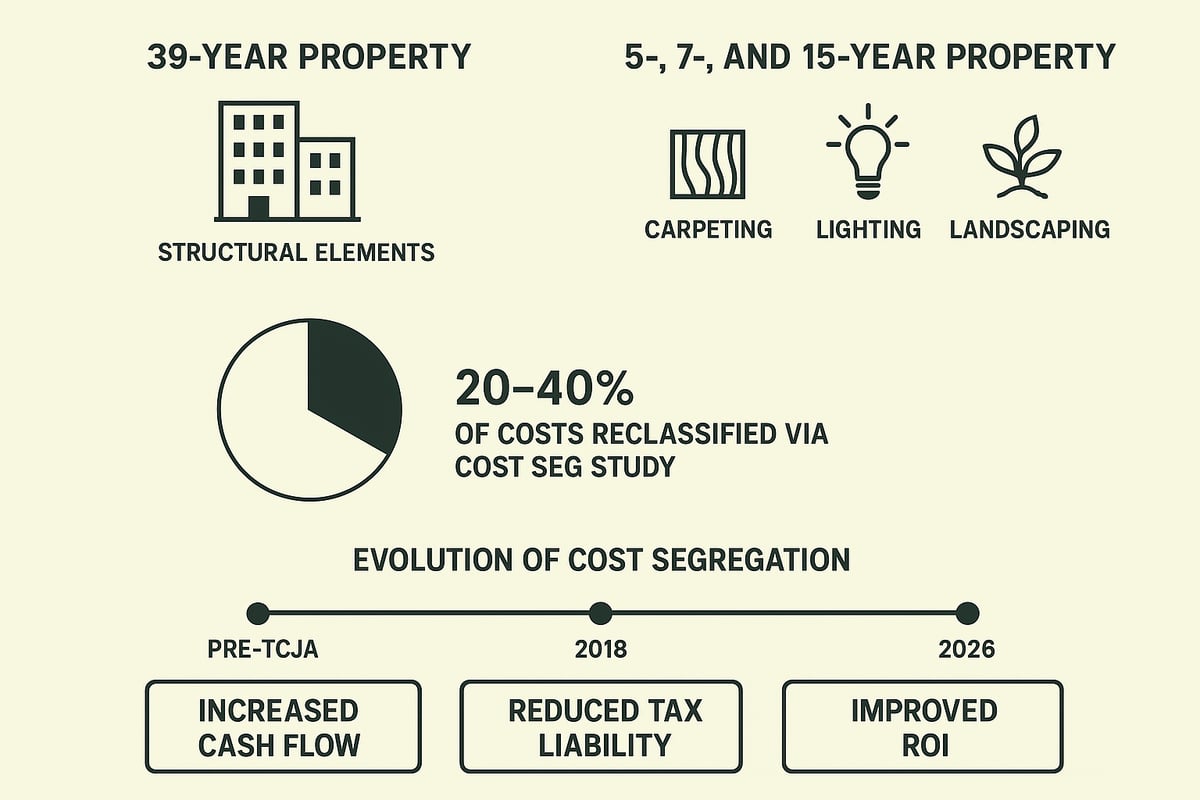
A cost seg study is a tax planning strategy that allows property owners to accelerate depreciation deductions by identifying and reclassifying certain building components. Under U.S. tax law, commercial buildings are typically depreciated over 39 years, but not all building assets must follow this timeline.
The core idea behind a cost seg study is to separate personal property and land improvements from the main structure. Personal property, such as carpeting, specialty lighting, and certain types of wiring, can be depreciated over 5, 7, or 15 years. In contrast, core structural elements like foundations and walls remain on the 39-year schedule.
Let’s consider an example. If you own a commercial property, items like landscaping, signage, and dedicated electrical systems for equipment can be moved to shorter depreciation periods. According to IRS guidelines and the American Society of Cost Segregation Professionals, a quality cost seg study can reclassify 20 to 40 percent of a building’s total cost to these shorter lives.
This reclassification leads to larger depreciation deductions in the early years of ownership. The result is increased cash flow, reduced current tax liability, and improved return on investment. For property owners, these benefits make a cost seg study a critical part of any comprehensive tax strategy.
Historical Context and Growing Relevance in 2026
Cost segregation has evolved significantly, especially after the Tax Cuts and Jobs Act (TCJA) introduced new rules for bonus depreciation. The growing complexity of modern properties means more building assets now qualify for accelerated depreciation through a cost seg study.
Following the TCJA, property owners gained the ability to take 100 percent bonus depreciation on qualified property, making the timing of a cost seg study even more valuable. As we approach 2026, anticipated changes to tax law continue to highlight the importance of thorough, engineering-based studies.
The landscape in 2026 is expected to bring both challenges and opportunities. While some bonus depreciation provisions may phase out, the underlying advantage of a cost seg study remains. Owners who stay proactive and keep up with IRS updates will continue to see meaningful savings, especially as studies adapt to new asset classifications and tax rules.
Cost segregation is not just a technical tax tool—it’s a forward-looking strategy that helps property owners maximize their investments and prepare for future legislative shifts. Understanding its fundamentals ensures you are ready to take advantage of every available opportunity.
Eligibility: Who Should Consider a Cost Segregation Study?
Determining if a cost seg study is right for you starts with understanding which properties and owners stand to benefit the most. Not every real estate owner will see the same return, so knowing the eligibility criteria can help you maximize your tax savings and make informed investment decisions.
Types of Properties and Owners That Benefit
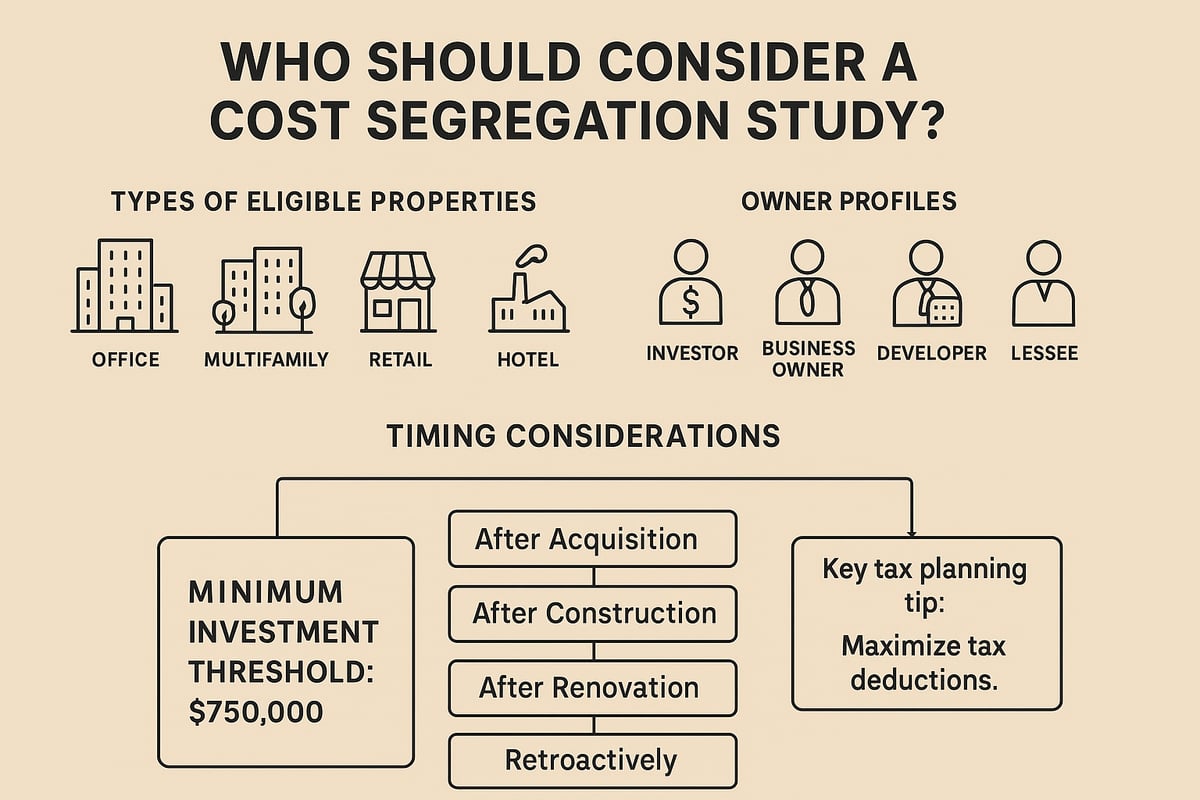
A wide range of property types may qualify for a cost seg study, making it a versatile tool for many real estate investors. Eligible properties typically include commercial buildings, residential rental complexes, industrial facilities, retail centers, healthcare clinics, and hotels.
New construction projects, recent acquisitions, major renovations, and leasehold improvements can all justify a cost seg study. Generally, properties with an investment of $500,000 or more see the best cost-benefit ratio. For example, an office building owner with a newly constructed property could accelerate depreciation on assets like lighting, carpeting, and landscaping, while a multifamily property investor could do the same for common area improvements.
Owner profiles are equally diverse. Real estate investors, business owners, property developers, and certain lessees who make substantial improvements may all benefit from a cost seg study. If you own multiple property types or manage a growing portfolio, a cost seg study can unlock significant tax advantages across your holdings. For an in-depth overview of who qualifies, visit the Who qualifies for cost segregation resource.
Timing and Strategic Considerations
Timing plays a crucial role in maximizing the value of a cost seg study. The ideal moment to conduct a study is soon after a property is acquired, constructed, or undergoes significant renovation. Acting early ensures that accelerated depreciation deductions are captured in the first year, boosting cash flow and reinvestment potential.
However, opportunities are not lost if a study was not performed at acquisition. The IRS allows for retroactive cost seg studies, also known as "look-back" studies, which enable property owners to claim catch-up depreciation deductions for assets placed in service in prior years. This can result in substantial tax benefits, especially when coordinated with annual tax planning and filing deadlines.
Strategic planning is essential. Aligning the timing of your cost seg study with other tax incentives, such as Section 179 or bonus depreciation, can further enhance your overall savings. By working closely with your CPA or tax advisor, you can ensure that all eligible deductions are identified and fully utilized.
Step-by-Step Cost Segregation Study Process
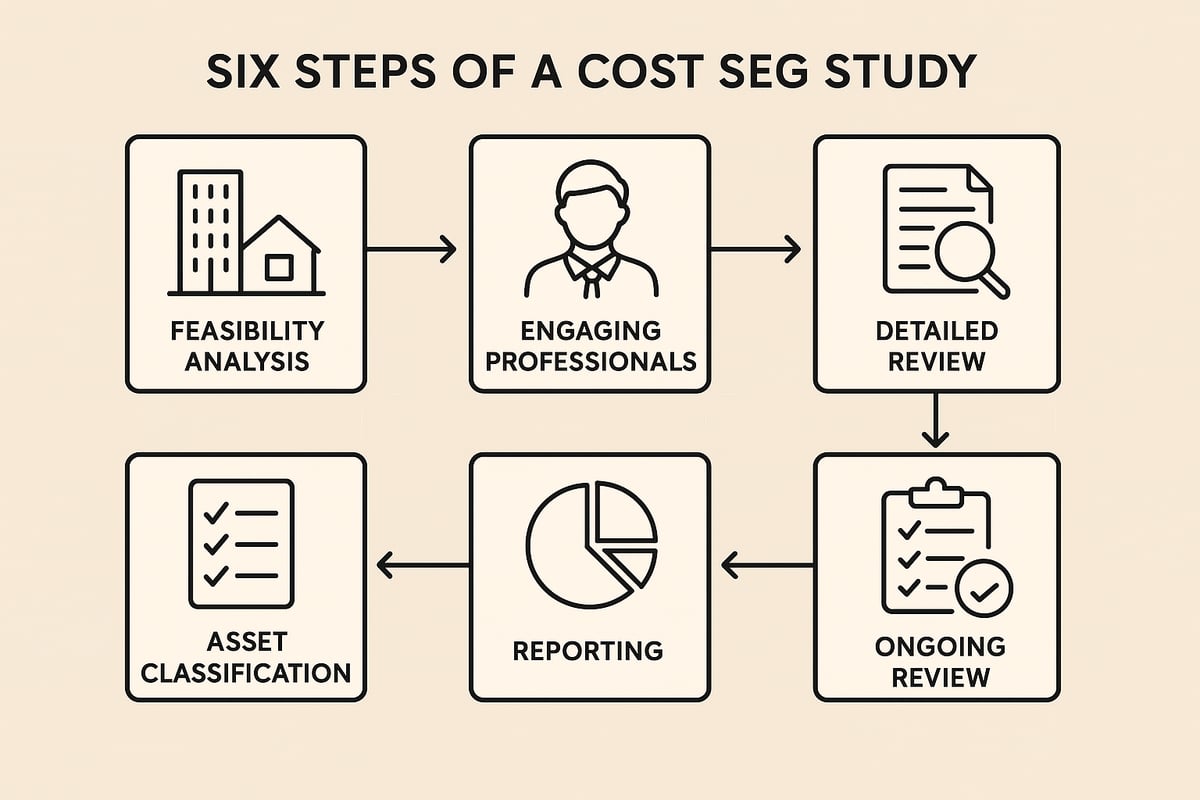
Unlocking the full benefit of a cost seg study requires following a proven, methodical process. Each phase builds on the last, ensuring accuracy, compliance, and optimal tax savings. Let us walk through each step, highlighting key actions and considerations for property owners and their advisors.
Step 1: Initial Feasibility Analysis
Every successful cost seg study begins with evaluating whether your property justifies the investment. This feasibility analysis examines property type, acquisition or construction costs, and the potential for accelerated depreciation.
The process starts by reviewing the property’s financials and intended use. For instance, a $2 million warehouse might offer less reclassification potential than a $10 million hotel with extensive amenities. Specialists will estimate what portion of your property’s cost can be shifted from 39-year real property to shorter-lived asset classes.
A feasibility analysis also projects the return on investment for the cost seg study. This includes estimating first-year tax savings and comparing them to the study’s cost. For many owners, especially those with properties exceeding $500,000 in value, the projected savings far outweigh the upfront expense.
By conducting this initial review, you can decide if moving forward with a cost seg study aligns with your broader tax planning goals.
Step 2: Engaging Qualified Professionals
Selecting the right experts is critical for a credible cost seg study. This phase involves choosing professionals such as engineers, CPAs, and specialized cost segregation consultants.
Key criteria for selection include:
- Industry credentials and certifications
- Demonstrated experience with similar property types
- Strong client references and documented success
Attempting a do-it-yourself approach or hiring inexperienced providers can lead to costly errors, audit risk, or disallowed deductions. The IRS often scrutinizes studies lacking engineering-based analysis or proper documentation.
A reputable provider will guide you through each phase of the cost seg study, ensuring every asset is properly classified and the process adheres to current tax law.
Step 3: Detailed Property Review and Documentation
Once your team is in place, the cost seg study moves into a thorough property review. This step involves on-site inspections and a deep dive into construction documents, blueprints, invoices, and cost breakdowns.
Specialists identify and inventory all components that can be reclassified. This includes items such as:
- Land improvements (parking lots, sidewalks, landscaping)
- Personal property (carpeting, specialty lighting, process-specific wiring)
- Building systems (HVAC, plumbing, specialty fixtures)
Using engineering-based analysis, professionals separate assets according to their use and expected lifespan. This detailed documentation is essential for substantiating your classifications in case of IRS scrutiny.
A meticulous review lays the groundwork for an effective cost seg study and supports every subsequent step.
Step 4: Asset Classification and Cost Allocation
With detailed data in hand, the next phase of your cost seg study is asset classification. Here, each building component is assigned to the correct depreciation category—5, 7, 15, or 39 years—based on IRS guidelines.
For example, HVAC systems used exclusively for manufacturing processes may qualify for a shorter recovery period, while those serving comfort purposes remain under 39-year property. Land improvements like fencing or exterior lighting often fall within the 15-year category.
Cost allocation uses IRS-approved methodologies to assign a portion of the total property cost to each asset class. The accuracy of this allocation is vital for maximizing tax deductions and defending your position in the event of an audit.
A clear classification and allocation process ensures your cost seg study delivers the greatest possible benefit.
Step 5: Reporting and Tax Compliance
After asset classification, a comprehensive report is prepared. This document provides detailed descriptions, cost breakdowns, and the methodologies used during your cost seg study. It must meet strict IRS standards to support your depreciation schedules and defend against challenges.
The report is integrated into your annual tax filings, typically using Form 4562 to reflect accelerated depreciation. Proper documentation is not just best practice, it is essential for audit defense. For in-depth guidance, consult the IRS Cost Segregation Audit Techniques Guide, which outlines what the IRS looks for during reviews.
A well-prepared report can minimize audit risk and secure the substantial tax savings your cost seg study is designed to deliver.
Step 6: Implementation and Ongoing Review
The final step is applying the new depreciation schedules to your tax returns. Your CPA or tax advisor will update records so you can realize accelerated deductions and improved cash flow.
Ongoing review is essential. Renovations, asset disposals, or major upgrades may require updates to your cost seg study. Regularly communicating with your advisors ensures you continue to capture all available tax benefits and remain compliant with evolving tax laws.
By following these steps, property owners maximize both immediate and long-term value from a cost seg study.
Tax Savings and Financial Impact: Quantifying the Benefits
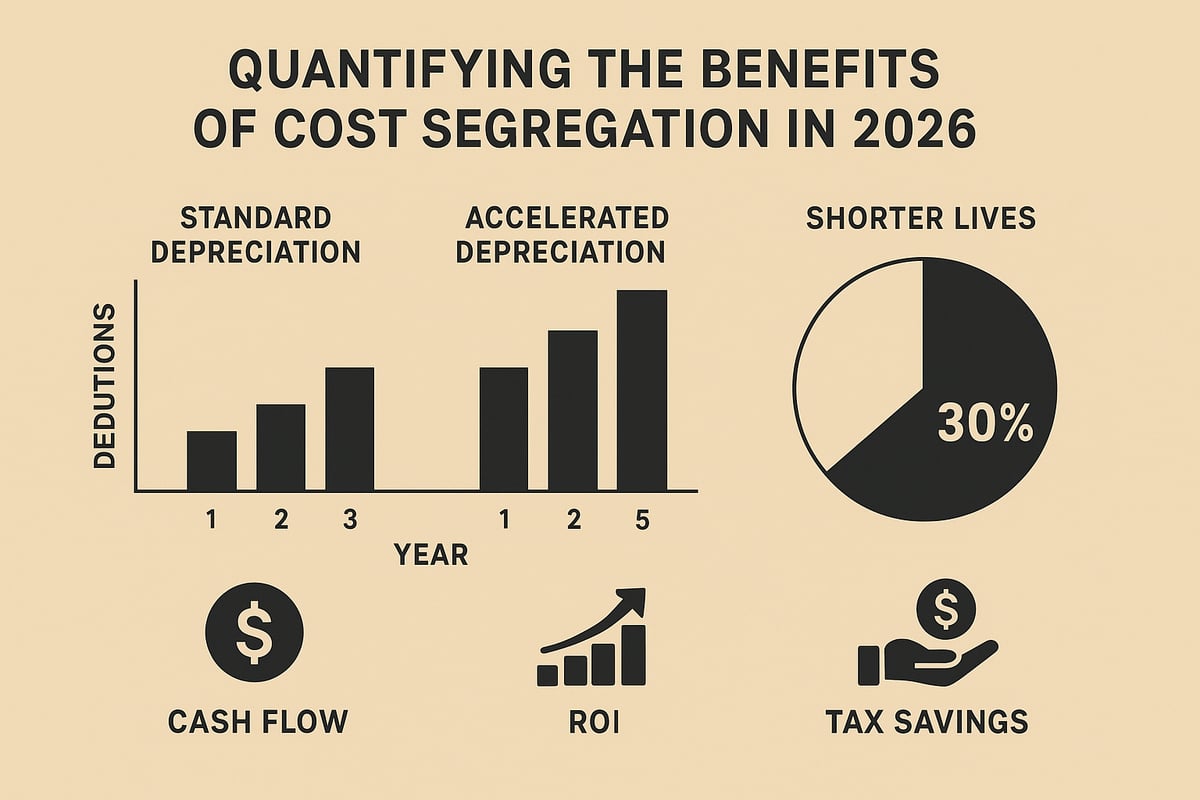
Unlocking the financial benefits of a cost seg study can dramatically change the bottom line for property owners. By accelerating depreciation, owners realize greater deductions sooner, leading to increased cash flow, improved net operating income, and stronger returns on investment. Understanding these impacts is essential for strategic tax planning in 2026.
Accelerated Depreciation and Tax Deductions
A cost seg study allows property owners to accelerate depreciation by reclassifying eligible building components. Instead of depreciating the entire property over 39 years, certain assets can be written off in 5, 7, or 15 years. This reclassification means much larger deductions in the first few years of ownership.
For example, under current rules, up to 40% of a commercial property's cost can qualify for shorter depreciation periods. In 2026, bonus depreciation and Section 179 expensing remain critical tools. Owners can often expense 100% of qualifying assets in the first year, capturing significant tax savings.
| Depreciation Method | First-Year Deduction | 5-Year Total Deductions |
|---|---|---|
| Standard (39-year) | $25,641 | $128,205 |
| With Cost Seg Study | $200,000 | $400,000 |
Suppose $1 million is reclassified to 5-year property via a cost seg study. The owner could claim a first-year deduction of about $200,000, compared to less than $26,000 with standard depreciation. This difference improves cash flow and frees up capital for reinvestment.
According to industry research, cost seg studies can result in a 5-10% increase in after-tax cash flow. For more on how new tax rules amplify these benefits, see Cost Segregation Studies Offer Renewed Value Under New Tax Rules.
Impact on Net Operating Income (NOI) and ROI
The immediate tax deductions from a cost seg study reduce taxable income, which directly boosts net operating income. Lower tax outflows mean owners retain more profits, enhancing the property's cash flow and overall financial health.
Consider a commercial property owner who completes a cost seg study after purchasing a $5 million building. Before the study, annual tax outflows limited reinvestment and reduced returns. After reclassifying assets, the owner realizes a substantial first-year deduction, increasing NOI and making the property more attractive to investors.
Case Study:
- Before Cost Seg Study: NOI = $350,000, ROI = 7%
- After Cost Seg Study: NOI rises to $450,000, ROI jumps to 9%
These gains not only improve day-to-day finances but also enhance property valuation. Buyers and investors often pay a premium for assets with optimized cash flow, so a cost seg study can make properties more marketable and valuable.
Considerations for Partnerships, REITs, and Special Structures
A cost seg study offers unique opportunities and challenges for partnerships, REITs, and syndications. Depreciation deductions must be allocated among multiple investors, often according to ownership percentages or specific tax agreements.
For example, in a real estate partnership, the accelerated depreciation from a cost seg study can be distributed to each partner, reducing individual tax liabilities and improving after-tax returns. REITs and syndications may have additional rules, but the principle remains: more deductions mean better cash flow for all stakeholders.
Coordinating with tax advisors is essential to ensure proper allocation and compliance. With the right strategy, even complex ownership structures can realize the full financial impact of a cost seg study.
Risks, Downsides, and IRS Compliance Considerations
Understanding the risks and compliance considerations of a cost seg study is essential for every property owner. While the benefits can be substantial, navigating this process requires awareness of potential pitfalls and strict adherence to IRS guidelines.
Potential Risks and Pitfalls
A cost seg study can unlock major tax benefits, but it also introduces unique risks that property owners must manage. The most notable is audit risk. If the IRS questions your asset classifications or documentation, you could face disallowed deductions and penalties.
Another critical risk is depreciation recapture. When you sell or dispose of property, accelerated depreciation may result in higher taxable income, partially offsetting earlier savings. Upfront costs are also a consideration. A quality cost seg study often requires a significant investment, which may not justify the benefits for smaller properties.
Complexity can be a barrier, especially for owner-occupied real estate or properties with limited eligible assets. Inadequate or low-quality studies create further problems, sometimes leading to IRS disallowance or increased scrutiny.
Here’s a quick comparison of key risks and their mitigation strategies:
| Risk | Description | Mitigation |
|---|---|---|
| Audit Risk | IRS challenges study findings | Use credentialed professionals |
| Recapture Risk | Taxable gain on sale due to depreciation | Plan for future sales |
| Upfront Costs | Fees for study and professional services | Analyze ROI before proceeding |
| Documentation Gap | Missing or weak supporting evidence | Maintain thorough records |
Ultimately, approaching a cost seg study with a strategic mindset helps reduce exposure to these pitfalls.
IRS Guidance and Audit Defense
The IRS has established clear expectations for cost seg study documentation and methodologies. Their Cost Segregation Audit Techniques Guide outlines best practices for substantiating asset classifications and depreciation calculations. Adhering to these standards is essential for audit defense.
Key compliance practices include using engineering-based analysis, maintaining detailed supporting documentation, and engaging qualified professionals. Studies prepared by credentialed experts are more likely to withstand IRS scrutiny and deliver reliable results.
To further reduce audit risk, property owners should ensure all classifications follow IRS-approved methodologies and keep comprehensive records of all study findings. Consulting specialized tax advisors can help align your study with current regulations and best practices, as outlined in this tax advisory services overview.
Remember, a robust cost seg study is not only about maximizing deductions but also about ensuring those deductions can withstand regulatory review. Proactive compliance and expert guidance are the foundation of long-term tax savings.
Cost Segregation in 2026: Key Tax Law Updates and Strategic Opportunities
As 2026 approaches, understanding the latest tax law changes is crucial for anyone considering a cost seg study. The evolving legislative landscape means property owners and advisors must stay proactive to capture all available tax benefits. With several depreciation rules shifting, a well-timed cost seg study can make a significant difference in your tax strategy.
Legislative Updates Impacting Cost Segregation
The legislative environment for cost seg study strategies is evolving as we move into 2026. One of the most impactful changes is the scheduled phase-out of 100% bonus depreciation, which previously allowed property owners to fully expense eligible assets in the first year. In 2026, this bonus percentage will be lower, directly influencing the timing and value of a cost seg study.
Section 179 expensing limits are also expected to adjust, with annual caps increasing slightly but not matching the prior generosity of bonus depreciation. These updates require careful review of both acquisition dates and asset types to maximize deductions. In addition, new IRS guidance or court rulings may redefine asset classifications, affecting what can be accelerated for depreciation.
For example, if you place a property in service just before the bonus depreciation percentage drops, you could secure a much larger first-year deduction. According to the Cost Segregation Services Market Research Report 2035, market adoption of cost seg study services is expected to rise as these legislative shifts prompt more property owners to seek expert guidance.
Strategic Planning for Maximum Tax Savings
Strategic timing is now more essential than ever when planning a cost seg study. Completing a study before bonus depreciation phases down allows you to capture the highest possible deductions. For those acquiring or renovating properties in 2026, synchronizing your cost seg study with other incentives, such as energy credits or R&D credits, can further boost your tax benefits.
Proactive planning should include a review of all upcoming property activities. This means considering studies not only for new purchases but also for significant renovations or improvements. By aligning your cost seg study with annual tax filing deadlines, you can ensure that deductions are maximized and compliance is maintained.
To optimize your approach, stay informed about the latest IRS updates and best practices. Accessing Articles and tax insights can provide ongoing guidance for navigating the complexities of tax law in 2026. Timely studies can help you capture remaining bonus depreciation opportunities and position your portfolio for continued financial growth.
Expert Tips for a Successful Cost Segregation Study
Unlocking the full value of a cost seg study requires more than just technical knowledge. Success comes from a combination of strategic planning, strong professional collaboration, and careful attention to compliance details. By following expert guidance, you can optimize your tax savings and minimize risks throughout the process.
Maximizing ROI: Key Steps for a Successful Cost Segregation Study
To get the most out of your cost seg study, start by engaging a qualified team of professionals. Look for providers with engineering expertise, a history of successful IRS audit support, and strong client references.
Gather all relevant property documents early, such as blueprints, construction costs, and renovation records. Early organization streamlines the study and prevents costly delays. Keep your CPA or tax advisor involved from the beginning for seamless integration into your tax planning.
Strategic timing is critical. Conduct the study soon after acquisition or renovation to maximize first-year deductions. Regularly update your study after improvements or asset disposals to sustain benefits over time.
For more insights on uncovering hidden financial opportunities and maximizing your ROI, consider reading about Maximizing B2B growth opportunities.
Avoiding Common Pitfalls: Lessons from Real-World Success
Many property owners underestimate the complexity of a cost seg study. Relying on inexperienced providers or incomplete documentation can lead to IRS disallowance, reduced savings, or even audit penalties.
Consider this case: A business owner who invested in a multifamily property partnered with a specialized team and completed the study promptly after acquisition. By maintaining open communication with their tax advisor and updating the study after each renovation, they maximized deductions and minimized audit risk. Their after-tax cash flow increased by 8 percent within the first year.
Avoid shortcuts like DIY studies or generic templates. Instead, invest in a tailored, engineering-based approach for lasting financial benefits.
Essential Checklist: Questions to Ask Your Cost Segregation Provider
Selecting the right partner for your cost seg study is crucial. Use this checklist to ensure you are making an informed decision:
- Are your reports prepared by credentialed engineers and reviewed by CPAs?
- What is your experience with properties similar to mine?
- Can you provide references or case studies of successful outcomes?
- How do you document and support asset classifications for IRS compliance?
- What is your process for updating studies after renovations or asset disposals?
- How do you coordinate with my CPA or tax advisor?
- What is the estimated ROI and timeline for the study?
By asking these questions, you can confidently choose a provider who will help you realize the full value of your cost seg study and support your long-term tax planning goals.
Now that you understand how a cost segregation study can unlock substantial tax savings and boost your bottom line in 2026, why not take the next step? At Nero and Associates, we specialize in guiding property owners and business leaders through complex tax strategies that save both time and money while promoting long-term financial health. If you want to explore how these insights apply to your specific properties and goals, let’s connect for a one-on-one conversation. You’ll gain personalized recommendations and clarity for your 2026 tax planning.
Book a Consultation