
Imagine making critical business decisions in seconds as data floods in from every direction. The pace and complexity of choices are accelerating, making effective decision management more important than ever. This guide will help you navigate the evolving landscape of decision management, offering proven strategies to make smarter choices in 2026.
We will explore how modern frameworks, technology, and real-world applications are transforming the way organizations operate. Discover how improved efficiency, accuracy, and agility can give you a competitive edge. Ready to take control? Start applying the latest decision management techniques today.
The Evolution of Decision Management
The story of decision management begins in the mid-20th century, when businesses and researchers first sought to bring order to complex choices. As organizations grew, so did the need for systematic ways to make decisions quickly and accurately. Early pioneers in expert systems and operations research laid the foundation for the sophisticated, automated decision management systems we see today.
Historical Background and Foundations
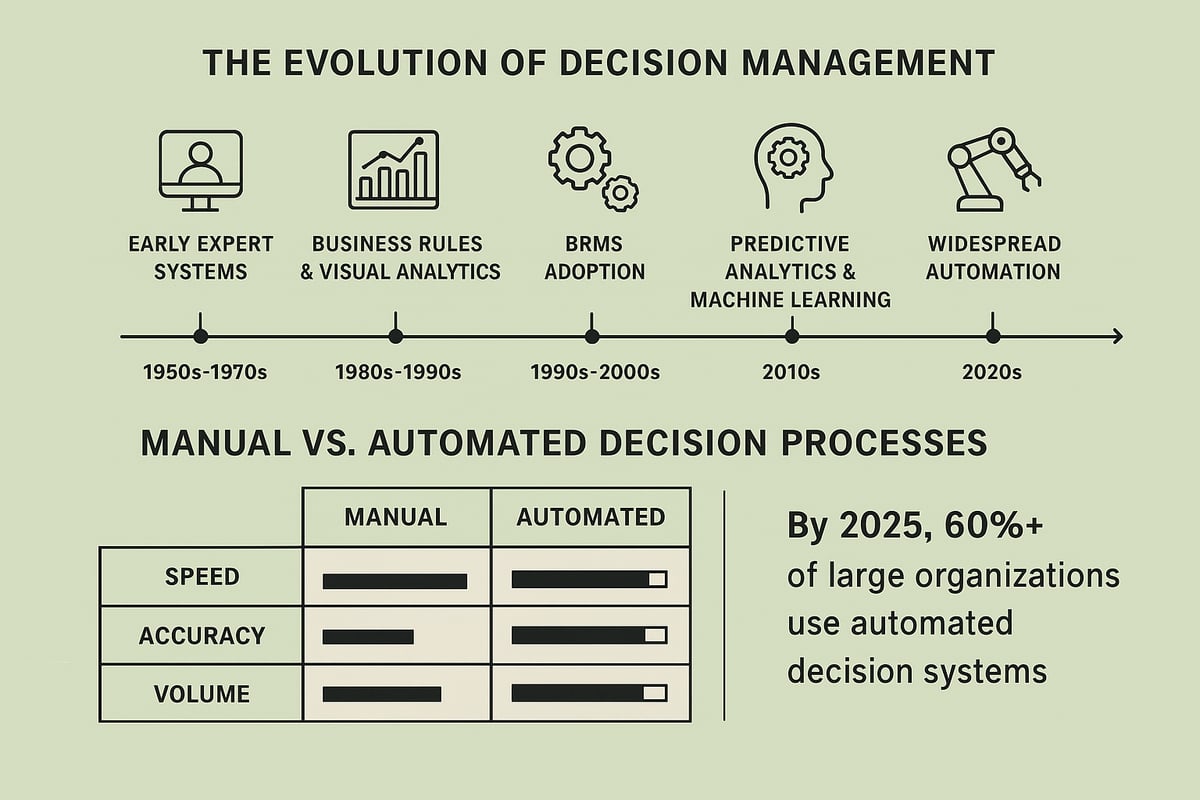
Decision management has its roots in the rise of expert systems and operations research during the 1950s and 1960s. These early systems aimed to codify expert knowledge, making it possible for organizations to make complex decisions more consistently. Over time, businesses began to realize that relying solely on intuition or manual processes was no longer sustainable, especially as data volumes exploded and markets became more competitive.
The introduction of business rules and visual analytics in the 1980s and 1990s marked a turning point. These tools allowed organizations to separate decision logic from application code, making it easier to update policies and guidelines without overhauling entire systems. For example, early expert systems supported clinical diagnosis in healthcare and credit approval in finance, providing structured methodologies for repeatable decisions.
The distinction between operational and strategic decisions became clearer as companies focused on optimizing high-volume, repeatable choices such as loan approvals or claims processing. Today, automation handles a majority of routine operational decisions in sectors like banking and insurance. Understanding the journey from manual processes to automated robust decision-making frameworks helps organizations appreciate the rationale behind modern decision management strategies.
Manual vs. Automated Decision Management
| Aspect | Manual Decision Management | Automated Decision Management |
|---|---|---|
| Speed | Slow | Instant |
| Consistency | Variable | High |
| Scalability | Limited | Extensive |
| Auditability | Difficult | Built-in |
Key Milestones and Industry Adoption
The 1990s and 2000s saw the widespread adoption of Business Rules Management Systems (BRMS), which enabled companies to formalize and manage decision logic at scale. This innovation made decision management more agile, as rules could be updated quickly to reflect regulatory changes or new business objectives. The 2010s brought another leap forward with the integration of predictive analytics and machine learning, further enhancing the accuracy and adaptability of automated systems.
Industries rapidly adopted these technologies to solve sector-specific challenges. In finance, predictive models improved fraud detection by analyzing transaction patterns in real time. Insurance companies streamlined claims processing through automated adjudication, while retailers optimized supply chains using data-driven forecasts. By 2025, over 60% of large organizations are expected to rely on automated decision systems for critical operations.
Regulatory and competitive pressures have accelerated this shift. Financial services, for instance, face strict compliance requirements, making traceability and transparency in decision management essential. As organizations continue to embrace these milestones, they not only boost efficiency but also gain a strategic edge in an increasingly complex business environment.
Core Frameworks and Components of Decision Management
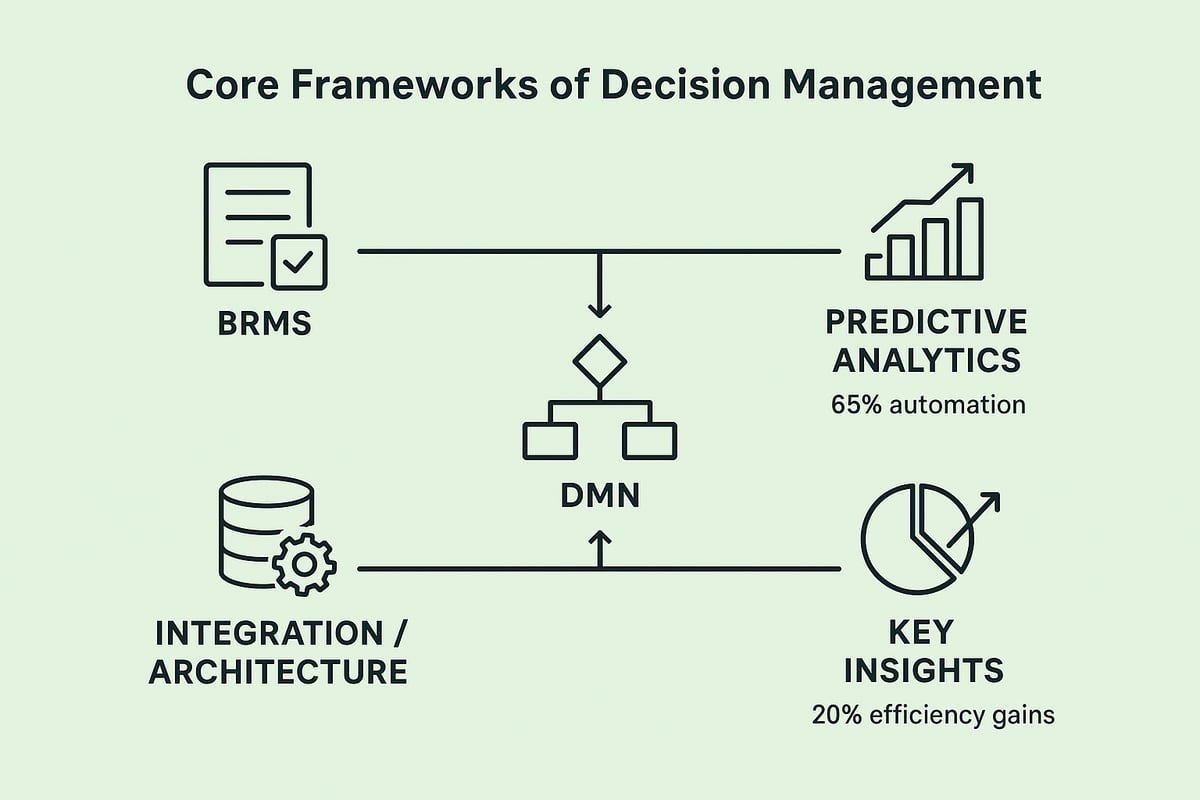
Modern decision management relies on an interconnected set of frameworks that transform how organizations make and execute choices. Let’s explore the essential building blocks that enable smarter, faster, and more transparent decision processes.
Business Rules Management Systems (BRMS)
Business Rules Management Systems, or BRMS, are foundational to decision management. They allow organizations to separate business logic from application code, making it easier to update rules without heavy IT involvement. This separation promotes agility and reduces errors.
A practical example is retailers who adjust return policies in real time during peak shopping seasons. BRMS ensure consistency across channels and improve compliance. The benefits of BRMS extend to transparency, as every rule is documented and traceable. For more on how automation boosts efficiency, see the Benefits of Business Automation.
Predictive Analytics and Machine Learning
Predictive analytics and machine learning are now integral to decision management. These tools forecast outcomes by analyzing historical data and identifying patterns. Machine learning models continuously improve, leading to more accurate decisions over time.
For instance, banks use predictive analytics for credit risk assessment, while hospitals rely on machine learning for patient triage. Companies that leverage these techniques report up to 25 percent faster decision cycles. Embedding predictive analytics within decision management frameworks helps organizations respond quickly to changing conditions.
Decision Modeling and Notation (DMN)
Decision Modeling and Notation, or DMN, offers a standardized way to visualize and communicate decision logic. DMN bridges the gap between business teams and IT, ensuring everyone understands how decisions are made.
Insurance companies, for example, use DMN diagrams to model claims adjudication processes. This approach fosters agility, especially when regulations shift. By adopting DMN, organizations can quickly update decision management models and maintain compliance without losing clarity.
Integration and Architecture
A robust decision management strategy depends on flexible integration and modern architecture. Service-oriented architectures allow decision logic to be deployed as modular, reusable services. This design supports scalability and maintainability.
Consider a scenario where modular decision services are reused by multiple business units, such as eligibility checks in healthcare and finance. The ability to manage and update these services centrally streamlines operations. Integration ensures that decision management adapts seamlessly as business needs evolve.
Key Arguments and Insights
Combining these frameworks leads to smarter, more agile decision management. The synergy between BRMS, predictive analytics, DMN, and modular integration creates a system that is both transparent and adaptable.
Traceability and auditability are essential for compliance, especially in regulated industries. Organizations that invest in these core components position themselves for sustained success in an increasingly complex environment. Decision management, when built on these pillars, delivers measurable improvements in efficiency and oversight.
The Role of Technology: AI, Automation, and Hybrid Decision-Making
The pace of modern business demands smarter, faster choices. Technology has become the backbone of effective decision management, driving a shift from manual processes to intelligent, automated, and hybrid systems. Let’s explore how artificial intelligence, automation, and new models are reshaping the way organizations make decisions in 2026.
Artificial Intelligence in Decision Management
Artificial intelligence is now central to decision management, enabling organizations to analyze massive volumes of structured and unstructured data. Machine learning algorithms can detect patterns, predict outcomes, and continuously refine their models, making each decision more accurate over time.
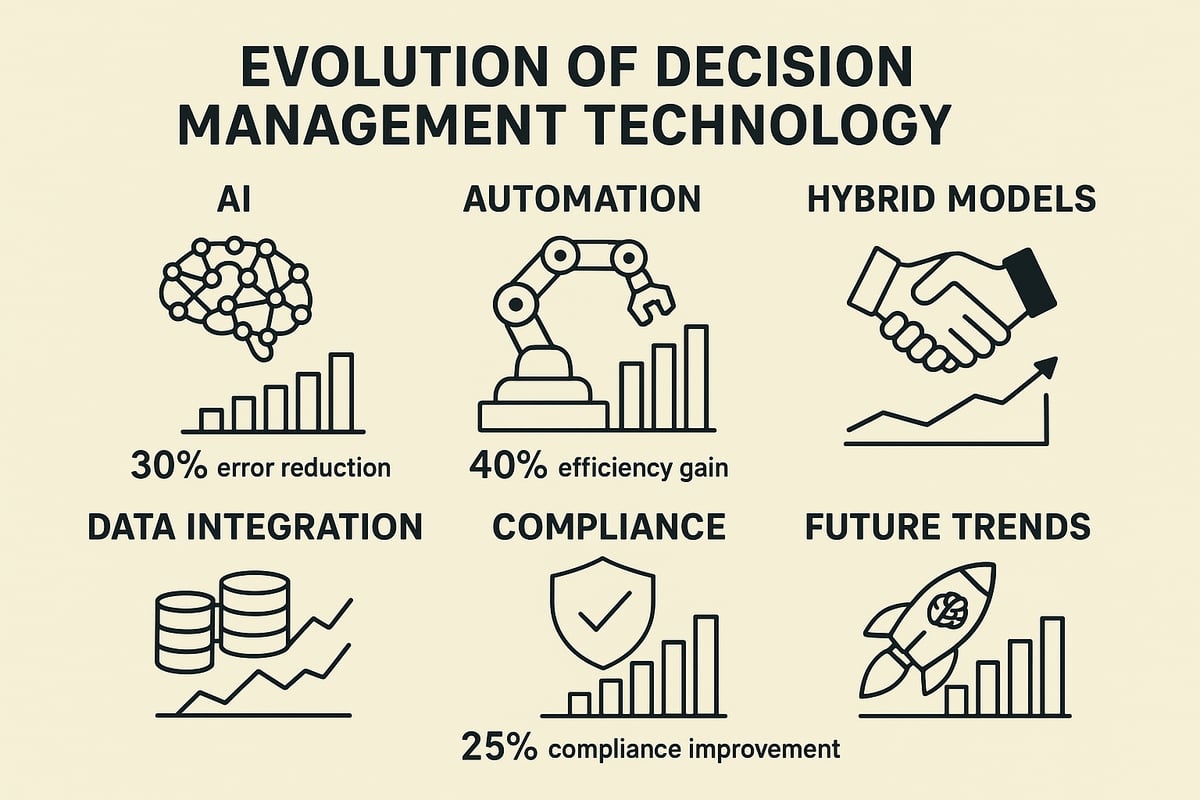
For example, real-time fraud detection in financial transactions uses AI to spot anomalies and prevent losses before they occur. Recent studies show that AI-enhanced systems can reduce operational decision error rates by up to 30 percent. This improvement not only boosts efficiency but also helps organizations stay competitive in rapidly changing markets.
AI's ability to handle complex, evolving scenarios is a key differentiator. Businesses can now leverage AI & Automation Integration Solutions to seamlessly embed intelligent decision-making into their workflows. As a result, decision management becomes more agile, scalable, and responsive to market shifts.
Automation and Real-Time Decisioning
Automation takes decision management to the next level by processing high-volume, repetitive tasks with unmatched speed and accuracy. Automated systems can approve insurance claims or process e-commerce transactions in milliseconds, freeing up human experts for higher-value activities.
This real-time decisioning capability allows organizations to meet customer expectations for instant results. For instance, in insurance, automated approval processes cut claim handling times dramatically. In retail, automation enables dynamic pricing and personalized offers based on live data.
Key benefits of automation in decision management include:
- Consistent application of business rules
- Reduced manual errors and delays
- Scalable solutions for growing data volumes
As technology advances, automation is not just about speed, but also about ensuring every decision aligns with business objectives and compliance requirements.
Hybrid Decision-Making Models
While AI and automation are powerful, some scenarios demand a blend of machine intelligence and human judgment. Hybrid decision-making models combine the strengths of both to handle complex, high-stakes choices.
For example, medical diagnosis systems use AI to analyze patient data and suggest possible conditions, but doctors make the final call. In banking, complex loan approvals may require human review for exceptions or ethical considerations.
Hybrid models offer several advantages in decision management:
- Balance between efficiency and oversight
- Ability to address ethical, legal, or contextual nuances
- Enhanced trust and transparency for stakeholders
As organizations strive for smarter choices, hybrid approaches ensure that critical decisions benefit from both computational power and human experience.
Data Integration and Quality
Effective decision management relies on integrating data from diverse sources, including internal systems, partner networks, and third-party providers. High-quality, real-time data fuels predictive models and automation.
However, challenges remain. Organizations often face issues with data silos, inconsistent formats, and governance policies. Overcoming these obstacles requires robust data pipelines and quality controls.
For example, supply chain optimization depends on accurate, up-to-date vendor and logistics data. By investing in integration tools, businesses can ensure their decision management systems deliver reliable insights and outcomes.
Regulatory Compliance and Traceability
As technology-driven decision management expands, ensuring compliance with regulations like GDPR and HIPAA becomes critical. Automated systems must provide traceability, documenting how and why each decision was made.
One practical example is healthcare, where automated platforms flag compliance issues in patient records and generate audit trails for regulators. This transparency protects organizations from legal risks and builds trust with stakeholders.
Traceable decision management also supports continuous improvement, allowing teams to review and refine their models in response to new rules or market changes.
Future Trends in Technology
Looking ahead, several trends are set to transform decision management:
- Explainable AI: Making decision logic transparent and understandable
- Self-learning systems: Adapting automatically to new data and scenarios
- Context-aware engines: Factoring in environmental and situational inputs
Forward-thinking organizations are investing in adaptive decision management platforms to stay ahead of disruptions. By embracing these technologies, businesses position themselves for sustained agility, compliance, and growth.
Actionable Strategies for Smarter Choices in 2026
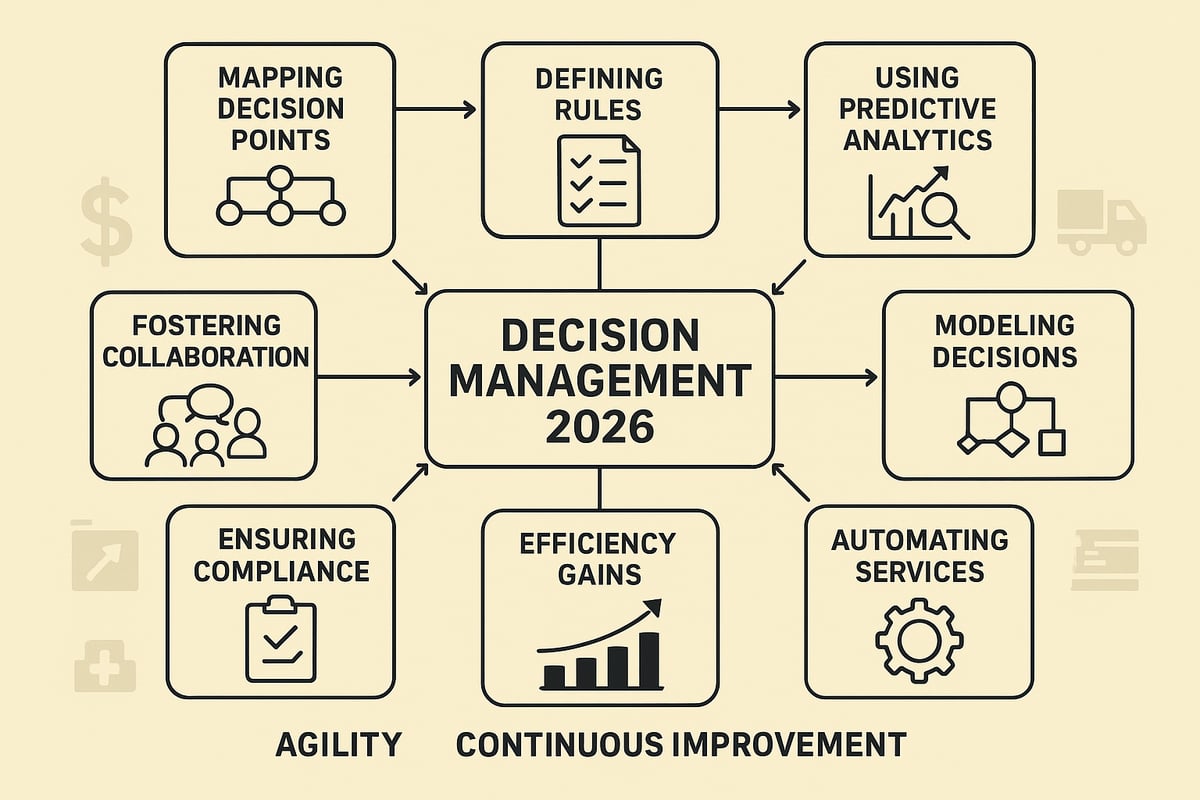
Making smarter choices in 2026 requires a structured approach to decision management. The following actionable strategies are designed to help organizations build robust, agile systems that improve efficiency, accuracy, and adaptability.
Step 1: Identify and Prioritize Decision Points
Begin by mapping all critical decision points within your business processes. Focus on both operational and strategic levels. Use process mining tools to reveal manual steps, delays, and inefficiencies.
Identify where decisions are made repeatedly or at high volume. Examples include procurement approvals, customer onboarding, and inventory restocking. Clear visibility into these points is the foundation of effective decision management.
Create a visual flow of decision points, highlighting which ones are bottlenecks. This clarity enables targeted improvements and sets the stage for smarter, faster choices.
Step 2: Define Clear Business Rules and Objectives
Collaborate with stakeholders to articulate specific business rules for each decision point. Ensure that objectives and criteria are well documented.
Utilize structured templates to maintain consistency across departments. For instance, set precise thresholds for loan approvals or customer discounts.
Regularly review and update rules as business needs change. This step ensures that your decision management approach adapts to evolving goals and market dynamics.
Step 3: Leverage Predictive Analytics and Historical Data
Gather historical data relevant to each decision point. Use predictive analytics to forecast outcomes and assess risks.
Build models that draw on past trends to inform future actions. In retail, analyze sales data to optimize inventory levels. In finance, leverage transaction history to assess credit risks.
Integrating predictive insights into decision management enables more accurate, proactive choices, reducing uncertainty and minimizing costly errors.
Step 4: Implement Decision Modeling Standards
Adopt visual modeling standards such as DMN for documenting and communicating decision logic. These frameworks bridge the gap between business and IT teams.
Train staff on model creation, ensuring everyone understands how decisions are made and modified. Use visual models for processes like insurance claims adjudication or loan approvals.
Clear models improve transparency, facilitate collaboration, and support agile decision management across your organization.
Step 5: Automate and Integrate Decision Services
Deploy modular decision logic as reusable services within your IT architecture. Integration with existing applications is essential for seamless operation.
Automate routine checks, such as eligibility in healthcare or discount approvals in retail. Modular design allows logic to be reused across departments, reducing duplication and maintenance costs.
This step elevates decision management by increasing speed, consistency, and scalability, while freeing staff to focus on higher-value tasks.
Step 6: Monitor, Test, and Optimize Continuously
Establish key performance indicators (KPIs) and dashboards to monitor decision outcomes in real time. Use A/B testing and simulations to refine decision logic regularly.
Track efficiency, accuracy, and compliance metrics to identify areas for improvement. For detailed metrics, refer to Efficiency Metrics in Automation, which offers practical guidance for ongoing performance measurement.
Continuous monitoring is vital for maintaining high standards in decision management and adapting to changing business environments.
Step 7: Ensure Compliance and Ethical Considerations
Build traceability and audit trails into every decision process. Regularly review models for regulatory compliance, such as GDPR or HIPAA, and assess for potential bias.
Conduct bias audits in HR or lending decisions to ensure fairness. Document decision paths for accountability.
Ethical decision management safeguards reputation and builds trust with stakeholders, regulators, and customers.
Perspectives and Insights
Effective decision management depends on cross-functional collaboration. Engage business, IT, compliance, and analytics teams to ensure all perspectives are considered.
Agility is crucial. Organizations must adapt decision logic quickly when regulations shift or market conditions change. Mature decision management practices are linked to 20 percent higher operational efficiency.
By implementing these strategies, your organization will be well-equipped to make smarter, more resilient choices in 2026.
Real-World Applications and Industry Use Cases
Modern decision management is reshaping how organizations operate, bringing speed, accuracy, and adaptability across sectors. Let us explore how industries are leveraging these tools for smarter, data-driven outcomes in 2026.
Financial Services: Credit Risk and Fraud Detection
Financial institutions rely heavily on decision management to automate credit scoring and streamline loan approvals. Predictive analytics assess applicant risk in real time, cutting processing from days to minutes. AI-driven fraud detection analyzes transaction patterns, flagging anomalies before significant losses occur.
For instance, banks are integrating solutions to optimize accounts payable processes using automation, as detailed in Optimizing Accounts Payable with Automation. This approach ensures both compliance and operational efficiency. The result is faster, more secure financial decisions that build customer trust.
Insurance: Claims Processing and Underwriting
Insurance providers utilize decision management frameworks to automate claims adjudication and premium calculations. Claims that once required lengthy manual reviews are now processed in minutes, freeing up staff for complex cases.
Automated underwriting leverages historical data and business rules to evaluate applications consistently. With these systems, insurers report up to a 40 percent reduction in manual claim reviews, while maintaining accuracy and compliance. This transformation drives both customer satisfaction and cost savings.
Retail: Personalization and Supply Chain Optimization
Retailers embrace decision management for dynamic pricing, tailored promotions, and inventory optimization. By analyzing customer data, businesses create personalized marketing offers that boost engagement and sales.
Supply chain decisions are informed by real-time analytics, ensuring stock levels meet customer demand without overstocking. Retailers leveraging these methods have seen sales increases of 15 percent. The agility provided by decision management keeps them responsive to shifting market trends.
Healthcare: Patient Triage and Compliance
In healthcare, decision management powers AI-driven triage systems that quickly assess patient needs. These tools prioritize cases based on urgency, enabling faster care and better outcomes.
Automated documentation ensures regulatory compliance, reducing administrative burdens. Hospitals using such systems report shorter triage times and improved patient satisfaction. Decision management helps healthcare providers balance efficiency with the highest standards of care.
Telecommunications and Logistics: Service Optimization
Telecommunications and logistics companies depend on decision management to automate service eligibility checks and optimize network routing. These systems accelerate service activation and enhance delivery performance.
Logistics providers use real-time data to reroute deliveries, adapt to traffic conditions, and minimize delays. For example, telecoms have achieved a 50 percent reduction in activation times. Decision management ensures reliable, scalable operations.
Cross-Industry Insights
Decision management frameworks prove adaptable across industries, supporting everything from compliance to customer experience. A recent study on AI-Based Decision Support Systems in Industry 4.0 highlights how advanced analytics and automation are driving operational transformation at scale.
Notably, 70 percent of organizations report improved customer experience as a primary benefit of adopting decision management. The future points to even broader adoption as industries strive for smarter, more resilient operations.
Future Trends and Challenges in Decision Management
Modern organizations must navigate a rapidly evolving landscape, where decision management is both an opportunity and a challenge. As technology advances, several critical trends are shaping the future of smarter, more responsible choices.
The Rise of Explainable and Ethical AI
Transparency is becoming essential in decision management. Organizations face increasing regulatory pressures to ensure decisions made by AI are understandable and fair. For example, financial regulators now require lenders to explain automated loan decisions to applicants.
Explainable AI (XAI) helps stakeholders trust and audit decision processes, especially in high-stakes sectors. Frameworks like the Agentic LLM Framework for Adaptive Decision Discourse illustrate how collaborative AI can improve both transparency and outcomes. As ethical considerations become central, companies must proactively address bias and accountability.
Adaptive and Self-Learning Decision Systems
Adaptive decision management systems represent the next frontier. These platforms learn and evolve in real time, adjusting models based on new data without manual intervention. Retailers use self-learning algorithms to fine-tune dynamic pricing and respond instantly to market changes.
Such adaptability drives competitive advantage. However, it also demands robust monitoring to ensure alignment with business goals. Continuous learning must be balanced with safeguards to prevent drift or unintended consequences.
Managing Complexity and Data Governance
Integrating diverse data sources is a core challenge for decision management. As organizations expand, maintaining data quality and governance becomes more complex. Common issues include data silos, inconsistent formats, and lack of real-time access.
Effective data governance frameworks are vital. They ensure that decision management systems remain reliable, auditable, and compliant with regulations. Investing in data stewardship now will reduce risks and operational headaches later.
Human-AI Collaboration and Skill Development
Despite automation, human expertise remains critical for many decision management scenarios. Hybrid models leverage the speed of AI with the nuance of human judgment, especially for oversight and exception handling.
To maximize value, organizations must upskill their workforce. Training employees to interpret AI outputs and manage automated workflows fosters resilience. This collaboration ensures smarter, more context-aware decisions.
Preparing for Disruption and Innovation
Staying ahead means investing in future-ready decision management platforms. Early adopters report sustained competitive advantages, thanks to agility and rapid response to change.
Leaders should study best practices for integrating AI into strategic decision management, as outlined in AI Integration for Strategic IT Decision-Making Frameworks. Balancing automation with oversight helps build trust and accountability. Ultimately, strategic investment in decision management will power long-term success.
Article written using RankPill.