

Efficiency Gains: Transform Your Business Performance

Share on Facebook
Share on X
Share on LinkedIn

Organizations face mounting pressure to deliver superior results with fewer resources. The ability to achieve meaningful efficiency gains has become the defining characteristic separating market leaders from those struggling to maintain relevance. In professional services, where human capital represents the primary cost center, even modest improvements in operational efficiency translate directly to competitive advantage. Companies that systematically identify and eliminate waste, streamline workflows, and empower their workforce create sustainable pathways to profitability while enhancing employee satisfaction and client outcomes.

Understanding the True Value of Efficiency Improvements

Efficiency gains represent the measurable improvements in output relative to input within business operations. These improvements manifest across multiple dimensions, including time savings, cost reduction, quality enhancement, and resource optimization. When organizations achieve genuine efficiency gains through strategic interventions, they unlock capacity for growth without proportional increases in overhead.

The financial impact extends beyond immediate cost savings. Professional services firms that eliminate 1,000 hours of manual processes annually create opportunities to redirect that capacity toward revenue-generating activities. This reallocation effect multiplies the value of each efficiency improvement, generating returns that compound over time.

Quantifying Performance Improvements

Measuring efficiency requires establishing baseline metrics before implementing changes. Key performance indicators vary by function but typically include:

  • Processing time per transaction to identify bottlenecks
  • Error rates and rework frequency to assess quality
  • Cost per unit of output to evaluate resource utilization
  • Employee utilization rates to optimize capacity
  • Client satisfaction scores to validate service quality

Organizations should track both leading and lagging indicators. Leading indicators predict future performance, while lagging indicators confirm results after implementation. This dual approach enables proactive adjustments and validates the impact of efficiency initiatives.
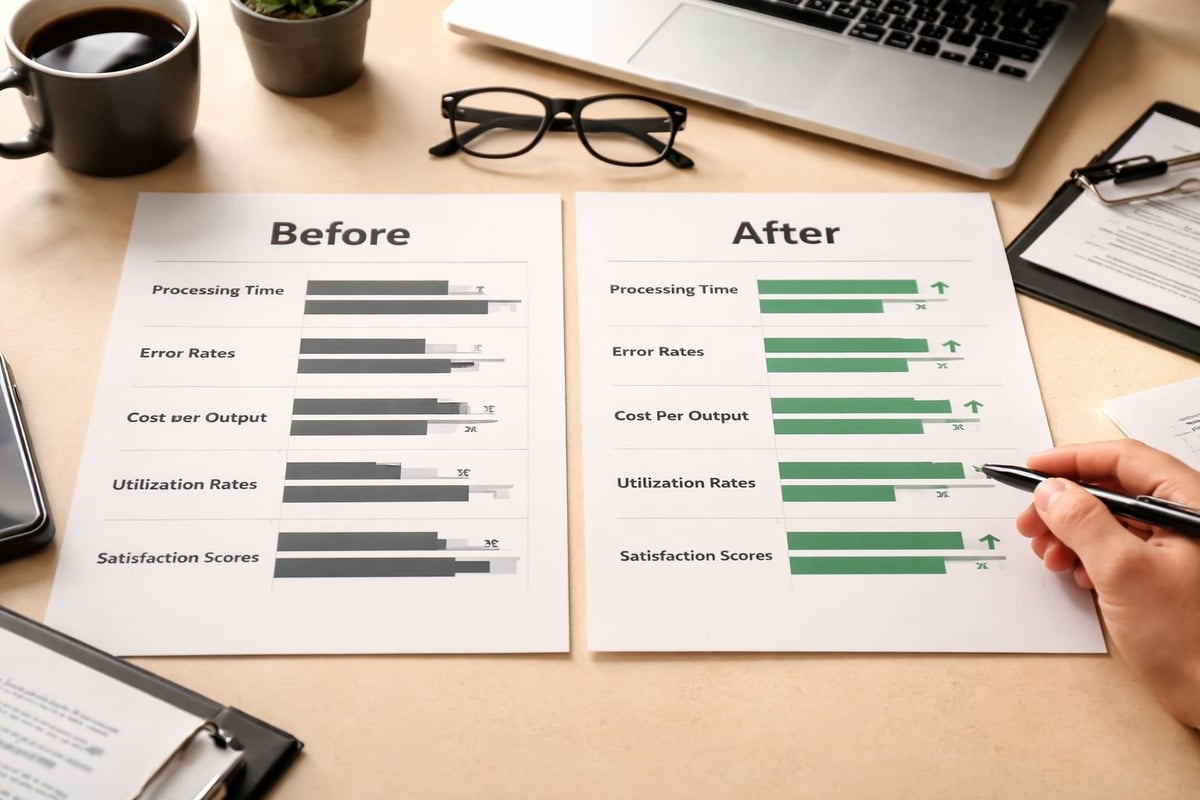
Efficiency measurement framework

Automation as an Efficiency Multiplier

Technology-enabled automation represents the most powerful lever for achieving substantial efficiency gains in 2026. Artificial intelligence and process automation eliminate repetitive tasks that consume disproportionate amounts of human capital. Professional services firms implementing intelligent automation report time savings ranging from 30% to 70% across affected processes.

The strategic value extends beyond speed improvements. Automated systems execute tasks with consistent accuracy, reducing error rates that trigger costly rework cycles. This reliability improvement enhances client confidence while freeing professionals to focus on high-value advisory services that differentiate the firm.

Identifying Automation Opportunities

Not all processes benefit equally from automation. Successful implementation requires systematic evaluation to identify optimal candidates. High-volume, rules-based processes with minimal exception handling deliver the strongest returns. Consider these criteria when prioritizing automation investments:

  1. Process volume and frequency determine total hours saved
  2. Standardization level affects implementation complexity
  3. Error sensitivity highlights quality improvement potential
  4. Staff frustration indicates morale enhancement opportunities
  5. Client visibility reveals service experience improvements

Financial processes, data entry operations, report generation, and client communication workflows typically rank among the highest-value automation targets. Organizations should sequence implementations to build momentum through early wins before tackling more complex transformations.

Process Type Automation Potential Implementation Complexity Typical Time Savings
Invoice Processing High Low 60-75%
Data Entry Very High Low 70-85%
Report Generation High Medium 50-65%
Client Onboarding Medium Medium 40-55%
Compliance Checking High High 45-60%

Optimizing Human Capital Management

People represent both the greatest asset and the largest cost center for professional services firms. Efficiency gains in human capital management create value through improved productivity, reduced turnover, and enhanced employee wellbeing. Organizations that invest in workforce optimization realize returns that persist long after initial implementations.

Strategic human capital management addresses multiple efficiency dimensions simultaneously. When employees receive the tools, training, and support needed to perform optimally, they complete work faster while maintaining higher quality standards. This dual improvement compounds over time as institutional knowledge deepens and best practices become embedded in organizational culture.

Wellness Programs and Performance Correlation

Research demonstrates strong correlation between employee wellness and operational efficiency. Organizations supporting proactive approaches to mental, physical, and financial health report measurably higher productivity levels. The mechanism operates through multiple pathways including reduced absenteeism, decreased healthcare costs, improved focus, and enhanced engagement.

Financial wellness programs deserve particular attention in 2026. Employees distracted by financial stress demonstrate 34% lower productivity than financially secure colleagues. Providing education, tools, and resources that build financial resilience generates efficiency gains through improved concentration and reduced personal disruptions during work hours.

Physical health initiatives similarly impact performance. Access to preventive care, fitness programs, and ergonomic workspaces reduces illness-related absences while boosting energy levels. Mental health support through counseling services, stress management training, and flexible work arrangements prevents burnout that destroys productivity and increases turnover costs.

Employee wellness impact

Revenue Cycle Management Efficiency

Healthcare organizations and related professional services face unique efficiency challenges within revenue cycle management. The complexity of billing, coding, claims processing, and collections creates numerous opportunities for delays, errors, and revenue leakage. Targeted revenue recovery strategies address these inefficiencies while improving cash flow.

Denials management represents a critical efficiency frontier. Each denied claim requires additional labor hours for research, appeal preparation, and resubmission. Organizations that reduce denial rates through upstream process improvements achieve efficiency gains that free resources for other revenue-generating activities. Prevention delivers far greater value than remediation.

Streamlining Claims Processing

Modern revenue cycle efficiency requires integration across multiple systems and stakeholders. Disconnected processes create handoff delays, data entry redundancies, and communication gaps that extend collection timeframes. Implementing integrated workflows reduces these friction points while improving visibility into performance metrics.

Advanced analytics enable proactive intervention before issues escalate. Predictive models identify claims likely to face delays or denials, triggering preventive actions that maintain revenue velocity. This shift from reactive to proactive management fundamentally changes the efficiency equation, as stated in resources on improving operational efficiency.

Process Reengineering for Sustainable Results

Achieving lasting efficiency gains requires more than incremental improvements to existing processes. Organizations must periodically challenge fundamental assumptions about how work gets accomplished. Process reengineering examines workflows from first principles, questioning whether current approaches serve strategic objectives optimally.

The reengineering methodology follows a structured approach:

  1. Map current state processes with granular detail
  2. Identify value-added versus non-value-added activities
  3. Eliminate, simplify, or automate non-value activities
  4. Redesign workflows around optimal sequences
  5. Implement technology enablers to support new processes
  6. Monitor performance against baseline metrics
  7. Iterate continuously based on results and feedback

This systematic approach uncovers hidden inefficiencies that incremental improvements never address. Organizations commonly discover that 40% to 60% of activities in legacy processes add no measurable value. Eliminating these activities generates immediate efficiency gains while reducing complexity.

Change Management Considerations

Process transformation succeeds or fails based on human factors rather than technical design. Employees must understand the rationale for changes, receive adequate training on new approaches, and see leadership commitment to the transformation. Resistance emerges when people perceive changes as threats rather than opportunities.

Effective change management communicates benefits explicitly. When staff understand how efficiency improvements reduce frustrating manual work, eliminate unnecessary stress, and create capacity for more meaningful contributions, they become advocates rather than obstacles. Involving front-line workers in redesign efforts builds ownership while leveraging their practical insights.

Change Management Element Impact on Success Rate Implementation Priority
Executive Sponsorship Very High Critical
Clear Communication High Critical
Employee Involvement High Important
Adequate Training High Critical
Quick Wins Demonstration Medium Important
Performance Incentives Medium Beneficial

Technology Integration Strategies

Disconnected technology systems create inefficiency through duplicate data entry, manual reconciliation, and limited visibility across functions. Integration strategies that connect previously siloed systems generate efficiency gains by eliminating redundant work and enabling automated workflows. The value proposition centers on effort reduction rather than system replacement.

Modern integration platforms enable connections without extensive custom coding. Application programming interfaces allow systems to exchange data in real time, triggering downstream actions automatically. When a client engagement begins in the CRM system, integrated platforms automatically provision project workspaces, notify relevant team members, and initialize billing arrangements without manual intervention.

Systems integration workflow

Selecting Integration Priorities

Not all integration opportunities deliver equal value. Organizations should evaluate potential integrations based on transaction volume, current manual effort, and strategic importance. High-frequency processes with significant manual touchpoints typically justify integration investment most readily.

Consider also the downstream effects of integration. Connecting systems that support asset classification and financial reporting creates compounding benefits beyond the immediate time savings. Improved data accuracy enables better decision-making while reducing audit preparation efforts.

The historical context of productivity gains in manufacturing offers valuable lessons for service industries. While manufacturing initially focused on labor efficiency, sustained improvements emerged through technological integration and process optimization. Professional services firms following similar evolution patterns position themselves for long-term competitive advantage.

Building an Efficiency-Focused Culture

Sustainable efficiency gains require organizational culture that values continuous improvement. One-time initiatives deliver temporary results, but cultures that empower employees to identify and address inefficiencies generate ongoing benefits. This cultural foundation transforms efficiency from a project into a permanent operating principle.

Leadership behaviors set the tone for efficiency culture. When executives demonstrate commitment by participating in improvement initiatives, removing barriers to change, and celebrating successes, employees receive clear signals about organizational priorities. Conversely, leaders who espouse efficiency while tolerating wasteful practices undermine credibility.

Empowering Front-Line Innovation

Employees closest to daily operations possess the deepest insights into inefficiency sources. Creating channels for these individuals to propose improvements and experiment with solutions unlocks distributed innovation. Formal suggestion programs, improvement teams, and dedicated innovation time all serve this objective.

Recognition systems should reward efficiency contributions alongside traditional performance metrics. When organizations acknowledge and celebrate employees who eliminate waste, streamline processes, or improve service delivery, they reinforce desired behaviors. Financial rewards matter less than genuine appreciation and organizational visibility.

Professional services consultancies supporting non-profit organizations demonstrate how efficiency culture multiplies mission impact. Limited resources necessitate maximum effectiveness, making every efficiency improvement directly translate to expanded program capacity.

Data-Driven Decision Making

Efficiency improvements grounded in data deliver superior results compared to intuition-based changes. Organizations that measure current performance, analyze root causes, and validate improvements through metrics make better decisions while building institutional knowledge. This analytical discipline prevents wasted effort on low-impact initiatives.

Establishing baseline measurements represents the critical first step. Without accurate understanding of current performance, organizations cannot reliably assess whether changes generate meaningful improvements. Baseline data also enables prioritization by quantifying the relative magnitude of different inefficiency sources.

Analytics Infrastructure Requirements

Effective data-driven efficiency management requires appropriate technological infrastructure. Organizations need the ability to capture relevant data, analyze patterns, and visualize trends in accessible formats. Business intelligence platforms democratize analytics, enabling managers across the organization to monitor performance and identify opportunities.

Real-time dashboards provide immediate feedback on key efficiency metrics. When processing times, error rates, or resource utilization deviate from targets, automated alerts enable rapid response. This responsiveness prevents small issues from escalating into major problems while reinforcing accountability.

The connection between operational excellence and financial strategy highlights how efficiency improvements directly impact profitability. Organizations that embed efficiency metrics into financial planning and analysis create alignment between operational initiatives and business outcomes.

Benchmarking and Best Practices

Understanding industry performance standards provides context for efficiency improvement targets. Benchmarking against peer organizations or industry standards reveals both gaps and opportunities. While every organization possesses unique characteristics, comparative analysis identifies areas where performance significantly trails typical results.

External benchmarks supplement internal historical comparisons. Year-over-year improvements demonstrate progress, but organizations performing below industry medians face competitive disadvantages regardless of internal trends. Balanced scorecards incorporating both perspectives drive optimal results.

Learning from Adjacent Industries

Professional services firms gain valuable insights by studying efficiency practices in manufacturing, technology, and other sectors. The principles underlying operational efficiency in manufacturing apply broadly despite industry differences. Concepts like lean management, six sigma, and continuous improvement translate effectively when adapted appropriately.

Cross-industry learning accelerates improvement by leveraging proven methodologies rather than developing approaches through trial and error. Organizations that actively seek external perspectives and adapt relevant practices to their context progress faster than those relying exclusively on internal innovation.

Investing in Long-Term Capability Building

Short-term efficiency gains create immediate value, but investing in fundamental capability development generates compounding returns over time. Organizations that build internal expertise in process improvement, change management, and technology implementation develop sustainable competitive advantages. These capabilities enable continuous adaptation as market conditions evolve.

Training programs that develop employee skills in efficiency methodologies pay dividends across multiple improvement cycles. When staff understand root cause analysis, process mapping, and data interpretation, they contribute more effectively to improvement initiatives while requiring less external support. This capability internalization reduces dependency on outside consultants.

Technology investments similarly benefit from long-term perspective. Platforms selected for adaptability and scalability accommodate future requirements without complete replacement. Organizations that prioritize flexibility over narrow functionality reduce total cost of ownership while maintaining agility. Strategic approaches to utility optimization demonstrate how systematic analysis identifies opportunities others overlook.

Capability Investment Immediate Impact Long-Term Value ROI Timeline
Employee Training Low Very High 18-36 months
Process Documentation Medium High 12-24 months
Technology Platform Medium Very High 24-48 months
Analytics Infrastructure Low High 12-18 months
Change Management High Medium 6-12 months

Efficiency gains represent far more than cost reduction tactics. They create organizational capacity for growth, enhance employee satisfaction, and improve service quality simultaneously. By systematically addressing inefficiencies through automation, process optimization, and human capital investment, organizations position themselves for sustainable competitive advantage. Nero and Associates, Inc. partners with organizations to identify and capture efficiency opportunities through performance-based consulting that delivers measurable results. Our integrated approach to AI automation, human capital management, and revenue cycle optimization helps businesses eliminate manual processes while empowering employees to thrive.

Efficiency Gains: Transform Your Business Performance

Organizations face mounting pressure to deliver superior results with fewer resources. The ability to achieve meaningful efficiency gains has become the defining characteristic separating market leaders from those struggling to maintain relevance. In professional services, where human capital represents the primary cost center, even modest improvements in operational efficiency translate directly to competitive advantage. Companies that systematically identify and eliminate waste, streamline workflows, and empower their workforce create sustainable pathways to profitability while enhancing employee satisfaction and client outcomes.

Understanding the True Value of Efficiency Improvements

Efficiency gains represent the measurable improvements in output relative to input within business operations. These improvements manifest across multiple dimensions, including time savings, cost reduction, quality enhancement, and resource optimization. When organizations achieve genuine efficiency gains through strategic interventions, they unlock capacity for growth without proportional increases in overhead.

The financial impact extends beyond immediate cost savings. Professional services firms that eliminate 1,000 hours of manual processes annually create opportunities to redirect that capacity toward revenue-generating activities. This reallocation effect multiplies the value of each efficiency improvement, generating returns that compound over time.

Quantifying Performance Improvements

Measuring efficiency requires establishing baseline metrics before implementing changes. Key performance indicators vary by function but typically include:

  • Processing time per transaction to identify bottlenecks
  • Error rates and rework frequency to assess quality
  • Cost per unit of output to evaluate resource utilization
  • Employee utilization rates to optimize capacity
  • Client satisfaction scores to validate service quality

Organizations should track both leading and lagging indicators. Leading indicators predict future performance, while lagging indicators confirm results after implementation. This dual approach enables proactive adjustments and validates the impact of efficiency initiatives.

Efficiency measurement framework

Automation as an Efficiency Multiplier

Technology-enabled automation represents the most powerful lever for achieving substantial efficiency gains in 2026. Artificial intelligence and process automation eliminate repetitive tasks that consume disproportionate amounts of human capital. Professional services firms implementing intelligent automation report time savings ranging from 30% to 70% across affected processes.

The strategic value extends beyond speed improvements. Automated systems execute tasks with consistent accuracy, reducing error rates that trigger costly rework cycles. This reliability improvement enhances client confidence while freeing professionals to focus on high-value advisory services that differentiate the firm.

Identifying Automation Opportunities

Not all processes benefit equally from automation. Successful implementation requires systematic evaluation to identify optimal candidates. High-volume, rules-based processes with minimal exception handling deliver the strongest returns. Consider these criteria when prioritizing automation investments:

  1. Process volume and frequency determine total hours saved
  2. Standardization level affects implementation complexity
  3. Error sensitivity highlights quality improvement potential
  4. Staff frustration indicates morale enhancement opportunities
  5. Client visibility reveals service experience improvements

Financial processes, data entry operations, report generation, and client communication workflows typically rank among the highest-value automation targets. Organizations should sequence implementations to build momentum through early wins before tackling more complex transformations.

Process Type Automation Potential Implementation Complexity Typical Time Savings
Invoice Processing High Low 60-75%
Data Entry Very High Low 70-85%
Report Generation High Medium 50-65%
Client Onboarding Medium Medium 40-55%
Compliance Checking High High 45-60%

Optimizing Human Capital Management

People represent both the greatest asset and the largest cost center for professional services firms. Efficiency gains in human capital management create value through improved productivity, reduced turnover, and enhanced employee wellbeing. Organizations that invest in workforce optimization realize returns that persist long after initial implementations.

Strategic human capital management addresses multiple efficiency dimensions simultaneously. When employees receive the tools, training, and support needed to perform optimally, they complete work faster while maintaining higher quality standards. This dual improvement compounds over time as institutional knowledge deepens and best practices become embedded in organizational culture.

Wellness Programs and Performance Correlation

Research demonstrates strong correlation between employee wellness and operational efficiency. Organizations supporting proactive approaches to mental, physical, and financial health report measurably higher productivity levels. The mechanism operates through multiple pathways including reduced absenteeism, decreased healthcare costs, improved focus, and enhanced engagement.

Financial wellness programs deserve particular attention in 2026. Employees distracted by financial stress demonstrate 34% lower productivity than financially secure colleagues. Providing education, tools, and resources that build financial resilience generates efficiency gains through improved concentration and reduced personal disruptions during work hours.

Physical health initiatives similarly impact performance. Access to preventive care, fitness programs, and ergonomic workspaces reduces illness-related absences while boosting energy levels. Mental health support through counseling services, stress management training, and flexible work arrangements prevents burnout that destroys productivity and increases turnover costs.

Employee wellness impact

Revenue Cycle Management Efficiency

Healthcare organizations and related professional services face unique efficiency challenges within revenue cycle management. The complexity of billing, coding, claims processing, and collections creates numerous opportunities for delays, errors, and revenue leakage. Targeted revenue recovery strategies address these inefficiencies while improving cash flow.

Denials management represents a critical efficiency frontier. Each denied claim requires additional labor hours for research, appeal preparation, and resubmission. Organizations that reduce denial rates through upstream process improvements achieve efficiency gains that free resources for other revenue-generating activities. Prevention delivers far greater value than remediation.

Streamlining Claims Processing

Modern revenue cycle efficiency requires integration across multiple systems and stakeholders. Disconnected processes create handoff delays, data entry redundancies, and communication gaps that extend collection timeframes. Implementing integrated workflows reduces these friction points while improving visibility into performance metrics.

Advanced analytics enable proactive intervention before issues escalate. Predictive models identify claims likely to face delays or denials, triggering preventive actions that maintain revenue velocity. This shift from reactive to proactive management fundamentally changes the efficiency equation, as stated in resources on improving operational efficiency.

Process Reengineering for Sustainable Results

Achieving lasting efficiency gains requires more than incremental improvements to existing processes. Organizations must periodically challenge fundamental assumptions about how work gets accomplished. Process reengineering examines workflows from first principles, questioning whether current approaches serve strategic objectives optimally.

The reengineering methodology follows a structured approach:

  1. Map current state processes with granular detail
  2. Identify value-added versus non-value-added activities
  3. Eliminate, simplify, or automate non-value activities
  4. Redesign workflows around optimal sequences
  5. Implement technology enablers to support new processes
  6. Monitor performance against baseline metrics
  7. Iterate continuously based on results and feedback

This systematic approach uncovers hidden inefficiencies that incremental improvements never address. Organizations commonly discover that 40% to 60% of activities in legacy processes add no measurable value. Eliminating these activities generates immediate efficiency gains while reducing complexity.

Change Management Considerations

Process transformation succeeds or fails based on human factors rather than technical design. Employees must understand the rationale for changes, receive adequate training on new approaches, and see leadership commitment to the transformation. Resistance emerges when people perceive changes as threats rather than opportunities.

Effective change management communicates benefits explicitly. When staff understand how efficiency improvements reduce frustrating manual work, eliminate unnecessary stress, and create capacity for more meaningful contributions, they become advocates rather than obstacles. Involving front-line workers in redesign efforts builds ownership while leveraging their practical insights.

Change Management Element Impact on Success Rate Implementation Priority
Executive Sponsorship Very High Critical
Clear Communication High Critical
Employee Involvement High Important
Adequate Training High Critical
Quick Wins Demonstration Medium Important
Performance Incentives Medium Beneficial

Technology Integration Strategies

Disconnected technology systems create inefficiency through duplicate data entry, manual reconciliation, and limited visibility across functions. Integration strategies that connect previously siloed systems generate efficiency gains by eliminating redundant work and enabling automated workflows. The value proposition centers on effort reduction rather than system replacement.

Modern integration platforms enable connections without extensive custom coding. Application programming interfaces allow systems to exchange data in real time, triggering downstream actions automatically. When a client engagement begins in the CRM system, integrated platforms automatically provision project workspaces, notify relevant team members, and initialize billing arrangements without manual intervention.

Systems integration workflow

Selecting Integration Priorities

Not all integration opportunities deliver equal value. Organizations should evaluate potential integrations based on transaction volume, current manual effort, and strategic importance. High-frequency processes with significant manual touchpoints typically justify integration investment most readily.

Consider also the downstream effects of integration. Connecting systems that support asset classification and financial reporting creates compounding benefits beyond the immediate time savings. Improved data accuracy enables better decision-making while reducing audit preparation efforts.

The historical context of productivity gains in manufacturing offers valuable lessons for service industries. While manufacturing initially focused on labor efficiency, sustained improvements emerged through technological integration and process optimization. Professional services firms following similar evolution patterns position themselves for long-term competitive advantage.

Building an Efficiency-Focused Culture

Sustainable efficiency gains require organizational culture that values continuous improvement. One-time initiatives deliver temporary results, but cultures that empower employees to identify and address inefficiencies generate ongoing benefits. This cultural foundation transforms efficiency from a project into a permanent operating principle.

Leadership behaviors set the tone for efficiency culture. When executives demonstrate commitment by participating in improvement initiatives, removing barriers to change, and celebrating successes, employees receive clear signals about organizational priorities. Conversely, leaders who espouse efficiency while tolerating wasteful practices undermine credibility.

Empowering Front-Line Innovation

Employees closest to daily operations possess the deepest insights into inefficiency sources. Creating channels for these individuals to propose improvements and experiment with solutions unlocks distributed innovation. Formal suggestion programs, improvement teams, and dedicated innovation time all serve this objective.

Recognition systems should reward efficiency contributions alongside traditional performance metrics. When organizations acknowledge and celebrate employees who eliminate waste, streamline processes, or improve service delivery, they reinforce desired behaviors. Financial rewards matter less than genuine appreciation and organizational visibility.

Professional services consultancies supporting non-profit organizations demonstrate how efficiency culture multiplies mission impact. Limited resources necessitate maximum effectiveness, making every efficiency improvement directly translate to expanded program capacity.

Data-Driven Decision Making

Efficiency improvements grounded in data deliver superior results compared to intuition-based changes. Organizations that measure current performance, analyze root causes, and validate improvements through metrics make better decisions while building institutional knowledge. This analytical discipline prevents wasted effort on low-impact initiatives.

Establishing baseline measurements represents the critical first step. Without accurate understanding of current performance, organizations cannot reliably assess whether changes generate meaningful improvements. Baseline data also enables prioritization by quantifying the relative magnitude of different inefficiency sources.

Analytics Infrastructure Requirements

Effective data-driven efficiency management requires appropriate technological infrastructure. Organizations need the ability to capture relevant data, analyze patterns, and visualize trends in accessible formats. Business intelligence platforms democratize analytics, enabling managers across the organization to monitor performance and identify opportunities.

Real-time dashboards provide immediate feedback on key efficiency metrics. When processing times, error rates, or resource utilization deviate from targets, automated alerts enable rapid response. This responsiveness prevents small issues from escalating into major problems while reinforcing accountability.

The connection between operational excellence and financial strategy highlights how efficiency improvements directly impact profitability. Organizations that embed efficiency metrics into financial planning and analysis create alignment between operational initiatives and business outcomes.

Benchmarking and Best Practices

Understanding industry performance standards provides context for efficiency improvement targets. Benchmarking against peer organizations or industry standards reveals both gaps and opportunities. While every organization possesses unique characteristics, comparative analysis identifies areas where performance significantly trails typical results.

External benchmarks supplement internal historical comparisons. Year-over-year improvements demonstrate progress, but organizations performing below industry medians face competitive disadvantages regardless of internal trends. Balanced scorecards incorporating both perspectives drive optimal results.

Learning from Adjacent Industries

Professional services firms gain valuable insights by studying efficiency practices in manufacturing, technology, and other sectors. The principles underlying operational efficiency in manufacturing apply broadly despite industry differences. Concepts like lean management, six sigma, and continuous improvement translate effectively when adapted appropriately.

Cross-industry learning accelerates improvement by leveraging proven methodologies rather than developing approaches through trial and error. Organizations that actively seek external perspectives and adapt relevant practices to their context progress faster than those relying exclusively on internal innovation.

Investing in Long-Term Capability Building

Short-term efficiency gains create immediate value, but investing in fundamental capability development generates compounding returns over time. Organizations that build internal expertise in process improvement, change management, and technology implementation develop sustainable competitive advantages. These capabilities enable continuous adaptation as market conditions evolve.

Training programs that develop employee skills in efficiency methodologies pay dividends across multiple improvement cycles. When staff understand root cause analysis, process mapping, and data interpretation, they contribute more effectively to improvement initiatives while requiring less external support. This capability internalization reduces dependency on outside consultants.

Technology investments similarly benefit from long-term perspective. Platforms selected for adaptability and scalability accommodate future requirements without complete replacement. Organizations that prioritize flexibility over narrow functionality reduce total cost of ownership while maintaining agility. Strategic approaches to utility optimization demonstrate how systematic analysis identifies opportunities others overlook.

Capability Investment Immediate Impact Long-Term Value ROI Timeline
Employee Training Low Very High 18-36 months
Process Documentation Medium High 12-24 months
Technology Platform Medium Very High 24-48 months
Analytics Infrastructure Low High 12-18 months
Change Management High Medium 6-12 months

Efficiency gains represent far more than cost reduction tactics. They create organizational capacity for growth, enhance employee satisfaction, and improve service quality simultaneously. By systematically addressing inefficiencies through automation, process optimization, and human capital investment, organizations position themselves for sustainable competitive advantage. Nero and Associates, Inc. partners with organizations to identify and capture efficiency opportunities through performance-based consulting that delivers measurable results. Our integrated approach to AI automation, human capital management, and revenue cycle optimization helps businesses eliminate manual processes while empowering employees to thrive.

Website developed in accordance with Web Content Accessibility Guidelines 2.2.
If you encounter any issues while using this site, please contact us: 215.526.5126