

In today's rapidly evolving business landscape, organizations face unprecedented challenges that demand adaptability and strategic foresight. The ability to pivot quickly, seize opportunities, and weather economic storms has become essential for survival and growth. At the heart of this capability lies a critical concept: the strategic management of resources that enables companies to respond effectively to both challenges and opportunities. This foundational strength determines whether businesses thrive during disruptions or struggle to maintain operations when market conditions shift unexpectedly.
Understanding the Core Elements of Financial Flexibility
Financial flexibility represents an organization's capacity to access and deploy capital resources when opportunities arise or when economic conditions deteriorate. This strategic capability extends beyond simply maintaining cash reserves. It encompasses the ability to restructure assets, access credit markets, adjust operational spending, and reallocate resources without compromising long-term strategic objectives.
Organizations with strong financial flexibility maintain multiple pathways to capital. They cultivate relationships with lenders, preserve borrowing capacity, and structure their balance sheets to support rapid decision-making. Research on corporate financing efficiency demonstrates how financial flexibility significantly enhances a company's ability to optimize capital structure and respond to market dynamics.
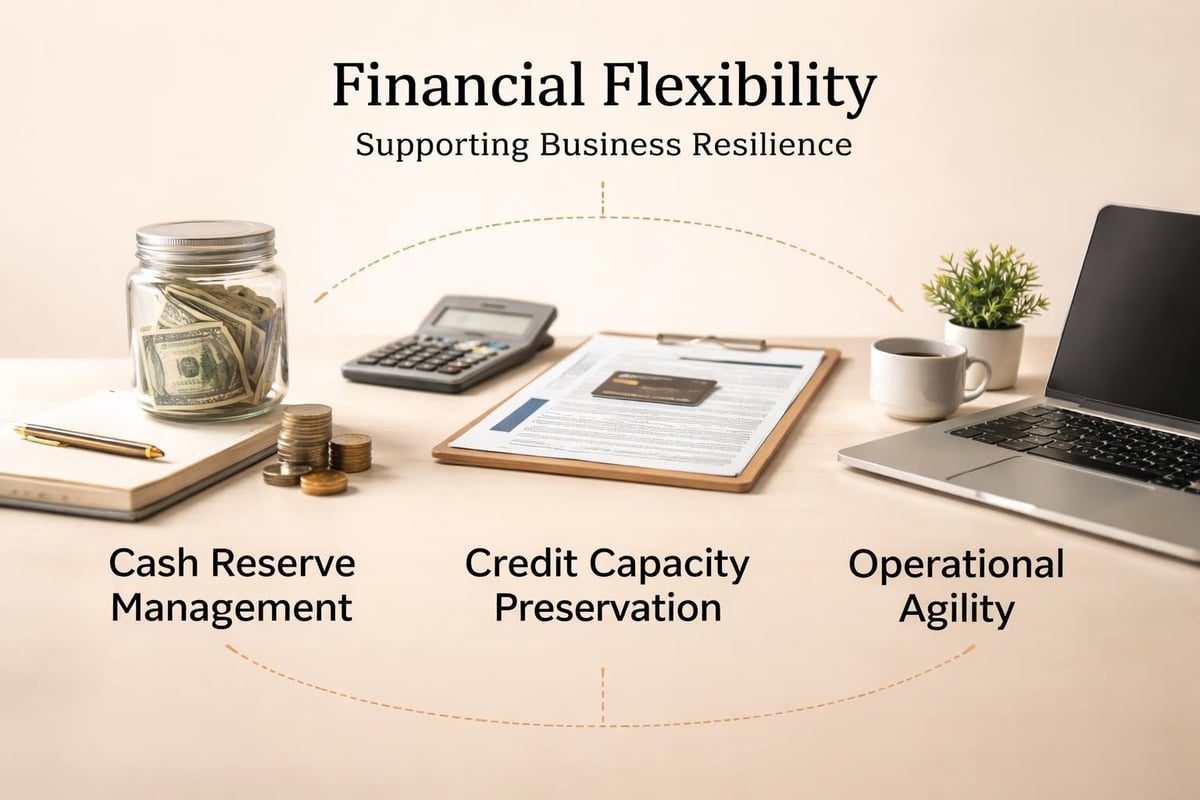
The Three Pillars of Resource Adaptability
Cash Reserve Management forms the first pillar. Companies must determine optimal cash holdings that balance opportunity costs against the security of immediate liquidity. Too little cash creates vulnerability during downturns, while excessive reserves signal inefficient capital deployment.
Credit Capacity Preservation represents the second pillar. Maintaining unused credit lines and favorable debt ratios ensures access to capital when internal resources prove insufficient. This requires disciplined borrowing practices and strategic relationships with financial institutions.
Operational Agility completes the framework. Organizations must design processes and cost structures that allow rapid scaling up or down without catastrophic consequences. This includes workforce flexibility, variable cost arrangements, and modular operational designs.
Strategic Value During Economic Uncertainty
The COVID-19 pandemic provided stark evidence of how financial flexibility protects organizational value. Studies examining stock price performance during revenue shortfalls revealed that companies with greater resource adaptability experienced significantly smaller market value declines compared to constrained competitors. This protection manifested across industries and geographic markets.
Organizations with robust financial positioning could maintain critical operations, retain talent, and even pursue strategic acquisitions while competitors struggled. The ability to weather temporary disruptions without forced asset sales or bankruptcy protection preserved long-term competitive positioning and shareholder value.
Quantifying the Performance Impact
| Performance Metric | High Flexibility | Low Flexibility | Difference |
|---|---|---|---|
| Revenue Recovery Time | 6-9 months | 18-24 months | 66% faster |
| Market Share Retention | 95-98% | 75-85% | 15-20% higher |
| Employee Retention | 90-95% | 65-75% | 25% higher |
| Investment Capacity | Maintained | Reduced 40-60% | Significant advantage |
These performance differentials compound over time. Organizations that maintain strategic initiatives during downturns emerge stronger, while constrained competitors lose ground they may never recover.
Building Sustainable Resource Capacity
Creating genuine financial flexibility requires systematic planning and disciplined execution. Organizations cannot simply declare intentions or establish policies. They must embed flexibility principles into strategic planning, capital allocation, and performance management systems.
Assessment and Benchmarking begins the process. Companies must evaluate current positioning against industry standards and strategic requirements. This includes stress-testing scenarios that model various economic conditions and identifying potential vulnerabilities.
Key assessment questions include:
- How many months can operations continue without external financing?
- What percentage of credit capacity remains available?
- How quickly can operational costs adjust to revenue changes?
- Which assets could be monetized without impairing core capabilities?
- What alternative financing sources exist beyond traditional banking relationships?
Strategic Reserve Policies formalize target levels and acceptable ranges. These policies should consider industry dynamics, business cycle sensitivity, and growth investment requirements. Manufacturing firms with high fixed costs require different reserves than service businesses with variable cost structures.
Continuous Monitoring Systems track key indicators and trigger management attention when thresholds are approached. Early warning systems prevent gradual erosion of strategic positioning and enable proactive responses before crises emerge.

Operational Integration and Efficiency
Financial flexibility cannot exist in isolation from operational excellence. The most effective organizations integrate resource management with process optimization, technology deployment, and workforce development. This holistic approach creates compounding benefits that strengthen both efficiency and adaptability.
Automation and Process Optimization
Modern automation technologies fundamentally reshape how organizations manage resources. By eliminating manual processes and reducing operational complexity, companies simultaneously lower costs and increase flexibility. Automated systems scale efficiently, reduce error rates, and free human capital for higher-value activities.
Organizations implementing comprehensive automation across finance, operations, and human capital management report dramatic improvements. Thousands of hours previously dedicated to manual data entry, reconciliation, and reporting become available for strategic analysis and decision support. This efficiency directly enhances financial positioning by reducing fixed overhead while improving information quality.
The systematic review of financial flexibility applications across industries highlights how operational integration amplifies strategic benefits. Companies that view flexibility as purely financial miss opportunities to embed adaptability throughout their operations.
Technology-Enabled Resource Management
Digital transformation reshapes how organizations approach resource allocation and strategic planning. Advanced analytics provide real-time visibility into cash flows, predictive models forecast future requirements, and integrated systems enable rapid scenario analysis.
Research examining digital transformation’s impact on financial reserves reveals fascinating dynamics. While digital capabilities may reduce required reserve levels by decreasing uncertainty, they simultaneously create new investment requirements. Organizations must balance current flexibility needs against strategic technology investments that enhance future adaptability.
The most successful companies view technology not as a cost center but as a strategic enabler of both efficiency and flexibility. Cloud-based systems eliminate large capital expenditures, subscription models convert fixed costs to variable expenses, and modular architectures support rapid scaling.
Industry-Specific Considerations
Different sectors face unique challenges in developing and maintaining financial flexibility. Professional services firms, healthcare organizations, and manufacturing companies each require tailored approaches that address their specific operational and market characteristics.
Professional Services Dynamics
Consulting and professional services businesses typically carry lower fixed asset requirements but face significant human capital dependencies. Financial flexibility in this context emphasizes:
- Workforce scalability through contractor networks and flexible staffing models
- Project-based revenue management and pipeline visibility
- Client concentration risk management
- Intellectual property and methodology development funding
Healthcare Sector Requirements
Healthcare organizations navigate complex regulatory environments, extended revenue cycles, and significant capital equipment needs. Their flexibility strategies must address:
- Revenue cycle management optimization to accelerate cash collection
- Payor mix diversification to reduce dependency on single revenue sources
- Equipment financing strategies that preserve borrowing capacity
- Compliance investment requirements and regulatory change adaptation
Cross-Industry Best Practices
Despite sector differences, successful organizations share common practices:
- Quarterly scenario planning that stress-tests multiple economic conditions
- Executive dashboards providing real-time visibility into key flexibility metrics
- Cross-functional governance ensuring finance, operations, and strategy alignment
- Regular policy reviews adapting targets to changing market conditions
- Stakeholder communication maintaining investor and lender confidence
Strategic Investment and Growth Enablement
Financial flexibility serves defensive purposes during crises, but its strategic value extends to enabling growth and competitive positioning. Organizations with strong resource adaptability can pursue opportunities that constrained competitors must decline.
Research and Development Investment
Studies analyzing financial flexibility’s impact on R&D investment and performance demonstrate clear connections between resource availability and innovation capacity. Companies with greater flexibility allocate more resources to research initiatives, which subsequently drive superior performance through product differentiation and market expansion.
This dynamic creates virtuous cycles. Flexibility enables innovation investment, innovation drives revenue growth and market position, and stronger performance further enhances financial positioning. Organizations trapped in resource constraints struggle to break this cycle, falling progressively further behind more flexible competitors.

Acquisition and Partnership Opportunities
Market disruptions create acquisition opportunities as distressed competitors seek buyers or strategic partners. Organizations maintaining strong financial positions can pursue these opportunities while others focus on survival. The ability to act quickly often determines success, as competitive bidding situations favor those with established financing relationships and rapid decision-making capabilities.
Beyond acquisitions, strategic partnerships require resource commitments for technology integration, process alignment, and joint development initiatives. Companies lacking flexibility cannot participate in potentially valuable collaborations that could enhance competitive positioning.
Comparative Analysis Across Market Conditions
The value of financial flexibility varies across economic environments and market maturity levels. Research comparing pandemic impacts between Chinese and American markets reveals how regulatory environments, market structures, and institutional frameworks influence flexibility's protective effects.
| Market Characteristic | Impact on Flexibility Value | Strategic Implication |
|---|---|---|
| Market Maturity | Higher in developed markets | Established credit systems amplify benefits |
| Regulatory Environment | Varies by jurisdiction | Compliance requirements affect resource allocation |
| Banking Relationships | Critical in all markets | Diversification reduces dependency risk |
| Economic Volatility | Increases flexibility premium | Emerging markets require higher reserves |
Organizations operating across multiple markets must calibrate their approaches to local conditions while maintaining consistent global principles. This balance requires sophisticated governance structures and strong central oversight combined with local autonomy for tactical decisions.
Human Capital and Workforce Considerations
Employee financial wellness directly impacts organizational performance and strategic flexibility. Companies that help employees build personal financial resilience reduce stress-related productivity losses, decrease turnover costs, and strengthen workforce stability during uncertain periods.
Comprehensive Benefits Design includes financial planning resources, emergency savings programs, and education initiatives that empower employees to manage personal finances effectively. These investments generate measurable returns through improved retention, higher engagement, and reduced healthcare costs from stress-related conditions.
Mental and Physical Health Integration recognizes that financial stress affects overall wellbeing. Organizations providing holistic support see compounding benefits as healthier, less stressed employees contribute more effectively and require fewer resources for crisis intervention.
The connection between employee wellness and organizational flexibility flows both directions. Companies with strong financial positions can maintain benefits during downturns, preserving workforce stability. Simultaneously, a stable, healthy workforce reduces operational disruptions and maintains productivity during challenging periods.
Implementation Roadmap for Organizations
Developing robust financial flexibility requires systematic approaches tailored to organizational context. While specific timelines and priorities vary, successful implementations follow consistent patterns:
Months 1-3: Assessment and Strategy Development
- Conduct comprehensive financial position analysis
- Benchmark against industry standards and competitors
- Identify vulnerabilities through scenario stress testing
- Establish target flexibility levels and acceptable ranges
- Secure executive commitment and board oversight
Months 4-6: Policy Development and System Design
- Create formal reserve and liquidity policies
- Design monitoring dashboards and reporting systems
- Establish governance processes and decision authorities
- Develop communication protocols for stakeholders
- Initiate technology assessments for operational integration
Months 7-12: Implementation and Optimization
- Deploy monitoring systems and management reporting
- Execute initial reserve building or restructuring initiatives
- Launch employee wellness and education programs
- Begin operational efficiency improvements
- Conduct quarterly strategy reviews and adjustments
Ongoing: Continuous Improvement
- Regular scenario planning and stress testing
- Annual policy reviews and target adjustments
- Technology capability enhancements
- Stakeholder communication and confidence building
- Best practice research and benchmarking
Organizations seeking to accelerate implementation often partner with specialized consultants who bring expertise, proven methodologies, and implementation support. The team at Nero and Associates works with clients to design customized approaches that address specific industry challenges and organizational contexts.
Risk Management and Governance
Effective financial flexibility requires robust governance that balances opportunity pursuit against prudent risk management. Organizations must establish clear decision frameworks that prevent both excessive risk-taking and overly conservative resource management.
Board Oversight Responsibilities include establishing risk appetite, approving major financial policies, and monitoring key metrics. Regular reporting should provide visibility into flexibility positioning, potential vulnerabilities, and strategic opportunities requiring resource deployment.
Management Execution Authority defines decision-making levels for various resource commitments. Clear delegation enables rapid responses while ensuring appropriate review for major strategic decisions. Many organizations establish tiered authorities based on dollar amounts, strategic significance, and reversibility.
Control Environment Design prevents unauthorized resource depletion while enabling legitimate operational needs. Segregation of duties, approval workflows, and regular audits protect assets without creating bureaucratic obstacles that undermine operational effectiveness.
Future Trends and Emerging Considerations
The business environment continues evolving in ways that affect how organizations approach financial flexibility. Several trends deserve particular attention as companies plan for coming years:
Increasing Economic Volatility driven by geopolitical tensions, climate change impacts, and technological disruption suggests that flexibility premiums will remain elevated. Organizations should plan for more frequent stress events rather than assuming long periods of stable conditions.
Digital Currency and Payment Evolution may reshape liquidity management and cross-border transaction efficiency. Companies should monitor developments in central bank digital currencies, blockchain-based payment systems, and evolving regulatory frameworks.
Sustainability and ESG Integration increasingly influences investor expectations and access to capital. Organizations must consider how environmental and social commitments interact with financial flexibility requirements, potentially creating new constraints or opportunities.
Artificial Intelligence Applications in financial planning, forecasting, and decision support will enhance analytical capabilities while potentially reducing the human judgment required for complex decisions. Companies should explore how AI tools can strengthen flexibility management without creating new technology dependencies.
Financial flexibility serves as a cornerstone of organizational resilience and competitive advantage, enabling companies to navigate uncertainty while pursuing strategic opportunities. By integrating resource management with operational excellence, technology deployment, and workforce development, organizations create sustainable competitive advantages that compound over time. Nero and Associates, Inc. partners with organizations to build comprehensive solutions that enhance financial positioning while improving operational efficiency and employee wellness, creating integrated strategies that drive measurable performance improvements across all dimensions of business success.