

Healthcare organizations generate massive volumes of patient data every single day, from electronic health records to billing information and diagnostic imaging. The ability to effectively manage this information determines not only operational efficiency but also patient safety, regulatory compliance, and financial performance. As healthcare systems become increasingly digitized and interconnected, implementing robust healthcare data management strategies has evolved from a technical consideration to a strategic imperative that directly impacts an organization's bottom line and its ability to deliver quality care.
The Foundation of Modern Healthcare Operations
Healthcare data management encompasses the collection, storage, organization, protection, and analysis of patient and operational information across an organization. This discipline requires balancing multiple objectives simultaneously: ensuring data accessibility for clinical decision-making, maintaining strict privacy and security standards, supporting regulatory compliance, and enabling analytics that drive operational improvements.
The complexity of this challenge stems from the unique characteristics of healthcare information. Unlike many other industries, healthcare data carries life-or-death implications, requires retention for decades, involves multiple stakeholders with different access needs, and falls under stringent regulatory frameworks like HIPAA. Organizations must design systems that accommodate these requirements while remaining flexible enough to integrate new technologies and adapt to evolving care delivery models.
Why Data Quality Matters More Than Volume
Many healthcare organizations struggle with what experts call "dirty data"-information that is incomplete, inaccurate, duplicated, or inconsistent across systems. The impact of poor data quality extends far beyond administrative inconvenience, affecting clinical outcomes, reimbursement rates, and patient safety.
Consider a patient with allergies documented differently across three separate systems. This fragmentation creates dangerous scenarios where critical information might not be available at the point of care. Similarly, inconsistent coding practices can result in claim denials, revenue leakage, and compliance violations that cost organizations millions annually.
Key indicators of data quality problems include:
- High rates of duplicate patient records in master indexes
- Frequent claim denials due to coding or documentation errors
- Inconsistent reporting across departments or facilities
- Delays in locating patient information during care delivery
- Incomplete medication histories or allergy documentation
Organizations that invest in data governance frameworks and quality improvement processes see measurable returns. These initiatives typically reduce duplicate records by 40-60%, decrease claim denial rates, and improve clinical decision support system effectiveness.

Overcoming Integration and Interoperability Challenges
Healthcare data management faces unique obstacles that distinguish it from other industries. The healthcare sector encounters specific challenges in adopting data management best practices, including legacy system dependencies, vendor lock-in, and resistance to standardization.
Most healthcare organizations operate dozens of disparate systems: electronic health records, laboratory information systems, radiology platforms, billing software, and departmental applications. Each system stores data in different formats, uses different identifiers, and operates on different update schedules. This fragmentation creates information silos that prevent comprehensive patient views and complicate analytics initiatives.
The Hidden Costs of System Fragmentation
| Challenge Area | Financial Impact | Operational Impact | Patient Care Impact |
|---|---|---|---|
| Data Duplication | $15-30K annually per provider | 3-5 hours weekly on reconciliation | Delayed access to critical information |
| Integration Failures | 12-18% revenue cycle inefficiency | Manual data entry increases errors | Incomplete medical histories |
| Interoperability Gaps | $8.9B annually (industry-wide) | Redundant testing and procedures | Care coordination breakdowns |
The financial and operational consequences extend throughout the organization. Clinical staff spend valuable time searching for information across multiple systems. Administrative teams manually re-enter data between platforms. Quality improvement initiatives struggle to aggregate data for analysis. Revenue cycle teams face delays in obtaining documentation needed for billing.
Automation and integration solutions can eliminate these inefficiencies. By connecting systems through standardized interfaces, organizations reduce manual processes, improve data accuracy, and enable real-time information flow. Similar to how automation transforms accounts payable processes, healthcare data integration delivers measurable time and cost savings.
Security and Privacy in an Era of Constant Threats
Healthcare organizations face unprecedented cybersecurity challenges as threat actors increasingly target valuable patient information. Recent incidents demonstrate the severity of this threat, with major healthcare data breaches exposing hundreds of thousands of patient records and causing operational disruptions that impact patient care delivery.
The consequences of inadequate security extend beyond immediate breach response costs. Organizations face regulatory penalties, class-action lawsuits, reputational damage, and loss of patient trust. The average healthcare data breach now costs organizations $10.93 million, according to recent industry research, making it the most expensive sector for cyber incidents.
Building Comprehensive Security Frameworks
Effective healthcare data management requires layered security approaches that address both external threats and internal vulnerabilities. Organizations must implement technical controls, establish governance policies, and create security-aware cultures among staff members who handle sensitive information daily.
Essential security components include:
- Access controls that limit data exposure based on role and need-to-know principles
- Encryption for data at rest and in transit across all systems and devices
- Audit logging that tracks who accessed what information and when
- Regular security assessments including penetration testing and vulnerability scanning
- Incident response planning with defined protocols for breach detection and containment
Third-party vendors introduce additional complexity to healthcare data management security. Many organizations share patient information with billing companies, transcription services, analytics platforms, and cloud storage providers. Each vendor relationship creates potential vulnerability points that require careful management. Understanding third-party risk management challenges in healthcare helps organizations develop more comprehensive security strategies.

Leveraging Advanced Technologies for Better Outcomes
Artificial intelligence and automation are transforming healthcare data management from a primarily defensive function focused on compliance and security into a strategic capability that drives clinical and operational improvements. Organizations that effectively harness these technologies gain competitive advantages through improved decision-making, enhanced efficiency, and better patient experiences.
Machine learning algorithms can identify patterns in clinical data that human analysts might miss, predicting patient deterioration, identifying high-risk populations, and recommending personalized treatment approaches. Natural language processing extracts structured information from clinical notes, radiology reports, and other unstructured sources, making this valuable data accessible for analytics and decision support.
Automation's Role in Reducing Manual Burden
Healthcare organizations implementing automation for data management tasks report significant productivity gains. Robotic process automation handles repetitive tasks like data entry, record updates, and report generation, freeing staff to focus on higher-value activities that require human judgment and expertise.
High-impact automation opportunities:
- Automated patient record matching and duplicate detection
- Insurance eligibility verification and prior authorization requests
- Clinical documentation improvement through AI-assisted coding
- Supply chain data integration and inventory management
- Quality measure calculation and regulatory reporting
The challenge lies in managing the data sprawl that accompanies AI adoption. As organizations deploy more AI-powered tools, data sprawl creates new security and governance challenges that require proactive management strategies.
Organizations serving enterprise-scale operations must balance innovation with governance, ensuring new technologies integrate into existing data management frameworks rather than creating additional silos.
Regulatory Compliance and Governance Frameworks
Healthcare data management exists within a complex regulatory environment that continues to evolve. HIPAA establishes baseline privacy and security requirements, but organizations must also navigate state-specific regulations, payer requirements, and accreditation standards. International organizations face additional complexity from GDPR and other regional data protection laws.
Compliance failures carry severe consequences. The Department of Health and Human Services Office for Civil Rights has assessed penalties ranging from thousands to millions of dollars for HIPAA violations. Beyond financial penalties, organizations face corrective action plans, ongoing monitoring requirements, and potential criminal charges in cases of willful neglect.
Creating Sustainable Governance Structures
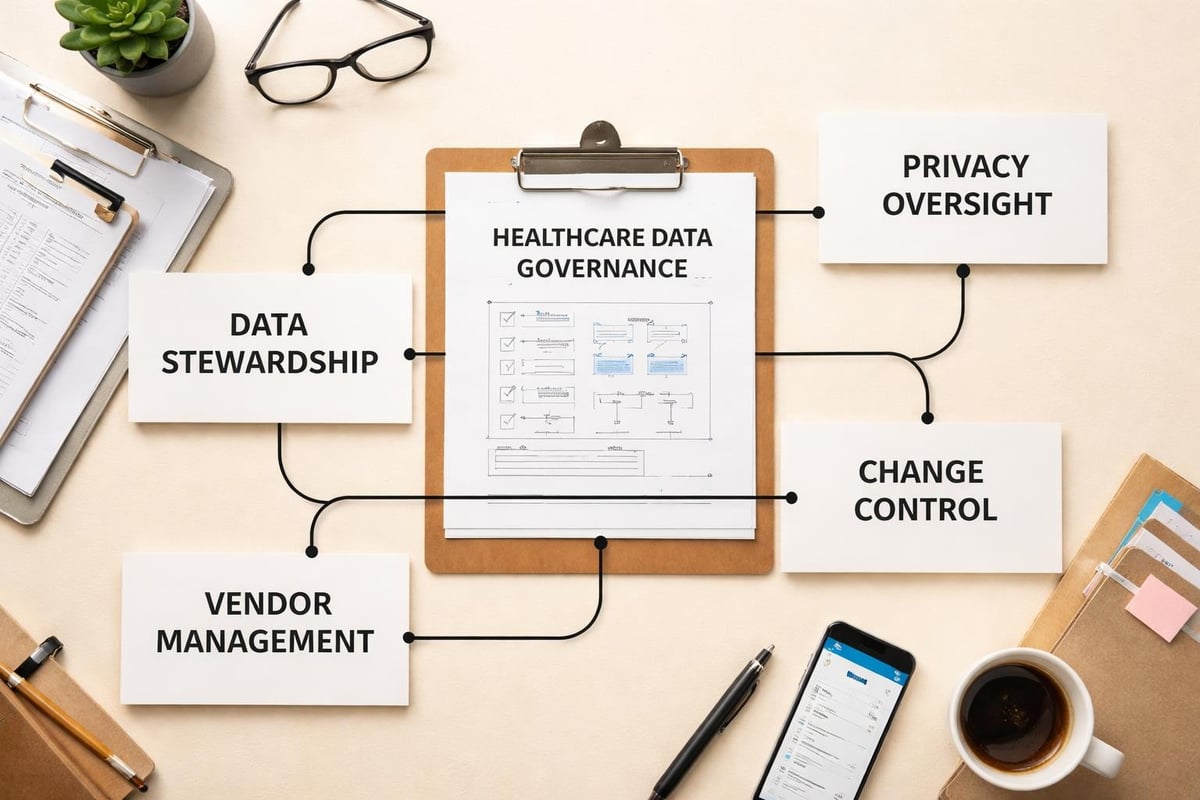
Effective data governance requires more than policy documentation. Organizations need active governance structures with clear accountability, defined processes, and ongoing monitoring mechanisms. Leading healthcare organizations establish data management principles that guide decision-making and create consistency across departments and facilities.
| Governance Element | Purpose | Key Stakeholders | Success Metrics |
|---|---|---|---|
| Data Stewardship | Define data ownership and quality standards | Clinical, IT, Compliance | Data accuracy rates, issue resolution time |
| Privacy Oversight | Monitor access, detect inappropriate use | Privacy Officer, Legal, IT Security | Audit findings, breach prevention |
| Vendor Management | Assess third-party data handling practices | Procurement, Legal, IT | Contract compliance, risk assessments completed |
| Change Management | Evaluate data impacts of system changes | IT, Clinical Informatics | Implementation success, downtime prevention |
Governance frameworks must balance control with flexibility. Overly rigid policies create workarounds that undermine security and compliance. Effective governance provides clear guidelines while empowering teams to make appropriate decisions within established parameters.
Emerging Technologies Reshaping Healthcare Data
Blockchain technology offers promising solutions to longstanding healthcare data management challenges. The potential for blockchain in healthcare data management includes improved data sharing, enhanced security through distributed ledgers, and better patient control over health information.
While blockchain adoption in healthcare remains relatively early-stage, pilot projects demonstrate potential applications in areas like medical credentialing, pharmaceutical supply chain tracking, and patient consent management. The technology's ability to create immutable audit trails and facilitate secure data exchange between untrusted parties addresses fundamental healthcare data management challenges.
Cloud Computing and Edge Processing
Cloud platforms provide healthcare organizations with scalable infrastructure that supports growing data volumes without massive capital investments. Organizations can leverage cloud-based analytics, disaster recovery, and collaboration tools while maintaining control over sensitive patient information through encryption and access controls.
Edge computing brings data processing closer to the point of care, reducing latency for time-sensitive applications like real-time monitoring and clinical decision support. This distributed architecture complements cloud strategies by keeping certain data local while synchronizing relevant information to central repositories.
The challenge lies in maintaining consistent healthcare data management practices across hybrid environments that span on-premises data centers, private clouds, public clouds, and edge devices. Organizations need unified governance frameworks, security policies, and data quality standards that apply regardless of where information resides.
Building Analytics Capabilities on Strong Data Foundations
Healthcare organizations increasingly recognize data as a strategic asset that drives improvement across clinical, operational, and financial domains. However, analytics initiatives fail when built on poor data foundations. Organizations must establish robust healthcare data management practices before expecting meaningful insights from advanced analytics.
Life sciences organizations turning data overload into actionable insights demonstrate the importance of data integration, quality management, and governance as prerequisites for analytics success.
Analytics maturity progression:
- Descriptive analytics answer "what happened" through reporting and dashboards
- Diagnostic analytics explain "why it happened" through root cause analysis
- Predictive analytics forecast "what will happen" using statistical models
- Prescriptive analytics recommend "what should we do" through optimization
Organizations must develop analytics capabilities progressively, ensuring each level builds on solid data management foundations. Attempting advanced predictive modeling with poor data quality produces unreliable results that erode confidence in analytics initiatives.
Operational Efficiency Through Strategic Data Management
Healthcare data management directly impacts operational efficiency and financial performance. Organizations with mature data practices report reduced administrative burden, faster revenue cycle processes, and improved resource utilization. These operational improvements translate into measurable financial returns that justify continued investment in data management capabilities.
Revenue cycle management particularly benefits from strong data practices. Accurate patient information, proper coding, complete documentation, and timely claim submission all depend on effective data management. Organizations addressing common healthcare supply chain management challenges through better data integration see inventory reductions, decreased waste, and improved procurement efficiency.
Measuring Data Management ROI
| Metric Category | Before Optimization | After Optimization | Annual Value |
|---|---|---|---|
| Duplicate Record Rate | 15-20% | 3-5% | $180K-240K savings |
| Claims Denial Rate | 8-12% | 4-6% | $500K-800K revenue recovery |
| Documentation Time | 2.5 hours daily per clinician | 1.5 hours daily | 2,000+ hours reclaimed |
| Report Generation | 15-20 hours monthly | 2-3 hours monthly | $75K-100K staff productivity |
Organizations serving non-profit healthcare missions must demonstrate stewardship of limited resources. Strategic healthcare data management enables these organizations to maximize mission impact through operational efficiency.
The Human Element in Technology Implementation
Technology alone cannot solve healthcare data management challenges. Successful initiatives require change management, staff training, and cultural transformation. Clinical and administrative staff must understand their roles in maintaining data quality, protecting patient privacy, and using information systems effectively.
Organizations often underestimate the effort required to drive adoption of new data management practices and technologies. Resistance emerges when staff perceive systems as adding work without clear benefits. Effective implementation strategies emphasize workflow integration, demonstrate value through early wins, and provide ongoing support as teams adapt to new approaches.
Success factors for data management initiatives:
- Executive sponsorship that prioritizes data as organizational asset
- Clear communication of benefits to frontline staff
- Training programs tailored to different roles and skill levels
- Workflow design that minimizes disruption to patient care
- Quick wins that demonstrate value and build momentum
- Feedback mechanisms that enable continuous improvement
Leading organizations recognize that healthcare data management represents an ongoing journey rather than a destination. As care delivery models evolve, regulations change, and technologies advance, data management strategies must adapt accordingly. Building organizational capabilities, establishing governance frameworks, and fostering data-driven cultures creates sustainable advantages that persist across technological shifts.
Strategic Investment in Data Infrastructure
Healthcare organizations face constant pressure to control costs while improving quality. Data infrastructure investments often compete with clinical priorities, facility improvements, and staff compensation for limited capital budgets. However, viewing healthcare data management as discretionary spending rather than strategic investment creates long-term competitive disadvantages.
Organizations that prioritize data infrastructure realize returns through multiple pathways. Operational efficiency gains reduce ongoing costs. Better analytics enable proactive population health management that prevents expensive complications. Improved security and compliance reduce risk exposure. Enhanced interoperability supports value-based care models that reward outcomes rather than volume.
Building business cases for data management initiatives requires quantifying both hard cost savings and softer strategic benefits. Automation might eliminate specific manual processes with clear labor hour reductions. Improved data quality might reduce claim denials with direct revenue impact. Better security might prevent breaches with quantifiable risk reduction. Enhanced analytics might improve patient outcomes with both quality and financial implications.
Organizations should explore resources and insights through industry knowledge sharing to understand how peers approach similar challenges and identify best practices applicable to their specific contexts.
Effective healthcare data management transforms organizational performance across clinical, operational, and financial dimensions while ensuring compliance and protecting patient information. Organizations that treat data as a strategic asset, implement robust governance frameworks, and leverage automation and integration technologies position themselves for success in increasingly complex healthcare environments. Nero and Associates, Inc. helps healthcare organizations optimize data management through AI-powered automation, revenue cycle management solutions, and strategic consulting that eliminates manual processes while improving outcomes and financial performance.