
Human Capital Management: A Strategic Guide for 2026

Share on Facebook
Share on X
Share on LinkedIn

Organizations in 2026 face unprecedented challenges in managing their most valuable asset: their people. The modern business landscape demands more than traditional human resources practices. Companies need comprehensive strategies that align workforce capabilities with business objectives, optimize employee performance, and create sustainable competitive advantages. This shift has elevated human capital management from an administrative function to a strategic imperative that directly impacts organizational success, revenue growth, and long-term sustainability.

Understanding Human Capital Management in Modern Organizations

Human capital management represents a holistic approach to optimizing workforce value through strategic planning, technology integration, and data-driven decision-making. Unlike traditional HR functions that focus primarily on administrative tasks, human capital management encompasses the full employee lifecycle, from recruitment and onboarding through development, retention, and succession planning.

The distinction matters significantly for organizations seeking operational excellence. Traditional HR departments manage processes, while human capital management systems drive business outcomes. This evolution reflects growing recognition that workforce capabilities directly correlate with organizational performance, innovation capacity, and market competitiveness.

Core Components of Effective HCM Systems

A comprehensive human capital management strategy integrates multiple functional areas into a unified framework. Workforce planning establishes the foundation by forecasting talent needs based on business objectives, market trends, and organizational growth projections. This proactive approach prevents talent shortages and ensures the right people occupy the right roles at the right time.

Talent acquisition and recruitment have transformed dramatically with technology advancement. Modern systems leverage artificial intelligence to identify qualified candidates, reduce bias, and accelerate hiring timelines. Organizations implementing sophisticated recruitment technologies report significant improvements in candidate quality and time-to-hire metrics.

Performance management systems align individual contributions with organizational goals through continuous feedback, objective setting, and development planning. The shift from annual reviews to ongoing performance conversations represents a fundamental change in how organizations cultivate excellence and accountability.
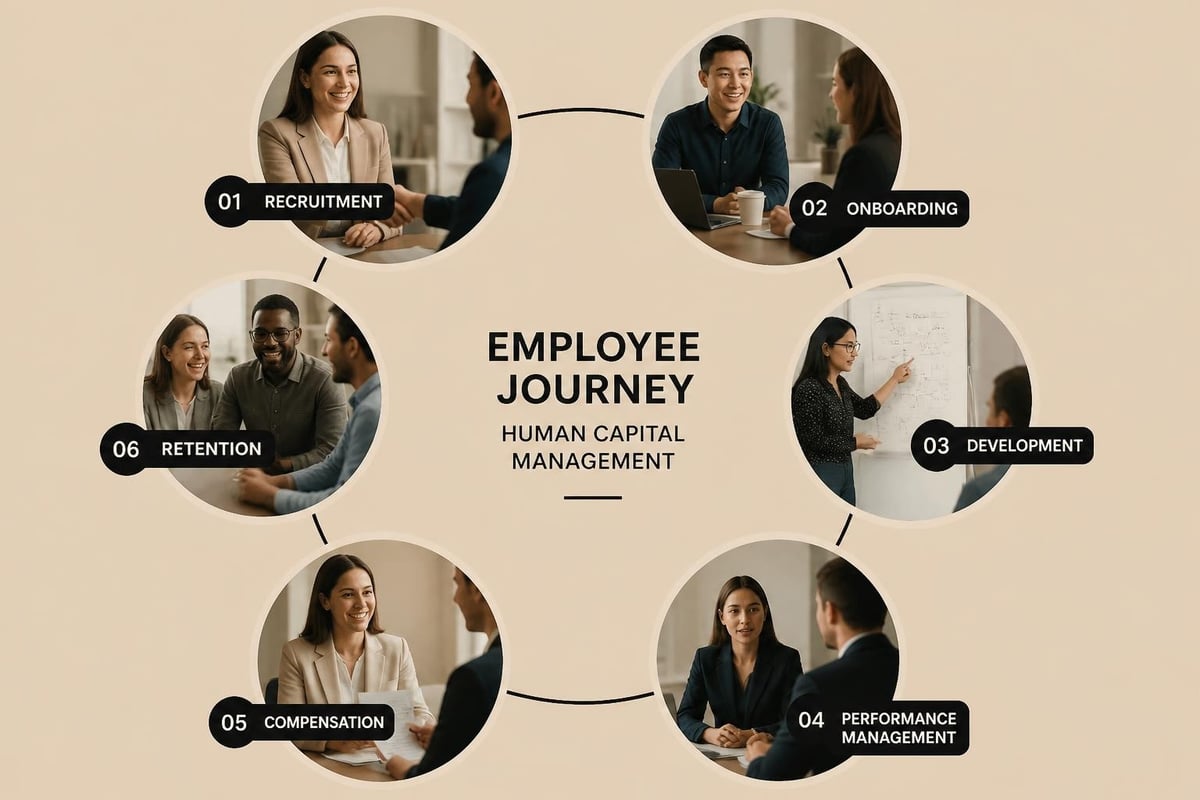
Employee lifecycle stages in HCM

Key performance indicators for human capital management include:

  • Employee productivity and output metrics
  • Retention rates across departments and seniority levels
  • Time-to-fill for critical positions
  • Training completion and skill development rates
  • Employee engagement and satisfaction scores
  • Cost-per-hire and recruitment efficiency
  • Internal promotion and mobility rates

Technology Integration and Digital Transformation

The technological revolution has fundamentally altered how organizations approach human capital management. Cloud-based platforms now consolidate previously fragmented systems, creating unified environments where workforce data flows seamlessly between recruitment, payroll, benefits administration, and performance management functions.

Automation and integration solutions eliminate thousands of manual hours previously consumed by data entry, report generation, and compliance documentation. Organizations implementing integrated HCM platforms report administrative time savings ranging from 30% to 50%, allowing HR professionals to focus on strategic initiatives rather than transactional tasks.

Artificial Intelligence Applications in Workforce Management

Artificial intelligence has emerged as a transformative force in human capital management, enabling capabilities that were impossible just five years ago. Predictive analytics identify flight risks among high-value employees, allowing organizations to implement retention strategies before valuable talent departs. Natural language processing analyzes employee feedback at scale, surfacing insights that inform policy decisions and workplace improvements.

Recent research in skill and job title intelligence demonstrates how advanced language technologies enhance recruitment precision and workforce planning accuracy. These innovations help organizations match candidates to positions based on nuanced skill assessments rather than keyword matching alone.

HCM Technology Primary Function Business Impact
Applicant Tracking Systems Streamline recruitment workflows Reduce time-to-hire by 40-60%
Learning Management Platforms Deliver training and development Increase skill proficiency 35-50%
Workforce Analytics Tools Generate predictive insights Improve retention rates 20-30%
Self-Service Portals Empower employee autonomy Decrease HR tickets 50-70%

Strategic Workforce Planning and Development

Strategic workforce planning represents the intersection of business strategy and talent management. Organizations must anticipate future skill requirements based on market evolution, technological advancement, and competitive dynamics. This forward-looking approach prevents capability gaps that could compromise strategic initiatives.

The planning process begins with comprehensive workforce analysis examining current capabilities, demographic trends, and succession risks. Organizations identify critical positions where departures would significantly impact operations, then develop targeted strategies to mitigate those risks through knowledge transfer, cross-training, and succession development.

Building Talent Pipelines for Sustainable Growth

Effective human capital management requires robust talent pipelines that support both immediate needs and long-term objectives. Organizations should maintain relationships with passive candidates, cultivate internal talent through development programs, and partner with educational institutions to shape future workforce capabilities.

Internal mobility programs deserve particular attention. Research consistently demonstrates that organizations promoting from within achieve higher engagement, better retention, and stronger cultural alignment. Employees who see clear advancement pathways invest more deeply in organizational success and demonstrate greater commitment to performance excellence.

Development initiatives should balance technical skill building with leadership capability development. As organizations flatten hierarchies and empower distributed decision-making, leadership competencies become essential at all levels, not just senior management.

Talent development framework

Compensation, Benefits, and Total Rewards Strategy

Compensation philosophy directly impacts an organization's ability to attract, motivate, and retain top talent. Human capital management systems must integrate compensation planning with performance management, ensuring that rewards align with contributions and reinforce desired behaviors.

The concept of total rewards extends beyond base salary to encompass benefits, work-life balance, development opportunities, and recognition programs. Forward-thinking organizations recognize that employees value different elements at different career stages. Ancillary benefits such as wellness programs, financial planning resources, and mental health support increasingly influence employment decisions.

Innovative Approaches to Employee Financial Wellness

Financial stress significantly impacts employee productivity, engagement, and health outcomes. Organizations implementing comprehensive financial wellness programs report measurable improvements across multiple performance indicators. Earned wage access programs exemplify innovative solutions that address employee financial challenges while differentiating organizations in competitive talent markets.

Benefits strategy must also address healthcare costs, which continue rising faster than general inflation. Organizations should evaluate traditional health insurance alongside alternative approaches that control costs while maintaining quality coverage. Strategic benefits design balances employer cost management with employee value perception, creating sustainable programs that serve both constituencies.

Compliance and Regulatory Considerations

Human capital management operates within complex regulatory frameworks that vary by jurisdiction, industry, and organizational size. Federal agencies establish standards for strategic human capital management systems that inform private sector best practices, even though compliance requirements differ.

The U.S. Office of Personnel Management provides comprehensive guidance on human capital management approaches, including strategic planning frameworks applicable across sectors. Organizations benefit from understanding these frameworks regardless of whether direct compliance applies.

Key compliance areas include:

  1. Equal employment opportunity regulations prohibiting discrimination
  2. Wage and hour laws governing compensation and overtime
  3. Employee benefits compliance under ERISA and ACA provisions
  4. Data privacy requirements protecting employee information
  5. Workplace safety standards ensuring employee wellbeing
  6. Immigration compliance for workforce authorization verification

Documentation requirements demand meticulous record-keeping across all HCM functions. Organizations must maintain applicant data, employment records, performance documentation, and compensation histories according to specified retention schedules. Technology platforms that automate compliance workflows reduce risk while minimizing administrative burden.

Data Analytics and Metrics-Driven Decision Making

The transformation of human capital management from intuition-based practices to data-driven strategies represents one of the most significant evolutions in workforce management. Organizations now capture comprehensive data across all employee touchpoints, creating opportunities for sophisticated analysis that informs strategic decisions.

Workforce analytics examine patterns in recruitment, performance, retention, and engagement data to identify trends and predict outcomes. These insights enable proactive interventions that prevent problems rather than reacting to crises. For example, analytics might reveal that employees in specific departments show declining engagement six months before voluntary departures, allowing targeted retention efforts.

Metric Category Key Indicators Strategic Application
Recruitment Efficiency Time-to-fill, cost-per-hire, offer acceptance rate Optimize sourcing channels and selection processes
Employee Performance Goal achievement, productivity metrics, quality scores Identify high performers and development needs
Retention and Turnover Voluntary separation rate, tenure distribution, regrettable loss percentage Design targeted retention strategies
Learning and Development Training completion, skill acquisition, certification attainment Measure ROI on development investments

Predictive Analytics for Workforce Planning

Advanced analytics move beyond descriptive reporting to predictive modeling that forecasts future workforce dynamics. Machine learning algorithms identify factors contributing to employee success, allowing organizations to refine selection criteria and onboarding processes. Predictive models also forecast attrition risk, enabling preemptive retention efforts focused on high-value employees.

The Human Capital Ontology demonstrates how standardized data classifications enable sophisticated workforce analysis. Organizations adopting consistent taxonomies for skills, positions, and competencies can benchmark performance against industry standards and identify capability gaps requiring attention.

HR analytics dashboard

Integration with Business Strategy and Operational Excellence

Human capital management achieves maximum impact when fully integrated with broader business strategy. Organizations serving enterprise clients must align workforce capabilities with strategic objectives, ensuring that talent strategies support growth initiatives, market expansion, and operational improvements.

This alignment requires ongoing collaboration between HR leadership and executive management. Workforce planning should reflect business planning, with talent acquisition timelines synchronized to product launches, market entries, and capacity expansions. Performance management systems must reinforce strategic priorities through goal cascading and competency frameworks that define success at each organizational level.

Operational excellence depends on workforce capabilities, engagement, and enablement. Organizations cannot achieve process improvements, quality enhancements, or efficiency gains without employees who possess requisite skills, understand objectives, and feel motivated to contribute discretionary effort. Human capital management directly influences operational outcomes through talent quality, skill development, and engagement initiatives.

Industry-Specific Considerations

Different sectors face unique human capital management challenges requiring tailored approaches. Healthcare organizations must navigate complex licensing requirements, shift scheduling challenges, and burnout prevention while maintaining care quality. Hospitality sector employers contend with high turnover, seasonal staffing fluctuations, and customer service excellence demands.

Non-profit organizations balance mission-driven cultures with resource constraints, requiring creative compensation strategies and emphasis on purpose-driven engagement. Private equity portfolio companies must rapidly scale workforce capabilities while maintaining culture during growth phases and integrations.

Change Management and Cultural Transformation

Implementing comprehensive human capital management systems requires significant organizational change. Technology adoption alone proves insufficient without corresponding shifts in mindsets, behaviors, and processes. Successful transformations address both technical and cultural dimensions of change.

Change management strategies should include:

  • Executive sponsorship demonstrating visible commitment to transformation
  • Stakeholder engagement involving employees in design and implementation
  • Communication planning explaining rationale, benefits, and timelines
  • Training programs building capabilities required for new systems
  • Quick wins generating momentum through early successes
  • Continuous improvement refining approaches based on feedback and results

Cultural transformation often presents greater challenges than technical implementation. Organizations must shift from compliance mentalities to strategic orientations, from administrative focuses to business partnership models, and from reactive approaches to proactive strategies. These transitions require patience, persistence, and consistent leadership messaging.

Measuring Return on Investment

Executives increasingly demand evidence that human capital management investments generate measurable returns. Calculating ROI requires establishing baseline metrics, tracking improvements, and attributing outcomes to specific interventions. While some benefits manifest quickly, others emerge gradually over extended periods.

Quantifiable returns include:

  • Reduced turnover costs from improved retention
  • Productivity gains through better talent selection and development
  • Administrative efficiency via process automation and self-service
  • Compliance risk reduction through systematic controls
  • Improved customer satisfaction resulting from employee engagement

Organizations should also consider qualitative benefits including enhanced employer brand, stronger succession pipelines, and improved organizational agility. These advantages may prove difficult to quantify precisely but contribute significantly to long-term competitive positioning.

Investment Area Typical ROI Timeline Primary Benefits
Integrated HCM Platform 12-18 months Administrative efficiency, data accuracy, employee experience
Talent Analytics Tools 6-12 months Improved hiring quality, reduced turnover, workforce optimization
Learning Management System 18-24 months Skill development, compliance training, knowledge retention
Performance Management Software 12-18 months Goal alignment, feedback quality, development planning

Organizations that master human capital management gain sustainable competitive advantages through optimized workforce performance, strategic talent alignment, and operational excellence. The integration of technology, analytics, and strategic planning transforms traditional HR functions into business-critical capabilities that drive growth and profitability. Nero and Associates, Inc. partners with organizations to implement comprehensive human capital management solutions that eliminate manual processes, reduce costs, and empower employees while delivering measurable business results. Our performance-based approach ensures that your workforce strategies align with business objectives and generate meaningful returns on investment.

Human Capital Management: A Strategic Guide for 2026

Organizations in 2026 face unprecedented challenges in managing their most valuable asset: their people. The modern business landscape demands more than traditional human resources practices. Companies need comprehensive strategies that align workforce capabilities with business objectives, optimize employee performance, and create sustainable competitive advantages. This shift has elevated human capital management from an administrative function to a strategic imperative that directly impacts organizational success, revenue growth, and long-term sustainability.

Understanding Human Capital Management in Modern Organizations

Human capital management represents a holistic approach to optimizing workforce value through strategic planning, technology integration, and data-driven decision-making. Unlike traditional HR functions that focus primarily on administrative tasks, human capital management encompasses the full employee lifecycle, from recruitment and onboarding through development, retention, and succession planning.

The distinction matters significantly for organizations seeking operational excellence. Traditional HR departments manage processes, while human capital management systems drive business outcomes. This evolution reflects growing recognition that workforce capabilities directly correlate with organizational performance, innovation capacity, and market competitiveness.

Core Components of Effective HCM Systems

A comprehensive human capital management strategy integrates multiple functional areas into a unified framework. Workforce planning establishes the foundation by forecasting talent needs based on business objectives, market trends, and organizational growth projections. This proactive approach prevents talent shortages and ensures the right people occupy the right roles at the right time.

Talent acquisition and recruitment have transformed dramatically with technology advancement. Modern systems leverage artificial intelligence to identify qualified candidates, reduce bias, and accelerate hiring timelines. Organizations implementing sophisticated recruitment technologies report significant improvements in candidate quality and time-to-hire metrics.

Performance management systems align individual contributions with organizational goals through continuous feedback, objective setting, and development planning. The shift from annual reviews to ongoing performance conversations represents a fundamental change in how organizations cultivate excellence and accountability.

Employee lifecycle stages in HCM

Key performance indicators for human capital management include:

  • Employee productivity and output metrics
  • Retention rates across departments and seniority levels
  • Time-to-fill for critical positions
  • Training completion and skill development rates
  • Employee engagement and satisfaction scores
  • Cost-per-hire and recruitment efficiency
  • Internal promotion and mobility rates

Technology Integration and Digital Transformation

The technological revolution has fundamentally altered how organizations approach human capital management. Cloud-based platforms now consolidate previously fragmented systems, creating unified environments where workforce data flows seamlessly between recruitment, payroll, benefits administration, and performance management functions.

Automation and integration solutions eliminate thousands of manual hours previously consumed by data entry, report generation, and compliance documentation. Organizations implementing integrated HCM platforms report administrative time savings ranging from 30% to 50%, allowing HR professionals to focus on strategic initiatives rather than transactional tasks.

Artificial Intelligence Applications in Workforce Management

Artificial intelligence has emerged as a transformative force in human capital management, enabling capabilities that were impossible just five years ago. Predictive analytics identify flight risks among high-value employees, allowing organizations to implement retention strategies before valuable talent departs. Natural language processing analyzes employee feedback at scale, surfacing insights that inform policy decisions and workplace improvements.

Recent research in skill and job title intelligence demonstrates how advanced language technologies enhance recruitment precision and workforce planning accuracy. These innovations help organizations match candidates to positions based on nuanced skill assessments rather than keyword matching alone.

HCM Technology Primary Function Business Impact
Applicant Tracking Systems Streamline recruitment workflows Reduce time-to-hire by 40-60%
Learning Management Platforms Deliver training and development Increase skill proficiency 35-50%
Workforce Analytics Tools Generate predictive insights Improve retention rates 20-30%
Self-Service Portals Empower employee autonomy Decrease HR tickets 50-70%

Strategic Workforce Planning and Development

Strategic workforce planning represents the intersection of business strategy and talent management. Organizations must anticipate future skill requirements based on market evolution, technological advancement, and competitive dynamics. This forward-looking approach prevents capability gaps that could compromise strategic initiatives.

The planning process begins with comprehensive workforce analysis examining current capabilities, demographic trends, and succession risks. Organizations identify critical positions where departures would significantly impact operations, then develop targeted strategies to mitigate those risks through knowledge transfer, cross-training, and succession development.

Building Talent Pipelines for Sustainable Growth

Effective human capital management requires robust talent pipelines that support both immediate needs and long-term objectives. Organizations should maintain relationships with passive candidates, cultivate internal talent through development programs, and partner with educational institutions to shape future workforce capabilities.

Internal mobility programs deserve particular attention. Research consistently demonstrates that organizations promoting from within achieve higher engagement, better retention, and stronger cultural alignment. Employees who see clear advancement pathways invest more deeply in organizational success and demonstrate greater commitment to performance excellence.

Development initiatives should balance technical skill building with leadership capability development. As organizations flatten hierarchies and empower distributed decision-making, leadership competencies become essential at all levels, not just senior management.

Talent development framework

Compensation, Benefits, and Total Rewards Strategy

Compensation philosophy directly impacts an organization's ability to attract, motivate, and retain top talent. Human capital management systems must integrate compensation planning with performance management, ensuring that rewards align with contributions and reinforce desired behaviors.

The concept of total rewards extends beyond base salary to encompass benefits, work-life balance, development opportunities, and recognition programs. Forward-thinking organizations recognize that employees value different elements at different career stages. Ancillary benefits such as wellness programs, financial planning resources, and mental health support increasingly influence employment decisions.

Innovative Approaches to Employee Financial Wellness

Financial stress significantly impacts employee productivity, engagement, and health outcomes. Organizations implementing comprehensive financial wellness programs report measurable improvements across multiple performance indicators. Earned wage access programs exemplify innovative solutions that address employee financial challenges while differentiating organizations in competitive talent markets.

Benefits strategy must also address healthcare costs, which continue rising faster than general inflation. Organizations should evaluate traditional health insurance alongside alternative approaches that control costs while maintaining quality coverage. Strategic benefits design balances employer cost management with employee value perception, creating sustainable programs that serve both constituencies.

Compliance and Regulatory Considerations

Human capital management operates within complex regulatory frameworks that vary by jurisdiction, industry, and organizational size. Federal agencies establish standards for strategic human capital management systems that inform private sector best practices, even though compliance requirements differ.

The U.S. Office of Personnel Management provides comprehensive guidance on human capital management approaches, including strategic planning frameworks applicable across sectors. Organizations benefit from understanding these frameworks regardless of whether direct compliance applies.

Key compliance areas include:

  1. Equal employment opportunity regulations prohibiting discrimination
  2. Wage and hour laws governing compensation and overtime
  3. Employee benefits compliance under ERISA and ACA provisions
  4. Data privacy requirements protecting employee information
  5. Workplace safety standards ensuring employee wellbeing
  6. Immigration compliance for workforce authorization verification

Documentation requirements demand meticulous record-keeping across all HCM functions. Organizations must maintain applicant data, employment records, performance documentation, and compensation histories according to specified retention schedules. Technology platforms that automate compliance workflows reduce risk while minimizing administrative burden.

Data Analytics and Metrics-Driven Decision Making

The transformation of human capital management from intuition-based practices to data-driven strategies represents one of the most significant evolutions in workforce management. Organizations now capture comprehensive data across all employee touchpoints, creating opportunities for sophisticated analysis that informs strategic decisions.

Workforce analytics examine patterns in recruitment, performance, retention, and engagement data to identify trends and predict outcomes. These insights enable proactive interventions that prevent problems rather than reacting to crises. For example, analytics might reveal that employees in specific departments show declining engagement six months before voluntary departures, allowing targeted retention efforts.

Metric Category Key Indicators Strategic Application
Recruitment Efficiency Time-to-fill, cost-per-hire, offer acceptance rate Optimize sourcing channels and selection processes
Employee Performance Goal achievement, productivity metrics, quality scores Identify high performers and development needs
Retention and Turnover Voluntary separation rate, tenure distribution, regrettable loss percentage Design targeted retention strategies
Learning and Development Training completion, skill acquisition, certification attainment Measure ROI on development investments

Predictive Analytics for Workforce Planning

Advanced analytics move beyond descriptive reporting to predictive modeling that forecasts future workforce dynamics. Machine learning algorithms identify factors contributing to employee success, allowing organizations to refine selection criteria and onboarding processes. Predictive models also forecast attrition risk, enabling preemptive retention efforts focused on high-value employees.

The Human Capital Ontology demonstrates how standardized data classifications enable sophisticated workforce analysis. Organizations adopting consistent taxonomies for skills, positions, and competencies can benchmark performance against industry standards and identify capability gaps requiring attention.

HR analytics dashboard

Integration with Business Strategy and Operational Excellence

Human capital management achieves maximum impact when fully integrated with broader business strategy. Organizations serving enterprise clients must align workforce capabilities with strategic objectives, ensuring that talent strategies support growth initiatives, market expansion, and operational improvements.

This alignment requires ongoing collaboration between HR leadership and executive management. Workforce planning should reflect business planning, with talent acquisition timelines synchronized to product launches, market entries, and capacity expansions. Performance management systems must reinforce strategic priorities through goal cascading and competency frameworks that define success at each organizational level.

Operational excellence depends on workforce capabilities, engagement, and enablement. Organizations cannot achieve process improvements, quality enhancements, or efficiency gains without employees who possess requisite skills, understand objectives, and feel motivated to contribute discretionary effort. Human capital management directly influences operational outcomes through talent quality, skill development, and engagement initiatives.

Industry-Specific Considerations

Different sectors face unique human capital management challenges requiring tailored approaches. Healthcare organizations must navigate complex licensing requirements, shift scheduling challenges, and burnout prevention while maintaining care quality. Hospitality sector employers contend with high turnover, seasonal staffing fluctuations, and customer service excellence demands.

Non-profit organizations balance mission-driven cultures with resource constraints, requiring creative compensation strategies and emphasis on purpose-driven engagement. Private equity portfolio companies must rapidly scale workforce capabilities while maintaining culture during growth phases and integrations.

Change Management and Cultural Transformation

Implementing comprehensive human capital management systems requires significant organizational change. Technology adoption alone proves insufficient without corresponding shifts in mindsets, behaviors, and processes. Successful transformations address both technical and cultural dimensions of change.

Change management strategies should include:

  • Executive sponsorship demonstrating visible commitment to transformation
  • Stakeholder engagement involving employees in design and implementation
  • Communication planning explaining rationale, benefits, and timelines
  • Training programs building capabilities required for new systems
  • Quick wins generating momentum through early successes
  • Continuous improvement refining approaches based on feedback and results

Cultural transformation often presents greater challenges than technical implementation. Organizations must shift from compliance mentalities to strategic orientations, from administrative focuses to business partnership models, and from reactive approaches to proactive strategies. These transitions require patience, persistence, and consistent leadership messaging.

Measuring Return on Investment

Executives increasingly demand evidence that human capital management investments generate measurable returns. Calculating ROI requires establishing baseline metrics, tracking improvements, and attributing outcomes to specific interventions. While some benefits manifest quickly, others emerge gradually over extended periods.

Quantifiable returns include:

  • Reduced turnover costs from improved retention
  • Productivity gains through better talent selection and development
  • Administrative efficiency via process automation and self-service
  • Compliance risk reduction through systematic controls
  • Improved customer satisfaction resulting from employee engagement

Organizations should also consider qualitative benefits including enhanced employer brand, stronger succession pipelines, and improved organizational agility. These advantages may prove difficult to quantify precisely but contribute significantly to long-term competitive positioning.

Investment Area Typical ROI Timeline Primary Benefits
Integrated HCM Platform 12-18 months Administrative efficiency, data accuracy, employee experience
Talent Analytics Tools 6-12 months Improved hiring quality, reduced turnover, workforce optimization
Learning Management System 18-24 months Skill development, compliance training, knowledge retention
Performance Management Software 12-18 months Goal alignment, feedback quality, development planning

Organizations that master human capital management gain sustainable competitive advantages through optimized workforce performance, strategic talent alignment, and operational excellence. The integration of technology, analytics, and strategic planning transforms traditional HR functions into business-critical capabilities that drive growth and profitability. Nero and Associates, Inc. partners with organizations to implement comprehensive human capital management solutions that eliminate manual processes, reduce costs, and empower employees while delivering measurable business results. Our performance-based approach ensures that your workforce strategies align with business objectives and generate meaningful returns on investment.

Website developed in accordance with Web Content Accessibility Guidelines 2.2.
If you encounter any issues while using this site, please contact us: 215.526.5126