
Payroll Integration: Benefits and Best Practices

Share on Facebook
Share on X
Share on LinkedIn

Modern organizations face mounting pressure to streamline operations while maintaining accuracy in critical business functions. Payroll processing, one of the most sensitive and time-consuming administrative tasks, has evolved significantly with technological advancement. Organizations that manually transfer data between systems encounter costly errors, compliance risks, and frustrated employees. By implementing strategic payroll integration, businesses eliminate these challenges while unlocking significant operational efficiencies that directly impact their bottom line.

Understanding Payroll Integration Fundamentals

Payroll integration represents the technological bridge connecting payroll systems with other business applications such as human capital management platforms, time tracking software, benefits administration tools, and accounting systems. Rather than manually entering employee data, hours worked, or deduction information across multiple platforms, integration enables automatic data synchronization.

This automated approach transforms how organizations manage workforce compensation. When an employee updates their banking information in the HR system, that change automatically reflects in payroll processing. Similarly, approved time-off requests flow directly from scheduling software into payroll calculations without human intervention.

Core Components of Effective Integration

Successful integration relies on several technical and operational elements working in harmony:

  • Application Programming Interfaces (APIs) that enable secure data exchange between systems
  • Data mapping protocols ensuring information transfers accurately between different platforms
  • Authentication mechanisms protecting sensitive employee information during transmission
  • Error handling procedures identifying and resolving synchronization issues
  • Audit trails documenting all data transfers for compliance purposes

The architecture supporting these components varies based on organizational needs and existing infrastructure. Various integration approaches include point-to-point connections, middleware solutions, and integration platform as a service (iPaaS) offerings.
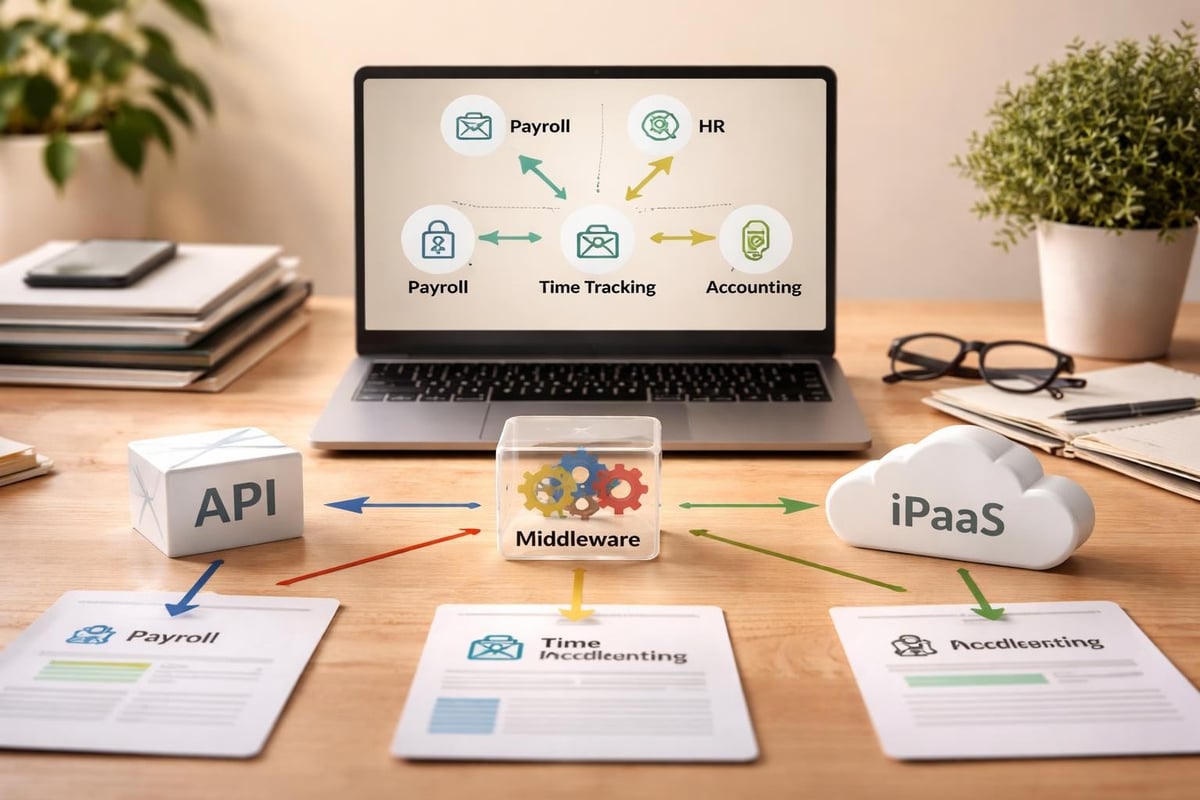
Payroll integration system architecture

Business Benefits Driving Integration Adoption

Organizations implementing comprehensive integration strategies experience measurable improvements across multiple operational dimensions. These benefits extend beyond simple time savings to fundamentally reshape how businesses manage their workforce.

Eliminating Manual Data Entry and Errors

Manual data transfer between systems creates numerous opportunities for mistakes. A single transposed digit in an employee's salary or an incorrect benefits deduction can trigger payroll errors affecting both the organization and the employee. Research shows that integration reduces payroll errors by up to 11% while simultaneously decreasing administrative workload by 30%.

Organizations processing payroll for hundreds or thousands of employees find these error reductions particularly valuable. Consider the cascading effects when a benefits deduction error occurs: incorrect tax withholdings, inaccurate financial reporting, potential compliance violations, and employee dissatisfaction requiring additional administrative time to resolve.

Enhancing Compliance and Regulatory Reporting

Regulatory compliance represents one of the most complex aspects of payroll management. Federal, state, and local regulations governing wage payments, tax withholdings, and reporting requirements change frequently. Integration ensures that updated employee information, tax rates, and regulatory requirements flow consistently across all connected systems.

When audit season arrives, organizations with integrated systems access complete, accurate records with minimal effort. Improved regulatory compliance and efficient reporting become natural byproducts of maintaining synchronized data across platforms. This capability proves especially valuable for organizations operating across multiple jurisdictions with varying regulatory requirements.

Benefit Category Manual Processing Integrated Systems
Error Rate 5-8% average Less than 1%
Processing Time 8-12 hours/cycle 2-4 hours/cycle
Compliance Risk High Minimal
Employee Satisfaction 65-70% 85-90%
Audit Preparation Days to weeks Hours

Improving Employee Experience

Employees expect immediate access to accurate payroll information. Integration enables self-service portals where team members view pay stubs, update direct deposit information, modify tax withholdings, and access year-end tax documents without contacting HR or payroll departments.

This transparency builds trust and reduces administrative burden. When employees can resolve routine inquiries independently, payroll teams focus on strategic initiatives rather than answering repetitive questions. Minimizing human errors and improving employee experience creates a positive feedback loop that enhances organizational culture.

Implementation Strategies for Successful Integration

Organizations approaching integration must carefully plan their implementation to maximize benefits while minimizing disruption. The process requires technical expertise, change management capabilities, and clear communication with stakeholders.

Assessing Current Systems and Requirements

Begin by inventorying existing systems and documenting current workflows. Which applications contain employee data? How does information currently flow between departments? What pain points frustrate users most? This assessment reveals integration priorities and helps identify quick wins that demonstrate value early in the project.

Organizations should evaluate:

  1. Data quality across existing systems to identify cleanup requirements
  2. System compatibility determining which platforms support integration
  3. Stakeholder needs understanding requirements from payroll, HR, finance, and IT teams
  4. Security requirements ensuring integration meets data protection standards
  5. Scalability considerations anticipating future growth and changing needs

At Nero and Associates, Inc., we help organizations navigate this assessment phase by identifying automation opportunities that deliver the greatest impact. Our performance-based approach ensures that integration investments generate measurable returns.

Selecting Integration Approaches and Technologies

Organizations choose from several integration methodologies based on their technical environment, budget constraints, and complexity requirements. Point-to-point integrations connect two specific systems, offering simplicity for organizations with limited integration needs. However, as the number of connected systems grows, point-to-point approaches become difficult to manage.
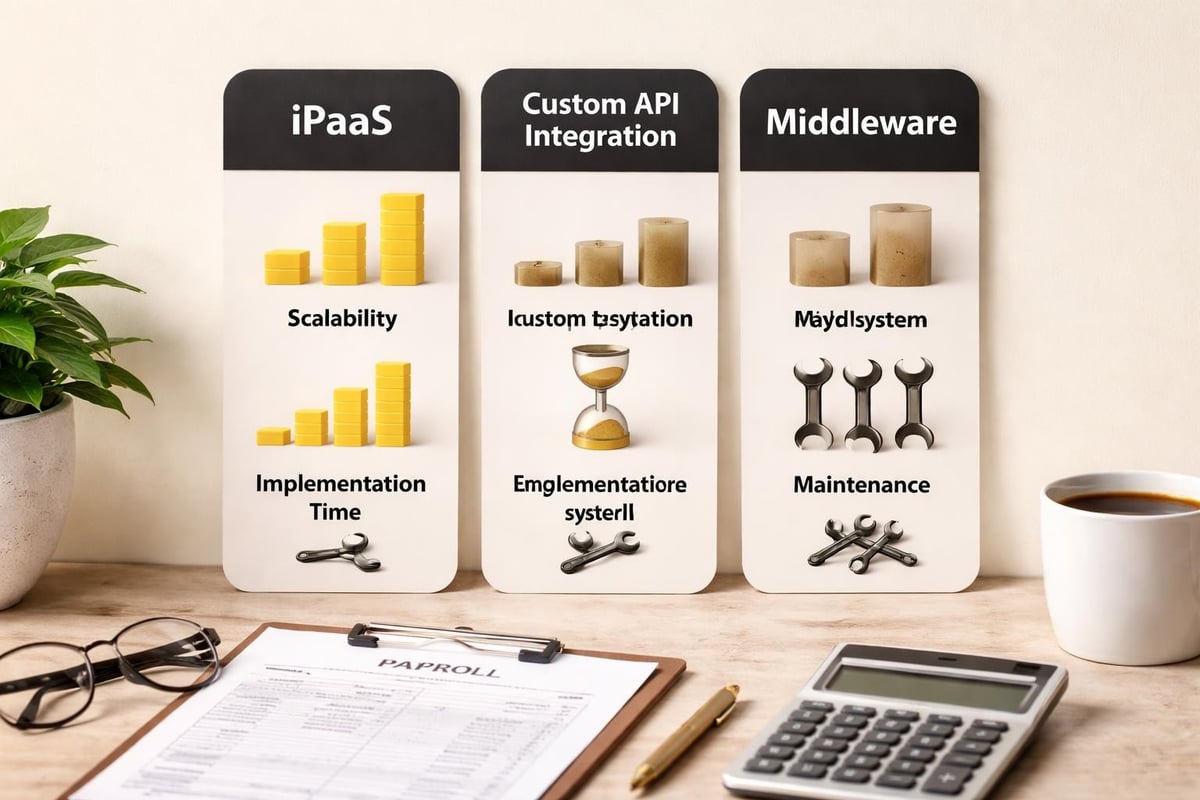
Integration technology comparison

Middleware platforms and iPaaS solutions provide more scalable alternatives. These platforms serve as central hubs managing connections between multiple applications. When organizations add new systems, they integrate once with the platform rather than creating individual connections to each existing application.

Cloud-based deployment models offer additional advantages including automatic updates, reduced infrastructure costs, and enhanced accessibility for distributed teams. Cloud platforms also simplify integration with other cloud-based applications that modern organizations increasingly adopt.

Prioritizing Security Throughout Implementation

Payroll data represents some of the most sensitive information organizations manage. Social Security numbers, banking details, salary information, and other personal data require robust protection throughout the integration lifecycle.

Best practices for securing payroll data include implementing strong access controls, encrypting data during transmission and storage, conducting regular security audits, and maintaining detailed activity logs. Organizations must verify that integration partners and vendors meet rigorous security standards.

Key security considerations include:

  • Role-based access controls limiting system access based on job responsibilities
  • Multi-factor authentication protecting against unauthorized access
  • Data encryption using industry-standard protocols for transmission and storage
  • Regular vulnerability assessments identifying and addressing security gaps
  • Incident response procedures establishing protocols for potential breaches
  • Vendor security certifications verifying third-party compliance with security standards

Real-World Results from Integration Projects

Organizations across industries have achieved significant improvements through strategic integration implementation. These case studies illustrate the tangible benefits that well-executed projects deliver.

Global Enterprise Transformation

Large multinational corporations face unique challenges managing payroll across countries with different currencies, regulations, and cultural expectations. PwC’s collaboration with Workday created an automated global payroll solution ensuring accurate, compliant compensation across 31 countries. This integration eliminated manual processes that previously consumed countless hours while introducing consistency and transparency into global operations.

The project addressed complex requirements including currency conversions, varying tax jurisdictions, diverse benefits structures, and multiple languages. By standardizing processes through integration, the organization reduced errors, accelerated processing times, and improved employee satisfaction across their global workforce.

Financial Services Optimization

A global fintech company recognized that their disconnected systems created inefficiencies and compliance risks. Integration with Workday HCM transformed their payroll operations, delivering significant time savings and improved audit readiness. The company eliminated duplicate data entry, reduced processing errors, and gained real-time visibility into payroll metrics.

This transformation enabled the finance team to redirect hours previously spent on manual reconciliation toward strategic analysis and planning. The improved accuracy also strengthened the organization's audit position, reducing the time required to prepare for regulatory reviews.

Advanced Integration Capabilities

As organizations mature in their integration journey, they unlock advanced capabilities that drive additional value. These sophisticated features transform payroll from a transactional process into a strategic business function.

Predictive Analytics and Reporting

Integrated systems generate comprehensive datasets that enable sophisticated analysis. Organizations gain insights into labor costs by department, project, or product line. They identify trends in overtime usage, benefits utilization, and compensation patterns that inform strategic decisions.

Real-time dashboards present payroll metrics alongside other business indicators, creating a unified view of organizational performance. Finance leaders access integrated data to forecast labor costs more accurately, improving budgeting precision and resource allocation.

Automated Compliance Monitoring

Integration enables continuous compliance monitoring rather than periodic audits. Systems automatically verify that employee classifications match regulatory requirements, tax withholdings align with current rates, and required deductions occur correctly. When regulatory changes occur, integrated systems update automatically rather than requiring manual configuration changes across multiple platforms.

This proactive approach reduces compliance risk while minimizing the administrative burden associated with regulatory changes. Organizations operating across multiple jurisdictions particularly benefit from automated monitoring that tracks different requirements simultaneously.

Overcoming Common Integration Challenges

Despite clear benefits, organizations encounter obstacles during integration projects. Understanding these challenges and developing mitigation strategies increases project success rates.

Managing Data Quality Issues

Integration exposes data quality problems that may have existed unnoticed in isolated systems. Duplicate employee records, inconsistent naming conventions, missing information, and inaccurate historical data create integration challenges. Organizations must invest in data cleanup before or during integration to ensure reliable results.

Establishing data governance policies prevents future quality issues. Clear ownership for data elements, validation rules enforcing data standards, and regular audits maintaining quality over time create sustainable data management practices.

Addressing Change Management Requirements

Technology implementation alone does not guarantee success. Users must understand new processes, trust integrated systems, and abandon familiar manual workflows. Effective change management addresses these human factors through communication, training, and support.

Successful organizations identify champions within each affected department who advocate for integration and support their colleagues through the transition. They provide comprehensive training covering both technical system usage and conceptual understanding of how integration changes workflows.

Balancing Customization and Standardization

Every organization possesses unique processes developed over years of operation. Integration projects force decisions about which unique processes to preserve through customization and which to standardize around best practices. Excessive customization increases costs, complicates maintenance, and limits upgrade flexibility. However, eliminating all customization may force organizations to abandon competitive advantages or regulatory requirements.

The optimal approach balances these considerations by customizing only where unique requirements deliver clear business value. Standard processes work for most payroll functions, allowing organizations to benefit from vendor best practices and simplified maintenance.

Future Trends Shaping Integration

The integration landscape continues evolving as new technologies and business models emerge. Organizations planning integration strategies should consider these trends to ensure their investments remain relevant.

Artificial intelligence and machine learning increasingly augment integration capabilities. These technologies identify anomalies in payroll data, predict processing issues before they occur, and automate complex decision-making that previously required human judgment. Organizations implementing AI-enhanced integration gain competitive advantages through superior accuracy and efficiency.

Blockchain technology shows promise for enhancing payroll security and transparency. While still emerging, blockchain applications could revolutionize how organizations verify employment history, manage international payments, and maintain immutable audit trails.

The shift toward gig economy workers and flexible employment models creates new integration requirements. Systems must handle diverse worker classifications, variable payment schedules, and complex contractor relationships. Organizations building integration strategies should ensure their solutions accommodate these evolving workforce models.

Future payroll integration trends

Measuring Integration Success

Organizations must establish clear metrics to evaluate integration performance and justify continued investment. These measurements should align with business objectives rather than focusing solely on technical performance.

Key performance indicators include:

  • Processing time reduction comparing pre and post-integration timelines
  • Error rate improvements tracking accuracy enhancements
  • Cost savings quantifying reduced labor hours and error corrections
  • Employee satisfaction scores measuring user experience improvements
  • Compliance metrics documenting audit findings and regulatory adherence
  • Return on investment calculating financial benefits against implementation costs

Regular measurement creates accountability and identifies opportunities for continuous improvement. Organizations should review metrics quarterly, adjusting integration configurations to address emerging issues and optimize performance.

Metric Baseline (Manual) Target (Integrated) Measurement Frequency
Processing Cycle Time 40 hours 10 hours Each pay period
Data Entry Errors 6% <1% Monthly
Compliance Issues 8-12 annually 0-2 annually Continuous
Employee Portal Usage N/A >80% adoption Quarterly
Cost per Paycheck $12-15 $4-6 Quarterly

Professional services organizations like those served by our team at Nero and Associates particularly benefit from integration because it eliminates billable hour losses associated with administrative tasks. When consultants spend less time managing payroll issues, they focus on client-facing activities that drive revenue.

Building a Sustainable Integration Strategy

Long-term success requires ongoing attention rather than treating integration as a one-time project. Organizations should establish governance structures that manage integration assets, evaluate new connection opportunities, and maintain system performance over time.

Regular reviews assess whether existing integrations continue meeting business needs. As organizations grow, acquire other companies, or enter new markets, integration requirements evolve. Proactive planning ensures systems scale appropriately and continue delivering value.

Vendor relationships play crucial roles in sustained success. Organizations should maintain active communication with integration platform providers, payroll vendors, and HR technology partners. These relationships provide early access to new capabilities, advance notice of changes affecting integration, and support resources when issues arise.

Documentation standards ensure knowledge persists despite staff changes. Comprehensive documentation covering integration architecture, data flows, error handling procedures, and troubleshooting steps enables efficient maintenance and reduces dependence on specific individuals. Organizations should update documentation whenever configurations change to maintain accuracy.


Strategic implementation of payroll integration delivers measurable improvements in accuracy, efficiency, and compliance while enhancing employee satisfaction. Organizations that thoughtfully approach integration projects position themselves for sustainable competitive advantages in an increasingly digital business environment. Nero and Associates, Inc. specializes in helping organizations identify and implement automation opportunities that eliminate manual processes, reduce costs, and improve operational performance. Our performance-based consultancy approach ensures that integration investments deliver tangible results aligned with your business objectives.

Payroll Integration: Benefits and Best Practices

Modern organizations face mounting pressure to streamline operations while maintaining accuracy in critical business functions. Payroll processing, one of the most sensitive and time-consuming administrative tasks, has evolved significantly with technological advancement. Organizations that manually transfer data between systems encounter costly errors, compliance risks, and frustrated employees. By implementing strategic payroll integration, businesses eliminate these challenges while unlocking significant operational efficiencies that directly impact their bottom line.

Understanding Payroll Integration Fundamentals

Payroll integration represents the technological bridge connecting payroll systems with other business applications such as human capital management platforms, time tracking software, benefits administration tools, and accounting systems. Rather than manually entering employee data, hours worked, or deduction information across multiple platforms, integration enables automatic data synchronization.

This automated approach transforms how organizations manage workforce compensation. When an employee updates their banking information in the HR system, that change automatically reflects in payroll processing. Similarly, approved time-off requests flow directly from scheduling software into payroll calculations without human intervention.

Core Components of Effective Integration

Successful integration relies on several technical and operational elements working in harmony:

  • Application Programming Interfaces (APIs) that enable secure data exchange between systems
  • Data mapping protocols ensuring information transfers accurately between different platforms
  • Authentication mechanisms protecting sensitive employee information during transmission
  • Error handling procedures identifying and resolving synchronization issues
  • Audit trails documenting all data transfers for compliance purposes

The architecture supporting these components varies based on organizational needs and existing infrastructure. Various integration approaches include point-to-point connections, middleware solutions, and integration platform as a service (iPaaS) offerings.

Payroll integration system architecture

Business Benefits Driving Integration Adoption

Organizations implementing comprehensive integration strategies experience measurable improvements across multiple operational dimensions. These benefits extend beyond simple time savings to fundamentally reshape how businesses manage their workforce.

Eliminating Manual Data Entry and Errors

Manual data transfer between systems creates numerous opportunities for mistakes. A single transposed digit in an employee's salary or an incorrect benefits deduction can trigger payroll errors affecting both the organization and the employee. Research shows that integration reduces payroll errors by up to 11% while simultaneously decreasing administrative workload by 30%.

Organizations processing payroll for hundreds or thousands of employees find these error reductions particularly valuable. Consider the cascading effects when a benefits deduction error occurs: incorrect tax withholdings, inaccurate financial reporting, potential compliance violations, and employee dissatisfaction requiring additional administrative time to resolve.

Enhancing Compliance and Regulatory Reporting

Regulatory compliance represents one of the most complex aspects of payroll management. Federal, state, and local regulations governing wage payments, tax withholdings, and reporting requirements change frequently. Integration ensures that updated employee information, tax rates, and regulatory requirements flow consistently across all connected systems.

When audit season arrives, organizations with integrated systems access complete, accurate records with minimal effort. Improved regulatory compliance and efficient reporting become natural byproducts of maintaining synchronized data across platforms. This capability proves especially valuable for organizations operating across multiple jurisdictions with varying regulatory requirements.

Benefit Category Manual Processing Integrated Systems
Error Rate 5-8% average Less than 1%
Processing Time 8-12 hours/cycle 2-4 hours/cycle
Compliance Risk High Minimal
Employee Satisfaction 65-70% 85-90%
Audit Preparation Days to weeks Hours

Improving Employee Experience

Employees expect immediate access to accurate payroll information. Integration enables self-service portals where team members view pay stubs, update direct deposit information, modify tax withholdings, and access year-end tax documents without contacting HR or payroll departments.

This transparency builds trust and reduces administrative burden. When employees can resolve routine inquiries independently, payroll teams focus on strategic initiatives rather than answering repetitive questions. Minimizing human errors and improving employee experience creates a positive feedback loop that enhances organizational culture.

Implementation Strategies for Successful Integration

Organizations approaching integration must carefully plan their implementation to maximize benefits while minimizing disruption. The process requires technical expertise, change management capabilities, and clear communication with stakeholders.

Assessing Current Systems and Requirements

Begin by inventorying existing systems and documenting current workflows. Which applications contain employee data? How does information currently flow between departments? What pain points frustrate users most? This assessment reveals integration priorities and helps identify quick wins that demonstrate value early in the project.

Organizations should evaluate:

  1. Data quality across existing systems to identify cleanup requirements
  2. System compatibility determining which platforms support integration
  3. Stakeholder needs understanding requirements from payroll, HR, finance, and IT teams
  4. Security requirements ensuring integration meets data protection standards
  5. Scalability considerations anticipating future growth and changing needs

At Nero and Associates, Inc., we help organizations navigate this assessment phase by identifying automation opportunities that deliver the greatest impact. Our performance-based approach ensures that integration investments generate measurable returns.

Selecting Integration Approaches and Technologies

Organizations choose from several integration methodologies based on their technical environment, budget constraints, and complexity requirements. Point-to-point integrations connect two specific systems, offering simplicity for organizations with limited integration needs. However, as the number of connected systems grows, point-to-point approaches become difficult to manage.

Integration technology comparison

Middleware platforms and iPaaS solutions provide more scalable alternatives. These platforms serve as central hubs managing connections between multiple applications. When organizations add new systems, they integrate once with the platform rather than creating individual connections to each existing application.

Cloud-based deployment models offer additional advantages including automatic updates, reduced infrastructure costs, and enhanced accessibility for distributed teams. Cloud platforms also simplify integration with other cloud-based applications that modern organizations increasingly adopt.

Prioritizing Security Throughout Implementation

Payroll data represents some of the most sensitive information organizations manage. Social Security numbers, banking details, salary information, and other personal data require robust protection throughout the integration lifecycle.

Best practices for securing payroll data include implementing strong access controls, encrypting data during transmission and storage, conducting regular security audits, and maintaining detailed activity logs. Organizations must verify that integration partners and vendors meet rigorous security standards.

Key security considerations include:

  • Role-based access controls limiting system access based on job responsibilities
  • Multi-factor authentication protecting against unauthorized access
  • Data encryption using industry-standard protocols for transmission and storage
  • Regular vulnerability assessments identifying and addressing security gaps
  • Incident response procedures establishing protocols for potential breaches
  • Vendor security certifications verifying third-party compliance with security standards

Real-World Results from Integration Projects

Organizations across industries have achieved significant improvements through strategic integration implementation. These case studies illustrate the tangible benefits that well-executed projects deliver.

Global Enterprise Transformation

Large multinational corporations face unique challenges managing payroll across countries with different currencies, regulations, and cultural expectations. PwC’s collaboration with Workday created an automated global payroll solution ensuring accurate, compliant compensation across 31 countries. This integration eliminated manual processes that previously consumed countless hours while introducing consistency and transparency into global operations.

The project addressed complex requirements including currency conversions, varying tax jurisdictions, diverse benefits structures, and multiple languages. By standardizing processes through integration, the organization reduced errors, accelerated processing times, and improved employee satisfaction across their global workforce.

Financial Services Optimization

A global fintech company recognized that their disconnected systems created inefficiencies and compliance risks. Integration with Workday HCM transformed their payroll operations, delivering significant time savings and improved audit readiness. The company eliminated duplicate data entry, reduced processing errors, and gained real-time visibility into payroll metrics.

This transformation enabled the finance team to redirect hours previously spent on manual reconciliation toward strategic analysis and planning. The improved accuracy also strengthened the organization's audit position, reducing the time required to prepare for regulatory reviews.

Advanced Integration Capabilities

As organizations mature in their integration journey, they unlock advanced capabilities that drive additional value. These sophisticated features transform payroll from a transactional process into a strategic business function.

Predictive Analytics and Reporting

Integrated systems generate comprehensive datasets that enable sophisticated analysis. Organizations gain insights into labor costs by department, project, or product line. They identify trends in overtime usage, benefits utilization, and compensation patterns that inform strategic decisions.

Real-time dashboards present payroll metrics alongside other business indicators, creating a unified view of organizational performance. Finance leaders access integrated data to forecast labor costs more accurately, improving budgeting precision and resource allocation.

Automated Compliance Monitoring

Integration enables continuous compliance monitoring rather than periodic audits. Systems automatically verify that employee classifications match regulatory requirements, tax withholdings align with current rates, and required deductions occur correctly. When regulatory changes occur, integrated systems update automatically rather than requiring manual configuration changes across multiple platforms.

This proactive approach reduces compliance risk while minimizing the administrative burden associated with regulatory changes. Organizations operating across multiple jurisdictions particularly benefit from automated monitoring that tracks different requirements simultaneously.

Overcoming Common Integration Challenges

Despite clear benefits, organizations encounter obstacles during integration projects. Understanding these challenges and developing mitigation strategies increases project success rates.

Managing Data Quality Issues

Integration exposes data quality problems that may have existed unnoticed in isolated systems. Duplicate employee records, inconsistent naming conventions, missing information, and inaccurate historical data create integration challenges. Organizations must invest in data cleanup before or during integration to ensure reliable results.

Establishing data governance policies prevents future quality issues. Clear ownership for data elements, validation rules enforcing data standards, and regular audits maintaining quality over time create sustainable data management practices.

Addressing Change Management Requirements

Technology implementation alone does not guarantee success. Users must understand new processes, trust integrated systems, and abandon familiar manual workflows. Effective change management addresses these human factors through communication, training, and support.

Successful organizations identify champions within each affected department who advocate for integration and support their colleagues through the transition. They provide comprehensive training covering both technical system usage and conceptual understanding of how integration changes workflows.

Balancing Customization and Standardization

Every organization possesses unique processes developed over years of operation. Integration projects force decisions about which unique processes to preserve through customization and which to standardize around best practices. Excessive customization increases costs, complicates maintenance, and limits upgrade flexibility. However, eliminating all customization may force organizations to abandon competitive advantages or regulatory requirements.

The optimal approach balances these considerations by customizing only where unique requirements deliver clear business value. Standard processes work for most payroll functions, allowing organizations to benefit from vendor best practices and simplified maintenance.

Future Trends Shaping Integration

The integration landscape continues evolving as new technologies and business models emerge. Organizations planning integration strategies should consider these trends to ensure their investments remain relevant.

Artificial intelligence and machine learning increasingly augment integration capabilities. These technologies identify anomalies in payroll data, predict processing issues before they occur, and automate complex decision-making that previously required human judgment. Organizations implementing AI-enhanced integration gain competitive advantages through superior accuracy and efficiency.

Blockchain technology shows promise for enhancing payroll security and transparency. While still emerging, blockchain applications could revolutionize how organizations verify employment history, manage international payments, and maintain immutable audit trails.

The shift toward gig economy workers and flexible employment models creates new integration requirements. Systems must handle diverse worker classifications, variable payment schedules, and complex contractor relationships. Organizations building integration strategies should ensure their solutions accommodate these evolving workforce models.

Future payroll integration trends

Measuring Integration Success

Organizations must establish clear metrics to evaluate integration performance and justify continued investment. These measurements should align with business objectives rather than focusing solely on technical performance.

Key performance indicators include:

  • Processing time reduction comparing pre and post-integration timelines
  • Error rate improvements tracking accuracy enhancements
  • Cost savings quantifying reduced labor hours and error corrections
  • Employee satisfaction scores measuring user experience improvements
  • Compliance metrics documenting audit findings and regulatory adherence
  • Return on investment calculating financial benefits against implementation costs

Regular measurement creates accountability and identifies opportunities for continuous improvement. Organizations should review metrics quarterly, adjusting integration configurations to address emerging issues and optimize performance.

Metric Baseline (Manual) Target (Integrated) Measurement Frequency
Processing Cycle Time 40 hours 10 hours Each pay period
Data Entry Errors 6% <1% Monthly
Compliance Issues 8-12 annually 0-2 annually Continuous
Employee Portal Usage N/A >80% adoption Quarterly
Cost per Paycheck $12-15 $4-6 Quarterly

Professional services organizations like those served by our team at Nero and Associates particularly benefit from integration because it eliminates billable hour losses associated with administrative tasks. When consultants spend less time managing payroll issues, they focus on client-facing activities that drive revenue.

Building a Sustainable Integration Strategy

Long-term success requires ongoing attention rather than treating integration as a one-time project. Organizations should establish governance structures that manage integration assets, evaluate new connection opportunities, and maintain system performance over time.

Regular reviews assess whether existing integrations continue meeting business needs. As organizations grow, acquire other companies, or enter new markets, integration requirements evolve. Proactive planning ensures systems scale appropriately and continue delivering value.

Vendor relationships play crucial roles in sustained success. Organizations should maintain active communication with integration platform providers, payroll vendors, and HR technology partners. These relationships provide early access to new capabilities, advance notice of changes affecting integration, and support resources when issues arise.

Documentation standards ensure knowledge persists despite staff changes. Comprehensive documentation covering integration architecture, data flows, error handling procedures, and troubleshooting steps enables efficient maintenance and reduces dependence on specific individuals. Organizations should update documentation whenever configurations change to maintain accuracy.


Strategic implementation of payroll integration delivers measurable improvements in accuracy, efficiency, and compliance while enhancing employee satisfaction. Organizations that thoughtfully approach integration projects position themselves for sustainable competitive advantages in an increasingly digital business environment. Nero and Associates, Inc. specializes in helping organizations identify and implement automation opportunities that eliminate manual processes, reduce costs, and improve operational performance. Our performance-based consultancy approach ensures that integration investments deliver tangible results aligned with your business objectives.

Website developed in accordance with Web Content Accessibility Guidelines 2.2.
If you encounter any issues while using this site, please contact us: 215.526.5126