Expert Guide to RCM Consulting for Healthcare Success 2026

Share on Facebook
Share on X
Share on LinkedIn

In 2026, healthcare organizations are encountering greater financial and operational pressures than ever before. The stakes for efficiency and profitability are high, making rcm consulting a vital resource for those seeking sustainable success.

This expert guide will empower healthcare leaders with the knowledge, strategies, and actionable steps to unlock the full potential of rcm consulting. You will discover essential concepts, emerging trends, technology innovations, and proven methods to maximize revenue, maintain compliance, and enhance patient satisfaction.

Explore how effective rcm consulting can transform your organization’s financial performance. Get ready for practical guidance that will drive measurable results.

Understanding RCM Consulting in Healthcare

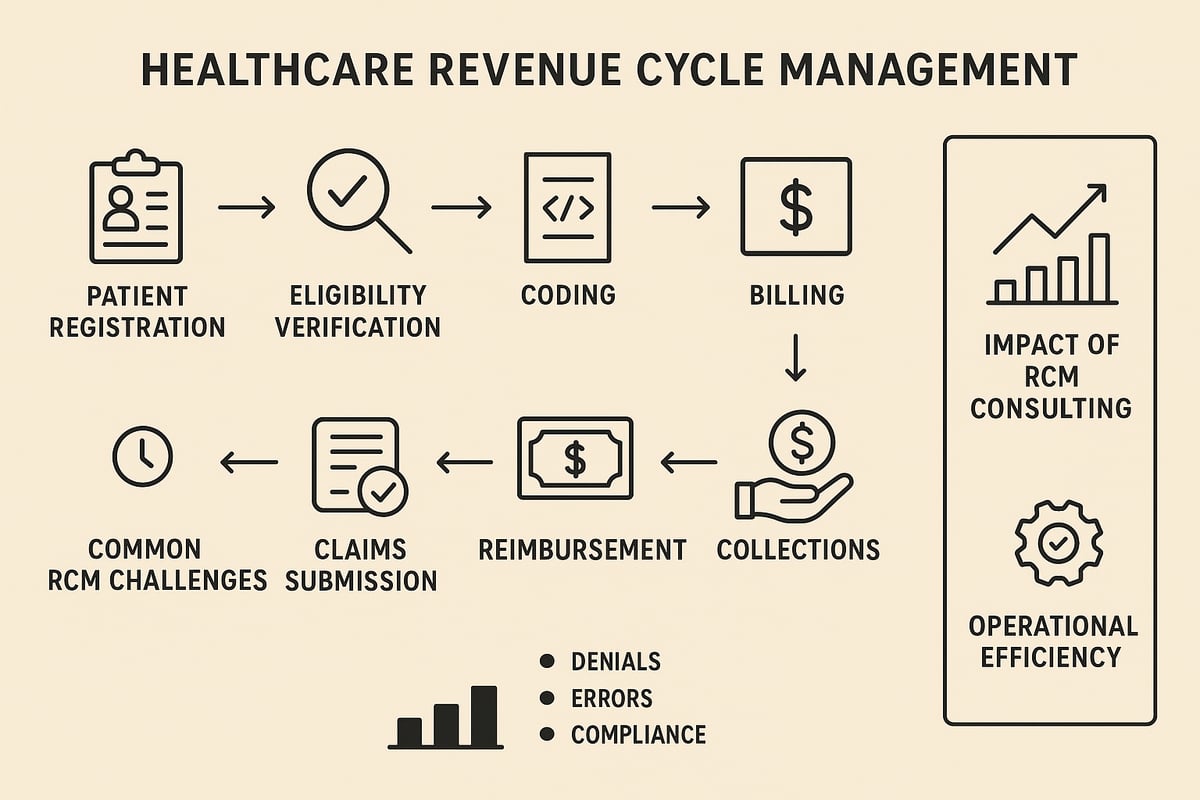
Revenue cycle management (RCM) consulting is the backbone of financial health for healthcare organizations. At its core, RCM consulting covers every touchpoint from patient registration to final payment, ensuring a seamless, compliant, and effective revenue process. The scope of RCM consulting includes optimizing billing, coding, collections, and compliance, helping organizations overcome issues like claim denials, coding errors, and regulatory risks. For example, a small medical practice that partnered with experts to optimize its RCM consulting process saw a dramatic improvement in cash flow and reduced billing errors. For a comprehensive look at these services, review end-to-end revenue cycle management solutions.
Understanding RCM Consulting in Healthcare

What is Revenue Cycle Management (RCM)?

RCM consulting begins by mapping the entire revenue process, ensuring each stage is working efficiently. The stages include:

  • Patient registration and insurance verification
  • Accurate medical coding and documentation
  • Claims submission and follow up
  • Payment posting and patient collections

Common challenges RCM consulting addresses are claim denials, coding errors, and compliance issues. For example, when a small practice implemented targeted RCM consulting, it saw fewer denied claims and improved cash flow, demonstrating the importance of a well-managed revenue cycle.

The Role of RCM Consultants

RCM consulting professionals are responsible for evaluating current processes, identifying inefficiencies, and redesigning workflows for better outcomes. Their expertise spans billing, coding, regulatory changes, and payer requirements. RCM consulting bridges the gap between clinical and administrative teams, ensuring everyone is aligned for success. The objective, third-party perspective consultants provide helps reveal hidden inefficiencies. In one case, a multi-specialty clinic saw a rapid financial turnaround after engaging RCM consulting experts to overhaul its processes.

Why RCM Consulting Matters in 2026

RCM consulting is more vital than ever in 2026 due to increasing payer complexity, value-based care models, and stricter regulatory scrutiny. Healthcare organizations face new billing and coding requirements, along with penalties for non-compliance. Rising patient financial responsibility also impacts collections, making expert RCM consulting essential. According to Healthrise, organizations have achieved up to a 50% reduction in eligibility denials with professional guidance. Operational excellence through RCM consulting gives healthcare leaders a distinct competitive edge.

Key Benefits for Healthcare Organizations

RCM consulting delivers measurable benefits across the revenue cycle. These include:

Benefit Impact Example
Improved cash flow Faster payments, reduced AR days
Lower denial rates Higher reimbursement accuracy
Enhanced patient experience Transparent billing, reduced confusion
Cost savings Streamlined workflows, less manual work
POS collections 3X increase reported by Healthrise

With RCM consulting, organizations gain sustainable improvements in revenue, compliance, and patient satisfaction, driving long-term success.

2026 Trends Shaping RCM Consulting

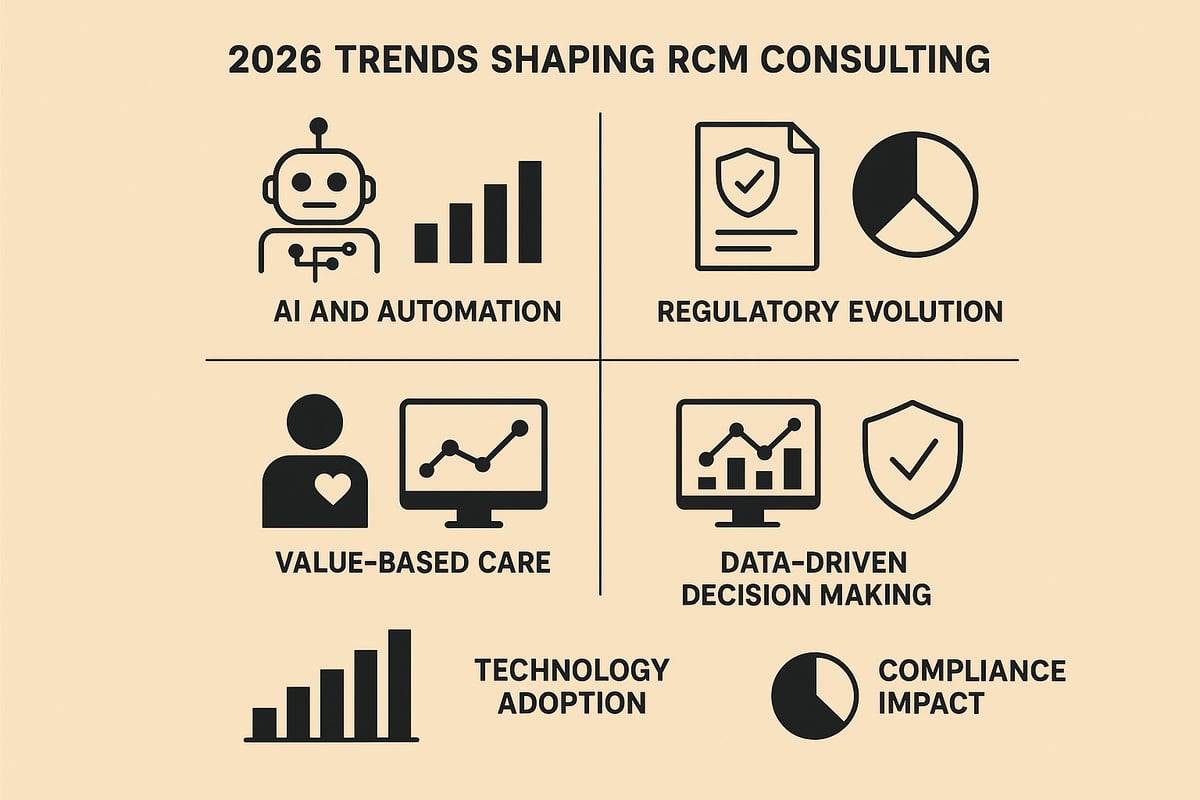
Healthcare organizations in 2026 are navigating rapid transformation, making rcm consulting a vital asset for operational success. Industry leaders must stay ahead of emerging trends to maximize efficiency, compliance, and patient outcomes. According to 2026 Healthcare RCM Trends, staying informed about key shifts is essential for thriving in the evolving landscape.
2026 Trends Shaping RCM Consulting

Advanced Technology Integration

In 2026, advanced technology is at the core of rcm consulting strategies. Healthcare organizations are rapidly adopting artificial intelligence, automation, and sophisticated analytics to streamline revenue cycle processes. Seamless EHR interoperability and integration are enabling real-time eligibility verification and claims tracking, reducing delays and administrative burdens.

Key technology advancements include:

  • AI-powered denial management for faster claim resolution
  • Automated coding and payment posting to minimize manual errors
  • Predictive analytics for identifying reimbursement risks

For example, automated denial management systems are cutting labor costs by flagging issues instantly, allowing staff to focus on high-value tasks. Technology-driven rcm consulting helps organizations achieve measurable gains in cash flow and efficiency.

Regulatory and Compliance Evolution

The regulatory environment for rcm consulting is growing more complex in 2026. New federal and state billing requirements, along with updated coding guidelines, demand constant vigilance. HIPAA revisions and stricter patient data security standards require robust compliance frameworks.

Effective rcm consulting ensures organizations:

  • Stay current with changing regulations
  • Conduct regular risk assessments and compliance audits
  • Implement proactive monitoring tools to prevent violations

A consulting-driven audit strategy can help healthcare providers avoid costly penalties and reputational harm. By prioritizing compliance, organizations safeguard revenue and maintain trust with patients and payers.

Value-Based Care and Patient-Centric Models

The shift toward value-based care is transforming rcm consulting approaches. Healthcare organizations are moving away from fee-for-service models, focusing instead on patient engagement and outcome-driven reimbursement. Rcm consulting now emphasizes transparent billing, personalized financial counseling, and flexible payment plans.

Key elements of patient-centric rcm consulting:

  • Accurate, upfront cost estimates to improve satisfaction
  • Customized payment options to reduce financial stress
  • Enhanced communication to build trust

As a result, organizations see higher patient satisfaction scores and more timely collections, supporting both financial health and care quality.

Data-Driven Decision Making

Data analytics is revolutionizing rcm consulting by providing actionable insights into every aspect of the revenue cycle. Dashboards and key performance indicators (KPIs) allow leaders to monitor trends, forecast cash flow, and benchmark performance against industry standards.

Critical data-driven practices include:

  • Real-time AR and denial tracking for fast intervention
  • Predictive modeling for revenue forecasting
  • Continuous performance benchmarking

For instance, improved analytics have led to an 11 percent boost in scheduling efficiency, directly impacting revenue and patient access. With data as a foundation, rcm consulting empowers organizations to make informed decisions and sustain long-term growth.

The Step-by-Step RCM Consulting Process

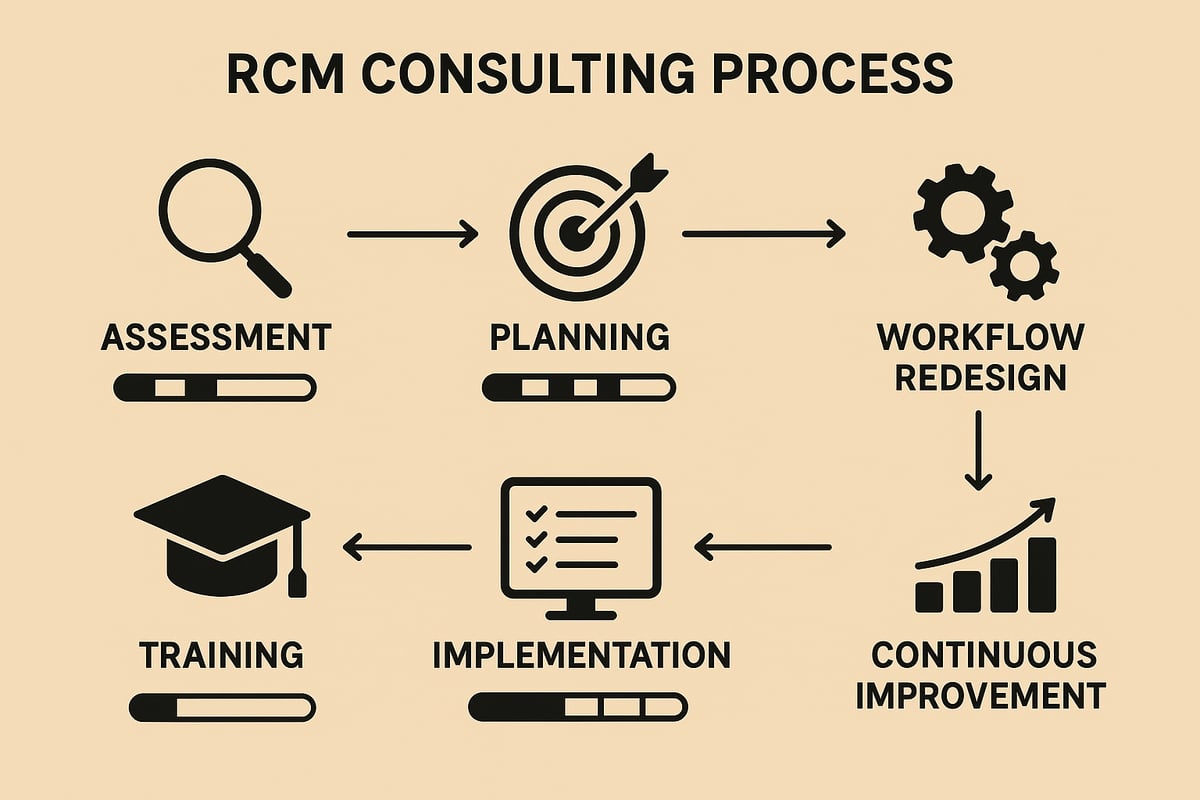
A structured approach is essential for healthcare organizations seeking measurable improvements through rcm consulting. By following a systematic process, providers can uncover hidden revenue, reduce inefficiencies, and drive sustainable financial health. Let us walk through each stage of a successful rcm consulting engagement.
The Step-by-Step RCM Consulting Process

Step 1: Comprehensive Assessment and Gap Analysis

The first step in rcm consulting is a thorough assessment of your current revenue cycle. Consultants review workflows, technology, staff roles, and key metrics. They conduct stakeholder interviews and analyze data to identify bottlenecks, compliance risks, and missed opportunities.

Common findings include incomplete charge capture or outdated billing processes. For example, one organization discovered significant lost revenue due to inconsistent documentation. A comprehensive gap analysis not only highlights immediate issues but also reveals systemic challenges that need addressing. This foundational step sets the stage for targeted improvements and effective rcm consulting outcomes.

Step 2: Strategic Planning and Goal Setting

Once gaps are identified, rcm consulting moves into the strategic planning phase. Here, consultants collaborate with leadership to align revenue cycle goals with broader organizational objectives such as growth, compliance, and enhanced patient care.

Together, you define measurable KPIs like denial rates, AR days, and collection percentages. Quick wins are prioritized alongside long-term initiatives. For instance, a clinic may set a goal to reduce denial rates by 30 percent within six months. This clear blueprint ensures every action is purposeful, measurable, and directly tied to your rcm consulting strategy.

Step 3: Workflow Redesign and Technology Optimization

With a strategic plan in place, rcm consulting focuses on redesigning workflows and optimizing technology. This step involves streamlining patient registration, insurance verification, coding, and billing.

Implementing automation for repetitive tasks and integrating systems like EHR with RCM platforms are critical. Consultants may recommend streamlining your billing process to boost efficiency and maximize cash flow. Redesigning front-end processes, such as faster eligibility checks, accelerates collections and minimizes errors. This phase ensures technology and process changes work harmoniously for improved revenue cycle performance.

Step 4: Staff Training and Change Management

Effective rcm consulting recognizes that technology and process updates only succeed when staff are fully on board. Consultants provide tailored training on new workflows, compliance standards, and software tools.

Change management strategies help address resistance, ensuring smooth adoption of improvements. Ongoing support and feedback loops are established to reinforce learning. For example, after comprehensive training, one organization saw a marked decrease in coding errors and faster reimbursement cycles. Engaged, knowledgeable teams are essential for lasting rcm consulting results.

Step 5: Implementation and Monitoring

After preparation, the next rcm consulting step is implementation. Consultants oversee the rollout of new workflows and technologies, ensuring minimal disruption to daily operations.

Real-time monitoring tools are set up to track key performance indicators and flag issues early. Teams respond quickly to challenges, making iterative adjustments as needed. For example, dashboards highlight claim delays, allowing immediate action. This hands-on approach ensures that rcm consulting delivers not just plans, but real-world, measurable improvements.

Step 6: Continuous Improvement and Reporting

The final stage of rcm consulting is ongoing improvement and transparent reporting. Consultants schedule regular performance reviews, using benchmarking and analytics to identify new opportunities.

Monthly or quarterly reports provide leadership with actionable insights, supporting data-driven decisions. For example, consistent review cycles led one health system to a 15 percent cash flow increase over a year. Continuous improvement ensures that rcm consulting remains a dynamic process, adapting to regulatory changes and evolving payer requirements for sustained success.

Core Features of Effective RCM Consulting Services

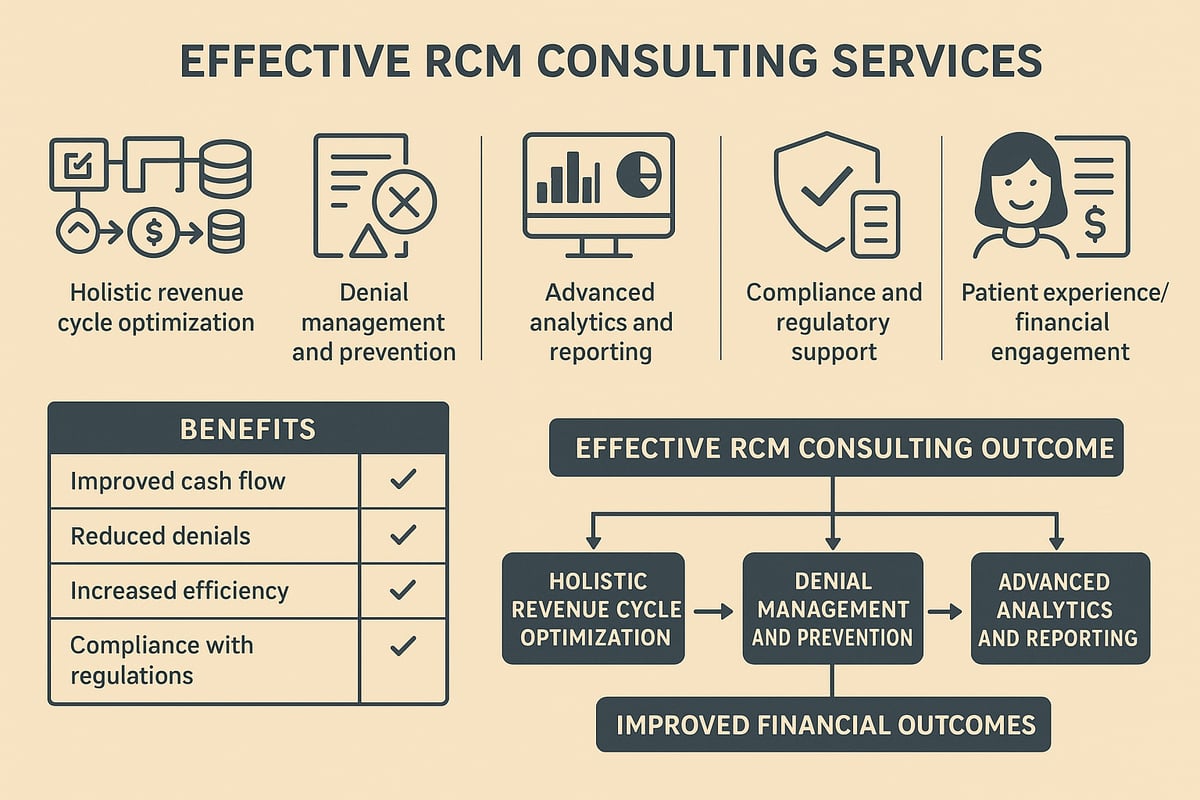
Effective rcm consulting services stand out by delivering comprehensive solutions that address every stage of the revenue cycle. These core features ensure healthcare organizations maximize financial performance, maintain compliance, and deliver a better patient experience.
Core Features of Effective RCM Consulting Services

Holistic Revenue Cycle Optimization

A hallmark of rcm consulting is its end-to-end approach. Consultants analyze every revenue cycle stage, from pre-registration to final collections, to identify inefficiencies and missed opportunities.

They break down silos between billing, clinical, and administrative teams. This collaboration streamlines workflows, eliminates redundant steps, and ensures accurate data flow.

For example, an rcm consulting project may involve redesigning both front-end and back-end processes. This synergy reduces delays and improves cash flow.

  • Integration of front-desk and billing systems
  • Standardized patient data entry
  • Unified communication channels

Holistic optimization empowers organizations to maximize every dollar earned.

Denial Management and Prevention Strategies

Denial management is a critical focus in rcm consulting. Consultants perform root cause analysis to understand why claims are denied or underpaid, and then implement prevention strategies.

Proactive measures include eligibility verification, coding audits, and regular payer rule updates. Automated alerts can flag missing documentation before claims are submitted.

A key aspect is underpayment recovery. For a deeper dive into this topic, read how to efficiently recover underpayments as part of rcm consulting best practices.

  • Real-time denial tracking systems
  • Automated appeals processes
  • Staff training on common denial reasons

These strategies can reduce authorization and eligibility denials by up to 50 percent.

Advanced Analytics and Customized Reporting

Rcm consulting leverages advanced analytics to drive decision-making. Real-time dashboards display key metrics such as accounts receivable, denial rates, and cash flow.

Custom reporting allows organizations to analyze performance by specialty, payer, or service line. Actionable insights help leadership target areas for improvement.

Consultants often provide tailored KPI dashboards that highlight trends in delayed payments or workflow bottlenecks. This level of visibility is essential for ongoing revenue cycle optimization.

  • Interactive performance dashboards
  • Custom KPI reports for executive review
  • Predictive analytics for cash flow forecasting

With these tools, rcm consulting transforms raw data into strategic advantage.

Compliance and Regulatory Support

Staying compliant with evolving regulations is vital for every healthcare provider. Rcm consulting ensures organizations adhere to the latest billing, coding, and privacy requirements.

Consultants conduct risk assessments, prepare for audits, and train staff on new regulatory changes for 2026. Proactive compliance checks help avoid costly penalties and reputational damage.

A robust compliance program includes:

  • Regular internal audits and documentation reviews
  • Automated alerts for regulation updates
  • Staff education on HIPAA and payer requirements

Through ongoing support, rcm consulting safeguards organizations against compliance risks.

Patient Experience and Financial Engagement

Modern rcm consulting recognizes the importance of patient satisfaction. Transparent billing, clear communication, and flexible payment options are central to a positive experience.

Consultants help organizations implement financial counseling and upfront cost estimates. This reduces patient confusion, increases trust, and accelerates payments.

A focus on patient financial engagement has led to a threefold increase in point-of-service collections for some health systems.

  • User-friendly billing statements
  • Multiple payment plan options
  • Dedicated support for patient inquiries

By prioritizing patient engagement, rcm consulting not only boosts revenue but also strengthens long-term patient relationships.

Technology Innovations Driving RCM Success

Healthcare organizations in 2026 are harnessing technology to transform rcm consulting and deliver measurable financial outcomes. Innovations in automation, integration, analytics, and security are reshaping how providers manage revenue cycles, reduce errors, and strengthen compliance.

Artificial Intelligence and Automation

Artificial intelligence is rapidly advancing rcm consulting by streamlining claims management, coding, and denial prediction. AI-powered claims scrubbing tools automatically flag errors before submission, minimizing costly rejections and manual rework. Automation reduces administrative burden, freeing staff to focus on patient care and complex cases.

For example, AI-driven coding solutions can identify missing or incorrect codes in real time, increasing first-pass claim acceptance rates. These improvements not only accelerate cash flow but also lower operational costs. As highlighted in AI and Automation in Healthcare RCM, organizations that implement intelligent automation within rcm consulting see significant reductions in claim rejections and denials.

EHR and RCM System Integration

Seamless integration between electronic health records (EHR) and revenue cycle management systems is a cornerstone of modern rcm consulting. By connecting clinical and billing workflows, providers eliminate duplicate data entry and reduce the risk of errors.

Integrated systems enable smoother data transfer, which improves accuracy in patient demographics, insurance details, and treatment documentation. This synchronized approach ensures that claims are submitted correctly the first time, accelerating reimbursement cycles. As a result, healthcare teams experience fewer delays, improved communication, and a unified view of patient and financial information.

Predictive Analytics and Performance Dashboards

Predictive analytics has become indispensable in rcm consulting for forecasting revenue trends, identifying at-risk claims, and optimizing cash flow. Customizable dashboards provide real-time visibility into key performance indicators (KPIs) such as denial rates, days in accounts receivable, and collection percentages.

With these tools, organizations can proactively address bottlenecks, benchmark performance against industry standards, and make data-driven decisions. For instance, dashboards that highlight patterns in delayed payments empower managers to intervene quickly, improving both financial outcomes and operational efficiency.

Cybersecurity and Compliance Technology

Protecting sensitive patient data is a critical focus in rcm consulting. Advances in cybersecurity technology help healthcare organizations safeguard information and comply with HIPAA and other regulations. Automated monitoring systems detect unusual activity, flagging potential breaches before they escalate.

Compliance tools also simplify audit preparation and ensure processes align with evolving regulatory standards. By investing in robust security measures, providers can prevent costly data incidents, avoid penalties, and maintain patient trust. The result is a more resilient and compliant revenue cycle environment for 2026.

Choosing the Right RCM Consulting Partner

Selecting the right rcm consulting partner is a pivotal decision for any healthcare organization aiming for long-term revenue cycle success. The right consultant brings expertise, technology, and a collaborative approach that can transform financial and operational outcomes. Here are the key factors to consider when making your choice.

Criteria for Selecting an RCM Consultant

When evaluating rcm consulting options, start by examining the consultant’s track record in healthcare revenue optimization. Look for proven results across various specialties and organization sizes. A strong partner should offer tailored solutions rather than a generic approach.

Consider industry reputation, depth of expertise, and references from similar organizations. In today’s rapidly expanding market, the U.S. Healthcare RCM Market Growth Projections highlight the increasing demand for skilled rcm consulting, making it essential to choose wisely.

  • Assess history of measurable financial improvements
  • Check for multi-specialty experience
  • Prioritize customization and adaptability

A consultant that aligns with your goals will set the stage for meaningful results.

Evaluating Technology and Methodology

Effective rcm consulting depends on advanced technology and transparent methodologies. Assess how potential partners leverage automation, analytics, and integration capabilities to optimize your revenue cycle.

Look for consultants who provide intuitive dashboards, real-time reporting, and actionable insights. Strong rcm consulting firms should be able to integrate seamlessly with your existing EHR and billing systems, minimizing disruption.

  • Evaluate use of AI and automation tools
  • Ask for examples of measurable outcomes
  • Confirm ability to work with your current systems

A transparent, data-driven approach ensures that you have full visibility into performance improvements.

Assessing Cultural Fit and Communication

Cultural alignment is just as important as technical expertise in rcm consulting. The ideal partner will share your organization’s values, understand your unique challenges, and communicate clearly throughout the engagement.

Ongoing support and solution-driven conversations are signs of a consultant who will truly integrate with your team. Check for references and testimonials that speak to their hands-on approach and responsiveness.

  • Prioritize open, proactive communication
  • Look for evidence of relationship-driven service
  • Confirm willingness to adapt to your organizational culture

A strong cultural fit leads to smoother implementation and more sustainable results.

Implementation Support and Performance Guarantees

The best rcm consulting partners offer comprehensive support, from assessment through to ongoing monitoring. Look for end-to-end services that include training, change management, and real-time performance tracking.

Performance-based contracts or guarantees can provide added assurance that your investment will deliver tangible results. Ask about continuous improvement processes and how the consultant will help you adapt to future changes.

  • Confirm availability of training and support
  • Check for performance guarantees or outcome-based contracts
  • Ensure commitment to long-term partnership

With the right support and guarantees, your organization can confidently pursue revenue cycle excellence.

Proven Strategies for Maximizing RCM Outcomes

Healthcare leaders aiming for sustainable growth in 2026 must focus on proven rcm consulting strategies. These strategies target every aspect of the revenue cycle, from workflow redesign to ongoing performance improvement. By leveraging expert insights, organizations can reduce inefficiencies, minimize revenue leakage, and create a resilient foundation for the future.

Streamlined Operational Workflows

A core benefit of rcm consulting is transforming outdated processes into efficient, automated workflows. Consultants analyze every step, from patient intake to final payment posting, identifying bottlenecks and wasted effort.

By automating repetitive tasks, such as claim submissions and eligibility checks, staff can focus on higher-value activities. This not only speeds up revenue collection but also reduces the risk of costly errors.

For example, a workflow redesign might shift manual claims entry to automated systems, resulting in faster turnaround times. Ultimately, streamlined workflows mean fewer delays and a healthier cash flow.

Optimized Organizational Structure

Effective rcm consulting addresses not just the processes but the people and structure behind revenue cycle operations. Consultants clarify roles, reporting lines, and responsibilities to eliminate confusion and overlapping duties.

A well-designed organizational chart ensures everyone knows their tasks and how they contribute to the revenue cycle. Cross-departmental communication improves, breaking down silos between billing, clinical, and administrative teams.

This structure enables staff to respond quickly to payer changes or compliance updates. As a result, organizations see fewer missed revenue opportunities and more accountability across the board.

Enhanced Performance Metrics and KPIs

Measuring success is fundamental to rcm consulting. Consultants help organizations establish and track key performance indicators (KPIs) such as denial rates, accounts receivable (AR) days, and collection percentages.

By using real-time dashboards and analytics tools, leaders gain visibility into every aspect of the revenue cycle. These insights empower quick, data-driven decisions that drive improvement.

For instance, a health system tracking KPIs saw a 3X increase in monthly point-of-service (POS) collections. Regular metric reviews foster a culture of accountability and continuous progress.

KPI Target Result (Example)
Denial Rate <5% 3.2% (post-consulting)
AR Days <40 28 (post-consulting)
POS Collections 3X growth Achieved in 6 months

Proactive Denial and Underpayment Management

One of the most valuable aspects of rcm consulting is tackling denials and underpayments head-on. Consultants analyze denial patterns, identify root causes, and implement targeted prevention strategies.

A key element is educating staff on common billing mistakes that lead to denials. For more on these pitfalls, see Common medical billing mistakes. Prevention efforts include real-time eligibility checks, coding audits, and regular payer updates.

With proactive interventions, organizations can achieve up to a 50 percent reduction in denials. Rapid appeals and follow-ups ensure underpayments are addressed before they impact the bottom line.

Patient Engagement and Satisfaction

rcm consulting increasingly emphasizes the patient experience. Consultants develop strategies for transparent billing, clear communication, and accessible financial counseling.

Patients value upfront estimates and flexible payment options. When organizations invest in these areas, satisfaction scores rise and payment delays decrease.

For example, health systems that improved patient engagement through rcm consulting achieved a threefold increase in point-of-service collections. Engaged patients are more likely to pay on time and recommend the practice to others.

Continuous Improvement and Adaptation

Sustained success in rcm consulting requires a commitment to ongoing evaluation and adaptation. Consultants set up regular performance reviews, using data to identify trends and areas for refinement.

Leaders receive transparent reports, ensuring everyone understands progress and next steps. This process allows organizations to stay ahead of regulatory and payer changes.

Monthly performance reviews have led to consistent revenue growth and better cash flow. In a rapidly changing healthcare environment, continuous improvement is not optional, but essential.

How Nero & Associates, Inc. Empowers Healthcare RCM Success

Nero & Associates, Inc. stands out in the rcm consulting field by offering performance-based solutions that directly address the unique challenges facing healthcare organizations in 2026.

Their team leverages advanced AI, automation, and deep industry expertise to eliminate manual processes, optimize cash flow, and reduce administrative burden. Services span end-to-end revenue cycle diagnostics, claims and denials management, and actionable analytics that uncover new opportunities for financial improvement.

What sets Nero & Associates, Inc. apart is their performance-based model—clients pay only for measurable results, with no up-front fees. This approach ensures every engagement is outcome-driven and aligned with your organization’s goals.

Personalized, relationship-driven service means seamless integration with your teams, delivering long-term value and sustainable operational improvements. For a tailored rcm consulting strategy that drives measurable success, contact Nero & Associates, Inc. today.

As you’ve seen throughout this guide, the right RCM consulting partner can truly transform healthcare operations—saving money, time, and even improving patient satisfaction. If you’re ready to explore how performance-based consulting and the latest in AI and automation can help your organization achieve measurable financial and operational success in 2026, let’s connect. We’ll work together to tailor a strategy that fits your unique needs and empowers your team to thrive.
Book a Consultation
and take the first step toward a smarter, more efficient healthcare future.
Expert Guide to RCM Consulting for Healthcare Success 2026

In 2026, healthcare organizations are encountering greater financial and operational pressures than ever before. The stakes for efficiency and profitability are high, making rcm consulting a vital resource for those seeking sustainable success.

This expert guide will empower healthcare leaders with the knowledge, strategies, and actionable steps to unlock the full potential of rcm consulting. You will discover essential concepts, emerging trends, technology innovations, and proven methods to maximize revenue, maintain compliance, and enhance patient satisfaction.

Explore how effective rcm consulting can transform your organization’s financial performance. Get ready for practical guidance that will drive measurable results.

Understanding RCM Consulting in Healthcare

Revenue cycle management (RCM) consulting is the backbone of financial health for healthcare organizations. At its core, RCM consulting covers every touchpoint from patient registration to final payment, ensuring a seamless, compliant, and effective revenue process. The scope of RCM consulting includes optimizing billing, coding, collections, and compliance, helping organizations overcome issues like claim denials, coding errors, and regulatory risks. For example, a small medical practice that partnered with experts to optimize its RCM consulting process saw a dramatic improvement in cash flow and reduced billing errors. For a comprehensive look at these services, review end-to-end revenue cycle management solutions.

Understanding RCM Consulting in Healthcare

What is Revenue Cycle Management (RCM)?

RCM consulting begins by mapping the entire revenue process, ensuring each stage is working efficiently. The stages include:

  • Patient registration and insurance verification
  • Accurate medical coding and documentation
  • Claims submission and follow up
  • Payment posting and patient collections

Common challenges RCM consulting addresses are claim denials, coding errors, and compliance issues. For example, when a small practice implemented targeted RCM consulting, it saw fewer denied claims and improved cash flow, demonstrating the importance of a well-managed revenue cycle.

The Role of RCM Consultants

RCM consulting professionals are responsible for evaluating current processes, identifying inefficiencies, and redesigning workflows for better outcomes. Their expertise spans billing, coding, regulatory changes, and payer requirements. RCM consulting bridges the gap between clinical and administrative teams, ensuring everyone is aligned for success. The objective, third-party perspective consultants provide helps reveal hidden inefficiencies. In one case, a multi-specialty clinic saw a rapid financial turnaround after engaging RCM consulting experts to overhaul its processes.

Why RCM Consulting Matters in 2026

RCM consulting is more vital than ever in 2026 due to increasing payer complexity, value-based care models, and stricter regulatory scrutiny. Healthcare organizations face new billing and coding requirements, along with penalties for non-compliance. Rising patient financial responsibility also impacts collections, making expert RCM consulting essential. According to Healthrise, organizations have achieved up to a 50% reduction in eligibility denials with professional guidance. Operational excellence through RCM consulting gives healthcare leaders a distinct competitive edge.

Key Benefits for Healthcare Organizations

RCM consulting delivers measurable benefits across the revenue cycle. These include:

Benefit Impact Example
Improved cash flow Faster payments, reduced AR days
Lower denial rates Higher reimbursement accuracy
Enhanced patient experience Transparent billing, reduced confusion
Cost savings Streamlined workflows, less manual work
POS collections 3X increase reported by Healthrise

With RCM consulting, organizations gain sustainable improvements in revenue, compliance, and patient satisfaction, driving long-term success.

2026 Trends Shaping RCM Consulting

Healthcare organizations in 2026 are navigating rapid transformation, making rcm consulting a vital asset for operational success. Industry leaders must stay ahead of emerging trends to maximize efficiency, compliance, and patient outcomes. According to 2026 Healthcare RCM Trends, staying informed about key shifts is essential for thriving in the evolving landscape.

2026 Trends Shaping RCM Consulting

Advanced Technology Integration

In 2026, advanced technology is at the core of rcm consulting strategies. Healthcare organizations are rapidly adopting artificial intelligence, automation, and sophisticated analytics to streamline revenue cycle processes. Seamless EHR interoperability and integration are enabling real-time eligibility verification and claims tracking, reducing delays and administrative burdens.

Key technology advancements include:

  • AI-powered denial management for faster claim resolution
  • Automated coding and payment posting to minimize manual errors
  • Predictive analytics for identifying reimbursement risks

For example, automated denial management systems are cutting labor costs by flagging issues instantly, allowing staff to focus on high-value tasks. Technology-driven rcm consulting helps organizations achieve measurable gains in cash flow and efficiency.

Regulatory and Compliance Evolution

The regulatory environment for rcm consulting is growing more complex in 2026. New federal and state billing requirements, along with updated coding guidelines, demand constant vigilance. HIPAA revisions and stricter patient data security standards require robust compliance frameworks.

Effective rcm consulting ensures organizations:

  • Stay current with changing regulations
  • Conduct regular risk assessments and compliance audits
  • Implement proactive monitoring tools to prevent violations

A consulting-driven audit strategy can help healthcare providers avoid costly penalties and reputational harm. By prioritizing compliance, organizations safeguard revenue and maintain trust with patients and payers.

Value-Based Care and Patient-Centric Models

The shift toward value-based care is transforming rcm consulting approaches. Healthcare organizations are moving away from fee-for-service models, focusing instead on patient engagement and outcome-driven reimbursement. Rcm consulting now emphasizes transparent billing, personalized financial counseling, and flexible payment plans.

Key elements of patient-centric rcm consulting:

  • Accurate, upfront cost estimates to improve satisfaction
  • Customized payment options to reduce financial stress
  • Enhanced communication to build trust

As a result, organizations see higher patient satisfaction scores and more timely collections, supporting both financial health and care quality.

Data-Driven Decision Making

Data analytics is revolutionizing rcm consulting by providing actionable insights into every aspect of the revenue cycle. Dashboards and key performance indicators (KPIs) allow leaders to monitor trends, forecast cash flow, and benchmark performance against industry standards.

Critical data-driven practices include:

  • Real-time AR and denial tracking for fast intervention
  • Predictive modeling for revenue forecasting
  • Continuous performance benchmarking

For instance, improved analytics have led to an 11 percent boost in scheduling efficiency, directly impacting revenue and patient access. With data as a foundation, rcm consulting empowers organizations to make informed decisions and sustain long-term growth.

The Step-by-Step RCM Consulting Process

A structured approach is essential for healthcare organizations seeking measurable improvements through rcm consulting. By following a systematic process, providers can uncover hidden revenue, reduce inefficiencies, and drive sustainable financial health. Let us walk through each stage of a successful rcm consulting engagement.

The Step-by-Step RCM Consulting Process

Step 1: Comprehensive Assessment and Gap Analysis

The first step in rcm consulting is a thorough assessment of your current revenue cycle. Consultants review workflows, technology, staff roles, and key metrics. They conduct stakeholder interviews and analyze data to identify bottlenecks, compliance risks, and missed opportunities.

Common findings include incomplete charge capture or outdated billing processes. For example, one organization discovered significant lost revenue due to inconsistent documentation. A comprehensive gap analysis not only highlights immediate issues but also reveals systemic challenges that need addressing. This foundational step sets the stage for targeted improvements and effective rcm consulting outcomes.

Step 2: Strategic Planning and Goal Setting

Once gaps are identified, rcm consulting moves into the strategic planning phase. Here, consultants collaborate with leadership to align revenue cycle goals with broader organizational objectives such as growth, compliance, and enhanced patient care.

Together, you define measurable KPIs like denial rates, AR days, and collection percentages. Quick wins are prioritized alongside long-term initiatives. For instance, a clinic may set a goal to reduce denial rates by 30 percent within six months. This clear blueprint ensures every action is purposeful, measurable, and directly tied to your rcm consulting strategy.

Step 3: Workflow Redesign and Technology Optimization

With a strategic plan in place, rcm consulting focuses on redesigning workflows and optimizing technology. This step involves streamlining patient registration, insurance verification, coding, and billing.

Implementing automation for repetitive tasks and integrating systems like EHR with RCM platforms are critical. Consultants may recommend streamlining your billing process to boost efficiency and maximize cash flow. Redesigning front-end processes, such as faster eligibility checks, accelerates collections and minimizes errors. This phase ensures technology and process changes work harmoniously for improved revenue cycle performance.

Step 4: Staff Training and Change Management

Effective rcm consulting recognizes that technology and process updates only succeed when staff are fully on board. Consultants provide tailored training on new workflows, compliance standards, and software tools.

Change management strategies help address resistance, ensuring smooth adoption of improvements. Ongoing support and feedback loops are established to reinforce learning. For example, after comprehensive training, one organization saw a marked decrease in coding errors and faster reimbursement cycles. Engaged, knowledgeable teams are essential for lasting rcm consulting results.

Step 5: Implementation and Monitoring

After preparation, the next rcm consulting step is implementation. Consultants oversee the rollout of new workflows and technologies, ensuring minimal disruption to daily operations.

Real-time monitoring tools are set up to track key performance indicators and flag issues early. Teams respond quickly to challenges, making iterative adjustments as needed. For example, dashboards highlight claim delays, allowing immediate action. This hands-on approach ensures that rcm consulting delivers not just plans, but real-world, measurable improvements.

Step 6: Continuous Improvement and Reporting

The final stage of rcm consulting is ongoing improvement and transparent reporting. Consultants schedule regular performance reviews, using benchmarking and analytics to identify new opportunities.

Monthly or quarterly reports provide leadership with actionable insights, supporting data-driven decisions. For example, consistent review cycles led one health system to a 15 percent cash flow increase over a year. Continuous improvement ensures that rcm consulting remains a dynamic process, adapting to regulatory changes and evolving payer requirements for sustained success.

Core Features of Effective RCM Consulting Services

Effective rcm consulting services stand out by delivering comprehensive solutions that address every stage of the revenue cycle. These core features ensure healthcare organizations maximize financial performance, maintain compliance, and deliver a better patient experience.

Core Features of Effective RCM Consulting Services

Holistic Revenue Cycle Optimization

A hallmark of rcm consulting is its end-to-end approach. Consultants analyze every revenue cycle stage, from pre-registration to final collections, to identify inefficiencies and missed opportunities.

They break down silos between billing, clinical, and administrative teams. This collaboration streamlines workflows, eliminates redundant steps, and ensures accurate data flow.

For example, an rcm consulting project may involve redesigning both front-end and back-end processes. This synergy reduces delays and improves cash flow.

  • Integration of front-desk and billing systems
  • Standardized patient data entry
  • Unified communication channels

Holistic optimization empowers organizations to maximize every dollar earned.

Denial Management and Prevention Strategies

Denial management is a critical focus in rcm consulting. Consultants perform root cause analysis to understand why claims are denied or underpaid, and then implement prevention strategies.

Proactive measures include eligibility verification, coding audits, and regular payer rule updates. Automated alerts can flag missing documentation before claims are submitted.

A key aspect is underpayment recovery. For a deeper dive into this topic, read how to efficiently recover underpayments as part of rcm consulting best practices.

  • Real-time denial tracking systems
  • Automated appeals processes
  • Staff training on common denial reasons

These strategies can reduce authorization and eligibility denials by up to 50 percent.

Advanced Analytics and Customized Reporting

Rcm consulting leverages advanced analytics to drive decision-making. Real-time dashboards display key metrics such as accounts receivable, denial rates, and cash flow.

Custom reporting allows organizations to analyze performance by specialty, payer, or service line. Actionable insights help leadership target areas for improvement.

Consultants often provide tailored KPI dashboards that highlight trends in delayed payments or workflow bottlenecks. This level of visibility is essential for ongoing revenue cycle optimization.

  • Interactive performance dashboards
  • Custom KPI reports for executive review
  • Predictive analytics for cash flow forecasting

With these tools, rcm consulting transforms raw data into strategic advantage.

Compliance and Regulatory Support

Staying compliant with evolving regulations is vital for every healthcare provider. Rcm consulting ensures organizations adhere to the latest billing, coding, and privacy requirements.

Consultants conduct risk assessments, prepare for audits, and train staff on new regulatory changes for 2026. Proactive compliance checks help avoid costly penalties and reputational damage.

A robust compliance program includes:

  • Regular internal audits and documentation reviews
  • Automated alerts for regulation updates
  • Staff education on HIPAA and payer requirements

Through ongoing support, rcm consulting safeguards organizations against compliance risks.

Patient Experience and Financial Engagement

Modern rcm consulting recognizes the importance of patient satisfaction. Transparent billing, clear communication, and flexible payment options are central to a positive experience.

Consultants help organizations implement financial counseling and upfront cost estimates. This reduces patient confusion, increases trust, and accelerates payments.

A focus on patient financial engagement has led to a threefold increase in point-of-service collections for some health systems.

  • User-friendly billing statements
  • Multiple payment plan options
  • Dedicated support for patient inquiries

By prioritizing patient engagement, rcm consulting not only boosts revenue but also strengthens long-term patient relationships.

Technology Innovations Driving RCM Success

Healthcare organizations in 2026 are harnessing technology to transform rcm consulting and deliver measurable financial outcomes. Innovations in automation, integration, analytics, and security are reshaping how providers manage revenue cycles, reduce errors, and strengthen compliance.

Artificial Intelligence and Automation

Artificial intelligence is rapidly advancing rcm consulting by streamlining claims management, coding, and denial prediction. AI-powered claims scrubbing tools automatically flag errors before submission, minimizing costly rejections and manual rework. Automation reduces administrative burden, freeing staff to focus on patient care and complex cases.

For example, AI-driven coding solutions can identify missing or incorrect codes in real time, increasing first-pass claim acceptance rates. These improvements not only accelerate cash flow but also lower operational costs. As highlighted in AI and Automation in Healthcare RCM, organizations that implement intelligent automation within rcm consulting see significant reductions in claim rejections and denials.

EHR and RCM System Integration

Seamless integration between electronic health records (EHR) and revenue cycle management systems is a cornerstone of modern rcm consulting. By connecting clinical and billing workflows, providers eliminate duplicate data entry and reduce the risk of errors.

Integrated systems enable smoother data transfer, which improves accuracy in patient demographics, insurance details, and treatment documentation. This synchronized approach ensures that claims are submitted correctly the first time, accelerating reimbursement cycles. As a result, healthcare teams experience fewer delays, improved communication, and a unified view of patient and financial information.

Predictive Analytics and Performance Dashboards

Predictive analytics has become indispensable in rcm consulting for forecasting revenue trends, identifying at-risk claims, and optimizing cash flow. Customizable dashboards provide real-time visibility into key performance indicators (KPIs) such as denial rates, days in accounts receivable, and collection percentages.

With these tools, organizations can proactively address bottlenecks, benchmark performance against industry standards, and make data-driven decisions. For instance, dashboards that highlight patterns in delayed payments empower managers to intervene quickly, improving both financial outcomes and operational efficiency.

Cybersecurity and Compliance Technology

Protecting sensitive patient data is a critical focus in rcm consulting. Advances in cybersecurity technology help healthcare organizations safeguard information and comply with HIPAA and other regulations. Automated monitoring systems detect unusual activity, flagging potential breaches before they escalate.

Compliance tools also simplify audit preparation and ensure processes align with evolving regulatory standards. By investing in robust security measures, providers can prevent costly data incidents, avoid penalties, and maintain patient trust. The result is a more resilient and compliant revenue cycle environment for 2026.

Choosing the Right RCM Consulting Partner

Selecting the right rcm consulting partner is a pivotal decision for any healthcare organization aiming for long-term revenue cycle success. The right consultant brings expertise, technology, and a collaborative approach that can transform financial and operational outcomes. Here are the key factors to consider when making your choice.

Criteria for Selecting an RCM Consultant

When evaluating rcm consulting options, start by examining the consultant’s track record in healthcare revenue optimization. Look for proven results across various specialties and organization sizes. A strong partner should offer tailored solutions rather than a generic approach.

Consider industry reputation, depth of expertise, and references from similar organizations. In today’s rapidly expanding market, the U.S. Healthcare RCM Market Growth Projections highlight the increasing demand for skilled rcm consulting, making it essential to choose wisely.

  • Assess history of measurable financial improvements
  • Check for multi-specialty experience
  • Prioritize customization and adaptability

A consultant that aligns with your goals will set the stage for meaningful results.

Evaluating Technology and Methodology

Effective rcm consulting depends on advanced technology and transparent methodologies. Assess how potential partners leverage automation, analytics, and integration capabilities to optimize your revenue cycle.

Look for consultants who provide intuitive dashboards, real-time reporting, and actionable insights. Strong rcm consulting firms should be able to integrate seamlessly with your existing EHR and billing systems, minimizing disruption.

  • Evaluate use of AI and automation tools
  • Ask for examples of measurable outcomes
  • Confirm ability to work with your current systems

A transparent, data-driven approach ensures that you have full visibility into performance improvements.

Assessing Cultural Fit and Communication

Cultural alignment is just as important as technical expertise in rcm consulting. The ideal partner will share your organization’s values, understand your unique challenges, and communicate clearly throughout the engagement.

Ongoing support and solution-driven conversations are signs of a consultant who will truly integrate with your team. Check for references and testimonials that speak to their hands-on approach and responsiveness.

  • Prioritize open, proactive communication
  • Look for evidence of relationship-driven service
  • Confirm willingness to adapt to your organizational culture

A strong cultural fit leads to smoother implementation and more sustainable results.

Implementation Support and Performance Guarantees

The best rcm consulting partners offer comprehensive support, from assessment through to ongoing monitoring. Look for end-to-end services that include training, change management, and real-time performance tracking.

Performance-based contracts or guarantees can provide added assurance that your investment will deliver tangible results. Ask about continuous improvement processes and how the consultant will help you adapt to future changes.

  • Confirm availability of training and support
  • Check for performance guarantees or outcome-based contracts
  • Ensure commitment to long-term partnership

With the right support and guarantees, your organization can confidently pursue revenue cycle excellence.

Proven Strategies for Maximizing RCM Outcomes

Healthcare leaders aiming for sustainable growth in 2026 must focus on proven rcm consulting strategies. These strategies target every aspect of the revenue cycle, from workflow redesign to ongoing performance improvement. By leveraging expert insights, organizations can reduce inefficiencies, minimize revenue leakage, and create a resilient foundation for the future.

Streamlined Operational Workflows

A core benefit of rcm consulting is transforming outdated processes into efficient, automated workflows. Consultants analyze every step, from patient intake to final payment posting, identifying bottlenecks and wasted effort.

By automating repetitive tasks, such as claim submissions and eligibility checks, staff can focus on higher-value activities. This not only speeds up revenue collection but also reduces the risk of costly errors.

For example, a workflow redesign might shift manual claims entry to automated systems, resulting in faster turnaround times. Ultimately, streamlined workflows mean fewer delays and a healthier cash flow.

Optimized Organizational Structure

Effective rcm consulting addresses not just the processes but the people and structure behind revenue cycle operations. Consultants clarify roles, reporting lines, and responsibilities to eliminate confusion and overlapping duties.

A well-designed organizational chart ensures everyone knows their tasks and how they contribute to the revenue cycle. Cross-departmental communication improves, breaking down silos between billing, clinical, and administrative teams.

This structure enables staff to respond quickly to payer changes or compliance updates. As a result, organizations see fewer missed revenue opportunities and more accountability across the board.

Enhanced Performance Metrics and KPIs

Measuring success is fundamental to rcm consulting. Consultants help organizations establish and track key performance indicators (KPIs) such as denial rates, accounts receivable (AR) days, and collection percentages.

By using real-time dashboards and analytics tools, leaders gain visibility into every aspect of the revenue cycle. These insights empower quick, data-driven decisions that drive improvement.

For instance, a health system tracking KPIs saw a 3X increase in monthly point-of-service (POS) collections. Regular metric reviews foster a culture of accountability and continuous progress.

KPI Target Result (Example)
Denial Rate <5% 3.2% (post-consulting)
AR Days <40 28 (post-consulting)
POS Collections 3X growth Achieved in 6 months

Proactive Denial and Underpayment Management

One of the most valuable aspects of rcm consulting is tackling denials and underpayments head-on. Consultants analyze denial patterns, identify root causes, and implement targeted prevention strategies.

A key element is educating staff on common billing mistakes that lead to denials. For more on these pitfalls, see Common medical billing mistakes. Prevention efforts include real-time eligibility checks, coding audits, and regular payer updates.

With proactive interventions, organizations can achieve up to a 50 percent reduction in denials. Rapid appeals and follow-ups ensure underpayments are addressed before they impact the bottom line.

Patient Engagement and Satisfaction

rcm consulting increasingly emphasizes the patient experience. Consultants develop strategies for transparent billing, clear communication, and accessible financial counseling.

Patients value upfront estimates and flexible payment options. When organizations invest in these areas, satisfaction scores rise and payment delays decrease.

For example, health systems that improved patient engagement through rcm consulting achieved a threefold increase in point-of-service collections. Engaged patients are more likely to pay on time and recommend the practice to others.

Continuous Improvement and Adaptation

Sustained success in rcm consulting requires a commitment to ongoing evaluation and adaptation. Consultants set up regular performance reviews, using data to identify trends and areas for refinement.

Leaders receive transparent reports, ensuring everyone understands progress and next steps. This process allows organizations to stay ahead of regulatory and payer changes.

Monthly performance reviews have led to consistent revenue growth and better cash flow. In a rapidly changing healthcare environment, continuous improvement is not optional, but essential.

How Nero & Associates, Inc. Empowers Healthcare RCM Success

Nero & Associates, Inc. stands out in the rcm consulting field by offering performance-based solutions that directly address the unique challenges facing healthcare organizations in 2026.

Their team leverages advanced AI, automation, and deep industry expertise to eliminate manual processes, optimize cash flow, and reduce administrative burden. Services span end-to-end revenue cycle diagnostics, claims and denials management, and actionable analytics that uncover new opportunities for financial improvement.

What sets Nero & Associates, Inc. apart is their performance-based model—clients pay only for measurable results, with no up-front fees. This approach ensures every engagement is outcome-driven and aligned with your organization’s goals.

Personalized, relationship-driven service means seamless integration with your teams, delivering long-term value and sustainable operational improvements. For a tailored rcm consulting strategy that drives measurable success, contact Nero & Associates, Inc. today.

As you’ve seen throughout this guide, the right RCM consulting partner can truly transform healthcare operations—saving money, time, and even improving patient satisfaction. If you’re ready to explore how performance-based consulting and the latest in AI and automation can help your organization achieve measurable financial and operational success in 2026, let’s connect. We’ll work together to tailor a strategy that fits your unique needs and empowers your team to thrive.
Book a Consultation
and take the first step toward a smarter, more efficient healthcare future.

Website developed in accordance with Web Content Accessibility Guidelines 2.2.
If you encounter any issues while using this site, please contact us: 215.526.5126