
Revenue Acceleration: Strategies for Sustainable Growth

Share on Facebook
Share on X
Share on LinkedIn

Organizations today face unprecedented pressure to grow faster while operating more efficiently. The traditional approach of simply adding headcount or expanding market reach no longer delivers the competitive advantage needed to thrive. Revenue acceleration has emerged as a strategic imperative for professional services firms seeking to maximize growth potential while minimizing resource drain. This comprehensive approach combines technology, process optimization, and strategic alignment to create sustainable pathways toward increased profitability and market expansion.

Understanding Revenue Acceleration in Professional Services

Revenue acceleration represents a systematic methodology for increasing the velocity at which organizations generate income while simultaneously improving operational efficiency. Unlike traditional growth strategies that focus solely on top-line expansion, this approach examines the entire revenue lifecycle to identify bottlenecks, eliminate friction, and optimize conversion points throughout the customer journey.

For professional services firms, revenue acceleration requires a multifaceted strategy that addresses both external market opportunities and internal operational capabilities. The goal extends beyond simply closing more deals to creating sustainable systems that generate predictable, scalable revenue streams. This means examining every touchpoint where value is created, delivered, and captured.

The Core Components of Revenue Acceleration

Successful revenue acceleration strategies rest on four fundamental pillars that work in concert to drive measurable results:

  • Process optimization through automation and artificial intelligence
  • Strategic alignment between marketing, sales, and delivery teams
  • Data-driven decision making enabled by integrated analytics platforms
  • Customer experience enhancement across all engagement touchpoints
  • Technology enablement that reduces manual effort and increases throughput

Each component plays a distinct role in reducing the time between initial customer contact and revenue realization. When these elements work together cohesively, organizations experience compounding benefits that extend far beyond individual improvements.
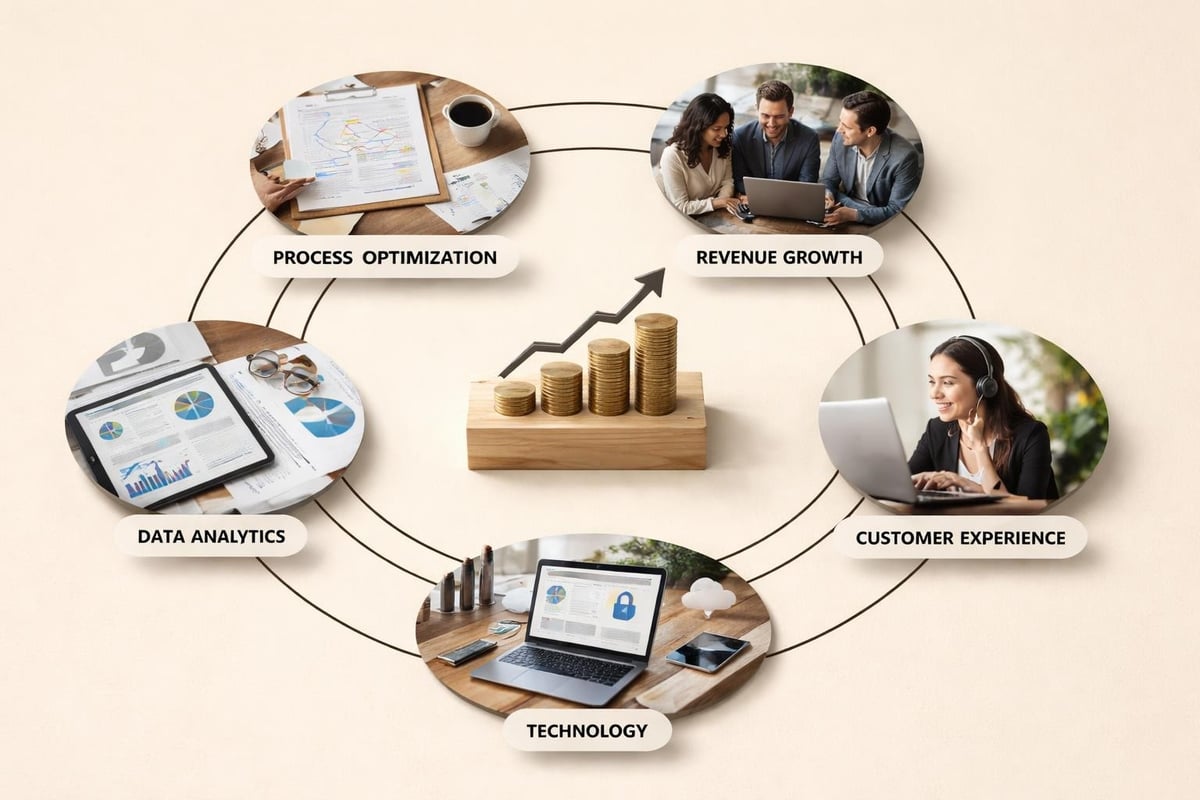
Revenue acceleration framework components

Leveraging Technology for Revenue Growth

Technology serves as the primary catalyst for modern revenue acceleration initiatives. Artificial intelligence and automation tools eliminate thousands of hours previously spent on repetitive tasks, freeing high-value employees to focus on strategic activities that directly impact the bottom line. This transformation represents more than simple efficiency gains; it fundamentally reshapes how professional services organizations operate.

AI implementation has demonstrated remarkable potential for enhancing sales productivity across industries. Machine learning algorithms can now predict customer behavior with unprecedented accuracy, enabling teams to prioritize opportunities that offer the highest conversion probability and lifetime value.

Automation and Integration Benefits

Modern automation platforms deliver measurable advantages that directly support revenue acceleration objectives:

  1. Reduction in manual data entry saving 15-25 hours per employee weekly
  2. Improved proposal accuracy reducing errors by 60-80 percent
  3. Faster quote generation decreasing turnaround time from days to hours
  4. Enhanced customer responsiveness through automated workflow triggers
  5. Better resource allocation based on real-time performance metrics

These improvements create a cascading effect throughout the organization. When teams spend less time on administrative tasks, they can dedicate more energy to relationship building, strategic planning, and value creation activities that differentiate professional services firms in competitive markets.

Technology Category Primary Benefit Impact on Revenue Acceleration
CRM Automation Customer data centralization 18-25% faster sales cycles
AI-Powered Analytics Predictive insights 30-40% improved targeting
Workflow Integration Process streamlining 40-50% reduced manual effort
Document Automation Faster deliverables 20-35% increased capacity

Strategic Pricing and Monetization Models

Pricing strategy represents one of the most powerful levers for revenue acceleration, yet many professional services firms underutilize this critical component. Strategic pricing approaches can dramatically impact profitability without requiring additional resource investment or market expansion.

The shift toward value-based pricing models enables organizations to capture more revenue from existing client relationships while demonstrating clear ROI. This approach requires deep understanding of client outcomes and willingness to tie pricing to measurable business results rather than time-based billing structures.

Performance-Based Pricing Advantages

Performance-based models align consultant incentives with client success metrics, creating powerful revenue acceleration opportunities:

  • Stronger client relationships built on shared outcomes
  • Higher average transaction values reflecting delivered value
  • Increased retention rates through demonstrated ROI
  • Differentiation from competitors using traditional billing methods
  • Natural expansion pathways as client success grows

This pricing philosophy particularly resonates with organizations seeking to transform their operations through technology and process improvements. When consultancies guarantee specific outcomes, they build trust while positioning themselves as true partners rather than vendors.

Aligning Marketing and Sales for Maximum Impact

Revenue acceleration demands seamless coordination between marketing and sales functions. Traditional silos create friction that extends sales cycles and reduces conversion efficiency. Aligning these teams around shared metrics and unified processes eliminates handoff delays and ensures consistent messaging throughout the buyer journey.

Professional services firms benefit tremendously from this alignment because their sales cycles typically involve multiple stakeholders and extended evaluation periods. When marketing generates qualified leads based on criteria jointly defined with sales, conversion rates improve substantially while time-to-close decreases measurably.

Marketing and sales alignment workflow

Building Effective Alignment Frameworks

Creating sustainable alignment requires more than occasional meetings or shared dashboards. Organizations must establish systematic processes that embed collaboration into daily operations:

  1. Define unified customer profiles incorporating insights from both teams
  2. Establish shared KPIs measuring end-to-end revenue generation
  3. Create service level agreements governing lead quality and response times
  4. Implement regular feedback loops for continuous process refinement
  5. Deploy integrated technology platforms providing visibility across functions

These frameworks transform how professional services organizations approach growth. Instead of marketing generating leads that sales may or may not pursue, both teams work collaboratively to attract, engage, and convert ideal customers efficiently.

Optimizing the Customer Journey

Every interaction along the customer journey presents opportunities to accelerate or impede revenue generation. Professional services firms must map these touchpoints comprehensively, identifying friction points that slow progression from awareness to closed business. This analysis reveals specific areas where process improvements deliver disproportionate returns.

The most successful revenue acceleration initiatives focus intensely on reducing time between major milestones in the buyer journey. B2B sales acceleration strategies emphasize removing obstacles that prevent prospects from making purchasing decisions, whether those barriers are informational, procedural, or technological.

Critical Journey Optimization Areas

Journey Stage Common Friction Points Acceleration Tactics
Awareness Limited market visibility Content marketing, thought leadership
Consideration Unclear value proposition Case studies, ROI calculators
Evaluation Complex proposal process Automated proposal generation
Decision Approval workflow delays Streamlined contracting, e-signatures
Onboarding Manual setup processes Automated workflows, self-service portals

Each optimization creates compounding benefits. When prospects move efficiently from one stage to the next, sales cycles compress, win rates improve, and customer satisfaction increases. These improvements directly translate to measurable revenue acceleration across the entire organization.

Data Analytics and Predictive Intelligence

Modern revenue acceleration depends heavily on sophisticated data analytics capabilities. Organizations must move beyond basic reporting to embrace predictive intelligence that anticipates customer needs, identifies growth opportunities, and optimizes resource allocation. This analytical maturity separates market leaders from competitors struggling with traditional reactive approaches.

Professional services firms possess tremendous data assets in client engagements, project outcomes, and relationship histories. Properly analyzed, this information reveals patterns that inform everything from pricing strategies to service development priorities. Revenue Grid’s research demonstrates how data-driven approaches streamline sales processes while boosting overall performance metrics.

Implementing Predictive Analytics

Effective predictive analytics programs require structured implementation addressing both technology and organizational capabilities:

  • Data consolidation from disparate systems into unified platforms
  • Quality assurance ensuring accuracy and completeness
  • Model development tailored to specific business questions
  • User training enabling teams to leverage insights effectively
  • Continuous refinement based on actual outcomes versus predictions

These capabilities enable professional services firms to anticipate which clients will require additional services, which prospects are most likely to convert, and which projects deliver the highest margins. This intelligence directly supports revenue acceleration by focusing resources on the highest-value opportunities.

Data analytics driving revenue decisions

Human Capital Management and Employee Enablement

Revenue acceleration extends beyond processes and technology to encompass human capital optimization. Employees who feel empowered, healthy, and financially secure perform at higher levels while delivering superior client experiences. This connection between employee wellbeing and business outcomes represents a critical but often overlooked component of sustainable growth strategies.

Professional services organizations depend entirely on human talent to deliver value. Investing in employee mental, physical, and financial health creates direct pathways to improved productivity, reduced turnover, and enhanced client satisfaction. These factors collectively accelerate revenue by ensuring top performers remain engaged and focused on high-value activities.

Employee Enablement Strategies

Forward-thinking firms implement comprehensive programs addressing multiple dimensions of employee wellbeing:

  1. Mental health support through counseling access and stress management resources
  2. Physical wellness initiatives encouraging healthy lifestyles and preventive care
  3. Financial education programs helping employees build long-term security
  4. Career development pathways creating clear advancement opportunities
  5. Technology tools eliminating frustrating manual processes

When employees feel supported holistically, they bring their best selves to client engagements. This translates directly to better outcomes, stronger relationships, and increased revenue opportunities through referrals and expanded engagements.

Revenue Cycle Management in Healthcare Services

For professional services firms operating in healthcare, revenue cycle management represents a specialized application of revenue acceleration principles. These organizations face unique challenges including complex billing requirements, regulatory compliance burdens, and extended payment cycles that strain cash flow and operational efficiency.

Optimizing healthcare revenue cycles requires deep expertise in claims processing, denial management, and payer relationship management. Automation and artificial intelligence deliver particularly strong returns in this domain by reducing coding errors, accelerating claims submission, and identifying denial patterns before they impact revenue.

Healthcare Revenue Optimization Tactics

Healthcare-focused consultancies employ specialized strategies to accelerate client revenue:

  • Automated coding verification reducing claim denials by 35-50 percent
  • Predictive denial management addressing issues before submission
  • Patient payment optimization through flexible billing options
  • Payer contract analysis ensuring appropriate reimbursement rates
  • Compliance automation reducing audit risk and penalties

These interventions create measurable financial impact for healthcare clients while positioning consultancies as indispensable partners. The ability to demonstrate clear ROI through reduced days in accounts receivable and improved collection rates drives both client retention and expansion opportunities.

Implementation Roadmap for Professional Services Firms

Implementing comprehensive revenue acceleration requires structured approaches that balance quick wins with long-term transformation initiatives. Professional services firms should develop phased roadmaps addressing immediate pain points while building toward more sophisticated capabilities over time.

The most successful implementations begin with diagnostic assessments identifying specific bottlenecks constraining revenue growth. These assessments examine technology infrastructure, process efficiency, organizational alignment, and capability gaps. Armed with this intelligence, firms can prioritize initiatives delivering maximum impact relative to implementation effort.

Phase-Based Implementation Approach

Phase Duration Key Activities Expected Outcomes
Discovery 4-6 weeks Process mapping, technology audit, stakeholder interviews Prioritized opportunity list
Foundation 8-12 weeks Core technology deployment, process redesign, team training 15-20% efficiency gains
Acceleration 12-16 weeks Advanced automation, analytics implementation, optimization 25-35% revenue velocity increase
Maturity Ongoing Continuous improvement, capability expansion, scaling Sustained competitive advantage

This phased approach enables organizations to demonstrate value quickly while building momentum for more ambitious transformation initiatives. Early wins generate organizational support and funding for subsequent phases that deliver increasingly sophisticated capabilities.

Measuring Revenue Acceleration Success

Effective measurement frameworks provide visibility into revenue acceleration progress while enabling data-driven course corrections. Professional services firms should establish comprehensive metric suites tracking both leading indicators and lagging outcomes across multiple dimensions of performance.

Leading indicators such as sales cycle length, proposal win rates, and average deal size reveal how initiatives impact revenue generation velocity. Lagging indicators including quarterly revenue growth, customer lifetime value, and profitability margins demonstrate sustained business impact. Together, these metrics create holistic views of program effectiveness.

Essential Performance Metrics

Comprehensive measurement programs track key performance indicators across the revenue acceleration framework:

  • Sales cycle duration measuring time from initial contact to closed business
  • Conversion rates at each stage of the customer journey
  • Average transaction value reflecting pricing optimization success
  • Customer acquisition cost demonstrating efficiency improvements
  • Revenue per employee indicating productivity enhancements
  • Client retention rates showing relationship strength
  • Net promoter scores measuring customer satisfaction

Regular review of these metrics enables professional services firms to identify which initiatives deliver expected returns and which require adjustment. This disciplined approach to measurement ensures resources flow toward highest-impact activities while underperforming initiatives receive prompt attention or elimination.

Future Trends Shaping Revenue Acceleration

The revenue acceleration landscape continues evolving as new technologies and methodologies emerge. Professional services firms must maintain awareness of developing trends to sustain competitive advantages and capitalize on emerging opportunities. Several key developments warrant particular attention as organizations plan their 2026 strategies and beyond.

Artificial intelligence capabilities continue advancing rapidly, enabling increasingly sophisticated automation and prediction. Natural language processing now handles client communications, while machine learning algorithms optimize pricing in real-time based on competitive dynamics and customer behavior patterns. These technologies fundamentally reshape how professional services firms operate and compete.

The shift toward subscription and as-a-service models accelerates across industries, including professional services. This transition creates recurring revenue streams that improve predictability while aligning consultant incentives with ongoing client success. Firms embracing these models position themselves for sustainable growth as one-time project work becomes increasingly commoditized.


Revenue acceleration represents far more than tactical improvements to individual processes. It encompasses holistic transformation of how professional services organizations create, deliver, and capture value throughout the customer lifecycle. By implementing the strategies outlined above, firms position themselves for sustainable growth in increasingly competitive markets. Nero and Associates, Inc. helps organizations achieve measurable revenue acceleration through AI-powered automation, human capital optimization, and revenue cycle management solutions that save costs, save time, and deliver transformative business outcomes. Contact our performance-based consultancy to discover how we can help your organization eliminate manual processes and accelerate profitable growth.

Revenue Acceleration: Strategies for Sustainable Growth

Organizations today face unprecedented pressure to grow faster while operating more efficiently. The traditional approach of simply adding headcount or expanding market reach no longer delivers the competitive advantage needed to thrive. Revenue acceleration has emerged as a strategic imperative for professional services firms seeking to maximize growth potential while minimizing resource drain. This comprehensive approach combines technology, process optimization, and strategic alignment to create sustainable pathways toward increased profitability and market expansion.

Understanding Revenue Acceleration in Professional Services

Revenue acceleration represents a systematic methodology for increasing the velocity at which organizations generate income while simultaneously improving operational efficiency. Unlike traditional growth strategies that focus solely on top-line expansion, this approach examines the entire revenue lifecycle to identify bottlenecks, eliminate friction, and optimize conversion points throughout the customer journey.

For professional services firms, revenue acceleration requires a multifaceted strategy that addresses both external market opportunities and internal operational capabilities. The goal extends beyond simply closing more deals to creating sustainable systems that generate predictable, scalable revenue streams. This means examining every touchpoint where value is created, delivered, and captured.

The Core Components of Revenue Acceleration

Successful revenue acceleration strategies rest on four fundamental pillars that work in concert to drive measurable results:

  • Process optimization through automation and artificial intelligence
  • Strategic alignment between marketing, sales, and delivery teams
  • Data-driven decision making enabled by integrated analytics platforms
  • Customer experience enhancement across all engagement touchpoints
  • Technology enablement that reduces manual effort and increases throughput

Each component plays a distinct role in reducing the time between initial customer contact and revenue realization. When these elements work together cohesively, organizations experience compounding benefits that extend far beyond individual improvements.

Revenue acceleration framework components

Leveraging Technology for Revenue Growth

Technology serves as the primary catalyst for modern revenue acceleration initiatives. Artificial intelligence and automation tools eliminate thousands of hours previously spent on repetitive tasks, freeing high-value employees to focus on strategic activities that directly impact the bottom line. This transformation represents more than simple efficiency gains; it fundamentally reshapes how professional services organizations operate.

AI implementation has demonstrated remarkable potential for enhancing sales productivity across industries. Machine learning algorithms can now predict customer behavior with unprecedented accuracy, enabling teams to prioritize opportunities that offer the highest conversion probability and lifetime value.

Automation and Integration Benefits

Modern automation platforms deliver measurable advantages that directly support revenue acceleration objectives:

  1. Reduction in manual data entry saving 15-25 hours per employee weekly
  2. Improved proposal accuracy reducing errors by 60-80 percent
  3. Faster quote generation decreasing turnaround time from days to hours
  4. Enhanced customer responsiveness through automated workflow triggers
  5. Better resource allocation based on real-time performance metrics

These improvements create a cascading effect throughout the organization. When teams spend less time on administrative tasks, they can dedicate more energy to relationship building, strategic planning, and value creation activities that differentiate professional services firms in competitive markets.

Technology Category Primary Benefit Impact on Revenue Acceleration
CRM Automation Customer data centralization 18-25% faster sales cycles
AI-Powered Analytics Predictive insights 30-40% improved targeting
Workflow Integration Process streamlining 40-50% reduced manual effort
Document Automation Faster deliverables 20-35% increased capacity

Strategic Pricing and Monetization Models

Pricing strategy represents one of the most powerful levers for revenue acceleration, yet many professional services firms underutilize this critical component. Strategic pricing approaches can dramatically impact profitability without requiring additional resource investment or market expansion.

The shift toward value-based pricing models enables organizations to capture more revenue from existing client relationships while demonstrating clear ROI. This approach requires deep understanding of client outcomes and willingness to tie pricing to measurable business results rather than time-based billing structures.

Performance-Based Pricing Advantages

Performance-based models align consultant incentives with client success metrics, creating powerful revenue acceleration opportunities:

  • Stronger client relationships built on shared outcomes
  • Higher average transaction values reflecting delivered value
  • Increased retention rates through demonstrated ROI
  • Differentiation from competitors using traditional billing methods
  • Natural expansion pathways as client success grows

This pricing philosophy particularly resonates with organizations seeking to transform their operations through technology and process improvements. When consultancies guarantee specific outcomes, they build trust while positioning themselves as true partners rather than vendors.

Aligning Marketing and Sales for Maximum Impact

Revenue acceleration demands seamless coordination between marketing and sales functions. Traditional silos create friction that extends sales cycles and reduces conversion efficiency. Aligning these teams around shared metrics and unified processes eliminates handoff delays and ensures consistent messaging throughout the buyer journey.

Professional services firms benefit tremendously from this alignment because their sales cycles typically involve multiple stakeholders and extended evaluation periods. When marketing generates qualified leads based on criteria jointly defined with sales, conversion rates improve substantially while time-to-close decreases measurably.

Marketing and sales alignment workflow

Building Effective Alignment Frameworks

Creating sustainable alignment requires more than occasional meetings or shared dashboards. Organizations must establish systematic processes that embed collaboration into daily operations:

  1. Define unified customer profiles incorporating insights from both teams
  2. Establish shared KPIs measuring end-to-end revenue generation
  3. Create service level agreements governing lead quality and response times
  4. Implement regular feedback loops for continuous process refinement
  5. Deploy integrated technology platforms providing visibility across functions

These frameworks transform how professional services organizations approach growth. Instead of marketing generating leads that sales may or may not pursue, both teams work collaboratively to attract, engage, and convert ideal customers efficiently.

Optimizing the Customer Journey

Every interaction along the customer journey presents opportunities to accelerate or impede revenue generation. Professional services firms must map these touchpoints comprehensively, identifying friction points that slow progression from awareness to closed business. This analysis reveals specific areas where process improvements deliver disproportionate returns.

The most successful revenue acceleration initiatives focus intensely on reducing time between major milestones in the buyer journey. B2B sales acceleration strategies emphasize removing obstacles that prevent prospects from making purchasing decisions, whether those barriers are informational, procedural, or technological.

Critical Journey Optimization Areas

Journey Stage Common Friction Points Acceleration Tactics
Awareness Limited market visibility Content marketing, thought leadership
Consideration Unclear value proposition Case studies, ROI calculators
Evaluation Complex proposal process Automated proposal generation
Decision Approval workflow delays Streamlined contracting, e-signatures
Onboarding Manual setup processes Automated workflows, self-service portals

Each optimization creates compounding benefits. When prospects move efficiently from one stage to the next, sales cycles compress, win rates improve, and customer satisfaction increases. These improvements directly translate to measurable revenue acceleration across the entire organization.

Data Analytics and Predictive Intelligence

Modern revenue acceleration depends heavily on sophisticated data analytics capabilities. Organizations must move beyond basic reporting to embrace predictive intelligence that anticipates customer needs, identifies growth opportunities, and optimizes resource allocation. This analytical maturity separates market leaders from competitors struggling with traditional reactive approaches.

Professional services firms possess tremendous data assets in client engagements, project outcomes, and relationship histories. Properly analyzed, this information reveals patterns that inform everything from pricing strategies to service development priorities. Revenue Grid’s research demonstrates how data-driven approaches streamline sales processes while boosting overall performance metrics.

Implementing Predictive Analytics

Effective predictive analytics programs require structured implementation addressing both technology and organizational capabilities:

  • Data consolidation from disparate systems into unified platforms
  • Quality assurance ensuring accuracy and completeness
  • Model development tailored to specific business questions
  • User training enabling teams to leverage insights effectively
  • Continuous refinement based on actual outcomes versus predictions

These capabilities enable professional services firms to anticipate which clients will require additional services, which prospects are most likely to convert, and which projects deliver the highest margins. This intelligence directly supports revenue acceleration by focusing resources on the highest-value opportunities.

Data analytics driving revenue decisions

Human Capital Management and Employee Enablement

Revenue acceleration extends beyond processes and technology to encompass human capital optimization. Employees who feel empowered, healthy, and financially secure perform at higher levels while delivering superior client experiences. This connection between employee wellbeing and business outcomes represents a critical but often overlooked component of sustainable growth strategies.

Professional services organizations depend entirely on human talent to deliver value. Investing in employee mental, physical, and financial health creates direct pathways to improved productivity, reduced turnover, and enhanced client satisfaction. These factors collectively accelerate revenue by ensuring top performers remain engaged and focused on high-value activities.

Employee Enablement Strategies

Forward-thinking firms implement comprehensive programs addressing multiple dimensions of employee wellbeing:

  1. Mental health support through counseling access and stress management resources
  2. Physical wellness initiatives encouraging healthy lifestyles and preventive care
  3. Financial education programs helping employees build long-term security
  4. Career development pathways creating clear advancement opportunities
  5. Technology tools eliminating frustrating manual processes

When employees feel supported holistically, they bring their best selves to client engagements. This translates directly to better outcomes, stronger relationships, and increased revenue opportunities through referrals and expanded engagements.

Revenue Cycle Management in Healthcare Services

For professional services firms operating in healthcare, revenue cycle management represents a specialized application of revenue acceleration principles. These organizations face unique challenges including complex billing requirements, regulatory compliance burdens, and extended payment cycles that strain cash flow and operational efficiency.

Optimizing healthcare revenue cycles requires deep expertise in claims processing, denial management, and payer relationship management. Automation and artificial intelligence deliver particularly strong returns in this domain by reducing coding errors, accelerating claims submission, and identifying denial patterns before they impact revenue.

Healthcare Revenue Optimization Tactics

Healthcare-focused consultancies employ specialized strategies to accelerate client revenue:

  • Automated coding verification reducing claim denials by 35-50 percent
  • Predictive denial management addressing issues before submission
  • Patient payment optimization through flexible billing options
  • Payer contract analysis ensuring appropriate reimbursement rates
  • Compliance automation reducing audit risk and penalties

These interventions create measurable financial impact for healthcare clients while positioning consultancies as indispensable partners. The ability to demonstrate clear ROI through reduced days in accounts receivable and improved collection rates drives both client retention and expansion opportunities.

Implementation Roadmap for Professional Services Firms

Implementing comprehensive revenue acceleration requires structured approaches that balance quick wins with long-term transformation initiatives. Professional services firms should develop phased roadmaps addressing immediate pain points while building toward more sophisticated capabilities over time.

The most successful implementations begin with diagnostic assessments identifying specific bottlenecks constraining revenue growth. These assessments examine technology infrastructure, process efficiency, organizational alignment, and capability gaps. Armed with this intelligence, firms can prioritize initiatives delivering maximum impact relative to implementation effort.

Phase-Based Implementation Approach

Phase Duration Key Activities Expected Outcomes
Discovery 4-6 weeks Process mapping, technology audit, stakeholder interviews Prioritized opportunity list
Foundation 8-12 weeks Core technology deployment, process redesign, team training 15-20% efficiency gains
Acceleration 12-16 weeks Advanced automation, analytics implementation, optimization 25-35% revenue velocity increase
Maturity Ongoing Continuous improvement, capability expansion, scaling Sustained competitive advantage

This phased approach enables organizations to demonstrate value quickly while building momentum for more ambitious transformation initiatives. Early wins generate organizational support and funding for subsequent phases that deliver increasingly sophisticated capabilities.

Measuring Revenue Acceleration Success

Effective measurement frameworks provide visibility into revenue acceleration progress while enabling data-driven course corrections. Professional services firms should establish comprehensive metric suites tracking both leading indicators and lagging outcomes across multiple dimensions of performance.

Leading indicators such as sales cycle length, proposal win rates, and average deal size reveal how initiatives impact revenue generation velocity. Lagging indicators including quarterly revenue growth, customer lifetime value, and profitability margins demonstrate sustained business impact. Together, these metrics create holistic views of program effectiveness.

Essential Performance Metrics

Comprehensive measurement programs track key performance indicators across the revenue acceleration framework:

  • Sales cycle duration measuring time from initial contact to closed business
  • Conversion rates at each stage of the customer journey
  • Average transaction value reflecting pricing optimization success
  • Customer acquisition cost demonstrating efficiency improvements
  • Revenue per employee indicating productivity enhancements
  • Client retention rates showing relationship strength
  • Net promoter scores measuring customer satisfaction

Regular review of these metrics enables professional services firms to identify which initiatives deliver expected returns and which require adjustment. This disciplined approach to measurement ensures resources flow toward highest-impact activities while underperforming initiatives receive prompt attention or elimination.

Future Trends Shaping Revenue Acceleration

The revenue acceleration landscape continues evolving as new technologies and methodologies emerge. Professional services firms must maintain awareness of developing trends to sustain competitive advantages and capitalize on emerging opportunities. Several key developments warrant particular attention as organizations plan their 2026 strategies and beyond.

Artificial intelligence capabilities continue advancing rapidly, enabling increasingly sophisticated automation and prediction. Natural language processing now handles client communications, while machine learning algorithms optimize pricing in real-time based on competitive dynamics and customer behavior patterns. These technologies fundamentally reshape how professional services firms operate and compete.

The shift toward subscription and as-a-service models accelerates across industries, including professional services. This transition creates recurring revenue streams that improve predictability while aligning consultant incentives with ongoing client success. Firms embracing these models position themselves for sustainable growth as one-time project work becomes increasingly commoditized.


Revenue acceleration represents far more than tactical improvements to individual processes. It encompasses holistic transformation of how professional services organizations create, deliver, and capture value throughout the customer lifecycle. By implementing the strategies outlined above, firms position themselves for sustainable growth in increasingly competitive markets. Nero and Associates, Inc. helps organizations achieve measurable revenue acceleration through AI-powered automation, human capital optimization, and revenue cycle management solutions that save costs, save time, and deliver transformative business outcomes. Contact our performance-based consultancy to discover how we can help your organization eliminate manual processes and accelerate profitable growth.

Website developed in accordance with Web Content Accessibility Guidelines 2.2.
If you encounter any issues while using this site, please contact us: 215.526.5126