

Risk adjustment has become a cornerstone of modern healthcare finance and operational strategy, fundamentally changing how organizations allocate resources, predict costs, and ensure equitable payment distribution. As healthcare systems grow increasingly complex in 2026, understanding and implementing effective risk adjustment methodologies enables organizations to align financial incentives with patient needs while maintaining sustainable business operations. For organizations seeking to optimize revenue cycles and improve operational efficiency, mastering these principles represents both a competitive advantage and a compliance imperative.
Understanding the Fundamentals of Risk Adjustment
Risk adjustment is a statistical process that accounts for variations in patient health status when determining appropriate payment levels for healthcare services. This methodology ensures that providers caring for sicker, more complex patient populations receive adequate compensation compared to those treating healthier individuals.
The concept emerged from a fundamental challenge in healthcare economics: without adjustment mechanisms, insurance plans and healthcare providers have financial incentives to avoid high-risk patients. By implementing risk adjustment, payers can neutralize these incentives and promote access to care for all populations regardless of health status.
Core Components of Risk Adjustment Models
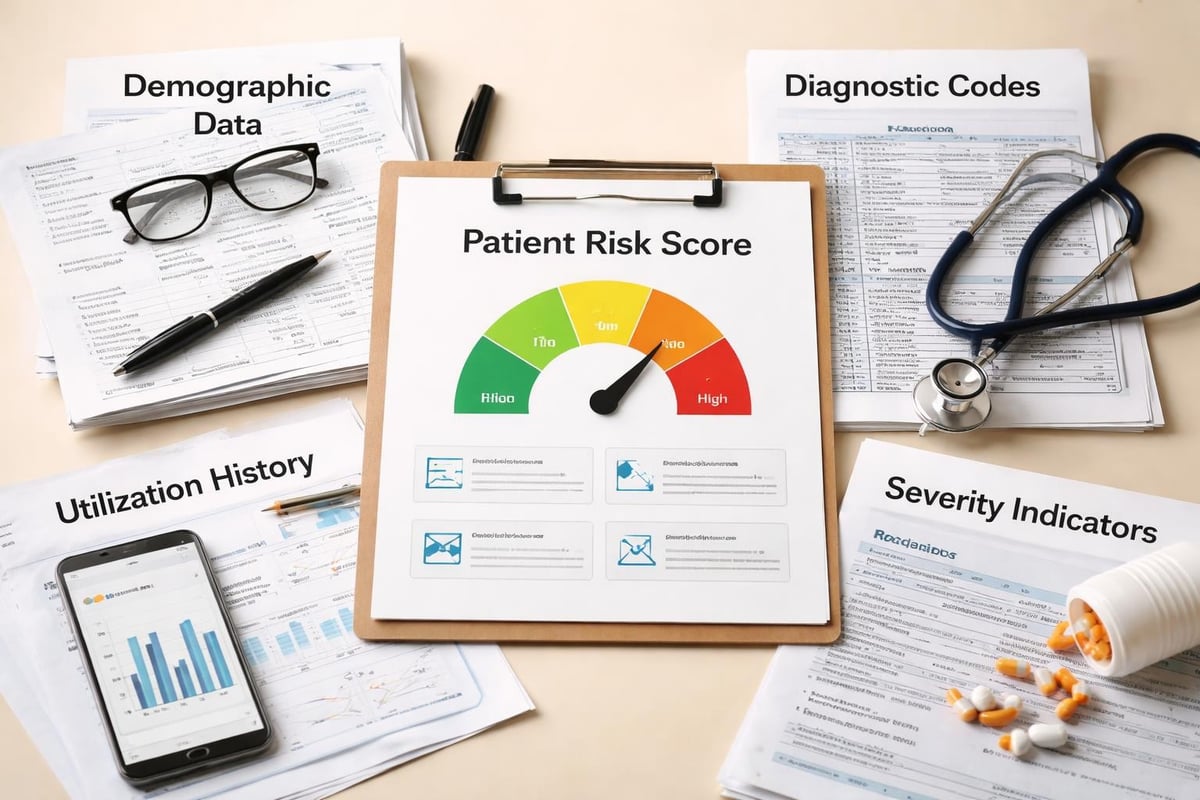
Modern risk adjustment systems incorporate several essential elements:
- Demographic factors including age, gender, and geographic location
- Diagnostic information captured through standardized coding systems
- Historical utilization patterns that indicate future resource needs
- Severity indicators that distinguish between mild and serious conditions
- Interaction terms that account for multiple concurrent conditions
These components work together to generate risk scores that predict expected healthcare costs. A patient with diabetes, heart disease, and kidney complications receives a higher risk score than a healthy 30-year-old, reflecting the anticipated difference in medical expenses.
Risk Adjustment in Medicare Advantage and Commercial Insurance
The Medicare Advantage program represents one of the most sophisticated applications of risk adjustment methodology. Plans receive monthly payments from the Centers for Medicare & Medicaid Services (CMS) based on the risk scores of enrolled beneficiaries. Research examining risk selection in Medicare Advantage programs demonstrates how these systems influence both plan behavior and government expenditures.
Implementation Across Different Payer Systems
Different insurance sectors have adopted varied approaches to risk adjustment:
| Payer Type | Primary Model | Key Features | Update Frequency |
|---|---|---|---|
| Medicare Advantage | CMS-HCC | Hierarchical condition categories | Annual |
| Marketplace Plans | HHS-HCC | Similar to CMS with modifications | Annual |
| Medicaid | State-specific | Varies by jurisdiction | Varies |
| Commercial | Proprietary | Custom algorithms | Continuous |
Each model reflects unique population characteristics and policy objectives. Medicare Advantage plans focus heavily on chronic disease management, while commercial models often emphasize pharmaceutical costs and preventive care patterns.
The Society of Actuaries provides comprehensive perspectives on these methodologies, offering insights into how different approaches affect reimbursement accuracy and organizational incentives.
Operational Impact on Revenue Cycle Management
For organizations managing complex revenue cycles, risk adjustment represents both an opportunity and a challenge. Accurate capture of patient complexity directly impacts payment levels, making documentation and coding precision essential operational functions.
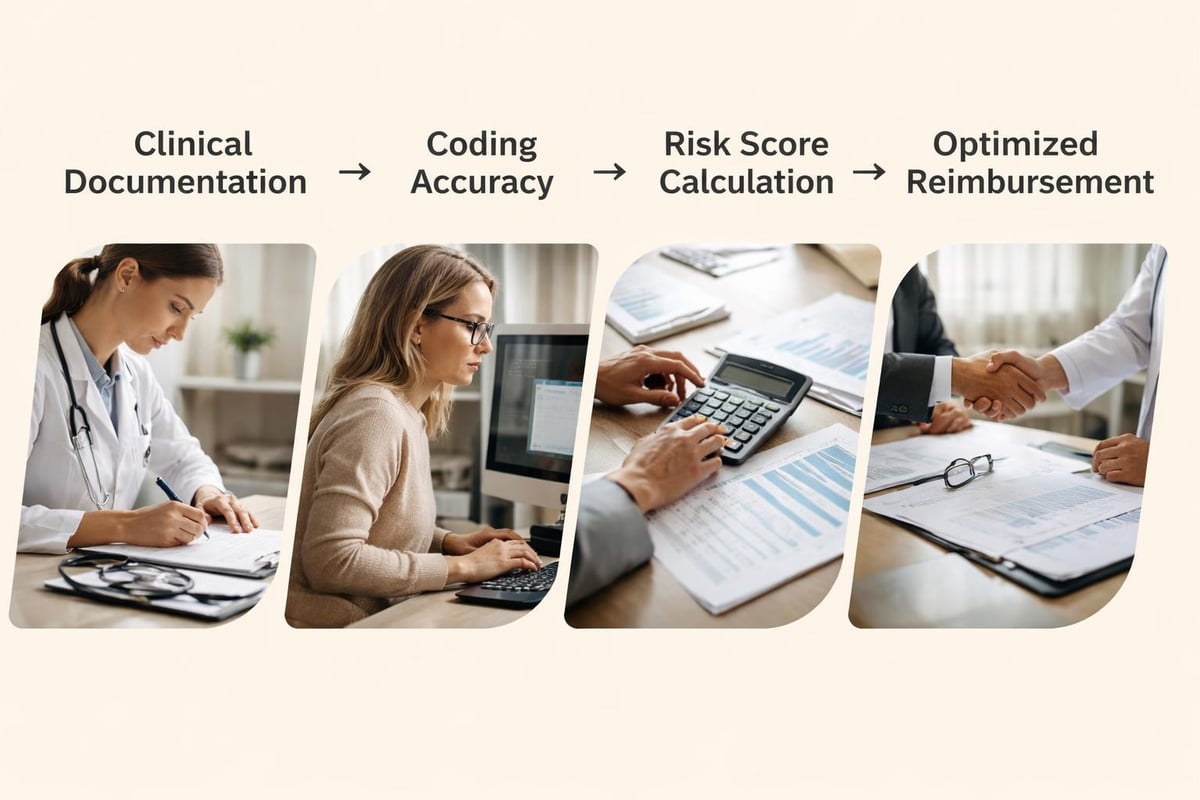
Revenue cycle teams must understand the intricate relationship between clinical documentation, coding accuracy, and risk score calculation. A missed diagnosis code or incomplete documentation can result in thousands of dollars in lost revenue per patient annually.
Documentation and Coding Excellence
Achieving optimal risk adjustment outcomes requires systematic approaches:
- Clinical documentation improvement programs that train providers to document comprehensively
- Regular coding audits to ensure accuracy and compliance
- Technology integration connecting electronic health records with coding systems
- Analytics platforms that identify documentation gaps before claims submission
- Compliance frameworks that balance revenue optimization with regulatory requirements
These operational elements transform risk adjustment from a passive reimbursement mechanism into an active revenue optimization strategy. Organizations that excel in these areas typically see 10-15% improvement in risk-adjusted revenues within the first year of focused initiatives.
Advanced Analytics and Machine Learning Applications
The evolution of risk adjustment methodology increasingly incorporates sophisticated analytical techniques. Research on simplifying risk adjustment systems demonstrates how machine learning algorithms can improve predictive accuracy while reducing model complexity.
Modern organizations leverage these technologies to:
- Identify patients likely to develop chronic conditions
- Predict future healthcare utilization patterns
- Optimize care management resources
- Detect coding errors and documentation gaps
- Forecast revenue based on population health trends
Implementing Predictive Models
Artificial intelligence transforms traditional risk adjustment from a retrospective payment calculation into a prospective management tool. Organizations can now identify high-risk patients before they experience costly health events, enabling preventive interventions that simultaneously improve outcomes and reduce expenses.
These capabilities align perfectly with value-based care initiatives, where providers assume financial risk for population health outcomes. Accurate risk stratification enables targeted resource allocation to patients who benefit most from intensive management.
Risk Equalization and Payment Equity
Beyond individual organizational applications, risk adjustment serves broader policy objectives related to market stability and access to care. The concept of risk equalization ensures that health insurance markets function efficiently without incentivizing discrimination against high-cost enrollees.
Market-Level Implications
When properly designed, risk adjustment systems create several market benefits:
- Reduced premium variation across plans serving different populations
- Enhanced competition based on efficiency rather than risk selection
- Improved access for patients with chronic conditions
- Stabilized insurance markets through predictable payment patterns
However, implementation challenges persist. Studies on responsiveness of expenditure to need reveal that standard risk adjustment models may not adequately align resources with patient needs across all conditions and populations.
Regulatory Compliance and Audit Preparedness
Organizations participating in risk-adjusted payment programs face significant compliance obligations. The Office of Inspector General and CMS regularly audit Medicare Advantage organizations to ensure appropriate diagnosis reporting and documentation support.
Building Robust Compliance Programs
Effective compliance frameworks include:
- Prospective chart reviews to validate diagnosis reporting before submission
- Retrospective audits sampling submitted claims for accuracy
- Provider education on documentation requirements and coding guidelines
- Technology controls that flag unusual coding patterns
- External validation through third-party auditors
These elements protect organizations from payment recoupments, civil monetary penalties, and program exclusion. Given that risk adjustment audit failures can trigger multi-million dollar repayment demands, investment in compliance infrastructure represents essential risk management.
Organizations must balance aggressive documentation improvement initiatives with conservative compliance practices. The tension between maximizing legitimate revenue and avoiding overcoding requires sophisticated governance and clear ethical boundaries.
Patient Experience and Quality Measurement
Risk adjustment methodologies extend beyond payment calculation to quality measurement and patient experience assessment. Research on patient risk adjustment models demonstrates applications in long-term care settings, where patient complexity significantly influences survey responses and quality metrics.
Adjusting Performance Metrics
Healthcare organizations increasingly face quality-based payment adjustments and public reporting of performance measures. Without appropriate risk adjustment, these systems unfairly penalize providers serving complex, disadvantaged populations.
Key quality domains requiring risk adjustment include:
| Measure Category | Adjustment Factors | Rationale |
|---|---|---|
| Readmissions | Diagnosis severity, social determinants | Sicker patients have higher baseline risk |
| Patient experience | Health status, survey mode | Illness affects perception and response |
| Clinical outcomes | Comorbidities, functional status | Multiple conditions complicate treatment |
| Cost efficiency | Case mix, demographics | Different populations require different resources |
Sophisticated risk adjustment in quality measurement promotes fairness while maintaining accountability for genuinely controllable outcomes.

Strategic Integration with Human Capital Management
For organizations providing comprehensive employee benefits, understanding risk adjustment principles enhances human capital management strategies. Self-insured employers can apply these methodologies to:
- Predict healthcare costs more accurately for budget planning
- Design targeted wellness programs based on population risk profiles
- Evaluate vendor performance accounting for employee health complexity
- Optimize benefit designs that address specific population needs
Integration of risk adjustment analytics with human capital systems creates opportunities for proactive health management. Identifying high-risk employees enables early intervention programs that prevent costly medical events while supporting employee wellbeing.
Technology Infrastructure and Data Integration
Successful risk adjustment programs require sophisticated data infrastructure connecting multiple information sources. Organizations must integrate:
- Electronic health records containing clinical documentation
- Claims processing systems with diagnosis and procedure codes
- Laboratory and imaging systems providing diagnostic evidence
- Pharmacy systems indicating medication usage patterns
- External data sources including health information exchanges
This integration enables real-time risk score calculation, documentation gap identification, and predictive modeling. Organizations investing in robust data platforms achieve significantly better risk adjustment outcomes than those relying on manual processes.
Modern cloud-based solutions facilitate these integrations while providing analytics capabilities that transform raw data into actionable insights. Automation eliminates thousands of manual hours previously required for chart review, coding validation, and submission preparation.
Future Trends and Emerging Considerations
The risk adjustment landscape continues to evolve in response to policy changes, technological advances, and market dynamics. Several trends are shaping the field in 2026:
Social determinants of health are increasingly incorporated into risk models, recognizing that non-medical factors significantly influence health outcomes and costs. Future iterations will likely weight factors like housing stability, food security, and transportation access alongside traditional clinical variables.
Real-time data integration enables continuous risk score updates rather than annual recalculations, allowing more responsive payment adjustments and care management interventions.
Alternative payment models are expanding risk adjustment applications beyond traditional insurance programs to accountable care organizations, bundled payment arrangements, and direct contracting entities.
Preparing for Regulatory Evolution
Organizations should monitor proposed changes to risk adjustment methodologies and prepare operational systems for adaptation. The transition from ICD-9 to ICD-10 coding demonstrated how methodological updates can significantly impact organizational processes and financial outcomes.
Building flexible systems that accommodate regulatory changes without requiring complete operational overhauls represents strategic investment in long-term sustainability.
Risk adjustment has evolved from a narrow payment calculation into a comprehensive framework influencing revenue management, quality measurement, and population health strategy. Organizations that master these principles gain competitive advantages through optimized reimbursement, improved compliance, and enhanced operational efficiency. Nero and Associates, Inc. helps organizations implement sophisticated revenue cycle management solutions that capture the full value of risk adjustment while automating manual processes, ensuring compliance, and improving financial performance through our proven consulting methodologies and technology integration expertise.