

Healthcare organizations face mounting pressure to deliver exceptional patient care while managing complex administrative tasks, regulatory compliance, and revenue cycle challenges. Robotic process automation offers a powerful solution to these operational pain points. By implementing rpa healthcare solutions, medical facilities can eliminate thousands of hours of manual data entry, accelerate claims processing, and free clinical staff to focus on what matters most: patient outcomes. This technology-driven approach enables healthcare providers to achieve operational excellence while simultaneously improving financial performance and staff satisfaction.
Understanding RPA in Modern Healthcare Settings
Robotic process automation represents a fundamental shift in how healthcare organizations approach routine operational tasks. Unlike traditional automation that requires extensive custom coding, RPA uses software robots to mimic human actions across existing systems and applications.
These digital workers can log into applications, copy and paste data, complete forms, extract structured information from documents, and perform rule-based tasks with remarkable speed and accuracy. The technology excels at high-volume, repetitive tasks that follow predictable patterns, making it ideal for healthcare environments where administrative burden continues to grow.
Core Components of Healthcare RPA Systems
RPA healthcare implementations typically include several key technical elements working in concert:
- Software bots that execute programmed workflows across multiple systems
- Process orchestration platforms that manage bot deployment and scheduling
- Exception handling protocols to route complex cases to human staff
- Audit trails and compliance monitoring for regulatory adherence
- Integration layers that connect legacy systems without API requirements
Most healthcare organizations start with attended automation, where bots work alongside staff members to complete tasks more efficiently. As confidence grows, they expand into unattended automation that runs independently, processing work during off-hours and peak demand periods.
High-Impact Use Cases Transforming Healthcare Operations
Revenue cycle management represents one of the most compelling applications for rpa healthcare technology. Medical billing involves numerous repetitive steps that drain staff time and introduce costly errors when performed manually.
Claims Processing and Denial Management
Claims submission requires gathering patient information, verifying insurance coverage, applying correct coding, and submitting to multiple payers with varying requirements. RPA bots can execute these steps in minutes rather than hours, processing hundreds of claims daily with consistent accuracy.
When claims are denied, automated systems can immediately identify the rejection reason, categorize the issue, gather necessary documentation, and resubmit or route for human review based on complexity. This rapid response dramatically reduces days in accounts receivable and improves cash flow.
| RPA Benefit | Manual Process | Automated Process | Impact |
|---|---|---|---|
| Claim submission time | 15-20 minutes | 2-3 minutes | 85% reduction |
| Error rate | 5-8% | <1% | 90% improvement |
| Denial resolution time | 14-21 days | 3-5 days | 75% faster |
| Processing capacity | 20-25 claims/day | 200+ claims/day | 10x increase |
Healthcare providers implementing revenue cycle management solutions report significant improvements in clean claim rates and revenue capture.
Patient Registration and Scheduling Optimization
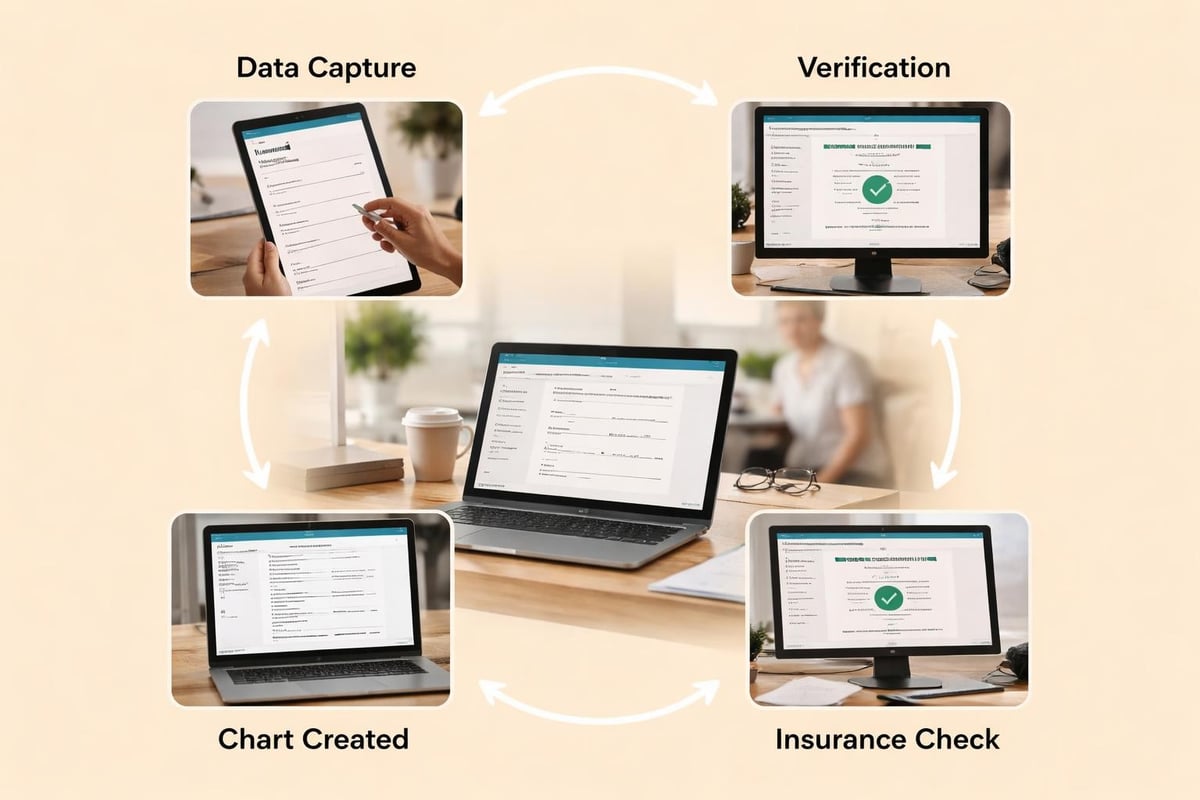
The patient journey begins with registration, a process that traditionally requires staff to manually enter demographic information, insurance details, and medical history across multiple systems. RPA eliminates this redundancy by capturing data once and populating all necessary platforms automatically.
Appointment scheduling bots can check provider availability, verify insurance coverage, send confirmation messages, and update calendars across clinical and administrative systems. They can also manage waitlists, identify cancellations, and proactively reach out to patients for rescheduling opportunities.
These automation capabilities reduce no-show rates while maximizing provider utilization, directly impacting organizational revenue and patient access to care.
Administrative Efficiency Gains Through Intelligent Automation
Healthcare administration encompasses countless processes that consume staff time without adding direct clinical value. RPA benefits healthcare providers by transforming these operational workflows.
Prior Authorization and Referral Management
Prior authorization remains one of the most frustrating administrative processes for both providers and patients. The average authorization requires multiple phone calls, fax submissions, and follow-ups spanning several days or weeks.
RPA bots can automatically submit authorization requests, check status updates, retrieve approval decisions, and document outcomes in patient records. For denied requests, bots gather clinical documentation and resubmit with supporting evidence, significantly reducing approval timeframes.
Referral management follows similar patterns. Bots can identify when referrals are needed based on clinical protocols, verify specialist network participation, submit referral requests, track approval status, and coordinate appointment scheduling.
- System identifies referral requirement based on diagnosis or treatment plan
- Bot verifies patient insurance and specialist network status
- Automated referral submission with complete clinical documentation
- Continuous status monitoring until approval received
- Patient notification and appointment coordination
- Documentation updated across all relevant systems
This streamlined approach reduces referral leakage, ensures patients receive timely specialty care, and maintains network compliance.
Data Management and Electronic Health Record Optimization
Electronic health records have created new data entry burdens as providers document across multiple screens and fields. RPA can extract information from various sources, including lab results, imaging reports, and external clinical documents, automatically populating EHR fields with structured data.
IBM’s exploration of RPA for healthcare highlights how organizations use bots to reconcile patient records across systems, identify duplicate entries, and maintain data integrity without manual intervention.

Financial Operations and Compliance Automation
Beyond clinical operations, rpa healthcare implementations deliver substantial value in financial and compliance functions that traditionally require significant manual effort.
Invoice Processing and Vendor Management
Healthcare organizations process thousands of invoices monthly for supplies, equipment, services, and contracted labor. Manual invoice processing involves receiving documents in various formats, extracting key information, matching to purchase orders, routing for approval, and entering data into accounts payable systems.
Bots can handle this entire workflow autonomously. They extract invoice details using optical character recognition, validate against purchase orders and contracts, route exceptions for human review, and process approved invoices for payment. This approach accelerates payment cycles while capturing early payment discounts.
Regulatory Reporting and Audit Preparation
Healthcare faces extensive regulatory requirements with strict reporting deadlines and accuracy standards. RPA excels at gathering data from disparate systems, validating completeness, formatting reports according to regulatory specifications, and submitting on schedule.
For audit preparation, bots can quickly compile requested documentation, organize files according to audit protocols, and generate summary reports that reduce the time auditors spend on-site. This automation significantly reduces the staff burden during audit season while ensuring comprehensive documentation.
| Compliance Function | Traditional Approach | RPA-Enabled Approach |
|---|---|---|
| Quality measure reporting | 40+ hours/quarter | 4-6 hours/quarter |
| Audit documentation | 2-3 weeks preparation | 2-3 days preparation |
| Regulatory submissions | Manual data gathering | Automated compilation |
| Compliance monitoring | Periodic sampling | Continuous validation |
Understanding key RPA use cases and benefits in healthcare helps organizations prioritize implementation efforts for maximum impact.
Implementation Strategies for Healthcare Organizations
Successful rpa healthcare deployment requires thoughtful planning and a structured approach that balances quick wins with long-term transformation goals.
Process Selection and Prioritization
Not every process makes a good candidate for automation. The ideal starting points involve high-volume, rule-based tasks with clearly defined inputs and outputs. Look for processes where staff spend significant time on repetitive activities that follow consistent patterns.
Priority should go to processes that impact revenue cycle performance, regulatory compliance, or patient experience. These areas deliver measurable ROI while addressing critical organizational priorities.
Evaluate potential processes using these criteria:
- Volume: How many transactions occur monthly?
- Complexity: Are decision rules clearly defined or highly subjective?
- Stability: Does the process change frequently or remain consistent?
- Impact: What value does automation create (time saved, errors reduced, revenue accelerated)?
- Feasibility: Are systems accessible to bots and well-documented?
Building Cross-Functional Implementation Teams
Healthcare RPA initiatives succeed when they include diverse perspectives. Implementation teams should include:
- Clinical staff who understand workflow nuances and patient impact
- IT professionals who manage technical infrastructure and security
- Revenue cycle leaders who identify financial optimization opportunities
- Compliance officers who ensure regulatory adherence
- Process improvement specialists who document and optimize workflows
- Change management experts who drive adoption and communication
This collaborative approach ensures automation solutions address real operational challenges while maintaining clinical quality and regulatory compliance standards.
Measuring ROI and Performance Outcomes
Healthcare organizations implementing rpa healthcare solutions must establish clear metrics to demonstrate value and guide continuous improvement. Financial metrics provide essential validation for automation investments.
Quantifiable Financial Benefits
Direct cost savings emerge from reduced full-time equivalent requirements for routine administrative tasks. While most organizations redeploy staff to higher-value activities rather than reducing headcount, the capacity gained represents real financial benefit.
Revenue acceleration through faster claims processing, improved clean claim rates, and reduced denial write-offs often exceeds direct cost savings. Organizations typically see a 15-25% reduction in days in accounts receivable within six months of implementing revenue cycle automation.
Error reduction translates to financial impact by eliminating rework costs, reducing compliance penalties, and preventing revenue leakage. Each prevented claim error saves 30-45 minutes of staff time while protecting revenue that might otherwise be lost.
Operational Performance Indicators
Beyond financial metrics, operational KPIs demonstrate how automation improves organizational effectiveness:
- Processing speed: Time required to complete key workflows
- Accuracy rates: Percentage of transactions processed without errors
- Capacity utilization: Volume of work completed with existing resources
- Staff satisfaction: Employee engagement scores in automated departments
- Patient experience: Wait times, appointment access, and satisfaction scores
Organizations should track metrics before and after automation to demonstrate improvement and identify optimization opportunities. Addressing key challenges in healthcare through RPA requires ongoing measurement and refinement.
Integration with Emerging Healthcare Technologies
RPA healthcare implementations increasingly combine with other advanced technologies to create more intelligent automation solutions. Artificial intelligence and machine learning enhance basic RPA capabilities by adding cognitive functions that handle unstructured data and complex decision-making.
Intelligent Document Processing
Traditional RPA excels with structured data in predictable formats. When combined with AI-powered optical character recognition and natural language processing, bots can extract information from unstructured clinical notes, handwritten forms, and variable-format documents.
This capability proves particularly valuable for processing referral documentation, insurance authorizations, and external medical records that arrive in inconsistent formats. The system learns to identify relevant information regardless of document structure, dramatically expanding automation potential.
Predictive Analytics and Proactive Intervention
Machine learning models can analyze patterns in automated workflows to predict issues before they occur. For example, analyzing historical claim denials helps identify submissions likely to be rejected, triggering proactive review and correction before submission.
Similarly, patient scheduling patterns can predict no-show likelihood, enabling targeted reminder interventions for high-risk appointments. These predictive capabilities transform RPA from reactive automation to proactive optimization.
Change Management and Staff Enablement
Technology implementation alone does not guarantee success. Healthcare organizations must invest in change management to ensure staff embrace automation and leverage it effectively.
Addressing Automation Concerns
Staff often worry that automation threatens their jobs. Leaders must clearly communicate that RPA eliminates tedious tasks, not positions. Freed from repetitive data entry and routine processing, staff can focus on complex problem-solving, patient interaction, and professional development.
Organizations that successfully implement automation typically create new roles focused on bot management, process improvement, and exception handling. These positions offer career advancement opportunities while ensuring automation delivers sustained value.
Training and Continuous Learning
Staff need training on how to work effectively with automated systems. This includes understanding what bots can and cannot do, knowing when to intervene in automated processes, and identifying opportunities for new automation.
Creating a culture of continuous improvement encourages staff at all levels to suggest processes for automation. Reducing inefficiencies within healthcare operations requires ongoing collaboration between technology teams and operational staff who understand workflow challenges firsthand.
Security and Compliance Considerations
Healthcare automation must maintain the highest standards for data security and regulatory compliance. Robotic process automation introduces new considerations that organizations must address proactively.
HIPAA and Data Protection
RPA bots access the same protected health information as human staff members, requiring equivalent security controls. Bot credentials must be secured, access should follow least-privilege principles, and all activities must be logged for audit purposes.
Unlike human users, bots can be configured to never store sensitive data locally, immediately purge information after processing, and encrypt all data transmissions by default. These capabilities actually enhance security compared to manual processes where staff might email sensitive information or save files to unsecured locations.
Audit Trails and Governance
Every action performed by RPA bots should be logged with timestamps, user identification, and detailed activity records. This creates comprehensive audit trails that exceed typical human documentation standards.
Governance frameworks should define who can create bots, what approvals are required before deployment, how changes are tested and validated, and when bots should be retired or updated. These controls ensure automation remains compliant as regulations and business requirements evolve.
Scaling Automation Across Healthcare Enterprises
Organizations that achieve early success with pilot projects often struggle to scale automation across the enterprise. Strategic scaling requires dedicated infrastructure, governance, and organizational commitment.
Center of Excellence Development
Leading healthcare organizations establish RPA centers of excellence that provide centralized expertise, standardized development practices, and shared infrastructure. These centers accelerate automation development while ensuring consistency and quality.
The center of excellence typically manages bot infrastructure, establishes development standards, provides training, and maintains a pipeline of automation opportunities prioritized by organizational impact. This structure prevents redundant efforts and ensures automation aligns with strategic objectives.
Enterprise Automation Roadmap
Rather than pursuing automation opportunities ad hoc, successful organizations develop multi-year roadmaps that sequence implementations based on dependencies, resource availability, and strategic priorities. Early phases focus on high-impact, low-complexity processes that build confidence and demonstrate value.
Later phases tackle more complex integrations, incorporate artificial intelligence capabilities, and expand automation into clinical workflows that require sophisticated decision logic. This phased approach manages risk while building organizational capability over time. Resources like Infocleanse’s examination of RPA in healthcare provide valuable insights for developing comprehensive automation strategies.
Robotic process automation represents a transformative opportunity for healthcare organizations seeking to improve operational efficiency, financial performance, and patient care quality. By systematically identifying high-impact processes, implementing proven automation technologies, and building organizational capabilities to sustain and scale efforts, medical facilities can eliminate thousands of hours of manual work while enhancing accuracy and compliance. Nero and Associates, Inc. specializes in helping healthcare organizations implement performance-based automation solutions that reduce costs, accelerate revenue cycles, and empower staff to focus on strategic priorities rather than repetitive tasks. Contact our team to discover how intelligent automation can transform your operations and deliver measurable results.