
Strategies Solutions Guide: Unlock Success in 2026

Share on Facebook
Share on X
Share on LinkedIn

The business world is changing at an unprecedented pace, demanding organizations to rethink how they operate and compete. From digital transformation to workforce challenges, leaders must navigate complex obstacles that test resilience and adaptability.

Implementing the right strategies solutions can unlock new opportunities, drive revenue growth, and ensure your organization remains ahead of the curve. This guide is designed to equip you with actionable insights for 2026, providing proven approaches to achieve lasting success.

Explore key areas including strategic planning, technology integration, workforce empowerment, financial optimization, and future-proofing operations. Let’s chart a course for thriving in the business landscape of tomorrow.

Strategic Planning for 2026: Laying the Foundation

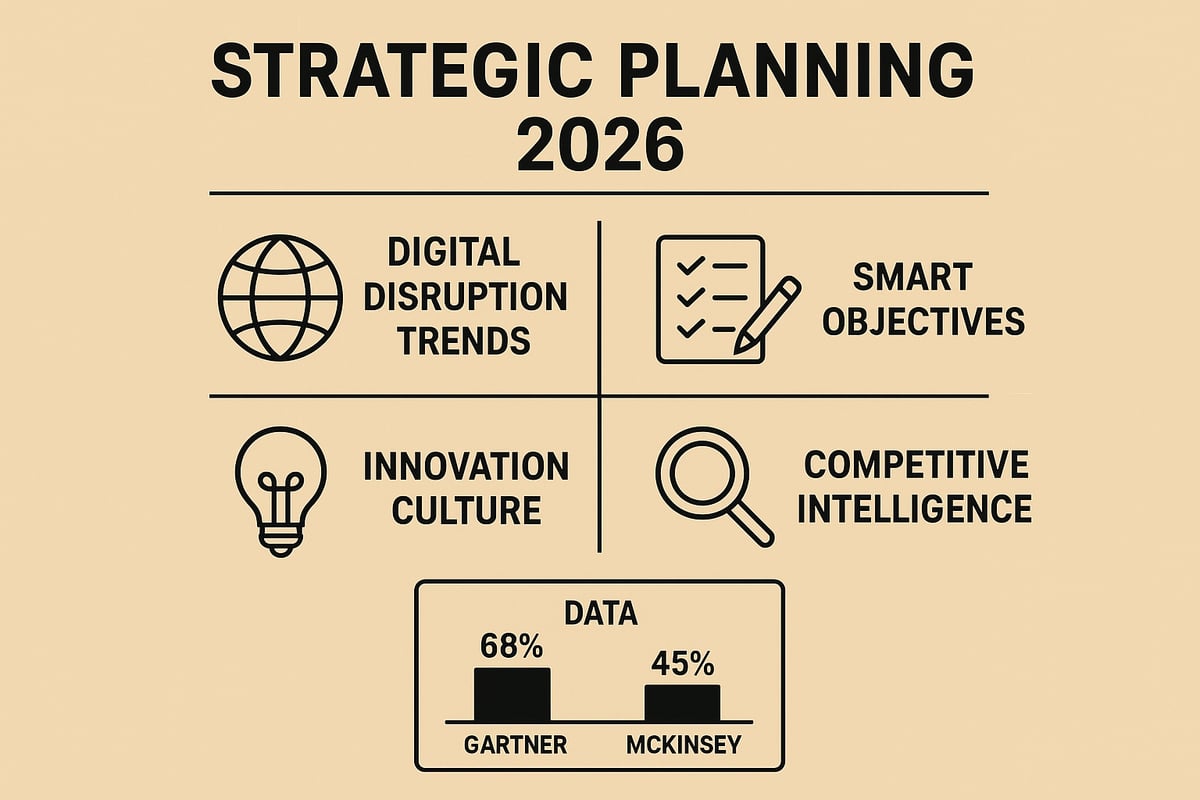
Strategic planning in 2026 is more than a routine exercise. It is the backbone of organizations determined to thrive amid disruption. Businesses must now foresee change, adapt quickly, and make informed decisions to ensure success. Let’s explore how strategies solutions shape the foundation for progress in today’s dynamic environment.
Strategic Planning for 2026: Laying the Foundation

Understanding the 2026 Business Landscape

The business world in 2026 is shaped by relentless digital disruption, expanding globalization, and a heightened focus on sustainability. Organizations must navigate shifting consumer expectations, new regulations, and emerging technologies. Agility and adaptability are no longer optional, they are vital elements of effective strategies solutions.

Data-driven decision-making gives companies a competitive edge. According to Gartner, 78% of organizations updating strategic plans annually outperform their peers. Scenario planning and risk assessment help leaders anticipate possible futures and prepare for uncertainty.

To stay ahead, companies must embrace these trends and continuously refine their strategies solutions. This proactive approach enables organizations to pivot quickly when faced with unexpected events or opportunities.

Setting Clear Objectives and KPIs

Clear objectives are the compass guiding every organization toward its vision. In 2026, aligning goals with market realities is essential for successful strategies solutions. The SMART framework—Specific, Measurable, Achievable, Relevant, Time-bound—remains a proven method for effective goal-setting.

Organizations use SMART objectives to break down ambitious plans into actionable steps. For example, a company might set a goal to increase market share by 10% within 12 months. Key Performance Indicators (KPIs) then track progress, highlighting areas needing adjustment.

Real-time monitoring of KPIs allows businesses to adapt strategies solutions quickly. This feedback loop ensures that teams remain focused and agile, driving measurable progress toward strategic goals.

Building a Culture of Innovation

Innovation is the engine that powers sustainable growth. To unlock the full potential of strategies solutions, organizations must encourage collaboration across departments and inspire employees to think like entrepreneurs. Cross-functional teams spark creativity by blending diverse skills and perspectives.

A growth mindset, where individuals view challenges as opportunities to learn, is critical. Companies that foster this culture are three times more likely to achieve above-average profitability, as noted by McKinsey. Simple initiatives, such as internal innovation challenges or intrapreneurship programs, can ignite new ideas.

Embedding innovation into daily routines ensures that strategies solutions remain fresh and relevant. This approach not only boosts performance but also attracts top talent eager to contribute to a forward-thinking workplace.

Leveraging Competitive Intelligence

Staying competitive in 2026 requires constant vigilance. Monitoring industry benchmarks and competitor moves helps organizations refine their strategies solutions. Advanced analytics provide actionable market insights, enabling leaders to make informed decisions quickly.

Tools for real-time competitive analysis, such as market intelligence platforms and benchmarking dashboards, are essential. By leveraging Maximizing B2B growth opportunities, companies can identify hidden prospects and adjust their approach proactively.

Competitive intelligence is not a one-time effort. It is an ongoing process that ensures strategies solutions align with evolving market dynamics. This discipline empowers organizations to anticipate shifts, respond to threats, and seize new growth opportunities.

Technology Integration: Harnessing Digital Solutions

The rapid pace of technological change in 2026 is reshaping how organizations approach their strategies solutions. Businesses that embrace digital transformation gain a critical edge, leveraging new tools to boost efficiency, security, and decision-making. In this section, we explore the essential pillars of technology integration and how they unlock value for your enterprise.
Technology Integration: Harnessing Digital Solutions

Embracing Artificial Intelligence and Automation

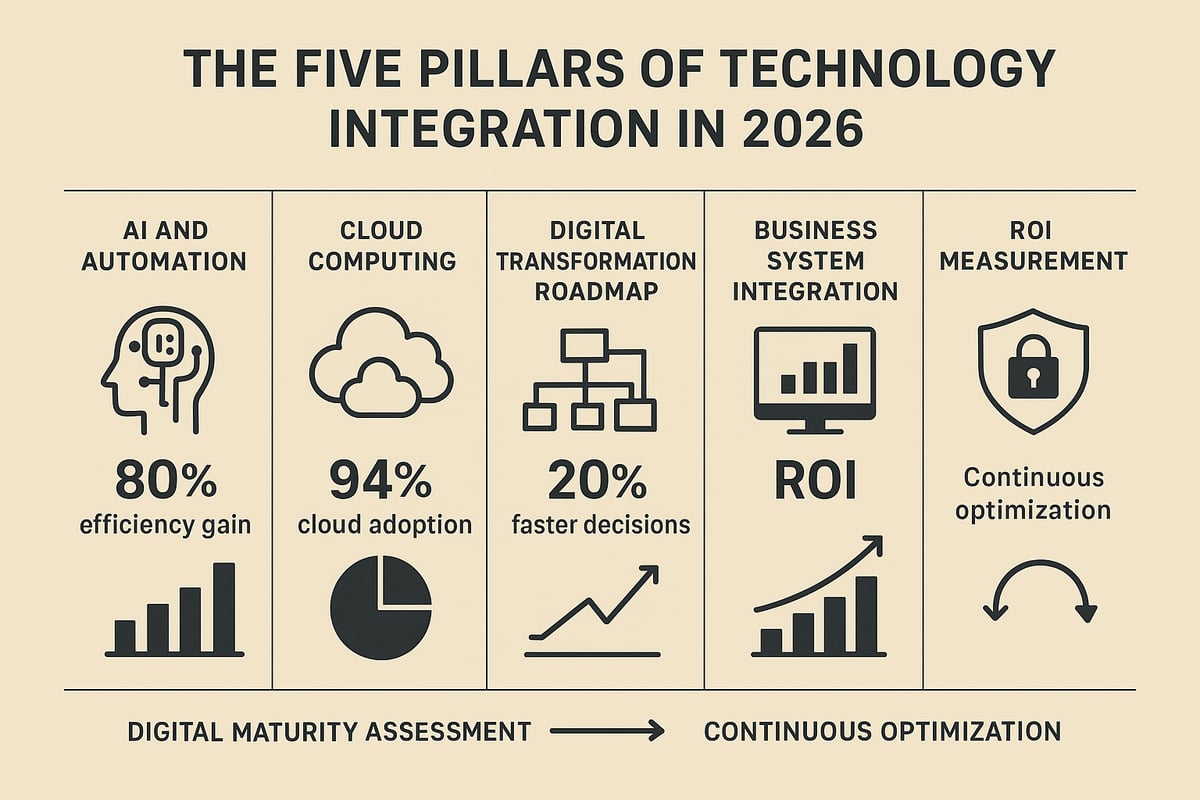
Artificial intelligence and automation are at the forefront of strategies solutions for 2026. Companies are deploying AI to streamline workflows, minimize errors, and cut operational costs. According to Deloitte, 80% of executives have reported greater efficiency following AI adoption.

Key benefits of AI and automation include:

  • Faster data processing and decision-making
  • Reduced manual workload for teams
  • Improved accuracy in repetitive tasks

For organizations seeking to maximize these gains, AI and automation integration solutions provide a strong foundation for scalable growth. By embedding smart automation into daily operations, businesses can stay ahead of competitors and respond rapidly to market shifts.

Cloud Computing and Data Security

Cloud computing has become a cornerstone of modern strategies solutions, offering unmatched scalability and flexibility. In 2026, 94% of enterprises use cloud services to support everything from storage to advanced analytics.

To fully realize these advantages, organizations must prioritize data privacy and cybersecurity. Best practices include:

  • Encrypting sensitive data in transit and at rest
  • Conducting regular security audits
  • Training staff on cybersecurity protocols

Adopting cloud-based systems allows for seamless scaling and remote access, but only with robust security frameworks in place can businesses protect their assets and maintain customer trust.

Digital Transformation Roadmap

A structured digital transformation roadmap is essential for executing strategies solutions effectively. Begin by assessing your current digital maturity—identify gaps in technology, skills, and processes.

Phased implementation is key:

  1. Set clear milestones for each stage
  2. Prioritize quick wins to build momentum
  3. Address resistance to change through communication

Common barriers include legacy system integration and skills shortages. Overcoming these requires leadership commitment, ongoing training, and a willingness to iterate on plans as the business evolves.

Integrating Business Systems and Processes

Unified business platforms such as ERP, CRM, and HCM are central to strategies solutions that drive operational agility. Integrated systems eliminate data silos, enabling teams to share information and make faster decisions.

A recent SAP study found that companies with fully integrated platforms achieve decision-making 20% faster than those relying on disconnected tools.

Key advantages:

  • Real-time visibility into operations
  • Reduced duplication of effort
  • Simplified compliance reporting

Investing in integration supports seamless workflows and prepares organizations for future growth.

Measuring ROI on Technology Investments

For strategies solutions to deliver lasting impact, organizations must measure the return on technology investments. Establish clear metrics aligned with business goals, such as cost savings, productivity gains, and customer satisfaction.

Example metrics table:

Metric Baseline Target 2026
Processing time (hrs) 10 4
Error rate (%) 3.5 1.0
Customer satisfaction 82 92

Continuous evaluation and optimization ensure that digital tools remain aligned with evolving needs and deliver measurable value. By tracking performance and adjusting strategies, businesses can secure a sustainable competitive advantage.

Empowering the Workforce: Human Capital Strategies

Empowering people is at the heart of successful strategies solutions for 2026. Organizations that prioritize their workforce unlock higher engagement, retention, and innovation. With the business environment shifting, leaders must adopt forward-thinking approaches to attract, develop, and retain top talent. This section explores the human capital strategies solutions every organization needs to thrive.
Empowering the Workforce: Human Capital Strategies

Talent Acquisition and Retention in 2026

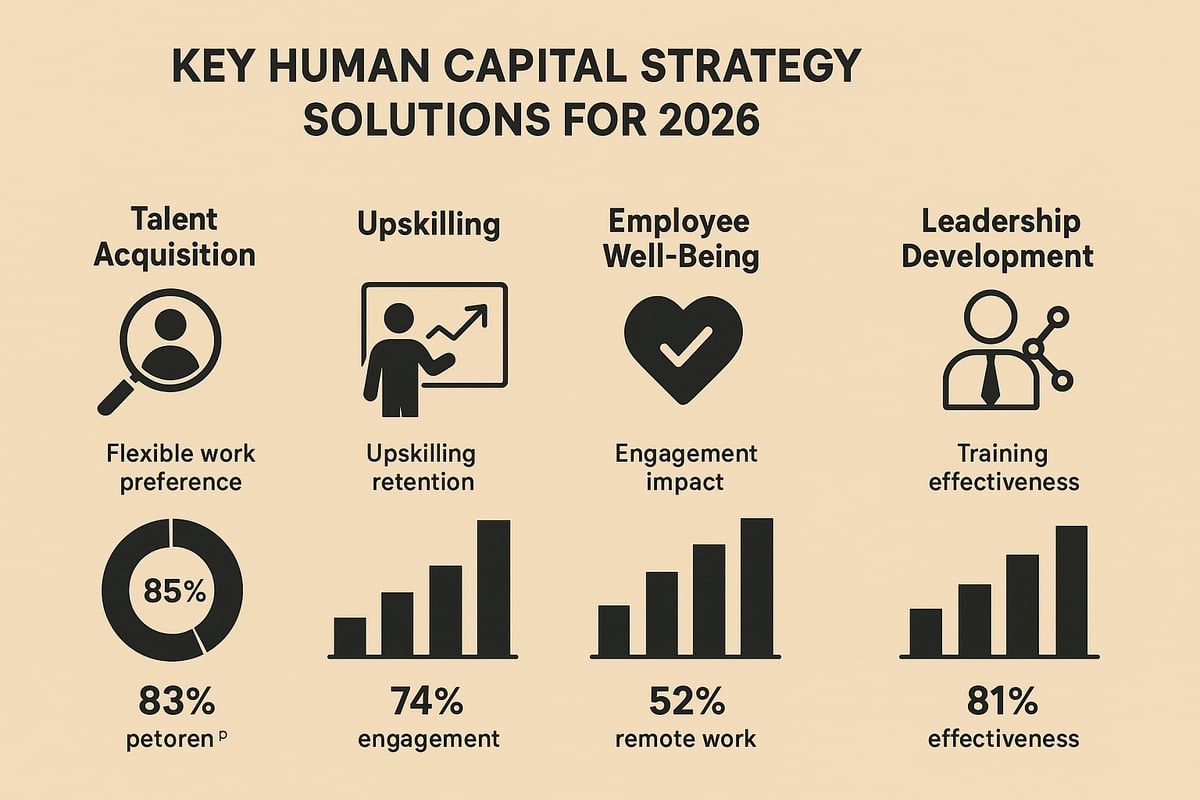
Attracting and retaining top talent is a major challenge for organizations evolving their strategies solutions. Workforce expectations are shifting, with 63% of employees now prioritizing flexible work options, according to Gallup. Companies must modernize their employer brand and offer compelling benefits.

To stay competitive, leverage technology for streamlined candidate sourcing, inclusive hiring, and predictive analytics. As outlined in Workforce Management Trends 2026, AI and automation help optimize scheduling and payroll, freeing managers to focus on strategic growth. Emphasize a strong employer value proposition and clear career pathways to boost retention.

Upskilling and Reskilling Initiatives

A commitment to continuous learning is central to strategies solutions that address skill gaps. The rapid pace of change requires organizations to invest in upskilling and reskilling programs aligned with business goals. LinkedIn research shows that companies prioritizing these initiatives see retention rates double.

Consider offering online courses, mentorship programs, and cross-functional training. Use assessments to identify emerging skills and tailor learning paths. A proactive approach to workforce development not only prepares employees for new roles but also strengthens organizational agility.

Training Method Benefits Best For
Online Courses Flexible, scalable Technical skills
Mentorship Personalized learning Leadership development
Cross-functional Broader perspectives Innovation

Employee Well-being and Engagement

Employee well-being is a cornerstone of effective strategies solutions. Organizations that invest in mental, physical, and financial wellness see measurable improvements in productivity and morale. According to Gallup, high engagement correlates with 21% higher profitability.

Implement wellness programs, flexible benefits, and regular feedback mechanisms. Foster a culture of inclusion and support where every voice is valued. Engaged employees are more likely to innovate, collaborate, and drive results, making well-being a strategic advantage.

Adapting to Hybrid and Remote Work Models

The adoption of hybrid and remote work models is now integral to successful strategies solutions. Organizations must equip teams with secure collaboration tools and clear policies for communication and accountability. Investing in technology that supports virtual teamwork ensures continuity and productivity.

Maintaining company culture across distributed teams requires intentional efforts. Schedule regular check-ins, virtual events, and leadership visibility to keep employees connected. Adaptability in work arrangements is critical for attracting diverse talent and meeting evolving workforce expectations.

Leadership Development and Succession Planning

Preparing future leaders is essential for sustaining strategies solutions over time. Leadership development programs, mentorship, and structured succession planning build a resilient talent pipeline. Focus on cultivating skills like adaptive thinking, emotional intelligence, and strategic decision-making.

Encourage emerging leaders to take on stretch assignments and participate in cross-departmental projects. A robust succession plan ensures business continuity and empowers employees to envision long-term careers within the organization.

Financial Optimization: Maximizing Profitability and Efficiency

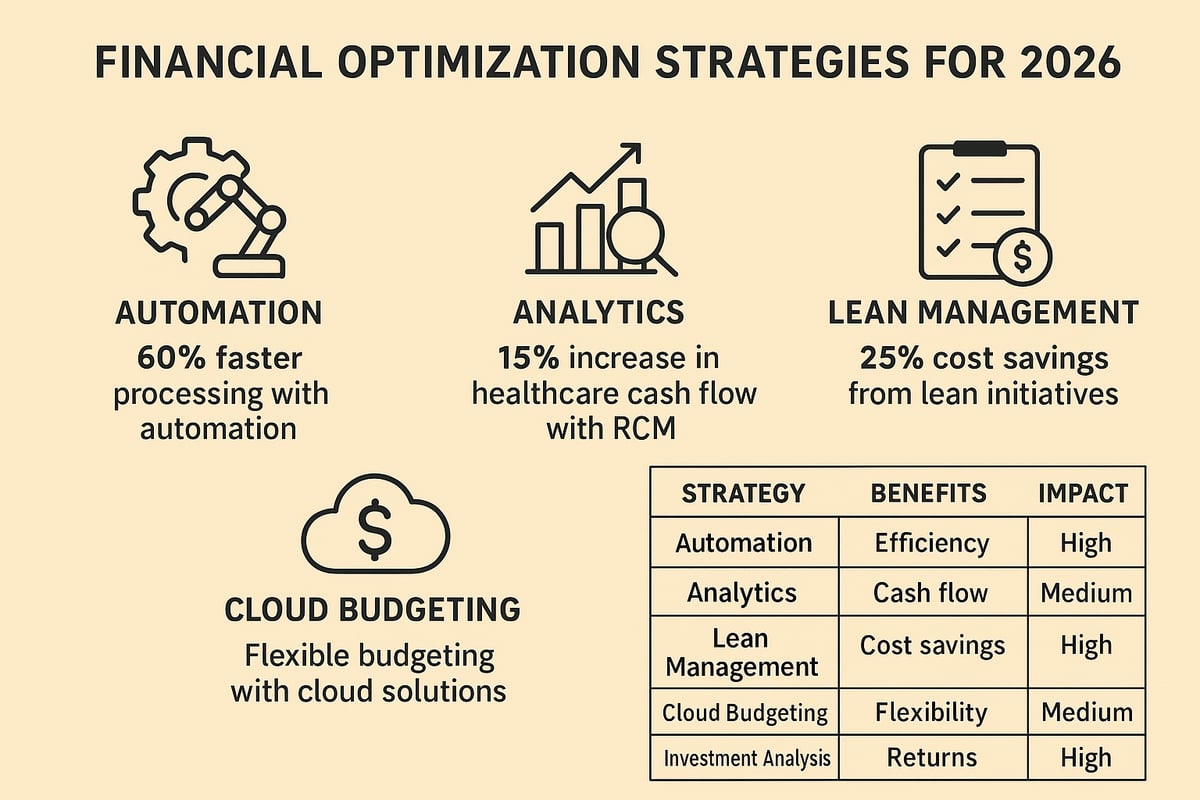
In 2026, financial optimization is more than a necessity, it is a strategic driver for growth. Businesses must adopt advanced strategies solutions to streamline their financial operations, maximize profitability, and ensure long-term sustainability. By embracing automation, analytics, and continuous improvement, organizations can unlock new levels of efficiency and resilience.
Financial Optimization: Maximizing Profitability and Efficiency

Streamlining Financial Processes

Automating financial processes is a cornerstone of effective strategies solutions. By leveraging technology to automate invoicing, payments, and expense management, businesses reduce manual tasks and minimize errors. This shift not only improves accuracy but also frees up valuable time for strategic analysis.

Financial automation delivers measurable results. According to PwC, automation can reduce financial processing time by 60 percent. Organizations that implement these strategies solutions see faster transaction cycles and lower administrative costs, allowing teams to focus on value-added activities.

Key steps include:

  • Assessing current workflows for automation potential
  • Selecting scalable financial software
  • Training staff on new systems

Streamlined processes are the foundation for agile and responsive financial management.

Revenue Cycle Management Best Practices

Optimizing the revenue cycle is essential for cash flow stability and growth. Comprehensive strategies solutions cover every stage, from billing to collections, ensuring no revenue opportunities are lost. Analytics play a key role in identifying revenue leaks and improving performance.

For healthcare organizations, comprehensive medical billing services exemplify how tailored strategies solutions can drive results. Data from the Healthcare Financial Management Association shows that organizations improving revenue cycle management see a 15 percent increase in cash flow.

Best practices include:

  • Automating patient billing and claims processing
  • Monitoring key metrics in real time
  • Addressing denied claims promptly

With the right strategies solutions, businesses can enhance their revenue streams and achieve financial targets.

Cost Reduction Through Operational Efficiency

Reducing costs without sacrificing quality is a top priority in 2026. Strategies solutions focused on operational efficiency identify waste, streamline workflows, and implement lean management principles. This approach not only saves money but also boosts productivity and competitiveness.

McKinsey reports that lean initiatives deliver average cost savings of 25 percent. To achieve these results, organizations should:

  • Map out and analyze key processes
  • Eliminate redundant steps and bottlenecks
  • Foster a culture of continuous improvement

By embedding strategies solutions into daily operations, companies can maintain profitability even in uncertain markets.

Financial Optimization Strategy Key Benefit Statistic/Result
Automation Faster processing 60% faster (PwC)
Revenue Cycle Management Increased cash flow 15% more (HFMA)
Lean Management Cost savings 25% savings (McKinsey)

Budgeting and Forecasting with Advanced Analytics

Accurate budgeting and forecasting are vital for proactive decision-making. Strategies solutions that utilize predictive modeling and real-time dashboards enable financial leaders to anticipate trends, allocate resources efficiently, and adapt quickly to changing conditions.

Advanced analytics provide:

  • Immediate visibility into financial health
  • Early identification of risks and opportunities
  • Data-driven support for strategic initiatives

Implementing these strategies solutions ensures organizations stay ahead of market fluctuations and can pivot with confidence.

Strategic Investment and Capital Allocation

Effective capital allocation balances risk and opportunity. Strategies solutions in this area focus on evaluating potential investments, using scenario analysis, and monitoring return on investment (ROI) with precision.

To optimize financial performance, leaders should:

  • Establish clear investment criteria
  • Use robust tools for ROI calculation
  • Regularly review and adjust portfolios

Strategic use of resources, guided by proven strategies solutions, positions organizations for sustainable growth and long-term value creation.

Future-Proofing Your Organization: Agility and Resilience

In 2026, future-proofing your organization is not just a competitive advantage—it is a necessity. As market dynamics, regulations, and technology evolve, leaders must adopt strategies solutions that foster both agility and resilience. This approach enables organizations to adapt, recover quickly from setbacks, and thrive in unpredictable environments. Below, we explore the pillars of future-proofing, ensuring your business is prepared for whatever lies ahead.

Building Organizational Agility

Agility empowers businesses to respond rapidly to changing circumstances. Modern organizations are shifting from rigid hierarchies to flexible networks, enabling faster decision-making and innovation. Structures that support cross-functional collaboration and iterative improvements are essential for embedding agility into daily operations.

Encouraging experimentation and learning from failure drives continuous improvement. According to McKinsey, agile organizations are 70% more likely to rank in the top quartile for organizational health. By prioritizing strategies solutions that promote adaptability, companies can navigate uncertainty with confidence.

Crisis Management and Business Continuity Planning

Unexpected disruptions can threaten even the strongest organizations. Effective crisis management and continuity planning are vital for resilience. This involves developing comprehensive contingency plans for a range of scenarios, from cyber threats to supply chain interruptions.

Training teams to respond swiftly and confidently ensures continuity of operations. Regular drills and scenario planning enhance preparedness. When strategies solutions include robust crisis response frameworks, organizations can minimize downtime and protect their reputation during challenging times.

Sustainable and Ethical Business Practices

Sustainability and ethics are no longer optional—they are strategic imperatives. Integrating ESG (Environmental, Social, Governance) criteria into your core strategy benefits both brand reputation and compliance. In fact, 88% of consumers prefer companies with strong sustainability practices, according to Nielsen.

By embedding Sustainability as a Core Strategy, businesses unlock new market opportunities and reduce regulatory risks. These strategies solutions also attract purpose-driven talent and foster long-term stakeholder trust.

Leveraging Partnerships and Ecosystems

No organization operates in isolation. Building strong partnerships and participating in robust business ecosystems drive innovation and resilience. Collaborating with industry peers, suppliers, and technology providers enhances your ability to respond to market shifts.

Resilient supply chains and trusted vendor relationships are critical. By weaving strategies solutions into partnership frameworks, organizations can share resources, mitigate risks, and accelerate growth even during times of disruption.

Monitoring and Adapting to Regulatory Changes

Regulatory landscapes are constantly evolving, impacting everything from data privacy to environmental compliance. Staying ahead requires proactive monitoring and rapid adaptation. Using technology to track regulatory developments and automate compliance reduces the risk of costly penalties.

Embedding strategies solutions for compliance management ensures your organization remains agile in the face of new laws. This forward-thinking approach enables leaders to anticipate change and swiftly adjust policies and processes as needed.

Case Studies and Real-World Examples: Success Stories from 2026

In 2026, organizations that embrace innovative strategies solutions achieve remarkable results. By examining real-world examples, we see how digital transformation, empowered workforces, financial optimization, and organizational agility drive measurable success. These stories provide practical insights for leaders eager to replicate such achievements in their own businesses.

Digital Transformation in Action

A global manufacturer adopted advanced automation to streamline its supply chain, resulting in 30 percent faster delivery times. By leveraging robust strategies solutions, the company integrated AI-driven analytics, allowing for real-time inventory adjustments and predictive demand planning. This approach reduced bottlenecks and improved customer satisfaction. According to industry reports, companies utilizing AI-Driven Decision Making can identify market opportunities and optimize processes more effectively. The transformation also lowered operational costs and positioned the company as an industry leader in innovation.

Workforce Empowerment Success

A leading tech company prioritized employee well-being and engagement, launching comprehensive wellness programs and flexible work arrangements. These strategies solutions led to a 40 percent increase in retention rates, as well as higher productivity and morale. The organization encouraged ongoing learning and skill development, fostering a culture where creativity and growth flourished. Employees reported greater job satisfaction and a stronger sense of loyalty. By aligning human capital initiatives with business objectives, the company was able to attract top talent and remain competitive in a rapidly changing market.

Financial Optimization Impact

A healthcare provider implemented end-to-end revenue cycle management, identifying inefficiencies and plugging revenue leaks. Through automation and analytics-driven strategies solutions, the organization realized a $5 million increase in annual cash flow. By achieving operational growth and efficiency, the provider reduced billing errors and accelerated collections. This not only improved financial health but also freed up resources for patient care and innovation. The case demonstrates how targeted financial strategies can deliver significant, sustainable returns.

Agility and Resilience in Practice

When faced with market disruptions, a national retailer rapidly shifted its focus to e-commerce, sustaining 20 percent growth despite challenging conditions. The adoption of agile strategies solutions enabled the company to respond quickly to changing consumer behaviors and supply chain constraints. Leadership empowered teams to experiment and iterate, resulting in new digital offerings and efficient fulfillment models. The retailer’s adaptability became a model for resilience, proving that proactive change management is essential for long-term success.

Lessons Learned and Key Takeaways

Across these diverse examples, several themes emerge. First, organizations that invest in strategies solutions tailored to their unique environments outperform peers. Second, integrating technology, empowering people, and optimizing finances are mutually reinforcing. Finally, agility and a commitment to continuous improvement set businesses apart in 2026. Leaders should assess their current practices, prioritize innovation, and foster a culture of adaptability. By applying these lessons, any organization can unlock new levels of success in a dynamic business landscape.

As you look ahead to 2026 and consider the strategies we've explored—from embracing AI and automation to building a resilient, empowered workforce—it's clear that thriving in this rapidly changing landscape requires more than just theory. You deserve tailored solutions that address your organization's unique challenges, whether it's streamlining operations, elevating employee well-being, or optimizing financial performance. If you're ready to unlock real results and take the next step toward measurable success, let's connect and explore how we can help you achieve your goals. Book a Consultation

Strategies Solutions Guide: Unlock Success in 2026

The business world is changing at an unprecedented pace, demanding organizations to rethink how they operate and compete. From digital transformation to workforce challenges, leaders must navigate complex obstacles that test resilience and adaptability.

Implementing the right strategies solutions can unlock new opportunities, drive revenue growth, and ensure your organization remains ahead of the curve. This guide is designed to equip you with actionable insights for 2026, providing proven approaches to achieve lasting success.

Explore key areas including strategic planning, technology integration, workforce empowerment, financial optimization, and future-proofing operations. Let’s chart a course for thriving in the business landscape of tomorrow.

Strategic Planning for 2026: Laying the Foundation

Strategic planning in 2026 is more than a routine exercise. It is the backbone of organizations determined to thrive amid disruption. Businesses must now foresee change, adapt quickly, and make informed decisions to ensure success. Let’s explore how strategies solutions shape the foundation for progress in today’s dynamic environment.

Strategic Planning for 2026: Laying the Foundation

Understanding the 2026 Business Landscape

The business world in 2026 is shaped by relentless digital disruption, expanding globalization, and a heightened focus on sustainability. Organizations must navigate shifting consumer expectations, new regulations, and emerging technologies. Agility and adaptability are no longer optional, they are vital elements of effective strategies solutions.

Data-driven decision-making gives companies a competitive edge. According to Gartner, 78% of organizations updating strategic plans annually outperform their peers. Scenario planning and risk assessment help leaders anticipate possible futures and prepare for uncertainty.

To stay ahead, companies must embrace these trends and continuously refine their strategies solutions. This proactive approach enables organizations to pivot quickly when faced with unexpected events or opportunities.

Setting Clear Objectives and KPIs

Clear objectives are the compass guiding every organization toward its vision. In 2026, aligning goals with market realities is essential for successful strategies solutions. The SMART framework—Specific, Measurable, Achievable, Relevant, Time-bound—remains a proven method for effective goal-setting.

Organizations use SMART objectives to break down ambitious plans into actionable steps. For example, a company might set a goal to increase market share by 10% within 12 months. Key Performance Indicators (KPIs) then track progress, highlighting areas needing adjustment.

Real-time monitoring of KPIs allows businesses to adapt strategies solutions quickly. This feedback loop ensures that teams remain focused and agile, driving measurable progress toward strategic goals.

Building a Culture of Innovation

Innovation is the engine that powers sustainable growth. To unlock the full potential of strategies solutions, organizations must encourage collaboration across departments and inspire employees to think like entrepreneurs. Cross-functional teams spark creativity by blending diverse skills and perspectives.

A growth mindset, where individuals view challenges as opportunities to learn, is critical. Companies that foster this culture are three times more likely to achieve above-average profitability, as noted by McKinsey. Simple initiatives, such as internal innovation challenges or intrapreneurship programs, can ignite new ideas.

Embedding innovation into daily routines ensures that strategies solutions remain fresh and relevant. This approach not only boosts performance but also attracts top talent eager to contribute to a forward-thinking workplace.

Leveraging Competitive Intelligence

Staying competitive in 2026 requires constant vigilance. Monitoring industry benchmarks and competitor moves helps organizations refine their strategies solutions. Advanced analytics provide actionable market insights, enabling leaders to make informed decisions quickly.

Tools for real-time competitive analysis, such as market intelligence platforms and benchmarking dashboards, are essential. By leveraging Maximizing B2B growth opportunities, companies can identify hidden prospects and adjust their approach proactively.

Competitive intelligence is not a one-time effort. It is an ongoing process that ensures strategies solutions align with evolving market dynamics. This discipline empowers organizations to anticipate shifts, respond to threats, and seize new growth opportunities.

Technology Integration: Harnessing Digital Solutions

The rapid pace of technological change in 2026 is reshaping how organizations approach their strategies solutions. Businesses that embrace digital transformation gain a critical edge, leveraging new tools to boost efficiency, security, and decision-making. In this section, we explore the essential pillars of technology integration and how they unlock value for your enterprise.

Technology Integration: Harnessing Digital Solutions

Embracing Artificial Intelligence and Automation

Artificial intelligence and automation are at the forefront of strategies solutions for 2026. Companies are deploying AI to streamline workflows, minimize errors, and cut operational costs. According to Deloitte, 80% of executives have reported greater efficiency following AI adoption.

Key benefits of AI and automation include:

  • Faster data processing and decision-making
  • Reduced manual workload for teams
  • Improved accuracy in repetitive tasks

For organizations seeking to maximize these gains, AI and automation integration solutions provide a strong foundation for scalable growth. By embedding smart automation into daily operations, businesses can stay ahead of competitors and respond rapidly to market shifts.

Cloud Computing and Data Security

Cloud computing has become a cornerstone of modern strategies solutions, offering unmatched scalability and flexibility. In 2026, 94% of enterprises use cloud services to support everything from storage to advanced analytics.

To fully realize these advantages, organizations must prioritize data privacy and cybersecurity. Best practices include:

  • Encrypting sensitive data in transit and at rest
  • Conducting regular security audits
  • Training staff on cybersecurity protocols

Adopting cloud-based systems allows for seamless scaling and remote access, but only with robust security frameworks in place can businesses protect their assets and maintain customer trust.

Digital Transformation Roadmap

A structured digital transformation roadmap is essential for executing strategies solutions effectively. Begin by assessing your current digital maturity—identify gaps in technology, skills, and processes.

Phased implementation is key:

  1. Set clear milestones for each stage
  2. Prioritize quick wins to build momentum
  3. Address resistance to change through communication

Common barriers include legacy system integration and skills shortages. Overcoming these requires leadership commitment, ongoing training, and a willingness to iterate on plans as the business evolves.

Integrating Business Systems and Processes

Unified business platforms such as ERP, CRM, and HCM are central to strategies solutions that drive operational agility. Integrated systems eliminate data silos, enabling teams to share information and make faster decisions.

A recent SAP study found that companies with fully integrated platforms achieve decision-making 20% faster than those relying on disconnected tools.

Key advantages:

  • Real-time visibility into operations
  • Reduced duplication of effort
  • Simplified compliance reporting

Investing in integration supports seamless workflows and prepares organizations for future growth.

Measuring ROI on Technology Investments

For strategies solutions to deliver lasting impact, organizations must measure the return on technology investments. Establish clear metrics aligned with business goals, such as cost savings, productivity gains, and customer satisfaction.

Example metrics table:

Metric Baseline Target 2026
Processing time (hrs) 10 4
Error rate (%) 3.5 1.0
Customer satisfaction 82 92

Continuous evaluation and optimization ensure that digital tools remain aligned with evolving needs and deliver measurable value. By tracking performance and adjusting strategies, businesses can secure a sustainable competitive advantage.

Empowering the Workforce: Human Capital Strategies

Empowering people is at the heart of successful strategies solutions for 2026. Organizations that prioritize their workforce unlock higher engagement, retention, and innovation. With the business environment shifting, leaders must adopt forward-thinking approaches to attract, develop, and retain top talent. This section explores the human capital strategies solutions every organization needs to thrive.

Empowering the Workforce: Human Capital Strategies

Talent Acquisition and Retention in 2026

Attracting and retaining top talent is a major challenge for organizations evolving their strategies solutions. Workforce expectations are shifting, with 63% of employees now prioritizing flexible work options, according to Gallup. Companies must modernize their employer brand and offer compelling benefits.

To stay competitive, leverage technology for streamlined candidate sourcing, inclusive hiring, and predictive analytics. As outlined in Workforce Management Trends 2026, AI and automation help optimize scheduling and payroll, freeing managers to focus on strategic growth. Emphasize a strong employer value proposition and clear career pathways to boost retention.

Upskilling and Reskilling Initiatives

A commitment to continuous learning is central to strategies solutions that address skill gaps. The rapid pace of change requires organizations to invest in upskilling and reskilling programs aligned with business goals. LinkedIn research shows that companies prioritizing these initiatives see retention rates double.

Consider offering online courses, mentorship programs, and cross-functional training. Use assessments to identify emerging skills and tailor learning paths. A proactive approach to workforce development not only prepares employees for new roles but also strengthens organizational agility.

Training Method Benefits Best For
Online Courses Flexible, scalable Technical skills
Mentorship Personalized learning Leadership development
Cross-functional Broader perspectives Innovation

Employee Well-being and Engagement

Employee well-being is a cornerstone of effective strategies solutions. Organizations that invest in mental, physical, and financial wellness see measurable improvements in productivity and morale. According to Gallup, high engagement correlates with 21% higher profitability.

Implement wellness programs, flexible benefits, and regular feedback mechanisms. Foster a culture of inclusion and support where every voice is valued. Engaged employees are more likely to innovate, collaborate, and drive results, making well-being a strategic advantage.

Adapting to Hybrid and Remote Work Models

The adoption of hybrid and remote work models is now integral to successful strategies solutions. Organizations must equip teams with secure collaboration tools and clear policies for communication and accountability. Investing in technology that supports virtual teamwork ensures continuity and productivity.

Maintaining company culture across distributed teams requires intentional efforts. Schedule regular check-ins, virtual events, and leadership visibility to keep employees connected. Adaptability in work arrangements is critical for attracting diverse talent and meeting evolving workforce expectations.

Leadership Development and Succession Planning

Preparing future leaders is essential for sustaining strategies solutions over time. Leadership development programs, mentorship, and structured succession planning build a resilient talent pipeline. Focus on cultivating skills like adaptive thinking, emotional intelligence, and strategic decision-making.

Encourage emerging leaders to take on stretch assignments and participate in cross-departmental projects. A robust succession plan ensures business continuity and empowers employees to envision long-term careers within the organization.

Financial Optimization: Maximizing Profitability and Efficiency

In 2026, financial optimization is more than a necessity, it is a strategic driver for growth. Businesses must adopt advanced strategies solutions to streamline their financial operations, maximize profitability, and ensure long-term sustainability. By embracing automation, analytics, and continuous improvement, organizations can unlock new levels of efficiency and resilience.

Financial Optimization: Maximizing Profitability and Efficiency

Streamlining Financial Processes

Automating financial processes is a cornerstone of effective strategies solutions. By leveraging technology to automate invoicing, payments, and expense management, businesses reduce manual tasks and minimize errors. This shift not only improves accuracy but also frees up valuable time for strategic analysis.

Financial automation delivers measurable results. According to PwC, automation can reduce financial processing time by 60 percent. Organizations that implement these strategies solutions see faster transaction cycles and lower administrative costs, allowing teams to focus on value-added activities.

Key steps include:

  • Assessing current workflows for automation potential
  • Selecting scalable financial software
  • Training staff on new systems

Streamlined processes are the foundation for agile and responsive financial management.

Revenue Cycle Management Best Practices

Optimizing the revenue cycle is essential for cash flow stability and growth. Comprehensive strategies solutions cover every stage, from billing to collections, ensuring no revenue opportunities are lost. Analytics play a key role in identifying revenue leaks and improving performance.

For healthcare organizations, comprehensive medical billing services exemplify how tailored strategies solutions can drive results. Data from the Healthcare Financial Management Association shows that organizations improving revenue cycle management see a 15 percent increase in cash flow.

Best practices include:

  • Automating patient billing and claims processing
  • Monitoring key metrics in real time
  • Addressing denied claims promptly

With the right strategies solutions, businesses can enhance their revenue streams and achieve financial targets.

Cost Reduction Through Operational Efficiency

Reducing costs without sacrificing quality is a top priority in 2026. Strategies solutions focused on operational efficiency identify waste, streamline workflows, and implement lean management principles. This approach not only saves money but also boosts productivity and competitiveness.

McKinsey reports that lean initiatives deliver average cost savings of 25 percent. To achieve these results, organizations should:

  • Map out and analyze key processes
  • Eliminate redundant steps and bottlenecks
  • Foster a culture of continuous improvement

By embedding strategies solutions into daily operations, companies can maintain profitability even in uncertain markets.

Financial Optimization Strategy Key Benefit Statistic/Result
Automation Faster processing 60% faster (PwC)
Revenue Cycle Management Increased cash flow 15% more (HFMA)
Lean Management Cost savings 25% savings (McKinsey)

Budgeting and Forecasting with Advanced Analytics

Accurate budgeting and forecasting are vital for proactive decision-making. Strategies solutions that utilize predictive modeling and real-time dashboards enable financial leaders to anticipate trends, allocate resources efficiently, and adapt quickly to changing conditions.

Advanced analytics provide:

  • Immediate visibility into financial health
  • Early identification of risks and opportunities
  • Data-driven support for strategic initiatives

Implementing these strategies solutions ensures organizations stay ahead of market fluctuations and can pivot with confidence.

Strategic Investment and Capital Allocation

Effective capital allocation balances risk and opportunity. Strategies solutions in this area focus on evaluating potential investments, using scenario analysis, and monitoring return on investment (ROI) with precision.

To optimize financial performance, leaders should:

  • Establish clear investment criteria
  • Use robust tools for ROI calculation
  • Regularly review and adjust portfolios

Strategic use of resources, guided by proven strategies solutions, positions organizations for sustainable growth and long-term value creation.

Future-Proofing Your Organization: Agility and Resilience

In 2026, future-proofing your organization is not just a competitive advantage—it is a necessity. As market dynamics, regulations, and technology evolve, leaders must adopt strategies solutions that foster both agility and resilience. This approach enables organizations to adapt, recover quickly from setbacks, and thrive in unpredictable environments. Below, we explore the pillars of future-proofing, ensuring your business is prepared for whatever lies ahead.

Building Organizational Agility

Agility empowers businesses to respond rapidly to changing circumstances. Modern organizations are shifting from rigid hierarchies to flexible networks, enabling faster decision-making and innovation. Structures that support cross-functional collaboration and iterative improvements are essential for embedding agility into daily operations.

Encouraging experimentation and learning from failure drives continuous improvement. According to McKinsey, agile organizations are 70% more likely to rank in the top quartile for organizational health. By prioritizing strategies solutions that promote adaptability, companies can navigate uncertainty with confidence.

Crisis Management and Business Continuity Planning

Unexpected disruptions can threaten even the strongest organizations. Effective crisis management and continuity planning are vital for resilience. This involves developing comprehensive contingency plans for a range of scenarios, from cyber threats to supply chain interruptions.

Training teams to respond swiftly and confidently ensures continuity of operations. Regular drills and scenario planning enhance preparedness. When strategies solutions include robust crisis response frameworks, organizations can minimize downtime and protect their reputation during challenging times.

Sustainable and Ethical Business Practices

Sustainability and ethics are no longer optional—they are strategic imperatives. Integrating ESG (Environmental, Social, Governance) criteria into your core strategy benefits both brand reputation and compliance. In fact, 88% of consumers prefer companies with strong sustainability practices, according to Nielsen.

By embedding Sustainability as a Core Strategy, businesses unlock new market opportunities and reduce regulatory risks. These strategies solutions also attract purpose-driven talent and foster long-term stakeholder trust.

Leveraging Partnerships and Ecosystems

No organization operates in isolation. Building strong partnerships and participating in robust business ecosystems drive innovation and resilience. Collaborating with industry peers, suppliers, and technology providers enhances your ability to respond to market shifts.

Resilient supply chains and trusted vendor relationships are critical. By weaving strategies solutions into partnership frameworks, organizations can share resources, mitigate risks, and accelerate growth even during times of disruption.

Monitoring and Adapting to Regulatory Changes

Regulatory landscapes are constantly evolving, impacting everything from data privacy to environmental compliance. Staying ahead requires proactive monitoring and rapid adaptation. Using technology to track regulatory developments and automate compliance reduces the risk of costly penalties.

Embedding strategies solutions for compliance management ensures your organization remains agile in the face of new laws. This forward-thinking approach enables leaders to anticipate change and swiftly adjust policies and processes as needed.

Case Studies and Real-World Examples: Success Stories from 2026

In 2026, organizations that embrace innovative strategies solutions achieve remarkable results. By examining real-world examples, we see how digital transformation, empowered workforces, financial optimization, and organizational agility drive measurable success. These stories provide practical insights for leaders eager to replicate such achievements in their own businesses.

Digital Transformation in Action

A global manufacturer adopted advanced automation to streamline its supply chain, resulting in 30 percent faster delivery times. By leveraging robust strategies solutions, the company integrated AI-driven analytics, allowing for real-time inventory adjustments and predictive demand planning. This approach reduced bottlenecks and improved customer satisfaction. According to industry reports, companies utilizing AI-Driven Decision Making can identify market opportunities and optimize processes more effectively. The transformation also lowered operational costs and positioned the company as an industry leader in innovation.

Workforce Empowerment Success

A leading tech company prioritized employee well-being and engagement, launching comprehensive wellness programs and flexible work arrangements. These strategies solutions led to a 40 percent increase in retention rates, as well as higher productivity and morale. The organization encouraged ongoing learning and skill development, fostering a culture where creativity and growth flourished. Employees reported greater job satisfaction and a stronger sense of loyalty. By aligning human capital initiatives with business objectives, the company was able to attract top talent and remain competitive in a rapidly changing market.

Financial Optimization Impact

A healthcare provider implemented end-to-end revenue cycle management, identifying inefficiencies and plugging revenue leaks. Through automation and analytics-driven strategies solutions, the organization realized a $5 million increase in annual cash flow. By achieving operational growth and efficiency, the provider reduced billing errors and accelerated collections. This not only improved financial health but also freed up resources for patient care and innovation. The case demonstrates how targeted financial strategies can deliver significant, sustainable returns.

Agility and Resilience in Practice

When faced with market disruptions, a national retailer rapidly shifted its focus to e-commerce, sustaining 20 percent growth despite challenging conditions. The adoption of agile strategies solutions enabled the company to respond quickly to changing consumer behaviors and supply chain constraints. Leadership empowered teams to experiment and iterate, resulting in new digital offerings and efficient fulfillment models. The retailer’s adaptability became a model for resilience, proving that proactive change management is essential for long-term success.

Lessons Learned and Key Takeaways

Across these diverse examples, several themes emerge. First, organizations that invest in strategies solutions tailored to their unique environments outperform peers. Second, integrating technology, empowering people, and optimizing finances are mutually reinforcing. Finally, agility and a commitment to continuous improvement set businesses apart in 2026. Leaders should assess their current practices, prioritize innovation, and foster a culture of adaptability. By applying these lessons, any organization can unlock new levels of success in a dynamic business landscape.

As you look ahead to 2026 and consider the strategies we've explored—from embracing AI and automation to building a resilient, empowered workforce—it's clear that thriving in this rapidly changing landscape requires more than just theory. You deserve tailored solutions that address your organization's unique challenges, whether it's streamlining operations, elevating employee well-being, or optimizing financial performance. If you're ready to unlock real results and take the next step toward measurable success, let's connect and explore how we can help you achieve your goals. Book a Consultation

Website developed in accordance with Web Content Accessibility Guidelines 2.2.
If you encounter any issues while using this site, please contact us: 215.526.5126