
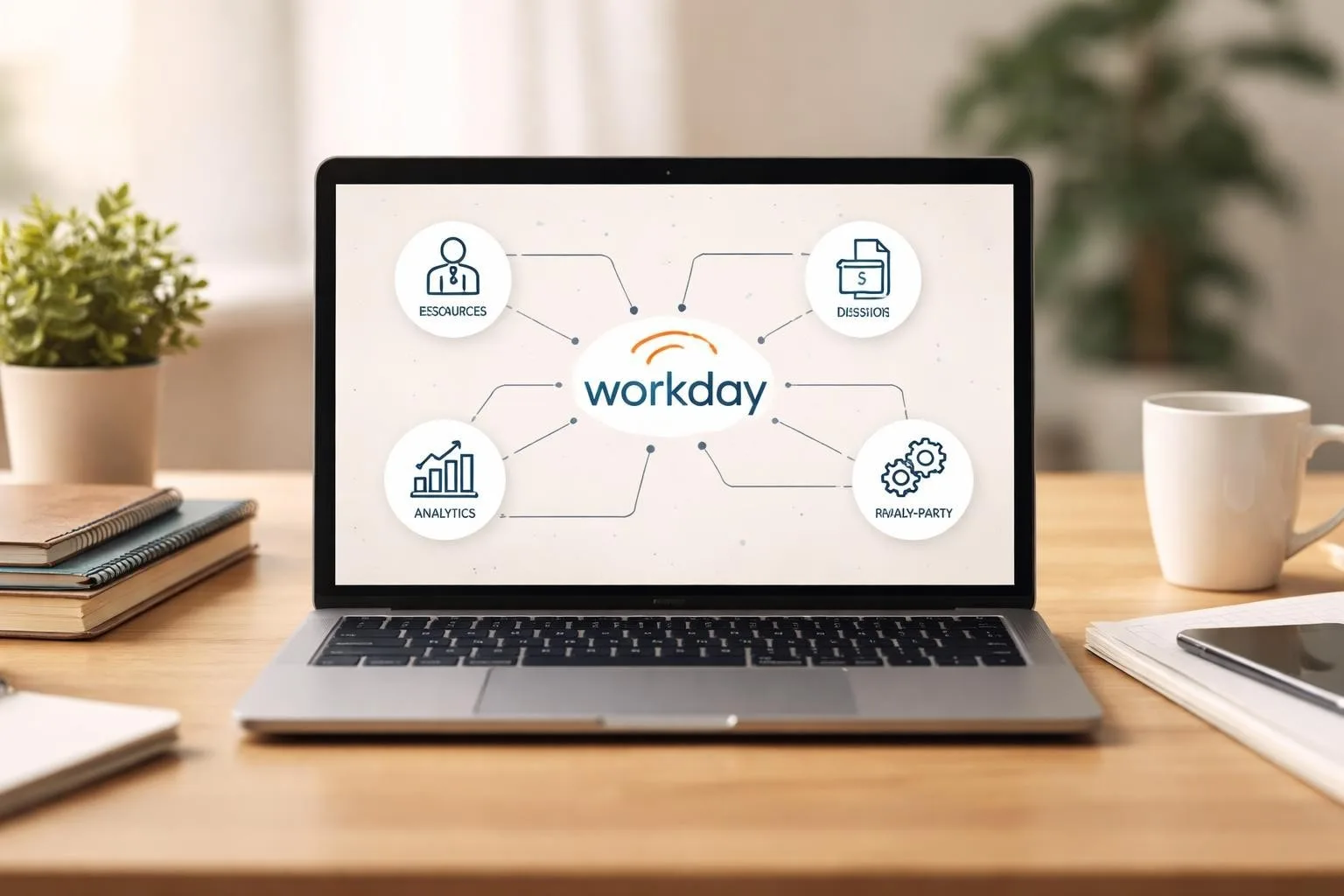
Workday Integration: A Complete Guide for 2026

Share on Facebook
Share on X
Share on LinkedIn

Modern organizations face a critical challenge: managing an increasingly complex ecosystem of business applications while maintaining data accuracy and operational efficiency. Workday integration has emerged as a strategic solution, enabling companies to connect their human capital management systems with other essential business platforms. For organizations seeking to eliminate manual processes and maximize efficiency, understanding the fundamentals of workday integration is no longer optional but essential for competitive success in 2026.

Understanding Workday Integration Fundamentals

Workday integration refers to the process of connecting Workday's cloud-based human capital management and financial management systems with other business applications, databases, and platforms. This connectivity enables seamless data exchange, automated workflows, and unified reporting across an organization's technology stack.

The importance of robust integration capabilities has grown exponentially as businesses adopt specialized tools for recruitment, payroll, benefits administration, time tracking, and performance management. Without proper integration, organizations face data silos, manual data entry errors, and delayed decision-making that directly impact their bottom line.

Core Integration Methods

Organizations can implement workday integration through several technical approaches:

  • Web Services API: Direct programmatic access to Workday functionality
  • Workday Studio: Development environment for complex custom integrations
  • Cloud Connect for Third-Party Payroll: Specialized connector for payroll systems
  • Enterprise Interface Builder (EIB): Tool for loading large data volumes
  • Workday Integration Cloud: Platform for pre-built and custom integration solutions

Each method serves specific use cases and technical requirements. The comprehensive guide to connecting business systems provides detailed insights into selecting the appropriate integration approach based on organizational needs.
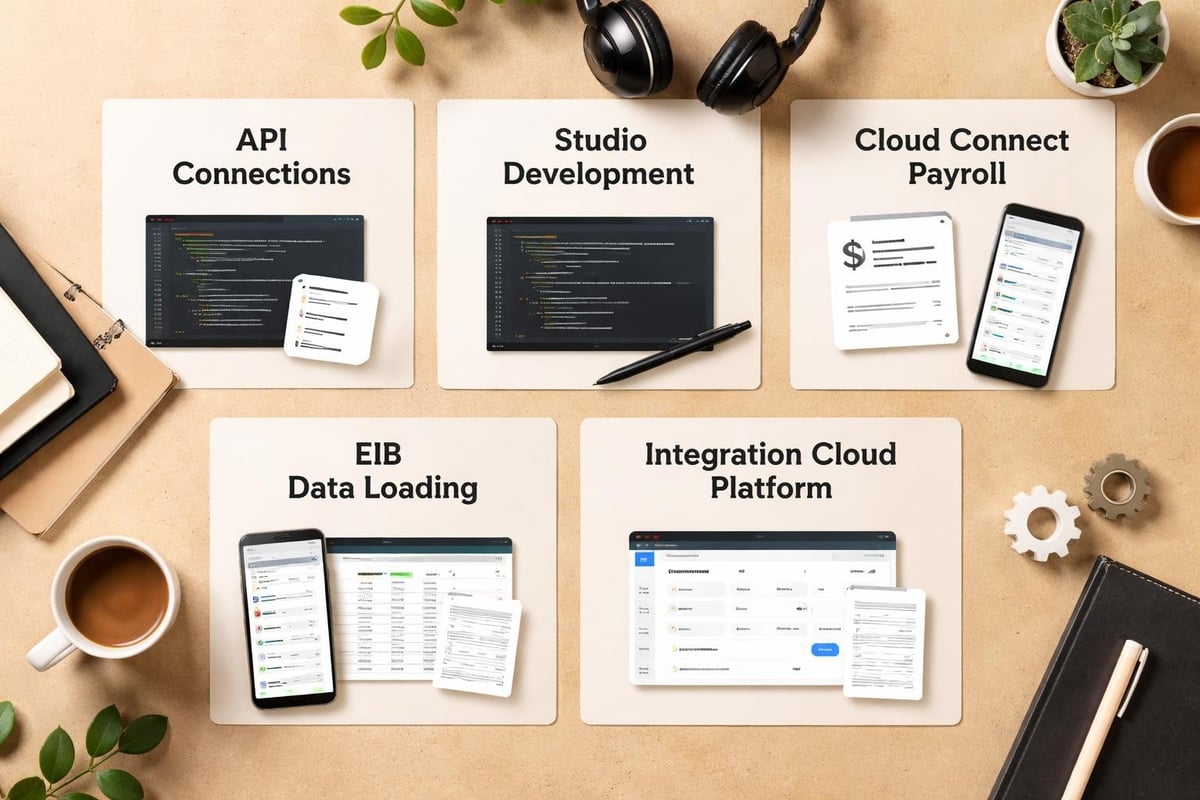
Integration methods comparison

Business Benefits of Strategic Integration

Organizations that successfully implement workday integration experience measurable improvements across multiple operational dimensions. The transformation extends beyond simple data synchronization to fundamental changes in how businesses operate.

Operational Efficiency Gains

When systems communicate automatically, employees spend significantly less time on manual data entry and reconciliation. A multinational technology corporation’s integration project demonstrated how connecting Workday with multiple vendor platforms enhanced data sharing capabilities and reduced administrative overhead by thousands of hours annually.

Financial Impact

Benefit Category Typical Impact Time to Realize
Reduced manual processing 40-60% time savings 3-6 months
Decreased error rates 75-90% reduction 2-4 months
Improved compliance 95%+ accuracy 6-12 months
Enhanced reporting speed Real-time vs. weekly 1-3 months

The financial benefits extend to improved cash flow management, reduced audit costs, and better resource allocation. Organizations can redirect staff from repetitive tasks to strategic initiatives that drive revenue growth.

Data Quality and Decision-Making

Real-time data synchronization ensures that decision-makers access current, accurate information across all connected systems. This capability proves particularly valuable for workforce planning, budget forecasting, and strategic resource allocation.

Modern analytics platforms require clean, consistent data to generate actionable insights. Workday integration establishes this foundation by eliminating discrepancies between systems and creating a single source of truth for human capital and financial data.

Common Integration Challenges and Solutions

Despite clear benefits, organizations frequently encounter obstacles when implementing workday integration projects. Understanding these challenges enables proactive mitigation strategies.

Technical Complexity

The common challenges in API integration include managing complex data structures, ensuring data quality, and maintaining system performance under load. Organizations must address authentication protocols, error handling mechanisms, and version control considerations.

Data mapping represents a particularly complex challenge. Workday's data model may not align perfectly with legacy systems or third-party applications. Successful projects invest significant time in field mapping, transformation logic, and validation rules.

Security and Compliance Considerations

Securing enterprise-grade integrations requires adopting Zero Trust principles and implementing robust error-handling mechanisms. Organizations must protect sensitive employee data while maintaining compliance with regulations like GDPR, CCPA, and industry-specific requirements.

Key security practices include:

  • Implementing multi-factor authentication for all integration endpoints
  • Encrypting data both in transit and at rest
  • Conducting regular security audits of integration points
  • Maintaining detailed logs for compliance and troubleshooting
  • Restricting access based on principle of least privilege

Best Practices for Implementation Success

Organizations that achieve optimal results from workday integration follow proven methodologies and strategic approaches. The best practices for integrating with Okta provide valuable insights into import configurations and field overrides that enhance performance and reliability.

Planning and Requirements Gathering

Successful integration projects begin with comprehensive planning that involves stakeholders across IT, HR, finance, and operations. This collaborative approach ensures that technical solutions address actual business requirements rather than perceived needs.

Critical planning steps include:

  1. Documenting all systems requiring integration
  2. Mapping current and desired data flows
  3. Identifying compliance and security requirements
  4. Establishing performance benchmarks and success metrics
  5. Creating a phased implementation roadmap
  6. Defining roles, responsibilities, and escalation procedures

Organizations should prioritize integrations based on business impact and technical complexity. Quick wins build momentum and demonstrate value while the team develops capabilities for more complex connections.

Integration planning workflow

Testing and Quality Assurance

Rigorous testing prevents costly production issues and ensures data integrity across connected systems. A comprehensive testing strategy includes multiple phases and validation approaches.

Testing Phase Focus Areas Success Criteria
Unit Testing Individual integration components 100% code coverage
Integration Testing System-to-system communication Successful data exchange
Performance Testing Load handling and response times Meets defined benchmarks
User Acceptance Testing Business process validation Stakeholder approval
Security Testing Vulnerability assessment Zero critical issues

Organizations should maintain separate development, testing, and production environments to prevent disruptions to live systems. Automated testing frameworks reduce manual effort and enable continuous validation as systems evolve.

Real-World Integration Use Cases

The practical applications of workday integration span numerous business processes and functional areas. Understanding these use cases helps organizations identify opportunities for improvement.

Global Payroll Integration

The PwC collaboration with Workday demonstrates how automated global payroll solutions ensure accurate and compliant processing across multiple countries. This integration eliminates manual data transfers, reduces processing time, and maintains compliance with local tax regulations.

Organizations with international operations benefit from standardized processes while accommodating country-specific requirements. The integration handles currency conversions, tax calculations, and regulatory reporting automatically.

Healthcare Enterprise Applications

An AI-enabled framework for orchestrating event-driven business processes within Workday ERP demonstrates advanced applications in healthcare enterprises. This approach improves efficiency and decision-making by automating complex workflows triggered by specific events or conditions.

Healthcare organizations face unique challenges including credential management, shift scheduling, and regulatory compliance. Integrated systems ensure that staff certifications remain current, scheduling reflects actual availability, and reporting meets industry requirements.

Talent Acquisition and Onboarding

Connecting Workday with applicant tracking systems, background check providers, and learning management platforms creates a seamless candidate-to-employee experience. New hires provide information once, and it flows automatically to all relevant systems.

This integration reduces time-to-productivity by ensuring that equipment, system access, and training materials are ready on day one. HR teams spend less time on administrative tasks and more time on strategic talent development initiatives.

Choosing the Right Integration Tools

The technology landscape for workday integration includes numerous platforms, connectors, and development tools. Selecting appropriate solutions requires careful evaluation of capabilities, costs, and organizational requirements.

Pre-Built Connectors vs. Custom Development

Pre-built connectors offer rapid implementation for common integration scenarios. Major platforms like Okta, ADP, and Salesforce provide certified connectors that handle standard use cases with minimal configuration.

Custom development becomes necessary when organizations have unique requirements, legacy systems, or specialized workflows. Workday Studio enables developers to create sophisticated integrations that address specific business needs not covered by standard connectors.

Evaluation criteria for integration tools:

  • Compatibility with existing technology stack
  • Scalability to handle current and projected data volumes
  • Support for required security and compliance standards
  • Total cost of ownership including licensing and maintenance
  • Vendor reputation and support quality
  • Ease of use for IT staff and business users

Integration Platform as a Service (iPaaS)

Modern iPaaS solutions provide cloud-based platforms that simplify integration development, deployment, and management. These platforms offer visual development environments, pre-built templates, and centralized monitoring capabilities.

The comprehensive guide to tools and use cases covers standard connectors and secure data transfer protocols that iPaaS platforms commonly support. Organizations benefit from faster implementation timelines and reduced technical expertise requirements.

Governance and Ongoing Management

Successful workday integration extends beyond initial implementation to ongoing governance, monitoring, and optimization. Organizations must establish processes that ensure integrations remain reliable, secure, and aligned with evolving business needs.

Establishing Integration Governance

A formal governance framework defines standards, policies, and procedures for all integration activities. This structure prevents unauthorized connections, maintains security standards, and ensures consistent approaches across the organization.

Governance framework components:

  1. Integration architecture standards and design patterns
  2. Security and compliance requirements for all connections
  3. Change management procedures for integration modifications
  4. Incident response protocols for integration failures
  5. Performance monitoring and optimization processes
  6. Documentation and knowledge management practices

The comprehensive guide emphasizing data governance highlights the importance of choosing appropriate authentication methods and maintaining robust security practices throughout the integration lifecycle.
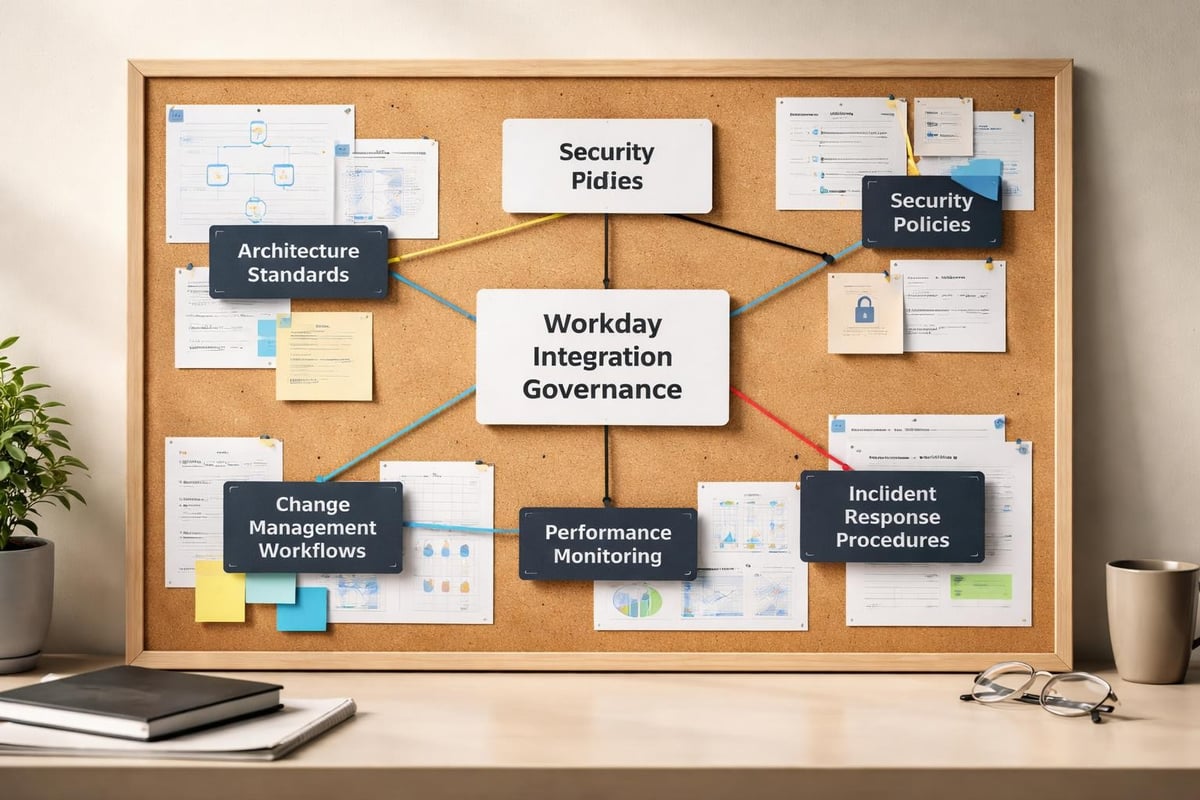
Integration governance framework

Monitoring and Optimization

Continuous monitoring identifies issues before they impact business operations and provides insights for optimization opportunities. Modern monitoring tools track integration performance, error rates, data quality metrics, and system availability.

Monitoring Metric Target Threshold Action Trigger
Integration success rate >99.5% Alert if below 99%
Average processing time <5 seconds Review if exceeds 10 seconds
Error resolution time <2 hours Escalate if exceeds 4 hours
Data accuracy rate >99.9% Immediate review if below
System availability >99.95% Emergency response if below 99%

Organizations should conduct quarterly reviews of integration performance, identifying trends and opportunities for improvement. This proactive approach prevents technical debt accumulation and ensures integrations continue delivering value as business requirements evolve.

Future Trends in Workday Integration

The workday integration landscape continues evolving with emerging technologies and changing business requirements. Organizations that anticipate these trends position themselves for sustained competitive advantage.

Artificial Intelligence and Machine Learning

AI-powered integration platforms increasingly automate complex tasks like data mapping, error resolution, and performance optimization. Machine learning algorithms identify patterns in integration failures and suggest preventive measures.

Intelligent automation extends to business processes themselves, with AI agents orchestrating workflows across multiple systems based on contextual understanding rather than rigid rules. This capability enables more adaptive and responsive business operations.

Low-Code and No-Code Integration

The democratization of integration development empowers business users to create and modify connections without extensive technical expertise. Visual development environments and natural language interfaces reduce dependence on IT resources for routine integration tasks.

This trend accelerates innovation by enabling rapid experimentation and iteration. Business teams can test new workflows and data connections without lengthy development cycles or significant resource investment.

The guide to challenges, benefits, and implementation steps provides real-world examples of improved efficiency and cost reduction that modern integration approaches deliver.

Measuring Integration ROI

Organizations must quantify the value delivered by workday integration investments to justify continued spending and prioritize future initiatives. Comprehensive ROI measurement encompasses both quantitative and qualitative benefits.

Quantitative Metrics

Direct cost savings emerge from:

  • Reduced manual labor hours for data entry and reconciliation
  • Decreased error correction and audit costs
  • Lower system maintenance and support expenses
  • Eliminated redundant software licenses
  • Improved vendor negotiation leverage through standardization

Revenue impact includes:

  • Faster hiring processes reducing time-to-productivity gaps
  • Improved employee retention through better experiences
  • Enhanced decision-making enabling revenue optimization
  • Increased capacity for revenue-generating activities

Qualitative Benefits

Beyond measurable financial returns, workday integration delivers strategic advantages that strengthen competitive position. Employee satisfaction improves when systems work seamlessly, reducing frustration and increasing engagement.

Customer experience benefits from more responsive service delivery enabled by real-time data availability. Organizational agility increases as business leaders can quickly implement new processes without extensive system modifications.


Successful workday integration transforms disconnected systems into a unified, efficient technology ecosystem that drives measurable business results. The strategic implementation of integration capabilities eliminates manual processes, reduces errors, and empowers data-driven decision-making across organizations. Nero and Associates, Inc. specializes in helping organizations implement automation and integration solutions that raise bottom-line performance while reducing operational complexity. Our performance-based approach ensures your integration investments deliver tangible value through cost savings, time reduction, and enhanced operational efficiency.

Workday Integration: A Complete Guide for 2026

Modern organizations face a critical challenge: managing an increasingly complex ecosystem of business applications while maintaining data accuracy and operational efficiency. Workday integration has emerged as a strategic solution, enabling companies to connect their human capital management systems with other essential business platforms. For organizations seeking to eliminate manual processes and maximize efficiency, understanding the fundamentals of workday integration is no longer optional but essential for competitive success in 2026.

Understanding Workday Integration Fundamentals

Workday integration refers to the process of connecting Workday's cloud-based human capital management and financial management systems with other business applications, databases, and platforms. This connectivity enables seamless data exchange, automated workflows, and unified reporting across an organization's technology stack.

The importance of robust integration capabilities has grown exponentially as businesses adopt specialized tools for recruitment, payroll, benefits administration, time tracking, and performance management. Without proper integration, organizations face data silos, manual data entry errors, and delayed decision-making that directly impact their bottom line.

Core Integration Methods

Organizations can implement workday integration through several technical approaches:

  • Web Services API: Direct programmatic access to Workday functionality
  • Workday Studio: Development environment for complex custom integrations
  • Cloud Connect for Third-Party Payroll: Specialized connector for payroll systems
  • Enterprise Interface Builder (EIB): Tool for loading large data volumes
  • Workday Integration Cloud: Platform for pre-built and custom integration solutions

Each method serves specific use cases and technical requirements. The comprehensive guide to connecting business systems provides detailed insights into selecting the appropriate integration approach based on organizational needs.

Integration methods comparison

Business Benefits of Strategic Integration

Organizations that successfully implement workday integration experience measurable improvements across multiple operational dimensions. The transformation extends beyond simple data synchronization to fundamental changes in how businesses operate.

Operational Efficiency Gains

When systems communicate automatically, employees spend significantly less time on manual data entry and reconciliation. A multinational technology corporation’s integration project demonstrated how connecting Workday with multiple vendor platforms enhanced data sharing capabilities and reduced administrative overhead by thousands of hours annually.

Financial Impact

Benefit Category Typical Impact Time to Realize
Reduced manual processing 40-60% time savings 3-6 months
Decreased error rates 75-90% reduction 2-4 months
Improved compliance 95%+ accuracy 6-12 months
Enhanced reporting speed Real-time vs. weekly 1-3 months

The financial benefits extend to improved cash flow management, reduced audit costs, and better resource allocation. Organizations can redirect staff from repetitive tasks to strategic initiatives that drive revenue growth.

Data Quality and Decision-Making

Real-time data synchronization ensures that decision-makers access current, accurate information across all connected systems. This capability proves particularly valuable for workforce planning, budget forecasting, and strategic resource allocation.

Modern analytics platforms require clean, consistent data to generate actionable insights. Workday integration establishes this foundation by eliminating discrepancies between systems and creating a single source of truth for human capital and financial data.

Common Integration Challenges and Solutions

Despite clear benefits, organizations frequently encounter obstacles when implementing workday integration projects. Understanding these challenges enables proactive mitigation strategies.

Technical Complexity

The common challenges in API integration include managing complex data structures, ensuring data quality, and maintaining system performance under load. Organizations must address authentication protocols, error handling mechanisms, and version control considerations.

Data mapping represents a particularly complex challenge. Workday's data model may not align perfectly with legacy systems or third-party applications. Successful projects invest significant time in field mapping, transformation logic, and validation rules.

Security and Compliance Considerations

Securing enterprise-grade integrations requires adopting Zero Trust principles and implementing robust error-handling mechanisms. Organizations must protect sensitive employee data while maintaining compliance with regulations like GDPR, CCPA, and industry-specific requirements.

Key security practices include:

  • Implementing multi-factor authentication for all integration endpoints
  • Encrypting data both in transit and at rest
  • Conducting regular security audits of integration points
  • Maintaining detailed logs for compliance and troubleshooting
  • Restricting access based on principle of least privilege

Best Practices for Implementation Success

Organizations that achieve optimal results from workday integration follow proven methodologies and strategic approaches. The best practices for integrating with Okta provide valuable insights into import configurations and field overrides that enhance performance and reliability.

Planning and Requirements Gathering

Successful integration projects begin with comprehensive planning that involves stakeholders across IT, HR, finance, and operations. This collaborative approach ensures that technical solutions address actual business requirements rather than perceived needs.

Critical planning steps include:

  1. Documenting all systems requiring integration
  2. Mapping current and desired data flows
  3. Identifying compliance and security requirements
  4. Establishing performance benchmarks and success metrics
  5. Creating a phased implementation roadmap
  6. Defining roles, responsibilities, and escalation procedures

Organizations should prioritize integrations based on business impact and technical complexity. Quick wins build momentum and demonstrate value while the team develops capabilities for more complex connections.

Integration planning workflow

Testing and Quality Assurance

Rigorous testing prevents costly production issues and ensures data integrity across connected systems. A comprehensive testing strategy includes multiple phases and validation approaches.

Testing Phase Focus Areas Success Criteria
Unit Testing Individual integration components 100% code coverage
Integration Testing System-to-system communication Successful data exchange
Performance Testing Load handling and response times Meets defined benchmarks
User Acceptance Testing Business process validation Stakeholder approval
Security Testing Vulnerability assessment Zero critical issues

Organizations should maintain separate development, testing, and production environments to prevent disruptions to live systems. Automated testing frameworks reduce manual effort and enable continuous validation as systems evolve.

Real-World Integration Use Cases

The practical applications of workday integration span numerous business processes and functional areas. Understanding these use cases helps organizations identify opportunities for improvement.

Global Payroll Integration

The PwC collaboration with Workday demonstrates how automated global payroll solutions ensure accurate and compliant processing across multiple countries. This integration eliminates manual data transfers, reduces processing time, and maintains compliance with local tax regulations.

Organizations with international operations benefit from standardized processes while accommodating country-specific requirements. The integration handles currency conversions, tax calculations, and regulatory reporting automatically.

Healthcare Enterprise Applications

An AI-enabled framework for orchestrating event-driven business processes within Workday ERP demonstrates advanced applications in healthcare enterprises. This approach improves efficiency and decision-making by automating complex workflows triggered by specific events or conditions.

Healthcare organizations face unique challenges including credential management, shift scheduling, and regulatory compliance. Integrated systems ensure that staff certifications remain current, scheduling reflects actual availability, and reporting meets industry requirements.

Talent Acquisition and Onboarding

Connecting Workday with applicant tracking systems, background check providers, and learning management platforms creates a seamless candidate-to-employee experience. New hires provide information once, and it flows automatically to all relevant systems.

This integration reduces time-to-productivity by ensuring that equipment, system access, and training materials are ready on day one. HR teams spend less time on administrative tasks and more time on strategic talent development initiatives.

Choosing the Right Integration Tools

The technology landscape for workday integration includes numerous platforms, connectors, and development tools. Selecting appropriate solutions requires careful evaluation of capabilities, costs, and organizational requirements.

Pre-Built Connectors vs. Custom Development

Pre-built connectors offer rapid implementation for common integration scenarios. Major platforms like Okta, ADP, and Salesforce provide certified connectors that handle standard use cases with minimal configuration.

Custom development becomes necessary when organizations have unique requirements, legacy systems, or specialized workflows. Workday Studio enables developers to create sophisticated integrations that address specific business needs not covered by standard connectors.

Evaluation criteria for integration tools:

  • Compatibility with existing technology stack
  • Scalability to handle current and projected data volumes
  • Support for required security and compliance standards
  • Total cost of ownership including licensing and maintenance
  • Vendor reputation and support quality
  • Ease of use for IT staff and business users

Integration Platform as a Service (iPaaS)

Modern iPaaS solutions provide cloud-based platforms that simplify integration development, deployment, and management. These platforms offer visual development environments, pre-built templates, and centralized monitoring capabilities.

The comprehensive guide to tools and use cases covers standard connectors and secure data transfer protocols that iPaaS platforms commonly support. Organizations benefit from faster implementation timelines and reduced technical expertise requirements.

Governance and Ongoing Management

Successful workday integration extends beyond initial implementation to ongoing governance, monitoring, and optimization. Organizations must establish processes that ensure integrations remain reliable, secure, and aligned with evolving business needs.

Establishing Integration Governance

A formal governance framework defines standards, policies, and procedures for all integration activities. This structure prevents unauthorized connections, maintains security standards, and ensures consistent approaches across the organization.

Governance framework components:

  1. Integration architecture standards and design patterns
  2. Security and compliance requirements for all connections
  3. Change management procedures for integration modifications
  4. Incident response protocols for integration failures
  5. Performance monitoring and optimization processes
  6. Documentation and knowledge management practices

The comprehensive guide emphasizing data governance highlights the importance of choosing appropriate authentication methods and maintaining robust security practices throughout the integration lifecycle.

Integration governance framework

Monitoring and Optimization

Continuous monitoring identifies issues before they impact business operations and provides insights for optimization opportunities. Modern monitoring tools track integration performance, error rates, data quality metrics, and system availability.

Monitoring Metric Target Threshold Action Trigger
Integration success rate >99.5% Alert if below 99%
Average processing time <5 seconds Review if exceeds 10 seconds
Error resolution time <2 hours Escalate if exceeds 4 hours
Data accuracy rate >99.9% Immediate review if below
System availability >99.95% Emergency response if below 99%

Organizations should conduct quarterly reviews of integration performance, identifying trends and opportunities for improvement. This proactive approach prevents technical debt accumulation and ensures integrations continue delivering value as business requirements evolve.

Future Trends in Workday Integration

The workday integration landscape continues evolving with emerging technologies and changing business requirements. Organizations that anticipate these trends position themselves for sustained competitive advantage.

Artificial Intelligence and Machine Learning

AI-powered integration platforms increasingly automate complex tasks like data mapping, error resolution, and performance optimization. Machine learning algorithms identify patterns in integration failures and suggest preventive measures.

Intelligent automation extends to business processes themselves, with AI agents orchestrating workflows across multiple systems based on contextual understanding rather than rigid rules. This capability enables more adaptive and responsive business operations.

Low-Code and No-Code Integration

The democratization of integration development empowers business users to create and modify connections without extensive technical expertise. Visual development environments and natural language interfaces reduce dependence on IT resources for routine integration tasks.

This trend accelerates innovation by enabling rapid experimentation and iteration. Business teams can test new workflows and data connections without lengthy development cycles or significant resource investment.

The guide to challenges, benefits, and implementation steps provides real-world examples of improved efficiency and cost reduction that modern integration approaches deliver.

Measuring Integration ROI

Organizations must quantify the value delivered by workday integration investments to justify continued spending and prioritize future initiatives. Comprehensive ROI measurement encompasses both quantitative and qualitative benefits.

Quantitative Metrics

Direct cost savings emerge from:

  • Reduced manual labor hours for data entry and reconciliation
  • Decreased error correction and audit costs
  • Lower system maintenance and support expenses
  • Eliminated redundant software licenses
  • Improved vendor negotiation leverage through standardization

Revenue impact includes:

  • Faster hiring processes reducing time-to-productivity gaps
  • Improved employee retention through better experiences
  • Enhanced decision-making enabling revenue optimization
  • Increased capacity for revenue-generating activities

Qualitative Benefits

Beyond measurable financial returns, workday integration delivers strategic advantages that strengthen competitive position. Employee satisfaction improves when systems work seamlessly, reducing frustration and increasing engagement.

Customer experience benefits from more responsive service delivery enabled by real-time data availability. Organizational agility increases as business leaders can quickly implement new processes without extensive system modifications.


Successful workday integration transforms disconnected systems into a unified, efficient technology ecosystem that drives measurable business results. The strategic implementation of integration capabilities eliminates manual processes, reduces errors, and empowers data-driven decision-making across organizations. Nero and Associates, Inc. specializes in helping organizations implement automation and integration solutions that raise bottom-line performance while reducing operational complexity. Our performance-based approach ensures your integration investments deliver tangible value through cost savings, time reduction, and enhanced operational efficiency.

Website developed in accordance with Web Content Accessibility Guidelines 2.2.
If you encounter any issues while using this site, please contact us: 215.526.5126