

Patient Registration: Process Optimization Guide 2026

Share on Facebook
Share on X
Share on LinkedIn

Patient registration represents the critical foundation of healthcare revenue cycle management, directly impacting claim accuracy, patient satisfaction, and financial performance. As healthcare organizations face mounting pressure to improve operational efficiency while reducing administrative costs, the registration process has emerged as a strategic priority. Errors at this initial touchpoint cascade throughout the entire revenue cycle, leading to denied claims, delayed payments, and frustrated patients. Organizations that modernize their registration workflows through automation and standardization can eliminate thousands of hours of manual work while improving data accuracy and patient experience.

The Financial Impact of Registration Accuracy

The connection between patient registration quality and revenue cycle performance cannot be overstated. Registration errors account for a substantial percentage of claim denials, with insurance verification failures and demographic inaccuracies ranking among the top reasons for rejected submissions.

Key financial consequences of registration errors include:

  • Claim denial rates increasing by 15-30% due to inaccurate patient information
  • Extended days in accounts receivable, delaying cash flow by 30-45 days
  • Increased administrative costs from rework and resubmission efforts
  • Patient billing disputes that erode trust and satisfaction scores
  • Compliance penalties from regulatory bodies monitoring data accuracy

Healthcare organizations must recognize that streamlining patient registration directly correlates with improved claim acceptance rates and faster reimbursement cycles. When registration staff capture accurate insurance information, verify eligibility in real-time, and validate demographic data at the point of entry, downstream revenue cycle processes function more efficiently.
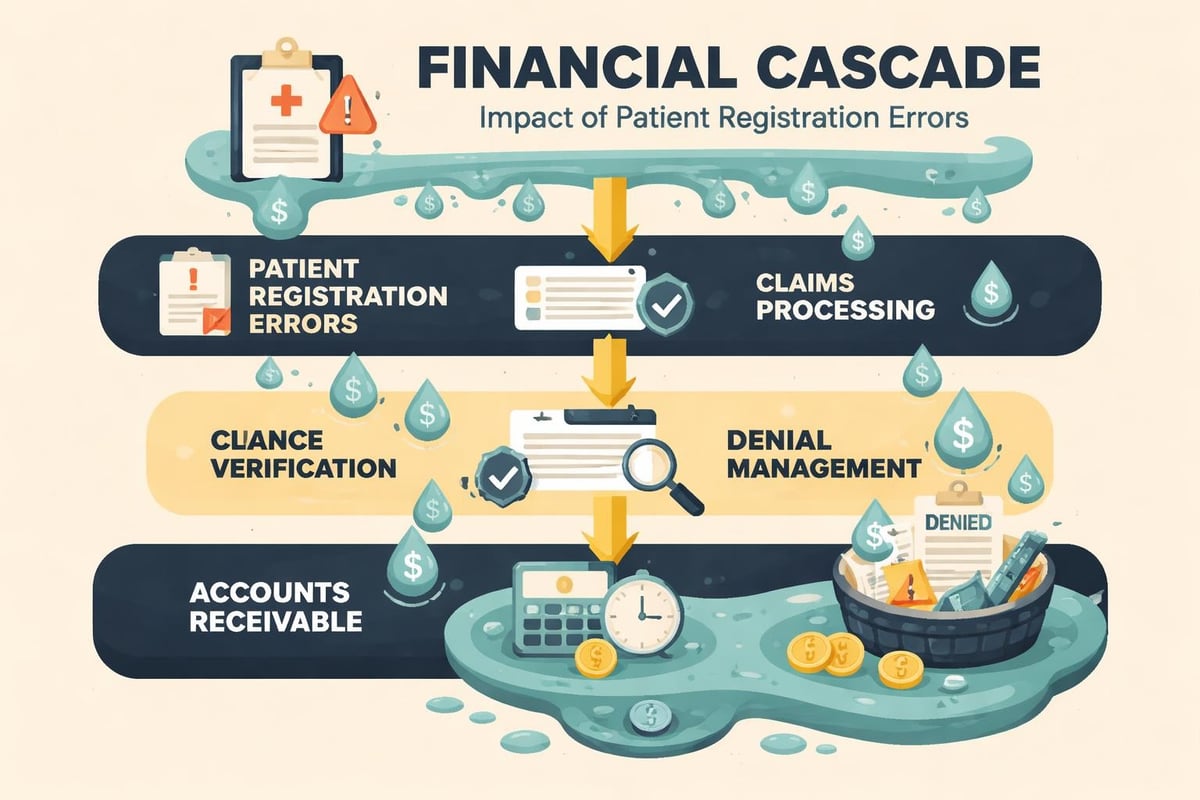
Registration error impact on revenue cycle

Common Registration Errors That Damage Revenue

Understanding the specific types of errors that occur during patient registration enables organizations to implement targeted prevention strategies. Data quality issues often stem from manual entry processes, incomplete patient information, and inadequate verification protocols.

Error Type Frequency Impact on Revenue Cycle
Insurance verification failure 35% Immediate claim denial
Demographic inaccuracies 28% Payment delays and patient disputes
Missing authorization information 18% Claim rejection and rework
Duplicate patient records 12% Billing confusion and compliance issues
Incomplete contact information 7% Communication breakdowns

These statistics highlight why healthcare organizations must prioritize registration process optimization as a strategic initiative rather than a routine administrative function.

Technology Solutions Transforming Patient Registration

Artificial intelligence and automation have revolutionized how healthcare facilities approach the registration process. Traditional manual methods that relied on paper forms and verbal information collection have given way to sophisticated digital workflows that improve accuracy while reducing patient wait times.

Modern registration solutions incorporate multiple technologies working in concert to create seamless patient experiences. Online pre-registration portals enable patients to submit information before their appointment, allowing staff to verify details and identify issues proactively. Self-service kiosks in facility lobbies empower patients to update their information independently while reducing administrative burdens.

AI-Driven Registration Automation

Artificial intelligence capabilities have addressed many challenges that previously plagued patient registration workflows. Natural language processing enables systems to extract information from various documents automatically, while machine learning algorithms identify potential errors or inconsistencies before they enter core systems.

Organizations implementing patient registration automation report significant improvements in data quality and operational efficiency. AI-powered systems can validate insurance coverage in real-time, cross-reference patient information against existing records to prevent duplicates, and flag incomplete or suspicious data for staff review.

Benefits of AI-enhanced registration include:

  • Real-time insurance eligibility verification reducing claim denials by 40%
  • Automated duplicate record detection preventing medical record fragmentation
  • Intelligent form completion suggesting information based on historical data
  • Predictive analytics identifying high-risk registration patterns
  • Natural language processing extracting data from identification documents

These technologies enable registration staff to focus on patient interaction and complex problem-solving rather than repetitive data entry tasks. The resulting efficiency gains translate directly into cost savings and improved patient throughput.

Best Practices for Registration Process Excellence

Establishing standardized workflows and clear protocols creates consistency across registration touchpoints, whether patients register online, by phone, or in person. Healthcare organizations that implement comprehensive best practices see measurable improvements in data quality and staff productivity.

Pre-Service Information Gathering

Efficient patient registration and communication begins well before patients arrive at the facility. Proactive outreach and pre-registration processes enable staff to collect information when time pressure is minimal and patients can provide thoughtful, accurate responses.

Effective pre-service strategies include automated appointment reminders with embedded registration links, phone-based pre-registration calls for complex procedures, and patient portal integration allowing information updates at any time. Organizations should leverage existing patient information to minimize redundant data collection while ensuring records remain current.
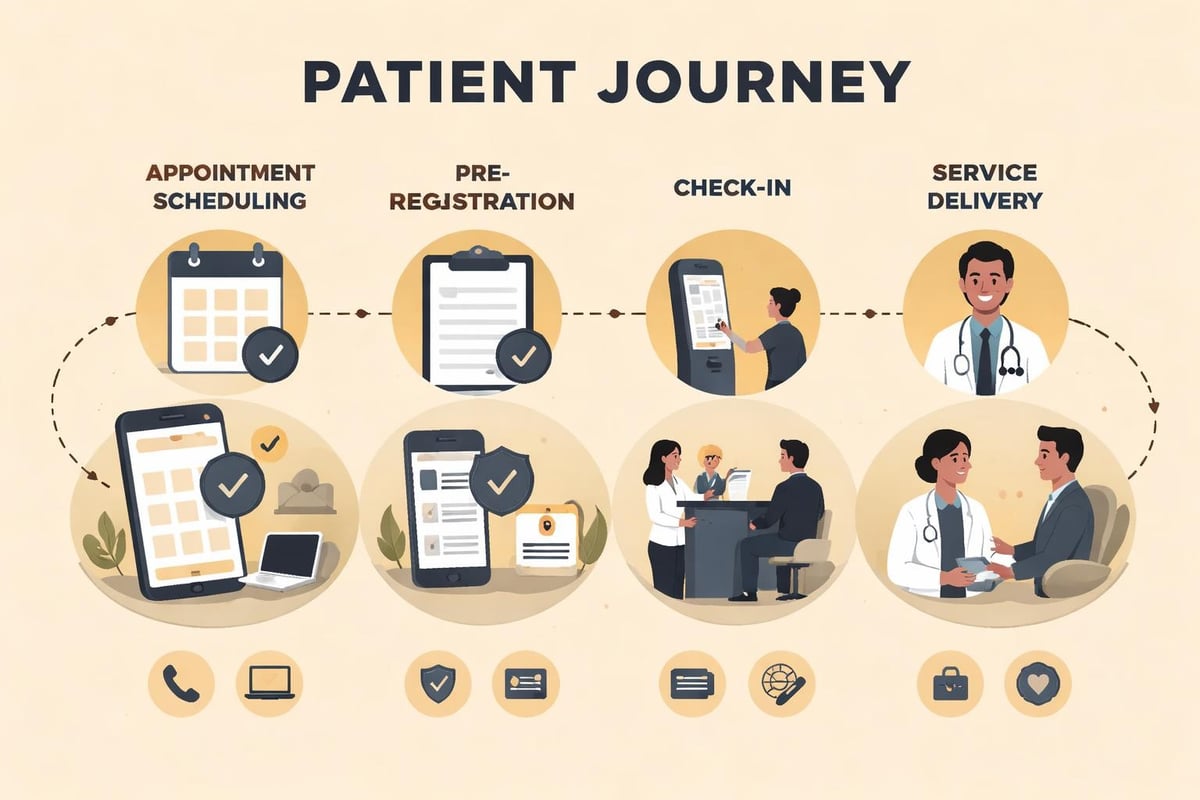
Pre-registration workflow optimization

Real-Time Verification Protocols

Insurance verification represents one of the most critical aspects of patient registration accuracy. Implementing real-time verification systems prevents costly claim denials and reduces the need for retroactive corrections.

Essential verification steps include:

  1. Electronic eligibility verification through payer connections
  2. Coverage level confirmation including copays and deductibles
  3. Authorization requirement identification for planned services
  4. Secondary insurance coordination when multiple policies exist
  5. Patient liability estimation and communication

Organizations must train registration staff to interpret verification results correctly and communicate financial responsibilities clearly to patients. Transparency during the registration process reduces billing surprises and improves collection rates.

Data Quality and Standardization Strategies

Consistent data entry standards prevent many common registration errors that compromise revenue cycle performance. Organizations should establish clear formatting guidelines for names, addresses, insurance information, and other critical data elements.

Standardized Data Entry Protocols

Creating comprehensive data entry manuals and training programs ensures all registration staff follow identical procedures regardless of location or shift. Standardization reduces variability that leads to downstream processing issues and claim rejections.

Data Element Standard Format Common Error Prevention Strategy
Patient names Last, First Middle Transposed first/last names Field labels and validation
Dates of birth MM/DD/YYYY Month/day reversal Calendar picker tools
Insurance ID Alpha-numeric exact match Misread characters OCR with manual verification
Address information USPS standardized Abbreviation inconsistency Address validation API

Technology solutions can enforce many standardization requirements automatically through field validation, dropdown menus, and required field indicators. However, staff training remains essential for handling exceptions and unusual situations that automated systems cannot address.

Duplicate Record Prevention

Patient matching challenges represent a persistent issue across healthcare organizations. Duplicate records create billing confusion, fragment medical histories, and compromise patient safety when critical information resides in separate files.

Advanced registration systems employ sophisticated matching algorithms that compare multiple data points to identify potential duplicates before creating new records. Biometric identification technologies, including fingerprint scanning and facial recognition, provide definitive matching capabilities that eliminate human judgment from the equation.

Patient Experience and Registration Efficiency

The patient registration process shapes first impressions and sets expectations for the entire healthcare encounter. Organizations that prioritize registration efficiency demonstrate respect for patient time while establishing a foundation for positive experiences.

Self-Service and Digital Options

Modern patients expect digital convenience similar to other service industries. Optimizing patient pre-registration through online portals and mobile applications meets these expectations while reducing facility congestion and wait times.

Self-service kiosks in facility lobbies provide an intermediate option for patients who prefer not to use online tools but still want to avoid traditional check-in lines. These devices guide patients through the registration process using intuitive interfaces, validate information in real-time, and alert staff when assistance is needed.

Advantages of self-service registration:

  • Reduced wait times and improved patient flow
  • Increased data accuracy through patient self-verification
  • Staff availability for complex cases requiring personal attention
  • Multilingual capabilities serving diverse patient populations
  • Contactless options supporting infection control protocols

Organizations should design digital registration workflows with accessibility in mind, ensuring options exist for patients with varying levels of technical proficiency and physical abilities.
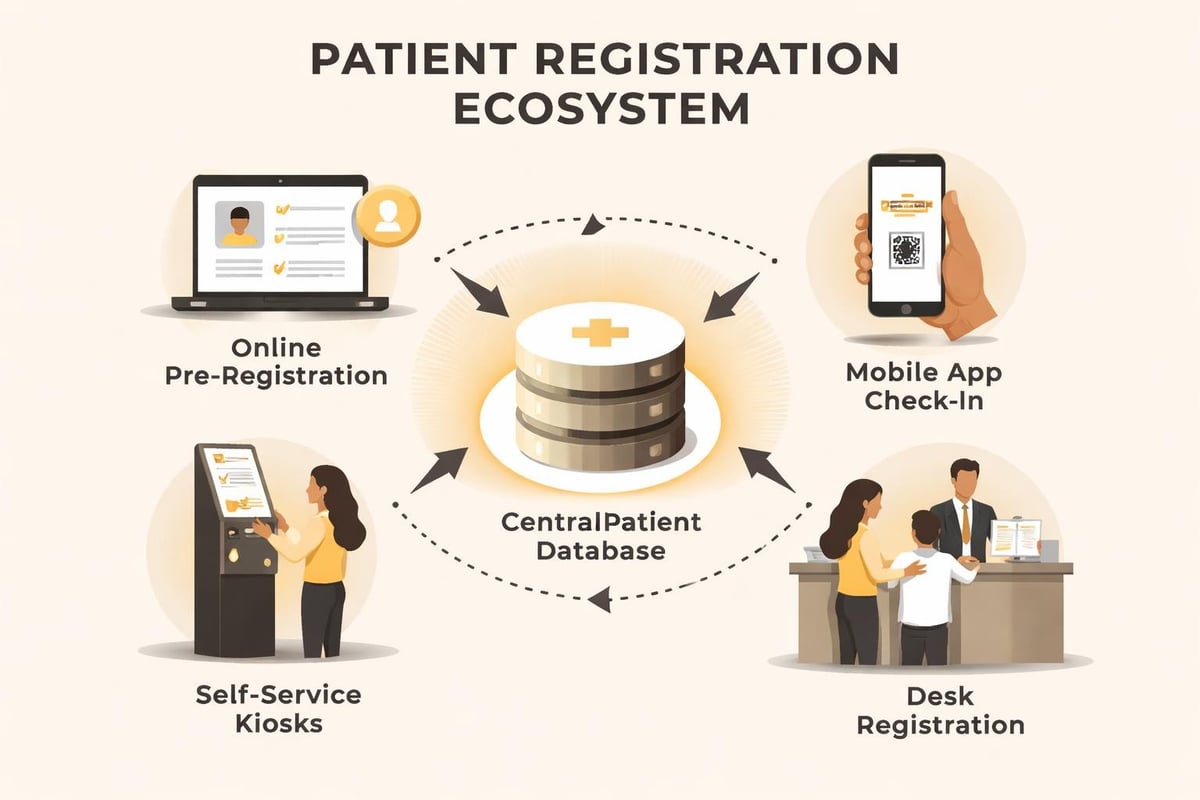
Multi-channel registration options

Staff Training and Performance Monitoring

Even the most sophisticated registration technology cannot compensate for inadequately trained staff. Comprehensive training programs should cover technical system operation, customer service skills, regulatory compliance requirements, and problem-solving strategies.

Regular performance monitoring identifies individual staff members who may need additional support while recognizing high performers who can mentor others. Key performance indicators for registration staff include data accuracy rates, average registration time, patient satisfaction scores, and insurance verification success rates.

Integration with Revenue Cycle Management

Patient registration does not exist in isolation but functions as the first stage of a comprehensive revenue cycle. Organizations must view registration within the broader context of how information flows through claims processing, payment posting, and collections.

Connecting Registration to Downstream Processes

Quality patient registration data enables smooth transitions through subsequent revenue cycle stages. When billing departments receive clean, verified information, they can submit claims confidently without extensive review or correction efforts. The vital role of patient registration extends far beyond initial data collection to influence every subsequent interaction.

Organizations should establish feedback loops that communicate registration-related denial reasons back to registration staff. This closed-loop approach helps teams learn from errors and adjust processes to prevent recurrence. Regular quality audits comparing registration data against claim submissions identify systematic issues requiring procedural changes.

Performance Metrics and Continuous Improvement

Measuring registration process performance provides the foundation for continuous improvement initiatives. Organizations should track both leading indicators that predict future performance and lagging indicators that confirm results.

Essential registration metrics include:

  • Point-of-service cash collection rates
  • Insurance verification accuracy percentages
  • Average registration completion time
  • Duplicate record creation frequency
  • First-pass claim acceptance rates
  • Patient satisfaction with registration experience

Trend analysis of these metrics over time reveals whether process changes produce desired results or require further refinement. Benchmarking against industry standards helps organizations understand their relative performance and set realistic improvement targets.

Regulatory Compliance and Security Considerations

Patient registration processes must comply with numerous regulatory requirements governing data privacy, security, and accuracy. HIPAA regulations mandate specific safeguards for protected health information collected during registration, while state laws may impose additional requirements.

Security Protocols for Registration Data

Registration staff often handle sensitive information including social security numbers, insurance details, and contact information. Organizations must implement appropriate technical, physical, and administrative safeguards to protect this data from unauthorized access or disclosure.

Enhancing security with biometric identification adds an authentication layer that traditional methods cannot match. Fingerprint scanning or facial recognition verifies patient identity definitively while reducing fraud risk and preventing medical identity theft.

Access controls should limit registration system access to authorized personnel only, with activity logging capturing who accesses patient information and when. Regular security training reinforces staff understanding of their compliance obligations and the serious consequences of data breaches.

Audit Trails and Documentation

Comprehensive audit trails documenting registration activity serve multiple purposes including compliance verification, quality improvement, and dispute resolution. Systems should capture who entered or modified information, when changes occurred, and what the previous values were.

These audit capabilities prove invaluable when investigating claim denials or patient disputes about coverage information. They also support compliance officers conducting internal reviews or responding to external audits. Organizations must retain audit data according to applicable regulations and ensure backups protect against data loss.

Strategic Implementation Roadmap

Organizations seeking to transform their patient registration processes should approach implementation strategically rather than attempting wholesale changes simultaneously. A phased approach allows staff to adapt gradually while minimizing disruption to ongoing operations.

Assessment and Planning Phase

Begin with comprehensive assessment of current registration processes, identifying pain points, error patterns, and opportunities for improvement. Staff input proves invaluable during this phase as front-line workers understand practical challenges that may not appear in high-level process documentation.

Assessment activities should include:

  1. Current state process mapping across all registration channels
  2. Error rate analysis by category and contributing factors
  3. Staff interviews regarding workflow challenges and inefficiencies
  4. Patient feedback collection about registration experience
  5. Technology evaluation identifying system limitations or capabilities

This assessment forms the foundation for creating a prioritized improvement roadmap that addresses high-impact opportunities first while building toward comprehensive optimization.

Technology Selection and Configuration

Selecting appropriate registration technology requires careful evaluation of organizational needs, existing system compatibility, and vendor capabilities. Organizations should prioritize solutions that integrate seamlessly with current electronic health records and revenue cycle management platforms rather than creating additional data silos.

Configuration decisions significantly impact long-term success. Organizations must customize registration workflows to match their specific operational requirements while maintaining enough standardization to ensure data quality. Testing thoroughly before go-live prevents situations where staff discover critical issues only after implementation.

Change Management and Staff Enablement

Technology implementation fails when organizations neglect the human factors involved in process change. Comprehensive change management strategies address staff concerns, communicate benefits clearly, and provide adequate support during transitions.

Training programs should accommodate different learning styles through varied instructional methods including hands-on practice, video tutorials, written documentation, and one-on-one coaching. Super-users identified within each department can provide peer support and answer questions as colleagues adapt to new workflows.

Organizations should anticipate productivity dips during initial implementation phases and plan accordingly with additional staffing or extended timelines. Celebrating early wins and sharing success stories maintains momentum through the more challenging aspects of transformation.

Future Trends in Patient Registration

The patient registration landscape continues evolving as new technologies mature and patient expectations shift. Organizations that anticipate future trends position themselves to adopt innovations smoothly rather than scrambling to catch up with competitors.

Artificial intelligence capabilities will expand beyond current applications to include predictive registration that pre-populates information based on appointment types, historical patterns, and external data sources. Voice-enabled registration through virtual assistants may become commonplace, allowing patients to complete registration conversationally rather than through form completion.

Blockchain technology promises solutions for patient identity management that prevent duplicate records while maintaining privacy. Distributed ledger approaches could enable patients to control their demographic information centrally while granting access to multiple providers without repeated data entry.

Interoperability improvements will finally deliver on the promise of seamless information exchange between organizations. When patient registration data flows automatically between referring physicians, specialists, and facilities, the burden on patients and registration staff decreases substantially while accuracy improves.


Optimizing patient registration processes delivers measurable benefits across financial performance, operational efficiency, and patient satisfaction metrics. Organizations that embrace modern technologies while maintaining focus on data quality and staff development position themselves for sustainable success in an increasingly competitive healthcare landscape. Nero and Associates, Inc. specializes in helping healthcare organizations transform their revenue cycle operations through strategic automation and process optimization that eliminates manual inefficiencies while improving accuracy and outcomes. Our performance-based approach ensures your registration transformation delivers tangible results that strengthen your bottom line while enhancing the patient experience.

Patient Registration: Process Optimization Guide 2026

Patient registration represents the critical foundation of healthcare revenue cycle management, directly impacting claim accuracy, patient satisfaction, and financial performance. As healthcare organizations face mounting pressure to improve operational efficiency while reducing administrative costs, the registration process has emerged as a strategic priority. Errors at this initial touchpoint cascade throughout the entire revenue cycle, leading to denied claims, delayed payments, and frustrated patients. Organizations that modernize their registration workflows through automation and standardization can eliminate thousands of hours of manual work while improving data accuracy and patient experience.

The Financial Impact of Registration Accuracy

The connection between patient registration quality and revenue cycle performance cannot be overstated. Registration errors account for a substantial percentage of claim denials, with insurance verification failures and demographic inaccuracies ranking among the top reasons for rejected submissions.

Key financial consequences of registration errors include:

  • Claim denial rates increasing by 15-30% due to inaccurate patient information
  • Extended days in accounts receivable, delaying cash flow by 30-45 days
  • Increased administrative costs from rework and resubmission efforts
  • Patient billing disputes that erode trust and satisfaction scores
  • Compliance penalties from regulatory bodies monitoring data accuracy

Healthcare organizations must recognize that streamlining patient registration directly correlates with improved claim acceptance rates and faster reimbursement cycles. When registration staff capture accurate insurance information, verify eligibility in real-time, and validate demographic data at the point of entry, downstream revenue cycle processes function more efficiently.

Registration error impact on revenue cycle

Common Registration Errors That Damage Revenue

Understanding the specific types of errors that occur during patient registration enables organizations to implement targeted prevention strategies. Data quality issues often stem from manual entry processes, incomplete patient information, and inadequate verification protocols.

Error Type Frequency Impact on Revenue Cycle
Insurance verification failure 35% Immediate claim denial
Demographic inaccuracies 28% Payment delays and patient disputes
Missing authorization information 18% Claim rejection and rework
Duplicate patient records 12% Billing confusion and compliance issues
Incomplete contact information 7% Communication breakdowns

These statistics highlight why healthcare organizations must prioritize registration process optimization as a strategic initiative rather than a routine administrative function.

Technology Solutions Transforming Patient Registration

Artificial intelligence and automation have revolutionized how healthcare facilities approach the registration process. Traditional manual methods that relied on paper forms and verbal information collection have given way to sophisticated digital workflows that improve accuracy while reducing patient wait times.

Modern registration solutions incorporate multiple technologies working in concert to create seamless patient experiences. Online pre-registration portals enable patients to submit information before their appointment, allowing staff to verify details and identify issues proactively. Self-service kiosks in facility lobbies empower patients to update their information independently while reducing administrative burdens.

AI-Driven Registration Automation

Artificial intelligence capabilities have addressed many challenges that previously plagued patient registration workflows. Natural language processing enables systems to extract information from various documents automatically, while machine learning algorithms identify potential errors or inconsistencies before they enter core systems.

Organizations implementing patient registration automation report significant improvements in data quality and operational efficiency. AI-powered systems can validate insurance coverage in real-time, cross-reference patient information against existing records to prevent duplicates, and flag incomplete or suspicious data for staff review.

Benefits of AI-enhanced registration include:

  • Real-time insurance eligibility verification reducing claim denials by 40%
  • Automated duplicate record detection preventing medical record fragmentation
  • Intelligent form completion suggesting information based on historical data
  • Predictive analytics identifying high-risk registration patterns
  • Natural language processing extracting data from identification documents

These technologies enable registration staff to focus on patient interaction and complex problem-solving rather than repetitive data entry tasks. The resulting efficiency gains translate directly into cost savings and improved patient throughput.

Best Practices for Registration Process Excellence

Establishing standardized workflows and clear protocols creates consistency across registration touchpoints, whether patients register online, by phone, or in person. Healthcare organizations that implement comprehensive best practices see measurable improvements in data quality and staff productivity.

Pre-Service Information Gathering

Efficient patient registration and communication begins well before patients arrive at the facility. Proactive outreach and pre-registration processes enable staff to collect information when time pressure is minimal and patients can provide thoughtful, accurate responses.

Effective pre-service strategies include automated appointment reminders with embedded registration links, phone-based pre-registration calls for complex procedures, and patient portal integration allowing information updates at any time. Organizations should leverage existing patient information to minimize redundant data collection while ensuring records remain current.

Pre-registration workflow optimization

Real-Time Verification Protocols

Insurance verification represents one of the most critical aspects of patient registration accuracy. Implementing real-time verification systems prevents costly claim denials and reduces the need for retroactive corrections.

Essential verification steps include:

  1. Electronic eligibility verification through payer connections
  2. Coverage level confirmation including copays and deductibles
  3. Authorization requirement identification for planned services
  4. Secondary insurance coordination when multiple policies exist
  5. Patient liability estimation and communication

Organizations must train registration staff to interpret verification results correctly and communicate financial responsibilities clearly to patients. Transparency during the registration process reduces billing surprises and improves collection rates.

Data Quality and Standardization Strategies

Consistent data entry standards prevent many common registration errors that compromise revenue cycle performance. Organizations should establish clear formatting guidelines for names, addresses, insurance information, and other critical data elements.

Standardized Data Entry Protocols

Creating comprehensive data entry manuals and training programs ensures all registration staff follow identical procedures regardless of location or shift. Standardization reduces variability that leads to downstream processing issues and claim rejections.

Data Element Standard Format Common Error Prevention Strategy
Patient names Last, First Middle Transposed first/last names Field labels and validation
Dates of birth MM/DD/YYYY Month/day reversal Calendar picker tools
Insurance ID Alpha-numeric exact match Misread characters OCR with manual verification
Address information USPS standardized Abbreviation inconsistency Address validation API

Technology solutions can enforce many standardization requirements automatically through field validation, dropdown menus, and required field indicators. However, staff training remains essential for handling exceptions and unusual situations that automated systems cannot address.

Duplicate Record Prevention

Patient matching challenges represent a persistent issue across healthcare organizations. Duplicate records create billing confusion, fragment medical histories, and compromise patient safety when critical information resides in separate files.

Advanced registration systems employ sophisticated matching algorithms that compare multiple data points to identify potential duplicates before creating new records. Biometric identification technologies, including fingerprint scanning and facial recognition, provide definitive matching capabilities that eliminate human judgment from the equation.

Patient Experience and Registration Efficiency

The patient registration process shapes first impressions and sets expectations for the entire healthcare encounter. Organizations that prioritize registration efficiency demonstrate respect for patient time while establishing a foundation for positive experiences.

Self-Service and Digital Options

Modern patients expect digital convenience similar to other service industries. Optimizing patient pre-registration through online portals and mobile applications meets these expectations while reducing facility congestion and wait times.

Self-service kiosks in facility lobbies provide an intermediate option for patients who prefer not to use online tools but still want to avoid traditional check-in lines. These devices guide patients through the registration process using intuitive interfaces, validate information in real-time, and alert staff when assistance is needed.

Advantages of self-service registration:

  • Reduced wait times and improved patient flow
  • Increased data accuracy through patient self-verification
  • Staff availability for complex cases requiring personal attention
  • Multilingual capabilities serving diverse patient populations
  • Contactless options supporting infection control protocols

Organizations should design digital registration workflows with accessibility in mind, ensuring options exist for patients with varying levels of technical proficiency and physical abilities.

Multi-channel registration options

Staff Training and Performance Monitoring

Even the most sophisticated registration technology cannot compensate for inadequately trained staff. Comprehensive training programs should cover technical system operation, customer service skills, regulatory compliance requirements, and problem-solving strategies.

Regular performance monitoring identifies individual staff members who may need additional support while recognizing high performers who can mentor others. Key performance indicators for registration staff include data accuracy rates, average registration time, patient satisfaction scores, and insurance verification success rates.

Integration with Revenue Cycle Management

Patient registration does not exist in isolation but functions as the first stage of a comprehensive revenue cycle. Organizations must view registration within the broader context of how information flows through claims processing, payment posting, and collections.

Connecting Registration to Downstream Processes

Quality patient registration data enables smooth transitions through subsequent revenue cycle stages. When billing departments receive clean, verified information, they can submit claims confidently without extensive review or correction efforts. The vital role of patient registration extends far beyond initial data collection to influence every subsequent interaction.

Organizations should establish feedback loops that communicate registration-related denial reasons back to registration staff. This closed-loop approach helps teams learn from errors and adjust processes to prevent recurrence. Regular quality audits comparing registration data against claim submissions identify systematic issues requiring procedural changes.

Performance Metrics and Continuous Improvement

Measuring registration process performance provides the foundation for continuous improvement initiatives. Organizations should track both leading indicators that predict future performance and lagging indicators that confirm results.

Essential registration metrics include:

  • Point-of-service cash collection rates
  • Insurance verification accuracy percentages
  • Average registration completion time
  • Duplicate record creation frequency
  • First-pass claim acceptance rates
  • Patient satisfaction with registration experience

Trend analysis of these metrics over time reveals whether process changes produce desired results or require further refinement. Benchmarking against industry standards helps organizations understand their relative performance and set realistic improvement targets.

Regulatory Compliance and Security Considerations

Patient registration processes must comply with numerous regulatory requirements governing data privacy, security, and accuracy. HIPAA regulations mandate specific safeguards for protected health information collected during registration, while state laws may impose additional requirements.

Security Protocols for Registration Data

Registration staff often handle sensitive information including social security numbers, insurance details, and contact information. Organizations must implement appropriate technical, physical, and administrative safeguards to protect this data from unauthorized access or disclosure.

Enhancing security with biometric identification adds an authentication layer that traditional methods cannot match. Fingerprint scanning or facial recognition verifies patient identity definitively while reducing fraud risk and preventing medical identity theft.

Access controls should limit registration system access to authorized personnel only, with activity logging capturing who accesses patient information and when. Regular security training reinforces staff understanding of their compliance obligations and the serious consequences of data breaches.

Audit Trails and Documentation

Comprehensive audit trails documenting registration activity serve multiple purposes including compliance verification, quality improvement, and dispute resolution. Systems should capture who entered or modified information, when changes occurred, and what the previous values were.

These audit capabilities prove invaluable when investigating claim denials or patient disputes about coverage information. They also support compliance officers conducting internal reviews or responding to external audits. Organizations must retain audit data according to applicable regulations and ensure backups protect against data loss.

Strategic Implementation Roadmap

Organizations seeking to transform their patient registration processes should approach implementation strategically rather than attempting wholesale changes simultaneously. A phased approach allows staff to adapt gradually while minimizing disruption to ongoing operations.

Assessment and Planning Phase

Begin with comprehensive assessment of current registration processes, identifying pain points, error patterns, and opportunities for improvement. Staff input proves invaluable during this phase as front-line workers understand practical challenges that may not appear in high-level process documentation.

Assessment activities should include:

  1. Current state process mapping across all registration channels
  2. Error rate analysis by category and contributing factors
  3. Staff interviews regarding workflow challenges and inefficiencies
  4. Patient feedback collection about registration experience
  5. Technology evaluation identifying system limitations or capabilities

This assessment forms the foundation for creating a prioritized improvement roadmap that addresses high-impact opportunities first while building toward comprehensive optimization.

Technology Selection and Configuration

Selecting appropriate registration technology requires careful evaluation of organizational needs, existing system compatibility, and vendor capabilities. Organizations should prioritize solutions that integrate seamlessly with current electronic health records and revenue cycle management platforms rather than creating additional data silos.

Configuration decisions significantly impact long-term success. Organizations must customize registration workflows to match their specific operational requirements while maintaining enough standardization to ensure data quality. Testing thoroughly before go-live prevents situations where staff discover critical issues only after implementation.

Change Management and Staff Enablement

Technology implementation fails when organizations neglect the human factors involved in process change. Comprehensive change management strategies address staff concerns, communicate benefits clearly, and provide adequate support during transitions.

Training programs should accommodate different learning styles through varied instructional methods including hands-on practice, video tutorials, written documentation, and one-on-one coaching. Super-users identified within each department can provide peer support and answer questions as colleagues adapt to new workflows.

Organizations should anticipate productivity dips during initial implementation phases and plan accordingly with additional staffing or extended timelines. Celebrating early wins and sharing success stories maintains momentum through the more challenging aspects of transformation.

Future Trends in Patient Registration

The patient registration landscape continues evolving as new technologies mature and patient expectations shift. Organizations that anticipate future trends position themselves to adopt innovations smoothly rather than scrambling to catch up with competitors.

Artificial intelligence capabilities will expand beyond current applications to include predictive registration that pre-populates information based on appointment types, historical patterns, and external data sources. Voice-enabled registration through virtual assistants may become commonplace, allowing patients to complete registration conversationally rather than through form completion.

Blockchain technology promises solutions for patient identity management that prevent duplicate records while maintaining privacy. Distributed ledger approaches could enable patients to control their demographic information centrally while granting access to multiple providers without repeated data entry.

Interoperability improvements will finally deliver on the promise of seamless information exchange between organizations. When patient registration data flows automatically between referring physicians, specialists, and facilities, the burden on patients and registration staff decreases substantially while accuracy improves.


Optimizing patient registration processes delivers measurable benefits across financial performance, operational efficiency, and patient satisfaction metrics. Organizations that embrace modern technologies while maintaining focus on data quality and staff development position themselves for sustainable success in an increasingly competitive healthcare landscape. Nero and Associates, Inc. specializes in helping healthcare organizations transform their revenue cycle operations through strategic automation and process optimization that eliminates manual inefficiencies while improving accuracy and outcomes. Our performance-based approach ensures your registration transformation delivers tangible results that strengthen your bottom line while enhancing the patient experience.

Website developed in accordance with Web Content Accessibility Guidelines 2.2.
If you encounter any issues while using this site, please contact us: 215.526.5126