

Strategic tax optimization has become a critical competency for organizations seeking to maximize profitability and maintain competitive advantages in an increasingly complex regulatory environment. As businesses navigate evolving tax laws, technological advancement, and shifting economic conditions in 2026, implementing comprehensive strategies to minimize tax liabilities while maintaining full compliance represents one of the most impactful ways to improve financial performance. Organizations that master tax optimization techniques can redirect saved capital toward growth initiatives, employee benefits, and operational improvements that strengthen their market position.
Understanding the Foundation of Strategic Tax Planning
Tax optimization encompasses far more than basic compliance or last-minute deduction scrambles. It requires a systematic approach that integrates financial planning, business structure decisions, and operational timing into a cohesive strategy. The fundamental principle involves legally minimizing tax obligations through careful analysis of available deductions, credits, and planning opportunities.
The Difference Between Tax Avoidance and Tax Optimization
Many business leaders confuse tax avoidance with illegal tax evasion, but there are crucial distinctions. Tax optimization represents the legal and ethical application of tax code provisions to reduce liabilities through:
- Strategic timing of income recognition and expense deductions
- Proper business entity structure selection
- Maximization of available tax credits and incentives
- Retirement plan contributions and employee benefit programs
- Investment portfolio management with tax-efficient strategies
Legitimate tax optimization always operates within the boundaries of current law, utilizing provisions that legislators specifically designed to encourage certain business behaviors. Organizations that invest in employee wellness programs, retirement benefits, or research and development activities can access substantial tax advantages while simultaneously building stronger workforces and more innovative operations.
Implementing Year-Round Tax Optimization Practices
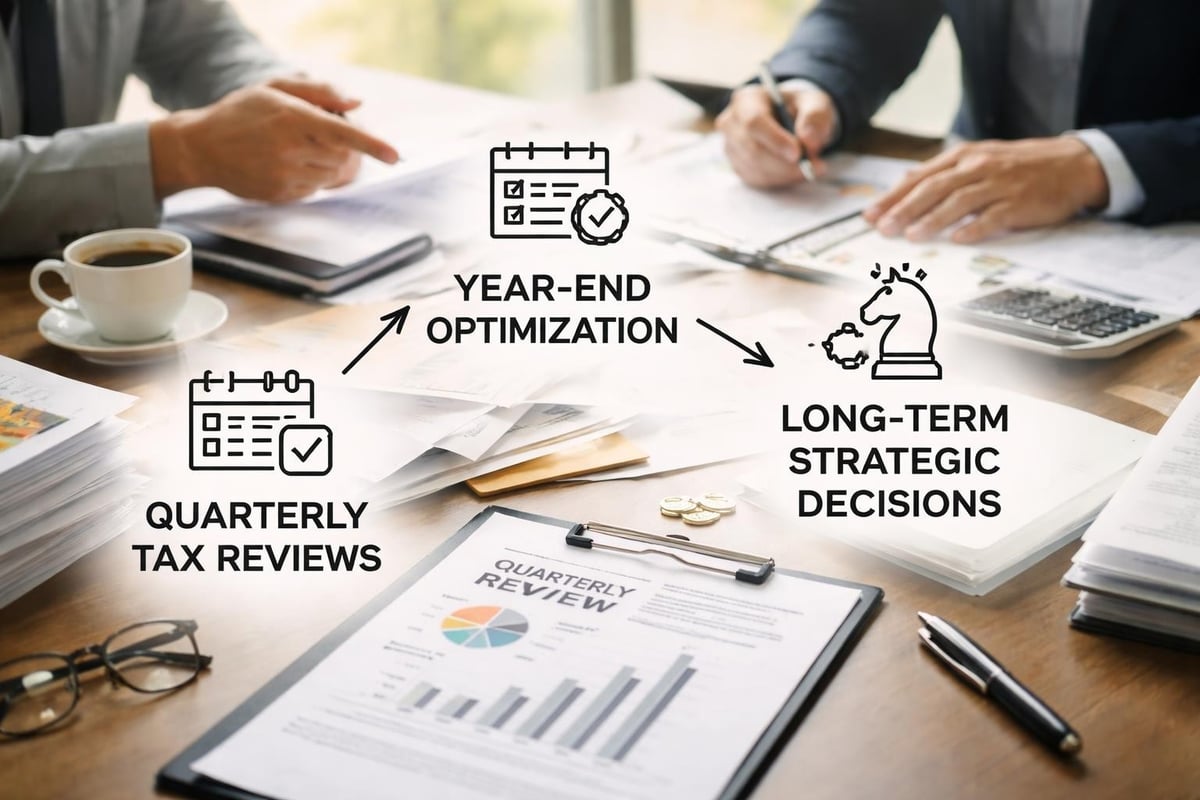
The most successful organizations approach tax optimization as a continuous process rather than an annual event. Year-round strategic planning enables businesses to capitalize on opportunities that might otherwise disappear due to timing constraints or changing circumstances.
Quarterly Review and Adjustment Strategies
Establishing quarterly tax planning sessions creates opportunities to adjust strategies based on current performance and regulatory changes. These regular check-ins allow finance teams to:
- Analyze current-year profit projections and determine optimal timing for major expenditures
- Review estimated tax payment accuracy to avoid underpayment penalties while preserving cash flow
- Assess retirement plan contribution opportunities for both the organization and key personnel
- Evaluate equipment purchases that might qualify for Section 179 deductions or bonus depreciation
- Monitor legislative changes that could impact planning strategies before year-end
Organizations should also maintain comprehensive records throughout the year rather than scrambling for documentation during tax season. Modern automation and integration solutions can streamline this record-keeping process, reducing administrative burden while ensuring nothing falls through the cracks.
Maximizing Business Expense Deductions
Strategic expense management represents one of the most accessible tax optimization opportunities for businesses of all sizes. Beyond standard operating expenses, organizations should carefully track and categorize:
| Expense Category | Optimization Opportunity | Documentation Required |
|---|---|---|
| Home Office Deductions | Significant savings for remote work arrangements | Square footage calculations, utility bills |
| Vehicle Expenses | Actual expense or standard mileage methods | Mileage logs, receipts, business purpose |
| Professional Development | Training, conferences, certifications | Registration fees, travel expenses, agendas |
| Technology Investments | Software, hardware, cybersecurity | Invoices, subscription agreements, deployment dates |
| Healthcare Benefits | Premium deductions, HSA contributions | Insurance statements, contribution records |
The year-round tax planning approach ensures businesses don't miss valuable deductions simply because they failed to maintain proper documentation or recognize qualifying expenses.
Leveraging Retirement Plans for Tax Advantages
Retirement plan contributions represent a powerful tax optimization strategy that simultaneously reduces current tax liabilities while building long-term financial security for team members. The dual benefit makes retirement planning particularly attractive for organizations committed to comprehensive employee wellness.
Employer-Sponsored Retirement Plan Options
Different retirement plan structures offer varying levels of tax benefits and administrative complexity. Selecting the optimal plan type depends on business size, profitability, and workforce characteristics:
- 401(k) plans allow substantial employee deferrals ($23,500 in 2026 for those under 50) plus employer matching contributions
- SEP IRAs enable employer contributions up to 25% of employee compensation with simplified administration
- SIMPLE IRAs provide middle-ground options for smaller businesses with straightforward contribution formulas
- Defined benefit plans deliver maximum contribution potential for high-income business owners nearing retirement
Employer contributions to these plans generate immediate tax deductions while building employee loyalty and supporting financial wellness initiatives. Organizations can strategically time contributions to optimize tax benefits across multiple years based on profitability fluctuations.
Advanced Investment Strategies for Tax Efficiency
Beyond basic retirement contributions, sophisticated investment management techniques can substantially reduce tax burdens while improving after-tax returns. These strategies require careful coordination between financial advisors and tax professionals to maximize effectiveness.
Tax-Loss Harvesting and Portfolio Management
Tax-loss harvesting involves strategically selling investments that have declined in value to offset capital gains from profitable positions. This technique reduces overall tax liability while maintaining portfolio exposure through careful reinvestment.
The investment strategists’ approach to tax-loss harvesting emphasizes systematic processes that identify harvesting opportunities throughout the year rather than waiting until December. Key considerations include:
- Monitoring portfolio positions for unrealized losses exceeding transaction costs
- Understanding wash-sale rules that disallow losses on substantially identical securities purchased within 30 days
- Reinvesting proceeds in similar but not identical positions to maintain market exposure
- Carrying forward unused losses to offset future capital gains
Organizations managing significant investment portfolios can benefit from direct indexing and other strategies to minimize taxes on large asset sales, particularly when divesting business units or reallocating substantial holdings.

Capital Gains Timing and Structure
Strategic timing of capital gains recognition can significantly impact tax obligations. Businesses planning to sell appreciated assets should consider:
- Holding period requirements to qualify for preferential long-term capital gains rates
- Installment sale structures that spread gain recognition across multiple tax years
- Qualified opportunity zone investments that defer and potentially reduce capital gains taxes
- Section 1031 exchanges for real estate transactions that defer recognition indefinitely
Structured sales provide alternative approaches to managing tax exposure when disposing of capital assets, using third-party funding to create installment payment streams without seller financing risk.
Navigating State and Local Tax Considerations
Federal tax optimization represents just one component of comprehensive planning. State and local tax obligations can substantially impact overall tax efficiency, particularly for businesses operating across multiple jurisdictions.
SALT Deduction Strategies
The state and local tax (SALT) deduction limitation has created planning challenges for businesses and individuals in high-tax states. However, innovative approaches can help organizations navigate these restrictions. New SALT cap deduction strategies using non-grantor trusts allow taxpayers to potentially multiply deductions and reduce overall tax burdens.
Business owners should evaluate:
- Entity-level tax elections that allow pass-through entities to pay state income taxes directly
- Trust structures that create additional SALT deduction opportunities for high-income individuals
- Multi-state nexus planning to optimize where income is recognized and taxed
- Remote work policies that impact state tax obligations for employees and businesses
Integrating Technology for Tax Optimization
Modern tax optimization increasingly depends on technological capabilities that automate data collection, identify opportunities, and ensure compliance. Organizations that leverage automation and integration solutions gain significant advantages over those relying on manual processes.
Automation Benefits for Tax Planning
Technology integration delivers tax optimization benefits through several mechanisms:
Data Aggregation and Analysis: Automated systems continuously collect financial data from multiple sources, providing real-time visibility into tax-relevant transactions and positions. This comprehensive view enables proactive planning rather than reactive compliance.
Opportunity Identification: Advanced analytics can flag potential tax-saving opportunities based on pattern recognition and rule-based triggers. Systems might identify optimal timing for equipment purchases, threshold proximity for various tax credits, or harvesting candidates within investment portfolios.
Compliance Assurance: Automation reduces human error in tax calculations and reporting while maintaining comprehensive audit trails. Integrated systems ensure consistency between operational records and tax documentation.
Scenario Modeling: Sophisticated platforms enable tax professionals to model various scenarios and quantify the tax impact of different strategic decisions before implementation.
Organizations implementing comprehensive automation solutions for financial management often discover unexpected tax optimization opportunities while simultaneously reducing the hours required for tax preparation and planning activities.
Business Structure Optimization
The legal structure through which businesses operate fundamentally impacts tax obligations and optimization opportunities. Periodic review of entity structure ensures alignment with current business realities and tax law provisions.
Entity Type Comparison
| Entity Type | Tax Treatment | Liability Protection | Optimization Opportunities |
|---|---|---|---|
| Sole Proprietorship | Pass-through to Schedule C | None | Limited; self-employment tax applies |
| Partnership | Pass-through to partners | Limited to general partners | Flexible allocations, basis planning |
| S Corporation | Pass-through; reasonable compensation required | Full corporate protection | Payroll tax savings on distributions |
| C Corporation | Corporate-level taxation | Full corporate protection | Graduated rates, qualified dividends, fringe benefits |
| LLC | Flexible tax election | Full member protection | Choose optimal tax treatment |
Many businesses benefit from hybrid structures or multiple entities that segregate different operations for tax efficiency. Professional service firms might separate consulting services from technology licensing, while organizations with real estate holdings often benefit from property-holding entities separate from operating companies.

Employee Benefits as Tax Optimization Tools
Strategic employee benefit programs deliver triple value by reducing organizational tax burdens, providing tax-advantaged compensation to team members, and supporting comprehensive wellness initiatives. This alignment makes benefits optimization particularly relevant for organizations committed to employee health and financial wellness.
Health and Wellness Program Tax Benefits
Organizations investing in employee physical and mental health access substantial tax advantages while building stronger, more productive teams:
- Health insurance premiums generate full tax deductions while providing valuable employee benefits
- Health Savings Account contributions create triple tax advantages through deductible contributions, tax-free growth, and tax-free qualified withdrawals
- Wellness program expenses including gym memberships, health screenings, and mental health resources qualify as deductible business expenses
- Employee Assistance Programs providing counseling and support services deliver tax-advantaged value to team members
These programs align perfectly with comprehensive approaches to employee wellness, creating financial value through tax optimization while simultaneously addressing the human capital needs that drive organizational performance.
Financial Wellness and Education Programs
Supporting employee financial health through education programs, financial counseling, and planning assistance generates organizational tax benefits while helping team members make better financial decisions. These initiatives can include:
- Student loan repayment assistance programs with favorable tax treatment
- Financial literacy workshops and one-on-one counseling sessions
- Retirement planning education that increases plan participation
- Emergency savings programs that reduce employee financial stress
Organizations implementing these programs often discover that the tax benefits partially offset program costs while delivering substantial returns through improved employee retention, productivity, and engagement.
Year-End Tax Optimization Strategies
Despite the importance of year-round planning, concentrated end-of-year tax planning moves create valuable opportunities to maximize current-year deductions and position organizations advantageously for future periods.
December Planning Priorities
The final weeks of each tax year require focused attention on time-sensitive opportunities:
Accelerate Deductions: Organizations expecting higher income in the current year than future periods should consider prepaying deductible expenses, accelerating equipment purchases, or making additional retirement plan contributions before December 31.
Defer Income: Conversely, businesses anticipating lower future tax rates might delay invoicing or defer year-end bonuses into the following year to recognize income at more favorable rates.
Review Depreciation Elections: Section 179 expensing and bonus depreciation provide powerful tools for immediate equipment cost recovery. Organizations should analyze whether these accelerated deduction methods or traditional depreciation schedules optimize their specific tax situations.
Charitable Contributions: Businesses making charitable donations should ensure contributions occur before year-end and maintain proper documentation for deduction purposes.
Estimated Tax Adjustments: Final quarter estimated tax payments provide the last opportunity to true up tax deposits and avoid underpayment penalties while preserving cash flow.
Ongoing Compliance and Professional Support
Effective tax optimization requires balancing aggressive but legal planning strategies with conservative compliance approaches that withstand regulatory scrutiny. This balance becomes particularly important as tax authorities increase enforcement activities and deploy advanced analytics to identify potential issues.
Organizations benefit from establishing relationships with qualified tax professionals who understand their industry, business model, and strategic objectives. These advisors provide value through:
- Current awareness of regulatory changes affecting tax planning strategies
- Industry-specific expertise regarding available credits and incentives
- Technical knowledge for complex transactions and entity structures
- Representation support during examinations or disputes with tax authorities
- Strategic planning that integrates tax considerations with broader business objectives
The investment in professional tax advisory services typically delivers substantial returns through identified opportunities and avoided penalties that far exceed advisory fees.
Strategic tax optimization represents a critical component of comprehensive business financial management that extends well beyond simple compliance activities. Organizations that implement systematic approaches to minimizing tax obligations while supporting employee wellness and operational efficiency position themselves for sustainable competitive advantages. Nero and Associates, Inc. helps businesses integrate tax-efficient strategies into broader operational improvement initiatives, leveraging automation, human capital management expertise, and strategic advisory services to reduce costs, increase profitability, and support comprehensive employee financial wellness programs that benefit both organizations and their teams.