

Cash flow improvement represents one of the most critical challenges facing professional services firms in 2026. While generating revenue and securing new clients remains essential, the ability to maintain healthy cash flow determines whether organizations can invest in growth, retain top talent, and weather economic uncertainties. For consulting businesses that provide specialized services, the gap between delivering value and receiving payment can create significant operational stress. Understanding how to optimize cash flow through strategic interventions enables service firms to build resilience and capitalize on opportunities that competitors might miss.
Understanding Cash Flow Dynamics in Professional Services
Professional services consulting operates differently from product-based businesses when it comes to cash flow management. The revenue model typically involves project-based engagements, retainer agreements, or value-based pricing structures that create unique timing challenges.
Service delivery often precedes payment by weeks or even months, creating a natural cash flow gap. Consultants must pay employees, maintain technology infrastructure, and cover operational expenses while waiting for client payments to arrive. This timing mismatch becomes particularly acute during growth phases when new hires and expanded capabilities require upfront investment.

The Revenue Recognition Challenge
Many consulting firms struggle with revenue recognition patterns that don't align with cash needs. A firm might recognize revenue upon project milestones while actual cash arrives on different schedules based on client payment terms. This disconnect requires sophisticated planning and forecasting.
Key factors affecting consulting cash flow:
- Project duration and payment milestone structure
- Client payment terms ranging from net-30 to net-90 days
- Upfront retainer requirements and deposit policies
- Seasonal fluctuations in client engagement patterns
- Contract renewal cycles and proposal-to-close timelines
Accelerating Cash Inflows Through Invoice Optimization
One of the most effective approaches to cash flow improvement involves optimizing how you bill and collect from clients. The invoice management strategies you implement directly impact how quickly revenue converts to available cash.
Strategic Billing Practices
Progressive billing represents a powerful method for service firms. Rather than waiting until project completion to invoice, break large engagements into milestone-based billing events. This approach provides regular cash inflows throughout the engagement lifecycle.
Consider implementing these billing improvements:
- Front-load payment terms with larger deposits or retainers for new client engagements
- Reduce standard payment terms from net-60 to net-30 or even net-15 where market conditions allow
- Offer early payment incentives such as 2% discounts for payment within 10 days
- Establish recurring billing for ongoing advisory services and retainer relationships
- Invoice immediately upon milestone completion rather than batching invoices monthly
| Billing Strategy | Cash Flow Impact | Implementation Difficulty |
|---|---|---|
| Milestone-based invoicing | High | Medium |
| Retainer requirements | Very High | Low |
| Early payment discounts | Medium | Low |
| Automated invoice delivery | Medium | Low |
| Shortened payment terms | High | Medium |
Technology-Enabled Collection Processes
Automation dramatically improves collection rates and reduces days sales outstanding (DSO). Modern accounting systems can send automatic payment reminders, provide client payment portals with multiple payment options, and flag overdue accounts for immediate follow-up.
Integration between your project management, time tracking, and billing systems eliminates delays in invoice generation. When consultants complete project milestones, automated workflows can trigger invoice creation and delivery without manual intervention.
Managing Cash Outflows With Strategic Precision
While accelerating inflows matters, effective cash flow management strategies also require careful control of when and how money leaves your organization. Professional services firms have several opportunities to optimize outflow timing without compromising operational quality.

Vendor Payment Optimization
Negotiate payment terms with your vendors that align with your cash collection cycles. If your average client pays in 45 days, structuring vendor payments for 45-60 days creates natural alignment. This doesn't mean delaying payments inappropriately but rather establishing mutually beneficial terms from the outset.
Vendor management tactics include:
- Consolidating vendors to improve negotiating leverage
- Requesting extended payment terms for larger annual commitments
- Scheduling payment processing to align with cash receipt patterns
- Taking advantage of early payment discounts only when cash position is strong
- Implementing approval workflows that prevent unnecessary expenditures
Labor Cost Management
For service firms, labor represents the largest expense category. Strategic workforce planning improves cash flow improvement outcomes by ensuring you're not carrying excess capacity during slow periods or scrambling with overtime during busy seasons.
Consider variable staffing models that include contract specialists for project peaks, creating flexibility in your largest expense category. This approach allows you to scale resources based on confirmed revenue rather than forecasted opportunities.
Forecasting for Proactive Cash Management
Cash flow forecasting transforms reactive scrambling into proactive planning. For consulting firms, building 13-week rolling cash flow forecasts provides the visibility needed to make informed decisions about hiring, capital investments, and growth initiatives.
Building Accurate Projections
Your forecast should incorporate both committed revenue from signed contracts and probabilistic revenue from active proposals. Weight pipeline opportunities by their close probability and expected timing to create realistic scenarios.
Track these essential metrics weekly:
- Current cash position and available credit
- Confirmed receipts from invoiced projects
- Expected receipts from completed but unbilled work
- Projected receipts from active proposals
- Committed expenditures including payroll and vendor obligations
- Discretionary expenses that can be adjusted if needed
Scenario Planning
Professional services firms benefit from maintaining three forecast scenarios: optimistic, realistic, and conservative. The conservative scenario helps identify potential cash crunches before they occur, allowing time to arrange credit facilities or adjust spending patterns.
Use your forecasting tools to model the impact of different strategies to improve business cash flow, such as shortened payment terms or different billing structures, before implementing them.
Leveraging Technology for Cash Flow Improvement
Automation and integration capabilities represent significant opportunities for consulting firms to improve cash flow while reducing administrative burden. The time your team spends on manual invoicing, payment tracking, and reconciliation could be redirected toward billable client work.
Integration Benefits
When your customer relationship management (CRM), project management, time tracking, and accounting systems communicate seamlessly, cash flow improves through multiple mechanisms. Proposals convert to projects faster, billable time gets captured and invoiced immediately, and payment processing happens without delays.
Modern platforms enable sophisticated capabilities:
- Automated time entry from calendar events and project management tools
- Real-time project profitability tracking that signals when to invoice
- Integrated payment processing that reduces collection cycles
- Automated financial reporting that highlights cash flow trends
- Predictive analytics that forecast cash positions based on pipeline activity
Organizations working with expert teams who understand both technology implementation and financial operations can achieve integration benefits faster and with less disruption.
Working Capital Optimization Strategies
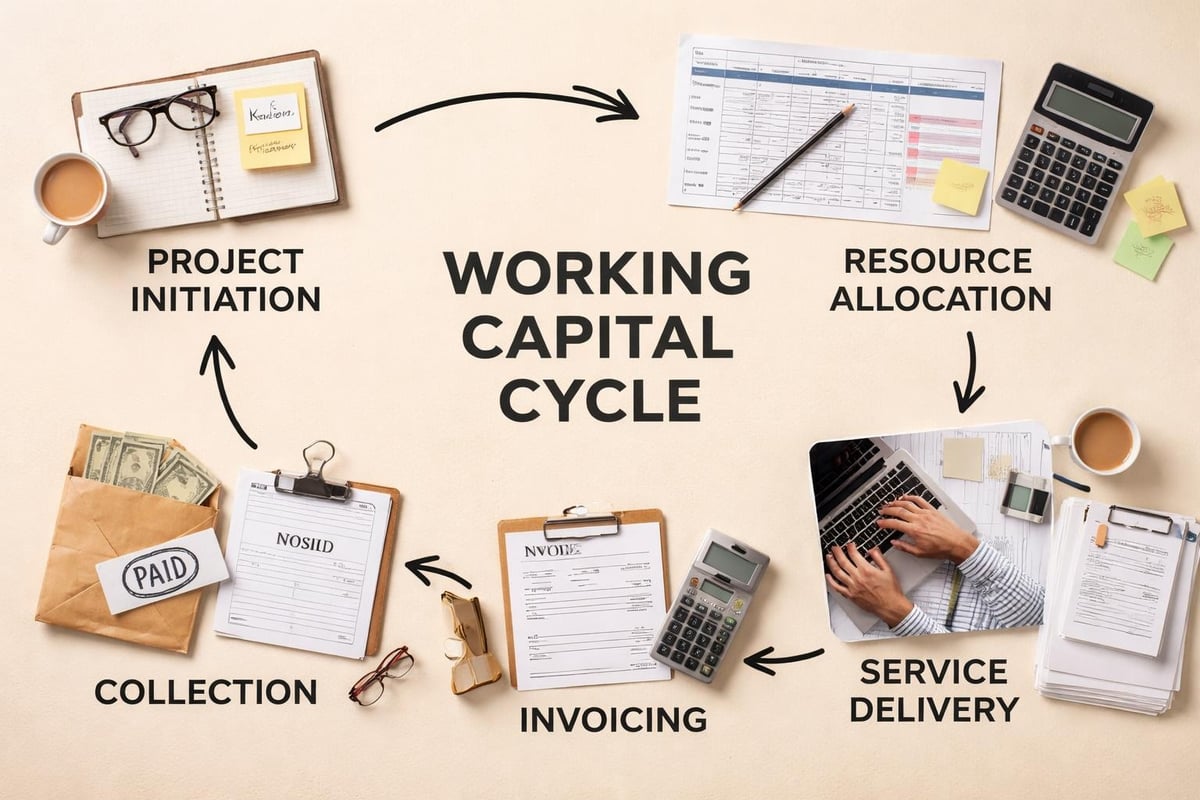
Working capital management extends beyond simple cash flow tracking to encompass how efficiently you convert operating assets into cash. For service firms, this primarily involves managing accounts receivable and controlling overhead expenses.
Accounts Receivable Excellence
Your accounts receivable management directly determines how much capital remains tied up in unpaid invoices. Best-in-class consulting firms maintain DSO below 45 days through disciplined processes.
| AR Management Practice | Target Metric | Impact on Cash Flow |
|---|---|---|
| Average collection period | Under 45 days | High |
| Invoice accuracy rate | Above 98% | Medium |
| First-contact resolution rate | Above 85% | Medium |
| Aging beyond 90 days | Below 5% | Very High |
| Write-off percentage | Below 1% | Medium |
Implement a dedicated collections process with clear escalation protocols. Assign responsibility for following up on overdue accounts and empower that person with authority to negotiate payment plans when needed.
Expense Discipline
Regular expense audits identify subscriptions, services, and overhead costs that no longer provide value. Service firms often accumulate software licenses, membership fees, and vendor relationships that made sense historically but don't justify their cost today.
Conduct quarterly reviews of all recurring expenses with department heads. Challenge each item to demonstrate clear ROI or operational necessity. This discipline prevents expense creep that gradually erodes cash position.
Building Cash Reserves and Credit Facilities
Even with optimized operations, professional services firms benefit from maintaining cash reserves and established credit facilities. These resources provide flexibility to pursue growth opportunities, weather temporary downturns, or manage seasonal fluctuations.
Reserve Target Setting
Financial best practices suggest service firms maintain 3-6 months of operating expenses in reserve. This buffer allows you to continue operations during unexpected disruptions while pursuing solutions to revenue challenges.
Calculate your monthly operating baseline including payroll, rent, insurance, technology costs, and other non-negotiable expenses. Multiply by your target reserve months to establish your cash reserve goal.
Credit Line Establishment
Secure credit facilities during strong financial periods rather than waiting until cash constraints force urgent action. Banks offer better terms and higher limits to businesses with strong balance sheets and consistent revenue.
Consider these credit options:
- Revolving lines of credit for short-term working capital needs
- Invoice factoring or accounts receivable financing for immediate cash against outstanding invoices
- Equipment financing for technology infrastructure investments
- Term loans for strategic initiatives with clear ROI
Performance Metrics and Continuous Improvement
Sustainable cash flow improvement requires ongoing measurement and refinement. Establish key performance indicators (KPIs) that provide early warning signals of developing issues and confirm that implemented strategies deliver expected results.
Essential Cash Flow KPIs
Track these metrics monthly and trend them over rolling 12-month periods:
- Operating cash flow: Cash generated from core business operations
- Cash conversion cycle: Days between paying expenses and collecting revenue
- Days sales outstanding (DSO): Average days to collect after invoicing
- Revenue per employee: Efficiency metric indicating capacity utilization
- Gross profit margin: Profitability before overhead allocation
- Current ratio: Current assets divided by current liabilities
When metrics trend negatively, investigate root causes immediately. A rising DSO might indicate collection process breakdowns, quality issues affecting client satisfaction, or economic pressures affecting your client base.
Benchmarking Against Industry Standards
Compare your cash flow metrics against industry benchmarks for professional services firms. Organizations like yours typically maintain DSO between 40-60 days and operating cash flow margins between 10-20% of revenue.
Understanding where you stand relative to peers helps prioritize improvement initiatives. If your DSO significantly exceeds industry norms, collection process improvements should take priority over other initiatives.
Client Relationship Considerations
Cash flow improvement strategies must balance financial optimization with client relationship management. Overly aggressive collection tactics or inflexible payment terms can damage relationships that took years to build.
Communication and Transparency
Frame payment terms and billing practices as professional standards that enable you to deliver exceptional service. When clients understand that your payment requirements support the quality team and resources they value, they typically respond cooperatively.
For enterprise clients with complex procurement processes, work within their systems while negotiating terms that work for both parties. Large organizations often have rigid payment cycles, but may accommodate deposits, milestone payments, or other structures that improve your cash flow.
Value-Based Conversations
Position payment discussions within the context of value delivered rather than transactional exchanges. When clients recognize the tangible results your consulting produces-whether cost savings, revenue growth, or operational improvements-they become more amenable to payment terms that support your business sustainability.
Document and communicate measurable outcomes regularly. Clients who see clear evidence of value rarely dispute invoices or delay payments.
Industry-Specific Applications
Different consulting specializations face unique cash flow challenges requiring tailored approaches. Healthcare consulting, technology implementation, and organizational development each present distinct timing patterns and client payment behaviors.
Healthcare organizations, particularly those in hospitality and service industries, often operate on tight margins themselves, making payment timing critical. Understanding these client constraints allows you to structure engagements that work for both parties.
For firms providing revenue cycle management solutions, applying the same rigor to your own billing processes that you recommend to clients demonstrates credibility. Healthcare clients expect consultants who optimize their cash flow to maintain excellent financial practices themselves.
Implementing comprehensive cash flow improvement strategies positions professional services firms for sustainable growth and operational resilience. By optimizing both the timing of cash inflows through strategic billing practices and the management of outflows through vendor negotiation and expense discipline, consulting firms create financial flexibility that supports strategic objectives. Nero and Associates, Inc. helps organizations implement the automation, integration, and process optimization solutions that transform cash flow management from a constant challenge into a strategic advantage, enabling you to focus resources on delivering exceptional client value while building long-term financial strength.