

Organizations today face mounting pressure to integrate new employees quickly while maintaining quality experiences that drive retention and productivity. Manual onboarding processes consume countless hours, create inconsistent experiences, and leave new hires feeling disconnected before they even begin contributing. The solution lies in strategically implementing technology to handle repetitive tasks while preserving the human connections that make employees feel valued. By automating administrative workflows, companies can redirect their focus toward meaningful interactions that accelerate time-to-productivity and strengthen organizational culture from the first day forward.
The Strategic Value of Automated Employee Integration
Modern businesses cannot afford the luxury of inefficient onboarding. Research consistently shows that effective employee integration directly impacts retention rates, with strong onboarding processes improving new hire retention by 82% and productivity by over 70%. Yet many organizations still rely on spreadsheets, email chains, and manual task tracking that drain resources and create gaps in the experience.
Onboarding automation transforms this landscape by systematizing workflows, ensuring consistency, and eliminating administrative bottlenecks. Instead of HR teams spending hours creating accounts, sending documents, and tracking completion, automated systems handle these tasks instantly while capturing data for continuous improvement.
The financial impact proves equally compelling. Organizations that eliminate manual processes through automation save an average of 60-80 hours per new hire. For companies bringing on dozens or hundreds of employees annually, these savings translate to significant cost reductions and resource reallocation. Implementing best practices for onboarding automation ensures these benefits materialize while maintaining the personal touch that drives engagement.
Quantifying the Business Impact
The return on investment for automated onboarding extends beyond time savings. Consider these measurable outcomes:
- Reduced time-to-productivity: New hires become fully productive 30-50% faster
- Improved compliance: Automated tracking ensures 100% completion of required documentation
- Enhanced employee experience: Consistent, professional onboarding increases satisfaction scores
- Scalability: Systems handle growth without proportional increases in HR headcount
- Data visibility: Real-time dashboards reveal bottlenecks and opportunities for improvement
Core Components of Effective Onboarding Systems
Building a comprehensive onboarding automation strategy requires understanding which elements to automate and which demand human intervention. The most successful implementations balance technological efficiency with personal connection.
| Component | Automation Opportunity | Human Element Required |
|---|---|---|
| Document Collection | High – electronic signatures, form pre-filling | Low – exception handling only |
| Account Provisioning | High – automated access based on role | Medium – verification and customization |
| Training Assignment | High – role-based curriculum delivery | Medium – discussion and application |
| Equipment Ordering | High – automated workflows and tracking | Low – special requests only |
| Manager Check-ins | Low – scheduled reminders only | High – relationship building |
| Culture Integration | Medium – content delivery and resources | High – mentorship and team bonding |
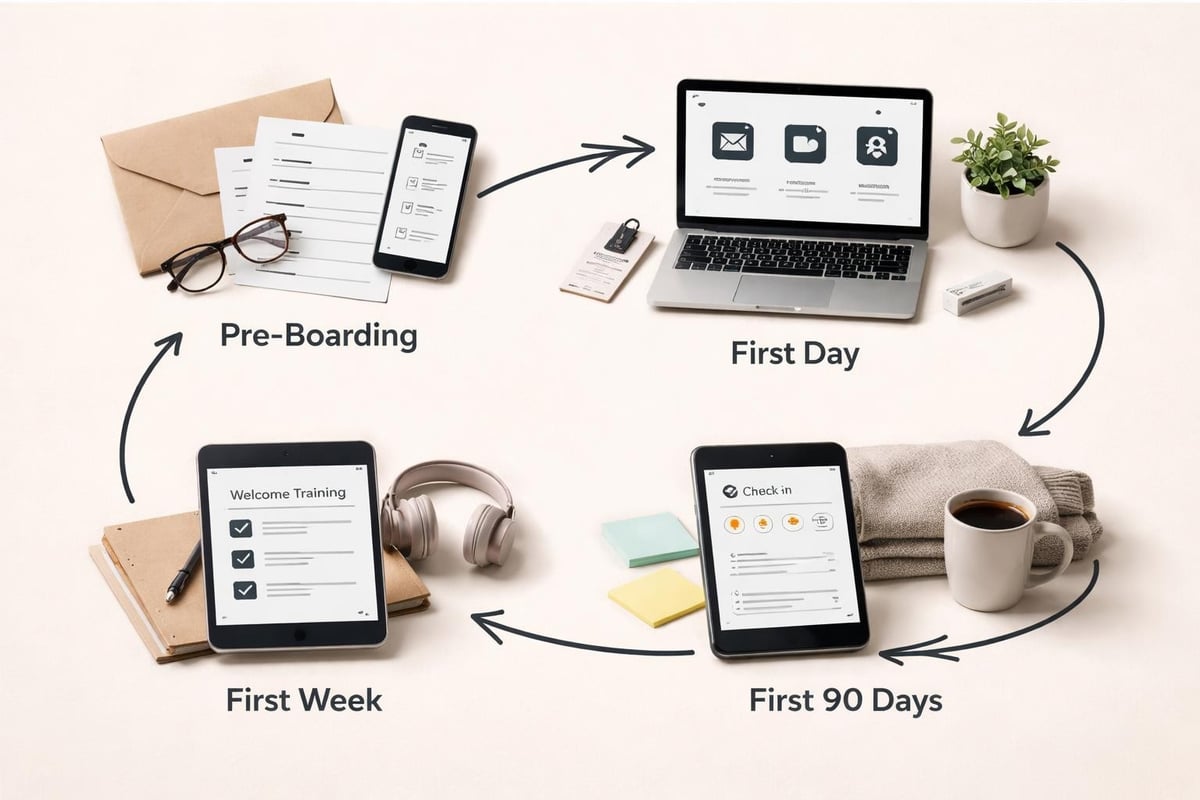
Pre-boarding represents the first opportunity to leverage automation effectively. Before an employee's first day, systems can automatically send welcome messages, collect necessary documentation, and provision access to relevant systems. This ensures new hires arrive prepared and reduces first-day administrative burden.
Task orchestration forms the backbone of successful automation. Instead of HR manually assigning activities, intelligent systems distribute tasks to appropriate stakeholders based on role, department, and location. Effective onboarding automation guides emphasize the importance of mapping these workflows before implementing technology.
Integration With Existing Systems
Onboarding automation delivers maximum value when connected to your broader technology ecosystem. Integration points include:
- Human Capital Management platforms: Sync employee data and eliminate duplicate entry
- Identity management systems: Automatically provision accounts and security access
- Learning management systems: Assign training based on role and department
- Communication platforms: Add new hires to relevant channels and distribution lists
- Project management tools: Create onboarding projects with automated task assignments
Organizations working with consultancies specializing in automation and integration achieve faster implementation timelines and more robust system architecture. The technical complexity of connecting disparate systems requires expertise in both workflow design and integration technologies.
Implementation Strategies That Drive Adoption
Successfully deploying onboarding automation demands more than selecting software. Organizations must approach implementation strategically to ensure adoption and realize intended benefits.
Begin by mapping current state workflows in detail. Document every task, decision point, and handoff in your existing onboarding process. This exercise reveals redundancies, bottlenecks, and opportunities for improvement that automation should address. Many organizations discover they're asking new hires to provide the same information multiple times or completing tasks that add no real value.
Phase your rollout to build confidence and allow for adjustments. Start with high-volume, low-complexity processes before tackling more nuanced workflows. For example, automate equipment ordering and account provisioning before addressing role-specific training paths or complex compliance requirements.
Personalization Within Automation
The most common objection to onboarding automation centers on concerns about creating impersonal experiences. This fear is valid when automation is applied without consideration for individual needs and preferences. However, technology enables personalization at scale impossible through manual processes.
Modern systems deliver customized experiences based on:
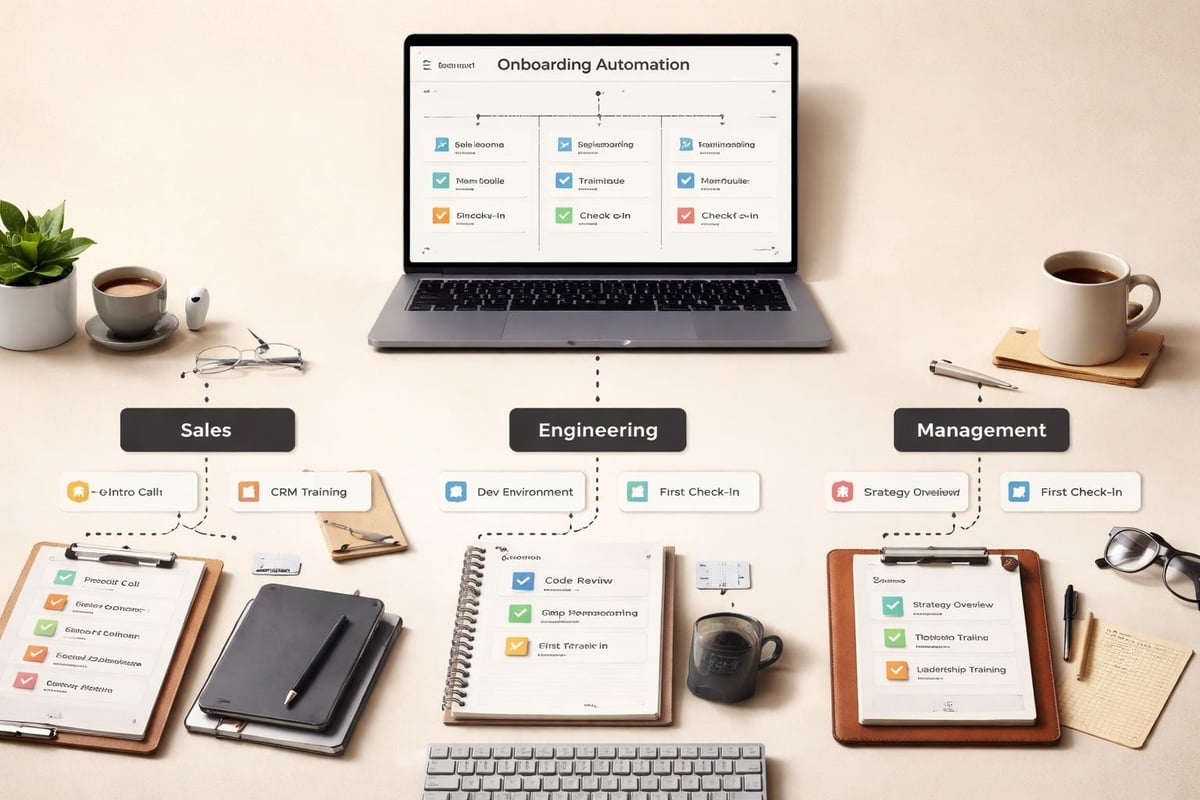
- Role and department-specific content and tasks
- Location and timezone-appropriate scheduling
- Learning style preferences and accessibility needs
- Career level and prior experience factors
- Individual progress and engagement patterns
Creating automated onboarding videos exemplifies how technology personalizes at scale. Instead of one-size-fits-all orientation sessions, systems deliver relevant video content when employees need it, in formats they prefer.
Measuring Success and Continuous Improvement
Implementing onboarding automation creates unprecedented visibility into the employee integration process. Organizations can track metrics that were previously impossible or impractical to measure manually.
Key Performance Indicators
Establish baseline measurements before automation to quantify improvement:
- Time to complete onboarding: Days from hire date to full productivity
- Task completion rates: Percentage of required activities finished on schedule
- Documentation accuracy: Error rates in submitted forms and information
- New hire satisfaction: Survey scores at 30, 60, and 90 days
- Manager engagement: Completion rates for manager-assigned activities
- 90-day retention: Percentage of new hires remaining after probationary period
Advanced analytics reveal patterns invisible in manual processes. For example, data might show that new hires who complete certain training modules within the first week demonstrate higher productivity at 90 days. These insights enable continuous refinement of the onboarding experience.
Organizations should review metrics quarterly and adjust workflows accordingly. Healthcare organizations implementing automation particularly benefit from data-driven optimization given their complex compliance requirements and specialized role structures.
Industry-Specific Applications and Case Studies
Different sectors face unique onboarding challenges that automation addresses in tailored ways. Understanding industry-specific applications helps organizations identify relevant solutions.
Professional Services Firms managing client-facing consultants need to balance rapid deployment with thorough preparation. Automated systems can deliver client background information, project context, and methodology training while ensuring consultants complete compliance training and understand engagement protocols. SMBs championing mid-market growth particularly benefit from scalable onboarding that supports expansion without proportional HR growth.
Healthcare Organizations face stringent credentialing and compliance requirements that make automation essential. Real-world implementations demonstrate how conditional logic ensures providers complete role-specific certifications while automated workflows track expiration dates and trigger renewal processes.
Technology Companies with distributed teams leverage automation to create consistent experiences across geographies. Systems handle timezone-appropriate scheduling, regional policy variations, and location-specific account provisioning without manual intervention.
Customer Onboarding Parallels
The principles of employee onboarding automation extend equally to customer integration. Customer onboarding automation strategies mirror employee approaches, focusing on reducing friction, accelerating time-to-value, and creating consistent experiences. Organizations often discover that expertise developed in one domain transfers effectively to the other.
AI-powered customer onboarding shows particularly strong results in complex B2B environments. A logistics company reduced their 60-day churn rate by 40% by automating initial setup and integration tasks that previously created frustration and delays.
Balancing Automation With Human Connection
Technology should enhance rather than replace human interaction during onboarding. The most successful implementations identify which touchpoints require personal connection and protect those from over-automation.
Schedule strategic human interactions at key moments:
- Day one welcome: Direct manager greeting and team introduction
- End of week one: Check-in conversation about initial impressions
- 30-day milestone: Career discussion and goal setting
- 60-day review: Performance feedback and development planning
- 90-day integration: Full evaluation and future pathway discussion
Between these touchpoints, automation handles administrative tasks, delivers training content, and tracks progress. This approach ensures managers spend their time on high-value interactions rather than paperwork and logistics.
Preventing impersonal digital experiences requires intentional design. Include video messages from leadership, peer mentor assignments, and opportunities for new hires to ask questions and receive personalized responses. Technology facilitates these connections rather than replacing them.

Building Your Onboarding Automation Roadmap
Organizations ready to transform their onboarding processes should approach implementation methodically. A structured roadmap ensures successful deployment and sustainable results.
Phase One: Foundation (Months 1-2)
- Audit current onboarding processes and identify pain points
- Map desired future state workflows with stakeholder input
- Select technology platform based on integration requirements and scalability
- Establish success metrics and baseline measurements
- Form cross-functional implementation team
Phase Two: Core Automation (Months 3-4)
- Configure essential workflows for document collection and account provisioning
- Build role-based task templates for common positions
- Create automated communication sequences for pre-boarding and first week
- Integrate with core HR and IT systems
- Pilot with small group and gather feedback
Phase Three: Enhancement (Months 5-6)
- Expand automation to training assignment and tracking
- Implement conditional logic for specialized roles and locations
- Deploy analytics dashboards for leadership visibility
- Train managers on leveraging automated insights
- Refine workflows based on pilot feedback
Phase Four: Optimization (Ongoing)
- Analyze metrics and identify improvement opportunities
- Gather new hire and manager feedback systematically
- Expand automation to additional processes and edge cases
- Share best practices across departments and locations
- Continuously update content and workflows
Enterprise organizations often extend this timeline given their complexity, while smaller organizations may compress phases. The key is maintaining momentum while ensuring quality implementation.
Technology Selection Criteria
Choosing the right platform determines long-term success. Organizations should evaluate options against specific criteria aligned with their needs and technical environment.
| Criteria | Considerations | Priority Level |
|---|---|---|
| Integration Capabilities | API availability, pre-built connectors, data flow | Critical |
| Workflow Flexibility | Conditional logic, role-based paths, customization | Critical |
| User Experience | Intuitive interface, mobile access, accessibility | High |
| Analytics and Reporting | Real-time dashboards, custom reports, data export | High |
| Scalability | Volume handling, multi-location support, performance | Medium-High |
| Support and Training | Implementation assistance, documentation, community | Medium |
| Security and Compliance | Data protection, audit trails, regulatory alignment | Critical |
Fast-growing teams particularly benefit from platforms that scale seamlessly as hiring accelerates. The ability to replicate successful workflows across new departments and locations without rebuilding processes saves considerable time and ensures consistency.
Organizations should also consider vendor stability, product roadmap, and alignment with their broader HR technology strategy. A platform that integrates seamlessly with existing systems delivers far more value than a standalone solution requiring duplicate data entry.
Overcoming Common Implementation Challenges
Even well-planned automation initiatives encounter obstacles. Anticipating these challenges and preparing responses increases likelihood of success.
Resistance to change often emerges from HR teams concerned about job security or skeptical of technology's ability to match their personal touch. Address this by emphasizing how automation eliminates tedious tasks and enables focus on strategic, relationship-building activities that technology cannot replicate.
Data quality issues surface when automated systems expose inconsistencies previously hidden in manual processes. Use implementation as an opportunity to clean data, standardize formats, and establish governance processes that maintain quality going forward.
Integration complexity can derail projects when technical dependencies aren't identified early. Involve IT teams from the beginning and allocate sufficient time for testing connections between systems. Organizations working with experienced consultants navigate these challenges more efficiently.
Scope creep threatens timelines when stakeholders continuously add requirements. Maintain a clear roadmap with defined phases and evaluate new requests against strategic priorities. Capture good ideas for future phases rather than expanding initial scope.
Future Trends Shaping Onboarding Technology
The evolution of onboarding automation continues accelerating as artificial intelligence and machine learning capabilities mature. Understanding emerging trends helps organizations plan for the future.
Predictive analytics will identify which new hires are at risk of early turnover based on engagement patterns during onboarding. Systems will automatically trigger interventions when warning signs appear, allowing proactive retention efforts.
AI-powered personalization will advance beyond role-based paths to truly individualized experiences. Systems will adapt content, pacing, and format based on how each employee learns and engages, optimizing for their specific needs.
Virtual and augmented reality will transform training delivery, particularly for roles requiring physical skills or complex equipment operation. New hires will practice procedures in safe, simulated environments before applying skills in real-world contexts.
Conversational interfaces will allow new hires to ask questions and receive instant, accurate responses without waiting for HR availability. AI assistants will handle common inquiries while routing complex questions to appropriate team members.
Organizations building onboarding automation strategies today should select platforms positioned to incorporate these emerging capabilities. The foundation established now will support increasingly sophisticated applications as technology evolves.
Modern organizations can no longer afford manual onboarding processes that waste time, create inconsistent experiences, and delay new hire productivity. Strategic automation transforms integration into a competitive advantage that drives retention, accelerates contribution, and scales effortlessly with growth. Nero and Associates, Inc. helps organizations implement automation and integration solutions that eliminate thousands of hours of manual processes while improving employee experiences from day one. Our performance-based approach ensures your investment delivers measurable results in cost savings, efficiency gains, and employee satisfaction.