

Financial Clearance: Process, Benefits & Best Practices

Share on Facebook
Share on X
Share on LinkedIn

Healthcare organizations face mounting pressure to optimize revenue cycles while delivering exceptional patient experiences. Financial clearance has emerged as a critical process that addresses both objectives simultaneously, ensuring that providers verify coverage, communicate costs transparently, and secure payment before services are rendered. For organizations seeking operational excellence and improved financial outcomes, understanding and implementing robust financial clearance procedures represents a strategic imperative that directly impacts bottom-line performance and patient satisfaction metrics.

Understanding Financial Clearance in Healthcare Operations

Financial clearance is the comprehensive process healthcare organizations use to verify patient eligibility, obtain necessary authorizations, estimate costs, and establish payment arrangements before or at the point of service delivery. This multi-step procedure ensures that both the healthcare provider and the patient have clarity regarding financial responsibility and payment expectations.

The financial clearance process encompasses several critical components that work together to create a seamless experience. Insurance eligibility verification confirms that coverage is active and applicable to the scheduled services. Prior authorization secures payer approval for specific procedures or treatments. Cost estimation provides patients with transparent information about their expected out-of-pocket expenses. Payment collection establishes arrangements for patient responsibility portions, whether through upfront payment, payment plans, or financial assistance programs.

Financial clearance components

Healthcare organizations that excel in financial clearance create structured workflows that address each component systematically. These workflows typically begin when appointments are scheduled and continue through the point of service, ensuring no critical step is overlooked.

The Business Case for Financial Clearance

Organizations implementing comprehensive financial clearance programs experience measurable improvements across multiple performance indicators. Revenue cycle efficiency increases as claims are submitted with complete, accurate information that reduces denial rates. Cash flow improves when patient responsibility portions are collected upfront rather than pursuing collections after service delivery.

Patient satisfaction rises significantly when financial transparency eliminates surprise bills and enables informed decision-making. Studies consistently demonstrate that patients who understand their financial obligations before treatment are more likely to proceed with necessary care and less likely to experience billing-related frustration.

Performance Metric Without Financial Clearance With Financial Clearance
Denial Rate 12-15% 4-7%
Upfront Collection Rate 25-35% 65-75%
Patient Satisfaction Score 72-78% 85-92%
Days in A/R 55-65 days 35-45 days

The financial impact extends beyond immediate collections. Organizations reduce bad debt write-offs, minimize administrative costs associated with claim rework and appeals, and allocate staff resources more effectively when processes are streamlined and automated.

Key Components of Effective Financial Clearance

Insurance Verification and Eligibility Confirmation

Insurance verification forms the foundation of financial clearance. This process confirms that patients have active coverage, identifies the specific plan and coverage parameters, and determines whether the scheduled services fall within covered benefits.

Real-time eligibility verification systems connect directly with payer databases to provide instant confirmation. These automated systems eliminate the delays and errors associated with manual verification processes, ensuring that staff have accurate information when scheduling appointments and counseling patients.

Coverage details extend beyond simple yes-or-no verification. Effective systems identify deductible status, coinsurance percentages, copayment amounts, and out-of-pocket maximums. This granular information enables accurate cost estimation and prevents situations where patients believe services are fully covered when significant out-of-pocket costs apply.

Prior Authorization Management

Prior authorization requirements vary significantly across payers and service types. Technology solutions streamline the authorization process by automatically identifying which procedures require authorization, submitting requests electronically, and tracking approval status.

Organizations that optimize authorization workflows reduce treatment delays and prevent denials related to missing or expired authorizations. Automated tracking systems alert staff when authorizations are pending, approved, or denied, enabling proactive communication with patients and payers.

The authorization process requires careful attention to timing. Submitting requests too early may result in approvals expiring before services are rendered, while late submissions delay care delivery. Sophisticated systems calculate optimal submission timing based on payer-specific requirements and scheduled service dates.

Cost Estimation and Price Transparency

Patients increasingly demand transparency regarding healthcare costs before committing to procedures or treatments. Automated financial clearance tools generate accurate estimates by combining verified insurance information with procedure codes and contracted rates.

Comprehensive cost estimates account for multiple variables:

  • Facility fees and professional charges
  • Deductible application and remaining amounts
  • Coinsurance calculations based on contracted rates
  • Copayment requirements for specific service types
  • Out-of-pocket maximum status

Clear communication of estimated costs builds trust and enables patients to make informed decisions about timing and treatment options. Organizations that provide detailed, written estimates experience higher satisfaction scores and improved collection rates.

Implementing Financial Clearance Best Practices

Workflow Design and Staff Training

Successful financial clearance programs require well-designed workflows that define responsibilities, establish timing parameters, and create accountability. Organizations should map current processes to identify gaps, redundancies, and opportunities for automation.

Staff training ensures consistent execution across all patient touchpoints. Training programs should address:

  1. Insurance verification protocols and system navigation
  2. Authorization submission procedures and tracking requirements
  3. Cost estimation tools and patient communication techniques
  4. Payment collection strategies and financial assistance programs
  5. Escalation procedures for complex situations

Regular refresher training reinforces best practices and introduces updates to payer requirements, system functionality, and organizational policies. Cross-training enables staff flexibility and ensures coverage during peak volumes or staff absences.
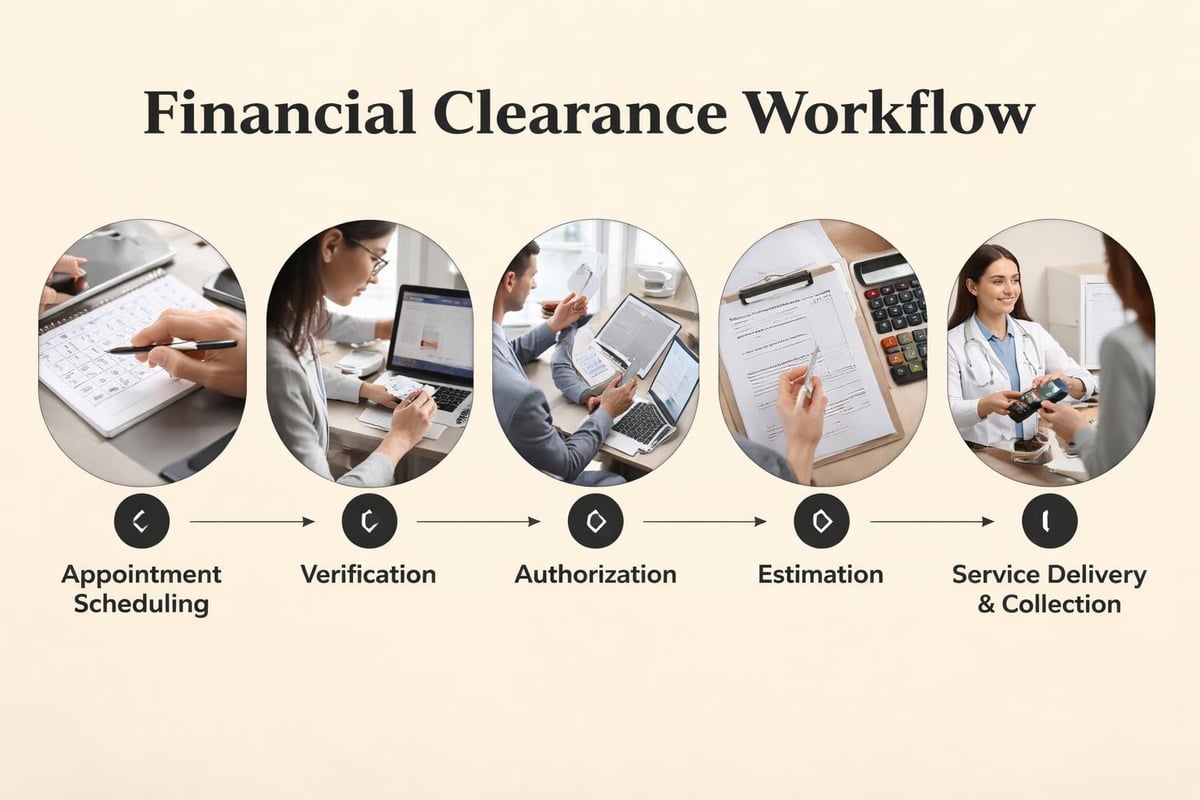
Financial clearance workflow

Technology Integration and Automation

Modern financial clearance relies heavily on integrated technology platforms that connect scheduling systems, electronic health records, practice management software, and payer portals. Advanced payment collection tools eliminate manual data entry, reduce errors, and accelerate processing times.

Automation transforms time-intensive manual processes into efficient, systematic workflows. Real-time eligibility checks occur automatically when appointments are scheduled, flagging coverage issues that require attention. Rules-based logic identifies high-dollar procedures requiring cost estimates and authorization management.

Integration with revenue cycle management systems ensures that information collected during financial clearance flows seamlessly to billing and collections teams. This continuity eliminates duplicate data entry and maintains data integrity throughout the revenue cycle.

Technology Component Manual Process Time Automated Process Time Time Savings
Eligibility Verification 8-12 minutes 30-45 seconds 90% reduction
Authorization Submission 15-25 minutes 2-3 minutes 88% reduction
Cost Estimation 20-30 minutes 1-2 minutes 95% reduction
Payment Processing 5-8 minutes 45-60 seconds 85% reduction

Organizations implementing automated solutions recover thousands of staff hours annually, enabling reallocation to higher-value activities that require human judgment and relationship-building skills.

Patient Communication Strategies

Proactive Engagement and Education

Financial clearance succeeds when patients understand the process and their responsibilities. Proactive communication begins when appointments are scheduled and continues through service delivery.

Effective patient engagement strategies include:

  • Automated appointment reminders that include financial clearance instructions
  • Pre-visit communications explaining what information patients should bring
  • Clear explanations of insurance benefits and patient responsibility
  • Written cost estimates provided before service dates
  • Multiple payment options including payment plans and online portals

Organizations should tailor communication methods to patient preferences, offering phone conversations, email exchanges, text messaging, and patient portal interactions. Meeting patients where they are increases engagement and improves outcomes.

Financial Assistance and Payment Planning

Many patients facing significant out-of-pocket costs qualify for financial assistance programs but remain unaware of available options. Financial clearance processes should systematically screen patients for program eligibility and facilitate enrollment.

Payment planning options enable patients to proceed with necessary care while managing financial obligations over time. Flexible payment arrangements demonstrate organizational commitment to access and affordability while protecting revenue.

Organizations partnering with financial technology providers can offer extended payment terms, zero-interest financing, and automated payment processing that improves the patient experience while reducing administrative burden. These solutions benefit both patients and providers by converting large bills into manageable monthly payments with high completion rates.

Measuring Financial Clearance Performance

Key Performance Indicators

Organizations must establish metrics that track financial clearance effectiveness and identify improvement opportunities. Critical KPIs include:

Verification and Authorization Metrics:

  • Percentage of patients verified before service date
  • Authorization approval rate
  • Average time to obtain authorization
  • Expired authorization rate

Financial Metrics:

  • Point-of-service collection rate
  • Cost estimate accuracy
  • Bad debt write-off percentage
  • Days in accounts receivable

Patient Experience Metrics:

  • Patient satisfaction with financial communication
  • Complaint rate related to billing surprises
  • Financial assistance application completion rate

Regular reporting enables leadership to track progress, identify trends, and make data-driven decisions about process improvements and resource allocation. Dashboard visualizations provide at-a-glance performance monitoring for operational teams.
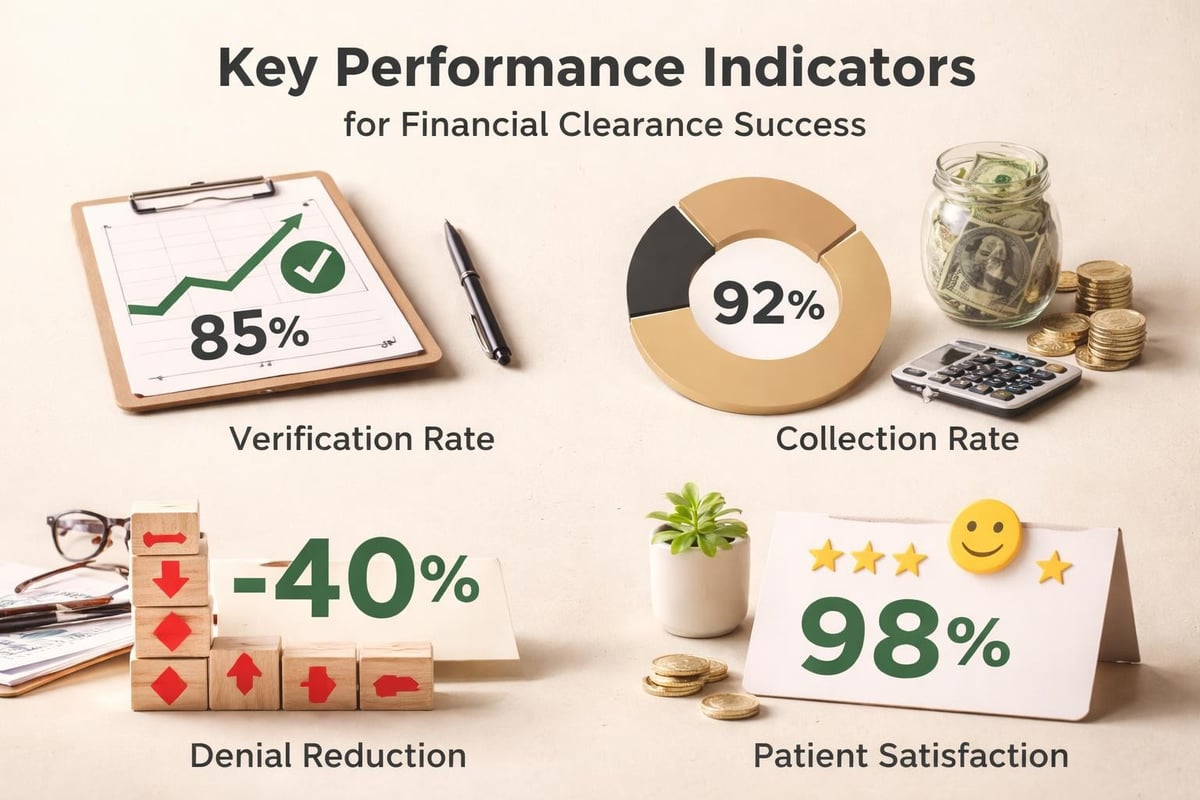
Financial clearance metrics

Continuous Improvement Initiatives

High-performing organizations treat financial clearance as a continuous improvement opportunity rather than a static process. Regular process audits identify bottlenecks, error patterns, and staff training needs.

Denial analysis reveals whether authorization issues, eligibility problems, or coding errors drive claim rejections. Root cause investigation enables targeted interventions that prevent recurring problems.

Patient feedback provides valuable insights into communication effectiveness and satisfaction drivers. Organizations should actively solicit feedback through surveys, focus groups, and direct conversations to understand patient perspectives and identify enhancement opportunities.

Integration with Revenue Cycle Management

Financial clearance represents the front-end component of comprehensive revenue cycle management. Organizations with advanced succession planning tools and workforce strategies ensure that financial clearance expertise is maintained and transferred as staff transitions occur.

Seamless integration between financial clearance and downstream revenue cycle functions prevents information gaps and workflow disruptions. When verification data, authorization numbers, and cost estimates flow automatically to billing systems, claim submission accuracy improves and payment acceleration follows.

Organizations should evaluate how financial clearance performance impacts overall revenue cycle metrics. Strong correlations exist between upfront verification quality and clean claim rates, between authorization management and denial prevention, and between cost transparency and patient payment behavior.

Cross-functional teams representing scheduling, financial counseling, patient access, billing, and collections should meet regularly to review performance, address systemic issues, and coordinate improvement initiatives. This collaborative approach breaks down departmental silos and creates shared accountability for revenue cycle outcomes.

Regulatory Compliance and Risk Management

Financial clearance processes must comply with multiple regulatory frameworks including HIPAA privacy requirements, price transparency regulations, and state-specific consumer protection laws. Organizations face significant penalties for violations and reputational damage when compliance lapses occur.

Privacy protections govern how patient financial information is collected, stored, shared, and destroyed. Staff training must emphasize confidentiality requirements and proper handling of sensitive data. Technology systems should incorporate role-based access controls and audit trails that document information access.

Price transparency regulations require healthcare organizations to provide good faith estimates for scheduled services and notify patients of coverage limitations. Financial clearance workflows should incorporate compliance checkpoints that ensure required disclosures occur and documentation is maintained.

Risk management extends beyond regulatory compliance to encompass financial and operational risks. Organizations should assess whether financial clearance processes adequately protect revenue, prevent fraud, and maintain appropriate segregation of duties between verification, estimation, and collection functions.

Overcoming Common Financial Clearance Challenges

Healthcare organizations encounter predictable obstacles when implementing or optimizing financial clearance programs. Payer complexity creates verification and authorization challenges as each insurance company maintains unique requirements, portals, and processing timelines.

Staff resistance to process changes can undermine implementation efforts. Change management strategies that emphasize benefits, provide adequate training, and celebrate early wins help overcome resistance and build momentum.

Technology integration difficulties arise when systems lack interoperability or when data exchange protocols are poorly designed. Organizations should prioritize vendor partnerships with providers offering robust integration capabilities and responsive technical support.

Patient communication barriers related to health literacy, language differences, and financial anxiety require thoughtful strategies. Organizations should develop communication materials at appropriate reading levels, provide multilingual support, and train staff in compassionate financial counseling techniques.

Resource constraints limit some organizations' ability to invest in advanced technology or expand financial counseling staff. Phased implementation approaches enable organizations to demonstrate value through pilot programs before requesting enterprise-wide investments. Performance-based partnerships with revenue cycle vendors align organizational interests and reduce upfront capital requirements.


Effective financial clearance transforms healthcare revenue cycles by preventing denials, accelerating collections, and improving patient satisfaction through transparency and communication. Organizations that implement comprehensive financial clearance programs position themselves for sustained financial performance and operational excellence. Nero and Associates, Inc. helps healthcare organizations optimize revenue cycle management through automation, process improvement, and strategic consulting that eliminates manual inefficiencies and drives measurable results. Contact our team to discover how performance-based solutions can strengthen your financial clearance processes and improve your bottom line.

Financial Clearance: Process, Benefits & Best Practices

Healthcare organizations face mounting pressure to optimize revenue cycles while delivering exceptional patient experiences. Financial clearance has emerged as a critical process that addresses both objectives simultaneously, ensuring that providers verify coverage, communicate costs transparently, and secure payment before services are rendered. For organizations seeking operational excellence and improved financial outcomes, understanding and implementing robust financial clearance procedures represents a strategic imperative that directly impacts bottom-line performance and patient satisfaction metrics.

Understanding Financial Clearance in Healthcare Operations

Financial clearance is the comprehensive process healthcare organizations use to verify patient eligibility, obtain necessary authorizations, estimate costs, and establish payment arrangements before or at the point of service delivery. This multi-step procedure ensures that both the healthcare provider and the patient have clarity regarding financial responsibility and payment expectations.

The financial clearance process encompasses several critical components that work together to create a seamless experience. Insurance eligibility verification confirms that coverage is active and applicable to the scheduled services. Prior authorization secures payer approval for specific procedures or treatments. Cost estimation provides patients with transparent information about their expected out-of-pocket expenses. Payment collection establishes arrangements for patient responsibility portions, whether through upfront payment, payment plans, or financial assistance programs.

Financial clearance components

Healthcare organizations that excel in financial clearance create structured workflows that address each component systematically. These workflows typically begin when appointments are scheduled and continue through the point of service, ensuring no critical step is overlooked.

The Business Case for Financial Clearance

Organizations implementing comprehensive financial clearance programs experience measurable improvements across multiple performance indicators. Revenue cycle efficiency increases as claims are submitted with complete, accurate information that reduces denial rates. Cash flow improves when patient responsibility portions are collected upfront rather than pursuing collections after service delivery.

Patient satisfaction rises significantly when financial transparency eliminates surprise bills and enables informed decision-making. Studies consistently demonstrate that patients who understand their financial obligations before treatment are more likely to proceed with necessary care and less likely to experience billing-related frustration.

Performance Metric Without Financial Clearance With Financial Clearance
Denial Rate 12-15% 4-7%
Upfront Collection Rate 25-35% 65-75%
Patient Satisfaction Score 72-78% 85-92%
Days in A/R 55-65 days 35-45 days

The financial impact extends beyond immediate collections. Organizations reduce bad debt write-offs, minimize administrative costs associated with claim rework and appeals, and allocate staff resources more effectively when processes are streamlined and automated.

Key Components of Effective Financial Clearance

Insurance Verification and Eligibility Confirmation

Insurance verification forms the foundation of financial clearance. This process confirms that patients have active coverage, identifies the specific plan and coverage parameters, and determines whether the scheduled services fall within covered benefits.

Real-time eligibility verification systems connect directly with payer databases to provide instant confirmation. These automated systems eliminate the delays and errors associated with manual verification processes, ensuring that staff have accurate information when scheduling appointments and counseling patients.

Coverage details extend beyond simple yes-or-no verification. Effective systems identify deductible status, coinsurance percentages, copayment amounts, and out-of-pocket maximums. This granular information enables accurate cost estimation and prevents situations where patients believe services are fully covered when significant out-of-pocket costs apply.

Prior Authorization Management

Prior authorization requirements vary significantly across payers and service types. Technology solutions streamline the authorization process by automatically identifying which procedures require authorization, submitting requests electronically, and tracking approval status.

Organizations that optimize authorization workflows reduce treatment delays and prevent denials related to missing or expired authorizations. Automated tracking systems alert staff when authorizations are pending, approved, or denied, enabling proactive communication with patients and payers.

The authorization process requires careful attention to timing. Submitting requests too early may result in approvals expiring before services are rendered, while late submissions delay care delivery. Sophisticated systems calculate optimal submission timing based on payer-specific requirements and scheduled service dates.

Cost Estimation and Price Transparency

Patients increasingly demand transparency regarding healthcare costs before committing to procedures or treatments. Automated financial clearance tools generate accurate estimates by combining verified insurance information with procedure codes and contracted rates.

Comprehensive cost estimates account for multiple variables:

  • Facility fees and professional charges
  • Deductible application and remaining amounts
  • Coinsurance calculations based on contracted rates
  • Copayment requirements for specific service types
  • Out-of-pocket maximum status

Clear communication of estimated costs builds trust and enables patients to make informed decisions about timing and treatment options. Organizations that provide detailed, written estimates experience higher satisfaction scores and improved collection rates.

Implementing Financial Clearance Best Practices

Workflow Design and Staff Training

Successful financial clearance programs require well-designed workflows that define responsibilities, establish timing parameters, and create accountability. Organizations should map current processes to identify gaps, redundancies, and opportunities for automation.

Staff training ensures consistent execution across all patient touchpoints. Training programs should address:

  1. Insurance verification protocols and system navigation
  2. Authorization submission procedures and tracking requirements
  3. Cost estimation tools and patient communication techniques
  4. Payment collection strategies and financial assistance programs
  5. Escalation procedures for complex situations

Regular refresher training reinforces best practices and introduces updates to payer requirements, system functionality, and organizational policies. Cross-training enables staff flexibility and ensures coverage during peak volumes or staff absences.

Financial clearance workflow

Technology Integration and Automation

Modern financial clearance relies heavily on integrated technology platforms that connect scheduling systems, electronic health records, practice management software, and payer portals. Advanced payment collection tools eliminate manual data entry, reduce errors, and accelerate processing times.

Automation transforms time-intensive manual processes into efficient, systematic workflows. Real-time eligibility checks occur automatically when appointments are scheduled, flagging coverage issues that require attention. Rules-based logic identifies high-dollar procedures requiring cost estimates and authorization management.

Integration with revenue cycle management systems ensures that information collected during financial clearance flows seamlessly to billing and collections teams. This continuity eliminates duplicate data entry and maintains data integrity throughout the revenue cycle.

Technology Component Manual Process Time Automated Process Time Time Savings
Eligibility Verification 8-12 minutes 30-45 seconds 90% reduction
Authorization Submission 15-25 minutes 2-3 minutes 88% reduction
Cost Estimation 20-30 minutes 1-2 minutes 95% reduction
Payment Processing 5-8 minutes 45-60 seconds 85% reduction

Organizations implementing automated solutions recover thousands of staff hours annually, enabling reallocation to higher-value activities that require human judgment and relationship-building skills.

Patient Communication Strategies

Proactive Engagement and Education

Financial clearance succeeds when patients understand the process and their responsibilities. Proactive communication begins when appointments are scheduled and continues through service delivery.

Effective patient engagement strategies include:

  • Automated appointment reminders that include financial clearance instructions
  • Pre-visit communications explaining what information patients should bring
  • Clear explanations of insurance benefits and patient responsibility
  • Written cost estimates provided before service dates
  • Multiple payment options including payment plans and online portals

Organizations should tailor communication methods to patient preferences, offering phone conversations, email exchanges, text messaging, and patient portal interactions. Meeting patients where they are increases engagement and improves outcomes.

Financial Assistance and Payment Planning

Many patients facing significant out-of-pocket costs qualify for financial assistance programs but remain unaware of available options. Financial clearance processes should systematically screen patients for program eligibility and facilitate enrollment.

Payment planning options enable patients to proceed with necessary care while managing financial obligations over time. Flexible payment arrangements demonstrate organizational commitment to access and affordability while protecting revenue.

Organizations partnering with financial technology providers can offer extended payment terms, zero-interest financing, and automated payment processing that improves the patient experience while reducing administrative burden. These solutions benefit both patients and providers by converting large bills into manageable monthly payments with high completion rates.

Measuring Financial Clearance Performance

Key Performance Indicators

Organizations must establish metrics that track financial clearance effectiveness and identify improvement opportunities. Critical KPIs include:

Verification and Authorization Metrics:

  • Percentage of patients verified before service date
  • Authorization approval rate
  • Average time to obtain authorization
  • Expired authorization rate

Financial Metrics:

  • Point-of-service collection rate
  • Cost estimate accuracy
  • Bad debt write-off percentage
  • Days in accounts receivable

Patient Experience Metrics:

  • Patient satisfaction with financial communication
  • Complaint rate related to billing surprises
  • Financial assistance application completion rate

Regular reporting enables leadership to track progress, identify trends, and make data-driven decisions about process improvements and resource allocation. Dashboard visualizations provide at-a-glance performance monitoring for operational teams.

Financial clearance metrics

Continuous Improvement Initiatives

High-performing organizations treat financial clearance as a continuous improvement opportunity rather than a static process. Regular process audits identify bottlenecks, error patterns, and staff training needs.

Denial analysis reveals whether authorization issues, eligibility problems, or coding errors drive claim rejections. Root cause investigation enables targeted interventions that prevent recurring problems.

Patient feedback provides valuable insights into communication effectiveness and satisfaction drivers. Organizations should actively solicit feedback through surveys, focus groups, and direct conversations to understand patient perspectives and identify enhancement opportunities.

Integration with Revenue Cycle Management

Financial clearance represents the front-end component of comprehensive revenue cycle management. Organizations with advanced succession planning tools and workforce strategies ensure that financial clearance expertise is maintained and transferred as staff transitions occur.

Seamless integration between financial clearance and downstream revenue cycle functions prevents information gaps and workflow disruptions. When verification data, authorization numbers, and cost estimates flow automatically to billing systems, claim submission accuracy improves and payment acceleration follows.

Organizations should evaluate how financial clearance performance impacts overall revenue cycle metrics. Strong correlations exist between upfront verification quality and clean claim rates, between authorization management and denial prevention, and between cost transparency and patient payment behavior.

Cross-functional teams representing scheduling, financial counseling, patient access, billing, and collections should meet regularly to review performance, address systemic issues, and coordinate improvement initiatives. This collaborative approach breaks down departmental silos and creates shared accountability for revenue cycle outcomes.

Regulatory Compliance and Risk Management

Financial clearance processes must comply with multiple regulatory frameworks including HIPAA privacy requirements, price transparency regulations, and state-specific consumer protection laws. Organizations face significant penalties for violations and reputational damage when compliance lapses occur.

Privacy protections govern how patient financial information is collected, stored, shared, and destroyed. Staff training must emphasize confidentiality requirements and proper handling of sensitive data. Technology systems should incorporate role-based access controls and audit trails that document information access.

Price transparency regulations require healthcare organizations to provide good faith estimates for scheduled services and notify patients of coverage limitations. Financial clearance workflows should incorporate compliance checkpoints that ensure required disclosures occur and documentation is maintained.

Risk management extends beyond regulatory compliance to encompass financial and operational risks. Organizations should assess whether financial clearance processes adequately protect revenue, prevent fraud, and maintain appropriate segregation of duties between verification, estimation, and collection functions.

Overcoming Common Financial Clearance Challenges

Healthcare organizations encounter predictable obstacles when implementing or optimizing financial clearance programs. Payer complexity creates verification and authorization challenges as each insurance company maintains unique requirements, portals, and processing timelines.

Staff resistance to process changes can undermine implementation efforts. Change management strategies that emphasize benefits, provide adequate training, and celebrate early wins help overcome resistance and build momentum.

Technology integration difficulties arise when systems lack interoperability or when data exchange protocols are poorly designed. Organizations should prioritize vendor partnerships with providers offering robust integration capabilities and responsive technical support.

Patient communication barriers related to health literacy, language differences, and financial anxiety require thoughtful strategies. Organizations should develop communication materials at appropriate reading levels, provide multilingual support, and train staff in compassionate financial counseling techniques.

Resource constraints limit some organizations' ability to invest in advanced technology or expand financial counseling staff. Phased implementation approaches enable organizations to demonstrate value through pilot programs before requesting enterprise-wide investments. Performance-based partnerships with revenue cycle vendors align organizational interests and reduce upfront capital requirements.


Effective financial clearance transforms healthcare revenue cycles by preventing denials, accelerating collections, and improving patient satisfaction through transparency and communication. Organizations that implement comprehensive financial clearance programs position themselves for sustained financial performance and operational excellence. Nero and Associates, Inc. helps healthcare organizations optimize revenue cycle management through automation, process improvement, and strategic consulting that eliminates manual inefficiencies and drives measurable results. Contact our team to discover how performance-based solutions can strengthen your financial clearance processes and improve your bottom line.

Website developed in accordance with Web Content Accessibility Guidelines 2.2.
If you encounter any issues while using this site, please contact us: 215.526.5126