

Revenue Integrity: A Complete Guide for 2026

Share on Facebook
Share on X
Share on LinkedIn

Revenue leakage costs healthcare organizations billions annually, yet many don't realize the problem exists until significant financial damage has occurred. The challenge lies not in isolated errors but in systemic gaps across documentation, coding, billing, and compliance processes. Revenue integrity serves as the comprehensive framework organizations need to protect their financial foundation while maintaining regulatory compliance and operational efficiency. As healthcare becomes increasingly complex in 2026, understanding and implementing robust revenue integrity practices has become essential for organizational survival and growth.

Understanding the Core Components of Revenue Integrity

Revenue integrity encompasses far more than accurate billing. It represents a holistic approach to ensuring every service provided generates appropriate reimbursement while maintaining strict compliance with regulatory requirements.

The Foundation of Accurate Charge Capture

Charge capture forms the bedrock of revenue integrity. Every procedure, service, medication, and supply must be properly documented and translated into billable charges. Missing charges represent pure revenue loss, while incorrect charges create compliance risks and potential audit exposure.

Organizations often lose revenue through:

  • Undocumented services that never enter the billing system
  • Delayed charge entry that misses filing deadlines
  • Incorrect charge quantities or units of service
  • Mismatched charge codes that don't reflect actual services
  • Missing physician documentation required for reimbursement

Automation technologies have revolutionized charge capture processes. Integrated systems now track clinical activities in real-time, automatically generating charges based on documented services. This eliminates the manual gaps where charges traditionally fell through cracks.
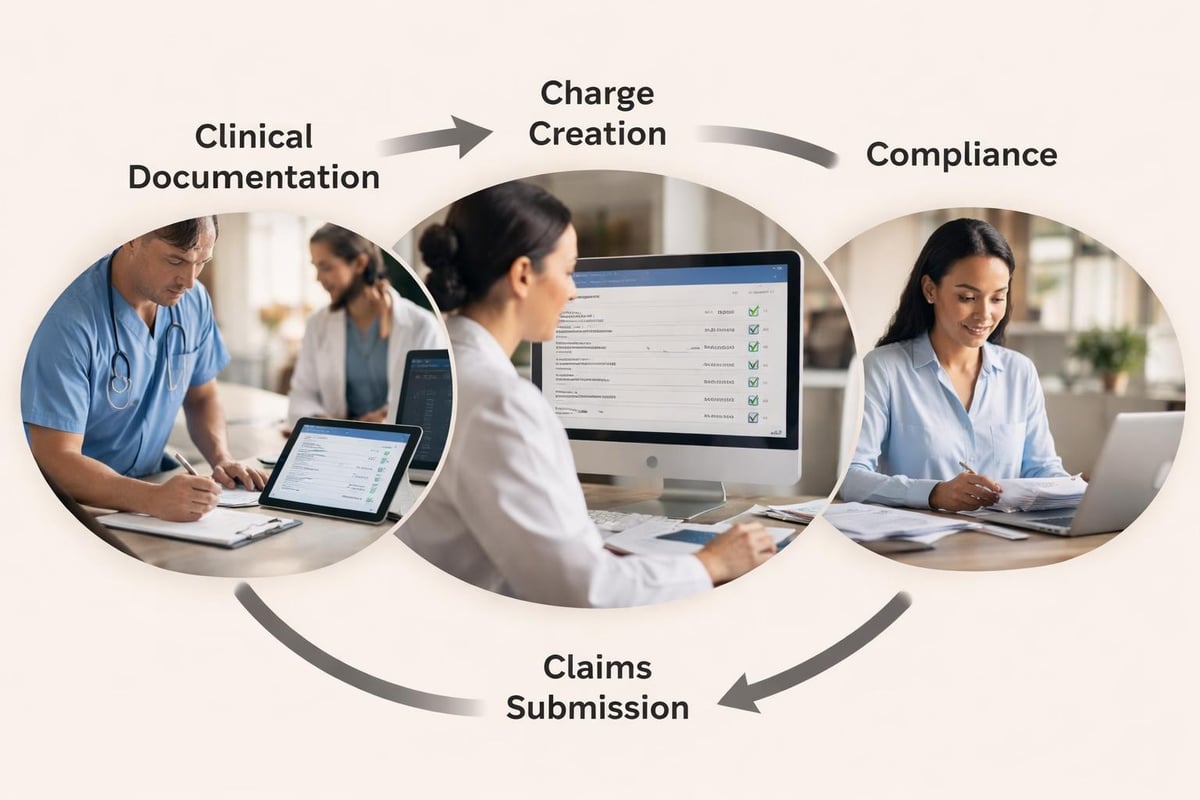
Charge capture workflow

Documentation and Coding Accuracy

Clinical documentation drives the entire revenue cycle. Incomplete or inaccurate documentation creates cascading problems throughout billing, coding, and reimbursement processes. Revenue integrity programs must bridge the gap between clinical activities and the business requirements of accurate billing.

Physician documentation must support the level of service billed. Coders require specific details about diagnoses, procedures, complications, and clinical decision-making. Without this information, they must code conservatively, leaving reimbursement on the table.

Documentation Element Revenue Impact Compliance Risk
Diagnosis specificity High Medium
Procedure details High High
Medical necessity Critical Critical
Time-based services Medium Medium
Complication documentation High High

Many organizations implement concurrent documentation improvement programs to address issues before claim submission. These programs embed specialists who work directly with physicians during patient care, ensuring documentation meets both clinical and business requirements.

The Relationship Between Revenue Integrity and Compliance

Compliance and revenue optimization might seem like competing priorities, but effective revenue integrity programs prove they're complementary goals. Accurate processes that capture appropriate revenue inherently support regulatory compliance.

Regulatory Framework and Risk Management

Healthcare operates under intense regulatory scrutiny. The Office of Inspector General, Centers for Medicare & Medicaid Services, and various commercial payers maintain strict standards for billing accuracy. Revenue integrity initiatives must navigate this complex landscape while protecting organizational finances.

Common compliance risks include:

  • Upcoding: Billing higher service levels than documentation supports
  • Unbundling: Separately billing services that should be combined
  • Medical necessity failures: Billing services without appropriate justification
  • Modifier misuse: Incorrect application of billing modifiers
  • Duplicate billing: Submitting multiple claims for single services

Organizations face substantial penalties for compliance violations. Beyond financial penalties, violations damage reputation and can result in exclusion from government programs. The cost of prevention through robust revenue integrity programs pales compared to remediation expenses.

Internal Controls and Audit Readiness

Strong internal controls form the defense mechanism protecting against both revenue loss and compliance violations. These controls create checkpoints throughout the revenue cycle where errors can be identified and corrected before claim submission.

Effective control systems include automated edits that flag potential issues, regular audits of high-risk areas, and clear escalation processes for problematic patterns. Organizations should maintain comprehensive audit trails documenting how charges were determined, who made coding decisions, and what evidence supports billed services.

Technology's Role in Modern Revenue Integrity

Manual revenue integrity processes cannot keep pace with the volume and complexity of modern healthcare. Technology enablement has become mandatory for organizations serious about protecting revenue and maintaining compliance.

Automation and Artificial Intelligence Applications

Artificial intelligence transforms revenue integrity from reactive problem-solving to proactive prevention. Machine learning algorithms analyze vast datasets to identify patterns invisible to human reviewers, predicting where revenue leakage or compliance risks are likely to occur.

Predictive analytics examine historical claim data to forecast denial risks before submission. These systems evaluate documentation quality, coding patterns, payer-specific requirements, and compliance markers to score each claim's likelihood of payment. High-risk claims receive additional review before submission, preventing denials rather than appealing them.

Natural language processing technologies review clinical documentation against coding assignments, identifying discrepancies between what physicians documented and what coders submitted. This automated clinical validation happens in real-time, allowing corrections before claims leave the organization.

Organizations leveraging AI and automation report significant improvements in clean claim rates, denial prevention, and staff productivity. Technology handles high-volume, routine validations while human expertise focuses on complex cases requiring clinical judgment.

AI revenue integrity system

Integration Across Revenue Cycle Systems

Fragmented systems create the gaps where revenue falls through. Modern revenue integrity requires seamless integration connecting electronic health records, charge capture systems, coding platforms, billing software, and business intelligence tools.

Integration enables real-time visibility across the entire revenue cycle. Clinical teams see how their documentation affects billing. Revenue cycle staff access clinical context needed for accurate coding. Leadership monitors key performance indicators identifying emerging problems before they become crises.

Integration Benefit Operational Impact Financial Impact
Real-time charge validation 30-40% faster processing 5-8% revenue increase
Automated coding assistance 50% reduction in coding time 95%+ coding accuracy
Denial prediction 60% fewer denials 10-15% faster collections
Compliance monitoring 80% fewer audit findings Reduced penalty risk

Operational Strategies for Revenue Integrity Excellence

Technology provides the foundation, but operational excellence requires strategic process design, skilled staff, and strong leadership commitment.

Chargemaster Management and Maintenance

The chargemaster serves as the pricing foundation for all services. This complex database containing thousands of charge codes requires continuous maintenance to reflect regulatory changes, payer requirements, and organizational service offerings.

Outdated chargemasters create multiple problems. Missing codes prevent billing for new services. Incorrect pricing leaves money on the table or violates payer contracts. Noncompliant code combinations trigger automatic denials.

Organizations should establish formal chargemaster governance including:

  • Quarterly comprehensive reviews of all active codes
  • Real-time updates when regulations or contracts change
  • Cross-functional teams representing clinical, coding, and financial perspectives
  • Validation against payer fee schedules and regulatory requirements
  • Documentation of all changes with effective dates and rationale

Denial Management and Prevention

Denials represent failures in revenue integrity processes. While some denials are unavoidable, most stem from preventable errors in documentation, coding, or billing.

Effective denial management goes beyond working individual denials. It requires root cause analysis identifying why denials occur and process improvements preventing recurrence. Organizations should track denial rates by category, payer, service line, and individual provider to identify improvement opportunities.

Prevention strategies include:

  1. Pre-claim validation checking all requirements before submission
  2. Eligibility verification confirming coverage before service delivery
  3. Authorization management securing necessary approvals in advance
  4. Documentation improvement ensuring clinical records support billed services
  5. Coding validation verifying accuracy against payer-specific rules

The shift from denial management to denial prevention fundamentally changes financial outcomes. Every prevented denial improves cash flow, reduces administrative costs, and enhances patient satisfaction by eliminating surprise bills.

Building a Revenue Integrity Program

Implementing comprehensive revenue integrity requires strategic planning, resource allocation, and organizational commitment extending beyond the revenue cycle department.

Organizational Structure and Governance

Successful revenue integrity programs establish clear governance structures defining roles, responsibilities, and decision-making authority. Many organizations create dedicated revenue integrity departments reporting to the chief financial officer, ensuring appropriate organizational visibility and resources.

Cross-functional steering committees provide oversight, bringing together clinical, financial, compliance, and information technology perspectives. These committees review performance metrics, prioritize improvement initiatives, and ensure alignment with organizational strategic objectives.

Staff expertise matters tremendously. Revenue integrity professionals require unique skill combinations spanning clinical knowledge, coding proficiency, regulatory understanding, data analytics capabilities, and process improvement methodologies. Organizations must invest in recruitment, training, and retention of these specialized professionals.

Performance Metrics and Continuous Improvement

What gets measured gets managed. Revenue integrity programs require robust metrics tracking both outcomes and process performance.

Key performance indicators should include:

  • Clean claim rate measuring first-pass acceptance
  • Days in accounts receivable tracking collection speed
  • Denial rate by category, payer, and reason
  • Coding accuracy through regular audits
  • Charge lag days from service to billing
  • Net collection rate versus expected reimbursement
  • Compliance audit findings and corrective actions

Metrics drive accountability and identify improvement opportunities. However, organizations must avoid metric gaming where staff manipulate numbers without improving actual performance. Balanced scorecards incorporating multiple perspectives prevent this dysfunction.
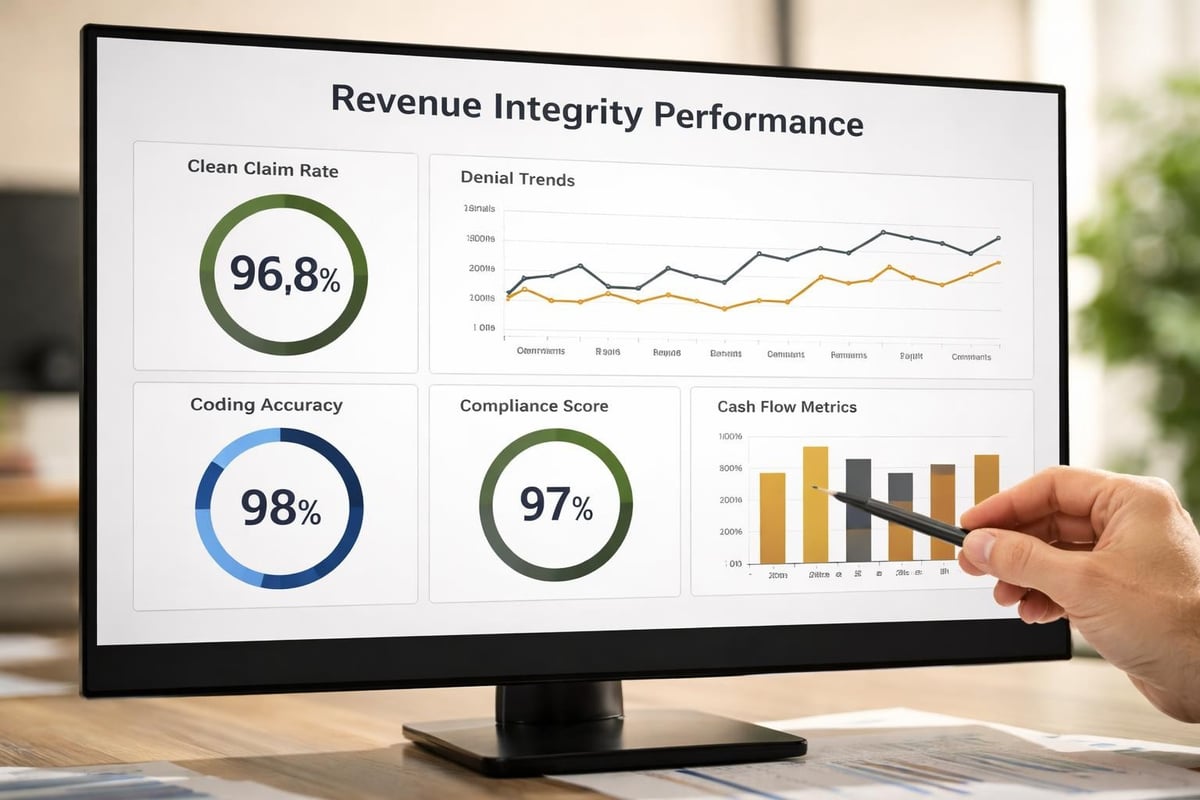
Revenue integrity dashboard

The Financial Impact of Revenue Integrity

Organizations often underestimate the financial magnitude of revenue integrity problems until they conduct comprehensive assessments revealing the true scope.

Quantifying Revenue Leakage

Revenue leakage occurs when organizations provide services but fail to receive appropriate payment. This differs from bad debt or contractual adjustments, representing money that should have been collected but wasn't due to process failures.

Common sources include:

  • Missed charges never submitted for billing
  • Coding errors that undervalue services provided
  • Denied claims not appealed within timelines
  • Underpayments not identified and pursued
  • Services provided without proper authorization
  • Documentation gaps preventing appropriate billing

Industry studies suggest healthcare organizations lose 1-5% of net patient revenue to preventable leakage. For a $500 million organization, this represents $5-25 million in annual lost revenue. The cumulative impact over years becomes staggering, representing hundreds of millions in foregone operating margin.

Return on Investment for Revenue Integrity Programs

Organizations implementing comprehensive revenue integrity initiatives typically see substantial returns. Initial investments in technology, staffing, and process redesign pay for themselves within 12-18 months through captured revenue and avoided compliance costs.

Documented benefits include:

Investment Area Typical ROI Payback Period
Charge capture automation 400-600% 8-12 months
Denial prevention technology 300-500% 10-14 months
Clinical documentation improvement 500-800% 6-10 months
Compliance monitoring systems 200-400% 12-18 months

Beyond direct financial returns, revenue integrity programs reduce organizational risk, improve staff satisfaction by eliminating frustrating rework, and enhance patient experience through accurate billing and reduced payment confusion.

Future Trends Shaping Revenue Integrity

The revenue integrity landscape continues evolving rapidly as healthcare payment models shift, regulations change, and technology capabilities expand.

Value-Based Payment and Revenue Integrity

Traditional fee-for-service payment rewarded volume. Value-based arrangements reward quality, outcomes, and efficiency. This fundamental shift creates new revenue integrity challenges requiring different approaches.

Organizations must track quality metrics affecting payment, manage risk-based contracts with accurate population health data, and coordinate care across multiple providers and settings. Revenue integrity extends beyond individual encounters to encompass episode-based payments, bundled services, and shared savings arrangements.

The data requirements multiply exponentially. Organizations need integrated systems tracking clinical outcomes, patient satisfaction, utilization patterns, and cost efficiency alongside traditional billing accuracy. Revenue integrity professionals must develop new competencies in population health analytics, risk stratification, and value-based contract management.

Regulatory Evolution and Compliance Complexity

Healthcare regulation never stops changing. The transition to value-based payment brings new compliance requirements. Telehealth expansion creates billing complexities. Price transparency mandates require new data management capabilities. Organizations must maintain agility to adapt revenue integrity processes as requirements evolve.

Artificial intelligence will play an increasing role in regulatory compliance. Systems can be programmed to automatically update when regulations change, applying new rules without manual intervention. Machine learning algorithms monitor regulatory announcements, interpret new requirements, and suggest process modifications to maintain compliance.

Strategic Implementation Considerations

Organizations beginning revenue integrity journeys or enhancing existing programs face critical strategic decisions shaping long-term success.

Assessment and Prioritization

Comprehensive revenue integrity assessments identify current state performance, quantify improvement opportunities, and prioritize initiatives based on financial impact and implementation feasibility. These assessments should examine:

  • Current charge capture completeness and accuracy
  • Coding quality and productivity metrics
  • Denial rates with root cause analysis
  • Compliance risk areas and control effectiveness
  • Technology capabilities and integration gaps
  • Organizational structure and governance maturity

Assessment findings guide strategic roadmap development. Organizations cannot address every issue simultaneously. Prioritization focuses resources on highest-impact opportunities while building foundation capabilities supporting long-term sustainability.

Change Management and Cultural Transformation

Revenue integrity requires cultural change extending throughout the organization. Physicians must understand how documentation affects billing. Clinical staff need to recognize their role in charge capture. Revenue cycle teams must embrace prevention over remediation.

Effective change management includes executive sponsorship demonstrating organizational commitment, clear communication explaining why changes matter, training providing skills needed for new processes, and recognition celebrating successes. Organizations that treat revenue integrity as purely technical implementation inevitably fail. Those recognizing the human dimensions achieve sustainable transformation.

Partnership and External Expertise

Many organizations lack internal expertise for comprehensive revenue integrity program development. Partnerships with specialized consultancies provide access to best practices, proven methodologies, and experienced professionals who have implemented similar programs across multiple organizations.

Performance-based partnerships align consultant incentives with organizational outcomes. Rather than paying for effort regardless of results, organizations compensate partners based on measurable improvements in revenue capture, denial prevention, and compliance performance. This structure ensures mutual commitment to actual results rather than activity completion.

Organizations should seek partners offering:

  1. Proven track record with measurable results
  2. Methodology combining technology and process improvement
  3. Staff expertise spanning clinical, coding, and compliance domains
  4. Willingness to transfer knowledge building internal capabilities
  5. Performance guarantees demonstrating confidence in their approach

Revenue recovery expertise complements revenue integrity by identifying historical underpayments and process failures, providing funding for forward-looking program investments while capturing value from past oversights.

The Interconnection with Broader Organizational Goals

Revenue integrity doesn't exist in isolation. It connects directly to organizational strategic objectives around financial sustainability, operational efficiency, and quality improvement.

Financial Sustainability and Growth Investment

Healthcare organizations face mounting financial pressure. Reimbursement rates decline while costs increase. Margin compression threatens the capital investments required for facility improvements, technology modernization, and service expansion.

Revenue integrity directly supports financial sustainability by protecting existing revenue streams and optimizing reimbursement for services provided. The incremental margin improvement from effective revenue integrity programs funds strategic investments impossible without this financial foundation.

Organizations viewing revenue integrity as compliance obligation miss its strategic value. Forward-thinking leaders recognize it as growth enabler, ensuring financial resources necessary for fulfilling organizational mission and serving community needs.

Operational Excellence and Process Optimization

Revenue integrity initiatives drive operational improvements extending beyond the revenue cycle. Process standardization, technology integration, and data-driven decision-making become organizational capabilities benefiting all departments.

The discipline of measuring performance, identifying root causes, and implementing systematic improvements transfers to other operational areas. Organizations developing revenue integrity competencies often apply these same methodologies to supply chain optimization, labor management, and patient flow improvement.

Staff empowerment represents another spillover benefit. Revenue integrity programs give frontline employees tools, training, and authority to identify and solve problems. This empowerment culture increases engagement, reduces turnover, and improves overall organizational performance.


Revenue integrity serves as the financial backbone protecting organizational sustainability while ensuring regulatory compliance and operational excellence. The comprehensive approach spanning charge capture, coding accuracy, compliance monitoring, and denial prevention creates measurable improvements in cash flow, margin performance, and risk management. As healthcare complexity continues increasing in 2026 and beyond, organizations must prioritize revenue integrity as strategic imperative rather than tactical concern. Nero and Associates, Inc. partners with healthcare organizations to implement performance-based revenue integrity solutions that eliminate manual process inefficiencies, optimize revenue capture, and build sustainable competitive advantage through proven methodologies combining advanced technology with deep operational expertise.

Revenue Integrity: A Complete Guide for 2026

Revenue leakage costs healthcare organizations billions annually, yet many don't realize the problem exists until significant financial damage has occurred. The challenge lies not in isolated errors but in systemic gaps across documentation, coding, billing, and compliance processes. Revenue integrity serves as the comprehensive framework organizations need to protect their financial foundation while maintaining regulatory compliance and operational efficiency. As healthcare becomes increasingly complex in 2026, understanding and implementing robust revenue integrity practices has become essential for organizational survival and growth.

Understanding the Core Components of Revenue Integrity

Revenue integrity encompasses far more than accurate billing. It represents a holistic approach to ensuring every service provided generates appropriate reimbursement while maintaining strict compliance with regulatory requirements.

The Foundation of Accurate Charge Capture

Charge capture forms the bedrock of revenue integrity. Every procedure, service, medication, and supply must be properly documented and translated into billable charges. Missing charges represent pure revenue loss, while incorrect charges create compliance risks and potential audit exposure.

Organizations often lose revenue through:

  • Undocumented services that never enter the billing system
  • Delayed charge entry that misses filing deadlines
  • Incorrect charge quantities or units of service
  • Mismatched charge codes that don't reflect actual services
  • Missing physician documentation required for reimbursement

Automation technologies have revolutionized charge capture processes. Integrated systems now track clinical activities in real-time, automatically generating charges based on documented services. This eliminates the manual gaps where charges traditionally fell through cracks.

Charge capture workflow

Documentation and Coding Accuracy

Clinical documentation drives the entire revenue cycle. Incomplete or inaccurate documentation creates cascading problems throughout billing, coding, and reimbursement processes. Revenue integrity programs must bridge the gap between clinical activities and the business requirements of accurate billing.

Physician documentation must support the level of service billed. Coders require specific details about diagnoses, procedures, complications, and clinical decision-making. Without this information, they must code conservatively, leaving reimbursement on the table.

Documentation Element Revenue Impact Compliance Risk
Diagnosis specificity High Medium
Procedure details High High
Medical necessity Critical Critical
Time-based services Medium Medium
Complication documentation High High

Many organizations implement concurrent documentation improvement programs to address issues before claim submission. These programs embed specialists who work directly with physicians during patient care, ensuring documentation meets both clinical and business requirements.

The Relationship Between Revenue Integrity and Compliance

Compliance and revenue optimization might seem like competing priorities, but effective revenue integrity programs prove they're complementary goals. Accurate processes that capture appropriate revenue inherently support regulatory compliance.

Regulatory Framework and Risk Management

Healthcare operates under intense regulatory scrutiny. The Office of Inspector General, Centers for Medicare & Medicaid Services, and various commercial payers maintain strict standards for billing accuracy. Revenue integrity initiatives must navigate this complex landscape while protecting organizational finances.

Common compliance risks include:

  • Upcoding: Billing higher service levels than documentation supports
  • Unbundling: Separately billing services that should be combined
  • Medical necessity failures: Billing services without appropriate justification
  • Modifier misuse: Incorrect application of billing modifiers
  • Duplicate billing: Submitting multiple claims for single services

Organizations face substantial penalties for compliance violations. Beyond financial penalties, violations damage reputation and can result in exclusion from government programs. The cost of prevention through robust revenue integrity programs pales compared to remediation expenses.

Internal Controls and Audit Readiness

Strong internal controls form the defense mechanism protecting against both revenue loss and compliance violations. These controls create checkpoints throughout the revenue cycle where errors can be identified and corrected before claim submission.

Effective control systems include automated edits that flag potential issues, regular audits of high-risk areas, and clear escalation processes for problematic patterns. Organizations should maintain comprehensive audit trails documenting how charges were determined, who made coding decisions, and what evidence supports billed services.

Technology's Role in Modern Revenue Integrity

Manual revenue integrity processes cannot keep pace with the volume and complexity of modern healthcare. Technology enablement has become mandatory for organizations serious about protecting revenue and maintaining compliance.

Automation and Artificial Intelligence Applications

Artificial intelligence transforms revenue integrity from reactive problem-solving to proactive prevention. Machine learning algorithms analyze vast datasets to identify patterns invisible to human reviewers, predicting where revenue leakage or compliance risks are likely to occur.

Predictive analytics examine historical claim data to forecast denial risks before submission. These systems evaluate documentation quality, coding patterns, payer-specific requirements, and compliance markers to score each claim's likelihood of payment. High-risk claims receive additional review before submission, preventing denials rather than appealing them.

Natural language processing technologies review clinical documentation against coding assignments, identifying discrepancies between what physicians documented and what coders submitted. This automated clinical validation happens in real-time, allowing corrections before claims leave the organization.

Organizations leveraging AI and automation report significant improvements in clean claim rates, denial prevention, and staff productivity. Technology handles high-volume, routine validations while human expertise focuses on complex cases requiring clinical judgment.

AI revenue integrity system

Integration Across Revenue Cycle Systems

Fragmented systems create the gaps where revenue falls through. Modern revenue integrity requires seamless integration connecting electronic health records, charge capture systems, coding platforms, billing software, and business intelligence tools.

Integration enables real-time visibility across the entire revenue cycle. Clinical teams see how their documentation affects billing. Revenue cycle staff access clinical context needed for accurate coding. Leadership monitors key performance indicators identifying emerging problems before they become crises.

Integration Benefit Operational Impact Financial Impact
Real-time charge validation 30-40% faster processing 5-8% revenue increase
Automated coding assistance 50% reduction in coding time 95%+ coding accuracy
Denial prediction 60% fewer denials 10-15% faster collections
Compliance monitoring 80% fewer audit findings Reduced penalty risk

Operational Strategies for Revenue Integrity Excellence

Technology provides the foundation, but operational excellence requires strategic process design, skilled staff, and strong leadership commitment.

Chargemaster Management and Maintenance

The chargemaster serves as the pricing foundation for all services. This complex database containing thousands of charge codes requires continuous maintenance to reflect regulatory changes, payer requirements, and organizational service offerings.

Outdated chargemasters create multiple problems. Missing codes prevent billing for new services. Incorrect pricing leaves money on the table or violates payer contracts. Noncompliant code combinations trigger automatic denials.

Organizations should establish formal chargemaster governance including:

  • Quarterly comprehensive reviews of all active codes
  • Real-time updates when regulations or contracts change
  • Cross-functional teams representing clinical, coding, and financial perspectives
  • Validation against payer fee schedules and regulatory requirements
  • Documentation of all changes with effective dates and rationale

Denial Management and Prevention

Denials represent failures in revenue integrity processes. While some denials are unavoidable, most stem from preventable errors in documentation, coding, or billing.

Effective denial management goes beyond working individual denials. It requires root cause analysis identifying why denials occur and process improvements preventing recurrence. Organizations should track denial rates by category, payer, service line, and individual provider to identify improvement opportunities.

Prevention strategies include:

  1. Pre-claim validation checking all requirements before submission
  2. Eligibility verification confirming coverage before service delivery
  3. Authorization management securing necessary approvals in advance
  4. Documentation improvement ensuring clinical records support billed services
  5. Coding validation verifying accuracy against payer-specific rules

The shift from denial management to denial prevention fundamentally changes financial outcomes. Every prevented denial improves cash flow, reduces administrative costs, and enhances patient satisfaction by eliminating surprise bills.

Building a Revenue Integrity Program

Implementing comprehensive revenue integrity requires strategic planning, resource allocation, and organizational commitment extending beyond the revenue cycle department.

Organizational Structure and Governance

Successful revenue integrity programs establish clear governance structures defining roles, responsibilities, and decision-making authority. Many organizations create dedicated revenue integrity departments reporting to the chief financial officer, ensuring appropriate organizational visibility and resources.

Cross-functional steering committees provide oversight, bringing together clinical, financial, compliance, and information technology perspectives. These committees review performance metrics, prioritize improvement initiatives, and ensure alignment with organizational strategic objectives.

Staff expertise matters tremendously. Revenue integrity professionals require unique skill combinations spanning clinical knowledge, coding proficiency, regulatory understanding, data analytics capabilities, and process improvement methodologies. Organizations must invest in recruitment, training, and retention of these specialized professionals.

Performance Metrics and Continuous Improvement

What gets measured gets managed. Revenue integrity programs require robust metrics tracking both outcomes and process performance.

Key performance indicators should include:

  • Clean claim rate measuring first-pass acceptance
  • Days in accounts receivable tracking collection speed
  • Denial rate by category, payer, and reason
  • Coding accuracy through regular audits
  • Charge lag days from service to billing
  • Net collection rate versus expected reimbursement
  • Compliance audit findings and corrective actions

Metrics drive accountability and identify improvement opportunities. However, organizations must avoid metric gaming where staff manipulate numbers without improving actual performance. Balanced scorecards incorporating multiple perspectives prevent this dysfunction.

Revenue integrity dashboard

The Financial Impact of Revenue Integrity

Organizations often underestimate the financial magnitude of revenue integrity problems until they conduct comprehensive assessments revealing the true scope.

Quantifying Revenue Leakage

Revenue leakage occurs when organizations provide services but fail to receive appropriate payment. This differs from bad debt or contractual adjustments, representing money that should have been collected but wasn't due to process failures.

Common sources include:

  • Missed charges never submitted for billing
  • Coding errors that undervalue services provided
  • Denied claims not appealed within timelines
  • Underpayments not identified and pursued
  • Services provided without proper authorization
  • Documentation gaps preventing appropriate billing

Industry studies suggest healthcare organizations lose 1-5% of net patient revenue to preventable leakage. For a $500 million organization, this represents $5-25 million in annual lost revenue. The cumulative impact over years becomes staggering, representing hundreds of millions in foregone operating margin.

Return on Investment for Revenue Integrity Programs

Organizations implementing comprehensive revenue integrity initiatives typically see substantial returns. Initial investments in technology, staffing, and process redesign pay for themselves within 12-18 months through captured revenue and avoided compliance costs.

Documented benefits include:

Investment Area Typical ROI Payback Period
Charge capture automation 400-600% 8-12 months
Denial prevention technology 300-500% 10-14 months
Clinical documentation improvement 500-800% 6-10 months
Compliance monitoring systems 200-400% 12-18 months

Beyond direct financial returns, revenue integrity programs reduce organizational risk, improve staff satisfaction by eliminating frustrating rework, and enhance patient experience through accurate billing and reduced payment confusion.

Future Trends Shaping Revenue Integrity

The revenue integrity landscape continues evolving rapidly as healthcare payment models shift, regulations change, and technology capabilities expand.

Value-Based Payment and Revenue Integrity

Traditional fee-for-service payment rewarded volume. Value-based arrangements reward quality, outcomes, and efficiency. This fundamental shift creates new revenue integrity challenges requiring different approaches.

Organizations must track quality metrics affecting payment, manage risk-based contracts with accurate population health data, and coordinate care across multiple providers and settings. Revenue integrity extends beyond individual encounters to encompass episode-based payments, bundled services, and shared savings arrangements.

The data requirements multiply exponentially. Organizations need integrated systems tracking clinical outcomes, patient satisfaction, utilization patterns, and cost efficiency alongside traditional billing accuracy. Revenue integrity professionals must develop new competencies in population health analytics, risk stratification, and value-based contract management.

Regulatory Evolution and Compliance Complexity

Healthcare regulation never stops changing. The transition to value-based payment brings new compliance requirements. Telehealth expansion creates billing complexities. Price transparency mandates require new data management capabilities. Organizations must maintain agility to adapt revenue integrity processes as requirements evolve.

Artificial intelligence will play an increasing role in regulatory compliance. Systems can be programmed to automatically update when regulations change, applying new rules without manual intervention. Machine learning algorithms monitor regulatory announcements, interpret new requirements, and suggest process modifications to maintain compliance.

Strategic Implementation Considerations

Organizations beginning revenue integrity journeys or enhancing existing programs face critical strategic decisions shaping long-term success.

Assessment and Prioritization

Comprehensive revenue integrity assessments identify current state performance, quantify improvement opportunities, and prioritize initiatives based on financial impact and implementation feasibility. These assessments should examine:

  • Current charge capture completeness and accuracy
  • Coding quality and productivity metrics
  • Denial rates with root cause analysis
  • Compliance risk areas and control effectiveness
  • Technology capabilities and integration gaps
  • Organizational structure and governance maturity

Assessment findings guide strategic roadmap development. Organizations cannot address every issue simultaneously. Prioritization focuses resources on highest-impact opportunities while building foundation capabilities supporting long-term sustainability.

Change Management and Cultural Transformation

Revenue integrity requires cultural change extending throughout the organization. Physicians must understand how documentation affects billing. Clinical staff need to recognize their role in charge capture. Revenue cycle teams must embrace prevention over remediation.

Effective change management includes executive sponsorship demonstrating organizational commitment, clear communication explaining why changes matter, training providing skills needed for new processes, and recognition celebrating successes. Organizations that treat revenue integrity as purely technical implementation inevitably fail. Those recognizing the human dimensions achieve sustainable transformation.

Partnership and External Expertise

Many organizations lack internal expertise for comprehensive revenue integrity program development. Partnerships with specialized consultancies provide access to best practices, proven methodologies, and experienced professionals who have implemented similar programs across multiple organizations.

Performance-based partnerships align consultant incentives with organizational outcomes. Rather than paying for effort regardless of results, organizations compensate partners based on measurable improvements in revenue capture, denial prevention, and compliance performance. This structure ensures mutual commitment to actual results rather than activity completion.

Organizations should seek partners offering:

  1. Proven track record with measurable results
  2. Methodology combining technology and process improvement
  3. Staff expertise spanning clinical, coding, and compliance domains
  4. Willingness to transfer knowledge building internal capabilities
  5. Performance guarantees demonstrating confidence in their approach

Revenue recovery expertise complements revenue integrity by identifying historical underpayments and process failures, providing funding for forward-looking program investments while capturing value from past oversights.

The Interconnection with Broader Organizational Goals

Revenue integrity doesn't exist in isolation. It connects directly to organizational strategic objectives around financial sustainability, operational efficiency, and quality improvement.

Financial Sustainability and Growth Investment

Healthcare organizations face mounting financial pressure. Reimbursement rates decline while costs increase. Margin compression threatens the capital investments required for facility improvements, technology modernization, and service expansion.

Revenue integrity directly supports financial sustainability by protecting existing revenue streams and optimizing reimbursement for services provided. The incremental margin improvement from effective revenue integrity programs funds strategic investments impossible without this financial foundation.

Organizations viewing revenue integrity as compliance obligation miss its strategic value. Forward-thinking leaders recognize it as growth enabler, ensuring financial resources necessary for fulfilling organizational mission and serving community needs.

Operational Excellence and Process Optimization

Revenue integrity initiatives drive operational improvements extending beyond the revenue cycle. Process standardization, technology integration, and data-driven decision-making become organizational capabilities benefiting all departments.

The discipline of measuring performance, identifying root causes, and implementing systematic improvements transfers to other operational areas. Organizations developing revenue integrity competencies often apply these same methodologies to supply chain optimization, labor management, and patient flow improvement.

Staff empowerment represents another spillover benefit. Revenue integrity programs give frontline employees tools, training, and authority to identify and solve problems. This empowerment culture increases engagement, reduces turnover, and improves overall organizational performance.


Revenue integrity serves as the financial backbone protecting organizational sustainability while ensuring regulatory compliance and operational excellence. The comprehensive approach spanning charge capture, coding accuracy, compliance monitoring, and denial prevention creates measurable improvements in cash flow, margin performance, and risk management. As healthcare complexity continues increasing in 2026 and beyond, organizations must prioritize revenue integrity as strategic imperative rather than tactical concern. Nero and Associates, Inc. partners with healthcare organizations to implement performance-based revenue integrity solutions that eliminate manual process inefficiencies, optimize revenue capture, and build sustainable competitive advantage through proven methodologies combining advanced technology with deep operational expertise.

Website developed in accordance with Web Content Accessibility Guidelines 2.2.
If you encounter any issues while using this site, please contact us: 215.526.5126