

Property assets form the backbone of many organizational operations, yet few business leaders fully understand the strategic implications of how they classify, value, and manage these resources. Land improvements represent a critical category of business assets that can significantly impact tax obligations, financial reporting, operational efficiency, and long-term value creation. Understanding the nuances of these improvements enables organizations to make informed decisions about capital investments, optimize depreciation strategies, and align physical infrastructure with broader business objectives.
Understanding the Financial Classification of Land Improvements
Land improvements encompass physical enhancements to property that increase functionality or value while maintaining a useful life distinct from the land itself. Unlike land, which never depreciates, these improvements gradually lose value over time and require strategic accounting treatment.
The Texas Comptroller’s classification framework provides clear guidance on distinguishing between land and land improvements. This distinction matters because it directly affects depreciation schedules, tax deductions, and balance sheet presentation. Organizations must understand these classifications to maximize financial benefits while maintaining regulatory compliance.
Key Categories of Depreciable Land Improvements
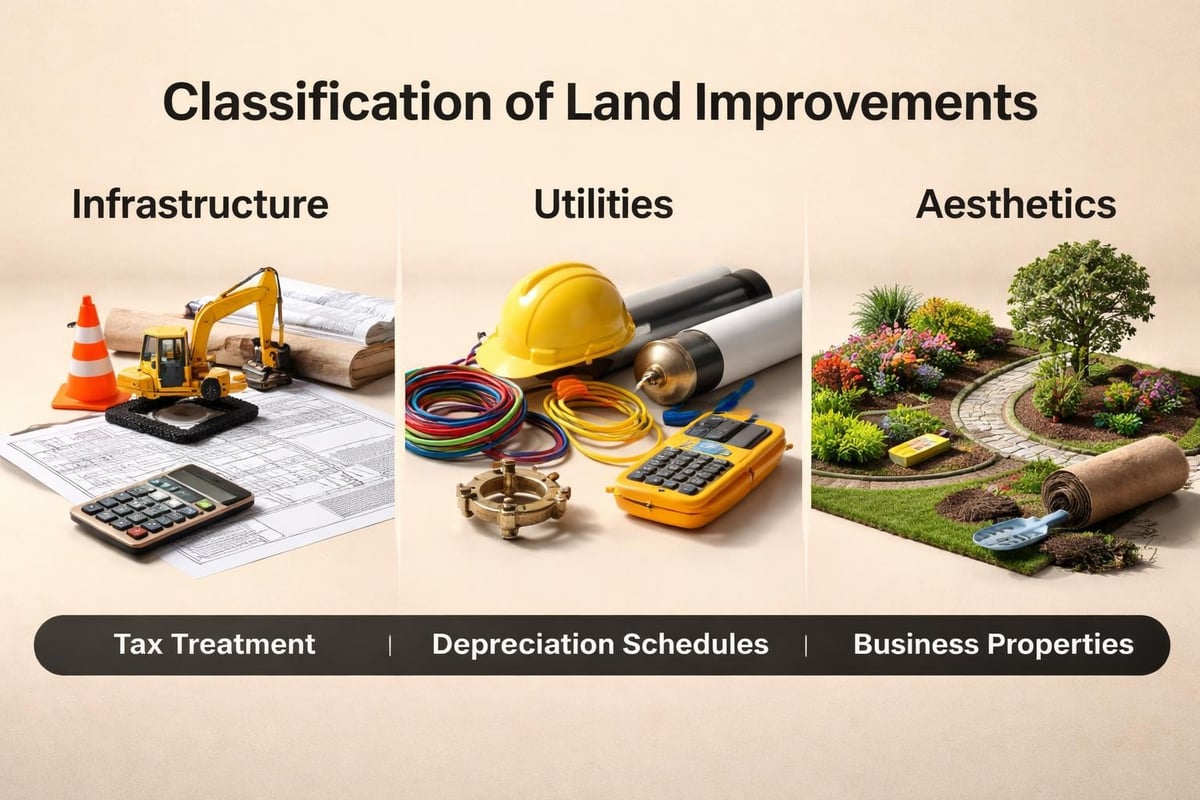
Infrastructure enhancements form the largest category and include:
- Parking lots and paved surfaces
- Site grading and excavation
- Drainage systems and retention ponds
- Outdoor lighting installations
- Fencing and perimeter security
Utility improvements encompass systems that support operations:
- Water and sewer line extensions
- Underground electrical conduits
- Gas distribution networks
- Telecommunications infrastructure
- Storm water management systems
Aesthetic and functional additions contribute to property usability:
- Landscaping and irrigation systems
- Retaining walls and terraces
- Walkways and pathways
- Signage and wayfinding elements
- Outdoor recreational facilities
The California Department of General Services guidelines detail capitalization thresholds that help organizations determine when expenditures should be recorded as assets versus expenses. This threshold analysis becomes particularly important for mid-sized organizations balancing growth investments with cash flow management.
Strategic Valuation Methods for Business Planning
Accurate valuation of land improvements requires sophisticated approaches that account for both current utility and future potential. Organizations must consider multiple methodologies to arrive at defensible values that withstand audit scrutiny while supporting strategic decision-making.
The Three Primary Valuation Approaches
The Ohio Administrative Code outlines three fundamental approaches that professional appraisers and assessors employ when evaluating improvements.
| Valuation Method | Best Application | Key Advantages | Primary Limitations |
|---|---|---|---|
| Market Data Approach | Properties with comparable sales | Reflects actual market conditions | Limited data for specialized improvements |
| Income Approach | Revenue-generating improvements | Links value to financial performance | Requires accurate income projections |
| Cost Approach | New or unique improvements | Straightforward calculation | May not reflect market realities |
Market data analysis examines recent sales of comparable properties with similar improvements. This approach works exceptionally well for common enhancements like parking facilities or standard landscaping but struggles with specialized infrastructure unique to specific industries or operations.
Income-based valuation connects improvements directly to revenue generation or cost savings. For organizations implementing efficiency initiatives, this method can demonstrate how site improvements contribute to operational performance. A well-designed parking system that reduces employee commute stress or a modern lighting system that cuts energy costs both generate measurable financial returns.
Cost approach methodology calculates replacement cost minus depreciation. This method proves valuable when assessing newer improvements or when comparable market data doesn't exist. Organizations planning major site upgrades often use this approach to establish baseline values for budgeting purposes.
Highest and Best Use Analysis
The Oregon Department of Revenue emphasizes the principle of highest and best use when appraising land improvements. This concept extends beyond simple valuation to encompass strategic planning and operational optimization.
Business leaders should evaluate whether current improvements support optimal property utilization. A distribution center with inadequate loading docks represents underutilized potential. Similarly, office campuses with aging parking infrastructure may constrain growth or employee satisfaction initiatives.
Tax Implications and Depreciation Strategies
The tax treatment of land improvements creates significant opportunities for organizations to reduce current tax liabilities while planning long-term capital strategies. Understanding these implications enables finance teams to structure investments for maximum benefit.
Federal Tax Considerations
The Internal Revenue Service regulations define real property and establish rules for determining what constitutes depreciable improvements versus non-depreciable land. These distinctions affect Modified Accelerated Cost Recovery System (MACRS) calculations and bonus depreciation eligibility.
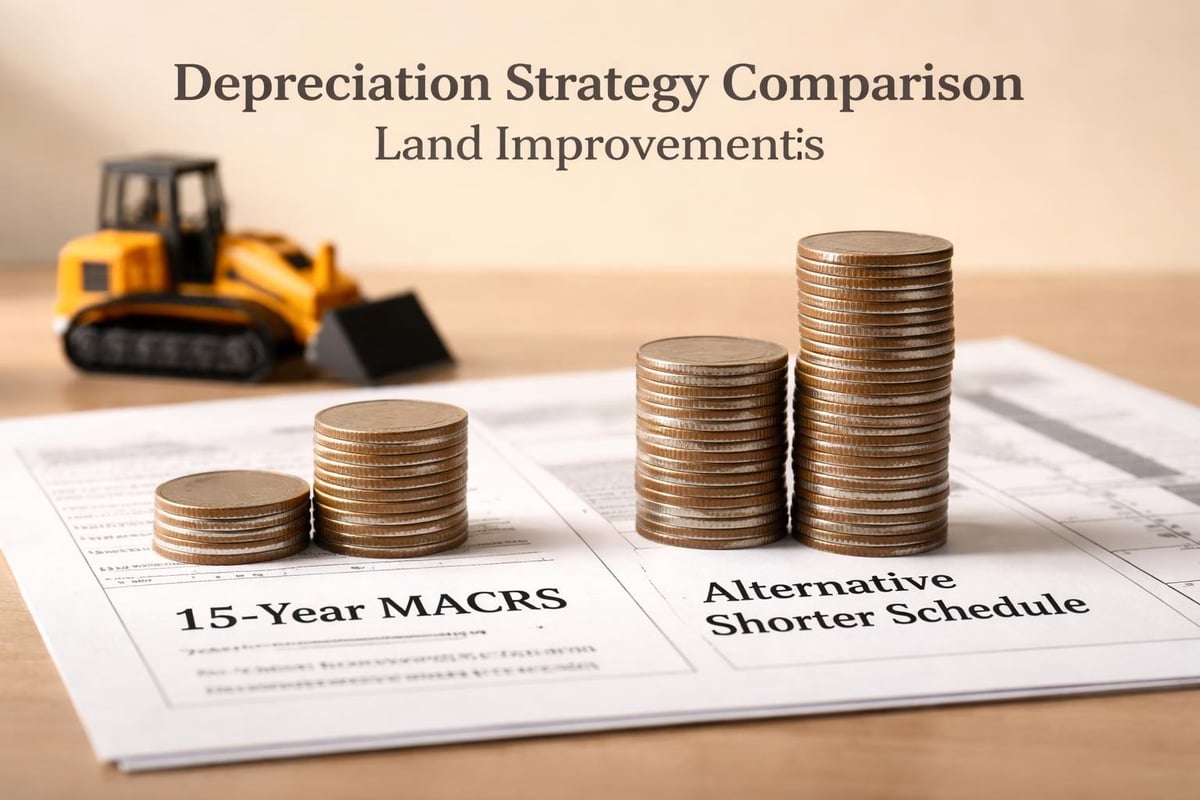
Most land improvements qualify for 15-year recovery periods under MACRS, though some specialized enhancements may use different schedules. Organizations should work with tax professionals to:
- Identify qualifying improvement costs separated from land acquisition expenses
- Determine appropriate depreciation methods based on improvement type and business use
- Calculate bonus depreciation eligibility for qualifying property placed in service
- Document cost segregation studies that maximize near-term deductions
- Plan improvement timing to optimize tax year benefits
State and Local Assessment Variations
Property tax assessments vary significantly across jurisdictions, with each state maintaining unique approaches to valuing and taxing land improvements. The Lincoln Institute of Land Policy research examines these variations and their implications for multi-location organizations.
State-specific considerations include:
- Assessment ratio differences between land and improvements
- Exemptions for certain improvement types
- Agricultural or conservation use valuations
- Economic development incentives
- Appeal processes and documentation requirements
Organizations operating across multiple states should implement standardized processes for tracking improvements while accommodating local regulatory requirements. This dual approach ensures consistency in internal reporting while meeting diverse external compliance obligations.
Accounting Standards and Financial Reporting
Proper accounting for land improvements requires adherence to Generally Accepted Accounting Principles (GAAP) or International Financial Reporting Standards (IFRS), depending on organizational structure and reporting requirements. These standards govern recognition, measurement, and disclosure of capital assets.
Initial Recognition and Capitalization
The Michigan Department of Treasury guidelines provide comprehensive frameworks for accounting and reporting infrastructure assets, including land improvements. While developed for municipal entities, these principles apply broadly to private sector organizations.
Capitalization thresholds determine whether expenditures become balance sheet assets or immediate expenses. Organizations should establish clear policies addressing:
- Minimum dollar amounts for capitalization
- Aggregation rules for related improvements
- Betterment versus maintenance distinctions
- Component accounting for complex improvements
- Useful life estimation methodologies
When organizations invest in site improvements, they must carefully document all costs properly includable in the asset basis. This includes direct construction costs, professional fees, permits, site preparation, and allocated overhead for internally managed projects.
Subsequent Measurement and Impairment
After initial recognition, land improvements require ongoing assessment for impairment indicators. Changes in business strategy, technological obsolescence, environmental regulations, or market conditions may trigger impairment reviews.
Organizations should monitor for events suggesting carrying amounts may not be recoverable, including:
- Significant decreases in market value
- Adverse changes in asset usage
- Physical damage or deterioration
- Regulatory or business climate changes
- Accumulated costs exceeding initial estimates
Strategic Planning and Operational Integration
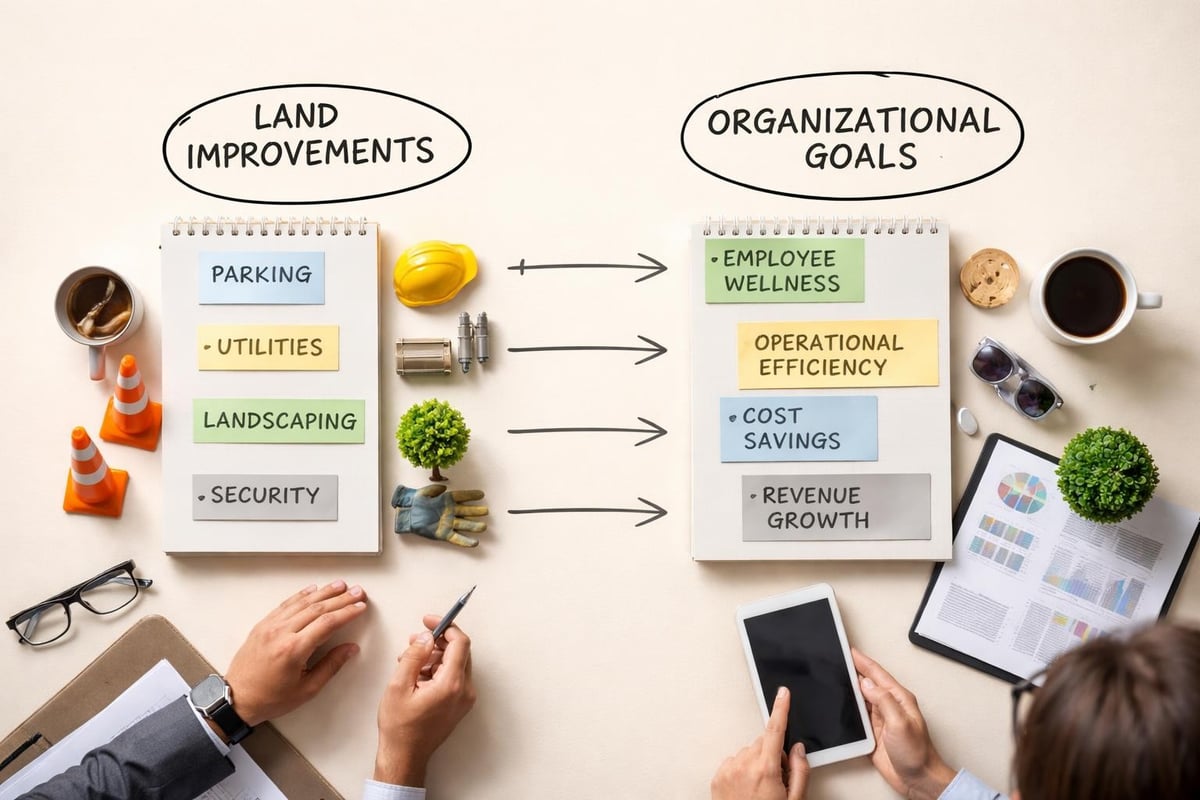
Forward-thinking organizations view land improvements not merely as accounting entries but as strategic tools for achieving operational excellence and competitive advantage. This perspective aligns infrastructure investments with broader business objectives around efficiency, employee wellness, and financial performance.
Aligning Improvements with Business Strategy
Every dollar invested in property improvements should advance measurable business outcomes. Organizations pursuing operational excellence through automation and process optimization must ensure physical infrastructure supports these initiatives.
Consider how improvements enable:
- Employee productivity enhancements through ergonomic site design and amenity access
- Operational efficiency gains via optimized traffic flow and utility infrastructure
- Cost reduction opportunities from energy-efficient systems and maintenance-friendly designs
- Revenue generation potential through enhanced customer experience or expanded capacity
- Risk mitigation advantages from improved security, safety, and environmental controls
The integration of physical improvements with technology infrastructure creates particularly powerful synergies. Smart parking systems, IoT-enabled lighting, and automated irrigation demonstrate how traditional land improvements evolve to support digital transformation initiatives.
Building Business Cases for Improvement Projects
Securing approval for land improvement investments requires compelling financial justification. Organizations should develop comprehensive business cases that quantify both tangible and intangible benefits.
Effective business cases address:
- Current state assessment documenting existing conditions and limitations
- Proposed improvement specifications with detailed scope and cost estimates
- Financial analysis including NPV, IRR, and payback period calculations
- Operational impact quantification measuring efficiency gains and cost savings
- Risk and mitigation strategies addressing implementation and operational challenges
- Strategic alignment demonstration connecting improvements to corporate objectives
For organizations focused on employee health and wellness, improvements like enhanced outdoor spaces, walking trails, or recreational facilities deliver measurable returns through reduced healthcare costs, improved retention, and increased productivity. These benefits should be quantified and incorporated into investment decisions.
Legal and Regulatory Compliance Considerations
Navigating the legal landscape surrounding land improvements requires attention to multiple regulatory frameworks spanning tax law, property rights, environmental regulations, and local zoning requirements. Non-compliance creates financial risks and operational disruptions that can undermine improvement benefits.
Classification Disputes and Resolution
Property classification disputes between taxpayers and assessors frequently center on whether enhancements constitute land, land improvements, or building components. The University of Chicago Law Review analysis explores these nuances in the context of on-site utilities and infrastructure.
These classifications matter because they affect depreciation schedules, property tax assessments, and eligibility for various incentives. Organizations should maintain detailed records documenting improvement purposes, installation methods, and relationships to other property elements.
Property Tax Assessment Appeals
When organizations disagree with assessed values for land improvements, formal appeal processes provide recourse. The New York State Department of Taxation and Finance opinions offer insights into how regulatory bodies interpret improvement definitions.
Successful appeals typically require:
- Independent appraisals supporting alternative valuations
- Comparable property data demonstrating assessment inequities
- Documentation of physical condition or functional obsolescence
- Clear demonstration of valuation methodology errors
- Compliance with jurisdiction-specific procedural requirements
Organizations should evaluate whether appeal costs and potential savings justify the effort, considering both immediate tax implications and precedent-setting effects for future assessments.
Implementation Best Practices for Professional Services Organizations
Professional services firms face unique considerations when planning and implementing land improvements. These organizations typically prioritize employee experience, client impressions, and operational flexibility over industrial or retail-specific requirements.
Creating Environments That Support Human Capital
For consultancies and professional services firms, office environments directly impact talent acquisition, retention, and productivity. Land improvements that enhance employee experience generate returns through reduced turnover costs and improved billable utilization.
High-impact improvements include:
- Outdoor meeting and collaboration spaces
- Walking paths and wellness areas
- Secure bicycle storage and electric vehicle charging
- Enhanced landscaping creating visual appeal
- Shaded parking and weather protection
These enhancements support broader human capital management strategies by demonstrating organizational commitment to employee wellbeing. When combined with programs addressing mental, physical, and financial health, improved facilities create comprehensive workplace experiences that attract and retain top talent.
Technology Integration and Future-Proofing
Modern land improvements increasingly incorporate technology infrastructure that enables smart building operations and data-driven facility management. Professional services organizations implementing AI and automation solutions should ensure site improvements support these initiatives.
Technology-enabled improvements provide:
- Real-time utilization monitoring for parking and outdoor spaces
- Automated environmental controls optimizing comfort and energy use
- Security systems integrating physical and digital access controls
- Network infrastructure supporting mobile and remote work
- Sensor networks gathering data for predictive maintenance
These capabilities align with broader digital transformation initiatives, creating connected environments that adapt to changing business needs and work patterns.
Long-Term Maintenance and Lifecycle Management
Strategic land improvement planning extends beyond initial installation to encompass long-term maintenance, eventual replacement, and continuous optimization. Organizations that view improvements through a lifecycle lens achieve better financial outcomes and sustained operational benefits.
Developing Comprehensive Maintenance Programs
Proactive maintenance preserves improvement functionality, extends useful lives, and prevents costly emergency repairs. Organizations should establish formal programs addressing both routine upkeep and periodic major maintenance.
| Improvement Type | Routine Maintenance Frequency | Typical Useful Life | Major Maintenance Intervals |
|---|---|---|---|
| Asphalt Parking | Annual seal coating | 20-25 years | 5-7 years (resurfacing) |
| Irrigation Systems | Seasonal startup/shutdown | 15-20 years | 3-5 years (component replacement) |
| Outdoor Lighting | Quarterly inspection | 15-20 years | 5-10 years (fixture upgrades) |
| Landscaping | Weekly/monthly care | Varies by species | Annual (replanting/renewal) |
| Drainage Systems | Bi-annual cleaning | 30-40 years | 10-15 years (rehabilitation) |
Effective maintenance programs balance immediate costs against long-term value preservation. Organizations should budget for ongoing maintenance as a percentage of improvement replacement value, typically ranging from two to four percent annually depending on improvement type and usage intensity.
Planning for Replacement and Upgrades
Even well-maintained improvements eventually require replacement. Strategic organizations anticipate these needs through capital reserve planning and opportunistic upgrade strategies.
Replacement planning considerations include:
- Monitoring condition assessments and performance metrics
- Evaluating emerging technologies offering superior functionality
- Timing replacements to coincide with operational changes
- Bundling related improvements for cost efficiency
- Incorporating sustainability and resilience enhancements
Organizations implementing major operational changes, facility expansions, or strategic repositioning should assess whether existing land improvements support future needs or require proactive upgrades.
Financial Modeling and Investment Analysis
Sophisticated financial analysis transforms land improvement decisions from reactive maintenance into strategic capital allocation. Organizations should apply rigorous investment criteria to improvement projects, ensuring capital flows to highest-return opportunities.
Building Multi-Year Capital Plans
Comprehensive capital planning integrates land improvements into broader facility investment strategies. This approach ensures balanced allocation across competing priorities while maintaining adequate reserves for unexpected needs.
Effective capital plans incorporate:
- Five to ten-year improvement forecasts based on condition assessments
- Prioritization frameworks weighting strategic importance and financial returns
- Funding strategies balancing internal resources and external financing
- Scenario analysis modeling different budget constraint outcomes
- Performance metrics tracking actual versus projected returns
Organizations should review and update capital plans annually, adjusting for business strategy changes, market conditions, and emerging opportunities. This dynamic approach ensures improvement investments remain aligned with evolving organizational needs.
Quantifying Intangible Benefits
While land improvements generate tangible financial returns through depreciation deductions and operational cost savings, they also deliver intangible benefits that influence employee satisfaction, client perception, and brand reputation.
Methods for quantifying intangible benefits:
- Employee surveys measuring satisfaction changes following improvements
- Recruitment metrics tracking offer acceptance rates and time-to-fill
- Retention analysis comparing turnover before and after enhancements
- Client feedback assessing facility impressions and experience ratings
- Productivity metrics evaluating output changes attributable to environment
By quantifying these typically subjective factors, organizations build more complete business cases that capture total improvement value rather than focusing solely on direct financial returns.
Strategic land improvement planning requires balancing financial optimization, operational requirements, and long-term value creation. Organizations that approach these investments systematically achieve better returns while supporting broader business objectives around efficiency, employee wellness, and competitive positioning. Nero and Associates, Inc. helps organizations optimize their operational infrastructure and capital allocation strategies through data-driven analysis and performance-based solutions. Our consultants work with leadership teams to align physical asset investments with strategic priorities, eliminate inefficient processes, and build comprehensive approaches to organizational performance that deliver measurable results across operations, finance, and human capital management.