

The structure of law firms has evolved significantly over the past decades, with the role of lawyer partners becoming increasingly complex and multifaceted. Understanding partnership structures, compensation models, and operational dynamics within legal practices offers valuable insights not only for law firms but also for professional services firms across industries. These organizational frameworks reveal how compensation strategies, equity distribution, and performance metrics shape firm culture and drive business outcomes.
Understanding the Foundation of Law Firm Partnerships
Lawyer partners represent the ownership tier within legal practices, holding equity stakes and sharing in firm profits while bearing responsibility for strategic direction and business development. The traditional partnership model established lawyers as both service providers and business owners, creating unique dynamics that differentiate law firms from corporate structures.
Traditional Partnership Structures
Traditional partnerships operated under the principle that all partners shared equally in profits and liabilities. This model fostered strong collaboration and collective decision-making, though it sometimes created tension when individual contributions varied significantly. The egalitarian approach emphasized long-term firm building over short-term individual gains.
Key characteristics of traditional partnerships include:
- Equal profit sharing regardless of individual billing
- Shared liability for firm debts and obligations
- Consensus-based governance structures
- Long-term commitment to firm development
- Collective responsibility for client relationships
The traditional model has largely given way to more sophisticated structures that differentiate between equity and non-equity partners, reflecting the reality that not all lawyer partners contribute equally to firm revenue or assume identical risks.

Modern Partnership Tiers and Their Implications
Today's law firms typically employ a two-tier partnership structure that distinguishes between equity partners who own firm shares and non-equity partners who receive partnership titles without ownership stakes. This evolution addresses the need for more flexible compensation models while maintaining partnership prestige as a career milestone.
Equity Partners: The Ownership Class
Equity partners hold actual ownership interests in the firm, receiving distributions based on profitability rather than guaranteed salaries. They participate in strategic decisions, vote on major firm initiatives, and bear personal liability depending on the firm’s organizational structure. Their compensation directly correlates with firm performance, creating alignment between individual interests and collective success.
These lawyer partners typically bring substantial books of business, demonstrate exceptional technical skills, or provide critical leadership. Capital contributions may be required upon admission to equity partnership, ranging from modest amounts to substantial six-figure investments depending on firm size and profitability.
Non-Equity Partners: The Middle Tier
Non-equity partners occupy a hybrid position between senior associates and full equity partners. They receive enhanced compensation compared to associates and carry the partnership title, but they do not share in firm ownership or participate fully in governance. This tier allows firms to recognize exceptional talent while maintaining selectivity around equity ownership.
| Partnership Tier | Ownership Rights | Compensation Structure | Governance Role | Capital Investment |
|---|---|---|---|---|
| Equity Partners | Full ownership stake | Profit distributions | Full voting rights | Required |
| Non-Equity Partners | No ownership | Enhanced salary + bonus | Limited or advisory | Typically none |
| Senior Associates | No ownership | Salary + bonus | None | None |
The non-equity tier serves strategic purposes beyond simple recognition. Firms use this designation to evaluate lawyers before granting full equity status, test compatibility with existing equity partners, and manage the total number of equity stakeholders. For professional services firms outside the legal industry, this model offers lessons in balancing recognition with actual ownership distribution.
Compensation Models That Drive Firm Culture
How lawyer partners are compensated fundamentally shapes firm culture, individual behavior, and business development strategies. The compensation model a firm chooses signals its values and priorities, whether emphasizing teamwork, individual performance, or a hybrid approach.
Lockstep Compensation
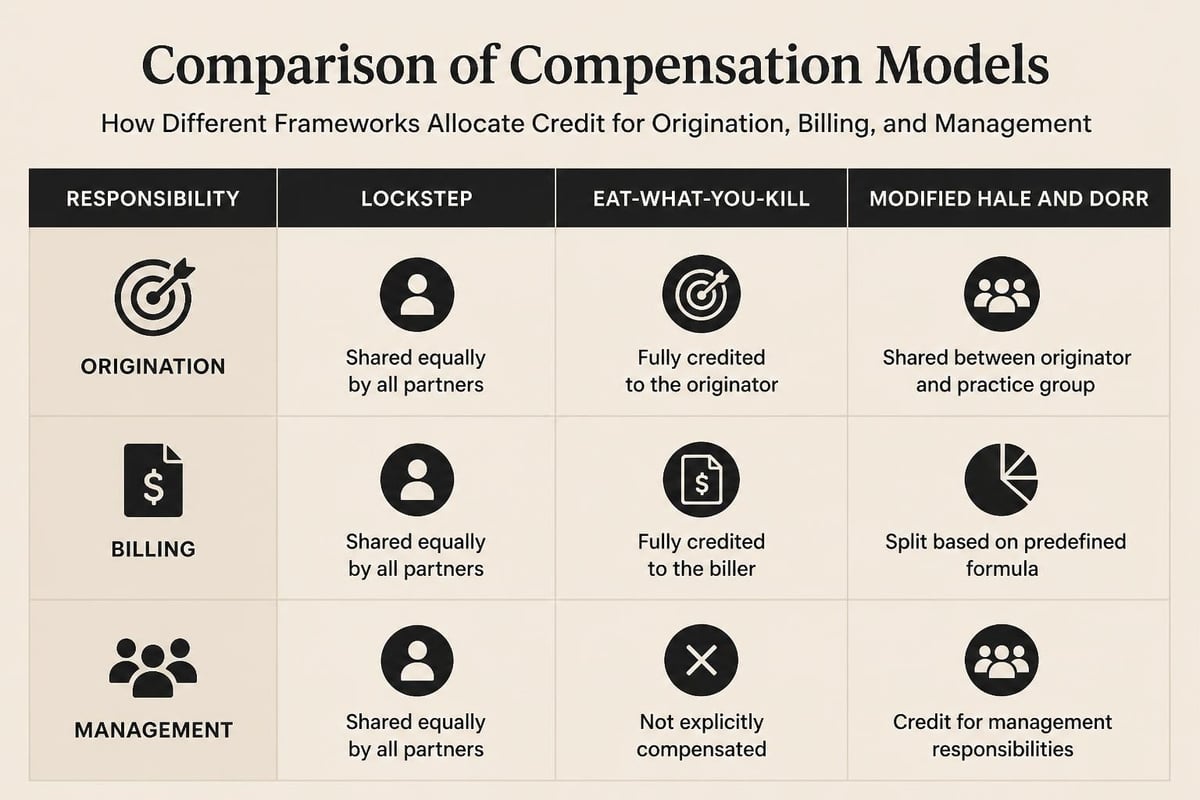
Lockstep models base partner compensation primarily on seniority, with all partners at the same class year receiving identical or similar distributions. This approach minimizes internal competition, encourages collaboration, and reduces political maneuvering around credit for client origination or matter execution.
Advantages of lockstep include:
- Reduced internal politics and competition
- Strong collaboration across practice groups
- Simplified administration and transparency
- Long-term firm focus over short-term gains
However, lockstep systems can frustrate high performers who generate significantly more revenue than peers, potentially leading to departures. They may also retain underperforming partners longer than merit-based systems would tolerate.
Eat-What-You-Kill Models
At the opposite end of the spectrum, eat-what-you-kill compensation directly ties partner earnings to individual billings and origination. Lawyer partners essentially operate as independent contractors within a shared infrastructure, keeping most of the revenue they personally generate after covering overhead allocations.
This model maximizes individual accountability and rewards top performers, but it can undermine collaboration. Partners may hoard clients, refuse to share credit, or decline to invest time in firm management or mentoring. The approach works best in firms with distinct practice areas requiring minimal cross-practice collaboration.
Modified Hale and Dorr Systems
Named after the firm that pioneered the approach, modified Hale and Dorr systems blend objective metrics with subjective assessments. Partners receive points or units based on factors including billable hours, client origination, matter responsibility, firm management contributions, and qualitative leadership measures.
Compensation committees evaluate multiple dimensions of partner performance rather than relying solely on billings. This balanced approach encourages well-rounded contributions while maintaining accountability. The system requires transparent criteria and consistent application to avoid perceptions of favoritism, making it administratively intensive but culturally beneficial.
Operational Excellence in Partnership Management
The most successful law firms treat partnership management as a strategic discipline requiring systems, processes, and ongoing refinement. Just as operational excellence transforms business performance across industries, systematic approaches to partner evaluation, compensation setting, and performance management strengthen law firm operations.
Performance Metrics and Evaluation Systems
Effective evaluation of lawyer partners requires quantitative metrics combined with qualitative assessments. Firms must track individual billing, realization rates, collection performance, client satisfaction, and business development activities. Equally important are subjective factors like mentoring quality, firm citizenship, practice group leadership, and strategic contributions.
Leading firms establish clear performance expectations at the beginning of each fiscal year, conduct mid-year check-ins, and deliver comprehensive year-end evaluations. This structure eliminates surprises, enables course correction, and documents rationales for compensation decisions. The transparency reduces internal tension and focuses partners on behaviors that align with firm strategy.
Business Development and Client Origination
Client origination represents a critical component of partner value, though measuring origination credit remains contentious. Did the lawyer partner who brought in the initial relationship deserve full credit when another partner now manages the work? Should credit split when multiple partners collaborated on business development?
Progressive firms establish clear origination credit policies before disputes arise. They may allocate primary credit to the originating partner while recognizing relationship managers and practice leaders. Some firms rotate credit annually based on who currently drives the relationship, acknowledging that client stewardship evolves over time. Whatever approach is chosen, consistency and transparency prevent the political battles that plague firms with ambiguous policies.
Strategic Challenges Facing Modern Partnerships
Law firm partnerships face mounting pressures that require strategic adaptation. Client demands for efficiency, technology disruption, talent competition, and generational shifts all challenge traditional partnership models.
Generational Expectations and Work Models
Younger lawyer partners often prioritize work-life balance differently than previous generations, questioning the all-consuming partnership model that dominated legal practice for decades. They may seek reduced schedules, remote work flexibility, or sabbatical options that traditional partnerships struggled to accommodate. Firms that rigidly maintain 1980s expectations risk losing emerging leaders to organizations offering more adaptable structures.
This generational evolution parallels broader workplace transformations across professional services. Organizations implementing modern HRIS systems and flexible work policies attract talent more effectively than those clinging to outdated models. Law firms must similarly evolve to remain competitive employers.
Technology Integration and Efficiency
Technology adoption fundamentally changes how lawyer partners deliver services and manage practices. Automation tools handle document review, contract analysis, and legal research that once required significant associate time. This efficiency pressure reduces billable hours while increasing client expectations for value.
Partners who embrace technology gain competitive advantages, though adoption requires cultural shifts. Firms must invest in training, change management, and process redesign to capture technology's full benefits. The most forward-thinking partnerships view technology as a strategic differentiator rather than a cost center.
| Technology Category | Impact on Partner Work | Client Benefit | Implementation Challenge |
|---|---|---|---|
| Document Automation | Reduces drafting time 40-60% | Lower costs, faster delivery | Template standardization |
| AI Legal Research | Accelerates case law review | More comprehensive analysis | Trust in algorithm accuracy |
| Client Portals | Streamlines communication | Transparency and access | User adoption and training |
| Practice Management | Improves efficiency | Better matter tracking | Process standardization |
Professional services firms across industries face similar technology integration challenges. The lessons learned in law firm partnerships apply broadly to consulting, accounting, and specialized service providers navigating digital transformation.
Governance Structures and Decision-Making Processes
How lawyer partners govern firms significantly impacts strategic agility, innovation capacity, and operational efficiency. Governance models range from pure democracy where every equity partner votes on major decisions to executive committee structures concentrating authority in a smaller leadership group.
Democratic Governance Models
Fully democratic partnerships grant each equity partner equal voting rights on strategic matters including partner admissions, major financial commitments, and practice group changes. This inclusive approach ensures broad buy-in and maintains partnership equality, though it can slow decision-making and favor status quo over innovation. Achieving consensus among dozens or hundreds of partners proves challenging when addressing controversial issues.
Smaller firms often function effectively under democratic models, leveraging regular partner meetings to maintain alignment. As firms grow beyond 20-30 equity partners, purely democratic governance typically gives way to representative structures.
Executive Committee Structures
Most mid-size and large firms delegate day-to-day governance to executive committees elected by or appointed from the partner group. These committees make operational decisions, approve budgets, and handle routine matters without full partner votes. Major strategic decisions like mergers or office openings still require broader partner approval.
Executive committees should represent diverse firm constituencies including practice groups, offices, and seniority levels. Clear authority limits prevent committee overreach while enabling responsive management. The best committees balance decisive leadership with transparent communication to maintain partner confidence.

Lessons for Professional Services Firms
The partnership dynamics within law firms offer valuable lessons for professional services organizations across sectors. How firms structure ownership, compensate leaders, evaluate performance, and govern operations directly impacts culture, retention, and financial results.
Aligning Compensation With Strategic Goals
The most critical lesson involves ensuring compensation systems support strategic objectives. If collaboration matters, compensation should reward it. If client satisfaction drives strategy, partner evaluation should measure it. Misalignment between stated values and compensation realities creates cynicism and undermines cultural dynamics.
Professional services consultancies like those focused on operational improvement must apply these principles to their own organizations while helping clients design effective compensation frameworks. The credibility gap becomes vast when firms advise clients on performance management while maintaining dysfunctional internal systems.
Balancing Stability and Performance
Partnership structures must balance rewarding exceptional individual performance against maintaining organizational stability. Pure eat-what-you-kill models maximize individual accountability but can fragment firms into competing fiefdoms. Complete lockstep prioritizes stability but may tolerate underperformance. The optimal approach incorporates elements of both, adjusted for firm size, practice mix, and strategic priorities.
Organizations serving industries from healthcare to private equity can apply these balanced frameworks to their leadership compensation, ensuring individual excellence supports collective success.
The Evolution Continues
Law firm partnerships continue evolving in response to market pressures, generational shifts, and competitive dynamics. Alternative legal service providers, in-house legal department expansion, and client demands for efficiency all challenge traditional models. Lawyer partners who adapt their structures, embrace technology, and maintain operational discipline will thrive in this changing landscape.
The fundamental principles underlying successful partnerships translate across professional services. Whether compensating lawyer partners or consulting principals, the need for transparency, alignment between compensation and strategy, and balanced governance remains constant. Firms that master these dynamics build sustainable competitive advantages that compound over decades.
Looking forward, partnerships will likely continue fragmenting into more specialized tiers, incorporate more variable compensation elements, and adopt governance structures enabling faster decision-making. The organizations that proactively design partnership structures reflecting modern realities rather than clinging to historical precedent will attract the best talent and serve clients most effectively.
The complexity of lawyer partners' structures, compensation frameworks, and governance models provides valuable insights for professional services firms navigating their own organizational challenges. The balance between individual performance and collective success, the transparency of evaluation systems, and the alignment of compensation with strategic goals determine whether partnerships thrive or struggle. As organizations across industries seek to optimize operations and improve performance, the lessons from law firm partnerships offer practical frameworks applicable to diverse contexts. Nero and Associates, Inc. helps professional services firms design compensation systems, implement performance management frameworks, and build operational excellence that drives sustainable growth. Our performance-based approach ensures your organization achieves measurable improvements in efficiency, revenue, and employee engagement.