

AI Claims Processing: Transform Insurance Operations

Share on Facebook
Share on X
Share on LinkedIn

The insurance industry has reached a critical inflection point where traditional claims processing methods can no longer keep pace with customer expectations, regulatory requirements, and operational costs. Organizations processing thousands of claims annually face mounting pressure to reduce cycle times, improve accuracy, and detect fraud while managing labor costs. Artificial intelligence has emerged as the transformative solution that addresses these challenges head-on, fundamentally reshaping how insurers handle everything from initial claim intake to final settlement. The shift toward ai claims processing represents not just an incremental improvement but a complete reimagining of insurance operations.

The Current State of Claims Processing Challenges

Traditional claims processing involves numerous manual touchpoints that create bottlenecks and inconsistencies. Adjusters spend significant time reviewing documents, validating information, and making subjective decisions that can vary widely between individuals. This manual approach leads to several persistent problems that impact both operational efficiency and customer satisfaction.

Processing delays frequently extend settlement times to weeks or months, frustrating policyholders who expect rapid resolution. Manual data entry introduces errors that compound throughout the workflow, requiring additional review cycles and corrections. The sheer volume of documentation required for complex claims overwhelms adjusters, who must juggle multiple cases simultaneously while maintaining accuracy and compliance.

Resource Allocation and Cost Pressures

Insurance companies typically allocate 60-70% of their operational budgets to claims-related activities. Within this allocation, labor costs dominate as organizations hire armies of adjusters, examiners, and support staff to manage incoming claims. The benefits administration complexity extends to claims teams, where turnover and training costs further erode profitability.

Fraud detection relies heavily on experience and intuition, missing sophisticated schemes that cost the industry billions annually. Without systematic pattern recognition, fraudulent claims slip through initial reviews, only surfacing after significant resources have been expended. This reactive approach to fraud prevention creates substantial financial exposure.
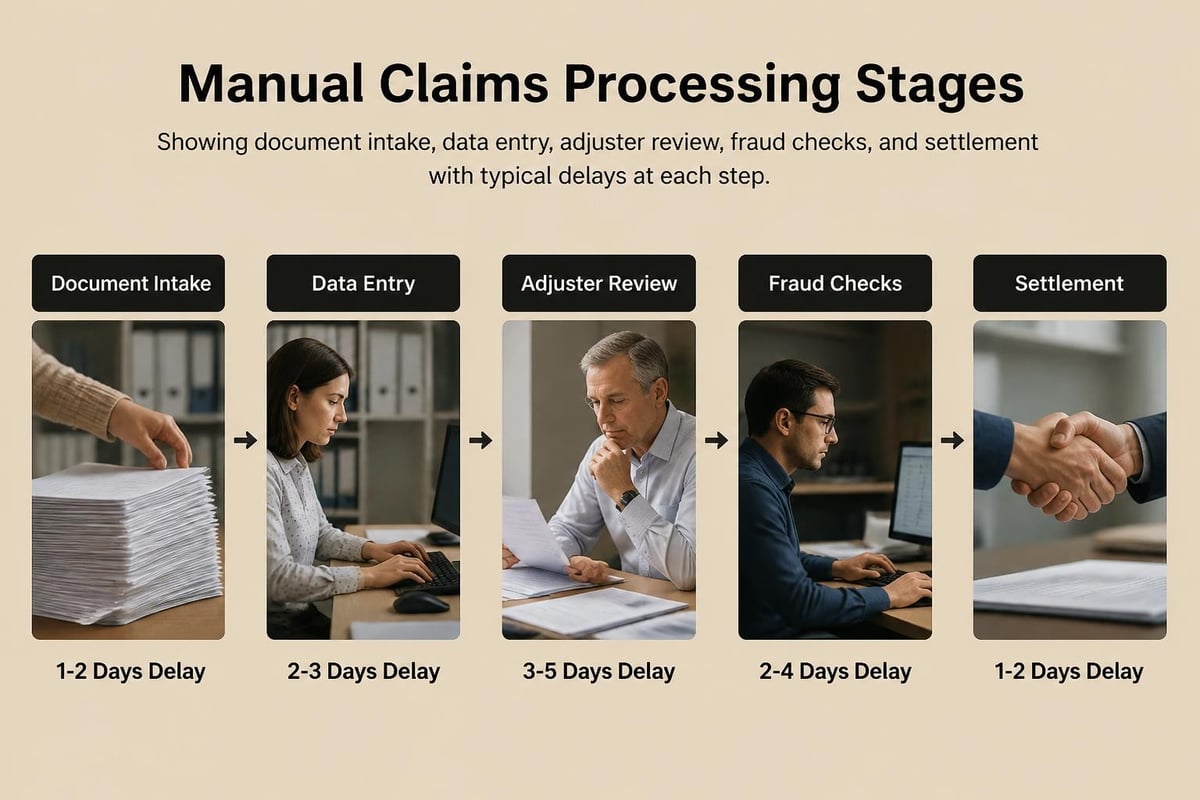
Traditional claims workflow bottlenecks

How AI Claims Processing Transforms Insurance Operations

Modern ai claims processing leverages machine learning algorithms, natural language processing, and computer vision to automate and enhance every stage of the claims lifecycle. These technologies work in concert to create intelligent workflows that reduce manual intervention while improving accuracy and speed. AI integrates into claims processing through machine learning and automated workflows that gather context, spot patterns, and recommend next steps.

The transformation begins at first notice of loss, where AI systems automatically categorize claims, extract relevant information from unstructured documents, and route cases to appropriate handling paths. This initial triage eliminates hours of manual sorting and ensures claims reach the right resources immediately.

Intelligent Document Processing

One of the most impactful applications involves converting unstructured data into structured formats. Insurance claims arrive with photographs, medical records, police reports, repair estimates, and witness statements in various formats. AI can automate the processing of claims documents, converting unstructured data into structured formats to expedite claims handling and reduce manual effort.

Key capabilities include:

  • Optical character recognition that reads handwritten and printed text with high accuracy
  • Image analysis that assesses vehicle damage, property loss, or injury severity
  • Natural language understanding that extracts relevant facts from narrative descriptions
  • Data validation that cross-references information against policy terms and historical patterns

Research demonstrates that large language models can extract structured data from unstructured claims documents, significantly improving data analysis and decision-making throughout the claims process. This capability eliminates the tedious manual review that typically consumes 30-40% of adjuster time.

Automated Damage Assessment

For property and auto claims, AI-powered damage assessment represents a quantum leap forward. Policyholders can submit smartphone photos of damage, which computer vision algorithms analyze to estimate repair costs, identify parts needed, and flag potential complications. This instant assessment accelerates the claims process while maintaining accuracy comparable to or exceeding human estimators.

A comprehensive framework for integrating AI into motor insurance details architectures for vehicle damage analysis and claims evaluation, providing insights into how AI automates claims workflows from initial assessment through final settlement.

Strategic Implementation Considerations

Organizations considering ai claims processing must address several critical questions to ensure successful adoption. Insurers must answer key questions about cloud adoption, clear objectives, core systems integration, and human oversight to embrace AI effectively and realize its transformative potential.

Infrastructure and Integration Requirements

Legacy systems present the primary obstacle to AI implementation. Most insurers operate on decades-old core platforms that weren't designed for modern API integrations or real-time data exchange. Before deploying ai claims processing solutions, organizations must evaluate their technical infrastructure and develop migration or integration strategies.

Implementation Factor Traditional Approach AI-Enhanced Approach Impact on Operations
Claim Intake Time 45-60 minutes 5-10 minutes 80% reduction
Document Processing Manual review Automated extraction 90% faster
Fraud Detection Rate 15-20% 60-75% 4x improvement
Adjuster Productivity 8-12 claims/day 20-30 claims/day 150% increase

Cloud adoption enables scalability and reduces infrastructure management burdens, but organizations must carefully evaluate data security, regulatory compliance, and vendor reliability. The decision between private, public, or hybrid cloud architectures depends on claim volume, data sensitivity, and existing technology investments.

Defining Clear Objectives and Success Metrics

Successful ai claims processing implementations begin with specific, measurable objectives. Vague goals like "improve efficiency" provide insufficient direction for technology selection, process redesign, and change management. Organizations should identify concrete targets such as reducing average claims cycle time by 50%, increasing straight-through processing rates to 40%, or improving fraud detection accuracy by 30 percentage points.

Essential success metrics include:

  1. Cycle time reduction: Measure average days from first notice to settlement
  2. Processing cost per claim: Calculate total labor and technology costs divided by claim volume
  3. Accuracy rates: Track error rates in data extraction, damage assessment, and payment calculations
  4. Customer satisfaction: Monitor Net Promoter Scores and complaint volumes
  5. Fraud detection effectiveness: Compare identified fraud cases against total suspicious activity

These metrics provide objective benchmarks for evaluating ROI and guiding continuous improvement efforts. Organizations pursuing operational excellence recognize that measurement drives accountability and enables data-driven optimization.
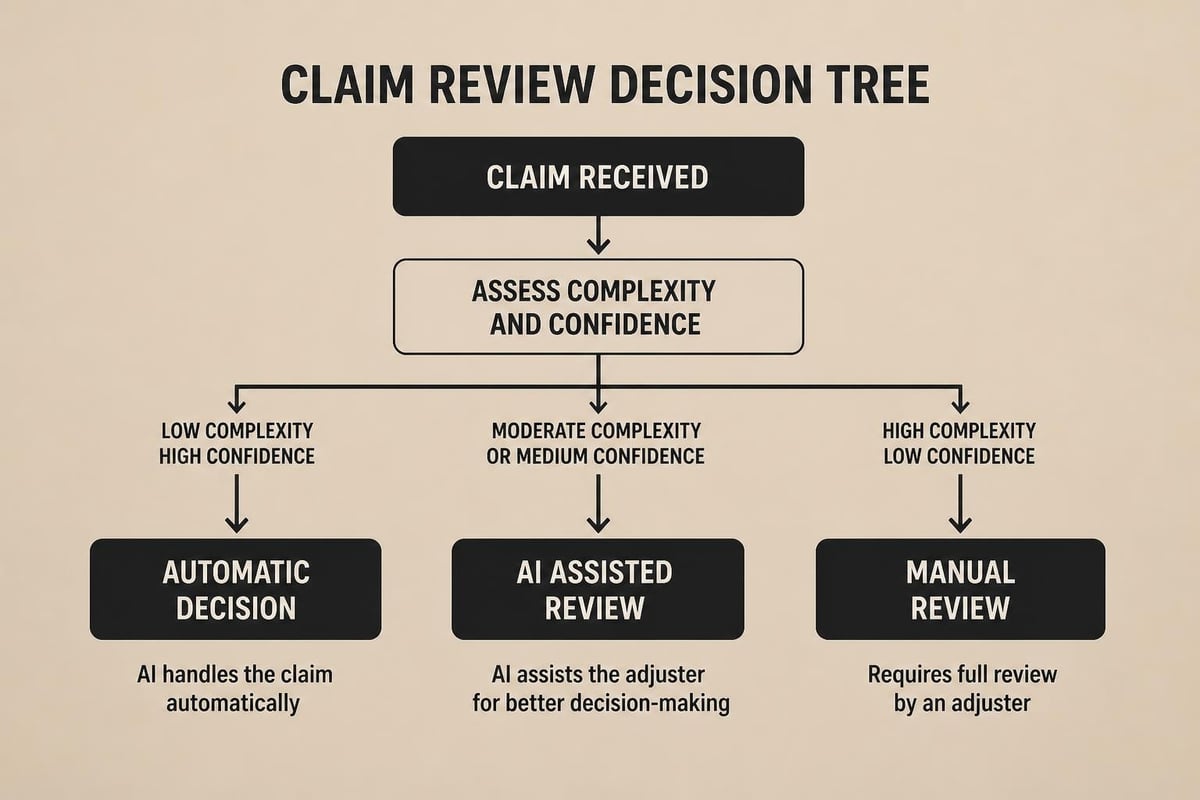
AI claims processing decision framework

Advanced Applications and Emerging Capabilities

Beyond basic automation, cutting-edge ai claims processing incorporates sophisticated capabilities that address complex scenarios requiring judgment and contextual understanding. These advanced applications represent the frontier of insurance technology, where AI transitions from simple task automation to intelligent decision support.

Conversational AI and Claims Assistance

AI-powered chatbots and virtual assistants now handle initial claims reporting, answer policyholder questions, and provide status updates without human intervention. Research on AI-powered chatbots designed to assist insurance agents demonstrates how these systems automate tasks such as policy recommendations and claims triage, showcasing AI's potential to enhance both customer experience and agent efficiency.

These conversational interfaces operate 24/7, providing immediate response to policyholders regardless of time zones or business hours. Natural language understanding enables them to comprehend questions phrased in everyday language, extract relevant policy details, and provide accurate guidance on coverage and next steps.

Predictive Analytics and Fraud Prevention

Machine learning models trained on historical claims data identify patterns that humans cannot discern. By analyzing thousands of data points simultaneously, these models flag suspicious claims for detailed investigation while allowing legitimate claims to proceed rapidly. Intelligent claims processing and fraud detection enhance efficiency and prevent fraud through automated workflows that learn from each interaction.

Fraud detection algorithms consider factors including:

  • Claim timing relative to policy inception
  • Geographic patterns and location anomalies
  • Claimant history and previous submissions
  • Network analysis revealing connection between claimants, providers, and witnesses
  • Behavioral indicators from communication patterns

This multi-dimensional analysis catches sophisticated fraud rings that coordinate activities across multiple policies and jurisdictions. The financial impact extends beyond prevented fraudulent payouts to include reduced investigation costs and faster processing of legitimate claims.

Blockchain Integration for Security and Transparency

Emerging applications combine AI with blockchain technology to create immutable audit trails and enhance trust. Research explores blockchain technology in insurance claims processing, focusing on formal verification methods to ensure secure and reliable transaction processing, highlighting the intersection of AI and blockchain in claims management.

This integration enables smart contracts that automatically execute payment when predefined conditions are met, eliminating delays associated with manual approval processes. The transparency inherent in blockchain systems also facilitates regulatory compliance and dispute resolution.

Workforce Transformation and Change Management

Implementing ai claims processing fundamentally alters workforce composition and skill requirements. Rather than eliminating jobs, AI typically shifts roles from routine processing to exception handling, customer advocacy, and complex case management. Organizations must proactively address this transition to maintain employee engagement and capture the full value of automation.

Reskilling and Upskilling Initiatives

Claims adjusters and examiners require training on new AI-powered tools and workflows. This extends beyond basic system operation to include understanding AI outputs, interpreting confidence scores, and knowing when to override automated recommendations. Successful organizations invest heavily in comprehensive training programs that build both technical competency and change readiness.

Training curricula should address:

  1. AI fundamentals: Basic understanding of how machine learning works and its limitations
  2. System operation: Hands-on practice with new interfaces and workflows
  3. Decision authority: Clear guidelines on human oversight responsibilities
  4. Quality assurance: Techniques for validating AI-generated assessments
  5. Customer communication: Skills for explaining AI-driven decisions to policyholders

Organizations that embrace business automation recognize that technology investments must be coupled with human capital development to achieve sustainable transformation.

Creating Hybrid Human-AI Workflows

The most effective implementations establish collaborative workflows where AI handles routine tasks while humans focus on judgment-intensive activities. This hybrid approach leverages the complementary strengths of both humans and machines, creating outcomes superior to either working independently.

Task Category AI Responsibility Human Responsibility Collaboration Model
Data Entry 100% automated Exception review AI executes, human audits samples
Damage Assessment Initial estimate Complex cases, disputes AI provides baseline, human adjusts
Fraud Detection Pattern identification Investigation, prosecution AI flags, human investigates
Settlement Authorization Routine claims High-value, complex cases AI recommends, human approves thresholds

This division of labor maximizes efficiency while maintaining necessary human oversight and accountability. Clear protocols prevent over-reliance on AI while avoiding unnecessary manual intervention that negates automation benefits.

AI claims processing ROI components

Measuring Return on Investment

Quantifying the financial impact of ai claims processing requires comprehensive analysis across multiple dimensions. Direct cost savings from reduced labor represent only one component of total value creation. Organizations must also consider cycle time improvements, accuracy gains, fraud prevention, and customer retention benefits.

Cost Reduction Analysis

Labor cost savings typically emerge over 12-18 months as organizations redirect staff from routine processing to higher-value activities. Rather than immediate headcount reduction, most insurers experience reduced overtime, lower contractor expenses, and slower hiring growth as automation absorbs volume increases.

Typical cost improvements include:

  • 40-60% reduction in document processing costs
  • 30-50% decrease in claims handling expense ratios
  • 20-35% lower fraud-related losses
  • 15-25% reduction in litigation and dispute costs

These savings compound over time as AI models improve through continuous learning and organizations optimize workflows based on performance data.

Revenue and Customer Impact

Faster claims settlement directly impacts customer satisfaction and retention. Policyholders who receive prompt, accurate claim payments demonstrate 30-40% higher renewal rates compared to those experiencing processing delays or disputes. This retention improvement translates to significant lifetime value gains.

Additionally, improved operational efficiency enables insurers to expand capacity without proportional cost increases. The same workforce handling 10,000 claims annually can process 15,000-20,000 claims with AI assistance, creating revenue growth opportunities without corresponding expense growth. Organizations focused on achieving growth and efficiency recognize this scalability as a key competitive advantage.

Regulatory Compliance and Ethical Considerations

As ai claims processing adoption accelerates, regulators increasingly scrutinize algorithmic decision-making to ensure fairness, transparency, and consumer protection. Organizations must proactively address compliance requirements and ethical considerations to avoid regulatory penalties and reputational damage.

Transparency and Explainability

Regulators require insurers to explain how AI systems reach decisions, particularly for claim denials or coverage disputes. Black-box algorithms that cannot provide clear reasoning create compliance risks and undermine consumer trust. Organizations should prioritize explainable AI approaches that generate human-readable justifications for their outputs.

Documentation requirements extend to model development, training data sources, bias testing, and ongoing performance monitoring. Comprehensive audit trails demonstrate due diligence and facilitate regulatory examinations.

Bias Detection and Mitigation

AI models trained on historical data may perpetuate or amplify existing biases related to demographics, geography, or other protected characteristics. Rigorous testing across diverse claim scenarios identifies potential disparate impacts before deployment. Ongoing monitoring ensures models maintain fairness as claim patterns evolve.

Bias mitigation strategies include:

  • Diverse training datasets representing full policyholder populations
  • Regular fairness audits across demographic segments
  • Human oversight for decisions affecting vulnerable populations
  • Transparent appeals processes for disputed outcomes
  • Independent third-party validation of algorithmic fairness

Technology Selection and Vendor Evaluation

Organizations face numerous choices when selecting ai claims processing solutions, ranging from point solutions addressing specific tasks to comprehensive platforms managing end-to-end workflows. Careful vendor evaluation prevents costly implementation failures and ensures solutions align with organizational needs.

Build Versus Buy Decisions

Large insurers with substantial technology resources may consider developing proprietary AI capabilities, while smaller organizations typically benefit from commercial solutions. This decision hinges on available capital, technical expertise, competitive differentiation requirements, and speed-to-value expectations.

Commercial platforms like ClaimRelay’s AI claims engine automate various aspects of claims processing, including intake, damage assessment, fraud detection, and settlement, offering proven capabilities that accelerate implementation timelines. These solutions provide immediate functionality while vendors continuously enhance features based on cross-industry learning.

Custom development offers maximum flexibility and potential competitive advantage but requires significant ongoing investment in data scientists, engineers, and infrastructure. Organizations must realistically assess their ability to attract and retain AI talent in competitive labor markets.

Integration Capabilities and Scalability

Selected solutions must integrate seamlessly with existing core systems, policy administration platforms, and third-party data sources. API-first architectures facilitate integration while enabling future flexibility as technology landscapes evolve.

Scalability considerations include:

  1. Volume handling: Capacity to process peak claim volumes without performance degradation
  2. Geographic expansion: Support for multiple jurisdictions and regulatory requirements
  3. Product diversity: Adaptability across different insurance lines and claim types
  4. Model updates: Ability to retrain and deploy improved algorithms without disruption
  5. Vendor stability: Financial health and long-term viability of technology providers

Organizations developing capital solutions strategies recognize that technology investments must deliver sustained value over multi-year horizons, requiring vendor partners committed to continuous innovation.

Implementation Roadmap and Best Practices

Successful ai claims processing deployments follow structured implementation approaches that manage technical complexity, organizational change, and operational risk. Rushing deployment without adequate preparation leads to user resistance, integration failures, and disappointing results.

Phased Rollout Strategy

Beginning with limited pilots enables organizations to validate technology performance, refine workflows, and build internal expertise before full-scale deployment. Initial phases typically focus on high-volume, low-complexity claim types where automation delivers immediate impact with minimal risk.

Recommended implementation phases:

  1. Discovery and design (2-3 months): Process mapping, requirements definition, vendor selection
  2. Pilot deployment (3-4 months): Limited rollout to single claim type or region
  3. Pilot evaluation (1-2 months): Performance analysis, workflow refinement, training optimization
  4. Scaled deployment (6-9 months): Phased expansion across claim types and geographies
  5. Optimization (ongoing): Continuous improvement based on performance metrics

This incremental approach reduces implementation risk while demonstrating value that builds organizational support for continued investment.

Stakeholder Engagement and Communication

Claims adjusters, customer service representatives, IT staff, and senior leadership all play critical roles in successful ai claims processing adoption. Early engagement builds buy-in and surfaces concerns before they become obstacles.

Regular communication should address how AI changes daily work, new expectations for performance, career development opportunities, and organizational commitment to supporting the transition. Transparency about automation's impact on workforce composition prevents rumors and anxiety that undermine change initiatives.


AI claims processing represents a fundamental shift in how insurance organizations operate, delivering substantial improvements in efficiency, accuracy, and customer satisfaction. The technology has matured beyond experimental applications to become mission-critical infrastructure for competitive insurers. Nero and Associates, Inc. helps organizations navigate this transformation through comprehensive consulting services that address technology selection, process optimization, and workforce development. Our performance-based approach ensures AI implementations deliver measurable results while positioning your organization for sustained operational excellence in an increasingly automated industry.

AI Claims Processing: Transform Insurance Operations

The insurance industry has reached a critical inflection point where traditional claims processing methods can no longer keep pace with customer expectations, regulatory requirements, and operational costs. Organizations processing thousands of claims annually face mounting pressure to reduce cycle times, improve accuracy, and detect fraud while managing labor costs. Artificial intelligence has emerged as the transformative solution that addresses these challenges head-on, fundamentally reshaping how insurers handle everything from initial claim intake to final settlement. The shift toward ai claims processing represents not just an incremental improvement but a complete reimagining of insurance operations.

The Current State of Claims Processing Challenges

Traditional claims processing involves numerous manual touchpoints that create bottlenecks and inconsistencies. Adjusters spend significant time reviewing documents, validating information, and making subjective decisions that can vary widely between individuals. This manual approach leads to several persistent problems that impact both operational efficiency and customer satisfaction.

Processing delays frequently extend settlement times to weeks or months, frustrating policyholders who expect rapid resolution. Manual data entry introduces errors that compound throughout the workflow, requiring additional review cycles and corrections. The sheer volume of documentation required for complex claims overwhelms adjusters, who must juggle multiple cases simultaneously while maintaining accuracy and compliance.

Resource Allocation and Cost Pressures

Insurance companies typically allocate 60-70% of their operational budgets to claims-related activities. Within this allocation, labor costs dominate as organizations hire armies of adjusters, examiners, and support staff to manage incoming claims. The benefits administration complexity extends to claims teams, where turnover and training costs further erode profitability.

Fraud detection relies heavily on experience and intuition, missing sophisticated schemes that cost the industry billions annually. Without systematic pattern recognition, fraudulent claims slip through initial reviews, only surfacing after significant resources have been expended. This reactive approach to fraud prevention creates substantial financial exposure.

Traditional claims workflow bottlenecks

How AI Claims Processing Transforms Insurance Operations

Modern ai claims processing leverages machine learning algorithms, natural language processing, and computer vision to automate and enhance every stage of the claims lifecycle. These technologies work in concert to create intelligent workflows that reduce manual intervention while improving accuracy and speed. AI integrates into claims processing through machine learning and automated workflows that gather context, spot patterns, and recommend next steps.

The transformation begins at first notice of loss, where AI systems automatically categorize claims, extract relevant information from unstructured documents, and route cases to appropriate handling paths. This initial triage eliminates hours of manual sorting and ensures claims reach the right resources immediately.

Intelligent Document Processing

One of the most impactful applications involves converting unstructured data into structured formats. Insurance claims arrive with photographs, medical records, police reports, repair estimates, and witness statements in various formats. AI can automate the processing of claims documents, converting unstructured data into structured formats to expedite claims handling and reduce manual effort.

Key capabilities include:

  • Optical character recognition that reads handwritten and printed text with high accuracy
  • Image analysis that assesses vehicle damage, property loss, or injury severity
  • Natural language understanding that extracts relevant facts from narrative descriptions
  • Data validation that cross-references information against policy terms and historical patterns

Research demonstrates that large language models can extract structured data from unstructured claims documents, significantly improving data analysis and decision-making throughout the claims process. This capability eliminates the tedious manual review that typically consumes 30-40% of adjuster time.

Automated Damage Assessment

For property and auto claims, AI-powered damage assessment represents a quantum leap forward. Policyholders can submit smartphone photos of damage, which computer vision algorithms analyze to estimate repair costs, identify parts needed, and flag potential complications. This instant assessment accelerates the claims process while maintaining accuracy comparable to or exceeding human estimators.

A comprehensive framework for integrating AI into motor insurance details architectures for vehicle damage analysis and claims evaluation, providing insights into how AI automates claims workflows from initial assessment through final settlement.

Strategic Implementation Considerations

Organizations considering ai claims processing must address several critical questions to ensure successful adoption. Insurers must answer key questions about cloud adoption, clear objectives, core systems integration, and human oversight to embrace AI effectively and realize its transformative potential.

Infrastructure and Integration Requirements

Legacy systems present the primary obstacle to AI implementation. Most insurers operate on decades-old core platforms that weren't designed for modern API integrations or real-time data exchange. Before deploying ai claims processing solutions, organizations must evaluate their technical infrastructure and develop migration or integration strategies.

Implementation Factor Traditional Approach AI-Enhanced Approach Impact on Operations
Claim Intake Time 45-60 minutes 5-10 minutes 80% reduction
Document Processing Manual review Automated extraction 90% faster
Fraud Detection Rate 15-20% 60-75% 4x improvement
Adjuster Productivity 8-12 claims/day 20-30 claims/day 150% increase

Cloud adoption enables scalability and reduces infrastructure management burdens, but organizations must carefully evaluate data security, regulatory compliance, and vendor reliability. The decision between private, public, or hybrid cloud architectures depends on claim volume, data sensitivity, and existing technology investments.

Defining Clear Objectives and Success Metrics

Successful ai claims processing implementations begin with specific, measurable objectives. Vague goals like "improve efficiency" provide insufficient direction for technology selection, process redesign, and change management. Organizations should identify concrete targets such as reducing average claims cycle time by 50%, increasing straight-through processing rates to 40%, or improving fraud detection accuracy by 30 percentage points.

Essential success metrics include:

  1. Cycle time reduction: Measure average days from first notice to settlement
  2. Processing cost per claim: Calculate total labor and technology costs divided by claim volume
  3. Accuracy rates: Track error rates in data extraction, damage assessment, and payment calculations
  4. Customer satisfaction: Monitor Net Promoter Scores and complaint volumes
  5. Fraud detection effectiveness: Compare identified fraud cases against total suspicious activity

These metrics provide objective benchmarks for evaluating ROI and guiding continuous improvement efforts. Organizations pursuing operational excellence recognize that measurement drives accountability and enables data-driven optimization.

AI claims processing decision framework

Advanced Applications and Emerging Capabilities

Beyond basic automation, cutting-edge ai claims processing incorporates sophisticated capabilities that address complex scenarios requiring judgment and contextual understanding. These advanced applications represent the frontier of insurance technology, where AI transitions from simple task automation to intelligent decision support.

Conversational AI and Claims Assistance

AI-powered chatbots and virtual assistants now handle initial claims reporting, answer policyholder questions, and provide status updates without human intervention. Research on AI-powered chatbots designed to assist insurance agents demonstrates how these systems automate tasks such as policy recommendations and claims triage, showcasing AI's potential to enhance both customer experience and agent efficiency.

These conversational interfaces operate 24/7, providing immediate response to policyholders regardless of time zones or business hours. Natural language understanding enables them to comprehend questions phrased in everyday language, extract relevant policy details, and provide accurate guidance on coverage and next steps.

Predictive Analytics and Fraud Prevention

Machine learning models trained on historical claims data identify patterns that humans cannot discern. By analyzing thousands of data points simultaneously, these models flag suspicious claims for detailed investigation while allowing legitimate claims to proceed rapidly. Intelligent claims processing and fraud detection enhance efficiency and prevent fraud through automated workflows that learn from each interaction.

Fraud detection algorithms consider factors including:

  • Claim timing relative to policy inception
  • Geographic patterns and location anomalies
  • Claimant history and previous submissions
  • Network analysis revealing connection between claimants, providers, and witnesses
  • Behavioral indicators from communication patterns

This multi-dimensional analysis catches sophisticated fraud rings that coordinate activities across multiple policies and jurisdictions. The financial impact extends beyond prevented fraudulent payouts to include reduced investigation costs and faster processing of legitimate claims.

Blockchain Integration for Security and Transparency

Emerging applications combine AI with blockchain technology to create immutable audit trails and enhance trust. Research explores blockchain technology in insurance claims processing, focusing on formal verification methods to ensure secure and reliable transaction processing, highlighting the intersection of AI and blockchain in claims management.

This integration enables smart contracts that automatically execute payment when predefined conditions are met, eliminating delays associated with manual approval processes. The transparency inherent in blockchain systems also facilitates regulatory compliance and dispute resolution.

Workforce Transformation and Change Management

Implementing ai claims processing fundamentally alters workforce composition and skill requirements. Rather than eliminating jobs, AI typically shifts roles from routine processing to exception handling, customer advocacy, and complex case management. Organizations must proactively address this transition to maintain employee engagement and capture the full value of automation.

Reskilling and Upskilling Initiatives

Claims adjusters and examiners require training on new AI-powered tools and workflows. This extends beyond basic system operation to include understanding AI outputs, interpreting confidence scores, and knowing when to override automated recommendations. Successful organizations invest heavily in comprehensive training programs that build both technical competency and change readiness.

Training curricula should address:

  1. AI fundamentals: Basic understanding of how machine learning works and its limitations
  2. System operation: Hands-on practice with new interfaces and workflows
  3. Decision authority: Clear guidelines on human oversight responsibilities
  4. Quality assurance: Techniques for validating AI-generated assessments
  5. Customer communication: Skills for explaining AI-driven decisions to policyholders

Organizations that embrace business automation recognize that technology investments must be coupled with human capital development to achieve sustainable transformation.

Creating Hybrid Human-AI Workflows

The most effective implementations establish collaborative workflows where AI handles routine tasks while humans focus on judgment-intensive activities. This hybrid approach leverages the complementary strengths of both humans and machines, creating outcomes superior to either working independently.

Task Category AI Responsibility Human Responsibility Collaboration Model
Data Entry 100% automated Exception review AI executes, human audits samples
Damage Assessment Initial estimate Complex cases, disputes AI provides baseline, human adjusts
Fraud Detection Pattern identification Investigation, prosecution AI flags, human investigates
Settlement Authorization Routine claims High-value, complex cases AI recommends, human approves thresholds

This division of labor maximizes efficiency while maintaining necessary human oversight and accountability. Clear protocols prevent over-reliance on AI while avoiding unnecessary manual intervention that negates automation benefits.

AI claims processing ROI components

Measuring Return on Investment

Quantifying the financial impact of ai claims processing requires comprehensive analysis across multiple dimensions. Direct cost savings from reduced labor represent only one component of total value creation. Organizations must also consider cycle time improvements, accuracy gains, fraud prevention, and customer retention benefits.

Cost Reduction Analysis

Labor cost savings typically emerge over 12-18 months as organizations redirect staff from routine processing to higher-value activities. Rather than immediate headcount reduction, most insurers experience reduced overtime, lower contractor expenses, and slower hiring growth as automation absorbs volume increases.

Typical cost improvements include:

  • 40-60% reduction in document processing costs
  • 30-50% decrease in claims handling expense ratios
  • 20-35% lower fraud-related losses
  • 15-25% reduction in litigation and dispute costs

These savings compound over time as AI models improve through continuous learning and organizations optimize workflows based on performance data.

Revenue and Customer Impact

Faster claims settlement directly impacts customer satisfaction and retention. Policyholders who receive prompt, accurate claim payments demonstrate 30-40% higher renewal rates compared to those experiencing processing delays or disputes. This retention improvement translates to significant lifetime value gains.

Additionally, improved operational efficiency enables insurers to expand capacity without proportional cost increases. The same workforce handling 10,000 claims annually can process 15,000-20,000 claims with AI assistance, creating revenue growth opportunities without corresponding expense growth. Organizations focused on achieving growth and efficiency recognize this scalability as a key competitive advantage.

Regulatory Compliance and Ethical Considerations

As ai claims processing adoption accelerates, regulators increasingly scrutinize algorithmic decision-making to ensure fairness, transparency, and consumer protection. Organizations must proactively address compliance requirements and ethical considerations to avoid regulatory penalties and reputational damage.

Transparency and Explainability

Regulators require insurers to explain how AI systems reach decisions, particularly for claim denials or coverage disputes. Black-box algorithms that cannot provide clear reasoning create compliance risks and undermine consumer trust. Organizations should prioritize explainable AI approaches that generate human-readable justifications for their outputs.

Documentation requirements extend to model development, training data sources, bias testing, and ongoing performance monitoring. Comprehensive audit trails demonstrate due diligence and facilitate regulatory examinations.

Bias Detection and Mitigation

AI models trained on historical data may perpetuate or amplify existing biases related to demographics, geography, or other protected characteristics. Rigorous testing across diverse claim scenarios identifies potential disparate impacts before deployment. Ongoing monitoring ensures models maintain fairness as claim patterns evolve.

Bias mitigation strategies include:

  • Diverse training datasets representing full policyholder populations
  • Regular fairness audits across demographic segments
  • Human oversight for decisions affecting vulnerable populations
  • Transparent appeals processes for disputed outcomes
  • Independent third-party validation of algorithmic fairness

Technology Selection and Vendor Evaluation

Organizations face numerous choices when selecting ai claims processing solutions, ranging from point solutions addressing specific tasks to comprehensive platforms managing end-to-end workflows. Careful vendor evaluation prevents costly implementation failures and ensures solutions align with organizational needs.

Build Versus Buy Decisions

Large insurers with substantial technology resources may consider developing proprietary AI capabilities, while smaller organizations typically benefit from commercial solutions. This decision hinges on available capital, technical expertise, competitive differentiation requirements, and speed-to-value expectations.

Commercial platforms like ClaimRelay’s AI claims engine automate various aspects of claims processing, including intake, damage assessment, fraud detection, and settlement, offering proven capabilities that accelerate implementation timelines. These solutions provide immediate functionality while vendors continuously enhance features based on cross-industry learning.

Custom development offers maximum flexibility and potential competitive advantage but requires significant ongoing investment in data scientists, engineers, and infrastructure. Organizations must realistically assess their ability to attract and retain AI talent in competitive labor markets.

Integration Capabilities and Scalability

Selected solutions must integrate seamlessly with existing core systems, policy administration platforms, and third-party data sources. API-first architectures facilitate integration while enabling future flexibility as technology landscapes evolve.

Scalability considerations include:

  1. Volume handling: Capacity to process peak claim volumes without performance degradation
  2. Geographic expansion: Support for multiple jurisdictions and regulatory requirements
  3. Product diversity: Adaptability across different insurance lines and claim types
  4. Model updates: Ability to retrain and deploy improved algorithms without disruption
  5. Vendor stability: Financial health and long-term viability of technology providers

Organizations developing capital solutions strategies recognize that technology investments must deliver sustained value over multi-year horizons, requiring vendor partners committed to continuous innovation.

Implementation Roadmap and Best Practices

Successful ai claims processing deployments follow structured implementation approaches that manage technical complexity, organizational change, and operational risk. Rushing deployment without adequate preparation leads to user resistance, integration failures, and disappointing results.

Phased Rollout Strategy

Beginning with limited pilots enables organizations to validate technology performance, refine workflows, and build internal expertise before full-scale deployment. Initial phases typically focus on high-volume, low-complexity claim types where automation delivers immediate impact with minimal risk.

Recommended implementation phases:

  1. Discovery and design (2-3 months): Process mapping, requirements definition, vendor selection
  2. Pilot deployment (3-4 months): Limited rollout to single claim type or region
  3. Pilot evaluation (1-2 months): Performance analysis, workflow refinement, training optimization
  4. Scaled deployment (6-9 months): Phased expansion across claim types and geographies
  5. Optimization (ongoing): Continuous improvement based on performance metrics

This incremental approach reduces implementation risk while demonstrating value that builds organizational support for continued investment.

Stakeholder Engagement and Communication

Claims adjusters, customer service representatives, IT staff, and senior leadership all play critical roles in successful ai claims processing adoption. Early engagement builds buy-in and surfaces concerns before they become obstacles.

Regular communication should address how AI changes daily work, new expectations for performance, career development opportunities, and organizational commitment to supporting the transition. Transparency about automation's impact on workforce composition prevents rumors and anxiety that undermine change initiatives.


AI claims processing represents a fundamental shift in how insurance organizations operate, delivering substantial improvements in efficiency, accuracy, and customer satisfaction. The technology has matured beyond experimental applications to become mission-critical infrastructure for competitive insurers. Nero and Associates, Inc. helps organizations navigate this transformation through comprehensive consulting services that address technology selection, process optimization, and workforce development. Our performance-based approach ensures AI implementations deliver measurable results while positioning your organization for sustained operational excellence in an increasingly automated industry.

Website developed in accordance with Web Content Accessibility Guidelines 2.2.
If you encounter any issues while using this site, please contact us: 215.526.5126