

Healthcare organizations process millions of claims annually, yet inefficiencies in claims submission continue to drain revenue and resources from even the most established practices. The difference between a streamlined submission process and a chaotic one can mean the difference between healthy cash flow and chronic revenue shortfalls. Understanding the mechanics, compliance requirements, and optimization strategies for claims submission has become essential for any healthcare organization seeking to maintain financial stability in 2026's complex regulatory environment.
Understanding the Claims Submission Process
Claims submission represents the formal request for payment that healthcare providers send to insurance companies and government payers for services rendered to patients. This critical step in the revenue cycle transforms clinical documentation into billable transactions that generate revenue for healthcare organizations.
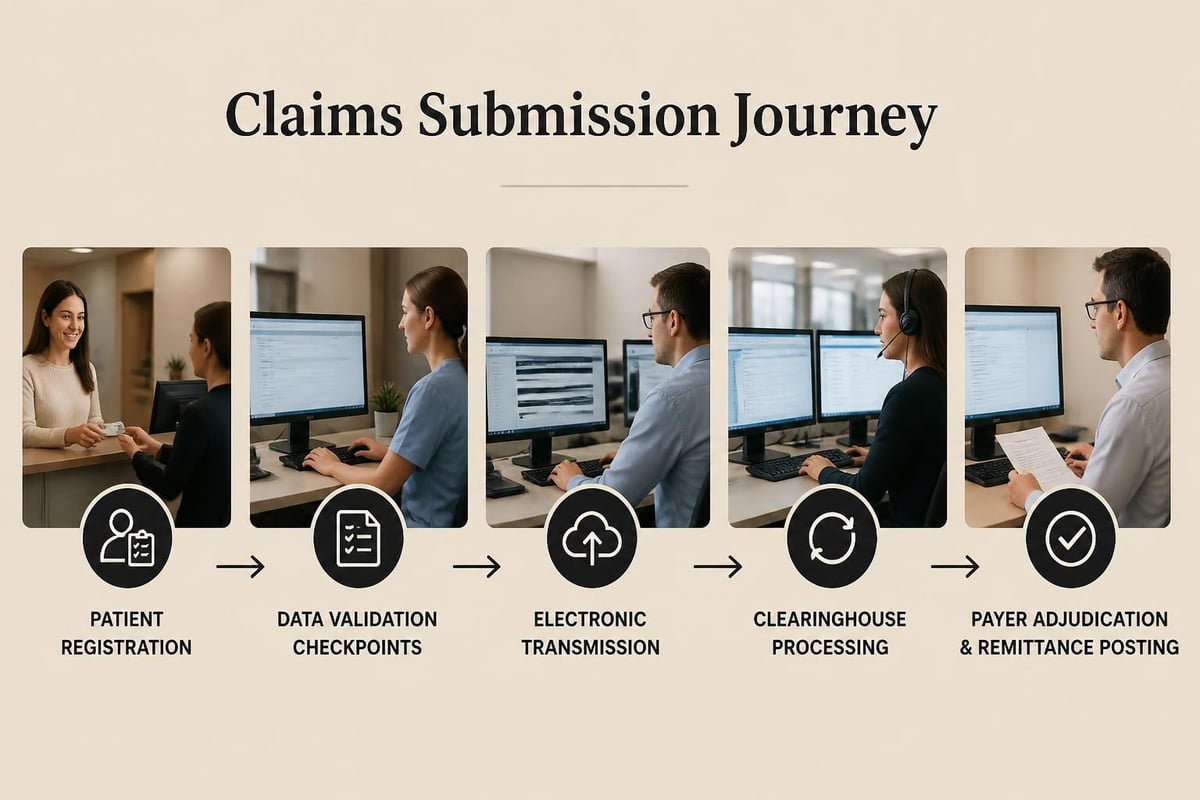
The process begins when a patient receives medical services and ends when the provider receives payment or a denial decision. Between these two points lies a complex workflow involving documentation review, medical coding, claim scrubbing, electronic transmission, payer adjudication, and payment posting.
Electronic vs. Paper Claims Submission
Modern healthcare has largely transitioned to electronic claims submission, which offers significant advantages over traditional paper-based methods. The electronic healthcare claims process through Medicare has established industry standards that most commercial payers have adopted.
Electronic claims provide several key benefits:
- Faster processing times, typically 7-14 days versus 30-45 days for paper
- Immediate acknowledgment of receipt through electronic responses
- Built-in validation that catches errors before transmission
- Lower processing costs for both providers and payers
- Automated tracking and status updates
Paper claims still exist in certain circumstances, such as attachment-heavy submissions or specific payer requirements. However, organizations relying heavily on paper submissions face significant competitive disadvantages in today's market.
Critical Components of Accurate Claims Submission
Every claim contains essential data elements that must be complete, accurate, and compliant with industry standards. Missing or incorrect information represents the primary cause of claim denials and payment delays across healthcare organizations.
Required Data Elements
The foundation of successful claims submission rests on capturing complete demographic and clinical information during the patient encounter. Patient identifiers, insurance information, provider credentials, service dates, procedure codes, diagnosis codes, and service location details must all align perfectly.
| Data Category | Required Elements | Common Errors |
|---|---|---|
| Patient Demographics | Name, DOB, gender, address, insurance ID | Misspelled names, incorrect birthdates |
| Insurance Information | Payer name, policy number, group number, effective dates | Outdated coverage, wrong subscriber information |
| Provider Data | NPI, taxonomy code, rendering provider, facility | Missing or invalid NPI numbers |
| Clinical Details | ICD-10 codes, CPT/HCPCS codes, modifiers, units | Non-specific diagnoses, incorrect code combinations |
Organizations that implement time-saving automation solutions for data capture and validation see dramatic reductions in claim errors and subsequent rework.
Documentation Requirements
Claims require supporting documentation that justifies medical necessity and validates the services billed. The claim documentation requirements established by Medicare contractors provide a framework that extends across most payer relationships.
Medical records must demonstrate that services were actually provided, were medically necessary for the patient's condition, and were performed at the level of complexity billed. Inadequate documentation remains one of the most expensive problems in healthcare revenue cycle management, leading to denials, downcoding, and audit vulnerabilities.
Compliance and Regulatory Standards
Claims submission operates within a heavily regulated environment where compliance failures can result in financial penalties, payment withholding, and potential fraud investigations. Healthcare organizations must navigate multiple layers of regulation from federal programs, state insurance departments, and individual payer policies.
HIPAA Transaction Standards
The Health Insurance Portability and Accountability Act established standardized electronic formats for claims submission that all covered entities must follow. The ASC X12N 837 transaction set defines the structure, data elements, and transmission protocols for electronic claims.
Three primary 837 formats exist:
- 837P (Professional) – Used by physicians, nurse practitioners, and other non-institutional providers for services in office settings, homes, and other non-facility locations
- 837I (Institutional) – Used by hospitals, skilled nursing facilities, and other institutional providers for facility-based services
- 837D (Dental) – Used by dental providers for oral health services
The CAQH CORE Infrastructure Rule for Health Care Claims establishes additional requirements for acknowledgments, validation, and connectivity that trading partners must support. Understanding these technical standards helps organizations choose appropriate technology partners and clearinghouse services.
CMS-1500 and UB-04 Forms
While electronic submission dominates, understanding the paper form equivalents remains important because electronic transactions map directly to these standardized forms. The CMS-1500 form used for professional claims contains specific fields that correspond to segments within the 837P transaction.
Each box on these forms has specific requirements regarding what information belongs there, how it should be formatted, and what values are acceptable. Errors in form completion, whether on paper or in the electronic equivalent, trigger immediate rejections or downstream denials.

Optimizing the Claims Submission Workflow
Efficiency in claims submission directly impacts days in accounts receivable, cash flow stability, and overall revenue cycle performance. Organizations that optimize their submission workflows consistently outperform competitors in collection rates and operating margins.
Front-End Prevention Strategies
The most cost-effective approach to claims submission optimization focuses on preventing errors before submission rather than correcting them afterward. Front-end verification processes catch issues when they are easiest and least expensive to fix.
Eligibility verification before service delivery prevents coverage-related denials. Real-time benefit checks identify coverage limitations, coordination of benefits requirements, and authorization needs before patients receive care. Authorization management systems track approval status and ensure services align with approved guidelines.
Registration accuracy establishes the foundation for clean claims. Training staff on data capture best practices, implementing registration scripts, and using technology to validate information at the point of entry all contribute to higher first-pass acceptance rates.
Claim Scrubbing and Validation
Before claims leave the organization, they should pass through multiple validation layers that identify and correct errors. Claim scrubbing software applies hundreds or thousands of edits that check for common errors, missing information, and compliance violations.
Effective claim scrubbing examines:
- Code validity (Are the diagnosis and procedure codes active and properly formatted?)
- Medical necessity (Do the diagnosis codes support the procedures billed?)
- Coverage rules (Does the payer cover these services for this patient?)
- Coding compliance (Are modifiers used correctly? Are units appropriate?)
- Billing rules (Are services bundled? Are there global period conflicts?)
Organizations should target a claim scrubbing pass rate above 95%, meaning fewer than 5% of claims require manual correction before submission. Lower pass rates indicate training gaps, system configuration issues, or workflow problems that require attention.
Clearinghouse Selection and Management
Most healthcare organizations submit claims through clearinghouses rather than directly to payers. Clearinghouses provide valuable services including format translation, additional validation, batch transmission, and status tracking across multiple payers.
Choosing the right clearinghouse partner requires evaluating several factors beyond just price. Transaction volume capacity, payer connectivity breadth, reporting capabilities, customer support quality, and integration capabilities with existing systems all matter significantly.
Organizations should regularly review clearinghouse performance metrics including rejection rates by payer, average acknowledgment time, issue resolution speed, and system uptime. Poor clearinghouse performance directly impacts revenue cycle metrics and requires swift remediation or vendor replacement.
Common Claims Submission Challenges
Despite sophisticated technology and established processes, healthcare organizations continue facing recurring challenges that undermine claims submission effectiveness. Recognizing these common pitfalls helps organizations implement preventive measures.
Coding Accuracy Issues
Medical coding errors represent one of the most persistent sources of claim denials. The transition to ICD-10, the regular updates to CPT codes, and the complexity of coding guidelines create ongoing challenges for coding staff. Common medical billing mistakes often stem from insufficient coder training, productivity pressure that sacrifices accuracy, and inadequate documentation from providers.
Unspecified diagnosis codes, mismatched diagnosis and procedure combinations, incorrect modifier usage, and unbundling violations all trigger denials that require costly rework. Investing in ongoing coder education, regular auditing, and technology that supports coders during the coding process pays significant dividends.
Payer-Specific Requirements
While HIPAA standards provide uniformity in transaction formats, individual payers maintain unique billing rules that complicate claims submission. Local coverage determinations, prior authorization requirements, documentation preferences, and claims submission deadlines vary across payers and even across different plans within the same payer organization.
| Payer Type | Common Requirements | Submission Complexity |
|---|---|---|
| Medicare Traditional | CMS policies, LCD/NCD compliance, timely filing (1 year) | Moderate |
| Medicare Advantage | Plan-specific authorizations, network restrictions, varied timely filing | High |
| Commercial Insurance | Prior auth, medical necessity criteria, bundling rules | High |
| Medicaid | State-specific requirements, eligibility verification, coordination of benefits | Very High |
Organizations must maintain current knowledge of payer requirements and configure their systems accordingly. Payer enrollment specialists, billing policy databases, and regular payer communication help organizations stay current with changing requirements.

Technology Solutions for Claims Submission
Modern claims submission relies heavily on technology platforms that automate routine tasks, enforce compliance rules, and provide visibility into submission status. Healthcare organizations must carefully evaluate and implement technology solutions that align with their specific needs and workflows.
Practice Management and Billing Systems
Integrated practice management systems combine scheduling, registration, charge capture, and billing functions in unified platforms. These systems maintain patient demographics, insurance information, fee schedules, and provider credentials while generating claims based on encounter data.
Organizations should seek systems that offer robust claims management features including built-in scrubbing, electronic submission capabilities, denial tracking, and comprehensive reporting. Integration with electronic health records eliminates duplicate data entry and ensures clinical documentation supports billed services.
Robotic Process Automation and AI
Artificial intelligence and robotic process automation are transforming claims submission by handling repetitive tasks with greater speed and accuracy than manual processes. Business automation solutions reduce manual intervention requirements while improving submission accuracy.
RPA bots can automatically retrieve eligibility information, download remittance advice files, post payments, and identify denial patterns. Machine learning algorithms predict claim denial probability before submission, allowing staff to address issues proactively. Natural language processing extracts information from clinical documentation to suggest appropriate codes and identify missing elements.
Organizations implementing intelligent automation for claims submission typically see 40-60% reductions in manual processing time and 25-35% improvements in first-pass acceptance rates.
Performance Monitoring and Continuous Improvement
Successful claims submission requires ongoing monitoring, analysis, and refinement. Organizations must establish key performance indicators, track them consistently, and take action when metrics fall outside acceptable ranges.
Essential Claims Submission Metrics
First-pass acceptance rate measures the percentage of claims accepted by payers without rejection or request for additional information. Industry leaders achieve rates above 95%, while average performers struggle to exceed 85%.
Days to submission tracks the average time between service delivery and claim submission. Faster submission accelerates cash flow and reduces the risk of missing timely filing deadlines. Best practice organizations submit claims within 3-5 days of service.
Clean claim rate represents claims paid on first submission without any follow-up, correction, or appeal. This metric reflects the combined effectiveness of registration, documentation, coding, and billing processes.
Denial rate measures the percentage of submitted claim dollars that payers deny. While some denials are inevitable, rates consistently above 8-10% indicate significant process problems requiring immediate attention.
Root Cause Analysis and Corrective Action
When claims submission metrics deteriorate, organizations must conduct thorough root cause analysis to identify underlying issues. Surface-level solutions that address symptoms rather than causes waste resources and fail to prevent recurrence.
Effective analysis examines denial patterns across multiple dimensions including payer, provider, service type, location, and denial reason. This multidimensional view reveals whether problems stem from specific individuals, locations, payers, or processes.
After identifying root causes, organizations must implement corrective actions and monitor their effectiveness. Staff retraining, process redesign, system configuration changes, and technology upgrades all play roles in resolving systemic claims submission problems. Organizations seeking to streamline their billing processes benefit from expert guidance in identifying and resolving root causes.
Timely Filing and Submission Deadlines
Missing claim submission deadlines represents one of the most costly and preventable revenue losses in healthcare. Every payer establishes timely filing limits that define how long after service delivery providers have to submit claims.
Understanding Timely Filing Requirements
Medicare typically allows 12 months from the date of service for claim submission, though this can vary for specific claim types. Commercial payers set their own deadlines ranging from 90 days to 12 months, with many clustering around 90-180 days.
The clock starts ticking from different points depending on payer policy. Most count from the date of service, but some count from discharge date for inpatient services or from the date of a related event like the completion of therapy or the receipt of required documentation.
Organizations must maintain current timely filing information for every payer contract and configure their systems to alert staff when claims approach filing deadlines. Claims approaching deadlines should receive expedited handling to ensure submission before the cutoff.
Appealing Timely Filing Denials
When claims are denied for late filing, organizations have limited options for recovery. Some circumstances justify filing extensions including delayed notification of coverage, coordination of benefits complications, or payer processing errors.
Successful appeals require documentation proving that the delay resulted from circumstances beyond the provider's control. Payer processing backlogs, incorrect eligibility information provided by the payer, or delayed authorization approvals can all support late filing appeals.
However, prevention remains far more effective than appeals. Internal processing delays, staffing shortages, and system problems rarely justify late filing exceptions. Organizations must establish workflows and monitoring systems that ensure timely submission regardless of internal challenges.
Supporting Documentation and Attachments
While the claim itself contains coded information about services provided, payers often require supporting documentation to verify medical necessity, validate service delivery, or comply with audit requirements. Managing this documentation effectively prevents payment delays and ensures successful claim adjudication.
When Documentation Is Required
Not every claim requires attachments. Routine services with straightforward coding typically process based solely on the claim data. However, certain triggers prompt documentation requests including high-cost services, new patient relationships, unusual service combinations, or claims flagged for medical review.
The electronic submission of medical documentation has streamlined the process for Medicare claims requiring additional records. Organizations can submit documentation electronically rather than through fax or mail, reducing processing delays.
Proactive attachment of documentation for claims likely to trigger review can prevent payment delays. However, organizations must balance the cost of preparing and sending documentation against the probability and consequence of a documentation request.
Documentation Best Practices
Clinical documentation must clearly support the services billed on the claim. Progress notes, operative reports, diagnostic test results, and consultation reports should explicitly address the medical necessity of services and demonstrate the level of service billed.
Provider documentation should include relevant history, examination findings, medical decision-making, and treatment plans. Diagnosis codes selected must reflect conditions documented in the medical record. Procedure codes must match procedures described in provider notes.
Organizations should implement documentation improvement programs that educate providers on documentation requirements, provide feedback on documentation quality, and address recurring deficiencies. Improved documentation prevents denials, supports appropriate coding, and protects organizations during audits.
Revenue Cycle Integration
Claims submission does not exist in isolation but rather represents one critical component within the broader revenue cycle. Upstream processes like scheduling, registration, and charge capture directly impact submission quality, while downstream processes like payment posting, denial management, and collections depend on effective submission.
Upstream Dependencies
Registration accuracy establishes the foundation for clean claims submission. Incomplete or incorrect demographic information, invalid insurance details, or missing authorization data create submission failures regardless of how sophisticated the billing system might be.
Charge capture completeness ensures that all billable services actually generate claims. Missed charges represent pure revenue loss since services provided but never billed can never be collected. Organizations should implement charge reconciliation processes that compare services documented in clinical systems to charges appearing in billing systems.
Authorization verification before service delivery prevents denials related to lack of medical necessity approval. Prior authorization requirements continue expanding across both government and commercial payers, making authorization management increasingly critical to claims submission success.
Downstream Integration
After successful claims submission, organizations must track claim status, post payments accurately, identify and appeal denials, and pursue underpayments. Recovering underpaid claims through audit technology represents a significant revenue opportunity for most healthcare organizations.
Electronic remittance advice provides detailed explanation of payment decisions including adjustment reasons, allowed amounts, and patient responsibility. Automated posting systems match payments to claims and identify discrepancies requiring investigation.
Denial management processes must classify denials by root cause, prioritize follow-up based on recovery probability and claim value, and implement corrective actions to prevent recurrence. Organizations that excel at claims submission still face denials, but they identify and resolve them efficiently while preventing similar future denials.
Mastering claims submission requires attention to detail, ongoing process improvement, and strategic technology implementation that transforms manual workflows into efficient, automated operations. Healthcare organizations that optimize their submission processes enjoy stronger cash flow, lower operating costs, and more predictable revenue.
Nero and Associates, Inc. helps healthcare organizations transform their revenue cycle management through intelligent automation, process optimization, and strategic consulting that addresses root causes rather than symptoms. Our performance-based approach ensures that improvements deliver measurable results in submission accuracy, collection rates, and operational efficiency. Contact our team today to discover how we can help your organization achieve sustainable revenue cycle excellence.