

Organizations today face mounting pressure to ensure every vendor agreement, client contract, and partnership arrangement meets strict regulatory and operational standards. Failure to maintain proper oversight can result in financial penalties, legal disputes, damaged relationships, and lost revenue opportunities. Contract compliance has become a critical business function that directly impacts profitability, risk management, and competitive advantage. As businesses expand their vendor networks and regulatory requirements grow more complex, establishing robust processes to monitor and enforce contractual obligations has never been more essential.
Understanding Contract Compliance Fundamentals
Contract compliance refers to the systematic process of ensuring all parties involved in a contractual agreement fulfill their respective obligations according to the terms specified in the document. This encompasses payment schedules, deliverable timelines, quality standards, regulatory requirements, and performance metrics.
The scope of contract compliance extends far beyond simple contract storage. It involves active monitoring, regular auditing, performance tracking, and corrective action when deviations occur. Organizations must verify that both internal teams and external partners adhere to agreed-upon terms throughout the entire contract lifecycle.
Key elements of effective contract compliance include:
- Comprehensive documentation of all contractual obligations
- Clear assignment of responsibility for monitoring specific terms
- Regular performance reviews against established benchmarks
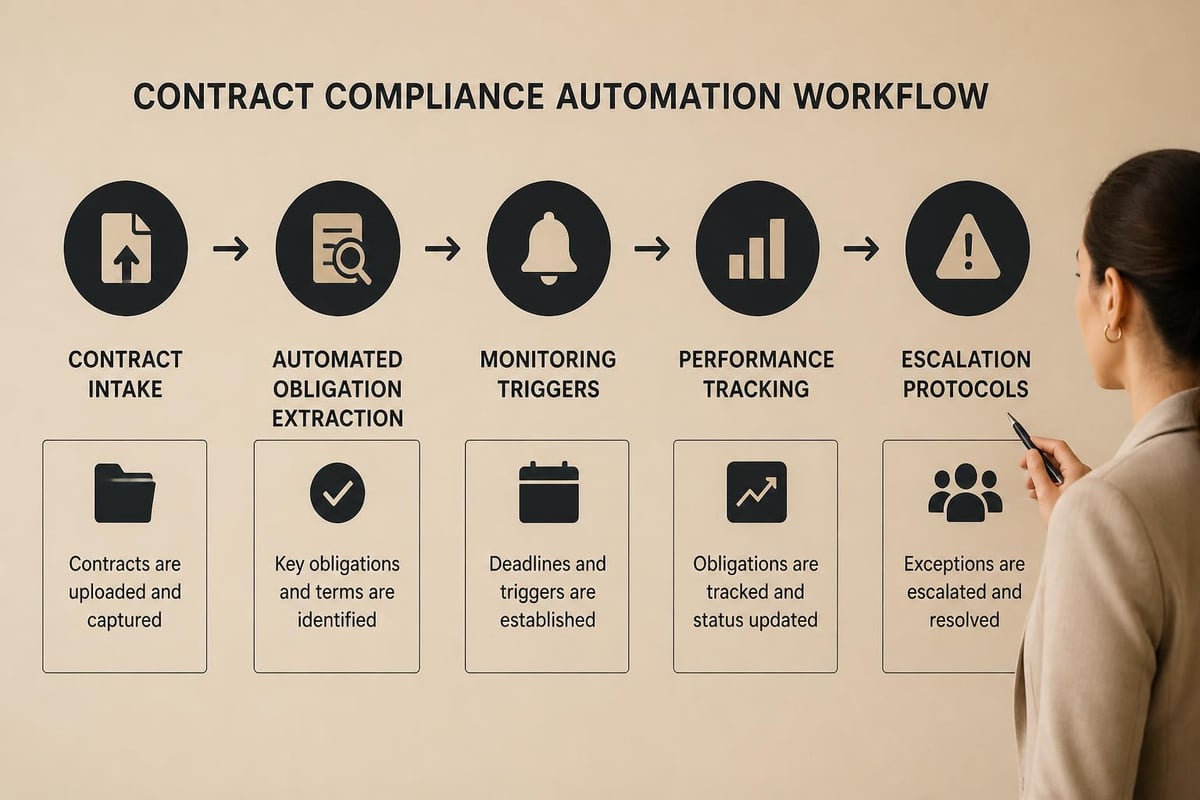
- Automated alerts for approaching deadlines or renewal dates
- Standardized processes for addressing non-compliance issues
Modern businesses typically manage hundreds or thousands of contracts simultaneously, making manual oversight virtually impossible. This complexity demands structured approaches that leverage technology and established workflows to maintain consistent oversight.

The Business Impact of Poor Contract Compliance
When organizations fail to maintain proper contract compliance, the consequences extend throughout the entire operation. Financial impacts often appear first, with companies missing out on discounts, rebates, or favorable terms they negotiated but failed to enforce.
Revenue leakage represents one of the most significant hidden costs. Businesses may deliver services beyond contractual scope without corresponding compensation, or they may fail to invoice for deliverables at agreed-upon rates. A 2025 study found that organizations lose an average of 9% of annual revenue due to poor contract management practices.
Legal and Regulatory Risks
Non-compliance with contractual terms creates substantial legal exposure. Vendors may pursue breach of contract claims when organizations fail to meet payment obligations or deliverable deadlines. Regulatory non-compliance carries even steeper penalties, particularly in healthcare, finance, and government contracting sectors.
Organizations working with healthcare providers face particularly stringent requirements. The unified healthcare contract governance case study demonstrates how healthcare organizations transformed their contract management to address these challenges effectively.
Common legal consequences include:
- Breach of contract lawsuits and settlement costs
- Regulatory fines from government agencies
- Loss of licensing or certification privileges
- Mandatory audits and increased oversight
- Reputational damage affecting future business opportunities
Operational Inefficiencies
Beyond financial and legal risks, poor contract compliance creates operational bottlenecks that reduce productivity across departments. Teams waste time searching for contract documents, clarifying ambiguous terms, or resolving disputes that proper oversight would have prevented.
Manual processes require employees to spend countless hours tracking obligations, reviewing contracts, and following up on deliverables. Nero and Associates, Inc. specializes in helping organizations eliminate these inefficiencies through automation and integration solutions that streamline contract management workflows.
Building a Contract Compliance Framework
Establishing effective contract compliance requires a structured framework that addresses the entire contract lifecycle from creation through renewal or termination. This framework must integrate with existing business processes while providing visibility into contractual obligations across the organization.
The foundation starts with centralization. Organizations should maintain a single source of truth for all contracts, eliminating scattered documents across email inboxes, shared drives, and filing cabinets. Cloud-based contract repositories enable authorized stakeholders to access current agreements from anywhere while maintaining proper security controls.
Standardization and Template Development
Creating standardized contract templates ensures consistency across agreements while incorporating lessons learned from past challenges. Templates should include pre-approved language for common terms, compliance clauses, and risk mitigation provisions.
| Template Component | Purpose | Compliance Benefit |
|---|---|---|
| Standard terms and conditions | Ensures consistent legal protections | Reduces review time and legal risk |
| Required approval workflows | Enforces proper authorization | Prevents unauthorized commitments |
| Compliance checkboxes | Confirms regulatory requirements | Documents due diligence |
| Performance metrics | Establishes measurable standards | Enables objective compliance tracking |
Professional services firms benefit significantly from standardization. Consulting teams can focus on delivering value rather than negotiating basic terms for each engagement, accelerating contract execution while maintaining compliance standards.
Implementing Automated Monitoring Systems
Automation transforms contract compliance from reactive firefighting to proactive management. Modern contract management platforms can automatically track obligations, send renewal reminders, monitor performance metrics, and flag potential compliance issues before they escalate.
Best practices for contract compliance emphasize leveraging technology to reduce human error and ensure nothing falls through the cracks. Automated systems can monitor payment schedules, deliverable deadlines, service level agreements, and regulatory requirements simultaneously.
Organizations implementing automation typically see immediate improvements in compliance rates. The ASC 606 compliance automation case study demonstrates how reviewing over 12,600 contracts through automated systems saved thousands of hours while ensuring regulatory compliance.
Essential Contract Compliance Best Practices
Successful contract compliance programs share common characteristics that distinguish them from organizations struggling with contractual oversight. These practices create sustainable systems that scale as business volume grows.
Establish Clear Accountability
Every contract should have a designated owner responsible for monitoring compliance with its terms. This individual coordinates with relevant departments, tracks performance metrics, and escalates issues requiring management attention. Without clear ownership, contracts become orphaned and compliance suffers.
Accountability extends beyond individual contracts to include process ownership. Organizations need defined roles for contract creation, review, approval, execution, and ongoing monitoring. Role-based access controls ensure appropriate personnel can modify terms while maintaining audit trails for compliance documentation.
Conduct Regular Audits
Periodic contract audits identify compliance gaps before they create significant problems. Contract audit best practices recommend structured approaches that examine contract performance, financial terms, risk provisions, and regulatory requirements systematically.
Effective audit programs typically include:
- Quarterly reviews of high-value contracts
- Annual comprehensive audits of the entire contract portfolio
- Risk-based sampling for medium and low-value agreements
- Compliance verification for contracts approaching renewal
- Performance assessments against service level agreements
Audit findings should drive continuous improvement initiatives. Organizations that treat audits as learning opportunities rather than punitive exercises build stronger compliance cultures over time.
Maintain Comprehensive Documentation
Documentation provides the evidence necessary to demonstrate compliance during disputes, audits, or regulatory reviews. Organizations must retain not only signed contracts but also supporting materials that demonstrate fulfillment of obligations.
This includes proof of delivery for goods and services, payment records, performance reports, change orders, amendment histories, and correspondence related to contractual matters. Digital documentation systems with version control prevent confusion about which terms are currently in effect.
Leveraging Technology for Contract Compliance
Technology serves as the backbone of modern contract compliance programs. Organizations relying solely on manual processes cannot scale their compliance efforts as contract volumes increase or regulatory requirements become more complex.
Contract Lifecycle Management Platforms
Comprehensive contract lifecycle management (CLM) systems manage contracts from initial request through final closeout. These platforms typically include features for contract creation, negotiation tracking, approval workflows, electronic signatures, obligation management, and compliance reporting.
Contract lifecycle management best practices emphasize selecting platforms that integrate with existing business systems like enterprise resource planning (ERP), customer relationship management (CRM), and procurement software. This integration eliminates data silos and ensures contract terms flow automatically to operational systems.
Organizations implementing CLM platforms often integrate them with accounts payable automation. Optimizing accounts payable processes becomes significantly easier when payment terms, approval hierarchies, and vendor information sync automatically from contract systems.
Artificial Intelligence and Machine Learning
Artificial intelligence capabilities are transforming contract compliance by analyzing contract language, extracting key terms, identifying risks, and predicting compliance issues before they occur. Machine learning algorithms can review thousands of contracts to identify patterns, anomalies, or non-standard terms requiring attention.
Natural language processing enables systems to read contracts like humans, extracting dates, dollar amounts, obligations, and clauses automatically. This eliminates manual data entry while ensuring critical information feeds compliance monitoring systems accurately.
AI-powered contract compliance tools can:
- Extract and classify contract obligations automatically
- Compare actual performance against contractual requirements
- Predict which contracts face highest non-compliance risk
- Recommend corrective actions based on historical data
- Generate compliance reports for stakeholders automatically
Integration Capabilities
The most effective contract compliance systems integrate seamlessly with other business platforms. When contracts connect to financial systems, procurement platforms, project management tools, and human capital management solutions, compliance monitoring becomes embedded in daily workflows rather than existing as a separate activity.
Integration enables real-time compliance verification. For example, when a purchase order exceeds contracted pricing, integrated systems can flag the discrepancy immediately rather than discovering it months later during an audit.
Industry-Specific Compliance Considerations
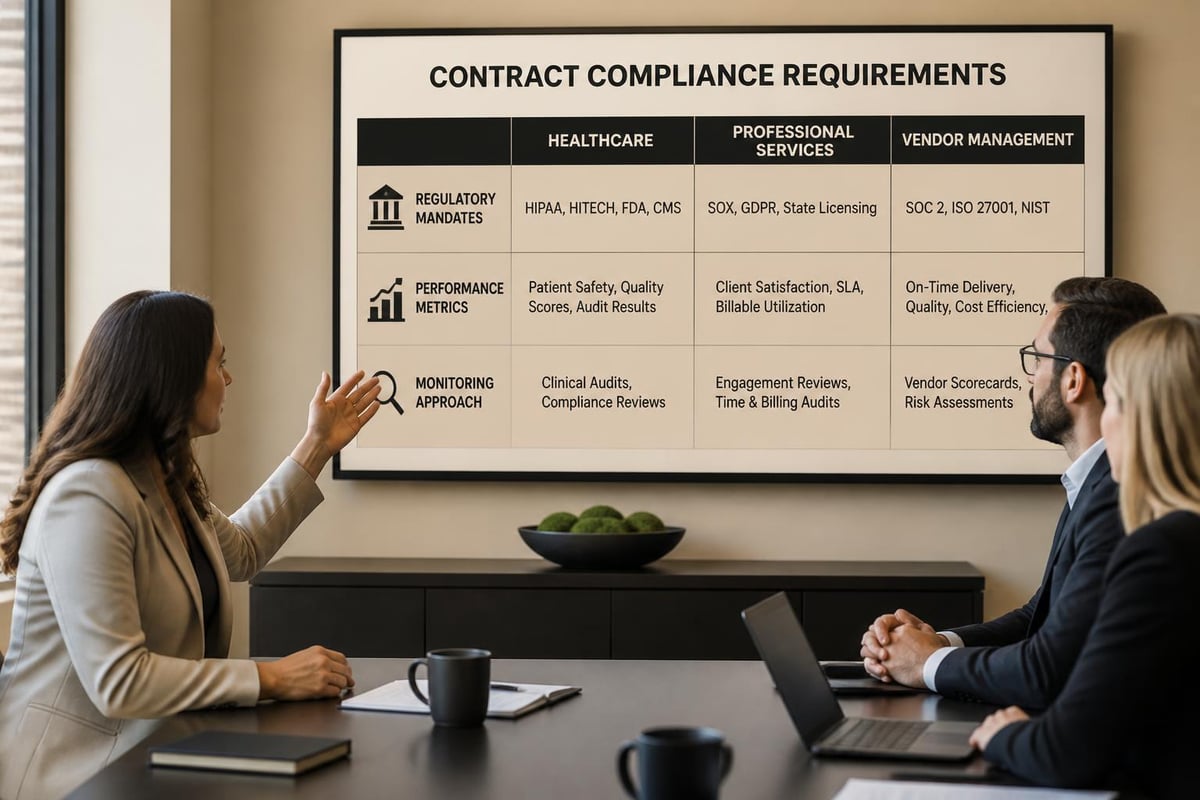
Different industries face unique contract compliance challenges based on their regulatory environments, business models, and operational characteristics. Understanding these nuances helps organizations tailor compliance programs to their specific context.
Healthcare Compliance Requirements
Healthcare organizations manage some of the most complex compliance requirements across payer contracts, provider agreements, vendor relationships, and regulatory mandates. Revenue cycle management depends heavily on contract compliance, as reimbursement rates, billing requirements, and claims processing rules all flow from contractual terms.
Healthcare contracts must comply with HIPAA privacy requirements, Stark Law provisions, Anti-Kickback Statute restrictions, and numerous state and federal regulations. Achieving 100% contract compliance requires specialized systems that understand healthcare-specific requirements.
Professional Services Compliance
Professional services firms face compliance challenges related to scope management, resource allocation, billing arrangements, and deliverable specifications. Fixed-price contracts require careful monitoring to ensure actual costs don't exceed contracted amounts, while time-and-materials agreements need robust time tracking and approval processes.
Firms offering performance-based consulting must track specific metrics that trigger payment obligations or bonuses. These arrangements require sophisticated monitoring systems that pull data from multiple sources to verify achievement of contractual milestones.
Vendor and Supplier Compliance
Organizations managing extensive vendor networks must ensure suppliers meet quality standards, delivery schedules, pricing terms, and compliance certifications. This requires systematic vendor performance monitoring integrated with procurement and accounts payable processes.
Vendor management optimization becomes critical as supply chains grow more complex. Contract compliance systems should track vendor scorecards, quality metrics, on-time delivery rates, and pricing adherence to identify high-performing partners and problematic relationships requiring intervention.
Measuring Contract Compliance Effectiveness
Organizations cannot improve what they don't measure. Establishing key performance indicators (KPIs) for contract compliance enables data-driven decision making and demonstrates program value to leadership.
Core Compliance Metrics
Fundamental KPIs that organizations should track include:
- Compliance rate: Percentage of contracts meeting all obligations
- Time to resolution: Average duration to address compliance issues
- Cost avoidance: Financial impact of catching non-compliance early
- Audit findings: Number and severity of issues identified during reviews
- Renewal rate: Percentage of contracts renewed successfully
- Vendor performance: Supplier adherence to contractual terms
Beyond these basics, organizations should develop metrics aligned with strategic objectives. Companies focused on cost reduction might emphasize contract pricing compliance and volume discount capture, while those prioritizing risk mitigation track regulatory compliance rates and audit readiness.
Compliance Dashboards and Reporting
Executive dashboards provide real-time visibility into contract compliance status across the organization. These tools should present information in easily digestible formats that enable quick identification of trends, outliers, and areas requiring attention.
| Dashboard Component | Purpose | Frequency |
|---|---|---|
| Overall compliance score | Executive-level overview | Real-time |
| Contracts at risk | Early warning system | Daily |
| Upcoming renewals | Proactive planning | Weekly |
| Vendor performance trends | Strategic sourcing decisions | Monthly |
| Audit readiness status | Risk management | Quarterly |
Improving contract compliance requires regular review of these metrics with stakeholders. Monthly business reviews should include contract compliance performance alongside financial results, operational metrics, and strategic initiative progress.
Overcoming Common Compliance Challenges
Even organizations with strong compliance frameworks encounter obstacles that threaten contractual oversight. Recognizing these challenges and implementing proactive solutions prevents minor issues from escalating into major problems.
Resource Constraints
Many organizations lack dedicated contract management staff, forcing employees to handle compliance responsibilities alongside their primary duties. This divided attention often results in missed deadlines, overlooked obligations, and reactive rather than proactive management.
Automation addresses resource constraints by handling routine monitoring tasks automatically. Systems can track hundreds of contracts simultaneously, alerting human overseers only when intervention becomes necessary. This enables lean teams to manage larger contract portfolios effectively.
Decentralized Contract Management
In organizations where multiple departments negotiate and manage contracts independently, maintaining centralized oversight becomes extremely difficult. Sales, procurement, legal, operations, and human resources may all execute contracts without coordinating or even informing each other.
Establishing enterprise-wide contract management policies and implementing centralized repositories solves this challenge. All contracts should flow through a single intake process that ensures proper review, approval, and registration in the compliance monitoring system regardless of originating department.
Incomplete Contract Data
Legacy contracts often lack complete information about obligations, deadlines, and performance requirements. Missing data creates blind spots in compliance monitoring systems, preventing effective oversight of these agreements.
Contract remediation projects systematically review existing agreements to extract and document key terms. While labor-intensive initially, this investment pays dividends through improved compliance and reduced risk exposure. Contract management best practices recommend prioritizing high-value and high-risk contracts for remediation efforts.
Creating a Culture of Compliance
Technology and processes provide the infrastructure for contract compliance, but organizational culture determines whether these systems deliver their full potential. Building a culture where everyone understands compliance importance and takes personal responsibility for contractual obligations creates sustainable long-term success.
Training and Education
Employees cannot comply with requirements they don't understand. Comprehensive training programs should educate staff about contract basics, organizational policies, their specific responsibilities, and available tools and resources.
Training content should vary by role. Executives need strategic-level understanding of compliance risks and program value. Contract managers require deep technical knowledge of systems and processes. End users need practical guidance on fulfilling their specific obligations within contracts affecting their work.
Incentive Alignment
When performance evaluations and compensation include contract compliance metrics, employees prioritize these obligations accordingly. Sales teams might receive bonuses tied to contract profitability rather than just revenue, encouraging them to negotiate terms the organization can actually fulfill profitably.
Vendor relationships also benefit from aligned incentives. Contracts should include performance-based payment terms that reward suppliers meeting or exceeding obligations while imposing penalties for non-compliance.
Continuous Improvement Processes
Organizations committed to compliance excellence treat every issue as a learning opportunity. Root cause analysis of compliance failures identifies systemic problems requiring process improvements rather than simply addressing individual incidents.
Regular feedback loops between operational teams executing contracts and those designing compliance processes ensure systems remain practical and effective. Business optimization strategies often reveal that contract compliance improvements unlock broader operational efficiencies.
The Future of Contract Compliance
Contract compliance continues evolving as technology advances and regulatory requirements increase. Organizations preparing for future challenges today will maintain competitive advantages while those clinging to outdated approaches face mounting risks.
Blockchain technology promises to revolutionize contract compliance through smart contracts that automatically execute when predetermined conditions are met. These self-executing agreements could eliminate disputes about whether parties fulfilled obligations by creating transparent, immutable records of performance.
Advanced analytics will enable predictive compliance, identifying contracts likely to experience issues before problems occur. Organizations can intervene proactively, preventing non-compliance rather than reacting after damage occurs.
The integration of contract compliance with broader enterprise risk management and governance programs will accelerate. Leading organizations already view contracts as strategic assets requiring the same careful oversight as financial assets, intellectual property, and human capital.
Effective contract compliance protects organizations from financial losses, legal risks, and operational inefficiencies while enabling them to capture full value from negotiated agreements. By implementing structured frameworks, leveraging automation technology, and building compliance-focused cultures, businesses transform contract management from administrative burden to strategic advantage. Nero and Associates, Inc. helps organizations achieve these outcomes through performance-based consulting that eliminates manual processes, reduces costs, and drives measurable improvements in operational efficiency. Contact our team to discover how automation and integration solutions can strengthen your contract compliance program while freeing your employees to focus on higher-value activities.