

Data Normalization: A Strategic Guide for 2026

Share on Facebook
Share on X
Share on LinkedIn

Organizations today face unprecedented data challenges. Multiple systems generate information across departments, creating duplicate records, inconsistent formats, and operational inefficiencies that drain resources and hinder decision-making. Data normalization provides a systematic approach to organizing information assets, eliminating redundancy, and creating reliable foundations for business intelligence. For professional services consultancies and mid-market organizations, understanding and implementing proper normalization strategies directly impacts operational efficiency, cost reduction, and competitive advantage.

Understanding Data Normalization Fundamentals

Data normalization is the structured process of organizing data within databases to minimize redundancy and dependency while ensuring data integrity. This technique divides larger tables into smaller, more manageable ones and defines relationships between them using foreign keys. The primary objective focuses on eliminating duplicate data, reducing storage costs, and maintaining consistency across all records.

The core principles include:

  • Eliminating repetitive data across multiple tables
  • Ensuring data dependencies make logical sense
  • Protecting data integrity during updates and deletions
  • Optimizing database performance for queries and maintenance
  • Creating scalable structures that accommodate business growth

Database normalization follows specific rules organized into progressive levels called normal forms. Each successive form builds upon the previous one, addressing increasingly subtle forms of redundancy and dependency. Organizations don't always need to achieve the highest normalization level, but understanding these stages helps determine the optimal balance between normalization benefits and practical performance considerations.

Normal Forms Explained

The progression through normal forms creates increasingly refined database structures. First Normal Form (1NF) requires that each table cell contains only atomic values, meaning no repeating groups or arrays within single fields. This foundational step eliminates the most obvious redundancies and establishes basic organizational structure.

Second Normal Form (2NF) builds on 1NF by removing partial dependencies. Every non-key attribute must depend on the entire primary key rather than just part of it. This becomes particularly relevant in tables with composite primary keys where certain attributes relate to only one component of the key.
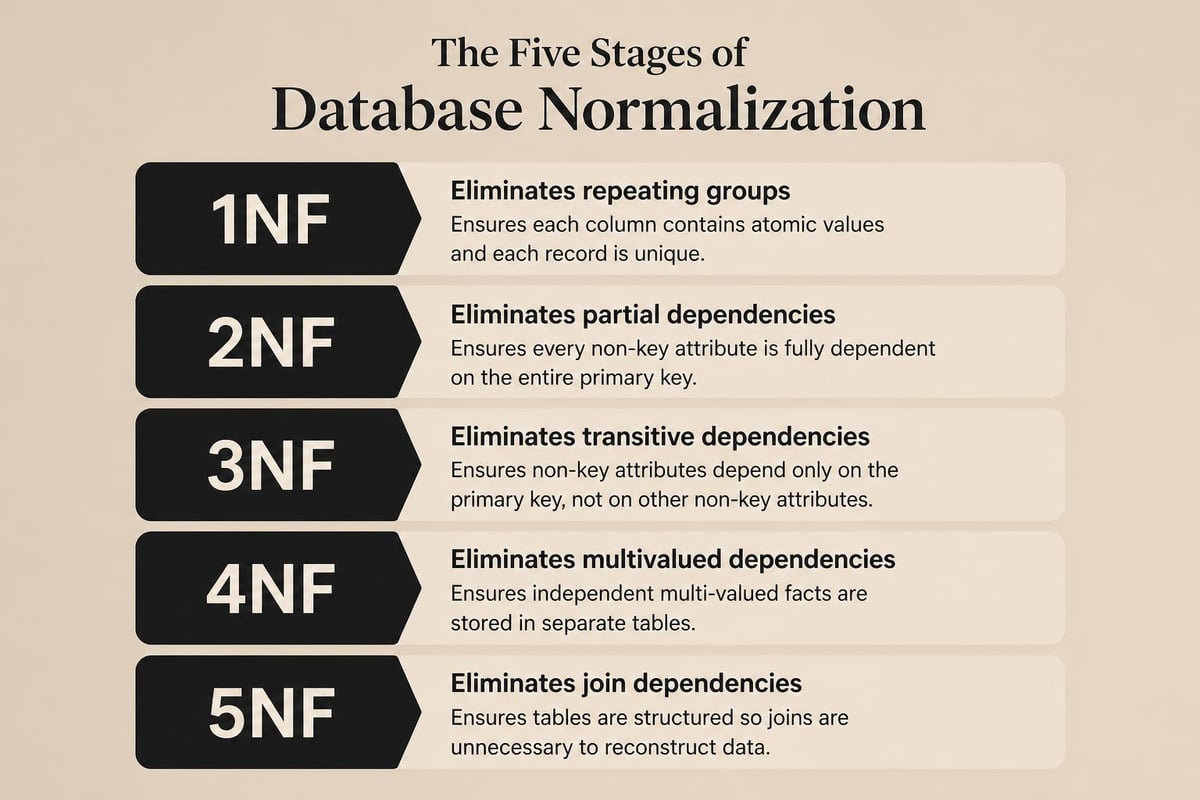
Normal forms progression

Third Normal Form (3NF) addresses transitive dependencies where non-key attributes depend on other non-key attributes rather than directly on the primary key. Achieving 3NF typically satisfies most business requirements, though higher forms exist for specialized scenarios.

Normal Form Primary Requirement Addresses
1NF Atomic values only Repeating groups, arrays in cells
2NF No partial dependencies Attributes depending on part of composite key
3NF No transitive dependencies Non-key attributes depending on non-key attributes
BCNF Every determinant is a candidate key Remaining anomalies in 3NF
4NF No multi-valued dependencies Independent multi-valued facts

Higher normal forms like Boyce-Codd Normal Form (BCNF), Fourth Normal Form (4NF), and Fifth Normal Form (5NF) address progressively specialized edge cases. Understanding these advanced concepts helps database architects make informed decisions about when additional normalization provides meaningful benefits versus unnecessary complexity.

Strategic Benefits for Business Operations

Implementing data normalization delivers measurable operational improvements that directly impact organizational efficiency. By eliminating redundant storage, companies reduce infrastructure costs while improving data accuracy across all systems. This becomes particularly valuable for consultancies managing multiple client datasets simultaneously.

Key operational advantages include:

  1. Reduced storage requirements through eliminated duplicate records
  2. Improved data consistency across all database queries and reports
  3. Simplified maintenance procedures requiring updates in fewer locations
  4. Enhanced data security through clearer access control boundaries
  5. Faster query performance for specific, targeted data retrieval operations

Organizations implementing automation and integration solutions find that normalized databases facilitate seamless data flow between systems. When data structures follow consistent patterns, automated processes encounter fewer exceptions and errors, reducing manual intervention requirements. This efficiency gain translates directly into cost savings and faster processing times.

Performance Considerations

While data normalization offers substantial benefits, organizations must balance normalization levels against query performance requirements. Highly normalized databases sometimes require multiple table joins to retrieve related information, potentially impacting response times for complex queries. Understanding these trade-offs enables informed architectural decisions.

For read-heavy applications where query speed takes priority, strategic denormalization in specific areas may prove beneficial. This controlled redundancy accepts some data duplication to avoid expensive join operations during frequent queries. The key involves identifying which tables warrant this approach based on usage patterns and performance metrics.

Modern database management systems include optimization techniques that mitigate normalization performance concerns. Proper indexing strategies, materialized views, and query optimization significantly reduce the performance impact of normalized structures. Organizations investing in these complementary techniques achieve both normalization benefits and strong query performance.

Application in Healthcare Revenue Cycle Management

Healthcare organizations face unique data normalization challenges given the complexity of medical coding systems, insurance providers, and regulatory requirements. Revenue cycle management depends heavily on accurate, normalized data to process claims efficiently and minimize rejections. Patient demographics, procedure codes, and billing information must maintain perfect consistency across multiple touchpoints.

Healthcare data normalization enables better interoperability between electronic health records, billing systems, and payer platforms. When patient identifiers follow normalized structures, matching records across systems becomes more reliable, reducing duplicate patient files and improving care coordination. This accuracy directly impacts revenue capture and compliance reporting.

Healthcare data workflow

Common normalization challenges in healthcare include:

  • Standardizing provider identifiers across multiple facilities
  • Normalizing procedure and diagnosis codes to current standards
  • Maintaining consistent patient demographic information
  • Integrating data from acquired practices or merged systems
  • Reconciling historical data with current normalization standards

Organizations addressing these challenges systematically see measurable improvements in claims acceptance rates, reduced accounts receivable aging, and faster payment cycles. The investment in proper data normalization pays dividends through improved cash flow and reduced administrative burden on billing staff.

Human Capital Management Data Integrity

Human capital management systems rely on normalized employee data to ensure accurate payroll processing, benefits administration, and compliance reporting. Employee records spanning multiple tables for personal information, compensation, benefits, time tracking, and performance create complex relational structures requiring careful normalization.

Proper normalization in HR databases prevents common issues like inconsistent employee identifiers, duplicate benefit enrollments, or mismatched payroll calculations. When employee demographic changes occur, such as address updates or name changes, normalized structures ensure these modifications propagate correctly through all related systems without manual reconciliation.

Compliance and Reporting Accuracy

Regulatory compliance depends on accurate, consistent data across all HR functions. Tax reporting, equal employment opportunity filings, and benefits compliance all require precise employee categorizations and calculations. Data normalization ensures these critical functions draw from single, authoritative sources rather than potentially conflicting duplicate records.

Normalization supports compliance through:

  • Single source of truth for employee demographic data
  • Consistent job classification and compensation structures
  • Accurate tracking of employment status changes over time
  • Reliable audit trails for regulatory inquiries
  • Simplified reporting across multiple jurisdictions

Organizations managing employees across multiple states or countries particularly benefit from normalized HR data structures. Consistent categorization enables accurate application of varying tax rules, benefit regulations, and labor law requirements without manual exception handling for each scenario.

Implementation Strategies for Existing Systems

Many organizations inherit legacy systems with poorly normalized data structures. Transforming these databases requires systematic analysis, planning, and staged implementation to avoid disrupting ongoing operations. The process begins with comprehensive data auditing to identify redundancies, inconsistencies, and dependency issues.

Data standardization and normalization serve complementary but distinct purposes in database optimization projects. Standardization focuses on consistent formats and values, while normalization addresses structural organization. Both typically occur together during database modernization initiatives to achieve comprehensive data quality improvements.

Implementation Phase Key Activities Success Metrics
Assessment Data profiling, redundancy analysis, dependency mapping Identified improvement opportunities
Design Schema redesign, normalization planning, migration strategy Approved architecture documentation
Migration Data extraction, transformation, loading, validation Data accuracy and completeness
Optimization Indexing, query tuning, performance testing Response time improvements
Maintenance Monitoring, regular audits, continuous improvement Sustained data quality metrics

Testing protocols must verify data integrity throughout migration processes. Comparing source and destination record counts, validating referential integrity constraints, and reconciling critical business metrics ensure normalization efforts don't introduce errors. Parallel operation periods allow organizations to validate normalized systems before fully decommissioning legacy structures.

Data migration workflow

Integration With Automation Initiatives

Modern automation and integration platforms leverage normalized data structures to build reliable, scalable workflows. When source data follows predictable, normalized patterns, automated processes require less exception handling and conditional logic. This simplification reduces development time, minimizes maintenance requirements, and improves automation reliability.

Professional services organizations implementing workflow automation find that preliminary data normalization significantly accelerates deployment timelines. Rather than building complex transformation logic to handle varied data formats, automation tools can process normalized inputs through standardized workflows. This efficiency translates into faster return on automation investments.

Integration benefits from normalization:

  • Consistent data mapping between connected systems
  • Reduced transformation complexity in integration middleware
  • Improved error handling through predictable data structures
  • Simplified monitoring and troubleshooting procedures
  • Enhanced scalability for adding new system connections

API development particularly benefits from underlying normalized data models. When databases maintain clear entity relationships and eliminate redundancy, API endpoints naturally align with business objects. This alignment creates intuitive interfaces that external systems and applications can consume efficiently.

Maintaining Normalized Structures Over Time

Database normalization isn't a one-time project but an ongoing discipline requiring continuous attention. As business requirements evolve, new data elements emerge, and organizations must evaluate how additions fit into existing normalized structures. Regular data quality audits identify normalization drift where shortcuts or expedient solutions gradually reintroduce redundancy.

Establishing governance frameworks ensures that database modifications follow normalization principles. Change management processes should include normalization review checkpoints where database architects evaluate proposed schema changes against normalization standards. This preventive approach maintains structural integrity more effectively than periodic remediation efforts.

Training development teams on normalization principles creates shared understanding of why these practices matter. When developers recognize how normalization prevents data anomalies and supports long-term maintainability, they become advocates for preserving normalized structures rather than viewing constraints as obstacles to rapid development.

Documentation plays a critical role in maintaining normalized databases across personnel changes. Entity relationship diagrams, data dictionaries, and normalization decision logs preserve the reasoning behind structural choices. This institutional knowledge helps future team members understand existing designs and maintain consistency in subsequent modifications.

Measuring Normalization Success

Quantifying normalization benefits helps justify initial investments and ongoing maintenance efforts. Organizations should establish baseline metrics before normalization projects and track improvements across multiple dimensions. Storage reduction percentages provide tangible evidence of eliminated redundancy, while query performance metrics demonstrate operational impacts.

Key performance indicators include:

  • Database storage size reduction percentage
  • Number of redundant data elements eliminated
  • Data consistency error rate decrease
  • Average query response time changes
  • Manual data reconciliation hours saved
  • System integration error rate reduction

Data quality scores measuring completeness, accuracy, and consistency typically improve following normalization efforts. These improvements cascade into better business intelligence, more accurate reporting, and increased confidence in data-driven decision-making. For consulting organizations managing multiple client environments, these quality improvements enhance service delivery capabilities.

Return on investment calculations should account for both direct cost savings from reduced storage and indirect benefits from improved efficiency. Fewer hours spent reconciling conflicting data, reduced error correction efforts, and faster report generation all contribute to measurable productivity gains that compound over time.


Effective data normalization transforms operational efficiency by creating reliable, consistent information foundations that support automation, integration, and business intelligence initiatives. Organizations that invest in proper normalization practices position themselves for scalable growth, reduced operational costs, and improved decision-making capabilities. Nero and Associates, Inc. helps businesses optimize their data infrastructure through comprehensive automation and integration solutions that eliminate manual processes and drive measurable bottom-line improvements. Our performance-based approach ensures your data normalization investments deliver tangible returns in efficiency, accuracy, and operational excellence.

Data Normalization: A Strategic Guide for 2026

Organizations today face unprecedented data challenges. Multiple systems generate information across departments, creating duplicate records, inconsistent formats, and operational inefficiencies that drain resources and hinder decision-making. Data normalization provides a systematic approach to organizing information assets, eliminating redundancy, and creating reliable foundations for business intelligence. For professional services consultancies and mid-market organizations, understanding and implementing proper normalization strategies directly impacts operational efficiency, cost reduction, and competitive advantage.

Understanding Data Normalization Fundamentals

Data normalization is the structured process of organizing data within databases to minimize redundancy and dependency while ensuring data integrity. This technique divides larger tables into smaller, more manageable ones and defines relationships between them using foreign keys. The primary objective focuses on eliminating duplicate data, reducing storage costs, and maintaining consistency across all records.

The core principles include:

  • Eliminating repetitive data across multiple tables
  • Ensuring data dependencies make logical sense
  • Protecting data integrity during updates and deletions
  • Optimizing database performance for queries and maintenance
  • Creating scalable structures that accommodate business growth

Database normalization follows specific rules organized into progressive levels called normal forms. Each successive form builds upon the previous one, addressing increasingly subtle forms of redundancy and dependency. Organizations don't always need to achieve the highest normalization level, but understanding these stages helps determine the optimal balance between normalization benefits and practical performance considerations.

Normal Forms Explained

The progression through normal forms creates increasingly refined database structures. First Normal Form (1NF) requires that each table cell contains only atomic values, meaning no repeating groups or arrays within single fields. This foundational step eliminates the most obvious redundancies and establishes basic organizational structure.

Second Normal Form (2NF) builds on 1NF by removing partial dependencies. Every non-key attribute must depend on the entire primary key rather than just part of it. This becomes particularly relevant in tables with composite primary keys where certain attributes relate to only one component of the key.

Normal forms progression

Third Normal Form (3NF) addresses transitive dependencies where non-key attributes depend on other non-key attributes rather than directly on the primary key. Achieving 3NF typically satisfies most business requirements, though higher forms exist for specialized scenarios.

Normal Form Primary Requirement Addresses
1NF Atomic values only Repeating groups, arrays in cells
2NF No partial dependencies Attributes depending on part of composite key
3NF No transitive dependencies Non-key attributes depending on non-key attributes
BCNF Every determinant is a candidate key Remaining anomalies in 3NF
4NF No multi-valued dependencies Independent multi-valued facts

Higher normal forms like Boyce-Codd Normal Form (BCNF), Fourth Normal Form (4NF), and Fifth Normal Form (5NF) address progressively specialized edge cases. Understanding these advanced concepts helps database architects make informed decisions about when additional normalization provides meaningful benefits versus unnecessary complexity.

Strategic Benefits for Business Operations

Implementing data normalization delivers measurable operational improvements that directly impact organizational efficiency. By eliminating redundant storage, companies reduce infrastructure costs while improving data accuracy across all systems. This becomes particularly valuable for consultancies managing multiple client datasets simultaneously.

Key operational advantages include:

  1. Reduced storage requirements through eliminated duplicate records
  2. Improved data consistency across all database queries and reports
  3. Simplified maintenance procedures requiring updates in fewer locations
  4. Enhanced data security through clearer access control boundaries
  5. Faster query performance for specific, targeted data retrieval operations

Organizations implementing automation and integration solutions find that normalized databases facilitate seamless data flow between systems. When data structures follow consistent patterns, automated processes encounter fewer exceptions and errors, reducing manual intervention requirements. This efficiency gain translates directly into cost savings and faster processing times.

Performance Considerations

While data normalization offers substantial benefits, organizations must balance normalization levels against query performance requirements. Highly normalized databases sometimes require multiple table joins to retrieve related information, potentially impacting response times for complex queries. Understanding these trade-offs enables informed architectural decisions.

For read-heavy applications where query speed takes priority, strategic denormalization in specific areas may prove beneficial. This controlled redundancy accepts some data duplication to avoid expensive join operations during frequent queries. The key involves identifying which tables warrant this approach based on usage patterns and performance metrics.

Modern database management systems include optimization techniques that mitigate normalization performance concerns. Proper indexing strategies, materialized views, and query optimization significantly reduce the performance impact of normalized structures. Organizations investing in these complementary techniques achieve both normalization benefits and strong query performance.

Application in Healthcare Revenue Cycle Management

Healthcare organizations face unique data normalization challenges given the complexity of medical coding systems, insurance providers, and regulatory requirements. Revenue cycle management depends heavily on accurate, normalized data to process claims efficiently and minimize rejections. Patient demographics, procedure codes, and billing information must maintain perfect consistency across multiple touchpoints.

Healthcare data normalization enables better interoperability between electronic health records, billing systems, and payer platforms. When patient identifiers follow normalized structures, matching records across systems becomes more reliable, reducing duplicate patient files and improving care coordination. This accuracy directly impacts revenue capture and compliance reporting.

Healthcare data workflow

Common normalization challenges in healthcare include:

  • Standardizing provider identifiers across multiple facilities
  • Normalizing procedure and diagnosis codes to current standards
  • Maintaining consistent patient demographic information
  • Integrating data from acquired practices or merged systems
  • Reconciling historical data with current normalization standards

Organizations addressing these challenges systematically see measurable improvements in claims acceptance rates, reduced accounts receivable aging, and faster payment cycles. The investment in proper data normalization pays dividends through improved cash flow and reduced administrative burden on billing staff.

Human Capital Management Data Integrity

Human capital management systems rely on normalized employee data to ensure accurate payroll processing, benefits administration, and compliance reporting. Employee records spanning multiple tables for personal information, compensation, benefits, time tracking, and performance create complex relational structures requiring careful normalization.

Proper normalization in HR databases prevents common issues like inconsistent employee identifiers, duplicate benefit enrollments, or mismatched payroll calculations. When employee demographic changes occur, such as address updates or name changes, normalized structures ensure these modifications propagate correctly through all related systems without manual reconciliation.

Compliance and Reporting Accuracy

Regulatory compliance depends on accurate, consistent data across all HR functions. Tax reporting, equal employment opportunity filings, and benefits compliance all require precise employee categorizations and calculations. Data normalization ensures these critical functions draw from single, authoritative sources rather than potentially conflicting duplicate records.

Normalization supports compliance through:

  • Single source of truth for employee demographic data
  • Consistent job classification and compensation structures
  • Accurate tracking of employment status changes over time
  • Reliable audit trails for regulatory inquiries
  • Simplified reporting across multiple jurisdictions

Organizations managing employees across multiple states or countries particularly benefit from normalized HR data structures. Consistent categorization enables accurate application of varying tax rules, benefit regulations, and labor law requirements without manual exception handling for each scenario.

Implementation Strategies for Existing Systems

Many organizations inherit legacy systems with poorly normalized data structures. Transforming these databases requires systematic analysis, planning, and staged implementation to avoid disrupting ongoing operations. The process begins with comprehensive data auditing to identify redundancies, inconsistencies, and dependency issues.

Data standardization and normalization serve complementary but distinct purposes in database optimization projects. Standardization focuses on consistent formats and values, while normalization addresses structural organization. Both typically occur together during database modernization initiatives to achieve comprehensive data quality improvements.

Implementation Phase Key Activities Success Metrics
Assessment Data profiling, redundancy analysis, dependency mapping Identified improvement opportunities
Design Schema redesign, normalization planning, migration strategy Approved architecture documentation
Migration Data extraction, transformation, loading, validation Data accuracy and completeness
Optimization Indexing, query tuning, performance testing Response time improvements
Maintenance Monitoring, regular audits, continuous improvement Sustained data quality metrics

Testing protocols must verify data integrity throughout migration processes. Comparing source and destination record counts, validating referential integrity constraints, and reconciling critical business metrics ensure normalization efforts don't introduce errors. Parallel operation periods allow organizations to validate normalized systems before fully decommissioning legacy structures.

Data migration workflow

Integration With Automation Initiatives

Modern automation and integration platforms leverage normalized data structures to build reliable, scalable workflows. When source data follows predictable, normalized patterns, automated processes require less exception handling and conditional logic. This simplification reduces development time, minimizes maintenance requirements, and improves automation reliability.

Professional services organizations implementing workflow automation find that preliminary data normalization significantly accelerates deployment timelines. Rather than building complex transformation logic to handle varied data formats, automation tools can process normalized inputs through standardized workflows. This efficiency translates into faster return on automation investments.

Integration benefits from normalization:

  • Consistent data mapping between connected systems
  • Reduced transformation complexity in integration middleware
  • Improved error handling through predictable data structures
  • Simplified monitoring and troubleshooting procedures
  • Enhanced scalability for adding new system connections

API development particularly benefits from underlying normalized data models. When databases maintain clear entity relationships and eliminate redundancy, API endpoints naturally align with business objects. This alignment creates intuitive interfaces that external systems and applications can consume efficiently.

Maintaining Normalized Structures Over Time

Database normalization isn't a one-time project but an ongoing discipline requiring continuous attention. As business requirements evolve, new data elements emerge, and organizations must evaluate how additions fit into existing normalized structures. Regular data quality audits identify normalization drift where shortcuts or expedient solutions gradually reintroduce redundancy.

Establishing governance frameworks ensures that database modifications follow normalization principles. Change management processes should include normalization review checkpoints where database architects evaluate proposed schema changes against normalization standards. This preventive approach maintains structural integrity more effectively than periodic remediation efforts.

Training development teams on normalization principles creates shared understanding of why these practices matter. When developers recognize how normalization prevents data anomalies and supports long-term maintainability, they become advocates for preserving normalized structures rather than viewing constraints as obstacles to rapid development.

Documentation plays a critical role in maintaining normalized databases across personnel changes. Entity relationship diagrams, data dictionaries, and normalization decision logs preserve the reasoning behind structural choices. This institutional knowledge helps future team members understand existing designs and maintain consistency in subsequent modifications.

Measuring Normalization Success

Quantifying normalization benefits helps justify initial investments and ongoing maintenance efforts. Organizations should establish baseline metrics before normalization projects and track improvements across multiple dimensions. Storage reduction percentages provide tangible evidence of eliminated redundancy, while query performance metrics demonstrate operational impacts.

Key performance indicators include:

  • Database storage size reduction percentage
  • Number of redundant data elements eliminated
  • Data consistency error rate decrease
  • Average query response time changes
  • Manual data reconciliation hours saved
  • System integration error rate reduction

Data quality scores measuring completeness, accuracy, and consistency typically improve following normalization efforts. These improvements cascade into better business intelligence, more accurate reporting, and increased confidence in data-driven decision-making. For consulting organizations managing multiple client environments, these quality improvements enhance service delivery capabilities.

Return on investment calculations should account for both direct cost savings from reduced storage and indirect benefits from improved efficiency. Fewer hours spent reconciling conflicting data, reduced error correction efforts, and faster report generation all contribute to measurable productivity gains that compound over time.


Effective data normalization transforms operational efficiency by creating reliable, consistent information foundations that support automation, integration, and business intelligence initiatives. Organizations that invest in proper normalization practices position themselves for scalable growth, reduced operational costs, and improved decision-making capabilities. Nero and Associates, Inc. helps businesses optimize their data infrastructure through comprehensive automation and integration solutions that eliminate manual processes and drive measurable bottom-line improvements. Our performance-based approach ensures your data normalization investments deliver tangible returns in efficiency, accuracy, and operational excellence.

Website developed in accordance with Web Content Accessibility Guidelines 2.2.
If you encounter any issues while using this site, please contact us: 215.526.5126