

Every organization experiences financial losses that never appear on balance sheets or get flagged in quarterly reviews. These silent profit drains operate beneath the surface of daily operations, gradually eroding margins through thousands of small inefficiencies, errors, and oversights. For professional services firms, healthcare organizations, and mid-market enterprises, understanding and addressing these hidden losses represents the difference between sustainable growth and stagnant profitability.
Understanding Revenue Leakage and Its Financial Impact
Revenue leakage represents the gap between what your organization should earn based on contracted services, pricing agreements, and delivered value versus what actually gets collected. Unlike obvious losses from bad debt or customer churn, revenue leakage occurs through systematic gaps in billing processes, contract management, pricing execution, and operational workflows.
Professional services firms face unique vulnerabilities to revenue loss. Billable hours that never get logged, scope creep without corresponding contract amendments, and time-tracking inconsistencies all contribute to significant financial drain. Healthcare organizations experience their own challenges through coding errors, denied claims, and inadequate charge capture systems.
The financial impact extends beyond immediate revenue loss. Organizations dealing with persistent leakage issues typically experience:
- Compressed profit margins that make competitive pricing difficult
- Cash flow disruptions affecting operational capacity and investment capability
- Resource misallocation as teams chase collection on undercharged services
- Strategic planning complications due to unreliable revenue projections
- Employee morale issues when compensation models rely on accurate revenue tracking

Research indicates that companies typically lose between three to five percent of annual revenue to various forms of leakage. For a mid-market organization generating $50 million annually, that translates to $1.5 to $2.5 million in recoverable revenue. Healthcare organizations often experience even higher rates, with some systems identifying tens of millions in uncollected accounts receivable.
Primary Sources of Revenue Leakage in Professional Services
Contract and Pricing Mismanagement
Contract-related issues create substantial revenue gaps across industries. When sales teams negotiate custom pricing without updating billing systems, services get delivered at incorrect rates. Evergreen contracts that lack escalation clauses continue indefinitely at outdated pricing, while scope changes proceed without formal amendments.
Common contract-related leakage points include:
- Manual contract entry creating data discrepancies between sales agreements and billing systems
- Missing or delayed contract renewal notifications allowing services to continue at legacy pricing
- Verbal agreements or email modifications that never get formalized in contract management systems
- Complex pricing structures with multiple tiers, discounts, or volume commitments that billing teams cannot accurately track
One financial services organization discovered over $10 million in revenue leakage stemming primarily from contract and billing mismatches, illustrating how these seemingly administrative issues create massive financial consequences.
Billing Process Inefficiencies
Professional services billing introduces complexity that manual processes struggle to manage effectively. Time tracking relies on individual discipline and memory, creating opportunities for unbilled hours. Project-based billing with milestone payments requires coordination across delivery teams, finance departments, and client stakeholders.
The billing cycle itself contains multiple leakage points:
| Billing Stage | Common Leakage Sources | Financial Impact |
|---|---|---|
| Time Capture | Delayed entries, rounded hours, forgotten tasks | 5-15% of billable time |
| Invoice Generation | Incorrect rates, missed reimbursables, calculation errors | 2-8% of invoice value |
| Invoice Delivery | Delayed sending, wrong contacts, missing documentation | Extended DSO by 10-20 days |
| Collections | No follow-up processes, unclear payment terms, dispute resolution delays | 3-7% write-offs |
Sales Process and Discount Management
Sales operations create revenue leakage through uncontrolled discounting, inconsistent pricing execution, and inadequate tracking of concessions. When sales representatives have broad discretion over pricing without systematic approval workflows, discount creep gradually erodes margins. Untracked discounts and promotional pricing that extend beyond intended periods compound these losses.
Mid-market and enterprise organizations often discover that standard pricing exists more in theory than practice, with actual charged rates varying significantly based on salesperson, region, or negotiation dynamics rather than strategic pricing decisions.
Operational Inefficiencies That Enable Revenue Loss
Manual Process Dependencies
Organizations relying heavily on manual data entry, spreadsheet-based tracking, and email-driven workflows create systematic opportunities for revenue leakage. Each handoff between systems or people introduces error potential. Each manual calculation or data transfer risks transcription mistakes.
Professional services firms frequently operate with disconnected systems where customer relationship management platforms, project management tools, time tracking applications, and billing systems require manual synchronization. This fragmentation ensures that information gets lost, delayed, or incorrectly transferred.
Technology gaps that perpetuate leakage include:
- Lack of integration between sales, delivery, and finance systems
- Manual invoice generation from templates rather than automated billing
- Spreadsheet-based pricing calculations vulnerable to formula errors
- Email-based approval processes with no systematic tracking
- Absence of automated validation rules to catch pricing or quantity errors
Inadequate Revenue Cycle Management
Healthcare organizations face particularly acute revenue cycle challenges where comprehensive revenue cycle management becomes essential for financial health. Charge capture failures, coding errors, denial management gaps, and compliance issues create multiple leakage points throughout the patient encounter and billing process.
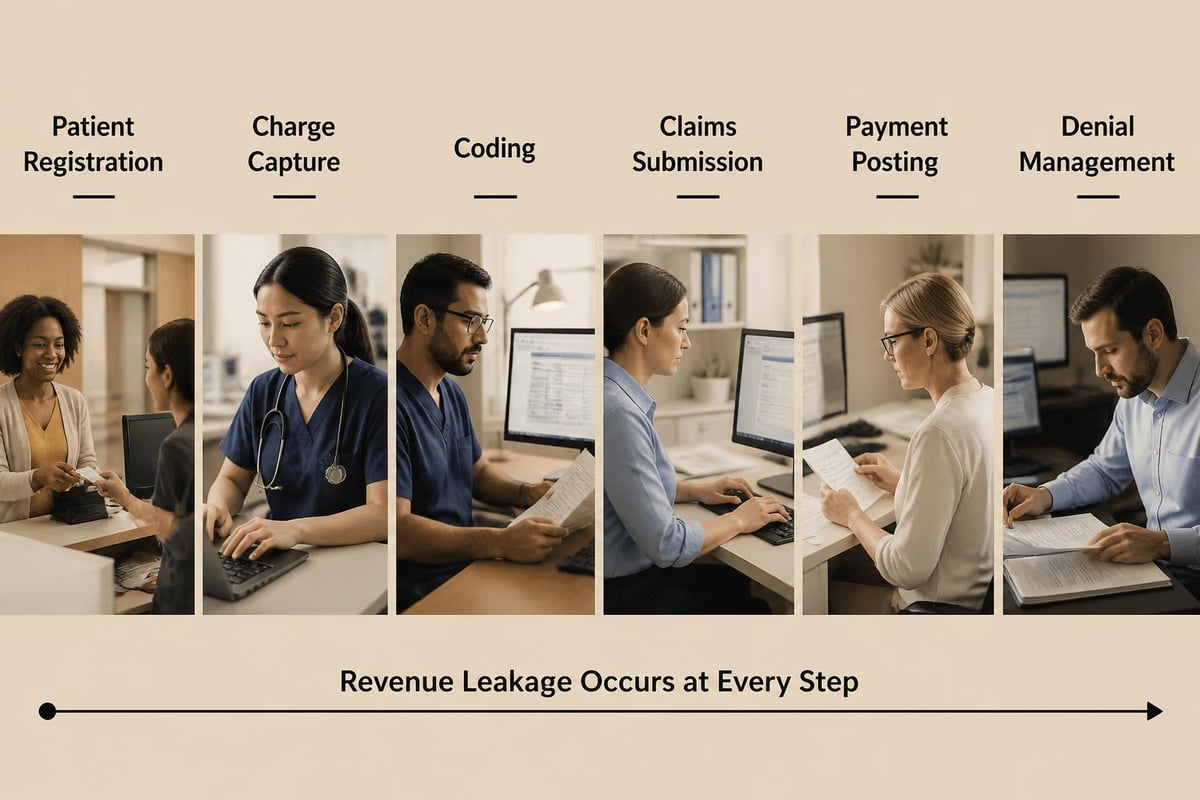
One health system's revenue cycle assessment identified over $18.2 million in uncollected accounts receivable, demonstrating how operational inefficiencies accumulate into massive financial losses. The assessment revealed issues spanning front-end registration processes, mid-cycle coding accuracy, and back-end collection procedures.
Detection Strategies and Diagnostic Approaches
Data Analysis and Pattern Recognition
Identifying revenue leakage requires systematic analysis across multiple data sources. Financial analytics should examine variance between contracted rates and billed amounts, comparing expected revenue based on service delivery against actual invoicing. Time-series analysis can reveal trends in discount frequency, average deal size deterioration, or expanding days sales outstanding.
Key metrics for leakage detection include:
- Realization rate: Actual revenue divided by potential revenue based on standard rates and delivered services
- Revenue per customer trends: Identifying declining average revenue that may indicate pricing erosion
- Discount penetration: Percentage of deals including discounts and average discount depth
- Write-off ratios: Uncollected revenue as a percentage of total billed amounts
- Billing cycle time: Days from service delivery to invoice generation
Organizations should establish baseline performance across these metrics, then monitor for deviations that signal emerging leakage issues. Mid-market companies often lack dedicated revenue operations teams to perform this analysis, allowing issues to compound undetected for extended periods.
Process Audits and Control Testing
Beyond data analysis, systematic process audits identify control weaknesses that enable revenue loss. Audit procedures should test whether billing matches contracted terms, pricing approvals follow established protocols, and revenue recognition aligns with service delivery.
Sample-based testing across recent transactions can reveal:
- Contracts billed at incorrect rates compared to signed agreements
- Services delivered but never invoiced
- Discounts applied without proper authorization
- Time entries that never converted to billable charges
- Reimbursable expenses absorbed rather than charged to clients
Internal audit teams or external consultants should periodically review end-to-end revenue processes, documenting workflows, identifying control gaps, and quantifying financial exposure. A manufacturing company's internal audit uncovered significant annual revenue leakage through comprehensive process review, addressing pricing inconsistencies and billing delays.
Prevention Through Technology and Process Improvement
Automation and System Integration
Technology represents the most effective defense against systematic revenue leakage. Integrated platforms that connect customer relationship management, billing, project management, and financial systems eliminate manual handoffs and ensure data consistency. Automation removes human error from repetitive tasks like invoice generation, payment application, and contract renewal notifications.
Modern artificial intelligence and automation solutions offer capabilities that were previously unavailable to mid-market organizations:
| Technology Solution | Leakage Prevention Impact | Implementation Complexity |
|---|---|---|
| AI-powered contract analysis | Identifies pricing discrepancies and missing billing triggers | Medium |
| Automated billing systems | Eliminates calculation errors and ensures timely invoicing | Low to Medium |
| Integrated CRM-ERP platforms | Maintains pricing consistency from quote to cash | High |
| Revenue recognition automation | Ensures proper accounting alignment with delivery | Medium to High |
| Predictive analytics for AR | Identifies collection risks before they become write-offs | Medium |
Organizations implementing comprehensive automation typically recover significant previously leaked revenue while simultaneously reducing the time finance teams spend on manual reconciliation and error correction.
Standardized Processes and Controls
Technology alone cannot prevent revenue leakage without supporting process discipline. Organizations need clearly defined workflows with embedded controls that prevent errors from occurring rather than catching them after the fact.
Effective process standardization includes:
- Pricing approval workflows requiring management sign-off on discounts beyond established thresholds
- Contract review procedures ensuring billing system updates match negotiated terms
- Time entry policies with mandatory daily or weekly submission requirements
- Invoice review protocols validating accuracy before customer delivery
- Regular reconciliation cadences comparing delivered services against billed amounts
Enterprise organizations often have more robust control environments, but complexity can create its own vulnerabilities. Mid-market firms benefit from establishing foundational controls before scaling, preventing the entrenchment of inefficient practices.
Building a Revenue Leakage Prevention Program
Establishing Ownership and Accountability
Revenue leakage prevention requires cross-functional coordination among sales, operations, finance, and executive leadership. No single department owns all contributing factors, yet someone must coordinate the overall effort. Progressive organizations establish revenue operations functions or designate finance business partners to bridge departmental silos.

Clear accountability mechanisms should define who monitors specific leakage indicators, investigates variances, and implements corrective actions. Regular revenue quality reviews bring stakeholders together to assess metrics, discuss emerging patterns, and coordinate improvement initiatives.
Continuous Monitoring and Improvement
Prevention programs must evolve as business models, pricing strategies, and service offerings change. Quarterly reviews should assess whether existing controls remain effective and whether new leakage sources have emerged. Healthcare organizations particularly benefit from continuous monitoring as regulatory requirements, payer policies, and coding guidelines constantly change.
Implementation roadmaps should prioritize improvements based on financial impact and implementation feasibility:
- Quick wins: High-impact changes with minimal complexity, such as automated payment term reminders or standard pricing validation rules
- Strategic initiatives: Fundamental process redesigns or major system implementations that address root causes
- Capability building: Training programs, documentation improvements, and culture change efforts that sustain long-term performance
Organizations should track both lagging indicators (actual recovered revenue, reduced write-offs) and leading indicators (process compliance rates, system adoption metrics) to ensure initiatives deliver expected results.
Industry-Specific Considerations
Professional Services and Consulting Firms
Consulting organizations face unique challenges around project-based billing, resource allocation, and scope management. Revenue leakage frequently occurs when project teams focus on client delivery while administrative tasks like timesheet completion and expense reporting receive less attention. Partner-level reviews of project profitability often reveal significant unbilled time or absorbed costs.
Successful prevention approaches for professional services include real-time project margin visibility, automated time entry reminders integrated into daily workflows, and clear escalation procedures when actual effort exceeds budgeted hours. Firms should also implement rigorous change order processes that formalize scope adjustments before additional work proceeds.
Healthcare Revenue Cycle Operations
Healthcare revenue cycles present extraordinary complexity with thousands of procedure codes, constantly changing payer requirements, and multi-step workflows from patient registration through final payment. Front-end issues like insurance verification failures cascade through the entire cycle, while back-end challenges around denial management and patient collections create write-off exposure.
Comprehensive revenue cycle management addresses leakage through systematic approaches to charge capture, coding accuracy, claim submission quality, and denial prevention. Analytics capabilities that identify patterns in denials, underpayments, or coding errors enable targeted interventions.
Private Equity Portfolio Companies
Private equity firms increasingly focus on revenue quality and operational efficiency within portfolio companies. Revenue leakage directly impacts EBITDA performance and valuation multiples. During due diligence, sophisticated buyers now conduct revenue quality assessments to understand true earning potential versus reported results.
Portfolio company value creation plans should include revenue leakage assessments within the first 100 days, establishing baseline performance and identifying improvement opportunities. Quick wins in billing accuracy and collections can generate immediate cash flow improvements while longer-term system investments build sustainable capabilities.
Measuring Success and Quantifying Impact
Organizations implementing leakage prevention programs should establish clear success metrics that demonstrate return on investment. Financial metrics directly measure recovered revenue, while operational metrics indicate process health and sustainability.
Key performance indicators for program success:
- Percentage reduction in revenue variance between expected and actual billing
- Improvement in realization rates across service lines or customer segments
- Decreased days sales outstanding and accelerated cash collection
- Reduction in invoice disputes and customer billing inquiries
- Lower bad debt write-offs as a percentage of revenue
- Decreased time finance teams spend on manual reconciliation and error correction
Beyond quantitative metrics, qualitative improvements matter. Sales teams gain confidence in pricing consistency. Finance departments shift from reactive error correction to proactive analysis. Customer relationships improve when billing accuracy reduces friction and disputes.
Organizations should calculate total program benefits including direct revenue recovery, avoided future leakage, operational cost savings from automation, and strategic value from improved decision-making based on accurate revenue data. Research on revenue leakage prevention demonstrates that comprehensive programs typically deliver returns of 10-to-1 or greater on implementation investment.
Revenue leakage silently erodes profitability across organizations of all sizes, but systematic detection and prevention programs can recover significant lost revenue while building sustainable operational capabilities. By addressing root causes through technology integration, process standardization, and cross-functional collaboration, companies transform revenue operations from a source of loss into a competitive advantage. Nero and Associates, Inc. helps organizations identify and eliminate revenue leakage through performance-based consulting in automation, integration, and revenue cycle management, enabling businesses to raise their bottom line while eliminating thousands of hours of manual processes.