

In today's business environment, organizations generate and consume massive volumes of information every day. However, the value of this information depends entirely on its reliability and accuracy. Poor-quality data costs businesses millions in lost revenue, wasted resources, and missed opportunities. For organizations seeking to leverage automation, artificial intelligence, and advanced analytics, the foundation of success rests on maintaining high standards for information accuracy, consistency, and completeness. Understanding what constitutes quality data and implementing systematic approaches to maintain it has become a critical competitive advantage across all industries.
Understanding the Core Dimensions of Information Reliability
Quality data encompasses multiple dimensions that work together to ensure information serves its intended purpose effectively. Six key elements define data quality: accuracy, completeness, consistency, timeliness, uniqueness, and validity. Each dimension plays a distinct role in determining whether information can support confident decision-making.
Accuracy measures how correctly data represents real-world entities or events. When customer addresses, financial figures, or patient records contain errors, the downstream consequences ripple through every business process that depends on that information. A single inaccurate data point can trigger incorrect invoices, failed deliveries, or compliance violations.
Completeness evaluates whether all required information is present. Missing fields in customer profiles, incomplete transaction records, or partial employee data creates gaps that undermine analysis and reporting capabilities.
The Remaining Critical Dimensions
Consistency ensures that the same information appears identically across different systems and databases. When customer names appear differently in sales, marketing, and finance systems, reconciliation becomes time-consuming and error-prone.
- Timeliness reflects whether information is available when needed and reflects the current state of reality
- Uniqueness prevents duplicate records that inflate counts and distort analysis
- Validity confirms that data conforms to defined formats, ranges, and business rules

Organizations implementing automation and AI solutions must prioritize all six dimensions simultaneously. AI and machine learning projects will fail without good data, regardless of how sophisticated the algorithms or how powerful the computing infrastructure.
The Business Impact of Information Quality Issues
The consequences of poor information quality extend far beyond technical inconveniences. Financial implications alone justify significant investment in improvement initiatives. Healthcare organizations experience claim denials and delayed reimbursements due to incorrect patient information or billing codes. Professional services firms lose billable hours reconciling conflicting project data across systems.
Operational efficiency suffers dramatically when employees spend hours validating questionable information before using it. Manual processes proliferate as workers create workarounds for unreliable systems. Decision-makers delay critical choices while waiting for data verification.
Quantifying the Cost of Quality Problems
| Impact Area | Common Consequences | Estimated Cost Factor |
|---|---|---|
| Revenue | Lost sales, claim denials, billing errors | 15-25% of revenue at risk |
| Operations | Manual reconciliation, rework, delays | 20-35% of staff time wasted |
| Compliance | Regulatory fines, audit failures | $100K-$10M+ per incident |
| Reputation | Customer dissatisfaction, trust erosion | Difficult to quantify but severe |
Professional services organizations face unique challenges. Client billing accuracy directly impacts cash flow and client relationships. Project resource allocation depends on reliable utilization data. Employee wellness programs require accurate health and benefits information to deliver value.
For consultancies focused on healthcare revenue cycle management, information quality directly determines reimbursement success rates. Inaccurate patient demographics, incorrect coding, or incomplete documentation leads to claim denials that reduce revenue and increase administrative burden.
Establishing Quality Measurement and Monitoring Systems
Improving information quality begins with establishing baseline measurements and ongoing monitoring capabilities. Organizations cannot manage what they do not measure. Developing appropriate metrics requires understanding both technical data characteristics and business requirements.
Profiling analyzes existing datasets to identify patterns, anomalies, and quality issues. This process reveals unexpected data distributions, missing values, duplicate records, and constraint violations. Regular profiling helps organizations understand the current state and track improvement over time.
Validation rules automate quality checks at the point of data entry and throughout processing pipelines. These rules enforce business logic, format requirements, and referential integrity. Effective validation prevents poor-quality data from entering systems while allowing legitimate exceptions through defined approval processes.
Creating Comprehensive Quality Scorecards
Quality scorecards provide stakeholders with clear visibility into information reliability across different datasets and business processes. These dashboards should include:
- Dimension-specific metrics for accuracy, completeness, consistency, timeliness, uniqueness, and validity
- Trend analysis showing improvement or degradation over time
- Issue categorization identifying root causes and responsible systems
- Business impact assessment linking quality metrics to operational and financial outcomes
- Remediation tracking monitoring progress on improvement initiatives
Research on data quality measurement tools demonstrates the variety of approaches organizations employ to assess information reliability. The most effective strategies combine automated monitoring with manual sampling and validation by subject matter experts.
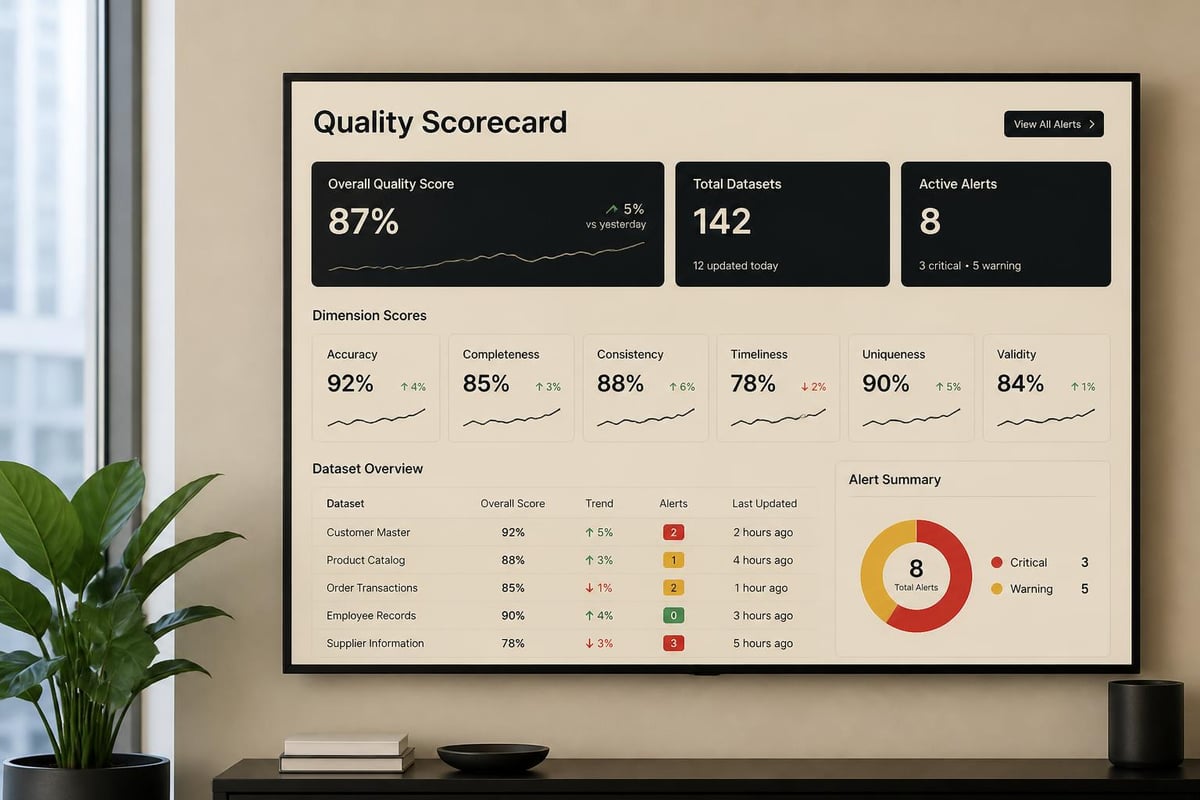
Organizations implementing human capital management solutions benefit particularly from quality scorecards. Employee data touches payroll, benefits, compliance, and workforce planning processes. A single source of truth with continuously monitored quality ensures all dependent systems operate reliably.
Implementing Systematic Quality Improvement Practices
Sustainable quality improvement requires systematic approaches embedded into organizational processes and culture. Five best practices to improve data quality provide a roadmap for organizations beginning their journey.
Eliminate data silos by establishing centralized master data management. When the same information exists in multiple disconnected systems, inconsistencies inevitably emerge. Creating authoritative sources for critical entities like customers, employees, products, and suppliers ensures everyone works from the same truth.
Define clear ownership and accountability for each data domain. Quality improves when specific individuals or teams take responsibility for maintaining accuracy and completeness. Data stewards bridge business and technical teams, translating requirements into validation rules and monitoring processes.
Building Quality into Data Lifecycles
Prevention costs less than remediation. Organizations should embed quality controls throughout the entire information lifecycle:
- Capture: Design input forms and interfaces that guide users toward correct entries
- Integration: Implement reconciliation and conflict resolution processes when combining data from multiple sources
- Storage: Enforce referential integrity, constraints, and validation rules at the database level
- Processing: Validate transformations and calculations to prevent logic errors
- Distribution: Ensure downstream consumers receive data in expected formats with documented quality characteristics
Invest in training and change management to help employees understand why quality matters and how their actions impact it. When staff members grasp the connection between their data entry practices and business outcomes, voluntary compliance improves significantly.
Automate wherever possible to reduce human error and improve consistency. Modern automation and integration platforms can validate incoming data, flag exceptions, trigger cleansing workflows, and maintain audit trails without manual intervention. Professional services firms specializing in AI and automation help organizations implement these capabilities efficiently.
Governance Frameworks for Sustained Excellence
Technology alone cannot solve quality challenges. Effective governance provides the policies, processes, and organizational structures necessary for long-term success. Government organizations have established frameworks that translate well to private sector applications.
Policy development establishes standards for accuracy, acceptable error rates, retention periods, and access controls. These policies should align with regulatory requirements, industry best practices, and organizational risk tolerance. Regular review and updates keep policies relevant as business needs evolve.
Quality committees bring together stakeholders from across the organization to prioritize improvement initiatives, resolve conflicts, and ensure alignment with strategic objectives. These groups typically include representatives from IT, operations, finance, compliance, and business units.
Governance Components and Responsibilities
| Component | Primary Responsibility | Key Activities |
|---|---|---|
| Executive Sponsorship | C-suite leadership | Resource allocation, strategic direction |
| Data Governance Council | Cross-functional leaders | Policy approval, priority setting |
| Data Stewards | Domain experts | Standard definition, quality monitoring |
| Technical Teams | IT and analytics staff | Tool implementation, automation |
| Business Users | Operational staff | Data creation, issue reporting |
Continuous improvement processes treat quality management as an ongoing journey rather than a one-time project. Regular assessments identify emerging issues, changing requirements, and new opportunities. Root cause analysis prevents recurring problems rather than merely treating symptoms.
Organizations focused on employee wellness and human capital management recognize that governance extends beyond operational data. Health information, benefits enrollment, and financial wellness program data require additional privacy and security controls while maintaining the same quality standards.
Leveraging Advanced Technologies for Quality Assurance
Emerging technologies provide new capabilities for maintaining and improving information reliability at scale. Machine learning algorithms can detect anomalies that traditional rule-based systems miss. Natural language processing validates unstructured data quality in documents, emails, and notes.
Artificial intelligence identifies complex patterns across massive datasets that would overwhelm human analysts. These systems learn normal data distributions and flag outliers for investigation. As algorithms encounter more data, their accuracy improves through continuous learning.

Data observability platforms provide comprehensive visibility into information flows across the organization. These tools monitor data pipelines, track lineage, profile datasets automatically, and alert teams to quality degradation before it impacts business processes.
Technology Selection Criteria
Organizations evaluating quality management technologies should consider several factors:
- Integration capabilities with existing systems and data sources
- Scalability to handle growing data volumes and complexity
- Ease of use for both technical and business users
- Customization options to address unique business requirements
- Vendor support and roadmap for long-term partnership
Research examining big data quality dimensions reveals that volume, velocity, and variety introduce new challenges requiring specialized tools and approaches. Traditional quality management strategies designed for structured relational databases may not address unstructured content, streaming data, or disparate sources effectively.
Professional services organizations implementing revenue cycle management solutions benefit from technologies that validate clinical documentation, medical coding, and billing information. Automated quality checks reduce claim denials and accelerate reimbursement while decreasing manual review burden.
Industry-Specific Considerations and Applications
Different industries face unique quality challenges based on their data types, regulatory environments, and operational models. Healthcare organizations must maintain HIPAA compliance while ensuring clinical data accuracy supports patient safety. Financial services firms balance fraud detection with customer experience while meeting stringent reporting requirements.
Professional services consulting organizations manage quality across multiple dimensions. Client data must support accurate billing and project tracking. Employee information enables effective resource allocation and workforce planning. Financial data ensures compliance and supports strategic decision-making.
For consultancies offering human capital management solutions, employee wellness program effectiveness depends entirely on accurate health and benefits data. Incorrect information leads to inappropriate recommendations, missed interventions, and reduced employee satisfaction.
Application Areas Requiring Premium Quality Standards
- Healthcare revenue cycle: Patient demographics, insurance verification, clinical documentation, medical coding
- Human resources: Employee records, payroll data, benefits enrollment, performance metrics
- Financial management: Transaction records, account balances, regulatory reports, tax information
- Customer relationship management: Contact information, interaction history, preferences, purchase records
- Supply chain operations: Inventory levels, supplier data, logistics tracking, demand forecasts
Consulting teams focused on performance improvement understand that quality initiatives must align with operational realities and resource constraints. Prioritization frameworks help organizations focus improvement efforts where they will deliver the greatest business value.
Building a Culture of Information Excellence
Sustainable quality improvement requires cultural transformation alongside technical implementation. When employees at all levels understand quality's importance and feel accountable for maintaining it, voluntary compliance improves dramatically.
Leadership commitment sets the tone. When executives discuss quality metrics in business reviews, allocate resources to improvement initiatives, and recognize teams for quality achievements, the entire organization takes notice.
Communication strategies help employees understand how their daily activities impact information reliability and business outcomes. Sharing success stories, publishing quality metrics, and explaining the connection between accurate data and organizational goals builds engagement.
Cultural Elements Supporting Quality Excellence
Organizations with strong quality cultures exhibit several common characteristics:
- Transparency about quality issues and improvement progress
- Accountability at individual and team levels for data accuracy
- Collaboration across functional boundaries to resolve systemic issues
- Continuous learning from mistakes and near-misses
- Recognition for quality improvement contributions
Training programs equip employees with the knowledge and skills to create and maintain quality information. These programs should cover technical aspects like validation rules and system functionality alongside conceptual understanding of why quality matters and how errors impact colleagues and customers.
Organizations implementing AI and automation solutions must prepare their workforce for changing roles. As technology handles routine validation and cleansing tasks, employees focus on exception handling, complex decision-making, and continuous improvement rather than manual data entry and reconciliation.
Future Trends Shaping Quality Management
The landscape of information quality management continues evolving rapidly. Several trends will shape practices over the coming years. Real-time quality monitoring becomes table stakes as organizations demand immediate visibility into information reliability rather than periodic assessment.
Embedded quality controls within operational applications prevent poor-quality data from entering systems in the first place. Modern low-code platforms include built-in validation, deduplication, and standardization capabilities that non-technical users can configure.
Collaborative quality improvement tools enable distributed teams to identify, investigate, and resolve issues together. These platforms combine workflow management, root cause analysis, and knowledge sharing to accelerate remediation.
The increasing adoption of cloud platforms and software-as-a-service applications creates new integration challenges. Quality management strategies must address data flowing between on-premises systems, multiple cloud environments, and external partner systems while maintaining security and compliance.
Organizations positioned for future success invest in foundational capabilities today. Master data management, automated monitoring, and governance frameworks provide the infrastructure necessary to adapt as technologies and requirements evolve.
Maintaining high information standards is no longer optional in today's data-driven business environment. Organizations that prioritize accuracy, completeness, and consistency across their information assets gain significant competitive advantages through improved decision-making, operational efficiency, and customer satisfaction. Nero and Associates, Inc. helps organizations implement comprehensive quality management programs that reduce costs, eliminate manual processes, and enable data-driven excellence across operations. Contact our team to discover how strategic quality improvements can transform your business performance and position your organization for sustainable growth.