

Data Governance: A Strategic Framework for 2026

Share on Facebook
Share on X
Share on LinkedIn

Organizations today generate and manage more data than ever before, creating both unprecedented opportunities and significant challenges. As businesses leverage artificial intelligence, automation, and advanced analytics to drive operational excellence, the need for structured oversight of data assets has become critical. Establishing robust protocols for managing information quality, security, and accessibility isn't just a technical requirement; it's a strategic imperative that directly impacts bottom-line performance, regulatory compliance, and competitive advantage.

Understanding the Foundation of Modern Data Stewardship

Data governance represents a comprehensive framework of policies, procedures, standards, and roles that organizations implement to ensure their information assets remain accurate, secure, accessible, and compliant with regulatory requirements. This structured approach defines who can take what actions with which data, under what circumstances, and using what methods.

At its core, effective governance transforms data from a liability into a strategic asset. Organizations that implement data governance frameworks establish clear ownership, accountability structures, and decision-making processes that protect information while maximizing its value. This becomes particularly crucial when thousands of employees interact with sensitive customer information, financial records, and operational data daily.

The Business Case for Structured Information Management

The financial implications of poor data management extend far beyond storage costs. Organizations face substantial risks from data breaches, regulatory penalties, operational inefficiencies, and flawed decision-making based on unreliable information. When multiple departments maintain conflicting versions of customer records or when automated systems process inaccurate data, the resulting errors cascade through operations, affecting everything from billing accuracy to strategic planning.

Key business drivers include:

  • Regulatory compliance with HIPAA, GDPR, CCPA, and industry-specific requirements
  • Risk mitigation against data breaches and unauthorized access
  • Operational efficiency through standardized data definitions and processes
  • Enhanced decision-making quality with trusted, accurate information
  • Accelerated AI and automation initiatives built on reliable data foundations

Organizations serving healthcare sectors face particularly stringent requirements, where patient privacy violations can result in millions of dollars in fines and irreparable reputation damage.
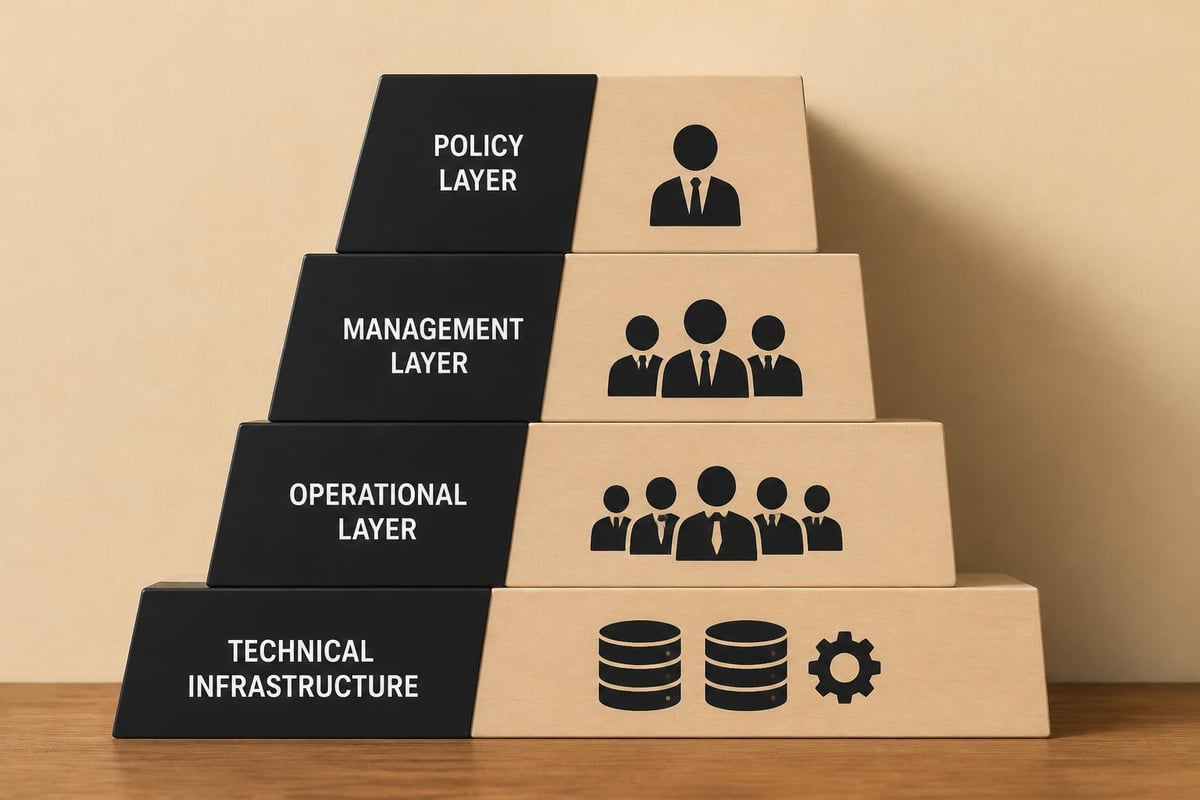
Data governance framework layers

Building Your Governance Framework

Establishing an effective data governance program requires careful planning, cross-functional collaboration, and executive sponsorship. The framework must balance control with accessibility, ensuring security without creating bottlenecks that slow business operations.

Defining Roles and Responsibilities

Successful programs clearly delineate who owns, manages, and uses data across the organization. The governance structure typically includes several key roles:

Role Primary Responsibilities Decision Authority
Data Governance Council Strategic oversight, policy approval, conflict resolution Final authority on governance policies
Data Stewards Data quality standards, metadata management, issue resolution Domain-specific data decisions
Data Owners Business accountability for specific data domains Access approval, quality standards
Data Custodians Technical implementation, security controls, infrastructure Technical execution of policies

These roles work together to ensure data governance principles are embedded throughout the organization rather than isolated in IT departments. Business leaders must recognize their accountability for the information assets their teams create and consume.

Establishing Core Policies and Standards

Organizations need comprehensive policies covering data quality, security, privacy, retention, and access control. Key principles of data governance emphasize integrity, confidentiality, and availability as foundational requirements.

Essential policy components include:

  1. Data classification schemes that categorize information by sensitivity level
  2. Quality standards defining accuracy, completeness, consistency, and timeliness requirements
  3. Access control policies specifying who can view, modify, or delete specific data types
  4. Retention schedules establishing how long different data categories must be preserved
  5. Privacy protocols governing collection, use, and sharing of personal information

For private equity portfolio companies, these policies become particularly critical during due diligence and integration activities where data consistency across acquired entities directly impacts valuation and operational synergies.

Implementing Best Practices for Sustainable Success

Theory alone doesn't deliver results. Organizations must translate governance frameworks into practical, enforceable processes that become embedded in daily operations. Data governance best practices emphasize starting with clear ownership and building systematic controls.

Prioritizing Data Quality Management

Data quality represents the most visible outcome of effective governance. Poor quality information undermines analytics, frustrates employees, damages customer relationships, and leads to costly errors. Organizations should establish continuous monitoring processes that measure quality dimensions and trigger remediation workflows when standards aren't met.

Quality management involves both preventive and detective controls. Input validation prevents bad data from entering systems, while regular audits identify and correct existing quality issues. Automated data quality tools can monitor millions of records, flagging anomalies and inconsistencies for steward review.

Quality dimensions to monitor:

  • Accuracy: Does the data correctly represent real-world entities?
  • Completeness: Are all required fields populated with valid values?
  • Consistency: Do related data elements align across systems?
  • Timeliness: Is information current and available when needed?
  • Validity: Does data conform to defined formats and business rules?

Organizations eliminating thousands of hours of manual processes through automation must ensure data quality, as automated systems amplify the impact of both good and bad data.
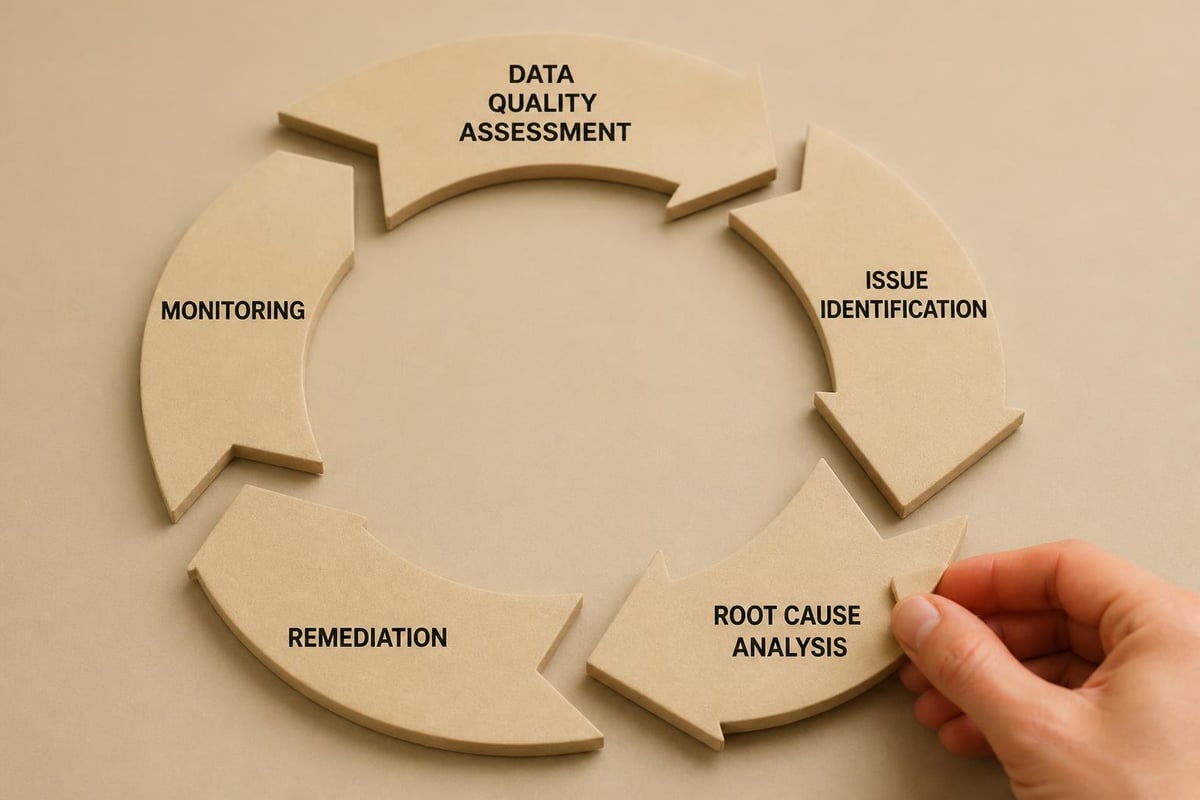
Data quality improvement cycle

Securing Information Assets

Security controls protect data from unauthorized access, modification, or destruction. Effective governance programs implement defense-in-depth strategies with multiple security layers working together.

Role-based access control (RBAC) represents a cornerstone security practice, granting permissions based on job functions rather than individual requests. This approach scales efficiently as organizations grow and simplifies compliance auditing by creating clear documentation of who can access what information.

Encryption protects data both at rest and in transit, ensuring that even if unauthorized parties intercept or access storage media, they cannot read sensitive information. Modern cloud platforms provide robust encryption capabilities, but organizations must configure them properly according to governance policies.

Security Control Purpose Implementation Consideration
Authentication Verify user identity Multi-factor authentication for sensitive systems
Authorization Control access rights Role-based access aligned with job functions
Encryption Protect data confidentiality Both at-rest and in-transit encryption
Auditing Track data access and changes Comprehensive logging with regular review
Data masking Hide sensitive elements Production data protection in non-production environments

Enabling AI and Automation Through Governance

The rise of artificial intelligence and automation creates both opportunities and challenges for data governance. Data governance’s critical role in successful AI projects cannot be overstated, as machine learning models are only as good as the data they're trained on.

Governance as an AI Enabler

Organizations hesitant to deploy AI often cite data concerns: incomplete datasets, inconsistent formats, questionable quality, or unclear lineage. Robust governance addresses these concerns systematically, creating the trusted data foundation that AI requires.

When implementing automation solutions that eliminate manual processes, governance frameworks ensure systems have access to accurate, complete information while maintaining security and compliance. Automated workflows must operate on reliable data to deliver the promised efficiency gains.

AI-specific governance considerations include:

  1. Training data quality and representativeness
  2. Model bias detection and mitigation
  3. Decision transparency and explainability
  4. Ongoing model performance monitoring
  5. Ethical use guidelines and impact assessments

For non-profit organizations seeking to maximize mission impact through AI-driven insights, governance ensures donor information, program outcomes, and beneficiary data remain secure while enabling advanced analytics.

Managing the Data Lifecycle

Effective governance extends across the entire data lifecycle, from creation through disposal. Each phase requires specific controls and procedures aligned with business requirements and regulatory obligations.

During the creation phase, governance policies define what information should be collected, in what format, and with what metadata. Collection methods must comply with privacy regulations and ethical standards, particularly when gathering personal information.

Storage and maintenance phases require policies for backup, recovery, archiving, and quality monitoring. Organizations must balance accessibility requirements against security and cost considerations, determining appropriate storage tiers and access mechanisms for different data categories.

The disposal phase presents particular challenges. Secure data management best practices emphasize proper destruction methods that prevent data recovery while meeting regulatory retention requirements. Automated retention policies help organizations systematically remove data that's no longer needed, reducing storage costs and security risks.
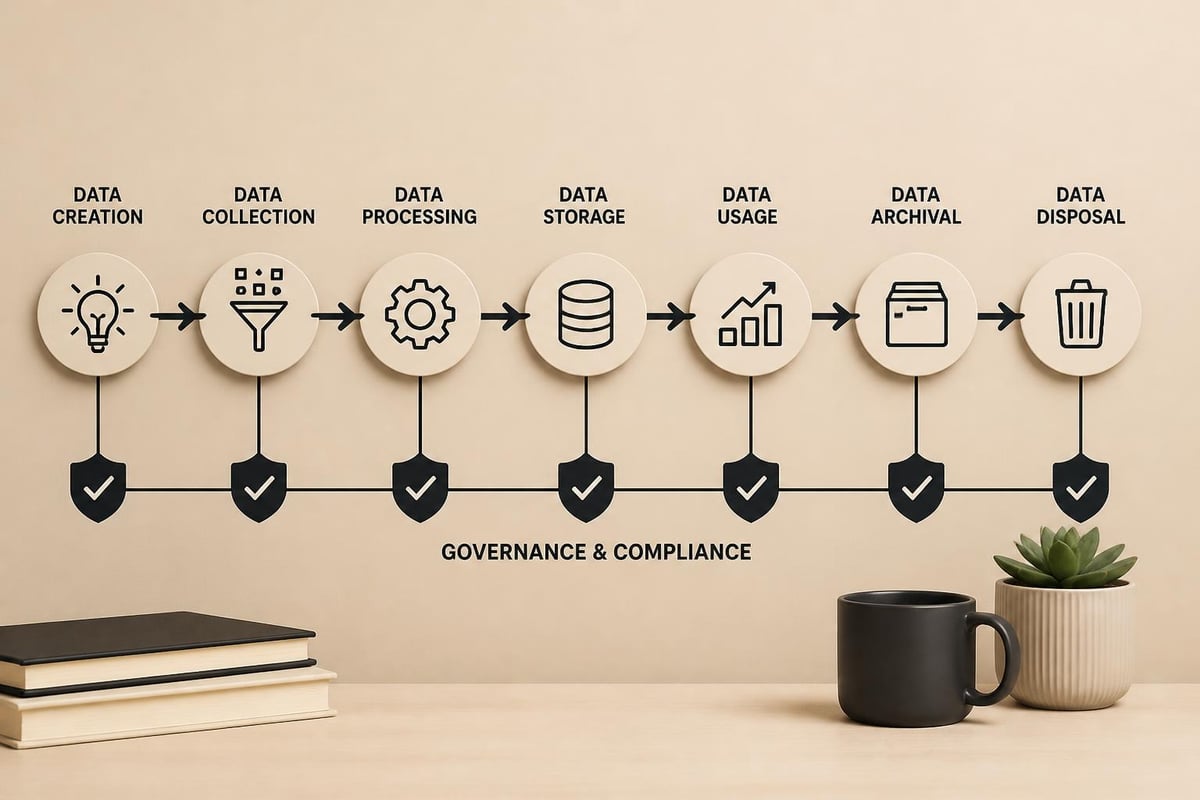
Data lifecycle governance stages

Measuring Governance Effectiveness

Organizations cannot improve what they don't measure. Effective governance programs establish clear metrics that demonstrate value, identify improvement opportunities, and ensure accountability.

Key Performance Indicators

Selecting the right metrics requires understanding both technical performance and business outcomes. Leading indicators predict future issues, while lagging indicators measure historical performance.

Technical metrics include:

  • Data quality scores by domain
  • Policy compliance rates
  • Security incident frequency and severity
  • System uptime and availability
  • Mean time to resolve data issues

Business metrics include:

  • Cost of poor quality data
  • Time saved through automated data processes
  • Regulatory audit outcomes
  • User satisfaction with data availability
  • Revenue impact from improved analytics

Regular reporting to executive leadership keeps governance visible and demonstrates return on investment. Dashboard visualizations make complex metrics accessible to non-technical stakeholders.

Overcoming Common Implementation Challenges

Even well-designed governance programs encounter obstacles during implementation. Anticipating these challenges and planning mitigation strategies improves success rates.

Cultural Resistance and Change Management

Data governance often requires significant changes to established workflows and decision-making processes. Employees accustomed to unrestricted data access may resist new controls as unnecessary bureaucracy. Successful programs address cultural resistance through clear communication, stakeholder engagement, and demonstrated value.

Executive sponsorship proves critical for overcoming resistance. When leadership visibly supports governance initiatives and holds teams accountable for compliance, adoption accelerates. Training programs help employees understand not just what's required, but why governance matters for their work and the organization's success.

Balancing Control with Agility

Overly restrictive governance creates bottlenecks that slow business operations and frustrate users. Organizations must calibrate controls appropriately, implementing strong security for sensitive data while enabling easier access to less critical information.

Risk-based approaches help strike this balance. High-risk data categories warrant stricter controls, comprehensive auditing, and formal approval processes. Lower-risk information can operate under streamlined procedures that maintain appropriate oversight without impeding productivity.

The hospitality sector illustrates this balance well: employee scheduling data requires different controls than guest payment information, yet both need governance.

Technology Integration Complexity

Modern organizations operate diverse technology ecosystems with cloud platforms, on-premises systems, SaaS applications, and legacy databases. Implementing consistent governance across this landscape requires careful planning and often significant integration work.

Governance tools should integrate with existing systems rather than requiring wholesale replacement. APIs, metadata management platforms, and data catalogs help create unified governance layers across heterogeneous environments. Phased implementation approaches allow organizations to demonstrate value quickly while building toward comprehensive coverage.

Governance in Regulated Industries

Certain industries face heightened regulatory scrutiny requiring enhanced governance capabilities. Healthcare, financial services, and government contractors must meet specific compliance requirements that shape governance frameworks.

Healthcare Data Governance

Healthcare organizations manage some of society's most sensitive information. HIPAA establishes strict requirements for protecting patient privacy, with substantial penalties for violations. Effective healthcare data governance ensures:

  • Protected health information (PHI) access limited to authorized personnel
  • Comprehensive audit trails documenting who accessed what patient data when
  • Business associate agreements with vendors handling PHI
  • Breach notification procedures and incident response plans
  • Patient rights management for access, amendment, and accounting of disclosures

Revenue cycle management operations depend heavily on accurate, timely data governance. Claims processing, billing, collections, and reporting all require trusted data foundations to maximize reimbursement while maintaining compliance.

Future Trends Reshaping Data Governance

The governance landscape continues evolving as new technologies, regulations, and business models emerge. Organizations should monitor these trends and adapt frameworks accordingly.

Privacy-Enhancing Technologies

Techniques like differential privacy, homomorphic encryption, and secure multi-party computation enable analysis of sensitive data while preserving privacy. These technologies allow organizations to extract value from information without exposing individual records, opening new opportunities for data sharing and collaboration.

Automated Governance Through AI

Ironically, AI itself becomes a governance tool. Machine learning models can classify data automatically, detect anomalies, predict quality issues, and recommend remediation actions. This automation helps governance scale to manage massive data volumes that manual processes cannot handle.

Data Fabric and Mesh Architectures

Emerging architectural patterns distribute data ownership and governance to domain teams rather than centralizing control. These approaches require mature governance frameworks that can operate consistently across decentralized environments while maintaining enterprise-wide standards and visibility.

Organizations partnering with consultancies like those found through Nero and Associates gain access to expertise in implementing these advanced governance capabilities while maintaining focus on core business operations.


Strong data governance transforms information from a liability into a strategic asset, enabling organizations to automate operations confidently, comply with regulations efficiently, and make decisions based on trusted insights. As businesses increasingly depend on data-driven processes and AI-powered solutions, governance frameworks provide the foundation for sustainable success. Nero and Associates, Inc. helps organizations implement performance-based governance solutions that raise bottom-line results, eliminate manual processes, and establish the data foundations needed for transformative automation and integration initiatives.

Data Governance: A Strategic Framework for 2026

Organizations today generate and manage more data than ever before, creating both unprecedented opportunities and significant challenges. As businesses leverage artificial intelligence, automation, and advanced analytics to drive operational excellence, the need for structured oversight of data assets has become critical. Establishing robust protocols for managing information quality, security, and accessibility isn't just a technical requirement; it's a strategic imperative that directly impacts bottom-line performance, regulatory compliance, and competitive advantage.

Understanding the Foundation of Modern Data Stewardship

Data governance represents a comprehensive framework of policies, procedures, standards, and roles that organizations implement to ensure their information assets remain accurate, secure, accessible, and compliant with regulatory requirements. This structured approach defines who can take what actions with which data, under what circumstances, and using what methods.

At its core, effective governance transforms data from a liability into a strategic asset. Organizations that implement data governance frameworks establish clear ownership, accountability structures, and decision-making processes that protect information while maximizing its value. This becomes particularly crucial when thousands of employees interact with sensitive customer information, financial records, and operational data daily.

The Business Case for Structured Information Management

The financial implications of poor data management extend far beyond storage costs. Organizations face substantial risks from data breaches, regulatory penalties, operational inefficiencies, and flawed decision-making based on unreliable information. When multiple departments maintain conflicting versions of customer records or when automated systems process inaccurate data, the resulting errors cascade through operations, affecting everything from billing accuracy to strategic planning.

Key business drivers include:

  • Regulatory compliance with HIPAA, GDPR, CCPA, and industry-specific requirements
  • Risk mitigation against data breaches and unauthorized access
  • Operational efficiency through standardized data definitions and processes
  • Enhanced decision-making quality with trusted, accurate information
  • Accelerated AI and automation initiatives built on reliable data foundations

Organizations serving healthcare sectors face particularly stringent requirements, where patient privacy violations can result in millions of dollars in fines and irreparable reputation damage.

Data governance framework layers

Building Your Governance Framework

Establishing an effective data governance program requires careful planning, cross-functional collaboration, and executive sponsorship. The framework must balance control with accessibility, ensuring security without creating bottlenecks that slow business operations.

Defining Roles and Responsibilities

Successful programs clearly delineate who owns, manages, and uses data across the organization. The governance structure typically includes several key roles:

Role Primary Responsibilities Decision Authority
Data Governance Council Strategic oversight, policy approval, conflict resolution Final authority on governance policies
Data Stewards Data quality standards, metadata management, issue resolution Domain-specific data decisions
Data Owners Business accountability for specific data domains Access approval, quality standards
Data Custodians Technical implementation, security controls, infrastructure Technical execution of policies

These roles work together to ensure data governance principles are embedded throughout the organization rather than isolated in IT departments. Business leaders must recognize their accountability for the information assets their teams create and consume.

Establishing Core Policies and Standards

Organizations need comprehensive policies covering data quality, security, privacy, retention, and access control. Key principles of data governance emphasize integrity, confidentiality, and availability as foundational requirements.

Essential policy components include:

  1. Data classification schemes that categorize information by sensitivity level
  2. Quality standards defining accuracy, completeness, consistency, and timeliness requirements
  3. Access control policies specifying who can view, modify, or delete specific data types
  4. Retention schedules establishing how long different data categories must be preserved
  5. Privacy protocols governing collection, use, and sharing of personal information

For private equity portfolio companies, these policies become particularly critical during due diligence and integration activities where data consistency across acquired entities directly impacts valuation and operational synergies.

Implementing Best Practices for Sustainable Success

Theory alone doesn't deliver results. Organizations must translate governance frameworks into practical, enforceable processes that become embedded in daily operations. Data governance best practices emphasize starting with clear ownership and building systematic controls.

Prioritizing Data Quality Management

Data quality represents the most visible outcome of effective governance. Poor quality information undermines analytics, frustrates employees, damages customer relationships, and leads to costly errors. Organizations should establish continuous monitoring processes that measure quality dimensions and trigger remediation workflows when standards aren't met.

Quality management involves both preventive and detective controls. Input validation prevents bad data from entering systems, while regular audits identify and correct existing quality issues. Automated data quality tools can monitor millions of records, flagging anomalies and inconsistencies for steward review.

Quality dimensions to monitor:

  • Accuracy: Does the data correctly represent real-world entities?
  • Completeness: Are all required fields populated with valid values?
  • Consistency: Do related data elements align across systems?
  • Timeliness: Is information current and available when needed?
  • Validity: Does data conform to defined formats and business rules?

Organizations eliminating thousands of hours of manual processes through automation must ensure data quality, as automated systems amplify the impact of both good and bad data.

Data quality improvement cycle

Securing Information Assets

Security controls protect data from unauthorized access, modification, or destruction. Effective governance programs implement defense-in-depth strategies with multiple security layers working together.

Role-based access control (RBAC) represents a cornerstone security practice, granting permissions based on job functions rather than individual requests. This approach scales efficiently as organizations grow and simplifies compliance auditing by creating clear documentation of who can access what information.

Encryption protects data both at rest and in transit, ensuring that even if unauthorized parties intercept or access storage media, they cannot read sensitive information. Modern cloud platforms provide robust encryption capabilities, but organizations must configure them properly according to governance policies.

Security Control Purpose Implementation Consideration
Authentication Verify user identity Multi-factor authentication for sensitive systems
Authorization Control access rights Role-based access aligned with job functions
Encryption Protect data confidentiality Both at-rest and in-transit encryption
Auditing Track data access and changes Comprehensive logging with regular review
Data masking Hide sensitive elements Production data protection in non-production environments

Enabling AI and Automation Through Governance

The rise of artificial intelligence and automation creates both opportunities and challenges for data governance. Data governance’s critical role in successful AI projects cannot be overstated, as machine learning models are only as good as the data they're trained on.

Governance as an AI Enabler

Organizations hesitant to deploy AI often cite data concerns: incomplete datasets, inconsistent formats, questionable quality, or unclear lineage. Robust governance addresses these concerns systematically, creating the trusted data foundation that AI requires.

When implementing automation solutions that eliminate manual processes, governance frameworks ensure systems have access to accurate, complete information while maintaining security and compliance. Automated workflows must operate on reliable data to deliver the promised efficiency gains.

AI-specific governance considerations include:

  1. Training data quality and representativeness
  2. Model bias detection and mitigation
  3. Decision transparency and explainability
  4. Ongoing model performance monitoring
  5. Ethical use guidelines and impact assessments

For non-profit organizations seeking to maximize mission impact through AI-driven insights, governance ensures donor information, program outcomes, and beneficiary data remain secure while enabling advanced analytics.

Managing the Data Lifecycle

Effective governance extends across the entire data lifecycle, from creation through disposal. Each phase requires specific controls and procedures aligned with business requirements and regulatory obligations.

During the creation phase, governance policies define what information should be collected, in what format, and with what metadata. Collection methods must comply with privacy regulations and ethical standards, particularly when gathering personal information.

Storage and maintenance phases require policies for backup, recovery, archiving, and quality monitoring. Organizations must balance accessibility requirements against security and cost considerations, determining appropriate storage tiers and access mechanisms for different data categories.

The disposal phase presents particular challenges. Secure data management best practices emphasize proper destruction methods that prevent data recovery while meeting regulatory retention requirements. Automated retention policies help organizations systematically remove data that's no longer needed, reducing storage costs and security risks.

Data lifecycle governance stages

Measuring Governance Effectiveness

Organizations cannot improve what they don't measure. Effective governance programs establish clear metrics that demonstrate value, identify improvement opportunities, and ensure accountability.

Key Performance Indicators

Selecting the right metrics requires understanding both technical performance and business outcomes. Leading indicators predict future issues, while lagging indicators measure historical performance.

Technical metrics include:

  • Data quality scores by domain
  • Policy compliance rates
  • Security incident frequency and severity
  • System uptime and availability
  • Mean time to resolve data issues

Business metrics include:

  • Cost of poor quality data
  • Time saved through automated data processes
  • Regulatory audit outcomes
  • User satisfaction with data availability
  • Revenue impact from improved analytics

Regular reporting to executive leadership keeps governance visible and demonstrates return on investment. Dashboard visualizations make complex metrics accessible to non-technical stakeholders.

Overcoming Common Implementation Challenges

Even well-designed governance programs encounter obstacles during implementation. Anticipating these challenges and planning mitigation strategies improves success rates.

Cultural Resistance and Change Management

Data governance often requires significant changes to established workflows and decision-making processes. Employees accustomed to unrestricted data access may resist new controls as unnecessary bureaucracy. Successful programs address cultural resistance through clear communication, stakeholder engagement, and demonstrated value.

Executive sponsorship proves critical for overcoming resistance. When leadership visibly supports governance initiatives and holds teams accountable for compliance, adoption accelerates. Training programs help employees understand not just what's required, but why governance matters for their work and the organization's success.

Balancing Control with Agility

Overly restrictive governance creates bottlenecks that slow business operations and frustrate users. Organizations must calibrate controls appropriately, implementing strong security for sensitive data while enabling easier access to less critical information.

Risk-based approaches help strike this balance. High-risk data categories warrant stricter controls, comprehensive auditing, and formal approval processes. Lower-risk information can operate under streamlined procedures that maintain appropriate oversight without impeding productivity.

The hospitality sector illustrates this balance well: employee scheduling data requires different controls than guest payment information, yet both need governance.

Technology Integration Complexity

Modern organizations operate diverse technology ecosystems with cloud platforms, on-premises systems, SaaS applications, and legacy databases. Implementing consistent governance across this landscape requires careful planning and often significant integration work.

Governance tools should integrate with existing systems rather than requiring wholesale replacement. APIs, metadata management platforms, and data catalogs help create unified governance layers across heterogeneous environments. Phased implementation approaches allow organizations to demonstrate value quickly while building toward comprehensive coverage.

Governance in Regulated Industries

Certain industries face heightened regulatory scrutiny requiring enhanced governance capabilities. Healthcare, financial services, and government contractors must meet specific compliance requirements that shape governance frameworks.

Healthcare Data Governance

Healthcare organizations manage some of society's most sensitive information. HIPAA establishes strict requirements for protecting patient privacy, with substantial penalties for violations. Effective healthcare data governance ensures:

  • Protected health information (PHI) access limited to authorized personnel
  • Comprehensive audit trails documenting who accessed what patient data when
  • Business associate agreements with vendors handling PHI
  • Breach notification procedures and incident response plans
  • Patient rights management for access, amendment, and accounting of disclosures

Revenue cycle management operations depend heavily on accurate, timely data governance. Claims processing, billing, collections, and reporting all require trusted data foundations to maximize reimbursement while maintaining compliance.

Future Trends Reshaping Data Governance

The governance landscape continues evolving as new technologies, regulations, and business models emerge. Organizations should monitor these trends and adapt frameworks accordingly.

Privacy-Enhancing Technologies

Techniques like differential privacy, homomorphic encryption, and secure multi-party computation enable analysis of sensitive data while preserving privacy. These technologies allow organizations to extract value from information without exposing individual records, opening new opportunities for data sharing and collaboration.

Automated Governance Through AI

Ironically, AI itself becomes a governance tool. Machine learning models can classify data automatically, detect anomalies, predict quality issues, and recommend remediation actions. This automation helps governance scale to manage massive data volumes that manual processes cannot handle.

Data Fabric and Mesh Architectures

Emerging architectural patterns distribute data ownership and governance to domain teams rather than centralizing control. These approaches require mature governance frameworks that can operate consistently across decentralized environments while maintaining enterprise-wide standards and visibility.

Organizations partnering with consultancies like those found through Nero and Associates gain access to expertise in implementing these advanced governance capabilities while maintaining focus on core business operations.


Strong data governance transforms information from a liability into a strategic asset, enabling organizations to automate operations confidently, comply with regulations efficiently, and make decisions based on trusted insights. As businesses increasingly depend on data-driven processes and AI-powered solutions, governance frameworks provide the foundation for sustainable success. Nero and Associates, Inc. helps organizations implement performance-based governance solutions that raise bottom-line results, eliminate manual processes, and establish the data foundations needed for transformative automation and integration initiatives.

Website developed in accordance with Web Content Accessibility Guidelines 2.2.
If you encounter any issues while using this site, please contact us: 215.526.5126