

Employee Records: Essential Guide for Modern Businesses

Share on Facebook
Share on X
Share on LinkedIn

Managing employee records effectively is a fundamental responsibility that impacts every organization's operational efficiency and legal compliance. In 2026, businesses face increasingly complex requirements surrounding personnel documentation, data privacy regulations, and retention policies. Understanding these obligations while implementing efficient systems can transform record management from a compliance burden into a strategic advantage. Organizations that excel at managing employee documentation not only protect themselves legally but also streamline human capital operations and improve decision-making capabilities.

Understanding the Scope of Employee Records

Employee records encompass all documentation related to an individual's employment journey within an organization. These records begin at recruitment and continue through separation, forming a comprehensive history of the employment relationship.

Core categories of employee records include:

  • Personal identification documents such as I-9 forms, Social Security information, and tax withholding forms
  • Compensation records including salary histories, commission statements, bonus documentation, and benefits enrollment
  • Performance materials such as evaluations, disciplinary actions, training certificates, and promotion records
  • Time and attendance data covering hours worked, leave requests, overtime authorization, and absence tracking
  • Employment agreements including offer letters, non-compete clauses, confidentiality agreements, and employment contracts

The EEOC requires employers to maintain specific records related to hiring, promotion, demotion, transfer, layoff, termination, rates of pay, and selection for training programs. These requirements apply to organizations with 15 or more employees and mandate retention periods ranging from one to three years depending on the document type.

Employee records lifecycle management

Beyond federal mandates, organizations must navigate state-specific regulations that often impose stricter requirements. Understanding employee record retention requirements by state helps businesses maintain compliance across multiple jurisdictions, particularly important for companies with distributed workforces.

Federal Compliance Requirements

The foundation of employee records compliance rests on federal statutes that establish minimum standards for documentation and retention. The Fair Labor Standards Act (FLSA), Age Discrimination in Employment Act (ADEA), and Title VII of the Civil Rights Act each impose specific recordkeeping obligations.

Mandatory Retention Periods

According to 29 CFR § 1627.3, employers must retain payroll records for at least three years. These records must include employee names, addresses, dates of birth, occupations, rates of pay, and weekly compensation amounts.

Record Type Minimum Retention Governing Law
Payroll Records 3 years FLSA
Personnel Files 1 year after separation Title VII
I-9 Forms 3 years or 1 year after separation IRCA
FMLA Documentation 3 years FMLA
Safety Records (OSHA) 5 years OSH Act
Benefits Plan Documents 6 years ERISA

Organizations implementing Human Capital Management solutions must ensure their systems accommodate these varied retention schedules while maintaining accessibility for audits and legitimate business purposes.

Privacy and Security Considerations

Employee records contain sensitive personal information that requires robust protection against unauthorized access and data breaches. The increasing digitization of personnel files creates both opportunities for efficiency and risks for security vulnerabilities.

Modern organizations must implement:

  1. Access controls limiting record visibility to personnel with legitimate business needs
  2. Encryption protocols for both stored data and information in transit
  3. Audit trails documenting who accessed records and when
  4. Data breach response plans addressing notification requirements and remediation steps
  5. Regular security assessments identifying vulnerabilities in record management systems

Building an Effective Records Management System

Transitioning from paper-based filing to digital employee records management delivers significant efficiency gains while supporting compliance objectives. However, this transition requires thoughtful planning and execution to avoid common pitfalls.

Digitization Strategy

Organizations embarking on digitization should prioritize records based on frequency of access, compliance risk, and physical storage costs. Active employee files typically warrant immediate conversion, while archived records may follow a phased approach.

Key implementation steps include:

  • Conducting a comprehensive inventory of existing records across all departments and locations
  • Establishing standardized naming conventions and folder structures for consistent organization
  • Selecting appropriate scanning equipment or service providers capable of handling volume requirements
  • Implementing optical character recognition (OCR) to enable searchability within scanned documents
  • Validating digital copies against originals to ensure accuracy and completeness

The complete guide to HR records management best practices emphasizes the importance of maintaining both digital accessibility and compliance with retention requirements during system transitions.

Digital employee records organization

Automation and Integration Opportunities

Advanced employee records management leverages automation to reduce manual data entry, minimize errors, and streamline routine processes. Integration with existing business systems creates a unified ecosystem where information flows seamlessly across platforms.

Organizations can automate:

  • New hire onboarding through electronic document collection and signature workflows
  • Performance review cycles with automated reminders and completion tracking
  • Compliance audits using scheduled reports identifying missing or expiring documents
  • Record disposal based on predetermined retention schedules and approval workflows
  • Access requests routing employee requests for record copies through appropriate channels

Automation and integration solutions eliminate thousands of hours previously spent on manual records administration while improving accuracy and reducing compliance risk. These efficiencies allow HR teams to redirect resources toward strategic initiatives that enhance employee experience and organizational performance.

Common Challenges and Solutions

Despite best intentions, many organizations struggle with employee records management due to resource constraints, competing priorities, and legacy systems. Recognizing these challenges enables proactive solutions.

Decentralized Record Storage

One frequent issue involves employee records scattered across multiple systems, departments, and physical locations. Hiring documents reside in one location, payroll records in another, and performance evaluations in yet another. This fragmentation creates inefficiency and compliance risk.

Solutions include:

  • Establishing a centralized records repository as the single source of truth
  • Implementing integration middleware connecting disparate systems
  • Creating clear policies designating official record locations
  • Conducting periodic audits verifying record completeness across all locations

Inconsistent Documentation Practices

Without standardized procedures, different managers may maintain varying levels of documentation quality. Some keep meticulous records while others maintain minimal files, creating exposure during audits or litigation.

Challenge Impact Solution
Missing required documents Compliance violations, penalties Automated checklists for each employee type
Incomplete performance documentation Difficulty defending employment decisions Required fields and approval workflows
Outdated information Inaccurate reporting, poor decisions Scheduled data validation campaigns
Unauthorized access Privacy violations, data breaches Role-based permissions and audit logging

Organizations serving enterprise clients and healthcare organizations particularly benefit from standardized documentation protocols that scale across large, complex workforces.

Retention Policy Violations

Keeping records too long creates unnecessary storage costs and litigation risk. Disposing of records prematurely violates compliance requirements and eliminates information needed for business decisions.

Effective employee records compliance requires documented retention schedules aligned with legal requirements, automated disposition workflows, and legal hold procedures suspending destruction when litigation is reasonably anticipated.

Strategic Value Beyond Compliance

While compliance drives initial attention to employee records management, forward-thinking organizations recognize strategic opportunities within their personnel data. Properly managed records enable workforce analytics, succession planning, and operational insights unavailable through fragmented systems.

Workforce Analytics

Comprehensive employee records support data-driven decision-making across talent management functions. Organizations can analyze:

  • Turnover patterns identifying retention risks by department, manager, or demographic group
  • Compensation equity ensuring fair pay across similar roles and experience levels
  • Training effectiveness correlating development programs with performance improvements
  • Recruitment efficiency measuring time-to-hire, source effectiveness, and offer acceptance rates
  • Performance trends spotting high-potential employees and areas requiring intervention

These insights inform strategic workforce planning and enable proactive responses to emerging challenges. Small and mid-market businesses particularly benefit from analytics capabilities previously available only to large enterprises.

Operational Efficiency

Streamlined employee records management reduces administrative burden across multiple functions. HR teams spend less time searching for documents and more time on value-added activities. Managers access performance histories instantly when coaching employees. Finance teams reconcile payroll discrepancies quickly with complete records.

According to employee record management best practices, organizations implementing modern systems typically reduce records-related administrative time by 40-60% while improving accuracy and compliance.
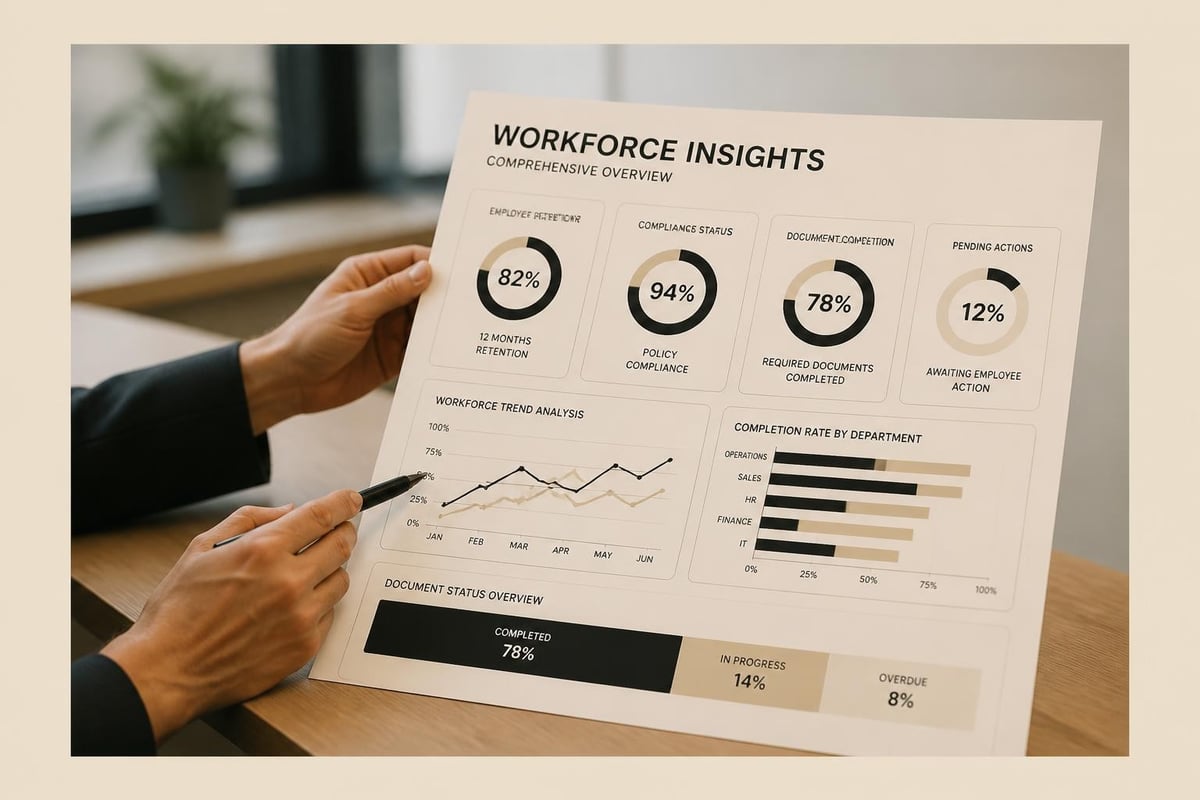
Employee records analytics dashboard

Implementation Roadmap

Transforming employee records management requires structured planning and phased execution. Organizations should approach implementation systematically rather than attempting wholesale change overnight.

Phase 1: Assessment and Planning (Weeks 1-4)

Begin by documenting current state processes, identifying pain points, and establishing success criteria. Conduct stakeholder interviews across HR, legal, IT, and business unit leadership. Research available solutions and evaluate build-versus-buy decisions.

Phase 2: System Selection and Design (Weeks 5-8)

Evaluate vendors based on functionality, integration capabilities, security features, and total cost of ownership. Design data structures, access permissions, and workflow automations. Develop migration strategies for existing records and establish data quality standards.

Phase 3: Pilot Implementation (Weeks 9-16)

Launch with a limited employee population or business unit to validate system configuration and identify issues before full deployment. Gather user feedback, refine processes, and document lessons learned. Train super-users who can support broader rollout.

Phase 4: Full Deployment (Weeks 17-26)

Expand systematically across the organization with robust change management support. Provide training tailored to different user roles and maintain readily accessible documentation. Monitor adoption metrics and address resistance proactively.

Phase 5: Optimization and Continuous Improvement (Ongoing)

After initial deployment, focus on maximizing value through advanced features, expanded integrations, and enhanced analytics. Conduct regular compliance audits and update retention schedules as regulations evolve. Solicit ongoing feedback and prioritize enhancements based on business impact.

Integration with Broader Business Systems

Employee records management delivers maximum value when integrated with complementary business systems. Standalone solutions create data silos and require duplicate entry, while integrated ecosystems enable information to flow seamlessly across organizational functions.

Key Integration Points

Modern employee records platforms should connect with:

  1. Applicant tracking systems transferring candidate information directly into employee files upon hire
  2. Payroll and HRIS platforms synchronizing compensation data, tax documents, and demographic information
  3. Performance management tools capturing evaluations, goals, and development plans within official records
  4. Learning management systems documenting training completion and certification records
  5. Time and attendance platforms maintaining accurate records of hours worked and leave taken
  6. Benefits administration systems storing enrollment elections, plan documents, and beneficiary designations

Payroll and Human Capital Management solutions that prioritize integration reduce manual effort, improve data accuracy, and provide comprehensive employee information through unified interfaces.

Organizations in hospitality and non-profit sectors particularly benefit from integrated systems that accommodate high-volume, variable workforces while maintaining compliance with limited administrative resources.

Future Trends in Employee Records Management

The employee records landscape continues evolving as technology advances and regulatory requirements expand. Organizations planning long-term strategies should consider emerging trends shaping future requirements.

Artificial Intelligence and Machine Learning

AI technologies are transforming employee records management through intelligent document classification, automated data extraction, and predictive compliance monitoring. Systems can now identify document types automatically, extract relevant data fields without manual entry, and flag potential compliance issues before they become violations.

Natural language processing enables sophisticated searching within unstructured documents, while machine learning algorithms identify patterns suggesting missing or inaccurate records. These capabilities reduce administrative burden while improving record quality and compliance.

Blockchain for Record Authentication

Blockchain technology offers potential solutions for verifying credential authenticity and maintaining tamper-proof employment records. Educational institutions and certification bodies increasingly issue blockchain-verified credentials that employers can validate instantly without contacting issuing organizations.

Smart contracts could automate record retention and disposal based on predetermined schedules, creating auditable trails of record lifecycle management. While still emerging, these applications warrant monitoring as adoption accelerates.

Enhanced Privacy Regulations

Privacy regulations continue expanding globally, with new requirements emerging regularly. The California Privacy Rights Act, European GDPR, and similar statutes impose strict controls on personal data collection, usage, and retention. Employee records fall squarely within these frameworks, requiring organizations to implement enhanced consent mechanisms, access controls, and data minimization practices.

Organizations must balance retention requirements with privacy mandates, keeping records long enough for compliance purposes while disposing of information no longer needed for legitimate business purposes. This tension requires careful policy development and system capabilities supporting granular data management.


Effective employee records management protects organizations legally while enabling operational efficiency and strategic workforce insights. Modern digital solutions combined with thoughtful processes transform compliance obligations into competitive advantages. Nero and Associates, Inc. helps organizations implement integrated Human Capital Management solutions that streamline records administration, ensure compliance, and empower data-driven decision-making. Our performance-based approach eliminates thousands of manual hours while positioning your workforce data as a strategic asset driving bottom-line results.

Employee Records: Essential Guide for Modern Businesses

Managing employee records effectively is a fundamental responsibility that impacts every organization's operational efficiency and legal compliance. In 2026, businesses face increasingly complex requirements surrounding personnel documentation, data privacy regulations, and retention policies. Understanding these obligations while implementing efficient systems can transform record management from a compliance burden into a strategic advantage. Organizations that excel at managing employee documentation not only protect themselves legally but also streamline human capital operations and improve decision-making capabilities.

Understanding the Scope of Employee Records

Employee records encompass all documentation related to an individual's employment journey within an organization. These records begin at recruitment and continue through separation, forming a comprehensive history of the employment relationship.

Core categories of employee records include:

  • Personal identification documents such as I-9 forms, Social Security information, and tax withholding forms
  • Compensation records including salary histories, commission statements, bonus documentation, and benefits enrollment
  • Performance materials such as evaluations, disciplinary actions, training certificates, and promotion records
  • Time and attendance data covering hours worked, leave requests, overtime authorization, and absence tracking
  • Employment agreements including offer letters, non-compete clauses, confidentiality agreements, and employment contracts

The EEOC requires employers to maintain specific records related to hiring, promotion, demotion, transfer, layoff, termination, rates of pay, and selection for training programs. These requirements apply to organizations with 15 or more employees and mandate retention periods ranging from one to three years depending on the document type.

Employee records lifecycle management

Beyond federal mandates, organizations must navigate state-specific regulations that often impose stricter requirements. Understanding employee record retention requirements by state helps businesses maintain compliance across multiple jurisdictions, particularly important for companies with distributed workforces.

Federal Compliance Requirements

The foundation of employee records compliance rests on federal statutes that establish minimum standards for documentation and retention. The Fair Labor Standards Act (FLSA), Age Discrimination in Employment Act (ADEA), and Title VII of the Civil Rights Act each impose specific recordkeeping obligations.

Mandatory Retention Periods

According to 29 CFR § 1627.3, employers must retain payroll records for at least three years. These records must include employee names, addresses, dates of birth, occupations, rates of pay, and weekly compensation amounts.

Record Type Minimum Retention Governing Law
Payroll Records 3 years FLSA
Personnel Files 1 year after separation Title VII
I-9 Forms 3 years or 1 year after separation IRCA
FMLA Documentation 3 years FMLA
Safety Records (OSHA) 5 years OSH Act
Benefits Plan Documents 6 years ERISA

Organizations implementing Human Capital Management solutions must ensure their systems accommodate these varied retention schedules while maintaining accessibility for audits and legitimate business purposes.

Privacy and Security Considerations

Employee records contain sensitive personal information that requires robust protection against unauthorized access and data breaches. The increasing digitization of personnel files creates both opportunities for efficiency and risks for security vulnerabilities.

Modern organizations must implement:

  1. Access controls limiting record visibility to personnel with legitimate business needs
  2. Encryption protocols for both stored data and information in transit
  3. Audit trails documenting who accessed records and when
  4. Data breach response plans addressing notification requirements and remediation steps
  5. Regular security assessments identifying vulnerabilities in record management systems

Building an Effective Records Management System

Transitioning from paper-based filing to digital employee records management delivers significant efficiency gains while supporting compliance objectives. However, this transition requires thoughtful planning and execution to avoid common pitfalls.

Digitization Strategy

Organizations embarking on digitization should prioritize records based on frequency of access, compliance risk, and physical storage costs. Active employee files typically warrant immediate conversion, while archived records may follow a phased approach.

Key implementation steps include:

  • Conducting a comprehensive inventory of existing records across all departments and locations
  • Establishing standardized naming conventions and folder structures for consistent organization
  • Selecting appropriate scanning equipment or service providers capable of handling volume requirements
  • Implementing optical character recognition (OCR) to enable searchability within scanned documents
  • Validating digital copies against originals to ensure accuracy and completeness

The complete guide to HR records management best practices emphasizes the importance of maintaining both digital accessibility and compliance with retention requirements during system transitions.

Digital employee records organization

Automation and Integration Opportunities

Advanced employee records management leverages automation to reduce manual data entry, minimize errors, and streamline routine processes. Integration with existing business systems creates a unified ecosystem where information flows seamlessly across platforms.

Organizations can automate:

  • New hire onboarding through electronic document collection and signature workflows
  • Performance review cycles with automated reminders and completion tracking
  • Compliance audits using scheduled reports identifying missing or expiring documents
  • Record disposal based on predetermined retention schedules and approval workflows
  • Access requests routing employee requests for record copies through appropriate channels

Automation and integration solutions eliminate thousands of hours previously spent on manual records administration while improving accuracy and reducing compliance risk. These efficiencies allow HR teams to redirect resources toward strategic initiatives that enhance employee experience and organizational performance.

Common Challenges and Solutions

Despite best intentions, many organizations struggle with employee records management due to resource constraints, competing priorities, and legacy systems. Recognizing these challenges enables proactive solutions.

Decentralized Record Storage

One frequent issue involves employee records scattered across multiple systems, departments, and physical locations. Hiring documents reside in one location, payroll records in another, and performance evaluations in yet another. This fragmentation creates inefficiency and compliance risk.

Solutions include:

  • Establishing a centralized records repository as the single source of truth
  • Implementing integration middleware connecting disparate systems
  • Creating clear policies designating official record locations
  • Conducting periodic audits verifying record completeness across all locations

Inconsistent Documentation Practices

Without standardized procedures, different managers may maintain varying levels of documentation quality. Some keep meticulous records while others maintain minimal files, creating exposure during audits or litigation.

Challenge Impact Solution
Missing required documents Compliance violations, penalties Automated checklists for each employee type
Incomplete performance documentation Difficulty defending employment decisions Required fields and approval workflows
Outdated information Inaccurate reporting, poor decisions Scheduled data validation campaigns
Unauthorized access Privacy violations, data breaches Role-based permissions and audit logging

Organizations serving enterprise clients and healthcare organizations particularly benefit from standardized documentation protocols that scale across large, complex workforces.

Retention Policy Violations

Keeping records too long creates unnecessary storage costs and litigation risk. Disposing of records prematurely violates compliance requirements and eliminates information needed for business decisions.

Effective employee records compliance requires documented retention schedules aligned with legal requirements, automated disposition workflows, and legal hold procedures suspending destruction when litigation is reasonably anticipated.

Strategic Value Beyond Compliance

While compliance drives initial attention to employee records management, forward-thinking organizations recognize strategic opportunities within their personnel data. Properly managed records enable workforce analytics, succession planning, and operational insights unavailable through fragmented systems.

Workforce Analytics

Comprehensive employee records support data-driven decision-making across talent management functions. Organizations can analyze:

  • Turnover patterns identifying retention risks by department, manager, or demographic group
  • Compensation equity ensuring fair pay across similar roles and experience levels
  • Training effectiveness correlating development programs with performance improvements
  • Recruitment efficiency measuring time-to-hire, source effectiveness, and offer acceptance rates
  • Performance trends spotting high-potential employees and areas requiring intervention

These insights inform strategic workforce planning and enable proactive responses to emerging challenges. Small and mid-market businesses particularly benefit from analytics capabilities previously available only to large enterprises.

Operational Efficiency

Streamlined employee records management reduces administrative burden across multiple functions. HR teams spend less time searching for documents and more time on value-added activities. Managers access performance histories instantly when coaching employees. Finance teams reconcile payroll discrepancies quickly with complete records.

According to employee record management best practices, organizations implementing modern systems typically reduce records-related administrative time by 40-60% while improving accuracy and compliance.

Employee records analytics dashboard

Implementation Roadmap

Transforming employee records management requires structured planning and phased execution. Organizations should approach implementation systematically rather than attempting wholesale change overnight.

Phase 1: Assessment and Planning (Weeks 1-4)

Begin by documenting current state processes, identifying pain points, and establishing success criteria. Conduct stakeholder interviews across HR, legal, IT, and business unit leadership. Research available solutions and evaluate build-versus-buy decisions.

Phase 2: System Selection and Design (Weeks 5-8)

Evaluate vendors based on functionality, integration capabilities, security features, and total cost of ownership. Design data structures, access permissions, and workflow automations. Develop migration strategies for existing records and establish data quality standards.

Phase 3: Pilot Implementation (Weeks 9-16)

Launch with a limited employee population or business unit to validate system configuration and identify issues before full deployment. Gather user feedback, refine processes, and document lessons learned. Train super-users who can support broader rollout.

Phase 4: Full Deployment (Weeks 17-26)

Expand systematically across the organization with robust change management support. Provide training tailored to different user roles and maintain readily accessible documentation. Monitor adoption metrics and address resistance proactively.

Phase 5: Optimization and Continuous Improvement (Ongoing)

After initial deployment, focus on maximizing value through advanced features, expanded integrations, and enhanced analytics. Conduct regular compliance audits and update retention schedules as regulations evolve. Solicit ongoing feedback and prioritize enhancements based on business impact.

Integration with Broader Business Systems

Employee records management delivers maximum value when integrated with complementary business systems. Standalone solutions create data silos and require duplicate entry, while integrated ecosystems enable information to flow seamlessly across organizational functions.

Key Integration Points

Modern employee records platforms should connect with:

  1. Applicant tracking systems transferring candidate information directly into employee files upon hire
  2. Payroll and HRIS platforms synchronizing compensation data, tax documents, and demographic information
  3. Performance management tools capturing evaluations, goals, and development plans within official records
  4. Learning management systems documenting training completion and certification records
  5. Time and attendance platforms maintaining accurate records of hours worked and leave taken
  6. Benefits administration systems storing enrollment elections, plan documents, and beneficiary designations

Payroll and Human Capital Management solutions that prioritize integration reduce manual effort, improve data accuracy, and provide comprehensive employee information through unified interfaces.

Organizations in hospitality and non-profit sectors particularly benefit from integrated systems that accommodate high-volume, variable workforces while maintaining compliance with limited administrative resources.

Future Trends in Employee Records Management

The employee records landscape continues evolving as technology advances and regulatory requirements expand. Organizations planning long-term strategies should consider emerging trends shaping future requirements.

Artificial Intelligence and Machine Learning

AI technologies are transforming employee records management through intelligent document classification, automated data extraction, and predictive compliance monitoring. Systems can now identify document types automatically, extract relevant data fields without manual entry, and flag potential compliance issues before they become violations.

Natural language processing enables sophisticated searching within unstructured documents, while machine learning algorithms identify patterns suggesting missing or inaccurate records. These capabilities reduce administrative burden while improving record quality and compliance.

Blockchain for Record Authentication

Blockchain technology offers potential solutions for verifying credential authenticity and maintaining tamper-proof employment records. Educational institutions and certification bodies increasingly issue blockchain-verified credentials that employers can validate instantly without contacting issuing organizations.

Smart contracts could automate record retention and disposal based on predetermined schedules, creating auditable trails of record lifecycle management. While still emerging, these applications warrant monitoring as adoption accelerates.

Enhanced Privacy Regulations

Privacy regulations continue expanding globally, with new requirements emerging regularly. The California Privacy Rights Act, European GDPR, and similar statutes impose strict controls on personal data collection, usage, and retention. Employee records fall squarely within these frameworks, requiring organizations to implement enhanced consent mechanisms, access controls, and data minimization practices.

Organizations must balance retention requirements with privacy mandates, keeping records long enough for compliance purposes while disposing of information no longer needed for legitimate business purposes. This tension requires careful policy development and system capabilities supporting granular data management.


Effective employee records management protects organizations legally while enabling operational efficiency and strategic workforce insights. Modern digital solutions combined with thoughtful processes transform compliance obligations into competitive advantages. Nero and Associates, Inc. helps organizations implement integrated Human Capital Management solutions that streamline records administration, ensure compliance, and empower data-driven decision-making. Our performance-based approach eliminates thousands of manual hours while positioning your workforce data as a strategic asset driving bottom-line results.

Website developed in accordance with Web Content Accessibility Guidelines 2.2.
If you encounter any issues while using this site, please contact us: 215.526.5126