

Employee turnover represents one of the most significant financial and operational challenges facing organizations today. The cost of replacing a single employee can range from 50% to 200% of their annual salary when accounting for recruitment, onboarding, training, and lost productivity. For professional services firms and consultancies, where expertise and client relationships are paramount, the impact multiplies exponentially. Effective retention strategies have become essential not just for reducing costs, but for maintaining competitive advantage, preserving institutional knowledge, and building sustainable growth.
Understanding the Business Case for Retention
The financial implications of employee turnover extend far beyond obvious recruitment costs. When talented professionals leave, they take with them years of accumulated knowledge, established client relationships, and cultural contributions that cannot be easily replaced. Organizations that fail to prioritize retention face cascading challenges including decreased team morale, overburdened remaining staff, and compromised service delivery.
Research consistently demonstrates that companies with strong retention strategies outperform their competitors across multiple metrics. These organizations report higher customer satisfaction scores, increased innovation, and stronger financial performance. The correlation between employee stability and business outcomes becomes particularly evident in professional services, where deep expertise and long-term client relationships drive revenue growth.
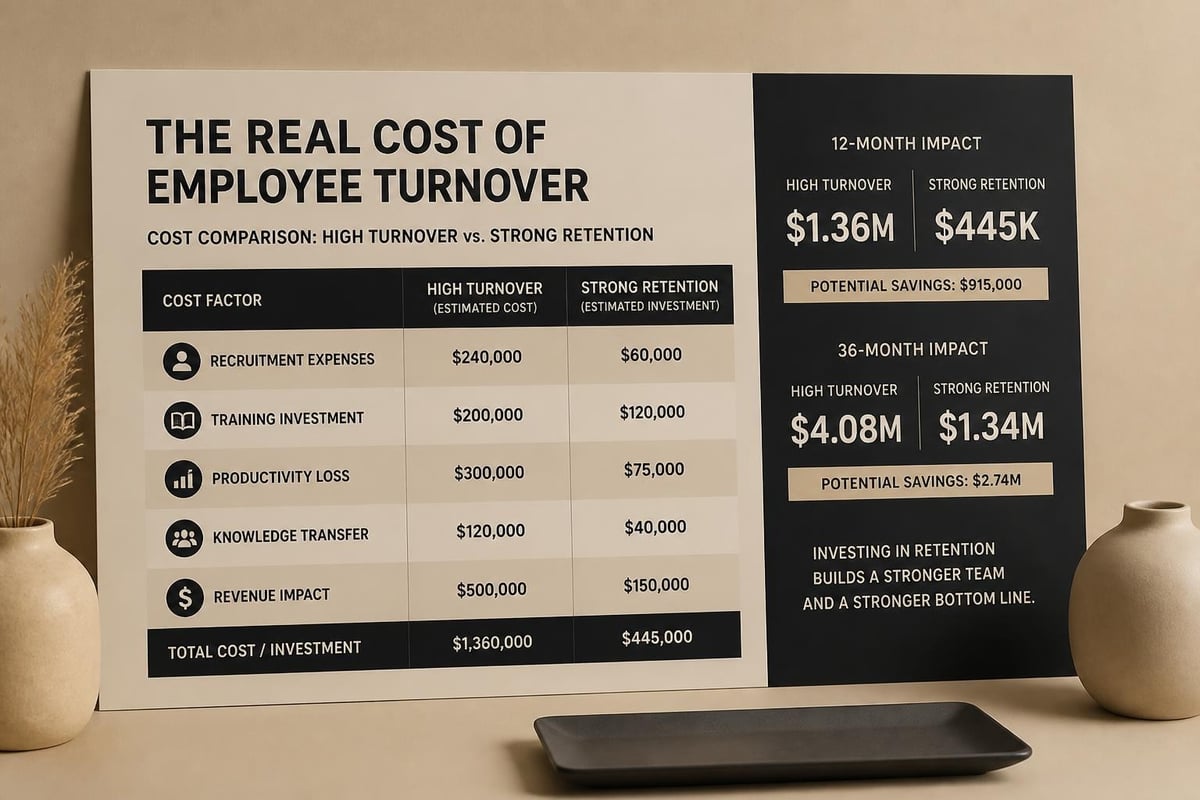
The True Cost of Turnover
Direct costs represent only the visible portion of turnover expenses. Hidden costs often dwarf the obvious expenditures:
- Recruitment and advertising for open positions
- Screening, interviewing, and selection time from HR and management
- Onboarding and training new employees to full productivity
- Lost productivity during the transition period
- Knowledge drain from departing expertise
- Client relationship disruption requiring relationship rebuilding
- Team morale impact affecting remaining employee engagement
According to comprehensive employee retention research, organizations that implement strategic retention initiatives see turnover reduction of 25% to 40% within the first year. This improvement translates directly to bottom-line savings and operational efficiency gains that compound over time.
Developing Competitive Compensation Frameworks
Compensation remains the foundation of any effective retention strategy. While money alone cannot ensure loyalty, inadequate compensation guarantees dissatisfaction and turnover. Organizations must approach compensation strategically, balancing competitiveness with sustainability.
Market-competitive base salaries establish the baseline expectation. However, total compensation packages increasingly differentiate employers in competitive talent markets. Performance-based bonuses, profit sharing arrangements, and equity participation create alignment between individual contribution and organizational success.
Beyond Base Salary
Modern compensation strategies incorporate multiple elements:
| Compensation Component | Impact on Retention | Implementation Complexity |
|---|---|---|
| Base Salary | High | Low |
| Performance Bonuses | High | Medium |
| Profit Sharing | Medium | Medium |
| Equity/Ownership | Very High | High |
| Benefits Package | High | Medium |
| Retirement Contributions | Medium | Low |
Organizations should conduct annual compensation benchmarking against industry standards and geographic markets. This data-driven approach ensures offerings remain competitive while identifying specific areas requiring adjustment. Transparency around compensation philosophy and advancement pathways also strengthens employee confidence in long-term earning potential.
The Best Practice Institute’s retention playbook emphasizes that compensation strategies must align with organizational values and business objectives to create sustainable retention improvements.
Creating Meaningful Professional Development Pathways
Career advancement opportunities rank among the top factors influencing employee retention decisions. Professionals seek environments where they can expand capabilities, assume greater responsibilities, and progress toward meaningful career goals. Organizations that invest in learning and development consultants create cultures where growth becomes embedded in daily operations.
Structured development programs should address both technical skill enhancement and leadership capacity building. Individual development plans establish clear pathways from current roles to future opportunities, making advancement tangible rather than abstract.
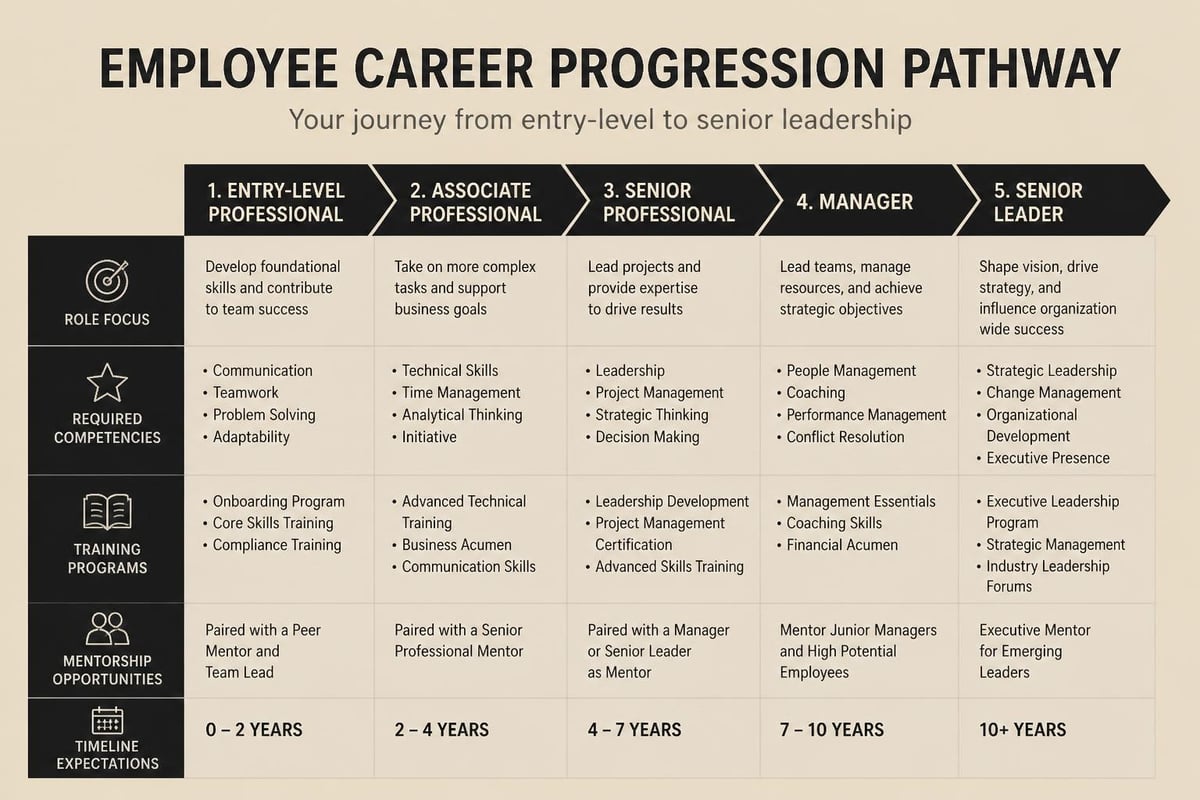
Building Comprehensive Development Programs
Effective professional development initiatives include multiple learning modalities:
- Formal training programs covering technical and soft skills
- Mentorship relationships pairing experienced leaders with emerging talent
- Cross-functional projects exposing employees to different business areas
- Conference and certification funding for industry expertise
- Internal mobility programs facilitating lateral and upward movement
- Leadership development tracks preparing future organizational leaders
Organizations should allocate specific budgets for employee development, typically ranging from 1% to 5% of total compensation expense. This investment demonstrates commitment to growth while building capabilities that enhance organizational performance. Companies utilizing human capital management solutions can track development participation, skill acquisition, and career progression systematically.
Optimizing Workplace Culture and Environment
Culture represents the daily lived experience of employees. While mission statements and values posters communicate aspirations, actual culture manifests through behaviors, decisions, and norms. Organizations with strong retention track records cultivate environments where employees feel valued, respected, and connected to meaningful work.
Psychological safety forms the foundation of healthy workplace culture. Employees must feel comfortable voicing concerns, proposing ideas, and acknowledging mistakes without fear of retaliation. This openness drives innovation, problem-solving, and continuous improvement while building trust between team members and leadership.
Cultural Elements That Drive Retention
Work-life integration has evolved beyond traditional balance concepts. Modern retention strategies recognize that employees have complex lives requiring flexibility and understanding. Remote work options, flexible scheduling, and results-oriented work environments demonstrate respect for employee autonomy while maintaining accountability for outcomes.
Recognition and appreciation represent powerful retention tools that cost little but deliver significant impact. Regular acknowledgment of contributions, both large and small, reinforces positive behaviors and strengthens employee connection to organizational success. Formal recognition programs should complement informal day-to-day appreciation from managers and peers.
According to employee retention experts, organizations that prioritize employee experience through cultural investments see retention rates 30% to 50% higher than industry averages. The connection between positive workplace culture and employee longevity proves consistently across industries and organization sizes.
Implementing Comprehensive Wellness Programs
Employee wellbeing directly impacts retention, productivity, and organizational performance. Comprehensive wellness initiatives address mental, physical, and financial health dimensions, recognizing that employees bring their whole selves to work. Organizations that implement robust wellness programs demonstrate genuine care for employee welfare beyond mere productivity concerns.
Mental health support has emerged as a critical retention factor, particularly as workplace stress and burnout reach epidemic levels. Employee assistance programs, mental health days, counseling services, and stress management resources provide essential support infrastructure.
Wellness Program Components
| Wellness Dimension | Program Elements | Retention Impact |
|---|---|---|
| Physical Health | Gym memberships, health screenings, wellness challenges | Medium-High |
| Mental Health | EAP, counseling, stress management, mental health days | Very High |
| Financial Wellness | Financial planning, debt management, retirement education | High |
| Work-Life Integration | Flexible scheduling, remote work, PTO policies | Very High |
| Social Connection | Team building, employee resource groups, social events | Medium |
Financial wellness programs address a significant source of employee stress. Solutions that empower employees to manage debt, build savings, and plan for retirement reduce anxiety while demonstrating organizational investment in long-term employee success. These programs particularly resonate with younger employees facing student loan burdens and uncertain economic conditions.
Organizations should integrate wellness into operational rhythms rather than treating it as separate initiatives. Walking meetings, mindfulness practices, and workload management become embedded in how work gets done, creating sustainable wellness rather than periodic programs.
Leveraging Technology for Retention Insights
Data-driven retention strategies outperform intuition-based approaches. Modern organizations leverage analytics to identify retention risks, understand departure patterns, and predict future turnover. Human capital management technology provides the infrastructure for collecting, analyzing, and acting on retention-relevant data.
Predictive analytics identify employees at higher flight risk based on engagement scores, tenure patterns, compensation positioning, and performance trends. These insights enable proactive interventions before valued employees begin active job searches.
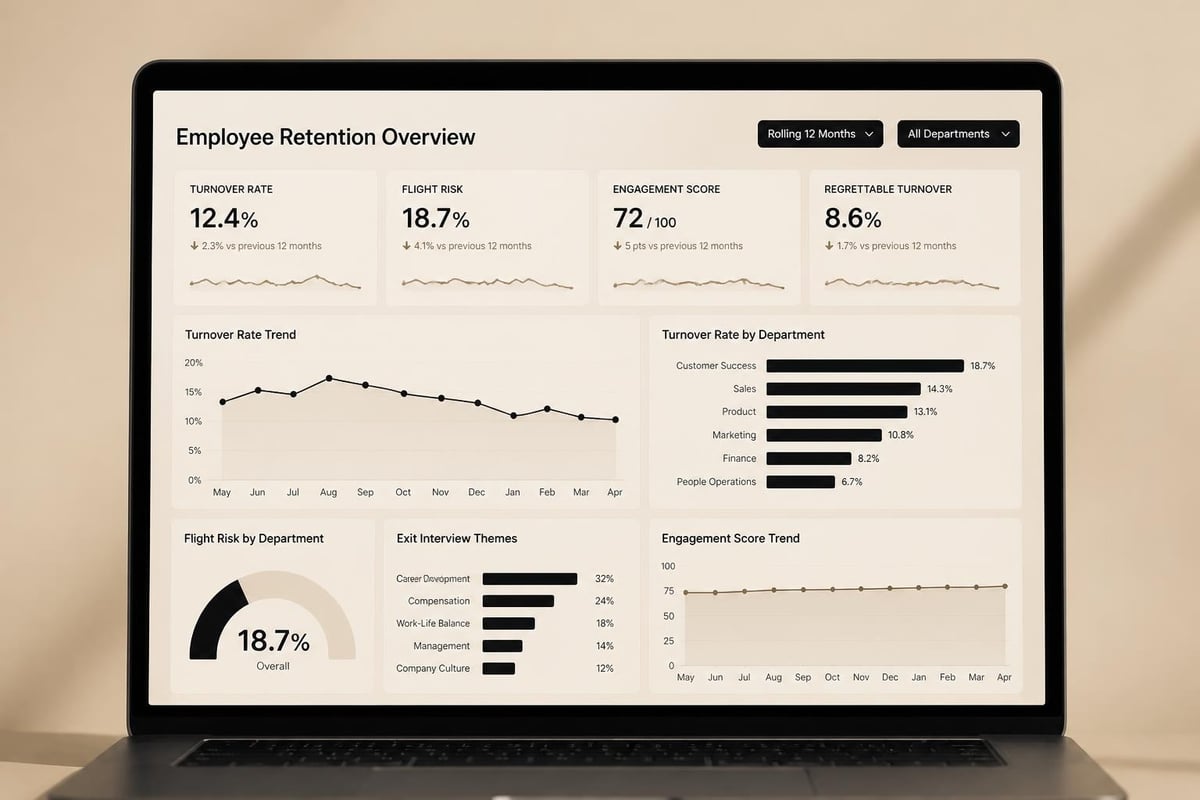
Key Retention Metrics
Organizations should track multiple retention indicators:
- Overall turnover rate measuring total departures against headcount
- Voluntary versus involuntary turnover distinguishing resignation from termination
- Regrettable turnover focusing on high-performer departures
- Time to productivity for new hires indicating onboarding effectiveness
- Retention by tenure revealing critical flight-risk periods
- Department and role-specific patterns identifying hotspots
- Cost per hire tracking recruitment investment efficiency
Regular pulse surveys and engagement assessments provide leading indicators of retention challenges. Rather than waiting for annual surveys, frequent check-ins identify emerging issues while they remain addressable. Exit interviews, when conducted thoughtfully, yield invaluable insights into organizational weaknesses and improvement opportunities.
Research on employee retention strategies demonstrates that organizations using data analytics for retention decisions reduce turnover 20% to 35% compared to those relying on reactive approaches.
Strengthening Manager Effectiveness
The relationship between employees and direct managers represents the single most influential factor in retention decisions. The old adage that "people don't leave companies, they leave managers" contains substantial truth. Organizations must invest in developing manager capabilities around coaching, feedback, recognition, and development.
Manager training should address both technical aspects of performance management and interpersonal skills essential for building strong working relationships. Effective managers create clarity around expectations, provide regular feedback, advocate for team member advancement, and buffer their teams from unnecessary organizational friction.
Essential Manager Competencies
First-line managers require specific capabilities to drive retention:
- Regular one-on-one meetings providing dedicated attention and coaching
- Clear goal setting connecting individual work to organizational objectives
- Constructive feedback delivered timely and specifically
- Career development discussions exploring growth opportunities and aspirations
- Recognition and appreciation acknowledging contributions meaningfully
- Workload management preventing burnout through reasonable assignments
- Advocacy and support representing team interests to senior leadership
Organizations should evaluate and reward managers based partly on retention metrics within their teams. This accountability ensures retention becomes a management priority rather than merely an HR concern. 360-degree feedback processes help managers understand their impact on team member experience and identify development areas.
The strategies for retaining top talent emphasize that manager development investments yield returns far exceeding their costs through improved retention and team performance.
Designing Thoughtful Onboarding Experiences
First impressions significantly influence long-term retention. Comprehensive onboarding programs set new employees up for success by providing necessary tools, knowledge, and connections. Organizations with structured onboarding see 50% higher new hire retention compared to those with ad hoc approaches.
Effective onboarding extends beyond first-week paperwork and orientation sessions. Research indicates that onboarding should span 90 to 180 days, progressively integrating new employees into organizational culture, team dynamics, and role responsibilities.
Onboarding Program Elements
Structured onboarding includes:
- Pre-arrival preparation ensuring workspace, technology, and access readiness
- First-day welcome creating positive initial experience with team introduction
- Role-specific training building necessary technical and procedural knowledge
- Cultural immersion communicating values, norms, and expectations
- Relationship building facilitating connections with colleagues and mentors
- 30-60-90 day milestones establishing clear success indicators and checkpoints
- Feedback loops gathering new hire perspectives on experience and needs
Organizations utilizing professional consultancy services to optimize operational processes can apply similar rigor to onboarding design, treating new hire integration as a critical business process requiring measurement and continuous improvement.
Building Internal Mobility Infrastructure
Career development increasingly occurs through lateral moves and cross-functional opportunities rather than purely vertical advancement. Organizations that facilitate internal mobility retain ambitious employees who might otherwise seek external opportunities for growth and variety.
Internal job posting systems, transfer policies, and cross-training programs create pathways for employees to explore different roles without leaving the organization. This approach retains institutional knowledge while filling positions with candidates who already understand organizational culture and operations.
Creating Mobility Opportunities
Internal mobility programs should balance employee interests with organizational needs. Transparent communication about available opportunities, clear qualification requirements, and supportive managers who encourage exploration rather than hoarding talent enable healthy internal movement.
Organizations might implement rotational programs, temporary assignments, or project-based opportunities allowing employees to test different areas before committing to permanent moves. These experiences build broader organizational understanding while developing versatile capabilities.
According to comprehensive retention strategy guides, companies with robust internal mobility programs report 30% lower external turnover among employees who have made at least one internal move.
Fostering Meaningful Work and Purpose
Employees increasingly seek work that provides meaning beyond paychecks. Connection to organizational mission, understanding of impact, and alignment with personal values influence retention decisions, particularly among younger workforce segments.
Organizations should regularly communicate how individual contributions connect to broader objectives and stakeholder outcomes. Client success stories, community impact reports, and mission reinforcement help employees understand their work's significance.
Purpose-Driven Retention Approaches
Meaningful work manifests through several channels:
- Mission clarity articulating organizational purpose and societal contribution
- Impact visibility demonstrating how individual work creates client and community value
- Values alignment ensuring organizational actions match stated principles
- Social responsibility engaging in community service and ethical business practices
- Autonomy and ownership empowering employees to shape their work approaches
- Innovation encouragement welcoming new ideas and improvement suggestions
Professional services organizations can emphasize the transformative impact of their client work, whether achieving operational efficiency, improving revenue cycle performance, or enhancing employee benefits programs. This connection between daily tasks and meaningful outcomes strengthens employee engagement and commitment.
Adapting Retention Strategies to Organizational Context
No universal retention strategy fits all organizations. Context matters tremendously. Industry dynamics, organizational size, geographic location, workforce demographics, and business model all influence which retention strategies prove most effective.
Small organizations may emphasize flexibility, close-knit culture, and rapid advancement opportunities. Large enterprises might leverage comprehensive benefits, established career pathways, and specialized development programs. Professional services firms should focus on intellectual challenge, client impact, and expertise development.
Customization Factors
Organizations should consider multiple factors when designing retention strategies:
| Factor | Considerations | Strategy Implications |
|---|---|---|
| Organization Size | Resource availability, bureaucracy levels, promotion speed | Small: flexibility, rapid advancement; Large: structured programs, resources |
| Industry | Competition intensity, skill specificity, growth trajectory | High-growth: equity, advancement; Mature: stability, expertise |
| Geography | Cost of living, competitive density, remote work norms | Urban: compensation focus; Rural: lifestyle emphasis |
| Demographics | Age distribution, career stage, family status | Younger: development, purpose; Experienced: flexibility, recognition |
| Business Model | Client relationship importance, team structure | Client-facing: relationship continuity; Project-based: variety, learning |
Organizations should assess their specific retention challenges through data analysis, employee feedback, and competitive benchmarking before designing interventions. Strategic consulting approaches help identify the highest-impact retention opportunities given organizational constraints and priorities.
Measuring Retention Strategy Effectiveness
Implementation without measurement wastes resources and misses improvement opportunities. Organizations must establish clear metrics, track progress consistently, and adjust strategies based on results. Retention strategy effectiveness assessment should examine both leading indicators (engagement, satisfaction) and lagging indicators (actual turnover).
Regular reporting to leadership ensures retention remains a strategic priority rather than tactical HR activity. Dashboard views of key retention metrics enable quick identification of emerging problems and successful interventions worthy of expansion.
Retention Measurement Framework
Comprehensive retention measurement includes:
- Quarterly turnover analysis tracking trends and identifying patterns
- Retention rate by cohort examining tenure-based retention curves
- Engagement survey results providing leading indicators of flight risk
- Stay interview insights understanding what keeps current employees engaged
- Exit interview themes learning why departures occur
- Cost-benefit analysis of retention program investments
- Benchmarking against industry standards contextualizing performance
Organizations implementing retention strategies should expect 12 to 18 months before seeing significant impact in overall turnover metrics. Leading indicators like engagement scores and manager effectiveness ratings typically show improvement within six months.
Resources like the employee retention strategies guide provide frameworks for measuring program effectiveness and identifying improvement opportunities through systematic evaluation.
Successful retention strategies require coordinated efforts across compensation, development, culture, wellness, and management effectiveness dimensions, all supported by data-driven decision-making and continuous refinement. Organizations that approach retention strategically position themselves for sustainable competitive advantage through workforce stability and institutional knowledge preservation. Nero and Associates, Inc. partners with organizations to optimize human capital management, implement automation solutions that eliminate manual processes, and develop comprehensive employee wellness programs that drive retention while improving operational efficiency and financial performance.