

The Fair Labor Standards Act remains one of the most critical employment laws affecting businesses across every industry in 2026. Despite being enacted nearly nine decades ago, many organizations still struggle with FLSA compliance, leading to costly lawsuits, penalties, and damaged employee relationships. For organizations seeking operational efficiency and cost savings, understanding and implementing proper compliance measures is not just about avoiding legal trouble-it's about creating fair, transparent workplace practices that support both business objectives and employee wellbeing. Whether you're managing a small team or overseeing enterprise-level operations, mastering these regulations is essential for sustainable growth.
Understanding FLSA Fundamentals
The Fair Labor Standards Act establishes minimum wage, overtime pay, recordkeeping, and child labor standards affecting full-time and part-time workers in the private sector and in federal, state, and local governments. The law's core provisions touch virtually every aspect of workforce management.
Key provisions include:
- Minimum wage requirements (currently $7.25 per hour federally, though many states have higher rates)
- Overtime pay at time-and-a-half for hours worked beyond 40 in a workweek
- Child labor protections limiting hours and types of work for minors
- Recordkeeping obligations for employers
- Employee classification standards
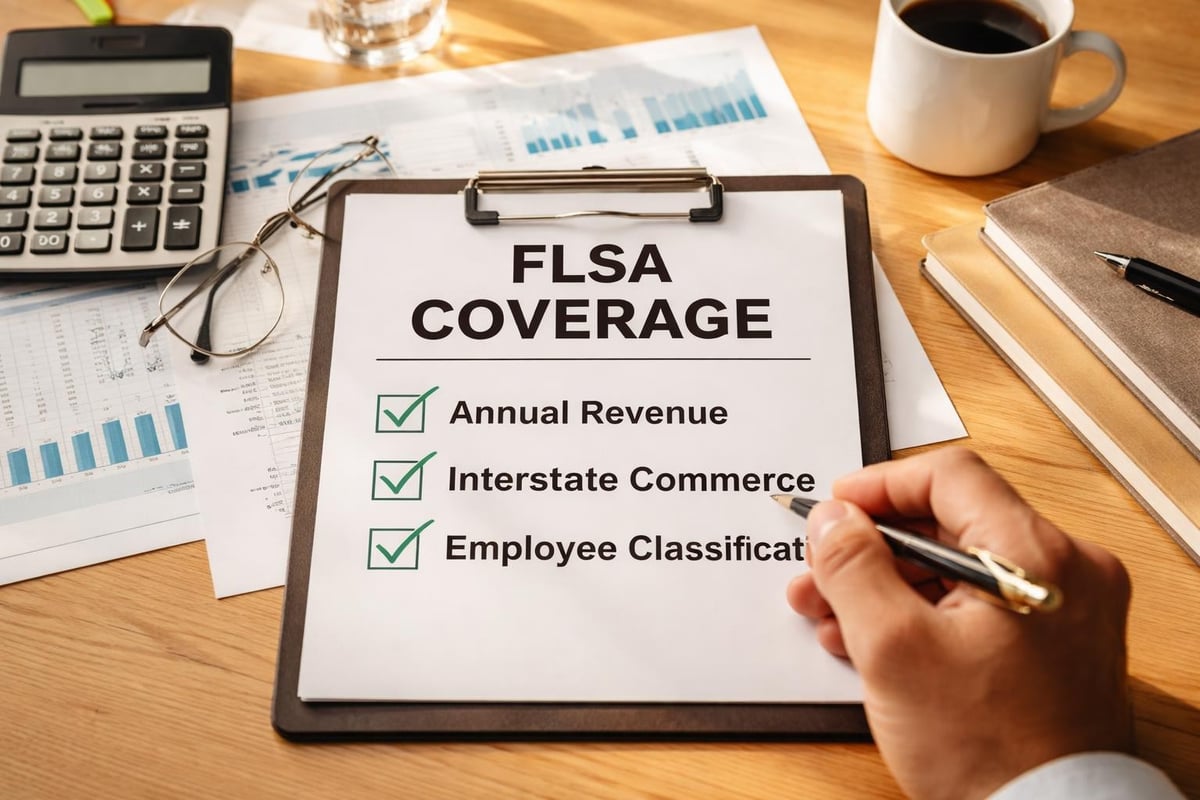
These fundamentals apply to most employers with annual dollar volume of sales or business done of at least $500,000. However, workers may be covered even when the enterprise does not meet this threshold if they engage in interstate commerce or the production of goods for interstate commerce.
The Cost of Non-Compliance
FLSA violations carry significant financial and reputational consequences. In 2025 alone, the Department of Labor recovered over $274 million in back wages for workers, with individual cases sometimes reaching millions in settlements. Beyond monetary penalties, companies face increased scrutiny, employee morale issues, and potential class-action lawsuits.
Organizations prioritizing Human Capital Management recognize that compliance isn't merely a defensive strategy. It's a foundational element of workforce optimization that protects both the business and its most valuable asset-its people.
Employee Classification: The Foundation of FLSA Compliance
Proper employee classification represents the single most critical aspect of FLSA compliance. The distinction between exempt and non-exempt employees determines who receives overtime pay, how hours are tracked, and what recordkeeping requirements apply.
Exempt vs. Non-Exempt Status
Non-exempt employees must receive overtime pay for hours worked beyond 40 in a workweek. Exempt employees, conversely, are not entitled to overtime regardless of hours worked. However, exemption status is not a choice-it's determined by specific criteria outlined in the FLSA.
| Classification Factor | Exempt Requirements | Non-Exempt Characteristics |
|---|---|---|
| Salary Basis | Must receive predetermined salary not subject to reduction | May be paid hourly or salary |
| Salary Level | Minimum $684 per week ($35,568 annually) as of 2026 | No minimum requirement |
| Duties Test | Must perform exempt duties per Executive, Administrative, or Professional categories | Performs non-exempt work primarily |
| Discretion | Exercises independent judgment on significant matters | Follows established procedures |
Common Classification Pitfalls
Many businesses make the mistake of classifying employees as exempt simply because they receive a salary or hold a management title. This approach creates substantial compliance risk. The duties test requires careful analysis of what employees actually do day-to-day, not just what their job description states.
Frequent misclassification scenarios include:
- Administrative assistants classified as exempt despite primarily clerical duties
- "Assistant managers" who spend most time performing non-managerial tasks
- IT help desk staff classified as exempt without true professional-level duties
- Sales employees misclassified under outside sales exemption while working primarily from office
For healthcare organizations, classification becomes even more complex with specialized roles like nurses, technicians, and administrative staff requiring individualized analysis.
Overtime Calculation and Payment Requirements
Calculating overtime correctly goes beyond simply paying time-and-a-half for hours over 40. Many compensation elements must be included in the regular rate calculation, creating complexity that catches unprepared employers off guard.
Components of Regular Rate
The regular rate includes all remuneration for employment except certain statutory exclusions. This means bonuses, commissions, shift differentials, and certain other payments must be factored into overtime calculations.
Included in regular rate:
- Hourly wages or salary
- Non-discretionary bonuses
- Commission payments
- Production bonuses
- Shift differentials
Excluded from regular rate:
- Discretionary bonuses
- Gifts for special occasions
- Paid time off payments
- Premium pay for weekend/holiday work (under certain conditions)
- Reimbursement of expenses
The Fluctuating Workweek Method
Some organizations use the fluctuating workweek method for salaried non-exempt employees whose hours vary week to week. This approach pays a fixed salary for all hours worked, then adds half-time overtime premium for hours over 40. While potentially cost-effective, this method requires specific conditions and clear communication with employees to maintain FLSA compliance.

Recordkeeping Requirements and Best Practices
Comprehensive FLSA compliance resources emphasize that accurate recordkeeping is not optional-it's a legal requirement. The FLSA mandates that employers maintain specific records for at least three years, with payroll records kept for two years.
Required Records
Every employer must maintain records showing the following information for each non-exempt employee:
- Personal information (name, address, occupation, sex, birth date if under 19)
- Hour and day when workweek begins
- Total hours worked each workday and workweek
- Total daily or weekly straight-time earnings
- Regular hourly pay rate for weeks when overtime is worked
- Total overtime pay for the workweek
- Deductions from or additions to wages
- Total wages paid each pay period
- Date of payment and pay period covered
Modern Recordkeeping Solutions
Organizations leveraging automation and integration technologies can transform recordkeeping from a compliance burden into a strategic advantage. Automated time-tracking systems, integrated payroll platforms, and AI-powered compliance monitoring tools reduce manual errors while providing real-time visibility into potential issues.
For enterprise organizations managing thousands of employees across multiple locations, these technologies become essential for maintaining consistent FLSA compliance at scale.
Special Considerations for Different Industries
FLSA compliance manifests differently across industries, with sector-specific challenges requiring tailored approaches.
Hospitality and Service Industries
The hospitality sector faces unique compliance challenges including tip credits, fluctuating schedules, and high employee turnover. Employers taking tip credits must ensure tipped employees receive minimum wage when tips are combined with direct wages, maintain accurate tip records, and properly notify employees of tip credit provisions.
Healthcare Sector Complexities
Healthcare organizations navigate additional layers of complexity with 24/7 operations, on-call time, sleep time for overnight shifts, and highly specialized professional roles. Determining whether time spent on-call constitutes compensable hours requires analyzing the degree of freedom employees have during on-call periods.
SMB and Mid-Market Organizations
Small and mid-sized businesses often lack dedicated compliance teams, making systematic approaches to FLSA compliance essential. These organizations benefit most from implementing scalable processes and technologies that grow with the business while maintaining compliance standards.
Auditing and Risk Assessment
Proactive compliance audits identify vulnerabilities before they become costly violations. A comprehensive FLSA audit examines classification decisions, pay practices, timekeeping procedures, and recordkeeping systems.
Conducting an Effective FLSA Audit
Phase 1: Classification Review
- Identify all positions currently classified as exempt
- Gather actual job descriptions and duty logs
- Apply duties tests objectively to each role
- Document rationale for all classification decisions
Phase 2: Pay Practice Analysis
- Review overtime calculation methods
- Verify regular rate calculations include all required elements
- Examine bonus and commission payment timing
- Check for unauthorized deductions
Phase 3: System and Process Evaluation
- Assess timekeeping accuracy and completeness
- Verify recordkeeping meets retention requirements
- Review approval workflows for time and pay
- Test system controls and edit checks
Detailed FLSA requirements provide the framework for thorough auditing procedures that protect organizations from compliance risks.
Policy Development and Employee Communication
Effective FLSA compliance requires clear policies and transparent communication. Employees who understand how they're classified, how their pay is calculated, and what's expected regarding timekeeping are more likely to comply with procedures and less likely to file complaints.
Essential Policy Components
| Policy Area | Key Elements | Communication Method |
|---|---|---|
| Classification | Exempt vs. non-exempt status, criteria applied | Individual notification, employee handbook |
| Timekeeping | Recording requirements, break policies, rounding rules | Training sessions, written procedures |
| Overtime | Authorization process, calculation method, payment timing | Manager training, employee orientation |
| Breaks and Meal Periods | Duration, compensability, documentation | Posted notices, handbook |
Training and Ongoing Education
Managers making scheduling and staffing decisions need thorough training on FLSA requirements. They should understand which employees are non-exempt, how to approve overtime appropriately, and the importance of accurate timekeeping. Annual refresher training keeps compliance top of mind as regulations evolve.
Technology Solutions for Compliance Management
In 2026, organizations have access to sophisticated tools that transform FLSA compliance from a manual, error-prone process into an automated, strategic function. The right technology stack supports compliance while generating insights that improve workforce management.
Core Technology Components
Automated Time and Attendance Systems capture employee hours electronically, apply company policies consistently, flag potential violations in real-time, and integrate with payroll systems to ensure accurate payment.
Payroll Platforms with built-in compliance features automatically calculate overtime using current rates, include required compensation in regular rate calculations, generate required records, and provide audit trails for all transactions.
Analytics and Monitoring Tools identify patterns indicating misclassification risk, track overtime trends by department or manager, monitor policy compliance across the organization, and generate reports for audit purposes.
Organizations implementing these solutions report significant reductions in compliance incidents, administrative time savings, and improved accuracy in pay calculations.
State and Local Variations
While the FLSA sets federal minimums, many states and localities have enacted more stringent requirements. Employers must comply with whichever standard-federal, state, or local-provides greater employee protection.
Common State Variations
- Higher minimum wages: Many states exceed the federal $7.25 minimum
- Daily overtime: Some states require overtime for hours over 8 in a day, not just 40 in a week
- Different exemption tests: California, for example, requires a higher salary threshold and more restrictive duties tests
- Meal and rest break mandates: Several states require specific breaks not mandated federally
Multi-state employers face particular challenges maintaining FLSA compliance across jurisdictions. Centralized policies must accommodate local variations, and payroll systems must apply location-specific rules correctly. For private equity firms managing portfolio companies across multiple states, standardizing compliance processes while respecting local requirements becomes a critical value-creation opportunity.
Responding to Complaints and Investigations
Despite best efforts, organizations may face FLSA complaints or Department of Labor investigations. How businesses respond can significantly impact outcomes.
Investigation Process
When the DOL receives a complaint, investigators typically contact the employer to schedule an on-site visit. During this visit, they'll review records, interview employees, and assess compliance with FLSA requirements. Cooperation and transparency generally lead to better outcomes than defensiveness or obstruction.
Best practices during investigations include:
- Designate a single point of contact for investigator communications
- Provide requested records promptly and completely
- Avoid volunteering information beyond what's requested
- Consult legal counsel before making substantive statements
- Document all interactions with investigators
- Begin remediation of identified issues immediately
Self-Correction Options
The DOL's Self-Audit Program allows employers to voluntarily identify and correct violations. Employers who discover violations through internal audits may be able to resolve issues with reduced penalties by proactively addressing problems before formal complaints arise.
Best Practices for Sustainable Compliance
Long-term FLSA compliance requires embedding compliance thinking into organizational culture and operational processes.
Building a Compliance Culture
Leadership Commitment: Executives must visibly prioritize compliance, allocating appropriate resources and holding managers accountable for compliance in their areas.
Regular Training: Beyond initial onboarding, ongoing education ensures all stakeholders understand current requirements and their responsibilities.
Clear Accountability: Assign specific individuals responsibility for compliance monitoring, policy updates, and issue resolution.
Open Communication: Create channels for employees to ask questions and report concerns without fear of retaliation.
Continuous Improvement
FLSA compliance is not a one-time project but an ongoing process requiring regular review and refinement. Schedule periodic audits, monitor regulatory changes, update policies as needed, and leverage technology to identify improvement opportunities. Organizations treating compliance as a continuous improvement initiative rather than a checkbox exercise build sustainable systems that protect the business while supporting employee fairness.
Integrating Compliance with Business Strategy
Forward-thinking organizations recognize that FLSA compliance aligns with broader business objectives around operational efficiency, employee engagement, and risk management. When compliance processes are streamlined through automation, organizations free up resources for strategic initiatives. When employees trust that they're being paid fairly and accurately, engagement and retention improve. When compliance risks are minimized, businesses protect their financial stability and reputation.
This integration becomes particularly powerful for organizations focused on eliminating manual processes and improving operational efficiency. Automated compliance systems not only reduce violation risk-they eliminate thousands of hours previously spent on manual calculations, record reconciliation, and administrative tasks.
Maintaining FLSA compliance in 2026 requires a comprehensive approach combining accurate classification, proper overtime calculations, meticulous recordkeeping, and ongoing monitoring. Organizations that view compliance as an opportunity to improve operations rather than merely a legal obligation position themselves for sustainable success. Nero and Associates, Inc. helps organizations transform compliance challenges into strategic advantages through automation, integration, and Human Capital Management solutions that save costs, eliminate manual processes, and create fair, efficient workplace practices. Contact us to discover how performance-based consulting can strengthen your compliance while driving bottom-line results.