
FSA Administration: Essential Guide for Business Leaders

Share on Facebook
Share on X
Share on LinkedIn

Managing employee benefits effectively remains one of the most complex yet critical responsibilities for modern organizations. Flexible Spending Accounts (FSAs) represent a powerful tool that benefits both employers and employees when administered correctly. As we navigate the evolving landscape of employee wellness and financial health in 2026, understanding the intricacies of fsa administration has become essential for organizations seeking to maximize value while maintaining compliance. This comprehensive guide explores the strategic, operational, and technical aspects that business leaders must master to deliver exceptional FSA programs.

Understanding FSA Administration Fundamentals

FSA administration encompasses the complete lifecycle of managing flexible spending accounts, from initial plan design through ongoing compliance and employee support. These tax-advantaged accounts allow employees to set aside pre-tax dollars for qualified medical expenses and dependent care costs, creating immediate value for both parties.

The core administrative responsibilities extend far beyond simple account setup. Organizations must navigate IRS regulations, maintain accurate documentation, process claims efficiently, and ensure continuous compliance with changing federal requirements. Effective fsa administration requires coordinating multiple stakeholders, including payroll systems, benefits platforms, third-party administrators, and internal HR teams.

Key Components of Effective FSA Programs

Modern fsa administration integrates several critical elements that work together to create a seamless experience:

  • Eligibility management and enrollment processing
  • Contribution tracking and payroll integration
  • Claims adjudication and reimbursement workflows
  • Compliance monitoring and regulatory reporting
  • Employee communication and education initiatives
  • Plan year management including carryovers and grace periods

Organizations that excel in these areas typically leverage automation and integration solutions to reduce manual processes and minimize administrative burden. The shift toward integrated platforms has transformed how companies approach benefits administration, enabling real-time data synchronization and improved accuracy.

Strategic Planning for FSA Implementation

Implementing a robust FSA program requires careful strategic planning that aligns with organizational objectives and employee needs. The planning phase determines long-term success and significantly impacts adoption rates.

Conducting Comprehensive Needs Assessment

Before launching or optimizing an FSA program, organizations must evaluate their workforce demographics, existing benefits utilization, and financial wellness goals. This assessment reveals which FSA types deliver maximum value.

Healthcare FSAs appeal broadly to employees with predictable medical expenses, while dependent care FSAs specifically benefit working parents and caregivers. Understanding your workforce composition guides contribution limit recommendations and communication strategies. Many organizations find that employees significantly underutilize FSAs due to lack of awareness, making education a critical component of fsa administration.

FSA program planning workflow

Establishing Administrative Infrastructure

The infrastructure supporting your FSA program determines operational efficiency and employee satisfaction. Organizations face a fundamental choice between self-administration and partnering with third-party administrators (TPAs).

Approach Advantages Challenges Best For
Self-Administration Complete control, lower ongoing costs, direct employee relationships High compliance risk, resource intensive, requires expertise Large enterprises with dedicated benefits teams
Third-Party Administrator Compliance expertise, proven systems, reduced internal burden Additional costs, less control, vendor dependency Most organizations seeking efficiency
Hybrid Model Balanced control and support, customizable approach Complexity in coordination, requires clear boundaries Organizations with specific internal capabilities

Selecting the right administrative approach fundamentally shapes your program's operational characteristics. The Federal Student Aid Handbook’s administrative requirements demonstrates the importance of clear procedures and compliance frameworks, principles that translate effectively to corporate FSA programs.

Operational Excellence in Daily FSA Management

Day-to-day fsa administration demands attention to detail, process consistency, and responsive employee support. Organizations that streamline these operations create superior experiences while reducing administrative costs.

Enrollment and Contribution Management

The enrollment period represents the foundation of annual fsa administration. Clear communication about contribution limits, eligible expenses, and use-it-or-lose-it provisions ensures employees make informed decisions.

For 2026, contribution limits continue reflecting inflation adjustments and legislative changes. Administrators must communicate these limits clearly while helping employees estimate appropriate contribution levels. The FSA calculator tools available online enable employees to project potential tax savings, supporting more confident enrollment decisions.

Payroll integration stands as perhaps the most critical technical component of fsa administration. Contribution deductions must process accurately each pay period, with proper tax treatment and timely fund transfers to FSA accounts. Errors in this area create compliance issues and employee dissatisfaction.

Claims Processing and Reimbursement

Efficient claims processing directly impacts employee perception of FSA value. Modern fsa administration leverages automated substantiation, electronic claim submission, and integration with payment card systems to accelerate reimbursements.

The claims workflow typically includes these steps:

  1. Employee submits claim with supporting documentation
  2. System validates expense against eligible categories
  3. Administrator reviews flagged or complex claims
  4. Approval triggers reimbursement via direct deposit or check
  5. System updates account balance and transaction history
  6. Documentation archived for compliance purposes

Organizations implementing automated claims processing reduce administrative time by up to 75% compared to manual review systems. This efficiency gain allows administrators to focus on complex cases and employee support rather than routine transaction processing.

Claims processing automation

Compliance and Regulatory Management

Maintaining compliance represents a non-negotiable aspect of fsa administration. The regulatory environment governing FSAs includes IRS guidelines, ERISA requirements, and various federal employment laws.

Essential Compliance Requirements

Plan document maintenance ensures your FSA operates according to written specifications that comply with current regulations. These documents must reflect actual operational practices and incorporate any regulatory changes.

Regular compliance reviews should assess:

  • Contribution limit adherence and proper tax treatment
  • Eligible expense categories and substantiation requirements
  • Non-discrimination testing to ensure equitable access
  • COBRA continuation rights for qualified beneficiaries
  • HIPAA privacy protections for health FSA participants
  • Documentation retention according to regulatory timelines

The USDA's approach to program administration policies in their Farm Loan Programs illustrates the importance of comprehensive policy frameworks and clear regulatory guidance, principles equally applicable to corporate FSA programs.

Audit Preparedness and Documentation

Maintaining audit-ready documentation protects organizations during IRS reviews or DOL investigations. Complete records demonstrate good-faith compliance efforts even when minor errors occur.

Critical documentation includes plan documents, summary plan descriptions, enrollment forms, contribution records, claims substantiation, and non-discrimination testing results. Many organizations leverage document management systems integrated with their fsa administration platforms to maintain organized, accessible records.

Technology Integration and Automation

Modern fsa administration increasingly relies on sophisticated technology platforms that integrate with broader human capital management systems. These solutions transform administrative efficiency and employee experience.

Platform Selection Criteria

When evaluating FSA administration technology, organizations should prioritize:

  • Seamless payroll integration ensuring accurate contribution processing
  • Mobile-friendly interfaces for employee self-service
  • Automated substantiation reducing manual claim review
  • Real-time reporting enabling proactive management
  • Compliance monitoring with automatic regulatory updates
  • Multi-plan support for organizations offering various FSA types

The shift toward integrated platforms aligns with broader trends in human capital management where organizations seek unified systems rather than disconnected point solutions.

Automation Opportunities

Process automation dramatically reduces the manual burden associated with fsa administration. Key automation opportunities include:

Process Manual Approach Automated Approach Time Savings
Enrollment data entry 15-20 min per employee Automatic from self-service 95% reduction
Claims substantiation 5-10 min per claim Instant for card transactions 90% reduction
Compliance reporting 8-16 hours quarterly Automated generation 85% reduction
Employee inquiries 10-15 min per contact Self-service knowledge base 70% reduction

Organizations implementing comprehensive automation typically recover their technology investment within 12-18 months through reduced administrative time and improved accuracy.

Employee Engagement and Education

Even the most well-designed FSA program delivers limited value if employees don't understand or utilize it effectively. Strategic communication and ongoing education drive engagement and maximize program benefits.

Developing Effective Communication Strategies

Successful fsa administration includes year-round communication, not just enrollment period messaging. Employees need regular reminders about FSA benefits, eligible expenses, and claim submission procedures.

Multi-channel communication reaches diverse employee populations effectively. Consider these approaches:

  • Monthly email newsletters highlighting FSA tips and reminders
  • Quarterly webinars explaining eligible expenses and claims processes
  • Mobile app notifications about account balances and deadlines
  • Personalized statements showing potential tax savings
  • Manager toolkits enabling frontline supervisors to answer basic questions

The educational component should address common misconceptions, particularly the "use-it-or-lose-it" rule. While this provision concerns employees, explaining carryover provisions and grace periods reduces anxiety and encourages appropriate participation.

Maximizing Participation and Utilization

Higher FSA participation rates benefit both organizations and employees through increased tax savings. Strategies to boost enrollment include:

  1. Simplifying the enrollment process through intuitive digital platforms
  2. Providing decision support tools like contribution calculators
  3. Sharing success stories from participating employees
  4. Offering enrollment assistance during benefits fairs and open enrollment
  5. Sending targeted communications to eligible non-participants

Organizations serving healthcare and hospitality sectors often find that employees in these industries particularly value dependent care FSAs given shift work patterns and childcare needs.
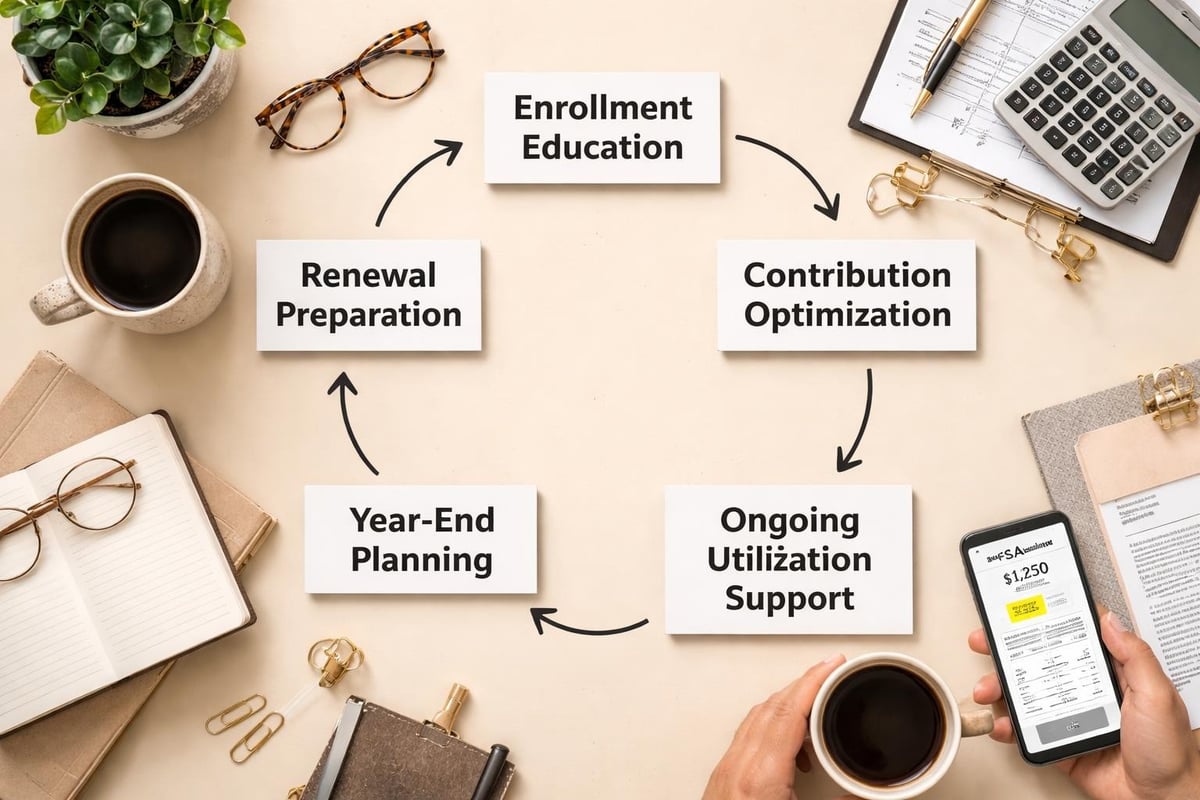
Employee FSA education journey

Advanced FSA Administration Strategies

Organizations mastering basic fsa administration can implement advanced strategies that further enhance value and differentiate their benefits offerings.

Optimizing Plan Design Features

Carryover provisions allow participants to roll over up to $640 (2026 limit) from one plan year to the next, reducing forfeiture anxiety. Alternatively, organizations may offer a grace period extending the spending deadline by 2.5 months. Careful analysis of workforce preferences and utilization patterns guides which approach better serves your population.

Contribution strategies vary by organization size and philosophy. Some employers contribute seed money to healthcare FSAs, demonstrating commitment to employee wellness while encouraging participation. Others focus on education and tools rather than direct contributions.

Integrating FSAs with Broader Wellness Initiatives

Leading organizations recognize that fsa administration supports comprehensive employee wellness strategies. FSAs complement other programs by:

  • Funding preventive care and wellness program copays through healthcare FSAs
  • Supporting work-life balance through dependent care FSAs
  • Reducing financial stress by increasing take-home pay through tax savings
  • Enabling proactive health management through accessible healthcare funding

This integration aligns perfectly with the financial wellness priorities many organizations now emphasize as part of total rewards packages.

Measuring FSA Program Success

Data-driven fsa administration enables continuous improvement and demonstrates program value to organizational leadership. Establishing clear metrics and regular reporting ensures accountability and identifies optimization opportunities.

Key Performance Indicators

Monitor these metrics to assess FSA program health:

  • Participation rate (percentage of eligible employees enrolled)
  • Average contribution amounts by FSA type
  • Claims processing time from submission to reimbursement
  • Forfeiture rates indicating potential over-contribution or underutilization
  • Employee satisfaction scores from benefits surveys
  • Administrative cost per participant tracking operational efficiency
  • Tax savings generated for both employees and organization

Organizations should track these metrics quarterly, with comprehensive annual reviews informing plan design adjustments.

Benchmarking and Continuous Improvement

Comparing your FSA program against industry benchmarks identifies strengths and improvement opportunities. Consider participation rates, contribution levels, and administrative costs relative to similar organizations in your sector.

The information disclosure procedures outlined by government agencies demonstrate the value of transparency and data accessibility, principles that enhance corporate FSA program management through clear reporting and stakeholder communication.

Risk Management in FSA Administration

Proactive risk management protects organizations from compliance penalties, financial losses, and reputational damage associated with FSA program failures.

Common Risk Areas

Payroll errors represent one of the most frequent risk points in fsa administration. Incorrect contribution amounts, missed deductions, or improper tax treatment create employee dissatisfaction and potential compliance issues. Robust payroll integration with verification checkpoints minimizes these risks.

Improper substantiation occurs when claims receive payment without adequate documentation of eligible expenses. While automated substantiation reduces this risk for card transactions, manual claims require careful review processes.

Non-discrimination failures happen when FSA benefits disproportionately favor highly compensated employees. Annual testing identifies these issues before they create tax consequences.

Implementing Controls and Safeguards

Effective controls protect your FSA program:

  • Regular reconciliation between payroll contributions and FSA account balances
  • Documented procedures for claim review and approval
  • Segregation of duties preventing single-person control over critical processes
  • Annual compliance audits by qualified benefits professionals
  • Error correction procedures addressing issues promptly and consistently
  • Employee communication about changes or corrections maintaining transparency

Organizations with robust revenue cycle management experience often apply similar control frameworks to their fsa administration, leveraging expertise across operational domains.

Special Considerations for Different Organization Types

FSA administration requirements and best practices vary based on organization size, industry, and workforce characteristics.

Small and Mid-Sized Businesses

SMBs often benefit most from partnering with experienced TPAs who provide expertise and systems that would be cost-prohibitive to develop internally. The key is selecting vendors who offer appropriate service levels without enterprise-level pricing.

Resource constraints make automation particularly valuable for smaller organizations. Even basic FSA platforms dramatically reduce administrative burden compared to manual spreadsheet tracking.

Enterprise Organizations

Large organizations face complexity from multiple business units, diverse workforce populations, and varying state regulations. Centralized fsa administration with local support teams often provides the right balance between consistency and responsiveness.

Scalability becomes critical as enrollment numbers reach thousands or tens of thousands of participants. Enterprise platforms must handle volume efficiently while maintaining data accuracy and security.

Private Equity Portfolio Companies

Private equity firms increasingly recognize that optimized benefits administration, including FSAs, contributes to portfolio company value creation. Standardizing fsa administration across portfolio companies while maintaining flexibility for industry-specific needs requires sophisticated program design.


Mastering fsa administration creates measurable value through tax savings, operational efficiency, and enhanced employee financial wellness. Organizations that approach FSA programs strategically, implement robust operational processes, leverage appropriate technology, and maintain rigorous compliance position themselves for sustainable success in supporting workforce health and financial security. Nero and Associates, Inc. helps organizations transform benefits administration through automation, integration, and strategic optimization, enabling companies to reduce administrative burden while improving employee engagement and program outcomes.

FSA Administration: Essential Guide for Business Leaders

Managing employee benefits effectively remains one of the most complex yet critical responsibilities for modern organizations. Flexible Spending Accounts (FSAs) represent a powerful tool that benefits both employers and employees when administered correctly. As we navigate the evolving landscape of employee wellness and financial health in 2026, understanding the intricacies of fsa administration has become essential for organizations seeking to maximize value while maintaining compliance. This comprehensive guide explores the strategic, operational, and technical aspects that business leaders must master to deliver exceptional FSA programs.

Understanding FSA Administration Fundamentals

FSA administration encompasses the complete lifecycle of managing flexible spending accounts, from initial plan design through ongoing compliance and employee support. These tax-advantaged accounts allow employees to set aside pre-tax dollars for qualified medical expenses and dependent care costs, creating immediate value for both parties.

The core administrative responsibilities extend far beyond simple account setup. Organizations must navigate IRS regulations, maintain accurate documentation, process claims efficiently, and ensure continuous compliance with changing federal requirements. Effective fsa administration requires coordinating multiple stakeholders, including payroll systems, benefits platforms, third-party administrators, and internal HR teams.

Key Components of Effective FSA Programs

Modern fsa administration integrates several critical elements that work together to create a seamless experience:

  • Eligibility management and enrollment processing
  • Contribution tracking and payroll integration
  • Claims adjudication and reimbursement workflows
  • Compliance monitoring and regulatory reporting
  • Employee communication and education initiatives
  • Plan year management including carryovers and grace periods

Organizations that excel in these areas typically leverage automation and integration solutions to reduce manual processes and minimize administrative burden. The shift toward integrated platforms has transformed how companies approach benefits administration, enabling real-time data synchronization and improved accuracy.

Strategic Planning for FSA Implementation

Implementing a robust FSA program requires careful strategic planning that aligns with organizational objectives and employee needs. The planning phase determines long-term success and significantly impacts adoption rates.

Conducting Comprehensive Needs Assessment

Before launching or optimizing an FSA program, organizations must evaluate their workforce demographics, existing benefits utilization, and financial wellness goals. This assessment reveals which FSA types deliver maximum value.

Healthcare FSAs appeal broadly to employees with predictable medical expenses, while dependent care FSAs specifically benefit working parents and caregivers. Understanding your workforce composition guides contribution limit recommendations and communication strategies. Many organizations find that employees significantly underutilize FSAs due to lack of awareness, making education a critical component of fsa administration.

FSA program planning workflow

Establishing Administrative Infrastructure

The infrastructure supporting your FSA program determines operational efficiency and employee satisfaction. Organizations face a fundamental choice between self-administration and partnering with third-party administrators (TPAs).

Approach Advantages Challenges Best For
Self-Administration Complete control, lower ongoing costs, direct employee relationships High compliance risk, resource intensive, requires expertise Large enterprises with dedicated benefits teams
Third-Party Administrator Compliance expertise, proven systems, reduced internal burden Additional costs, less control, vendor dependency Most organizations seeking efficiency
Hybrid Model Balanced control and support, customizable approach Complexity in coordination, requires clear boundaries Organizations with specific internal capabilities

Selecting the right administrative approach fundamentally shapes your program's operational characteristics. The Federal Student Aid Handbook’s administrative requirements demonstrates the importance of clear procedures and compliance frameworks, principles that translate effectively to corporate FSA programs.

Operational Excellence in Daily FSA Management

Day-to-day fsa administration demands attention to detail, process consistency, and responsive employee support. Organizations that streamline these operations create superior experiences while reducing administrative costs.

Enrollment and Contribution Management

The enrollment period represents the foundation of annual fsa administration. Clear communication about contribution limits, eligible expenses, and use-it-or-lose-it provisions ensures employees make informed decisions.

For 2026, contribution limits continue reflecting inflation adjustments and legislative changes. Administrators must communicate these limits clearly while helping employees estimate appropriate contribution levels. The FSA calculator tools available online enable employees to project potential tax savings, supporting more confident enrollment decisions.

Payroll integration stands as perhaps the most critical technical component of fsa administration. Contribution deductions must process accurately each pay period, with proper tax treatment and timely fund transfers to FSA accounts. Errors in this area create compliance issues and employee dissatisfaction.

Claims Processing and Reimbursement

Efficient claims processing directly impacts employee perception of FSA value. Modern fsa administration leverages automated substantiation, electronic claim submission, and integration with payment card systems to accelerate reimbursements.

The claims workflow typically includes these steps:

  1. Employee submits claim with supporting documentation
  2. System validates expense against eligible categories
  3. Administrator reviews flagged or complex claims
  4. Approval triggers reimbursement via direct deposit or check
  5. System updates account balance and transaction history
  6. Documentation archived for compliance purposes

Organizations implementing automated claims processing reduce administrative time by up to 75% compared to manual review systems. This efficiency gain allows administrators to focus on complex cases and employee support rather than routine transaction processing.

Claims processing automation

Compliance and Regulatory Management

Maintaining compliance represents a non-negotiable aspect of fsa administration. The regulatory environment governing FSAs includes IRS guidelines, ERISA requirements, and various federal employment laws.

Essential Compliance Requirements

Plan document maintenance ensures your FSA operates according to written specifications that comply with current regulations. These documents must reflect actual operational practices and incorporate any regulatory changes.

Regular compliance reviews should assess:

  • Contribution limit adherence and proper tax treatment
  • Eligible expense categories and substantiation requirements
  • Non-discrimination testing to ensure equitable access
  • COBRA continuation rights for qualified beneficiaries
  • HIPAA privacy protections for health FSA participants
  • Documentation retention according to regulatory timelines

The USDA's approach to program administration policies in their Farm Loan Programs illustrates the importance of comprehensive policy frameworks and clear regulatory guidance, principles equally applicable to corporate FSA programs.

Audit Preparedness and Documentation

Maintaining audit-ready documentation protects organizations during IRS reviews or DOL investigations. Complete records demonstrate good-faith compliance efforts even when minor errors occur.

Critical documentation includes plan documents, summary plan descriptions, enrollment forms, contribution records, claims substantiation, and non-discrimination testing results. Many organizations leverage document management systems integrated with their fsa administration platforms to maintain organized, accessible records.

Technology Integration and Automation

Modern fsa administration increasingly relies on sophisticated technology platforms that integrate with broader human capital management systems. These solutions transform administrative efficiency and employee experience.

Platform Selection Criteria

When evaluating FSA administration technology, organizations should prioritize:

  • Seamless payroll integration ensuring accurate contribution processing
  • Mobile-friendly interfaces for employee self-service
  • Automated substantiation reducing manual claim review
  • Real-time reporting enabling proactive management
  • Compliance monitoring with automatic regulatory updates
  • Multi-plan support for organizations offering various FSA types

The shift toward integrated platforms aligns with broader trends in human capital management where organizations seek unified systems rather than disconnected point solutions.

Automation Opportunities

Process automation dramatically reduces the manual burden associated with fsa administration. Key automation opportunities include:

Process Manual Approach Automated Approach Time Savings
Enrollment data entry 15-20 min per employee Automatic from self-service 95% reduction
Claims substantiation 5-10 min per claim Instant for card transactions 90% reduction
Compliance reporting 8-16 hours quarterly Automated generation 85% reduction
Employee inquiries 10-15 min per contact Self-service knowledge base 70% reduction

Organizations implementing comprehensive automation typically recover their technology investment within 12-18 months through reduced administrative time and improved accuracy.

Employee Engagement and Education

Even the most well-designed FSA program delivers limited value if employees don't understand or utilize it effectively. Strategic communication and ongoing education drive engagement and maximize program benefits.

Developing Effective Communication Strategies

Successful fsa administration includes year-round communication, not just enrollment period messaging. Employees need regular reminders about FSA benefits, eligible expenses, and claim submission procedures.

Multi-channel communication reaches diverse employee populations effectively. Consider these approaches:

  • Monthly email newsletters highlighting FSA tips and reminders
  • Quarterly webinars explaining eligible expenses and claims processes
  • Mobile app notifications about account balances and deadlines
  • Personalized statements showing potential tax savings
  • Manager toolkits enabling frontline supervisors to answer basic questions

The educational component should address common misconceptions, particularly the "use-it-or-lose-it" rule. While this provision concerns employees, explaining carryover provisions and grace periods reduces anxiety and encourages appropriate participation.

Maximizing Participation and Utilization

Higher FSA participation rates benefit both organizations and employees through increased tax savings. Strategies to boost enrollment include:

  1. Simplifying the enrollment process through intuitive digital platforms
  2. Providing decision support tools like contribution calculators
  3. Sharing success stories from participating employees
  4. Offering enrollment assistance during benefits fairs and open enrollment
  5. Sending targeted communications to eligible non-participants

Organizations serving healthcare and hospitality sectors often find that employees in these industries particularly value dependent care FSAs given shift work patterns and childcare needs.

Employee FSA education journey

Advanced FSA Administration Strategies

Organizations mastering basic fsa administration can implement advanced strategies that further enhance value and differentiate their benefits offerings.

Optimizing Plan Design Features

Carryover provisions allow participants to roll over up to $640 (2026 limit) from one plan year to the next, reducing forfeiture anxiety. Alternatively, organizations may offer a grace period extending the spending deadline by 2.5 months. Careful analysis of workforce preferences and utilization patterns guides which approach better serves your population.

Contribution strategies vary by organization size and philosophy. Some employers contribute seed money to healthcare FSAs, demonstrating commitment to employee wellness while encouraging participation. Others focus on education and tools rather than direct contributions.

Integrating FSAs with Broader Wellness Initiatives

Leading organizations recognize that fsa administration supports comprehensive employee wellness strategies. FSAs complement other programs by:

  • Funding preventive care and wellness program copays through healthcare FSAs
  • Supporting work-life balance through dependent care FSAs
  • Reducing financial stress by increasing take-home pay through tax savings
  • Enabling proactive health management through accessible healthcare funding

This integration aligns perfectly with the financial wellness priorities many organizations now emphasize as part of total rewards packages.

Measuring FSA Program Success

Data-driven fsa administration enables continuous improvement and demonstrates program value to organizational leadership. Establishing clear metrics and regular reporting ensures accountability and identifies optimization opportunities.

Key Performance Indicators

Monitor these metrics to assess FSA program health:

  • Participation rate (percentage of eligible employees enrolled)
  • Average contribution amounts by FSA type
  • Claims processing time from submission to reimbursement
  • Forfeiture rates indicating potential over-contribution or underutilization
  • Employee satisfaction scores from benefits surveys
  • Administrative cost per participant tracking operational efficiency
  • Tax savings generated for both employees and organization

Organizations should track these metrics quarterly, with comprehensive annual reviews informing plan design adjustments.

Benchmarking and Continuous Improvement

Comparing your FSA program against industry benchmarks identifies strengths and improvement opportunities. Consider participation rates, contribution levels, and administrative costs relative to similar organizations in your sector.

The information disclosure procedures outlined by government agencies demonstrate the value of transparency and data accessibility, principles that enhance corporate FSA program management through clear reporting and stakeholder communication.

Risk Management in FSA Administration

Proactive risk management protects organizations from compliance penalties, financial losses, and reputational damage associated with FSA program failures.

Common Risk Areas

Payroll errors represent one of the most frequent risk points in fsa administration. Incorrect contribution amounts, missed deductions, or improper tax treatment create employee dissatisfaction and potential compliance issues. Robust payroll integration with verification checkpoints minimizes these risks.

Improper substantiation occurs when claims receive payment without adequate documentation of eligible expenses. While automated substantiation reduces this risk for card transactions, manual claims require careful review processes.

Non-discrimination failures happen when FSA benefits disproportionately favor highly compensated employees. Annual testing identifies these issues before they create tax consequences.

Implementing Controls and Safeguards

Effective controls protect your FSA program:

  • Regular reconciliation between payroll contributions and FSA account balances
  • Documented procedures for claim review and approval
  • Segregation of duties preventing single-person control over critical processes
  • Annual compliance audits by qualified benefits professionals
  • Error correction procedures addressing issues promptly and consistently
  • Employee communication about changes or corrections maintaining transparency

Organizations with robust revenue cycle management experience often apply similar control frameworks to their fsa administration, leveraging expertise across operational domains.

Special Considerations for Different Organization Types

FSA administration requirements and best practices vary based on organization size, industry, and workforce characteristics.

Small and Mid-Sized Businesses

SMBs often benefit most from partnering with experienced TPAs who provide expertise and systems that would be cost-prohibitive to develop internally. The key is selecting vendors who offer appropriate service levels without enterprise-level pricing.

Resource constraints make automation particularly valuable for smaller organizations. Even basic FSA platforms dramatically reduce administrative burden compared to manual spreadsheet tracking.

Enterprise Organizations

Large organizations face complexity from multiple business units, diverse workforce populations, and varying state regulations. Centralized fsa administration with local support teams often provides the right balance between consistency and responsiveness.

Scalability becomes critical as enrollment numbers reach thousands or tens of thousands of participants. Enterprise platforms must handle volume efficiently while maintaining data accuracy and security.

Private Equity Portfolio Companies

Private equity firms increasingly recognize that optimized benefits administration, including FSAs, contributes to portfolio company value creation. Standardizing fsa administration across portfolio companies while maintaining flexibility for industry-specific needs requires sophisticated program design.


Mastering fsa administration creates measurable value through tax savings, operational efficiency, and enhanced employee financial wellness. Organizations that approach FSA programs strategically, implement robust operational processes, leverage appropriate technology, and maintain rigorous compliance position themselves for sustainable success in supporting workforce health and financial security. Nero and Associates, Inc. helps organizations transform benefits administration through automation, integration, and strategic optimization, enabling companies to reduce administrative burden while improving employee engagement and program outcomes.

Website developed in accordance with Web Content Accessibility Guidelines 2.2.
If you encounter any issues while using this site, please contact us: 215.526.5126