

Gap Coverage: Essential Protection for Your Business Assets

Share on Facebook
Share on X
Share on LinkedIn

Organizations face countless financial risks in their daily operations, from equipment purchases to fleet management. One often-overlooked exposure occurs when the actual cash value of an asset falls below what's owed on a loan or lease. This financial shortfall creates a vulnerable position that can impact your bottom line, drain operational budgets, and disrupt strategic initiatives. Understanding gap coverage becomes essential for any business committed to protecting its financial health while maintaining efficient operations. This protection mechanism addresses the difference between insurance payouts and outstanding debt obligations, safeguarding organizations from unexpected financial burdens that can derail growth plans and strain resources.

Understanding the Financial Gap in Business Operations

Gap coverage fills the space between what your insurance company pays when an asset is totaled or stolen and what you still owe to a lender. This difference emerges because vehicles and equipment depreciate rapidly while loan balances decrease slowly, especially in the early years of financing.

Consider a common scenario: Your company purchases a delivery van for $45,000 with a five-year loan. After 18 months, the vehicle is totaled in an accident. The insurance company determines the actual cash value at $32,000, but your outstanding loan balance sits at $38,000. Without gap coverage, your organization faces a $6,000 loss that must come from operating capital.

How Depreciation Creates Financial Exposure

Vehicle depreciation follows a predictable pattern that creates maximum exposure early in the ownership cycle. New vehicles typically lose 20-30% of their value within the first year, while loan principal reduction moves much more gradually through standard amortization schedules.

Key depreciation factors include:

  • Initial purchase price and down payment amount
  • Vehicle make, model, and market demand
  • Usage patterns and mileage accumulation
  • Maintenance history and condition
  • Market conditions and economic factors

The U.S. Consumer Financial Protection Bureau defines Guaranteed Asset Protection as insurance that covers the difference between the actual cash value and the outstanding balance on a loan or lease. This federal definition establishes the foundation for understanding how businesses can protect themselves from depreciation-related losses.
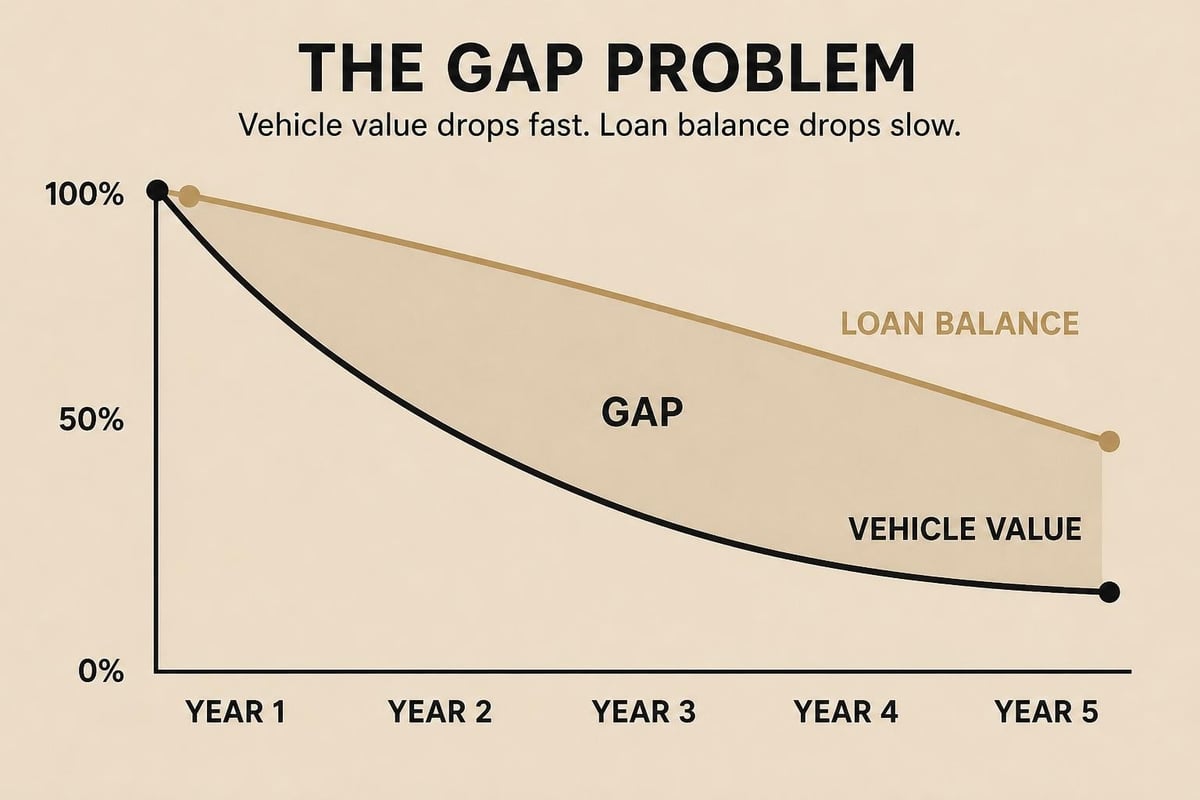
Asset depreciation versus loan paydown timeline

When Gap Coverage Makes Strategic Sense

Not every business vehicle or equipment purchase requires gap coverage, but specific circumstances create higher risk profiles that justify this protection. Strategic decision-making requires evaluating your financing terms, asset types, and operational requirements.

High-Risk Scenarios for Organizations

Organizations face elevated gap exposure when combining certain financing characteristics with specific operational patterns. Long-term loans naturally create larger gaps because principal reduction occurs slowly over extended periods.

Situations where gap coverage provides maximum value:

  1. Minimal down payments: Less than 20% down creates immediate negative equity
  2. Extended loan terms: Financing beyond 60 months increases gap duration
  3. Rapid depreciation vehicles: Luxury vehicles and specialized equipment lose value quickly
  4. High-mileage operations: Delivery fleets and service vehicles depreciate faster
  5. Lease agreements: Most leases create automatic gap exposure

According to Triple-I’s analysis of gap insurance, businesses with long-term loans and vehicles that depreciate rapidly benefit most from this coverage. Their research demonstrates how specific combinations of factors multiply risk exposure.

Cost-Benefit Analysis for Business Protection

Gap coverage typically costs between $400 and $700 when purchased through a dealer, or $20-40 annually when added to an existing commercial auto insurance policy. This relatively modest investment protects against potential losses ranging from $3,000 to $10,000 or more.

Purchase Method Typical Cost Coverage Duration Flexibility
Dealer/Lender $400-$700 (one-time) Length of loan Limited, often non-refundable
Insurance Company $20-$40/year Annual renewal High, can cancel anytime
Standalone Policy $200-$500 (one-time) Loan term Moderate, some refund options

The dramatic price difference between dealer-offered and insurer-provided gap coverage reflects markup practices and bundling strategies. Organizations seeking operational efficiency should compare both options carefully, considering total cost of ownership and cancellation flexibility.

Integrating Gap Coverage into Risk Management

Effective risk management requires viewing gap coverage as one component within a comprehensive protection strategy. Forward-thinking organizations align their coverage decisions with broader operational goals, financial planning, and asset management practices.

Aligning Protection with Business Objectives

Gap coverage decisions should reflect your organization's risk tolerance, cash flow patterns, and growth trajectory. Companies focused on maximizing operational efficiency recognize that unexpected financial losses divert resources from strategic initiatives.

Integration strategies include:

  • Coordinating gap coverage with fleet replacement cycles
  • Evaluating coverage needs during annual insurance reviews
  • Building coverage costs into total cost of ownership calculations
  • Aligning protection levels with risk management policies
  • Documenting coverage decisions for audit and compliance purposes

The AAA explanation of gap insurance demonstrates how this coverage interacts with actual cash value determinations and loan balances. Understanding these interactions helps businesses make informed decisions about when coverage provides genuine value versus representing unnecessary expense.

Policy Exclusions and Limitations

Gap coverage doesn't protect against all financial scenarios. Standard policies contain specific exclusions that organizations must understand before assuming complete protection.

Most policies exclude coverage for:

  • Extended warranties, credit life insurance, and other add-ons financed into the loan
  • Transfer fees, lease penalties, and balloon payments
  • Overdue loan payments and late fees
  • Vehicle damage from lack of maintenance or illegal activity
  • Amounts exceeding policy limits (typically 25% above actual cash value)

Gap coverage exclusions and limitations

Purchasing Strategies for Maximum Value

Strategic purchasing requires comparing options, understanding contract terms, and negotiating favorable conditions. Organizations that treat gap coverage as a procurement decision rather than an automatic add-on achieve better outcomes and lower costs.

Dealer Versus Insurance Company Options

Dealerships and lenders offer gap coverage as a one-time purchase rolled into your financing, while insurance companies provide annual policies that can be canceled when no longer needed. This fundamental difference creates significant implications for total cost and flexibility.

Dealer/lender advantages:

  • Convenient single-transaction purchase
  • Coverage automatically matches loan term
  • No separate billing or renewal requirements

Insurance company advantages:

  • Significantly lower annual costs
  • Cancellation flexibility as equity builds
  • Integration with existing commercial policies
  • Potential bundling discounts

Liberty Mutual’s guide on gap insurance provides current pricing comparisons and helps businesses evaluate when dealer-offered coverage might justify higher costs through convenience, versus when insurance company policies deliver superior value.

Timing and Cancellation Considerations

Gap coverage becomes unnecessary once your asset's value exceeds the outstanding loan balance. Organizations that monitor depreciation curves and loan paydown schedules can cancel coverage strategically, eliminating unnecessary expenses.

Optimal cancellation timing occurs when:

  1. Equity reaches 20% or higher
  2. Loan balance falls below fair market value
  3. Refinancing creates favorable loan-to-value ratios
  4. Fleet vehicles reach planned replacement points

Some dealer-offered policies allow pro-rated refunds upon cancellation, while others do not. This distinction significantly impacts the actual cost of coverage when vehicles are paid off early or replaced before loan maturity. Organizations implementing automation and integration solutions can track these metrics systematically, ensuring timely cancellation decisions that optimize cost efficiency.

Alternative Risk Management Approaches

While gap coverage provides straightforward protection, organizations have additional strategies for managing the financial gap between asset values and loan balances. These alternatives may prove more cost-effective depending on your specific circumstances and operational capabilities.

Larger Down Payments and Shorter Terms

Reducing gap exposure at the financing stage eliminates the need for separate coverage while improving overall financial positioning. Organizations with available capital can structure purchases to minimize or eliminate gaps entirely.

Financing Structure Initial Gap Gap Duration Coverage Need
10% down, 72 months High ($8,000-$12,000) 36-48 months Essential
20% down, 60 months Moderate ($4,000-$7,000) 24-36 months Recommended
30% down, 48 months Low ($1,000-$3,000) 12-18 months Optional
40%+ down, 36 months Minimal/None 0-12 months Unnecessary

According to Experian’s analysis of gap insurance, the interaction between depreciation and loan amortization creates predictable exposure patterns. Organizations can model these patterns during purchase negotiations to structure deals that minimize risk without requiring additional coverage.

Self-Insurance Through Reserved Capital

Large organizations with substantial fleets may find self-insurance more economical than purchasing gap coverage for individual vehicles. This approach requires maintaining reserved capital equal to potential gap exposure across the entire fleet.

Self-insurance requirements:

  • Sufficient capital reserves to absorb potential losses
  • Statistical modeling of actual gap exposure across fleet
  • Risk tolerance aligned with maximum potential loss scenarios
  • Financial controls preventing reserve depletion
  • Regular review of exposure as fleet composition changes

Healthcare organizations and enterprise-level businesses often implement self-insurance strategies for various risks, including gap exposure. The same analytical frameworks supporting medical malpractice reserves or property damage funds can accommodate gap-related risks.
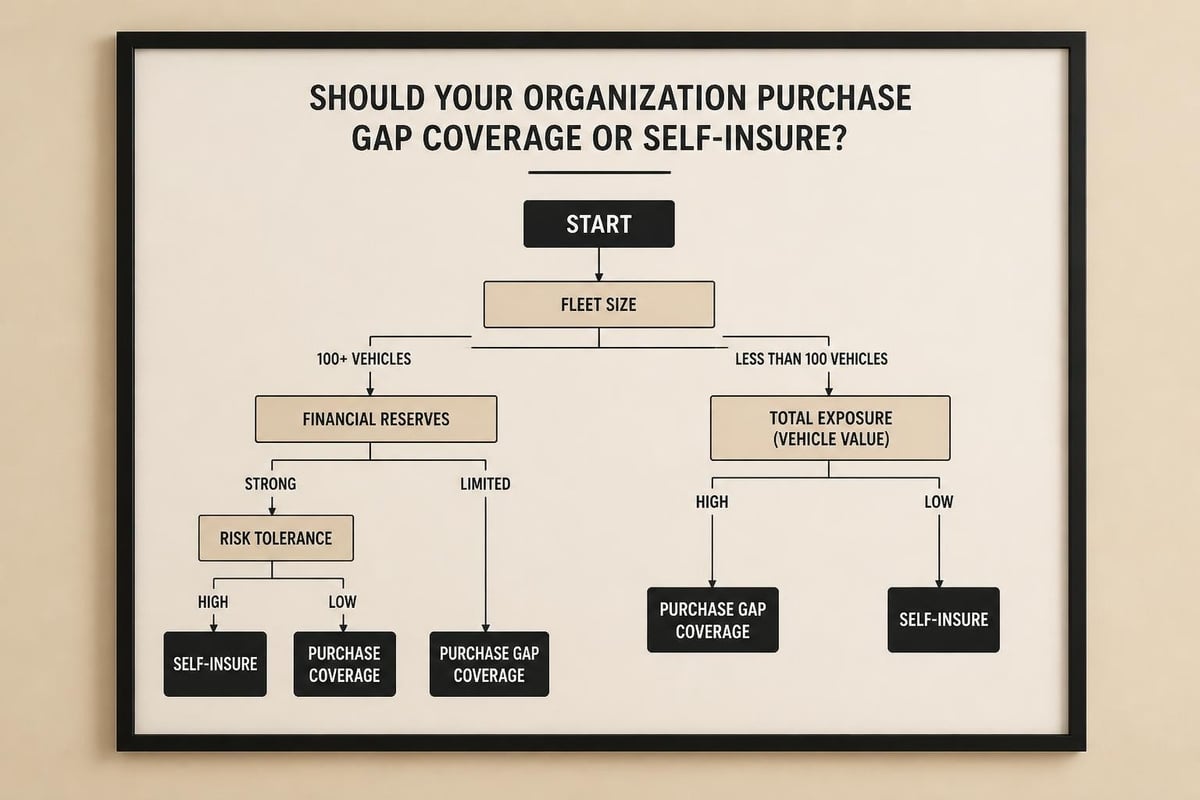
Self-insurance decision framework

Regulatory and Contractual Considerations

Gap coverage operates within specific regulatory frameworks that vary by state and financing type. Organizations must understand these requirements while navigating contractual obligations that may mandate coverage.

State Regulations and Consumer Protections

Individual states regulate gap coverage through insurance departments and consumer protection agencies. These regulations establish disclosure requirements, pricing limits, cancellation rights, and complaint procedures that protect purchasers.

The Washington State insurance department’s guidance on gap insurance illustrates how state-level regulations provide consumer protections while distinguishing between true insurance products and debt waiver agreements. Understanding these distinctions prevents confusion about coverage scope and regulatory oversight.

Key regulatory elements include:

  • Licensing requirements for gap coverage sellers
  • Mandatory disclosure of terms, conditions, and exclusions
  • Cancellation and refund policies
  • Complaint and dispute resolution procedures
  • Rate filing and approval requirements

Multi-state organizations must navigate varying requirements across jurisdictions, creating compliance complexity that mirrors challenges in healthcare revenue cycle management where regulations differ by state and payer.

Lender Requirements and Lease Provisions

Many lenders and leasing companies require gap coverage as a condition of financing, particularly for loans with minimal down payments or extended terms. These contractual requirements eliminate choice but create opportunities for strategic negotiation.

Negotiation opportunities include:

  1. Comparing lender-offered versus third-party coverage costs
  2. Negotiating removal of gap requirements with larger down payments
  3. Clarifying coverage duration and cancellation flexibility
  4. Understanding how coverage affects interest rates and terms
  5. Documenting compliance for audit and financial reporting

Organizations with strong credit profiles and established lender relationships can sometimes negotiate more favorable terms, including gap requirement waivers or acceptance of lower-cost third-party coverage.

Impact on Overall Operational Efficiency

Gap coverage represents just one element within comprehensive risk management and financial planning processes. Organizations committed to operational excellence integrate coverage decisions with broader efficiency initiatives that reduce costs, eliminate manual processes, and protect financial resources.

Automation and Tracking Systems

Modern organizations leverage technology to monitor gap exposure across fleets, triggering coverage reviews when equity thresholds are reached. This systematic approach eliminates the manual tracking that often results in unnecessary coverage continuation.

Automated tracking benefits:

  • Real-time visibility into loan balances and asset values
  • Automatic notifications when coverage becomes unnecessary
  • Integration with fleet management and accounting systems
  • Historical reporting for financial planning and budgeting
  • Compliance documentation for audit purposes

Companies implementing business automation solutions gain advantages extending beyond gap coverage management. The same integration platforms supporting accounts payable automation and payroll processing can incorporate fleet risk monitoring, creating unified operational dashboards.

Strategic Fleet Management Alignment

Fleet replacement cycles, financing strategies, and coverage decisions form interconnected elements of comprehensive fleet management. Organizations optimizing these relationships reduce total cost of ownership while maintaining appropriate risk protection.

Fleet Strategy Financing Approach Gap Coverage Need Total Cost Impact
Aggressive replacement (3 years) Lease with 20% cap reduction High (built into lease) Moderate-High
Standard replacement (5 years) Purchase, 15% down, 60 months Moderate (first 30 months) Moderate
Extended use (7+ years) Purchase, 25% down, 48 months Low (first 18 months) Low-Moderate
Mixed strategy Combination approach Varies by segment Optimized

Organizations serving healthcare providers or hospitality businesses often maintain diverse fleets with varying replacement cycles. Tailoring gap coverage to specific vehicle segments optimizes protection while controlling costs.

Financial Planning and Budget Integration

Effective gap coverage management requires incorporating costs into annual budgets and long-term financial plans. This integration ensures appropriate resources while preventing coverage lapses that create exposure.

Budget Modeling and Forecasting

Organizations should model gap coverage costs across multi-year horizons, accounting for fleet growth, replacement cycles, and anticipated financing patterns. This forward-looking approach prevents budget surprises while supporting informed decision-making.

Budget considerations include:

  • Annual coverage premiums for insurance company policies
  • One-time costs for dealer-offered coverage on new purchases
  • Potential refunds from early cancellations
  • Self-insurance reserve requirements
  • Administrative costs for policy management and tracking

Finance teams accustomed to modeling employee benefit costs or insurance premiums can apply similar methodologies to gap coverage forecasting. The relatively predictable nature of coverage needs based on purchase plans simplifies this analysis.

Cost Recovery and Risk Transfer

Some organizations incorporate gap coverage costs into internal charge-back systems, allocating expenses to specific departments or cost centers based on fleet utilization. This approach promotes accountability while ensuring coverage costs receive appropriate visibility.

Risk transfer mechanisms:

  • Departmental allocation of coverage premiums
  • Internal insurance programs pooling gap exposure
  • Vendor requirements for coverage on leased equipment
  • Customer contracts addressing fleet damage scenarios
  • Insurance deductible coordination reducing net exposure

Organizations with sophisticated cost allocation systems, similar to those tracking time savings from automation, can implement granular gap coverage tracking that supports operational decision-making and performance measurement.

Making Informed Decisions for Your Organization

Gap coverage decisions require balancing protection needs, cost considerations, and operational realities. Organizations benefit from structured evaluation processes that examine specific circumstances rather than applying universal rules.

Decision Framework and Evaluation Criteria

Systematic evaluation begins with understanding your current exposure, financing patterns, and risk tolerance. Organizations can develop internal guidelines that standardize coverage decisions while allowing flexibility for unique situations.

Evaluation questions include:

  • What is our current loan-to-value ratio across the fleet?
  • How many vehicles face gap exposure exceeding $5,000?
  • What percentage of our fleet carries gap coverage currently?
  • Are we paying for unnecessary coverage on vehicles with positive equity?
  • Do our lenders require gap coverage, or is it optional?
  • What is our organizational risk tolerance for asset-related losses?

The National Association of Insurance Commissioners’ overview of auto insurance coverage positions gap coverage within overall insurance architecture, helping organizations understand how different protection layers interact to create comprehensive risk management.

Implementation and Ongoing Management

Once coverage decisions are made, implementation requires coordinating with insurance carriers, lenders, and internal finance teams. Ongoing management ensures coverage remains appropriate as circumstances change.

Implementation steps:

  1. Obtain quotes from multiple providers
  2. Compare terms, exclusions, and cancellation policies
  3. Coordinate effective dates with vehicle acquisition or loan origination
  4. Document coverage in fleet management systems
  5. Establish review triggers based on equity thresholds
  6. Create cancellation procedures for timely cost reduction
  7. Integrate costs into budget tracking and forecasting

Organizations implementing human capital management solutions understand the importance of systematic processes for benefits administration and compliance. Similar rigor applied to gap coverage management ensures optimal outcomes while controlling administrative burden.


Understanding gap coverage enables organizations to make informed decisions that protect financial resources while optimizing operational costs. Strategic evaluation of when coverage provides value, how to purchase it cost-effectively, and when to cancel unnecessary protection creates measurable improvements in risk management efficiency. Nero and Associates, Inc. helps organizations implement systematic approaches to operational excellence, from automating manual processes to optimizing cost structures across all business functions. Whether you're managing fleet risk, streamlining revenue cycles, or empowering employees with better benefits, our performance-based consultancy delivers measurable results that raise your bottom line while protecting what matters most.

Gap Coverage: Essential Protection for Your Business Assets

Organizations face countless financial risks in their daily operations, from equipment purchases to fleet management. One often-overlooked exposure occurs when the actual cash value of an asset falls below what's owed on a loan or lease. This financial shortfall creates a vulnerable position that can impact your bottom line, drain operational budgets, and disrupt strategic initiatives. Understanding gap coverage becomes essential for any business committed to protecting its financial health while maintaining efficient operations. This protection mechanism addresses the difference between insurance payouts and outstanding debt obligations, safeguarding organizations from unexpected financial burdens that can derail growth plans and strain resources.

Understanding the Financial Gap in Business Operations

Gap coverage fills the space between what your insurance company pays when an asset is totaled or stolen and what you still owe to a lender. This difference emerges because vehicles and equipment depreciate rapidly while loan balances decrease slowly, especially in the early years of financing.

Consider a common scenario: Your company purchases a delivery van for $45,000 with a five-year loan. After 18 months, the vehicle is totaled in an accident. The insurance company determines the actual cash value at $32,000, but your outstanding loan balance sits at $38,000. Without gap coverage, your organization faces a $6,000 loss that must come from operating capital.

How Depreciation Creates Financial Exposure

Vehicle depreciation follows a predictable pattern that creates maximum exposure early in the ownership cycle. New vehicles typically lose 20-30% of their value within the first year, while loan principal reduction moves much more gradually through standard amortization schedules.

Key depreciation factors include:

  • Initial purchase price and down payment amount
  • Vehicle make, model, and market demand
  • Usage patterns and mileage accumulation
  • Maintenance history and condition
  • Market conditions and economic factors

The U.S. Consumer Financial Protection Bureau defines Guaranteed Asset Protection as insurance that covers the difference between the actual cash value and the outstanding balance on a loan or lease. This federal definition establishes the foundation for understanding how businesses can protect themselves from depreciation-related losses.

Asset depreciation versus loan paydown timeline

When Gap Coverage Makes Strategic Sense

Not every business vehicle or equipment purchase requires gap coverage, but specific circumstances create higher risk profiles that justify this protection. Strategic decision-making requires evaluating your financing terms, asset types, and operational requirements.

High-Risk Scenarios for Organizations

Organizations face elevated gap exposure when combining certain financing characteristics with specific operational patterns. Long-term loans naturally create larger gaps because principal reduction occurs slowly over extended periods.

Situations where gap coverage provides maximum value:

  1. Minimal down payments: Less than 20% down creates immediate negative equity
  2. Extended loan terms: Financing beyond 60 months increases gap duration
  3. Rapid depreciation vehicles: Luxury vehicles and specialized equipment lose value quickly
  4. High-mileage operations: Delivery fleets and service vehicles depreciate faster
  5. Lease agreements: Most leases create automatic gap exposure

According to Triple-I’s analysis of gap insurance, businesses with long-term loans and vehicles that depreciate rapidly benefit most from this coverage. Their research demonstrates how specific combinations of factors multiply risk exposure.

Cost-Benefit Analysis for Business Protection

Gap coverage typically costs between $400 and $700 when purchased through a dealer, or $20-40 annually when added to an existing commercial auto insurance policy. This relatively modest investment protects against potential losses ranging from $3,000 to $10,000 or more.

Purchase Method Typical Cost Coverage Duration Flexibility
Dealer/Lender $400-$700 (one-time) Length of loan Limited, often non-refundable
Insurance Company $20-$40/year Annual renewal High, can cancel anytime
Standalone Policy $200-$500 (one-time) Loan term Moderate, some refund options

The dramatic price difference between dealer-offered and insurer-provided gap coverage reflects markup practices and bundling strategies. Organizations seeking operational efficiency should compare both options carefully, considering total cost of ownership and cancellation flexibility.

Integrating Gap Coverage into Risk Management

Effective risk management requires viewing gap coverage as one component within a comprehensive protection strategy. Forward-thinking organizations align their coverage decisions with broader operational goals, financial planning, and asset management practices.

Aligning Protection with Business Objectives

Gap coverage decisions should reflect your organization's risk tolerance, cash flow patterns, and growth trajectory. Companies focused on maximizing operational efficiency recognize that unexpected financial losses divert resources from strategic initiatives.

Integration strategies include:

  • Coordinating gap coverage with fleet replacement cycles
  • Evaluating coverage needs during annual insurance reviews
  • Building coverage costs into total cost of ownership calculations
  • Aligning protection levels with risk management policies
  • Documenting coverage decisions for audit and compliance purposes

The AAA explanation of gap insurance demonstrates how this coverage interacts with actual cash value determinations and loan balances. Understanding these interactions helps businesses make informed decisions about when coverage provides genuine value versus representing unnecessary expense.

Policy Exclusions and Limitations

Gap coverage doesn't protect against all financial scenarios. Standard policies contain specific exclusions that organizations must understand before assuming complete protection.

Most policies exclude coverage for:

  • Extended warranties, credit life insurance, and other add-ons financed into the loan
  • Transfer fees, lease penalties, and balloon payments
  • Overdue loan payments and late fees
  • Vehicle damage from lack of maintenance or illegal activity
  • Amounts exceeding policy limits (typically 25% above actual cash value)

Gap coverage exclusions and limitations

Purchasing Strategies for Maximum Value

Strategic purchasing requires comparing options, understanding contract terms, and negotiating favorable conditions. Organizations that treat gap coverage as a procurement decision rather than an automatic add-on achieve better outcomes and lower costs.

Dealer Versus Insurance Company Options

Dealerships and lenders offer gap coverage as a one-time purchase rolled into your financing, while insurance companies provide annual policies that can be canceled when no longer needed. This fundamental difference creates significant implications for total cost and flexibility.

Dealer/lender advantages:

  • Convenient single-transaction purchase
  • Coverage automatically matches loan term
  • No separate billing or renewal requirements

Insurance company advantages:

  • Significantly lower annual costs
  • Cancellation flexibility as equity builds
  • Integration with existing commercial policies
  • Potential bundling discounts

Liberty Mutual’s guide on gap insurance provides current pricing comparisons and helps businesses evaluate when dealer-offered coverage might justify higher costs through convenience, versus when insurance company policies deliver superior value.

Timing and Cancellation Considerations

Gap coverage becomes unnecessary once your asset's value exceeds the outstanding loan balance. Organizations that monitor depreciation curves and loan paydown schedules can cancel coverage strategically, eliminating unnecessary expenses.

Optimal cancellation timing occurs when:

  1. Equity reaches 20% or higher
  2. Loan balance falls below fair market value
  3. Refinancing creates favorable loan-to-value ratios
  4. Fleet vehicles reach planned replacement points

Some dealer-offered policies allow pro-rated refunds upon cancellation, while others do not. This distinction significantly impacts the actual cost of coverage when vehicles are paid off early or replaced before loan maturity. Organizations implementing automation and integration solutions can track these metrics systematically, ensuring timely cancellation decisions that optimize cost efficiency.

Alternative Risk Management Approaches

While gap coverage provides straightforward protection, organizations have additional strategies for managing the financial gap between asset values and loan balances. These alternatives may prove more cost-effective depending on your specific circumstances and operational capabilities.

Larger Down Payments and Shorter Terms

Reducing gap exposure at the financing stage eliminates the need for separate coverage while improving overall financial positioning. Organizations with available capital can structure purchases to minimize or eliminate gaps entirely.

Financing Structure Initial Gap Gap Duration Coverage Need
10% down, 72 months High ($8,000-$12,000) 36-48 months Essential
20% down, 60 months Moderate ($4,000-$7,000) 24-36 months Recommended
30% down, 48 months Low ($1,000-$3,000) 12-18 months Optional
40%+ down, 36 months Minimal/None 0-12 months Unnecessary

According to Experian’s analysis of gap insurance, the interaction between depreciation and loan amortization creates predictable exposure patterns. Organizations can model these patterns during purchase negotiations to structure deals that minimize risk without requiring additional coverage.

Self-Insurance Through Reserved Capital

Large organizations with substantial fleets may find self-insurance more economical than purchasing gap coverage for individual vehicles. This approach requires maintaining reserved capital equal to potential gap exposure across the entire fleet.

Self-insurance requirements:

  • Sufficient capital reserves to absorb potential losses
  • Statistical modeling of actual gap exposure across fleet
  • Risk tolerance aligned with maximum potential loss scenarios
  • Financial controls preventing reserve depletion
  • Regular review of exposure as fleet composition changes

Healthcare organizations and enterprise-level businesses often implement self-insurance strategies for various risks, including gap exposure. The same analytical frameworks supporting medical malpractice reserves or property damage funds can accommodate gap-related risks.

Self-insurance decision framework

Regulatory and Contractual Considerations

Gap coverage operates within specific regulatory frameworks that vary by state and financing type. Organizations must understand these requirements while navigating contractual obligations that may mandate coverage.

State Regulations and Consumer Protections

Individual states regulate gap coverage through insurance departments and consumer protection agencies. These regulations establish disclosure requirements, pricing limits, cancellation rights, and complaint procedures that protect purchasers.

The Washington State insurance department’s guidance on gap insurance illustrates how state-level regulations provide consumer protections while distinguishing between true insurance products and debt waiver agreements. Understanding these distinctions prevents confusion about coverage scope and regulatory oversight.

Key regulatory elements include:

  • Licensing requirements for gap coverage sellers
  • Mandatory disclosure of terms, conditions, and exclusions
  • Cancellation and refund policies
  • Complaint and dispute resolution procedures
  • Rate filing and approval requirements

Multi-state organizations must navigate varying requirements across jurisdictions, creating compliance complexity that mirrors challenges in healthcare revenue cycle management where regulations differ by state and payer.

Lender Requirements and Lease Provisions

Many lenders and leasing companies require gap coverage as a condition of financing, particularly for loans with minimal down payments or extended terms. These contractual requirements eliminate choice but create opportunities for strategic negotiation.

Negotiation opportunities include:

  1. Comparing lender-offered versus third-party coverage costs
  2. Negotiating removal of gap requirements with larger down payments
  3. Clarifying coverage duration and cancellation flexibility
  4. Understanding how coverage affects interest rates and terms
  5. Documenting compliance for audit and financial reporting

Organizations with strong credit profiles and established lender relationships can sometimes negotiate more favorable terms, including gap requirement waivers or acceptance of lower-cost third-party coverage.

Impact on Overall Operational Efficiency

Gap coverage represents just one element within comprehensive risk management and financial planning processes. Organizations committed to operational excellence integrate coverage decisions with broader efficiency initiatives that reduce costs, eliminate manual processes, and protect financial resources.

Automation and Tracking Systems

Modern organizations leverage technology to monitor gap exposure across fleets, triggering coverage reviews when equity thresholds are reached. This systematic approach eliminates the manual tracking that often results in unnecessary coverage continuation.

Automated tracking benefits:

  • Real-time visibility into loan balances and asset values
  • Automatic notifications when coverage becomes unnecessary
  • Integration with fleet management and accounting systems
  • Historical reporting for financial planning and budgeting
  • Compliance documentation for audit purposes

Companies implementing business automation solutions gain advantages extending beyond gap coverage management. The same integration platforms supporting accounts payable automation and payroll processing can incorporate fleet risk monitoring, creating unified operational dashboards.

Strategic Fleet Management Alignment

Fleet replacement cycles, financing strategies, and coverage decisions form interconnected elements of comprehensive fleet management. Organizations optimizing these relationships reduce total cost of ownership while maintaining appropriate risk protection.

Fleet Strategy Financing Approach Gap Coverage Need Total Cost Impact
Aggressive replacement (3 years) Lease with 20% cap reduction High (built into lease) Moderate-High
Standard replacement (5 years) Purchase, 15% down, 60 months Moderate (first 30 months) Moderate
Extended use (7+ years) Purchase, 25% down, 48 months Low (first 18 months) Low-Moderate
Mixed strategy Combination approach Varies by segment Optimized

Organizations serving healthcare providers or hospitality businesses often maintain diverse fleets with varying replacement cycles. Tailoring gap coverage to specific vehicle segments optimizes protection while controlling costs.

Financial Planning and Budget Integration

Effective gap coverage management requires incorporating costs into annual budgets and long-term financial plans. This integration ensures appropriate resources while preventing coverage lapses that create exposure.

Budget Modeling and Forecasting

Organizations should model gap coverage costs across multi-year horizons, accounting for fleet growth, replacement cycles, and anticipated financing patterns. This forward-looking approach prevents budget surprises while supporting informed decision-making.

Budget considerations include:

  • Annual coverage premiums for insurance company policies
  • One-time costs for dealer-offered coverage on new purchases
  • Potential refunds from early cancellations
  • Self-insurance reserve requirements
  • Administrative costs for policy management and tracking

Finance teams accustomed to modeling employee benefit costs or insurance premiums can apply similar methodologies to gap coverage forecasting. The relatively predictable nature of coverage needs based on purchase plans simplifies this analysis.

Cost Recovery and Risk Transfer

Some organizations incorporate gap coverage costs into internal charge-back systems, allocating expenses to specific departments or cost centers based on fleet utilization. This approach promotes accountability while ensuring coverage costs receive appropriate visibility.

Risk transfer mechanisms:

  • Departmental allocation of coverage premiums
  • Internal insurance programs pooling gap exposure
  • Vendor requirements for coverage on leased equipment
  • Customer contracts addressing fleet damage scenarios
  • Insurance deductible coordination reducing net exposure

Organizations with sophisticated cost allocation systems, similar to those tracking time savings from automation, can implement granular gap coverage tracking that supports operational decision-making and performance measurement.

Making Informed Decisions for Your Organization

Gap coverage decisions require balancing protection needs, cost considerations, and operational realities. Organizations benefit from structured evaluation processes that examine specific circumstances rather than applying universal rules.

Decision Framework and Evaluation Criteria

Systematic evaluation begins with understanding your current exposure, financing patterns, and risk tolerance. Organizations can develop internal guidelines that standardize coverage decisions while allowing flexibility for unique situations.

Evaluation questions include:

  • What is our current loan-to-value ratio across the fleet?
  • How many vehicles face gap exposure exceeding $5,000?
  • What percentage of our fleet carries gap coverage currently?
  • Are we paying for unnecessary coverage on vehicles with positive equity?
  • Do our lenders require gap coverage, or is it optional?
  • What is our organizational risk tolerance for asset-related losses?

The National Association of Insurance Commissioners’ overview of auto insurance coverage positions gap coverage within overall insurance architecture, helping organizations understand how different protection layers interact to create comprehensive risk management.

Implementation and Ongoing Management

Once coverage decisions are made, implementation requires coordinating with insurance carriers, lenders, and internal finance teams. Ongoing management ensures coverage remains appropriate as circumstances change.

Implementation steps:

  1. Obtain quotes from multiple providers
  2. Compare terms, exclusions, and cancellation policies
  3. Coordinate effective dates with vehicle acquisition or loan origination
  4. Document coverage in fleet management systems
  5. Establish review triggers based on equity thresholds
  6. Create cancellation procedures for timely cost reduction
  7. Integrate costs into budget tracking and forecasting

Organizations implementing human capital management solutions understand the importance of systematic processes for benefits administration and compliance. Similar rigor applied to gap coverage management ensures optimal outcomes while controlling administrative burden.


Understanding gap coverage enables organizations to make informed decisions that protect financial resources while optimizing operational costs. Strategic evaluation of when coverage provides value, how to purchase it cost-effectively, and when to cancel unnecessary protection creates measurable improvements in risk management efficiency. Nero and Associates, Inc. helps organizations implement systematic approaches to operational excellence, from automating manual processes to optimizing cost structures across all business functions. Whether you're managing fleet risk, streamlining revenue cycles, or empowering employees with better benefits, our performance-based consultancy delivers measurable results that raise your bottom line while protecting what matters most.

Website developed in accordance with Web Content Accessibility Guidelines 2.2.
If you encounter any issues while using this site, please contact us: 215.526.5126