
The Expert Guide to Management Consulting Group (2026)

Share on Facebook
Share on X
Share on LinkedIn

The management consulting group landscape is rapidly transforming, shaping the way organizations achieve success in 2026. As the pace of change accelerates across industries, leaders are turning to expert advisors for critical guidance and innovative solutions.

Today’s business environment is defined by emerging technologies, shifting markets, and complex challenges. Consulting groups are evolving, leveraging new strategies and digital tools to deliver measurable results. The demand for actionable insights has never been higher, driving organizations to seek partners who can unlock growth and resilience.

This expert guide explores the fundamentals of management consulting groups, current market trends, essential services, and proven selection methods. Discover how to harness consulting expertise for transformative results and stay ahead in a competitive world.

Understanding Management Consulting Groups

Management consulting groups are at the center of business transformation, helping organizations solve complex challenges and drive sustainable growth. Their influence extends across industries, shaping how companies operate, compete, and adapt to change.
Understanding Management Consulting Groups

Definition and Core Functions

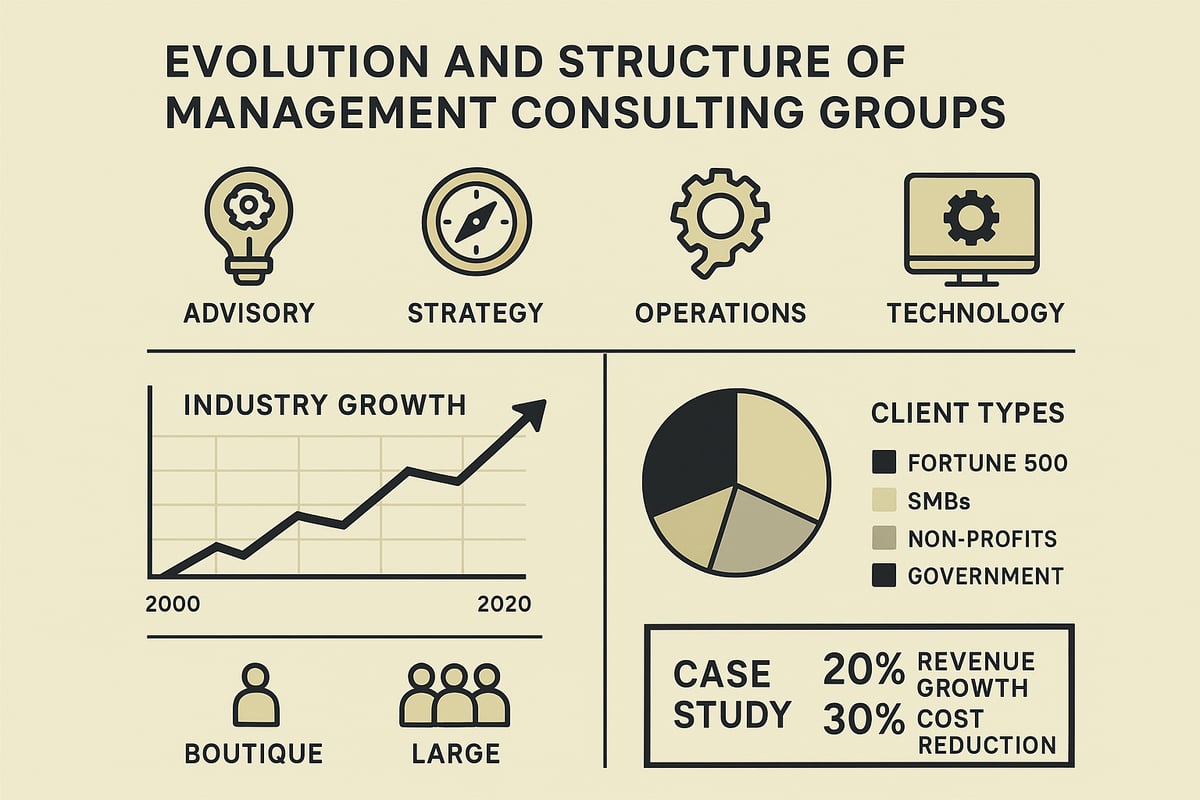
A management consulting group is a team of experts who provide independent advice to organizations seeking to improve performance, solve business problems, and achieve strategic goals. These groups bring specialized knowledge and a structured approach to help leaders make informed decisions.

Key roles within a management consulting group include:

  • Advisory: Guiding clients on business strategy and market positioning.
  • Strategy development: Crafting actionable plans for growth and transformation.
  • Operational improvement: Streamlining processes for greater efficiency.

Most groups are organized into multidisciplinary teams. Typical structures include partners, project managers, consultants, and analysts, each contributing unique expertise. Boutique firms tend to focus on niche markets or specialized skills, while large firms offer a broad range of services and global reach.

Feature Boutique Group Large Group
Focus Specialized/Niche Broad/Global
Team Size Small, agile Large, diverse
Client Base SMBs, select industries Fortune 500, global
Flexibility High Moderate

The impact of a management consulting group is measurable. Studies show organizations engaging consultants report an average performance improvement of 20-30 percent. Leading firms such as McKinsey, BCG, and Bain have continually evolved, adapting their models to incorporate digital transformation and data-driven insights.

Historical Evolution and Industry Growth

Management consulting groups originated in the early 20th century, initially focusing on organizational efficiency and scientific management. Over the decades, their influence expanded as businesses faced new challenges, from globalization to digital disruption.

Today, the industry is experiencing rapid growth. According to Management Consulting Service Market Growth 9.24% CAGR, the global management consulting group market is projected to expand significantly by 2026, driven by increasing demand for expert guidance in a complex business environment.

Key growth drivers include:

  • Globalization: Companies seek local insights for international expansion.
  • Digital transformation: Adopting new technologies requires specialized expertise.
  • Regulatory complexity: Navigating evolving compliance standards.

During economic crises, such as the 2008 financial downturn and the global pandemic, management consulting groups played a pivotal role. They helped organizations realign strategies, optimize costs, and emerge more resilient. This adaptability has solidified their reputation as trusted partners in times of uncertainty.

Types of Clients and Engagement Models

A management consulting group serves a diverse range of clients, including Fortune 500 corporations, small and medium-sized businesses, non-profits, and government agencies. Each client type brings unique challenges and objectives, requiring tailored consulting approaches.

Common engagement models include:

  • Retainer: Ongoing advisory support for long-term initiatives.
  • Project-based: Defined scope and deliverables for specific projects.
  • Performance-based: Compensation tied to measurable outcomes.

For example, a performance-based engagement might involve a manufacturing firm partnering with a management consulting group to increase production efficiency. If the consultants achieve predefined cost savings, they receive a portion of the value created. This model aligns incentives and drives tangible results.

By understanding client needs and matching them with the right engagement model, a management consulting group maximizes value and builds long-lasting relationships. Their flexible structures and data-driven methodologies make them indispensable to organizations navigating rapid change.

The 2026 Consulting Landscape: Trends and Market Forces

The management consulting group sector is undergoing rapid transformation as we approach 2026. Organizations are confronting new challenges and opportunities shaped by disruptive technology, evolving client expectations, and intensified global competition. Understanding these trends is crucial for businesses seeking to leverage a management consulting group for long-term success.
The 2026 Consulting Landscape: Trends and Market Forces

Digital Transformation and Technology Integration

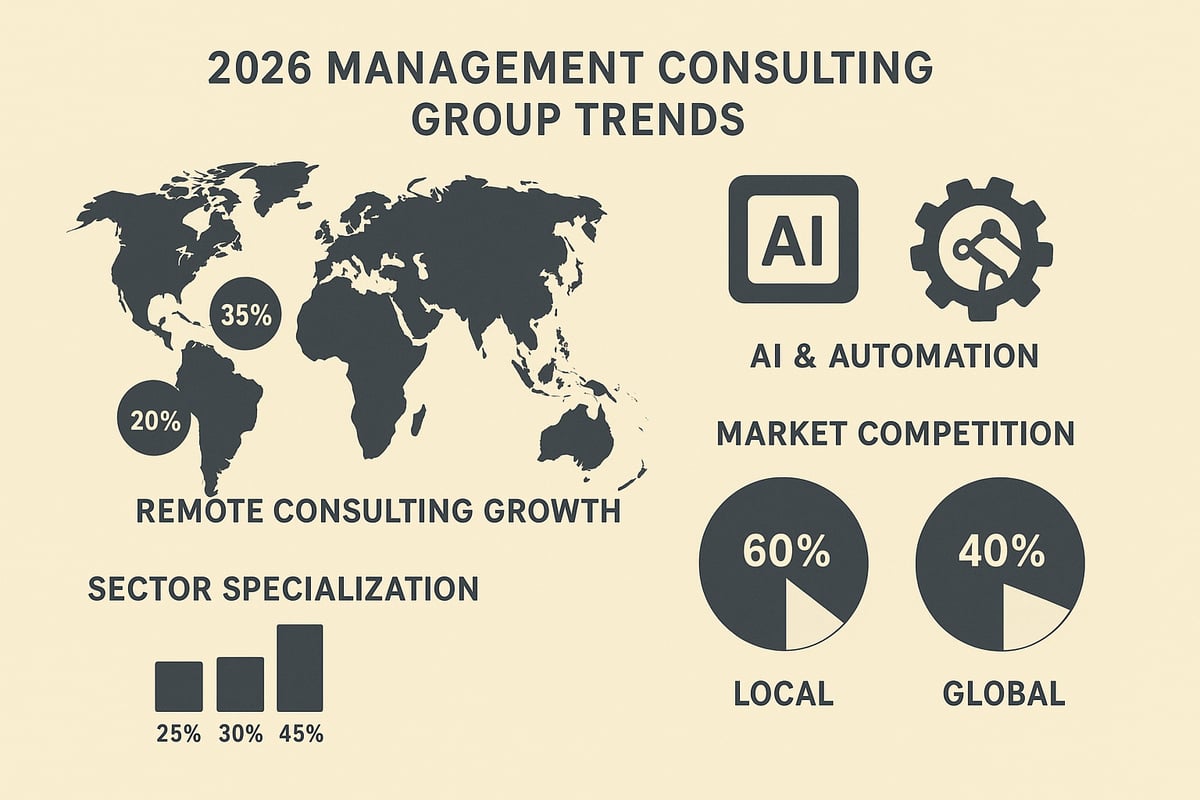
Technology is redefining the management consulting group model. Firms are integrating AI, automation, and advanced data analytics into their service offerings. This shift enables consultants to deliver faster, more precise solutions for operational efficiency and strategic planning.

Machine learning is now central to projects that optimize processes or forecast market trends. According to Gartner in 2024, over 65% of consulting firms have adopted AI-driven tools, demonstrating the sector’s embrace of digital transformation. Tools such as predictive analytics platforms and robotic process automation are streamlining client operations.

For organizations seeking to harness these innovations, partnering with a management consulting group that offers AI and Automation Integration Solutions ensures access to the latest advancements. These solutions help eliminate manual tasks and unlock new value from data.

Specialization and Niche Expertise

As industries become more complex, clients increasingly demand specialized knowledge from their management consulting group partners. Sector-specific consulting, such as healthcare, finance, and sustainability, is experiencing significant growth. ESG consulting, for instance, has seen a 30% year-over-year increase in demand, reflecting the rising importance of environmental and social governance.

Regulatory changes are another driver behind specialization. Consulting groups are developing tailored offerings to help clients navigate compliance requirements in highly regulated sectors. This trend is expected to continue as businesses seek deeper domain expertise.

Clients benefit from this focus by receiving actionable, industry-specific insights. A management consulting group with niche expertise can anticipate challenges and deliver targeted solutions that generalist firms may overlook.

Globalization and Remote Consulting

The global reach of the management consulting group is expanding. Firms are actively pursuing projects in emerging markets and collaborating across borders to tap into new growth opportunities. Remote consulting has also become standard, accelerated by the global shift to virtual work post-2020.

Cloud-based collaboration tools, secure video conferencing, and digital whiteboards enable consultants to deliver services without geographic limitations. This flexibility has led to a marked increase in remote consulting engagements, with industry surveys showing a 40% rise since 2020.

Clients now expect seamless support regardless of location. A management consulting group that excels in remote delivery can offer continuous guidance and rapid response, no matter where the client operates.

Talent and Workforce Evolution

The workforce within the management consulting group is evolving rapidly. Firms are building multidisciplinary teams that combine data scientists, behavioral economists, and industry specialists. This approach ensures a broader perspective when solving complex business problems.

Continuous learning and upskilling are strategic priorities. Many firms invest heavily in AI and digital training programs to keep consultants at the forefront of innovation. This commitment to talent development allows a management consulting group to offer cutting-edge solutions.

Clients benefit from this evolution through access to diverse expertise and fresh thinking. Consulting groups that prioritize workforce agility are better equipped to address today’s dynamic business environment.

Market Competition and New Entrants

Competition in the management consulting group market is intensifying. Traditional firms face challenges from tech giants and agile boutique consultancies introducing disruptive service models. Mergers and acquisitions are reshaping the landscape, with consolidation creating larger, more resourceful players.

The number of new consulting firms launched in 2025 reached record highs, highlighting the sector’s attractiveness and potential for innovation. This influx of competitors is driving all management consulting group providers to differentiate through specialization, technology adoption, and client-centric approaches.

For organizations, this means more choice and greater opportunity to find a management consulting group that aligns with their unique goals and culture.

Key Services Offered by Management Consulting Groups

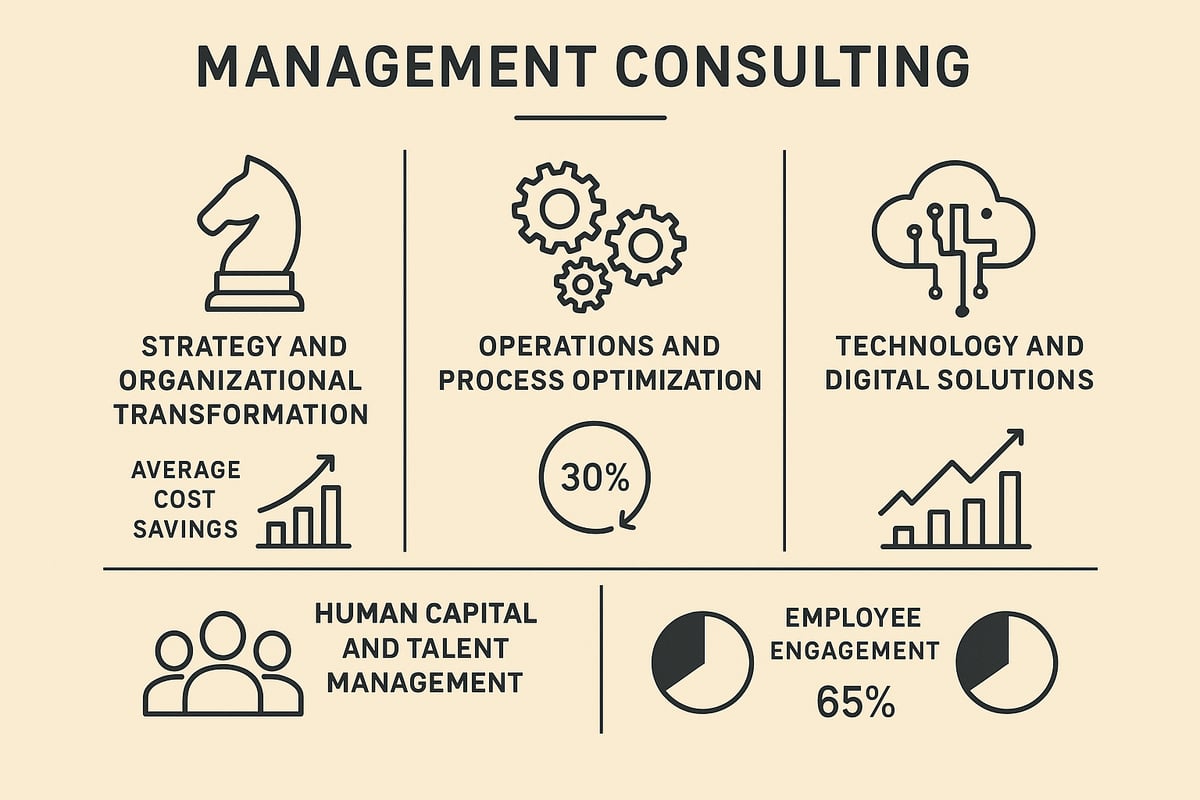
Organizations today turn to a management consulting group for specialized expertise that drives measurable business results. These groups offer a broad range of services designed to address complex challenges and unlock new opportunities. Let us break down the core offerings that define the management consulting group landscape in 2026.
Key Services Offered by Management Consulting Groups

Strategy and Organizational Transformation

A management consulting group excels at guiding companies through strategic and organizational change. These services focus on developing long-term visions, setting achievable goals, and executing transformation initiatives that align with business objectives.

Consultants work with leadership teams to design corporate strategies, identify growth opportunities, and manage complex change processes. This often includes restructuring departments, redefining roles, and implementing new governance models.

A notable example is a major retail chain that reversed declining sales by partnering with a management consulting group. Through data-driven analysis and stakeholder engagement, the group developed a turnaround plan that improved customer experience and restored profitability.

Core elements of strategy and transformation services:

  • Market analysis and benchmarking
  • Change management frameworks
  • Stakeholder alignment and communication plans

A management consulting group ensures that every strategy is actionable and tailored to the client's unique context.

Operations and Process Optimization

Operational excellence is a hallmark of any leading management consulting group. These firms deploy proven methodologies such as Lean and Six Sigma to identify inefficiencies, streamline workflows, and reduce costs.

By mapping current processes and using digital tools, consultants reveal hidden bottlenecks and opportunities for automation. For instance, a manufacturing client achieved a 20 percent efficiency gain after a management consulting group redesigned its production line and implemented continuous improvement practices.

Key steps in process optimization:

  • Conducting process audits
  • Implementing digital solutions
  • Tracking performance metrics

For additional insights into optimizing business operations, explore Achieving Growth and Efficiency in Operations.

The impact is clear: process optimization projects can generate significant cost savings and boost competitive advantage.

Technology and Digital Solutions

Technology transformation is now central to every management consulting group’s portfolio. Consultants help clients navigate IT strategy, digital transformation, and cybersecurity challenges.

Expert teams design digital roadmaps, manage cloud migrations, and advise on cutting-edge technologies like blockchain and the Internet of Things. For example, a management consulting group led a successful cloud adoption project for a logistics company, enabling real-time data access and improved decision-making.

Typical technology consulting services:

  • IT strategy and digital roadmaps
  • Cybersecurity risk assessments
  • Technology vendor selection

A management consulting group ensures technology investments deliver tangible business value, not just technical upgrades.

Human Capital and Talent Management

The people side of business is a critical focus for any management consulting group. Services in this area include leadership development, workforce planning, and diversity, equity, and inclusion (DEI) initiatives.

Consultants partner with HR teams to design programs that attract, retain, and engage talent. A global bank, for instance, worked with a management consulting group to launch a talent retention project that reduced turnover by 15 percent.

Areas of human capital management:

  • Leadership coaching and succession planning
  • Employee engagement and experience programs
  • DEI strategy development

A management consulting group helps organizations build resilient, high-performing teams that drive sustained success.

Financial Advisory and Risk Management

Financial advisory is another essential offering from a management consulting group. These services cover mergers and acquisitions (M&A), restructuring, and risk management.

Consultants provide due diligence support, financial modeling, and scenario planning to guide investment decisions. In a recent cross-border acquisition, a management consulting group’s expertise ensured regulatory compliance and maximized deal value.

Key components of financial advisory:

  • M&A support and integration planning
  • Risk assessment and mitigation
  • Revenue cycle management

In 2025, consultants supported billions in M&A deals worldwide, demonstrating the strategic value a management consulting group brings to financial decision-making.

How to Choose the Right Management Consulting Group

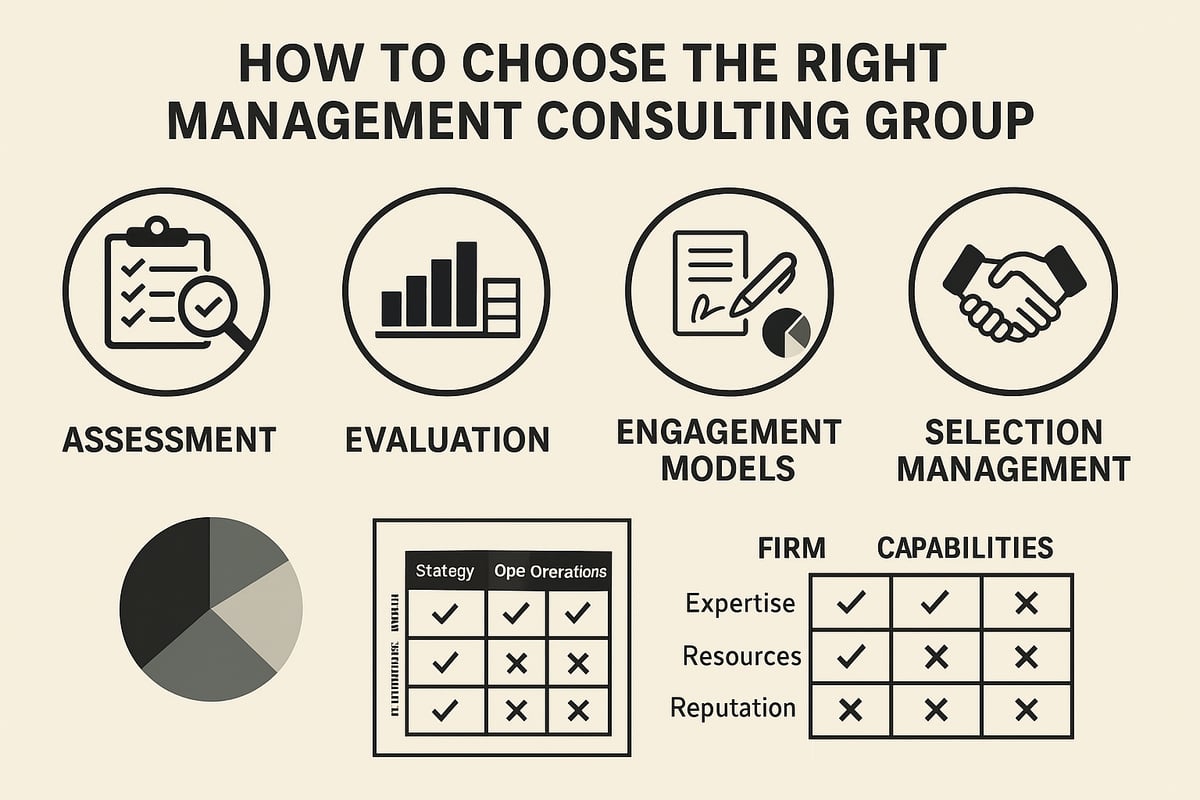
Selecting the right management consulting group is a pivotal decision for organizations seeking impactful change. The process requires a clear understanding of internal goals, careful evaluation of potential partners, and a structured approach to ensure successful collaboration. Here is a step-by-step guide to making an informed choice.
How to Choose the Right Management Consulting Group

Assessing Organizational Needs and Objectives

The foundation of a successful partnership with a management consulting group lies in a thorough assessment of your organization’s needs. Begin by identifying the specific challenges you face, such as operational inefficiencies, digital transformation requirements, or talent management gaps.

Map these needs to your strategic objectives. Are you seeking short-term process improvements or a long-term transformation? Clearly articulating goals will help you target consulting groups with the right expertise.

For example, a company aiming to overhaul its supply chain should look for a management consulting group with a proven track record in logistics and process optimization. Misalignment between organizational needs and the consultant’s specialization can derail projects, as seen in cases where a technology-focused firm was hired for a culture change initiative, leading to subpar results.

Involve key stakeholders early in the process. Their insights ensure the chosen management consulting group aligns with broader business priorities. Document all requirements and success metrics before moving forward.

Evaluating Consulting Group Capabilities

Once needs are defined, evaluate the capabilities of each management consulting group under consideration. Start by examining their expertise in your industry. Review their portfolio and look for case studies demonstrating measurable results in similar projects.

Create a comparison matrix to assess:

Criteria Firm A Firm B Firm C
Industry Experience High Medium High
Track Record Strong Good Excellent
Cultural Fit Good Excellent Good
References Available Limited Extensive

Prioritize groups that offer a blend of technical knowledge, strategic vision, and a collaborative approach. Client references are invaluable for verifying claims and understanding how the management consulting group operates in practice.

Consider the market’s growth and evolving demands. For more insights into consulting industry trends and how firms are positioning themselves for future success, review the Management Consulting Services Market Size & Demand Analysis by 2035.

Engagement Models and Pricing Structures

Understanding engagement models and pricing is essential when working with a management consulting group. The main models include:

  • Retainer: Ongoing support for a fixed monthly fee, ideal for long-term partnerships.
  • Fixed-fee: A set price for clearly defined deliverables, suitable for well-scoped projects.
  • Performance-based: Fees tied to achieving specific outcomes, aligning incentives with results.

Each model has pros and cons. Retainers offer flexibility but may lead to unclear deliverables. Fixed-fee projects provide budget certainty, while performance-based engagements motivate both parties to focus on outcomes.

Transparency is critical. Ensure the management consulting group provides detailed proposals outlining scope, timelines, and pricing. According to regional data, average consulting fees can vary significantly, so benchmarking against market standards is wise.

Request sample contracts and clarify any terms before signing. This step reduces the risk of misunderstandings and ensures both sides are aligned on expectations.

Managing the Selection Process

A structured selection process increases the likelihood of choosing the right management consulting group. Start by issuing a clear Request for Proposal (RFP) that details your needs, objectives, and evaluation criteria.

Shortlist firms based on their responses, then conduct interviews to assess cultural fit and communication style. Use a scoring system to objectively compare each management consulting group across key factors, such as expertise, approach, and pricing.

Negotiate terms transparently, focusing on deliverables and performance metrics. A successful selection process often follows this timeline:

  1. Define needs and draft RFP (1-2 weeks)
  2. Distribute RFP and receive proposals (2-3 weeks)
  3. Shortlist and interview firms (1-2 weeks)
  4. Final selection and contract negotiation (1 week)

This approach ensures you select a management consulting group that not only meets technical requirements but also fits your organizational culture. Investing time in this process pays dividends in project outcomes and long-term value.

The Future of Management Consulting Groups: Predictions for 2026 and Beyond

The future of the management consulting group is rapidly unfolding as new technologies, shifting client demands, and global priorities redefine the industry. By 2026, firms will need to be more agile, innovative, and forward-thinking than ever before. Let us explore the trends and forces that will shape the management consulting group landscape in the coming years.

Emerging Technologies and Consulting Innovation

By 2026, the management consulting group will be transformed by a wave of technological advancements. Artificial intelligence, quantum computing, and predictive analytics will become central to consulting solutions. Firms are piloting generative AI to develop business strategies, automate research, and deliver real-time insights.

Consultants will leverage advanced analytics to predict market shifts and optimize operations for clients. This tech-driven evolution means management consulting group offerings will be more data-centric and efficient. According to projections, the tech consulting market is set to surpass $400 billion in global revenue by 2026, reflecting the sector's increasing reliance on innovation.

Consulting firms will also experiment with blockchain, IoT, and cloud-based platforms, driving operational transparency and security. Those who adapt quickly to these innovations will lead the industry.

Evolving Client Expectations and Value Delivery

Clients are demanding more measurable value from every management consulting group engagement. Outcome-based contracts and transparent ROI metrics are rising, with over 60% of clients expected to require performance-based agreements by 2026.

This shift is creating a move toward partnership models, where consulting groups and clients co-create solutions and share accountability for results. Digital tools, dashboards, and hybrid delivery models are becoming the norm, allowing for greater visibility and collaboration. For further insight, three trends for management consultants in 2025 highlight the acceleration of digital adoption and hybrid consulting, reinforcing the need for continuous innovation.

Effective management consulting group engagements will focus on delivering tangible business outcomes, not just recommendations. Firms that can prove value and adapt to evolving expectations will thrive.

Regulatory and Ethical Considerations

As the management consulting group industry grows, regulatory and ethical challenges will intensify. Data privacy laws, ESG mandates, and industry-specific regulations are becoming more complex worldwide. Consulting groups must ensure compliance, protect sensitive data, and adapt quickly to changing legal landscapes.

New data protection standards will require firms to invest in secure technologies and transparent processes. Ethical consulting will become a differentiator, with clients seeking partners who demonstrate integrity and social responsibility.

Case studies already show consulting groups responding swiftly to new data regulations, updating protocols, and advising clients on risk management. Mastery of regulatory compliance will be a core competency for the management consulting group of the future.

The Role of Sustainability and Social Impact

Sustainability will move to the heart of every management consulting group’s value proposition. Environmental, Social, and Governance (ESG) consulting is projected to continue its double-digit growth, as organizations face increasing pressure from investors, regulators, and consumers.

Consulting groups will help clients integrate ESG principles across strategy, operations, and reporting. Examples include guiding non-profits through digital transformation to maximize social impact or advising corporations on decarbonization pathways.

Sustainability consulting revenue is expected to rise sharply, reflecting this shift in priorities. The management consulting group that embeds social impact into its core offerings will stand out in a crowded marketplace.

Preparing for the Next Decade

Looking ahead, success in the management consulting group space will depend on adaptability, innovation, and a relentless focus on client outcomes. Firms must invest in continuous learning for their teams, embracing multidisciplinary skills and new technologies.

Recommendations for consulting groups and clients include:

  • Foster a culture of innovation, encouraging experimentation and agility.
  • Prioritize upskilling in AI, data, and ESG topics.
  • Build resilient, flexible engagement models to address changing client needs.
  • Emphasize transparency and measurable value delivery.

By preparing for these changes, the management consulting group can future-proof its role as a trusted advisor, driving transformation and growth for clients worldwide.

The Expert Guide to Management Consulting Group (2026)

The management consulting group landscape is rapidly transforming, shaping the way organizations achieve success in 2026. As the pace of change accelerates across industries, leaders are turning to expert advisors for critical guidance and innovative solutions.

Today’s business environment is defined by emerging technologies, shifting markets, and complex challenges. Consulting groups are evolving, leveraging new strategies and digital tools to deliver measurable results. The demand for actionable insights has never been higher, driving organizations to seek partners who can unlock growth and resilience.

This expert guide explores the fundamentals of management consulting groups, current market trends, essential services, and proven selection methods. Discover how to harness consulting expertise for transformative results and stay ahead in a competitive world.

Understanding Management Consulting Groups

Management consulting groups are at the center of business transformation, helping organizations solve complex challenges and drive sustainable growth. Their influence extends across industries, shaping how companies operate, compete, and adapt to change.

Understanding Management Consulting Groups

Definition and Core Functions

A management consulting group is a team of experts who provide independent advice to organizations seeking to improve performance, solve business problems, and achieve strategic goals. These groups bring specialized knowledge and a structured approach to help leaders make informed decisions.

Key roles within a management consulting group include:

  • Advisory: Guiding clients on business strategy and market positioning.
  • Strategy development: Crafting actionable plans for growth and transformation.
  • Operational improvement: Streamlining processes for greater efficiency.

Most groups are organized into multidisciplinary teams. Typical structures include partners, project managers, consultants, and analysts, each contributing unique expertise. Boutique firms tend to focus on niche markets or specialized skills, while large firms offer a broad range of services and global reach.

Feature Boutique Group Large Group
Focus Specialized/Niche Broad/Global
Team Size Small, agile Large, diverse
Client Base SMBs, select industries Fortune 500, global
Flexibility High Moderate

The impact of a management consulting group is measurable. Studies show organizations engaging consultants report an average performance improvement of 20-30 percent. Leading firms such as McKinsey, BCG, and Bain have continually evolved, adapting their models to incorporate digital transformation and data-driven insights.

Historical Evolution and Industry Growth

Management consulting groups originated in the early 20th century, initially focusing on organizational efficiency and scientific management. Over the decades, their influence expanded as businesses faced new challenges, from globalization to digital disruption.

Today, the industry is experiencing rapid growth. According to Management Consulting Service Market Growth 9.24% CAGR, the global management consulting group market is projected to expand significantly by 2026, driven by increasing demand for expert guidance in a complex business environment.

Key growth drivers include:

  • Globalization: Companies seek local insights for international expansion.
  • Digital transformation: Adopting new technologies requires specialized expertise.
  • Regulatory complexity: Navigating evolving compliance standards.

During economic crises, such as the 2008 financial downturn and the global pandemic, management consulting groups played a pivotal role. They helped organizations realign strategies, optimize costs, and emerge more resilient. This adaptability has solidified their reputation as trusted partners in times of uncertainty.

Types of Clients and Engagement Models

A management consulting group serves a diverse range of clients, including Fortune 500 corporations, small and medium-sized businesses, non-profits, and government agencies. Each client type brings unique challenges and objectives, requiring tailored consulting approaches.

Common engagement models include:

  • Retainer: Ongoing advisory support for long-term initiatives.
  • Project-based: Defined scope and deliverables for specific projects.
  • Performance-based: Compensation tied to measurable outcomes.

For example, a performance-based engagement might involve a manufacturing firm partnering with a management consulting group to increase production efficiency. If the consultants achieve predefined cost savings, they receive a portion of the value created. This model aligns incentives and drives tangible results.

By understanding client needs and matching them with the right engagement model, a management consulting group maximizes value and builds long-lasting relationships. Their flexible structures and data-driven methodologies make them indispensable to organizations navigating rapid change.

The 2026 Consulting Landscape: Trends and Market Forces

The management consulting group sector is undergoing rapid transformation as we approach 2026. Organizations are confronting new challenges and opportunities shaped by disruptive technology, evolving client expectations, and intensified global competition. Understanding these trends is crucial for businesses seeking to leverage a management consulting group for long-term success.

The 2026 Consulting Landscape: Trends and Market Forces

Digital Transformation and Technology Integration

Technology is redefining the management consulting group model. Firms are integrating AI, automation, and advanced data analytics into their service offerings. This shift enables consultants to deliver faster, more precise solutions for operational efficiency and strategic planning.

Machine learning is now central to projects that optimize processes or forecast market trends. According to Gartner in 2024, over 65% of consulting firms have adopted AI-driven tools, demonstrating the sector’s embrace of digital transformation. Tools such as predictive analytics platforms and robotic process automation are streamlining client operations.

For organizations seeking to harness these innovations, partnering with a management consulting group that offers AI and Automation Integration Solutions ensures access to the latest advancements. These solutions help eliminate manual tasks and unlock new value from data.

Specialization and Niche Expertise

As industries become more complex, clients increasingly demand specialized knowledge from their management consulting group partners. Sector-specific consulting, such as healthcare, finance, and sustainability, is experiencing significant growth. ESG consulting, for instance, has seen a 30% year-over-year increase in demand, reflecting the rising importance of environmental and social governance.

Regulatory changes are another driver behind specialization. Consulting groups are developing tailored offerings to help clients navigate compliance requirements in highly regulated sectors. This trend is expected to continue as businesses seek deeper domain expertise.

Clients benefit from this focus by receiving actionable, industry-specific insights. A management consulting group with niche expertise can anticipate challenges and deliver targeted solutions that generalist firms may overlook.

Globalization and Remote Consulting

The global reach of the management consulting group is expanding. Firms are actively pursuing projects in emerging markets and collaborating across borders to tap into new growth opportunities. Remote consulting has also become standard, accelerated by the global shift to virtual work post-2020.

Cloud-based collaboration tools, secure video conferencing, and digital whiteboards enable consultants to deliver services without geographic limitations. This flexibility has led to a marked increase in remote consulting engagements, with industry surveys showing a 40% rise since 2020.

Clients now expect seamless support regardless of location. A management consulting group that excels in remote delivery can offer continuous guidance and rapid response, no matter where the client operates.

Talent and Workforce Evolution

The workforce within the management consulting group is evolving rapidly. Firms are building multidisciplinary teams that combine data scientists, behavioral economists, and industry specialists. This approach ensures a broader perspective when solving complex business problems.

Continuous learning and upskilling are strategic priorities. Many firms invest heavily in AI and digital training programs to keep consultants at the forefront of innovation. This commitment to talent development allows a management consulting group to offer cutting-edge solutions.

Clients benefit from this evolution through access to diverse expertise and fresh thinking. Consulting groups that prioritize workforce agility are better equipped to address today’s dynamic business environment.

Market Competition and New Entrants

Competition in the management consulting group market is intensifying. Traditional firms face challenges from tech giants and agile boutique consultancies introducing disruptive service models. Mergers and acquisitions are reshaping the landscape, with consolidation creating larger, more resourceful players.

The number of new consulting firms launched in 2025 reached record highs, highlighting the sector’s attractiveness and potential for innovation. This influx of competitors is driving all management consulting group providers to differentiate through specialization, technology adoption, and client-centric approaches.

For organizations, this means more choice and greater opportunity to find a management consulting group that aligns with their unique goals and culture.

Key Services Offered by Management Consulting Groups

Organizations today turn to a management consulting group for specialized expertise that drives measurable business results. These groups offer a broad range of services designed to address complex challenges and unlock new opportunities. Let us break down the core offerings that define the management consulting group landscape in 2026.

Key Services Offered by Management Consulting Groups

Strategy and Organizational Transformation

A management consulting group excels at guiding companies through strategic and organizational change. These services focus on developing long-term visions, setting achievable goals, and executing transformation initiatives that align with business objectives.

Consultants work with leadership teams to design corporate strategies, identify growth opportunities, and manage complex change processes. This often includes restructuring departments, redefining roles, and implementing new governance models.

A notable example is a major retail chain that reversed declining sales by partnering with a management consulting group. Through data-driven analysis and stakeholder engagement, the group developed a turnaround plan that improved customer experience and restored profitability.

Core elements of strategy and transformation services:

  • Market analysis and benchmarking
  • Change management frameworks
  • Stakeholder alignment and communication plans

A management consulting group ensures that every strategy is actionable and tailored to the client's unique context.

Operations and Process Optimization

Operational excellence is a hallmark of any leading management consulting group. These firms deploy proven methodologies such as Lean and Six Sigma to identify inefficiencies, streamline workflows, and reduce costs.

By mapping current processes and using digital tools, consultants reveal hidden bottlenecks and opportunities for automation. For instance, a manufacturing client achieved a 20 percent efficiency gain after a management consulting group redesigned its production line and implemented continuous improvement practices.

Key steps in process optimization:

  • Conducting process audits
  • Implementing digital solutions
  • Tracking performance metrics

For additional insights into optimizing business operations, explore Achieving Growth and Efficiency in Operations.

The impact is clear: process optimization projects can generate significant cost savings and boost competitive advantage.

Technology and Digital Solutions

Technology transformation is now central to every management consulting group’s portfolio. Consultants help clients navigate IT strategy, digital transformation, and cybersecurity challenges.

Expert teams design digital roadmaps, manage cloud migrations, and advise on cutting-edge technologies like blockchain and the Internet of Things. For example, a management consulting group led a successful cloud adoption project for a logistics company, enabling real-time data access and improved decision-making.

Typical technology consulting services:

  • IT strategy and digital roadmaps
  • Cybersecurity risk assessments
  • Technology vendor selection

A management consulting group ensures technology investments deliver tangible business value, not just technical upgrades.

Human Capital and Talent Management

The people side of business is a critical focus for any management consulting group. Services in this area include leadership development, workforce planning, and diversity, equity, and inclusion (DEI) initiatives.

Consultants partner with HR teams to design programs that attract, retain, and engage talent. A global bank, for instance, worked with a management consulting group to launch a talent retention project that reduced turnover by 15 percent.

Areas of human capital management:

  • Leadership coaching and succession planning
  • Employee engagement and experience programs
  • DEI strategy development

A management consulting group helps organizations build resilient, high-performing teams that drive sustained success.

Financial Advisory and Risk Management

Financial advisory is another essential offering from a management consulting group. These services cover mergers and acquisitions (M&A), restructuring, and risk management.

Consultants provide due diligence support, financial modeling, and scenario planning to guide investment decisions. In a recent cross-border acquisition, a management consulting group’s expertise ensured regulatory compliance and maximized deal value.

Key components of financial advisory:

  • M&A support and integration planning
  • Risk assessment and mitigation
  • Revenue cycle management

In 2025, consultants supported billions in M&A deals worldwide, demonstrating the strategic value a management consulting group brings to financial decision-making.

How to Choose the Right Management Consulting Group

Selecting the right management consulting group is a pivotal decision for organizations seeking impactful change. The process requires a clear understanding of internal goals, careful evaluation of potential partners, and a structured approach to ensure successful collaboration. Here is a step-by-step guide to making an informed choice.

How to Choose the Right Management Consulting Group

Assessing Organizational Needs and Objectives

The foundation of a successful partnership with a management consulting group lies in a thorough assessment of your organization’s needs. Begin by identifying the specific challenges you face, such as operational inefficiencies, digital transformation requirements, or talent management gaps.

Map these needs to your strategic objectives. Are you seeking short-term process improvements or a long-term transformation? Clearly articulating goals will help you target consulting groups with the right expertise.

For example, a company aiming to overhaul its supply chain should look for a management consulting group with a proven track record in logistics and process optimization. Misalignment between organizational needs and the consultant’s specialization can derail projects, as seen in cases where a technology-focused firm was hired for a culture change initiative, leading to subpar results.

Involve key stakeholders early in the process. Their insights ensure the chosen management consulting group aligns with broader business priorities. Document all requirements and success metrics before moving forward.

Evaluating Consulting Group Capabilities

Once needs are defined, evaluate the capabilities of each management consulting group under consideration. Start by examining their expertise in your industry. Review their portfolio and look for case studies demonstrating measurable results in similar projects.

Create a comparison matrix to assess:

Criteria Firm A Firm B Firm C
Industry Experience High Medium High
Track Record Strong Good Excellent
Cultural Fit Good Excellent Good
References Available Limited Extensive

Prioritize groups that offer a blend of technical knowledge, strategic vision, and a collaborative approach. Client references are invaluable for verifying claims and understanding how the management consulting group operates in practice.

Consider the market’s growth and evolving demands. For more insights into consulting industry trends and how firms are positioning themselves for future success, review the Management Consulting Services Market Size & Demand Analysis by 2035.

Engagement Models and Pricing Structures

Understanding engagement models and pricing is essential when working with a management consulting group. The main models include:

  • Retainer: Ongoing support for a fixed monthly fee, ideal for long-term partnerships.
  • Fixed-fee: A set price for clearly defined deliverables, suitable for well-scoped projects.
  • Performance-based: Fees tied to achieving specific outcomes, aligning incentives with results.

Each model has pros and cons. Retainers offer flexibility but may lead to unclear deliverables. Fixed-fee projects provide budget certainty, while performance-based engagements motivate both parties to focus on outcomes.

Transparency is critical. Ensure the management consulting group provides detailed proposals outlining scope, timelines, and pricing. According to regional data, average consulting fees can vary significantly, so benchmarking against market standards is wise.

Request sample contracts and clarify any terms before signing. This step reduces the risk of misunderstandings and ensures both sides are aligned on expectations.

Managing the Selection Process

A structured selection process increases the likelihood of choosing the right management consulting group. Start by issuing a clear Request for Proposal (RFP) that details your needs, objectives, and evaluation criteria.

Shortlist firms based on their responses, then conduct interviews to assess cultural fit and communication style. Use a scoring system to objectively compare each management consulting group across key factors, such as expertise, approach, and pricing.

Negotiate terms transparently, focusing on deliverables and performance metrics. A successful selection process often follows this timeline:

  1. Define needs and draft RFP (1-2 weeks)
  2. Distribute RFP and receive proposals (2-3 weeks)
  3. Shortlist and interview firms (1-2 weeks)
  4. Final selection and contract negotiation (1 week)

This approach ensures you select a management consulting group that not only meets technical requirements but also fits your organizational culture. Investing time in this process pays dividends in project outcomes and long-term value.

The Future of Management Consulting Groups: Predictions for 2026 and Beyond

The future of the management consulting group is rapidly unfolding as new technologies, shifting client demands, and global priorities redefine the industry. By 2026, firms will need to be more agile, innovative, and forward-thinking than ever before. Let us explore the trends and forces that will shape the management consulting group landscape in the coming years.

Emerging Technologies and Consulting Innovation

By 2026, the management consulting group will be transformed by a wave of technological advancements. Artificial intelligence, quantum computing, and predictive analytics will become central to consulting solutions. Firms are piloting generative AI to develop business strategies, automate research, and deliver real-time insights.

Consultants will leverage advanced analytics to predict market shifts and optimize operations for clients. This tech-driven evolution means management consulting group offerings will be more data-centric and efficient. According to projections, the tech consulting market is set to surpass $400 billion in global revenue by 2026, reflecting the sector's increasing reliance on innovation.

Consulting firms will also experiment with blockchain, IoT, and cloud-based platforms, driving operational transparency and security. Those who adapt quickly to these innovations will lead the industry.

Evolving Client Expectations and Value Delivery

Clients are demanding more measurable value from every management consulting group engagement. Outcome-based contracts and transparent ROI metrics are rising, with over 60% of clients expected to require performance-based agreements by 2026.

This shift is creating a move toward partnership models, where consulting groups and clients co-create solutions and share accountability for results. Digital tools, dashboards, and hybrid delivery models are becoming the norm, allowing for greater visibility and collaboration. For further insight, three trends for management consultants in 2025 highlight the acceleration of digital adoption and hybrid consulting, reinforcing the need for continuous innovation.

Effective management consulting group engagements will focus on delivering tangible business outcomes, not just recommendations. Firms that can prove value and adapt to evolving expectations will thrive.

Regulatory and Ethical Considerations

As the management consulting group industry grows, regulatory and ethical challenges will intensify. Data privacy laws, ESG mandates, and industry-specific regulations are becoming more complex worldwide. Consulting groups must ensure compliance, protect sensitive data, and adapt quickly to changing legal landscapes.

New data protection standards will require firms to invest in secure technologies and transparent processes. Ethical consulting will become a differentiator, with clients seeking partners who demonstrate integrity and social responsibility.

Case studies already show consulting groups responding swiftly to new data regulations, updating protocols, and advising clients on risk management. Mastery of regulatory compliance will be a core competency for the management consulting group of the future.

The Role of Sustainability and Social Impact

Sustainability will move to the heart of every management consulting group’s value proposition. Environmental, Social, and Governance (ESG) consulting is projected to continue its double-digit growth, as organizations face increasing pressure from investors, regulators, and consumers.

Consulting groups will help clients integrate ESG principles across strategy, operations, and reporting. Examples include guiding non-profits through digital transformation to maximize social impact or advising corporations on decarbonization pathways.

Sustainability consulting revenue is expected to rise sharply, reflecting this shift in priorities. The management consulting group that embeds social impact into its core offerings will stand out in a crowded marketplace.

Preparing for the Next Decade

Looking ahead, success in the management consulting group space will depend on adaptability, innovation, and a relentless focus on client outcomes. Firms must invest in continuous learning for their teams, embracing multidisciplinary skills and new technologies.

Recommendations for consulting groups and clients include:

  • Foster a culture of innovation, encouraging experimentation and agility.
  • Prioritize upskilling in AI, data, and ESG topics.
  • Build resilient, flexible engagement models to address changing client needs.
  • Emphasize transparency and measurable value delivery.

By preparing for these changes, the management consulting group can future-proof its role as a trusted advisor, driving transformation and growth for clients worldwide.

Website developed in accordance with Web Content Accessibility Guidelines 2.2.
If you encounter any issues while using this site, please contact us: 215.526.5126