

Organizations across industries face a common challenge that directly impacts their bottom line: uncollected revenue from unpaid invoices and failed transactions. Payment recovery represents not just a financial necessity but a strategic operational function that separates thriving businesses from those struggling with cash flow issues. For professional services firms, healthcare providers, and enterprises managing complex billing cycles, implementing effective payment recovery systems means the difference between sustainable growth and leaving millions on the table. Understanding how to approach this challenge with precision, empathy, and technological sophistication transforms what was once a labor-intensive process into an automated revenue engine.
Understanding Payment Recovery in Modern Business Operations
Payment recovery encompasses all processes, strategies, and technologies used to collect outstanding debts, failed payments, and overdue invoices from customers or clients. This discipline extends beyond simple collection calls to include sophisticated automation, data analytics, legal compliance, and customer relationship management.
The financial impact of ineffective payment recovery cannot be overstated. Research indicates that businesses lose an average of 12-15% of potential revenue due to failed payments, missed collections, and abandoned recovery efforts. For a professional services firm billing $10 million annually, this translates to $1.2-1.5 million in lost revenue that could have been recovered through systematic intervention.
The Evolution of Payment Recovery Strategies
Traditional payment recovery relied heavily on manual outreach, phone calls, and paper-based tracking systems that consumed thousands of hours of staff time. Modern approaches leverage automation, artificial intelligence, and integrated systems that dramatically improve recovery rates while reducing operational costs.
Key components of contemporary payment recovery include:
- Automated dunning management sequences that trigger based on payment status
- Predictive analytics to identify high-risk accounts before they become delinquent
- Multi-channel communication strategies encompassing email, SMS, phone, and portal notifications
- Self-service payment portals that reduce friction in the payment process
- Integration with accounting systems for real-time status updates
Organizations implementing accounts receivable automation best practices report recovery rate improvements of 25-40% compared to manual processes. This enhancement stems from consistent follow-up, optimized timing, and personalized messaging that maintains customer relationships while securing payment.
Building an Effective Payment Recovery Framework
Establishing a robust payment recovery system requires strategic planning, technological infrastructure, and clear procedural guidelines. Organizations must balance the need for revenue collection with maintaining positive customer relationships and adhering to regulatory requirements.
Early Intervention Strategies
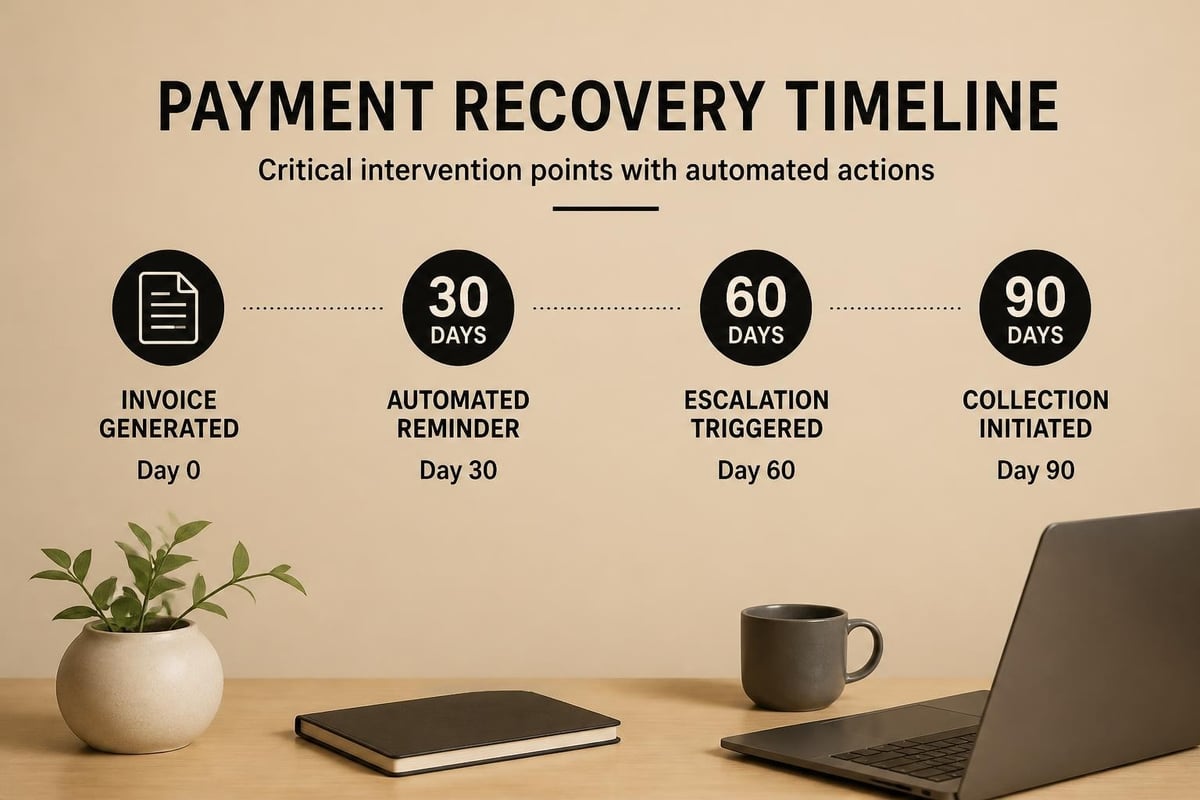
The most effective payment recovery begins before an account becomes seriously delinquent. Early intervention reduces the overall effort required and maintains customer goodwill. Research shows that payment recovery attempts initiated within 30 days of the due date achieve success rates 60% higher than those delayed beyond 90 days.
| Intervention Stage | Timeline | Recovery Rate | Recommended Action |
|---|---|---|---|
| Preventive | Before due date | 95% | Automated reminders, flexible payment options |
| Early | 1-30 days overdue | 75-85% | Gentle outreach, payment plan offers |
| Mid-Stage | 31-60 days overdue | 50-65% | Firm communication, escalation notices |
| Late-Stage | 61-90 days overdue | 30-45% | Final demands, legal preparation |
| Collections | 90+ days overdue | 15-25% | Third-party collections, legal action |
Implementing AI claims processing and automated workflows enables organizations to maintain consistent touchpoints without overwhelming staff resources. These systems can process thousands of accounts simultaneously, applying nuanced strategies based on customer history, payment patterns, and account value.
Technology Infrastructure for Payment Recovery
Modern payment recovery depends on integrated technology platforms that connect billing systems, communication tools, and analytics dashboards. The infrastructure should enable both automated processes and human intervention when necessary.
Essential technology components include:
- Automated retry logic that attempts failed transactions multiple times with varying timing strategies
- Dunning management platforms that orchestrate communication sequences based on predefined rules
- Payment gateway integrations offering multiple payment methods to reduce friction
- Analytics dashboards providing real-time visibility into recovery performance metrics
- CRM integration ensuring payment history informs all customer interactions
Organizations can learn from failed payment recovery strategies employed by subscription-based businesses, which have refined these processes to minimize involuntary churn. These strategies emphasize timing optimization, where payment retry attempts occur when accounts are most likely to have sufficient funds.
Legal and Compliance Considerations in Payment Recovery
Payment recovery operations must navigate complex legal frameworks that vary by jurisdiction, industry, and customer type. Understanding these requirements protects organizations from liability while ensuring recovery efforts remain effective.
Regulatory Compliance Requirements
The Fair Debt Collection Practices Act (FDCPA) and similar state-level regulations establish strict guidelines for payment recovery communications. Even when collecting legitimate business debts, organizations must avoid practices considered harassing, deceptive, or unfair.
Compliance essentials include:
- Restricting contact frequency to prevent harassment claims
- Providing clear debt validation information upon request
- Honoring customer cease-and-desist requests appropriately
- Maintaining accurate records of all collection communications
- Training staff on prohibited collection practices
For healthcare organizations, revenue cycle management solutions must account for additional regulations including HIPAA privacy requirements and state-specific billing regulations. These complexities demand specialized expertise to navigate successfully.
Legal Escalation Pathways
When standard payment recovery efforts fail, organizations must understand their legal options for collecting debts. The decision to pursue legal action requires careful cost-benefit analysis, considering legal fees, staff time, and the likelihood of successful collection.
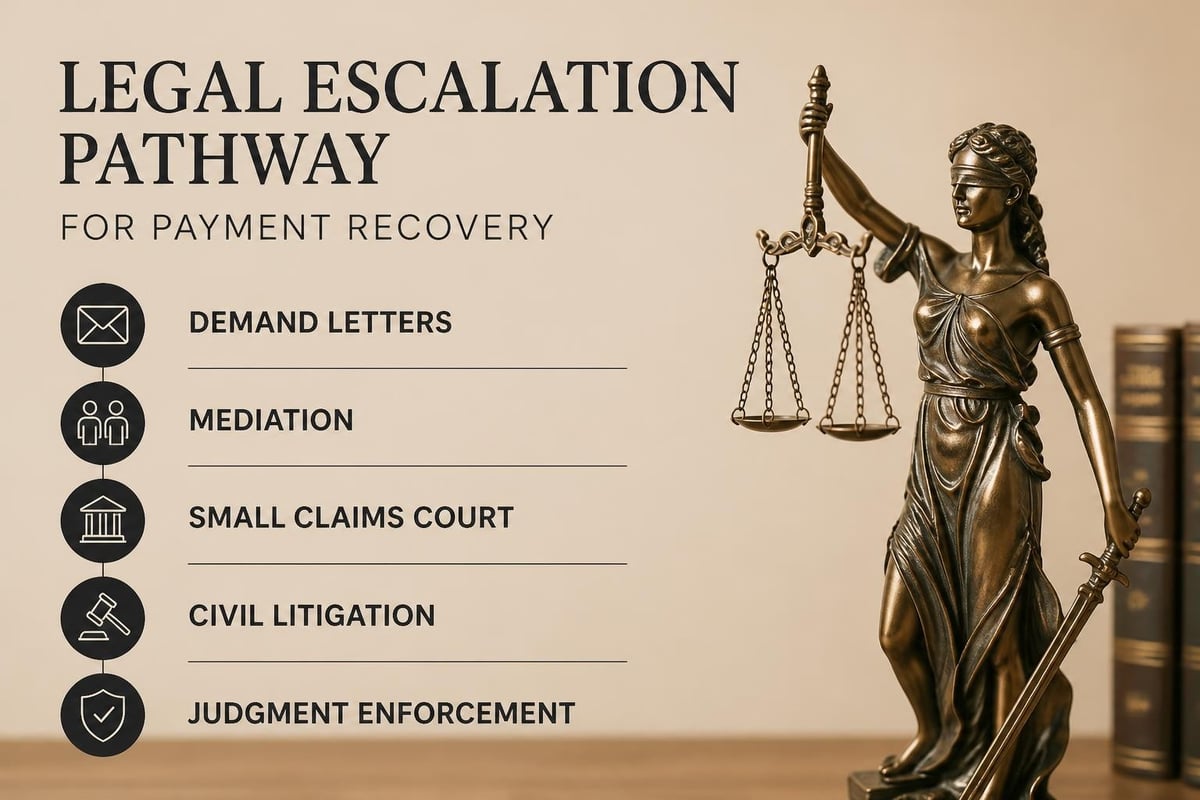
The typical legal escalation follows this progression:
- Formal demand letter outlining the debt and consequences of non-payment
- Pre-litigation settlement negotiations attempting to reach payment arrangements
- Small claims court filing for debts below jurisdictional thresholds
- Civil litigation for larger debts exceeding small claims limits
- Judgment enforcement through wage garnishment, bank levies, or property liens
Understanding the debt recovery procedure steps helps organizations make informed decisions about when to escalate and when to write off uncollectible debts. Professional services firms must weigh reputational considerations alongside financial recovery when deciding whether to pursue legal action against clients.
Optimizing Payment Recovery Through Data and Analytics
Data-driven approaches to payment recovery enable organizations to continuously refine strategies, allocate resources efficiently, and predict which accounts require special attention. Analytics transform payment recovery from reactive firefighting to proactive revenue management.
Key Performance Indicators for Payment Recovery
Measuring payment recovery effectiveness requires tracking specific metrics that reveal both process efficiency and financial outcomes. Organizations should establish baseline measurements and set improvement targets aligned with business objectives.
Critical metrics include:
- Days Sales Outstanding (DSO) measuring average collection time
- Collection Effectiveness Index (CEI) indicating overall recovery performance
- Recovery rate by aging bucket showing effectiveness across delinquency stages
- Cost per dollar collected revealing operational efficiency
- Customer retention rate ensuring collection efforts don't damage relationships
| Metric | Industry Benchmark | Excellent Performance | Action Threshold |
|---|---|---|---|
| DSO | 45-60 days | Under 35 days | Over 75 days |
| CEI | 65-75% | Over 85% | Under 55% |
| Recovery Rate (30 days) | 75-80% | Over 90% | Under 65% |
| Cost per $ Collected | $0.12-$0.18 | Under $0.08 | Over $0.25 |
Organizations serving healthcare providers face unique challenges with insurance adjudication delays and complex billing codes. Tracking payment recovery metrics specific to payer mix and service lines reveals opportunities for targeted improvements.
Predictive Analytics and Risk Scoring
Advanced payment recovery systems employ machine learning algorithms to predict which accounts are likely to become delinquent and which collection strategies will prove most effective. These predictive models analyze historical payment patterns, customer characteristics, and external economic indicators.
Risk scoring enables proactive intervention before accounts become seriously delinquent. High-risk accounts receive additional attention, flexible payment options, and personalized outreach that addresses underlying payment obstacles. This approach improves recovery rates while reducing the resources spent on low-risk accounts that will pay without extensive follow-up.
Implementing Automation in Payment Recovery Operations
Automation represents the most significant opportunity for improving payment recovery efficiency while reducing manual workload. Organizations can eliminate thousands of hours of repetitive tasks by implementing intelligent automation that handles routine collection activities.
Automated Dunning Management Systems
Dunning management refers to the systematic process of communicating with customers about overdue payments. Automated dunning sequences trigger specific messages based on payment status, customer segment, and previous response patterns.
Effective dunning best practices emphasize empathetic, personalized messaging that acknowledges the customer relationship while clearly communicating payment expectations. Automated systems can deliver these messages consistently across thousands of accounts simultaneously.
A typical automated dunning sequence includes:
- Pre-due reminder (3 days before due date) with payment link
- Friendly reminder (7 days past due) highlighting convenience of online payment
- Urgent notice (14 days past due) emphasizing account status
- Final notice (21 days past due) outlining consequences of non-payment
- Escalation notification (30 days past due) indicating transfer to collections
The timing, tone, and channel of each message should vary based on customer history and account characteristics. High-value clients might receive personal phone calls earlier in the sequence, while transactional customers receive exclusively automated communications.
Integration with Financial Systems
Payment recovery automation achieves maximum effectiveness when fully integrated with existing financial systems. This integration ensures real-time updates, prevents duplicate communications, and enables seamless handoffs between automated and manual processes.
Organizations implementing automation and integration solutions report significant improvements in both recovery rates and operational efficiency. Integration eliminates the need for manual data entry, reduces errors, and provides staff with comprehensive account visibility.
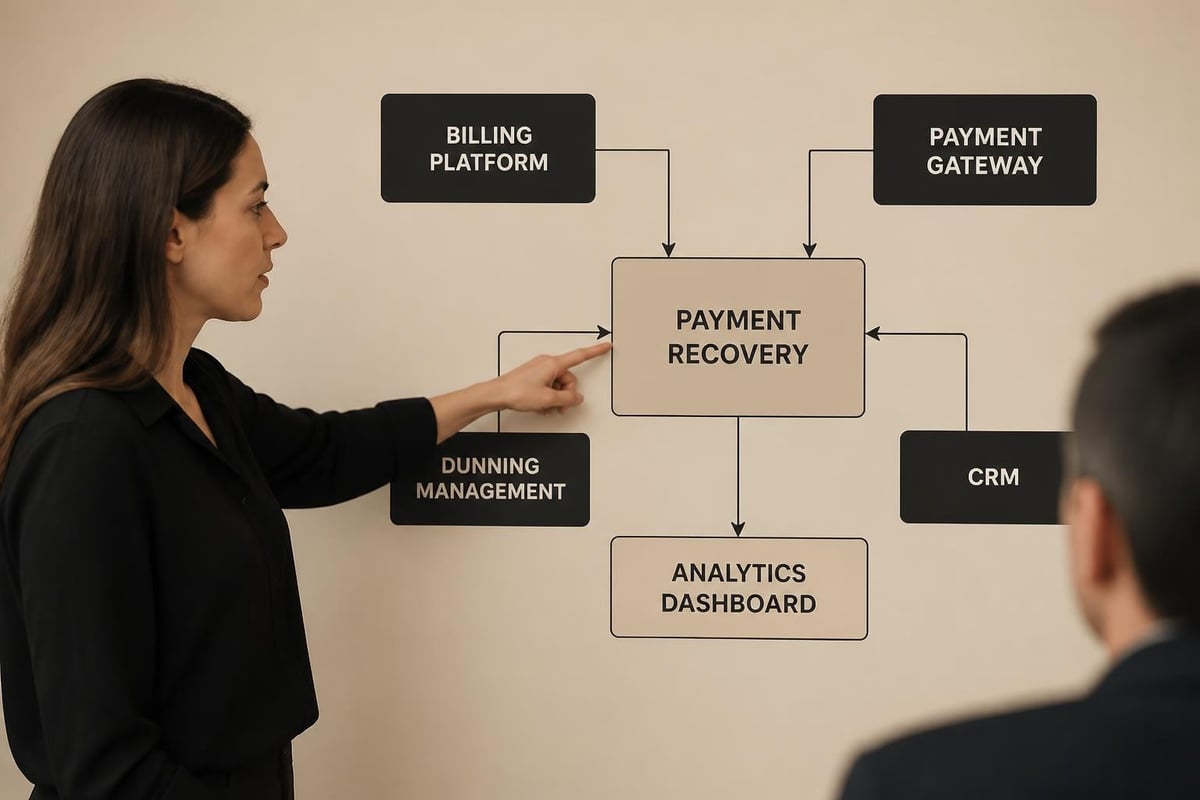
Key integration points include:
- Billing systems providing invoice data and payment status
- Payment gateways processing transactions and reporting failures
- Customer relationship management maintaining communication history
- Accounting platforms recording payments and adjustments
- Analytics tools generating insights and performance reports
Industry-Specific Payment Recovery Considerations
Different industries face unique payment recovery challenges that require tailored approaches. Understanding these nuances enables organizations to adopt strategies proven effective within their sector.
Healthcare Payment Recovery
Healthcare organizations manage particularly complex payment recovery due to insurance involvement, patient financial hardship, and regulatory constraints. The process involves coordinating between insurance payers and patient responsibility while maintaining compliance with healthcare-specific regulations.
Revenue cycle management strategies for healthcare emphasize insurance follow-up, eligibility verification, and patient communication about financial assistance options. Organizations must balance aggressive collection with maintaining patient relationships and community reputation.
Healthcare payment recovery priorities include:
- Insurance claim follow-up and denial management
- Patient responsibility estimation and communication
- Financial assistance screening and enrollment
- Payment plan establishment for large balances
- Compliance with state-specific healthcare billing regulations
Organizations seeking to efficiently recover underpayments must implement specialized auditing processes that identify contractual discrepancies and coding errors that reduce legitimate reimbursement.
Professional Services Payment Recovery
Professional services firms face payment recovery challenges related to disputed work quality, scope creep, and relationship management with ongoing clients. The approach must preserve business relationships while securing payment for delivered services.
For SMBs and mid-market organizations, payment recovery often involves direct communication between principals and clients. Automation can support this process without replacing the personal relationships that characterize professional services.
Subscription and Recurring Revenue Models
Businesses with subscription-based revenue models experience unique payment recovery challenges related to failed credit card transactions, expired payment methods, and involuntary churn. The focus shifts from one-time collection to maintaining ongoing payment relationships.
These organizations benefit from implementing customer payment recovery systems designed specifically for recurring revenue models. The strategies emphasize payment method updates, retry optimization, and proactive communication about upcoming charges.
Building a Customer-Centric Payment Recovery Culture
Effective payment recovery balances financial objectives with maintaining positive customer relationships. Organizations that approach collections with empathy, flexibility, and customer-focused policies achieve higher recovery rates while preserving long-term customer value.
Communication Strategies That Preserve Relationships
The tone, timing, and channel of payment recovery communications significantly impact both collection success and customer retention. Research shows that empathetic, solutions-focused messaging outperforms aggressive, demand-oriented approaches.
Effective communication principles include:
- Assuming positive intent and acknowledging potential legitimate reasons for non-payment
- Offering flexible payment options including installment plans
- Providing multiple convenient payment methods
- Maintaining professional, respectful tone across all channels
- Personalizing messages based on customer history and relationship
Organizations should train collection staff in de-escalation techniques and customer service principles. The goal extends beyond recovering individual payments to maintaining customer lifetime value.
Flexible Payment Solutions
Offering flexible payment options dramatically improves recovery rates by removing obstacles that prevent payment. Many customers want to pay but face temporary cash flow challenges or simply find the payment process inconvenient.
Payment flexibility options include:
- Installment plans spreading large balances across multiple months
- Alternative payment methods including ACH, credit cards, digital wallets
- Self-service payment portals enabling 24/7 payment access
- Automated payment enrollment establishing recurring payments
- Temporary payment deferrals for customers facing hardship
Debt resolution strategies demonstrate that structured payment plans often recover more total revenue than demanding immediate full payment, which may result in non-payment and eventual write-off.
Staff Training and Process Documentation
Payment recovery effectiveness depends significantly on staff capabilities and standardized processes. Organizations must invest in training programs that develop both technical skills and interpersonal competencies.
Essential Training Components
Comprehensive payment recovery training addresses legal compliance, system proficiency, communication skills, and decision-making frameworks. Staff should understand both the "how" and "why" behind payment recovery procedures.
Training curriculum should cover:
- Regulatory compliance including FDCPA requirements
- Technology platform operation and workflow management
- Communication techniques for various customer scenarios
- Escalation protocols and decision-making authority
- Documentation requirements and record-keeping standards
Regular refresher training ensures staff remain current with regulatory changes, new technology features, and evolving best practices. Organizations should measure training effectiveness through quality assurance reviews and performance metrics.
Process Documentation and Standardization
Documented processes ensure consistency across the payment recovery organization and enable efficient onboarding of new staff. Standard operating procedures should outline specific actions for various scenarios while allowing flexibility for unique situations.
Critical documentation includes:
- Dunning sequence templates and timing protocols
- Customer communication scripts and response frameworks
- Escalation criteria and approval requirements
- Legal action thresholds and procedures
- Exception handling guidelines
Organizations implementing debt recovery process strategies find that disciplined execution of standardized processes delivers superior results compared to ad-hoc approaches, even when individual staff possess strong collection skills.
Measuring and Improving Payment Recovery ROI
Payment recovery initiatives require investment in technology, staff, and processes. Organizations must demonstrate return on investment to justify ongoing resource allocation and identify opportunities for continuous improvement.
Cost-Benefit Analysis Framework
Calculating payment recovery ROI involves comparing total recovered revenue against all associated costs including technology subscriptions, staff salaries, legal fees, and opportunity costs of staff time.
| Cost Category | Annual Investment | Recovered Revenue Impact |
|---|---|---|
| Technology platforms | $50,000 – $200,000 | 15-25% improvement |
| Dedicated staff (3 FTE) | $180,000 – $240,000 | 30-45% improvement |
| Legal and collections fees | $25,000 – $100,000 | Variable by case |
| Training and development | $10,000 – $25,000 | 5-10% improvement |
Organizations should track both quantitative metrics (dollars recovered, DSO reduction) and qualitative benefits (customer retention, staff efficiency gains). The benefits of business automation extend beyond direct financial returns to include freed capacity for strategic activities.
Continuous Improvement Methodology
Leading organizations approach payment recovery as an evolving discipline requiring ongoing optimization. Regular analysis of performance data reveals trends, identifies underperforming segments, and highlights opportunities for process refinement.
Continuous improvement initiatives might include:
- A/B testing of communication messages and timing
- Segmentation analysis to identify high-performing strategies
- Technology evaluation to assess emerging capabilities
- Benchmarking against industry standards and competitors
- Staff feedback sessions to capture frontline insights
Organizations committed to operational excellence integrate payment recovery metrics into broader financial performance dashboards, ensuring executive visibility and strategic alignment.
Effective payment recovery transforms uncollected revenue into realized cash flow while maintaining valuable customer relationships and reducing operational burden. By combining automation, data analytics, customer-centric communication, and legal compliance, organizations achieve recovery rates that significantly impact their bottom line. Nero and Associates, Inc. helps businesses implement comprehensive payment recovery solutions through artificial intelligence, automation integration, and revenue cycle management expertise that eliminates thousands of manual hours while improving financial outcomes. Contact our team to discover how performance-based consulting can optimize your payment recovery operations and strengthen your organization's financial health.