

RCM Automation: Streamline Revenue Cycle Operations in 2026

Share on Facebook
Share on X
Share on LinkedIn

Healthcare organizations face mounting pressure to maintain financial stability while delivering exceptional patient care. The revenue cycle has become increasingly complex, with rising denial rates, stringent regulatory requirements, and persistent staffing challenges. RCM automation addresses these critical pain points by transforming manual, time-consuming processes into streamlined, intelligent workflows that reduce errors, accelerate cash flow, and free healthcare professionals to focus on what matters most: patient outcomes.

Understanding the Fundamentals of Revenue Cycle Management Automation

Revenue cycle management automation represents a comprehensive approach to digitizing and optimizing every stage of the healthcare billing process. From patient registration through final payment reconciliation, modern RCM automation integrates with existing healthcare systems to create seamless operational workflows.

The technology leverages artificial intelligence, machine learning, and robotic process automation to handle repetitive tasks that traditionally consumed thousands of staff hours. These systems can verify insurance eligibility in seconds, automatically code procedures based on clinical documentation, and flag potential claim denials before submission.

Core Components That Drive Automation Success

Effective rcm automation platforms incorporate several essential technologies working in concert:

  • Robotic Process Automation (RPA) for executing rule-based tasks across multiple systems
  • Natural Language Processing (NLP) to extract relevant information from clinical notes
  • Machine Learning algorithms that improve accuracy over time through pattern recognition
  • Predictive analytics to identify potential payment delays or denials
  • Intelligent workflow routing that directs tasks to appropriate team members or automated processes

Financial performance in healthcare organizations directly correlates with revenue cycle efficiency. Organizations implementing comprehensive automation solutions typically report 30-40% reductions in days in accounts receivable and significant improvements in first-pass claim acceptance rates.

RCM automation technology components

The Financial Impact of Implementing Automated Revenue Cycle Solutions

Healthcare providers implementing rcm automation experience measurable financial improvements across multiple performance indicators. The return on investment extends beyond simple cost reduction, encompassing revenue acceleration, improved cash flow predictability, and enhanced operational capacity.

Quantifiable Benefits Organizations Achieve

Performance Metric Pre-Automation Average Post-Automation Average Improvement
Days in A/R 52 days 32 days 38% reduction
First-pass claim rate 76% 94% 24% increase
Denial rate 8.5% 3.2% 62% reduction
Collection rate 93% 98% 5% increase
Staff productivity Baseline +45% capacity 45% increase

Organizations leveraging operational excellence strategies discover that automation creates capacity for staff to focus on complex cases requiring human judgment and empathy. This reallocation of human capital generates exponential value as employees apply critical thinking to exception handling rather than data entry.

The initial investment in rcm automation typically delivers payback within 12-18 months. Forward-thinking healthcare organizations recognize that end-to-end RCM automation addresses challenges like rising denial rates and staffing shortages while positioning them for sustainable growth.

Beyond Cost Savings: Strategic Advantages

Revenue cycle automation delivers strategic benefits that compound over time. Organizations gain real-time visibility into their financial performance, enabling proactive decision-making rather than reactive problem-solving. Predictive analytics identify trends before they impact cash flow, allowing teams to address root causes of denials or delays.

Patient satisfaction improves as automated systems reduce billing errors and provide transparent cost estimates upfront. The enhanced patient experience translates to higher collection rates and stronger patient retention in competitive healthcare markets.

Implementation Strategies for Maximum Effectiveness

Successful rcm automation requires thoughtful planning and phased execution. Organizations that rush implementation without proper preparation often encounter integration challenges, user resistance, and suboptimal results.

Phase One: Assessment and Foundation Building

  1. Conduct comprehensive process mapping to identify all current revenue cycle workflows
  2. Analyze pain points and bottlenecks where manual processes create delays or errors
  3. Establish baseline metrics for measuring improvement across key performance indicators
  4. Evaluate existing technology infrastructure and identify integration requirements
  5. Build cross-functional implementation teams including revenue cycle, IT, and clinical staff

This foundational work ensures that automation targets the highest-impact opportunities. Many organizations discover that 20% of their processes consume 80% of staff time, making these ideal candidates for initial automation deployment.

Phase Two: Technology Selection and Configuration

Selecting the right automation platform requires evaluating vendors against specific organizational needs. Healthcare providers need RCM automation solutions that integrate seamlessly with existing electronic health records, practice management systems, and clearinghouses.

Critical evaluation criteria include:

  • Integration capabilities with current technology stack
  • Scalability to accommodate organizational growth
  • Compliance features ensuring HIPAA and regulatory adherence
  • Vendor support quality and implementation expertise
  • Total cost of ownership including licensing, implementation, and maintenance

Configuration should reflect organizational workflows rather than forcing staff to adapt to rigid system requirements. Customization enables automation to complement existing strengths while addressing specific weaknesses.

RCM automation implementation roadmap

Technologies Powering Modern Revenue Cycle Automation

The automation landscape continues to evolve rapidly, with emerging technologies expanding what's possible in revenue cycle management. Understanding these capabilities helps organizations make informed investment decisions and anticipate future opportunities.

Artificial Intelligence and Machine Learning Applications

AI-powered systems transform revenue cycle management by learning from historical data to make increasingly accurate predictions and recommendations. Machine learning algorithms analyze millions of claims to identify patterns associated with denials, enabling proactive correction before submission.

Natural language processing extracts relevant billing information from unstructured clinical documentation, automatically suggesting appropriate CPT and ICD-10 codes. These suggestions improve coding accuracy while reducing the time clinicians spend on documentation.

Predictive analytics forecast patient payment likelihood based on demographic data, insurance coverage, and historical payment behavior. This intelligence enables staff to tailor collection strategies and offer appropriate payment plans upfront.

Robotic Process Automation in Daily Operations

Technologies powering end-to-end RCM automation include RPA systems that execute repetitive tasks with perfect consistency. Software robots can check eligibility across multiple payer portals, post payments from remittance files, and reconcile accounts without human intervention.

RPA excels at bridging systems that lack native integration, copying data between platforms while validating accuracy. This capability proves invaluable in healthcare environments where legacy systems remain operational alongside modern cloud-based applications.

The technology operates 24/7 without fatigue, processing work during off-hours to ensure morning staff encounter clean queues ready for complex cases requiring human expertise. This continuous operation accelerates throughput without increasing labor costs.

Addressing Common Implementation Challenges

Organizations implementing rcm automation encounter predictable obstacles that, when anticipated, become manageable rather than derailing. Proactive planning mitigates these challenges and accelerates time-to-value.

Change Management and Staff Adoption

Employees often view automation with apprehension, fearing job displacement or struggling with new workflows. Successful implementations prioritize transparent communication about how automation enhances rather than replaces human workers.

Training programs should emphasize the elimination of tedious tasks, allowing staff to apply judgment and expertise to complex scenarios. Highlighting how automation reduces overtime and workplace stress builds buy-in from frontline teams.

Effective change management strategies include:

  • Regular town halls addressing automation progress and employee concerns
  • Involving frontline staff in workflow design and testing
  • Celebrating quick wins and sharing success metrics
  • Providing comprehensive training with hands-on practice
  • Creating super-users who champion adoption among peers

Organizations with strong Human Capital Management solutions recognize that technology investments succeed or fail based on user adoption. Prioritizing the employee experience during transformation drives sustainable results.

Data Quality and System Integration

Automation amplifies existing data quality issues. Inaccurate or incomplete information in source systems produces errors at scale when automated processes lack human oversight. Pre-implementation data cleansing proves essential for automation success.

Integration Challenge Impact Solution Approach
Inconsistent data formats Processing failures Standardize data entry protocols
Duplicate patient records Incorrect posting Implement master data management
Legacy system limitations Integration gaps Deploy middleware or RPA bridges
Real-time sync requirements Delayed workflows Establish API connections
Security and compliance Risk exposure Enforce encryption and audit trails

Healthcare organizations benefit from engaging integration specialists who understand both clinical workflows and technical requirements. This expertise prevents common pitfalls and ensures secure, compliant implementations.
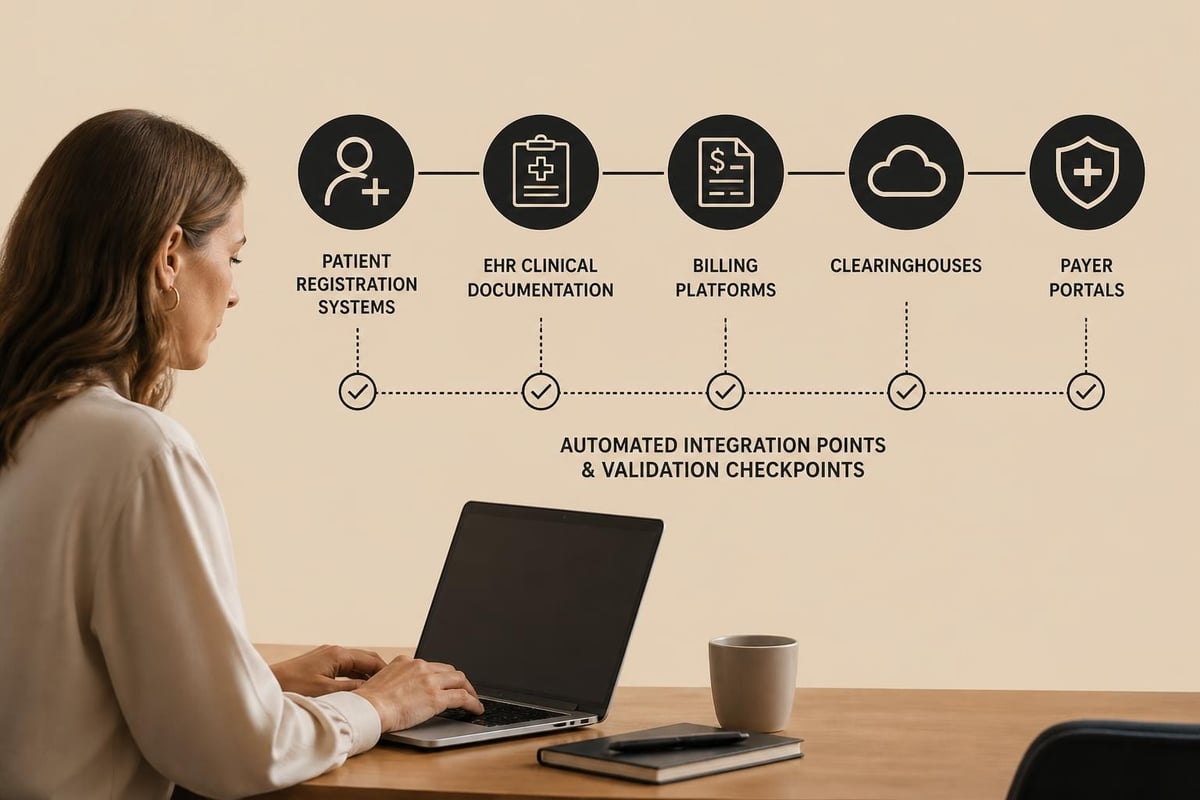
Data integration architecture

Measuring Success and Optimizing Performance

Implementing rcm automation marks the beginning rather than the end of the improvement journey. Continuous monitoring and optimization ensure organizations maximize their technology investments and adapt to changing requirements.

Key Performance Indicators to Track

Establishing comprehensive dashboards provides visibility into automation effectiveness across the revenue cycle. Leading organizations monitor both operational and financial metrics to gain complete performance understanding.

Operational metrics include:

  • Transaction processing volume per automated workflow
  • Error rates and exception handling requirements
  • Processing time reduction for specific tasks
  • Staff capacity freed for higher-value activities
  • System uptime and reliability statistics

Financial metrics encompass:

  • Net collection rate improvements
  • Reduction in days to payment
  • Denial rate trends by payer and service type
  • Cost per transaction processed
  • Revenue recovery from previously written-off accounts

Monthly performance reviews identify opportunities for refinement. Understanding what RCM automation really means includes recognizing that optimization continues long after initial deployment.

Continuous Improvement Through Analytics

Advanced automation platforms generate rich data about process performance, revealing insights invisible in manual operations. Analytics identify specific payers with high denial rates, procedures requiring additional documentation, or workflow bottlenecks limiting throughput.

Organizations leverage these insights to negotiate better payer contracts, refine clinical documentation practices, and reallocate resources toward highest-impact activities. The data-driven approach transforms revenue cycle management from reactive problem-solving to strategic optimization.

Machine learning systems improve autonomously over time, recognizing new patterns and adapting to changing payer requirements. This self-improvement capability means automation ROI increases year over year rather than plateauing after initial gains.

Industry Trends Shaping the Future of Revenue Cycle Automation

The healthcare landscape continues evolving rapidly, with regulatory changes, payer initiatives, and technology innovations creating new opportunities and challenges. Forward-thinking organizations position themselves to capitalize on emerging trends in rcm automation.

Value-Based Care and Automation Synergy

The healthcare industry's transition from fee-for-service to value-based reimbursement models demands sophisticated data management and reporting capabilities. Automation enables organizations to track quality metrics, capture necessary documentation, and submit appropriate risk adjustment data.

Population health management requires aggregating data across care settings and payer contracts. Automated systems consolidate this information, identify care gaps, and enable proactive outreach that improves outcomes while maximizing reimbursement under value-based contracts.

Interoperability and Standards Advancement

Federal initiatives promoting healthcare interoperability create opportunities for more seamless automation. FHIR standards enable real-time data exchange between systems, reducing manual data entry and accelerating prior authorization approvals.

Organizations investing in modern, standards-compliant platforms position themselves to benefit as interoperability matures. The ability to receive patient demographic updates, insurance changes, and clinical data electronically eliminates countless manual touches.

Artificial Intelligence Maturation

AI capabilities continue expanding, with natural language processing handling increasingly complex documentation analysis. Future systems will automatically generate appeals for denied claims, drafting compelling arguments based on clinical documentation and payer policies.

Conversational AI chatbots handle routine patient billing inquiries, freeing staff for complex collection scenarios requiring empathy and negotiation. These virtual assistants operate around the clock, improving patient satisfaction while reducing call center costs.

Selecting the Right Automation Partner

Healthcare organizations rarely possess internal expertise to implement comprehensive rcm automation independently. Selecting experienced implementation partners proves critical to success, accelerating deployment while avoiding costly missteps.

Evaluation Criteria for Technology Vendors

Organizations should assess potential automation vendors against multiple dimensions beyond basic functionality. The relationship extends years beyond initial implementation, making vendor stability and support quality essential considerations.

Critical evaluation factors include:

  • Proven healthcare experience with relevant organization sizes
  • Customer references from similar operational environments
  • Implementation methodology and typical timelines
  • Training programs and change management support
  • Ongoing optimization and support services
  • Roadmap alignment with industry trends
  • Financial stability and long-term viability

Requesting detailed proposals with specific automation scenarios helps compare vendor capabilities objectively. Organizations should insist on proof-of-concept demonstrations using actual data to validate claimed performance.

Consultancy Support for Strategic Implementation

Performance-based consultancies bring cross-industry expertise and objective perspectives to automation initiatives. They identify opportunities that internal teams, focused on daily operations, might overlook.

Healthcare organizations seeking financial and operational excellence benefit from consultants who understand both revenue cycle intricacies and change management best practices. This combination ensures technical implementations deliver sustainable business results.

Consultants facilitate vendor selection through structured evaluation processes, negotiate favorable contract terms, and provide project management throughout implementation. Their experience with common pitfalls helps organizations avoid delays and budget overruns.

Real-World Applications Across Healthcare Settings

RCM automation delivers value across diverse healthcare environments, though specific applications vary based on organizational characteristics. Understanding these variations helps organizations prioritize automation opportunities matching their unique circumstances.

Hospital and Health System Automation

Large healthcare systems manage complex revenue cycles spanning multiple specialties, payer contracts, and care settings. Automation standardizes processes across facilities while accommodating necessary variations.

Centralized business offices leverage automation to process claims from distributed care locations, creating economies of scale. Robotic process automation handles routine tasks while specialized staff focus on complex denials and payer negotiations.

Physician Practice and Ambulatory Care

Smaller practices lack dedicated IT resources, making cloud-based automation platforms particularly attractive. These solutions require minimal infrastructure investment while delivering enterprise-grade capabilities through subscription models.

Practice automation prioritizes patient engagement, with online scheduling, insurance verification, and payment collection reducing administrative burden. Staff capacity freed from phone calls and manual verification enables practice growth without proportional overhead increases.

Specialty Provider Considerations

Behavioral health, dental, and other specialty providers face unique revenue cycle challenges requiring tailored automation approaches. Specialized coding requirements, prior authorization complexity, and payer-specific rules demand flexible automation platforms.

These organizations benefit from automation that learns their specific workflows and payer requirements, reducing the manual research time staff spend navigating specialty reimbursement rules. The technology becomes institutional knowledge that persists regardless of staff turnover.

Security and Compliance in Automated Environments

Healthcare automation must maintain rigorous security and compliance standards protecting sensitive patient information. Organizations implementing rcm automation should prioritize platforms with robust security features and proven compliance track records.

HIPAA Compliance Requirements

Automated systems accessing, transmitting, or storing protected health information must comply with HIPAA Security Rule requirements. This includes implementing appropriate administrative, physical, and technical safeguards.

Encryption protects data both at rest and in transit between systems. Access controls ensure only authorized users view sensitive information, with comprehensive audit trails tracking all system interactions for compliance monitoring.

Business associate agreements with automation vendors clearly define responsibilities for protecting patient information. Regular security assessments identify vulnerabilities before they're exploited, maintaining robust defense against evolving threats.

Regulatory Reporting and Documentation

Automated systems should maintain complete documentation of all revenue cycle activities, supporting compliance with federal and state regulations. This includes tracking consent for treatment and billing, documenting collection activities under Fair Debt Collection Practices Act requirements, and maintaining records supporting medical necessity.

Automation actually enhances compliance by ensuring consistent application of policies across all transactions. Manual processes introduce variability as different staff members interpret requirements differently, while automated systems apply rules uniformly.


Healthcare revenue cycle automation represents a transformative opportunity to simultaneously improve financial performance, operational efficiency, and staff satisfaction. Organizations that strategically implement these technologies position themselves for sustainable success in an increasingly complex healthcare environment. Nero and Associates, Inc. partners with healthcare providers to implement comprehensive automation solutions that eliminate manual processes, accelerate cash flow, and empower teams to focus on delivering exceptional patient care. Our performance-based approach ensures your organization achieves measurable results from technology investments while building capabilities for continued optimization.

RCM Automation: Streamline Revenue Cycle Operations in 2026

Healthcare organizations face mounting pressure to maintain financial stability while delivering exceptional patient care. The revenue cycle has become increasingly complex, with rising denial rates, stringent regulatory requirements, and persistent staffing challenges. RCM automation addresses these critical pain points by transforming manual, time-consuming processes into streamlined, intelligent workflows that reduce errors, accelerate cash flow, and free healthcare professionals to focus on what matters most: patient outcomes.

Understanding the Fundamentals of Revenue Cycle Management Automation

Revenue cycle management automation represents a comprehensive approach to digitizing and optimizing every stage of the healthcare billing process. From patient registration through final payment reconciliation, modern RCM automation integrates with existing healthcare systems to create seamless operational workflows.

The technology leverages artificial intelligence, machine learning, and robotic process automation to handle repetitive tasks that traditionally consumed thousands of staff hours. These systems can verify insurance eligibility in seconds, automatically code procedures based on clinical documentation, and flag potential claim denials before submission.

Core Components That Drive Automation Success

Effective rcm automation platforms incorporate several essential technologies working in concert:

  • Robotic Process Automation (RPA) for executing rule-based tasks across multiple systems
  • Natural Language Processing (NLP) to extract relevant information from clinical notes
  • Machine Learning algorithms that improve accuracy over time through pattern recognition
  • Predictive analytics to identify potential payment delays or denials
  • Intelligent workflow routing that directs tasks to appropriate team members or automated processes

Financial performance in healthcare organizations directly correlates with revenue cycle efficiency. Organizations implementing comprehensive automation solutions typically report 30-40% reductions in days in accounts receivable and significant improvements in first-pass claim acceptance rates.

RCM automation technology components

The Financial Impact of Implementing Automated Revenue Cycle Solutions

Healthcare providers implementing rcm automation experience measurable financial improvements across multiple performance indicators. The return on investment extends beyond simple cost reduction, encompassing revenue acceleration, improved cash flow predictability, and enhanced operational capacity.

Quantifiable Benefits Organizations Achieve

Performance Metric Pre-Automation Average Post-Automation Average Improvement
Days in A/R 52 days 32 days 38% reduction
First-pass claim rate 76% 94% 24% increase
Denial rate 8.5% 3.2% 62% reduction
Collection rate 93% 98% 5% increase
Staff productivity Baseline +45% capacity 45% increase

Organizations leveraging operational excellence strategies discover that automation creates capacity for staff to focus on complex cases requiring human judgment and empathy. This reallocation of human capital generates exponential value as employees apply critical thinking to exception handling rather than data entry.

The initial investment in rcm automation typically delivers payback within 12-18 months. Forward-thinking healthcare organizations recognize that end-to-end RCM automation addresses challenges like rising denial rates and staffing shortages while positioning them for sustainable growth.

Beyond Cost Savings: Strategic Advantages

Revenue cycle automation delivers strategic benefits that compound over time. Organizations gain real-time visibility into their financial performance, enabling proactive decision-making rather than reactive problem-solving. Predictive analytics identify trends before they impact cash flow, allowing teams to address root causes of denials or delays.

Patient satisfaction improves as automated systems reduce billing errors and provide transparent cost estimates upfront. The enhanced patient experience translates to higher collection rates and stronger patient retention in competitive healthcare markets.

Implementation Strategies for Maximum Effectiveness

Successful rcm automation requires thoughtful planning and phased execution. Organizations that rush implementation without proper preparation often encounter integration challenges, user resistance, and suboptimal results.

Phase One: Assessment and Foundation Building

  1. Conduct comprehensive process mapping to identify all current revenue cycle workflows
  2. Analyze pain points and bottlenecks where manual processes create delays or errors
  3. Establish baseline metrics for measuring improvement across key performance indicators
  4. Evaluate existing technology infrastructure and identify integration requirements
  5. Build cross-functional implementation teams including revenue cycle, IT, and clinical staff

This foundational work ensures that automation targets the highest-impact opportunities. Many organizations discover that 20% of their processes consume 80% of staff time, making these ideal candidates for initial automation deployment.

Phase Two: Technology Selection and Configuration

Selecting the right automation platform requires evaluating vendors against specific organizational needs. Healthcare providers need RCM automation solutions that integrate seamlessly with existing electronic health records, practice management systems, and clearinghouses.

Critical evaluation criteria include:

  • Integration capabilities with current technology stack
  • Scalability to accommodate organizational growth
  • Compliance features ensuring HIPAA and regulatory adherence
  • Vendor support quality and implementation expertise
  • Total cost of ownership including licensing, implementation, and maintenance

Configuration should reflect organizational workflows rather than forcing staff to adapt to rigid system requirements. Customization enables automation to complement existing strengths while addressing specific weaknesses.

RCM automation implementation roadmap

Technologies Powering Modern Revenue Cycle Automation

The automation landscape continues to evolve rapidly, with emerging technologies expanding what's possible in revenue cycle management. Understanding these capabilities helps organizations make informed investment decisions and anticipate future opportunities.

Artificial Intelligence and Machine Learning Applications

AI-powered systems transform revenue cycle management by learning from historical data to make increasingly accurate predictions and recommendations. Machine learning algorithms analyze millions of claims to identify patterns associated with denials, enabling proactive correction before submission.

Natural language processing extracts relevant billing information from unstructured clinical documentation, automatically suggesting appropriate CPT and ICD-10 codes. These suggestions improve coding accuracy while reducing the time clinicians spend on documentation.

Predictive analytics forecast patient payment likelihood based on demographic data, insurance coverage, and historical payment behavior. This intelligence enables staff to tailor collection strategies and offer appropriate payment plans upfront.

Robotic Process Automation in Daily Operations

Technologies powering end-to-end RCM automation include RPA systems that execute repetitive tasks with perfect consistency. Software robots can check eligibility across multiple payer portals, post payments from remittance files, and reconcile accounts without human intervention.

RPA excels at bridging systems that lack native integration, copying data between platforms while validating accuracy. This capability proves invaluable in healthcare environments where legacy systems remain operational alongside modern cloud-based applications.

The technology operates 24/7 without fatigue, processing work during off-hours to ensure morning staff encounter clean queues ready for complex cases requiring human expertise. This continuous operation accelerates throughput without increasing labor costs.

Addressing Common Implementation Challenges

Organizations implementing rcm automation encounter predictable obstacles that, when anticipated, become manageable rather than derailing. Proactive planning mitigates these challenges and accelerates time-to-value.

Change Management and Staff Adoption

Employees often view automation with apprehension, fearing job displacement or struggling with new workflows. Successful implementations prioritize transparent communication about how automation enhances rather than replaces human workers.

Training programs should emphasize the elimination of tedious tasks, allowing staff to apply judgment and expertise to complex scenarios. Highlighting how automation reduces overtime and workplace stress builds buy-in from frontline teams.

Effective change management strategies include:

  • Regular town halls addressing automation progress and employee concerns
  • Involving frontline staff in workflow design and testing
  • Celebrating quick wins and sharing success metrics
  • Providing comprehensive training with hands-on practice
  • Creating super-users who champion adoption among peers

Organizations with strong Human Capital Management solutions recognize that technology investments succeed or fail based on user adoption. Prioritizing the employee experience during transformation drives sustainable results.

Data Quality and System Integration

Automation amplifies existing data quality issues. Inaccurate or incomplete information in source systems produces errors at scale when automated processes lack human oversight. Pre-implementation data cleansing proves essential for automation success.

Integration Challenge Impact Solution Approach
Inconsistent data formats Processing failures Standardize data entry protocols
Duplicate patient records Incorrect posting Implement master data management
Legacy system limitations Integration gaps Deploy middleware or RPA bridges
Real-time sync requirements Delayed workflows Establish API connections
Security and compliance Risk exposure Enforce encryption and audit trails

Healthcare organizations benefit from engaging integration specialists who understand both clinical workflows and technical requirements. This expertise prevents common pitfalls and ensures secure, compliant implementations.

Data integration architecture

Measuring Success and Optimizing Performance

Implementing rcm automation marks the beginning rather than the end of the improvement journey. Continuous monitoring and optimization ensure organizations maximize their technology investments and adapt to changing requirements.

Key Performance Indicators to Track

Establishing comprehensive dashboards provides visibility into automation effectiveness across the revenue cycle. Leading organizations monitor both operational and financial metrics to gain complete performance understanding.

Operational metrics include:

  • Transaction processing volume per automated workflow
  • Error rates and exception handling requirements
  • Processing time reduction for specific tasks
  • Staff capacity freed for higher-value activities
  • System uptime and reliability statistics

Financial metrics encompass:

  • Net collection rate improvements
  • Reduction in days to payment
  • Denial rate trends by payer and service type
  • Cost per transaction processed
  • Revenue recovery from previously written-off accounts

Monthly performance reviews identify opportunities for refinement. Understanding what RCM automation really means includes recognizing that optimization continues long after initial deployment.

Continuous Improvement Through Analytics

Advanced automation platforms generate rich data about process performance, revealing insights invisible in manual operations. Analytics identify specific payers with high denial rates, procedures requiring additional documentation, or workflow bottlenecks limiting throughput.

Organizations leverage these insights to negotiate better payer contracts, refine clinical documentation practices, and reallocate resources toward highest-impact activities. The data-driven approach transforms revenue cycle management from reactive problem-solving to strategic optimization.

Machine learning systems improve autonomously over time, recognizing new patterns and adapting to changing payer requirements. This self-improvement capability means automation ROI increases year over year rather than plateauing after initial gains.

Industry Trends Shaping the Future of Revenue Cycle Automation

The healthcare landscape continues evolving rapidly, with regulatory changes, payer initiatives, and technology innovations creating new opportunities and challenges. Forward-thinking organizations position themselves to capitalize on emerging trends in rcm automation.

Value-Based Care and Automation Synergy

The healthcare industry's transition from fee-for-service to value-based reimbursement models demands sophisticated data management and reporting capabilities. Automation enables organizations to track quality metrics, capture necessary documentation, and submit appropriate risk adjustment data.

Population health management requires aggregating data across care settings and payer contracts. Automated systems consolidate this information, identify care gaps, and enable proactive outreach that improves outcomes while maximizing reimbursement under value-based contracts.

Interoperability and Standards Advancement

Federal initiatives promoting healthcare interoperability create opportunities for more seamless automation. FHIR standards enable real-time data exchange between systems, reducing manual data entry and accelerating prior authorization approvals.

Organizations investing in modern, standards-compliant platforms position themselves to benefit as interoperability matures. The ability to receive patient demographic updates, insurance changes, and clinical data electronically eliminates countless manual touches.

Artificial Intelligence Maturation

AI capabilities continue expanding, with natural language processing handling increasingly complex documentation analysis. Future systems will automatically generate appeals for denied claims, drafting compelling arguments based on clinical documentation and payer policies.

Conversational AI chatbots handle routine patient billing inquiries, freeing staff for complex collection scenarios requiring empathy and negotiation. These virtual assistants operate around the clock, improving patient satisfaction while reducing call center costs.

Selecting the Right Automation Partner

Healthcare organizations rarely possess internal expertise to implement comprehensive rcm automation independently. Selecting experienced implementation partners proves critical to success, accelerating deployment while avoiding costly missteps.

Evaluation Criteria for Technology Vendors

Organizations should assess potential automation vendors against multiple dimensions beyond basic functionality. The relationship extends years beyond initial implementation, making vendor stability and support quality essential considerations.

Critical evaluation factors include:

  • Proven healthcare experience with relevant organization sizes
  • Customer references from similar operational environments
  • Implementation methodology and typical timelines
  • Training programs and change management support
  • Ongoing optimization and support services
  • Roadmap alignment with industry trends
  • Financial stability and long-term viability

Requesting detailed proposals with specific automation scenarios helps compare vendor capabilities objectively. Organizations should insist on proof-of-concept demonstrations using actual data to validate claimed performance.

Consultancy Support for Strategic Implementation

Performance-based consultancies bring cross-industry expertise and objective perspectives to automation initiatives. They identify opportunities that internal teams, focused on daily operations, might overlook.

Healthcare organizations seeking financial and operational excellence benefit from consultants who understand both revenue cycle intricacies and change management best practices. This combination ensures technical implementations deliver sustainable business results.

Consultants facilitate vendor selection through structured evaluation processes, negotiate favorable contract terms, and provide project management throughout implementation. Their experience with common pitfalls helps organizations avoid delays and budget overruns.

Real-World Applications Across Healthcare Settings

RCM automation delivers value across diverse healthcare environments, though specific applications vary based on organizational characteristics. Understanding these variations helps organizations prioritize automation opportunities matching their unique circumstances.

Hospital and Health System Automation

Large healthcare systems manage complex revenue cycles spanning multiple specialties, payer contracts, and care settings. Automation standardizes processes across facilities while accommodating necessary variations.

Centralized business offices leverage automation to process claims from distributed care locations, creating economies of scale. Robotic process automation handles routine tasks while specialized staff focus on complex denials and payer negotiations.

Physician Practice and Ambulatory Care

Smaller practices lack dedicated IT resources, making cloud-based automation platforms particularly attractive. These solutions require minimal infrastructure investment while delivering enterprise-grade capabilities through subscription models.

Practice automation prioritizes patient engagement, with online scheduling, insurance verification, and payment collection reducing administrative burden. Staff capacity freed from phone calls and manual verification enables practice growth without proportional overhead increases.

Specialty Provider Considerations

Behavioral health, dental, and other specialty providers face unique revenue cycle challenges requiring tailored automation approaches. Specialized coding requirements, prior authorization complexity, and payer-specific rules demand flexible automation platforms.

These organizations benefit from automation that learns their specific workflows and payer requirements, reducing the manual research time staff spend navigating specialty reimbursement rules. The technology becomes institutional knowledge that persists regardless of staff turnover.

Security and Compliance in Automated Environments

Healthcare automation must maintain rigorous security and compliance standards protecting sensitive patient information. Organizations implementing rcm automation should prioritize platforms with robust security features and proven compliance track records.

HIPAA Compliance Requirements

Automated systems accessing, transmitting, or storing protected health information must comply with HIPAA Security Rule requirements. This includes implementing appropriate administrative, physical, and technical safeguards.

Encryption protects data both at rest and in transit between systems. Access controls ensure only authorized users view sensitive information, with comprehensive audit trails tracking all system interactions for compliance monitoring.

Business associate agreements with automation vendors clearly define responsibilities for protecting patient information. Regular security assessments identify vulnerabilities before they're exploited, maintaining robust defense against evolving threats.

Regulatory Reporting and Documentation

Automated systems should maintain complete documentation of all revenue cycle activities, supporting compliance with federal and state regulations. This includes tracking consent for treatment and billing, documenting collection activities under Fair Debt Collection Practices Act requirements, and maintaining records supporting medical necessity.

Automation actually enhances compliance by ensuring consistent application of policies across all transactions. Manual processes introduce variability as different staff members interpret requirements differently, while automated systems apply rules uniformly.


Healthcare revenue cycle automation represents a transformative opportunity to simultaneously improve financial performance, operational efficiency, and staff satisfaction. Organizations that strategically implement these technologies position themselves for sustainable success in an increasingly complex healthcare environment. Nero and Associates, Inc. partners with healthcare providers to implement comprehensive automation solutions that eliminate manual processes, accelerate cash flow, and empower teams to focus on delivering exceptional patient care. Our performance-based approach ensures your organization achieves measurable results from technology investments while building capabilities for continued optimization.

Website developed in accordance with Web Content Accessibility Guidelines 2.2.
If you encounter any issues while using this site, please contact us: 215.526.5126