

Modern organizations generate vast amounts of employee data every day, from attendance records and performance reviews to compensation details and training completion rates. Yet many businesses struggle to transform this information into strategic insights that drive meaningful improvement. Workforce analytics bridges this gap by applying data science methodologies to human capital management, enabling organizations to make evidence-based decisions about their most valuable asset: their people. For professional services firms and consultancies, mastering workforce analytics represents a competitive advantage that directly impacts client outcomes, operational efficiency, and bottom-line results.
The Strategic Foundation of Workforce Analytics
Workforce analytics encompasses the systematic collection, analysis, and interpretation of employee data to improve organizational performance. This discipline extends far beyond basic HR reporting, integrating advanced statistical methods, predictive modeling, and business intelligence tools to uncover patterns and trends that inform strategic decision-making.
Organizations implementing workforce analytics typically progress through several maturity stages. Initial efforts focus on descriptive analytics, answering questions about what happened in the past through metrics like turnover rates and time-to-hire. As capabilities mature, companies move toward diagnostic analytics to understand why certain patterns emerged, then advance to predictive analytics that forecast future outcomes, and ultimately achieve prescriptive analytics that recommend specific actions.
Building a Data-Driven Culture in Human Capital Management
The Society for Human Resource Management (SHRM) emphasizes talent analytics as essential for optimizing workforce decisions and improving business outcomes. Creating this analytical culture requires investment in three critical areas: technology infrastructure, analytical talent, and leadership commitment.
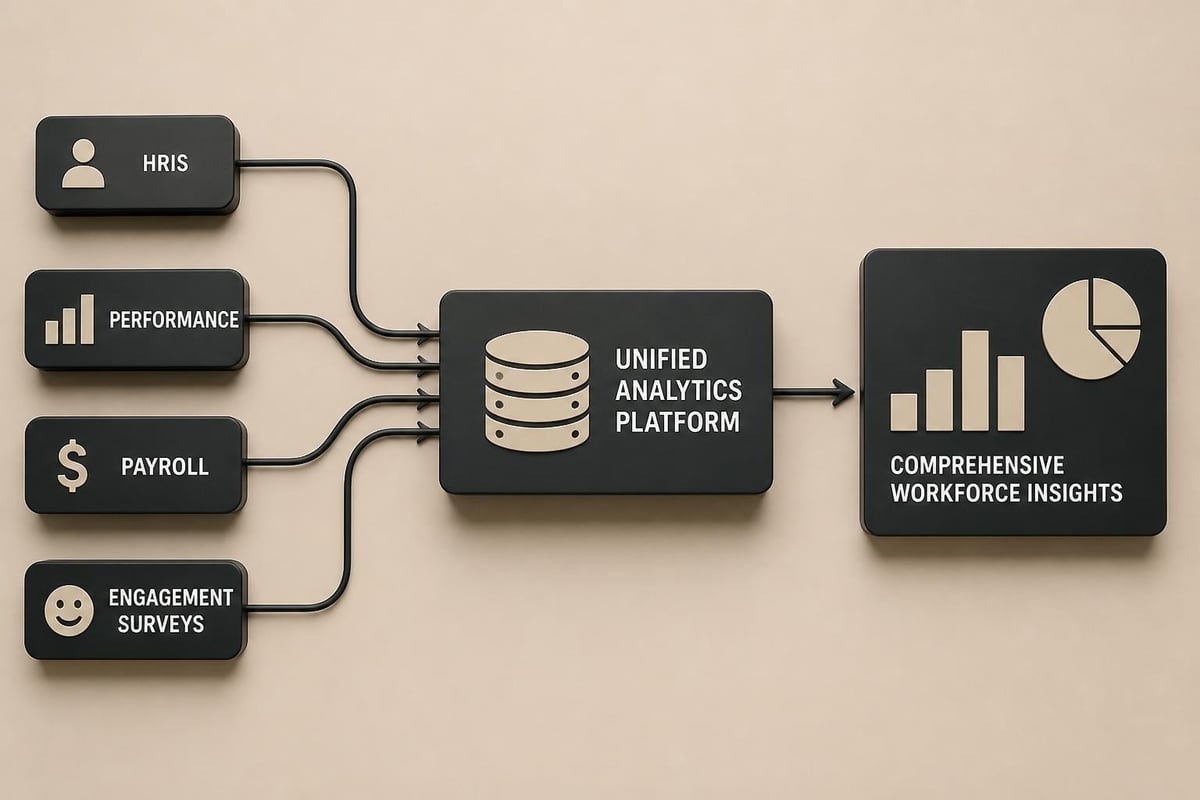
Technology infrastructure must support data integration from multiple sources including:
- Human resource information systems (HRIS)
- Performance management platforms
- Learning management systems
- Time and attendance tracking
- Payroll systems
- Employee engagement surveys
Analytical talent involves developing capabilities within HR teams or partnering with specialists who understand both data science and organizational dynamics. Leadership commitment ensures that insights generated through workforce analytics actually influence strategic decisions rather than gathering dust in reports.
Key Metrics That Drive Organizational Performance
Successful workforce analytics initiatives focus on metrics that align with strategic business objectives. Rather than tracking everything possible, high-performing organizations identify key performance indicators that directly relate to operational efficiency, revenue generation, and competitive positioning.
Productivity and Performance Indicators
Performance metrics extend beyond traditional annual review scores to capture real-time productivity data. Professional services firms particularly benefit from tracking billable utilization rates, client satisfaction scores, project completion timelines, and revenue per employee. These metrics reveal not only individual performance but also identify systemic issues affecting team effectiveness.
Consider how human capital management solutions enable organizations to automate data collection across these performance dimensions, eliminating manual tracking errors and providing managers with current insights rather than outdated quarterly reports.
Retention and Turnover Analytics
Employee turnover carries significant costs, including recruitment expenses, onboarding time, lost productivity, and knowledge drain. Workforce analytics transforms retention from a reactive concern into a proactive strategic priority.
| Turnover Metric | Definition | Strategic Value |
|---|---|---|
| Voluntary Turnover Rate | Percentage of employees who choose to leave | Identifies engagement and satisfaction issues |
| Regrettable Turnover | Loss of high-performing employees | Highlights retention risks in critical talent |
| Time-to-Replacement | Days from departure to new hire start | Measures recruitment efficiency |
| First-Year Turnover | New hires leaving within 12 months | Indicates onboarding effectiveness |
Predictive models can identify flight risks before employees actually resign by analyzing patterns in engagement scores, performance trends, compensation positioning, tenure milestones, and manager relationships. This foresight enables targeted retention interventions for valuable team members.
Operational Efficiency Through Workforce Insights
The U.S. Office of Personnel Management highlights workforce analysis as fundamental for understanding demographics, retirement eligibility, and succession planning. These insights directly support operational planning and risk mitigation.
Capacity Planning and Resource Allocation
Workforce analytics enables precise capacity planning by revealing actual utilization patterns versus planned allocations. Professional services organizations can identify which practice areas consistently operate above or below capacity, informing hiring decisions, project assignments, and skill development priorities.
Advanced analytics also reveal hidden capacity by identifying employees with underutilized skills or bandwidth. Rather than automatically hiring for new projects, firms can redeploy existing talent more effectively, reducing costs while improving employee development opportunities.
Skills Gap Analysis and Training Optimization
Understanding the gap between current workforce capabilities and future business requirements represents a critical application of workforce analytics. Organizations can map existing skills across their employee base, compare this inventory against strategic objectives, and identify specific development needs.
Training optimization benefits include:
- Targeted development programs addressing actual skill gaps rather than generic offerings
- Measurable ROI through pre- and post-training performance comparisons
- Identification of high-potential employees for accelerated development
- Strategic workforce planning aligned with market evolution
The connection between learning and development initiatives and measurable business outcomes becomes clear when analytics track how specific training investments correlate with performance improvements, client satisfaction gains, or revenue increases.

Cost Optimization and Financial Impact
Workforce expenses typically represent 50-70% of operating costs for professional services firms. Workforce analytics provides unprecedented visibility into these investments, enabling strategic cost management without sacrificing quality or capability.
Compensation Analysis and Market Positioning
Analytics-driven compensation strategies ensure organizations remain competitive for talent while maintaining financial discipline. By benchmarking salaries against market data, analyzing internal equity, and correlating compensation with performance and retention, companies can optimize their total rewards investment.
Sophisticated workforce analytics reveals patterns that might otherwise go unnoticed. For example, analysis might show that compensation levels have minimal correlation with retention beyond market median, but that career development opportunities and manager quality strongly predict tenure. This insight enables more effective allocation of retention budgets.
Overtime and Staffing Efficiency
Detailed analysis of overtime patterns, contractor utilization, and staffing levels across projects or departments identifies opportunities for operational improvement. Chronic overtime in specific teams might indicate understaffing, inefficient processes, or poor workload distribution rather than employee dedication.
Organizations can apply similar analytical approaches to optimize various operational expenses, as seen in strategies for accounts payable automation that eliminate manual processes and reduce processing costs.
Predictive Analytics for Strategic Workforce Planning
Moving beyond historical reporting to predictive capabilities represents a significant maturity advancement in workforce analytics. Predictive models leverage historical patterns to forecast future outcomes, enabling proactive rather than reactive management.
Forecasting Future Talent Needs
Predictive workforce planning models incorporate multiple variables including anticipated business growth, project pipeline, historical turnover patterns, retirement eligibility, market conditions, and skill evolution requirements. These models generate scenarios showing likely talent needs under different business conditions.
The CIPD emphasizes people analytics as essential for evidence-based HR decision-making. This evidence becomes particularly valuable when planning significant organizational changes, market expansions, or capability development initiatives.
Risk Mitigation and Succession Planning
Succession planning moves from qualitative assessments to data-driven strategies through workforce analytics. Organizations can identify critical roles, assess bench strength, evaluate readiness levels for potential successors, and quantify succession risk across leadership positions.
Succession analytics components:
- Role criticality scoring based on revenue impact, specialized knowledge, and client relationships
- Readiness assessment combining performance history, skill inventories, and leadership potential
- Demographic analysis identifying retirement risk timelines
- Development tracking showing progression of high-potential candidates
- Gap analysis revealing areas lacking adequate succession depth
Technology Enablement and Integration
Effective workforce analytics requires robust technology infrastructure that integrates data sources, applies analytical models, and delivers insights through accessible interfaces. The modern analytics stack typically includes data warehouses, business intelligence platforms, visualization tools, and increasingly, artificial intelligence capabilities.
Automation and Artificial Intelligence Applications
Artificial intelligence and automation solutions transform workforce analytics from periodic reporting exercises to continuous intelligence systems. Machine learning algorithms can process vast datasets to identify patterns human analysts might miss, generate real-time alerts about emerging issues, and continuously refine predictive models based on new data.
Natural language processing enables sentiment analysis of employee communications, feedback, and survey responses at scale. Computer vision can analyze video interview content to reduce bias and improve hiring decisions. Robotic process automation eliminates manual data collection and report generation, freeing analysts to focus on interpretation and recommendation development.
| Analytics Technology | Primary Application | Business Value |
|---|---|---|
| Data Warehousing | Centralized employee data repository | Single source of truth for all workforce metrics |
| Business Intelligence | Dashboard and reporting | Executive visibility into workforce trends |
| Predictive Analytics | Forecasting and modeling | Proactive planning and risk mitigation |
| AI/Machine Learning | Pattern recognition and automation | Scalable insights and reduced manual effort |
Privacy, Security, and Ethical Considerations
As workforce analytics capabilities expand, organizations must address legitimate concerns about employee privacy, data security, and ethical use of personal information. Transparent policies governing data collection, clear communication about how analytics inform decisions, and strong security protocols protecting sensitive information build trust and ensure compliance with regulations.

Implementing Workforce Analytics in Professional Services
Professional services organizations face unique workforce analytics challenges and opportunities. The project-based nature of work, importance of billable utilization, client relationship dynamics, and knowledge-intensive service delivery create specific analytical requirements.
Client-Facing Performance Metrics
Beyond internal efficiency measures, professional services firms benefit from analytics connecting workforce characteristics to client outcomes. Analyzing which employee skills, experience levels, team compositions, and engagement approaches correlate with client satisfaction, project profitability, and repeat business provides actionable intelligence for staffing decisions and capability development.
Organizations can track metrics including client retention rates by account team, Net Promoter Scores by service delivery team, project margin by team composition, and cross-selling success by relationship manager. These insights inform both immediate project staffing and longer-term talent strategy.
Project-Based Resource Optimization
Project-centric work creates complex resource allocation challenges that workforce analytics can address. Analyzing historical project data reveals patterns in estimation accuracy, resource loading, skill requirements, and delivery timelines. These insights improve future project planning, proposal development, and capacity management.
Similar analytical approaches that drive operational efficiency improvements in other business functions apply equally to project-based professional services delivery.
Advanced Applications and Emerging Trends
Leading organizations continue pushing workforce analytics boundaries, exploring applications that seemed impossible just years ago. These advanced capabilities provide competitive advantages for early adopters willing to invest in analytical maturity.
Network Analysis and Organizational Dynamics
Network analysis examines communication patterns, collaboration networks, and information flows within organizations. By analyzing email metadata, meeting attendance, project team compositions, and collaboration tool usage, organizations can identify influential employees, detect silos, understand informal leadership structures, and optimize team formations.
This analysis reveals insights about organizational health that traditional metrics miss. For example, network analysis might show that a nominally cross-functional team actually operates in departmental silos, or that innovation consistently emerges from specific collaboration patterns that can be intentionally replicated.
Real-Time Workforce Intelligence
The shift from periodic reporting to real-time analytics represents a fundamental transformation in workforce management. Real-time dashboards provide immediate visibility into attendance patterns, project status, resource availability, and emerging issues requiring attention.
Managers can make informed decisions based on current data rather than outdated reports. Real-time alerts notify leaders when metrics exceed acceptable thresholds, enabling rapid response to developing situations before they become serious problems.
Experience Analytics and Employee Journey Mapping
Understanding the employee experience throughout the entire employment lifecycle creates opportunities for targeted improvements. Experience analytics maps touchpoints from recruitment through onboarding, development, advancement, and eventual departure, identifying friction points that diminish engagement or drive turnover.
Employee journey analytics reveals:
- Which recruitment sources produce highest-performing, longest-tenured employees
- Onboarding elements that most strongly predict first-year success
- Career development experiences that increase retention and performance
- Exit patterns that indicate systemic rather than individual issues
- Recognition and reward moments that maximize engagement impact
Measuring Workforce Analytics ROI
Demonstrating return on investment for workforce analytics initiatives builds executive support and justifies continued investment in analytical capabilities. ROI measurement should connect analytical insights to tangible business outcomes through clear causal chains.
Quantifiable Impact Areas
Organizations can measure workforce analytics ROI through multiple dimensions including reduced turnover costs from improved retention, decreased time-to-productivity from optimized onboarding, increased revenue per employee from better skills alignment, lower recruitment costs from improved hiring success, and reduced compliance risk from better policy adherence monitoring.
For example, a professional services firm might document that predictive retention analytics identified flight risks among top performers, targeted interventions retained 75% of at-risk employees, average replacement cost for these roles equals $150,000, resulting in documented savings of $1.125 million against analytics investment of $200,000, yielding 463% ROI in year one.
Building the Business Case
Successful workforce analytics programs begin with clear business cases connecting analytical investments to strategic objectives. Rather than pursuing analytics for its own sake, effective initiatives target specific business challenges where data-driven insights can drive measurable improvement.
The business case should articulate the problem being addressed, explain how analytics will generate insights to solve it, project expected benefits with conservative assumptions, detail required investments in technology and talent, and establish measurement frameworks proving value delivery.
Organizations exploring how data analytics creates business benefits can apply similar frameworks to workforce analytics initiatives, ensuring alignment between analytical investments and operational priorities.
Overcoming Implementation Challenges
Despite compelling benefits, many workforce analytics initiatives struggle with common challenges including data quality issues, organizational resistance, skill gaps, and integration complexity. Addressing these obstacles proactively increases implementation success rates.
Data Quality and Governance
Analytics quality depends fundamentally on data quality. Inconsistent data entry, incomplete records, integration errors, and definitional ambiguity undermine analytical accuracy and credibility. Establishing data governance frameworks, implementing validation rules, standardizing definitions, and cleaning historical data creates the foundation for reliable insights.
Data governance also addresses compliance requirements, defining retention policies, access controls, privacy protections, and audit trails that satisfy regulatory obligations while enabling analytical use.
Change Management and Adoption
Technology and methodology represent only part of successful workforce analytics implementation. Cultural change management ensures that insights actually influence decisions and that stakeholders trust and act on analytical findings.
Adoption strategies include:
- Executive sponsorship demonstrating leadership commitment
- Quick wins proving value and building momentum
- User training developing analytical literacy across the organization
- Feedback loops incorporating user input into platform evolution
- Success communication celebrating wins and lessons learned
Workforce analytics represents a transformative capability for organizations committed to optimizing their human capital investments and driving strategic advantage through data-driven insights. By systematically collecting, analyzing, and acting on workforce data, companies can reduce costs, improve operational efficiency, enhance employee experiences, and achieve measurable performance improvements. Nero and Associates, Inc. partners with organizations to implement workforce analytics solutions that deliver tangible results, combining human capital management expertise with advanced automation and integration capabilities to help clients eliminate manual processes, optimize operations, and empower their workforce to achieve exceptional performance.