
The Essential Guide to Automation Consulting in 2026

Share on Facebook
Share on X
Share on LinkedIn

In 2026, organizations that overlook automation consulting risk falling behind as digital transformation accelerates. Business leaders need a clear, actionable roadmap to harness automation consulting for greater efficiency, innovation, and measurable ROI. This essential guide demystifies automation consulting, offering expert insights for future-proofing your organization. Explore the latest trends, practical implementation steps, technology landscape, industry-specific approaches, and how to choose the right consulting partner—empowering you to drive lasting success in a rapidly evolving landscape.

The Evolution of Automation Consulting: Trends Shaping 2026

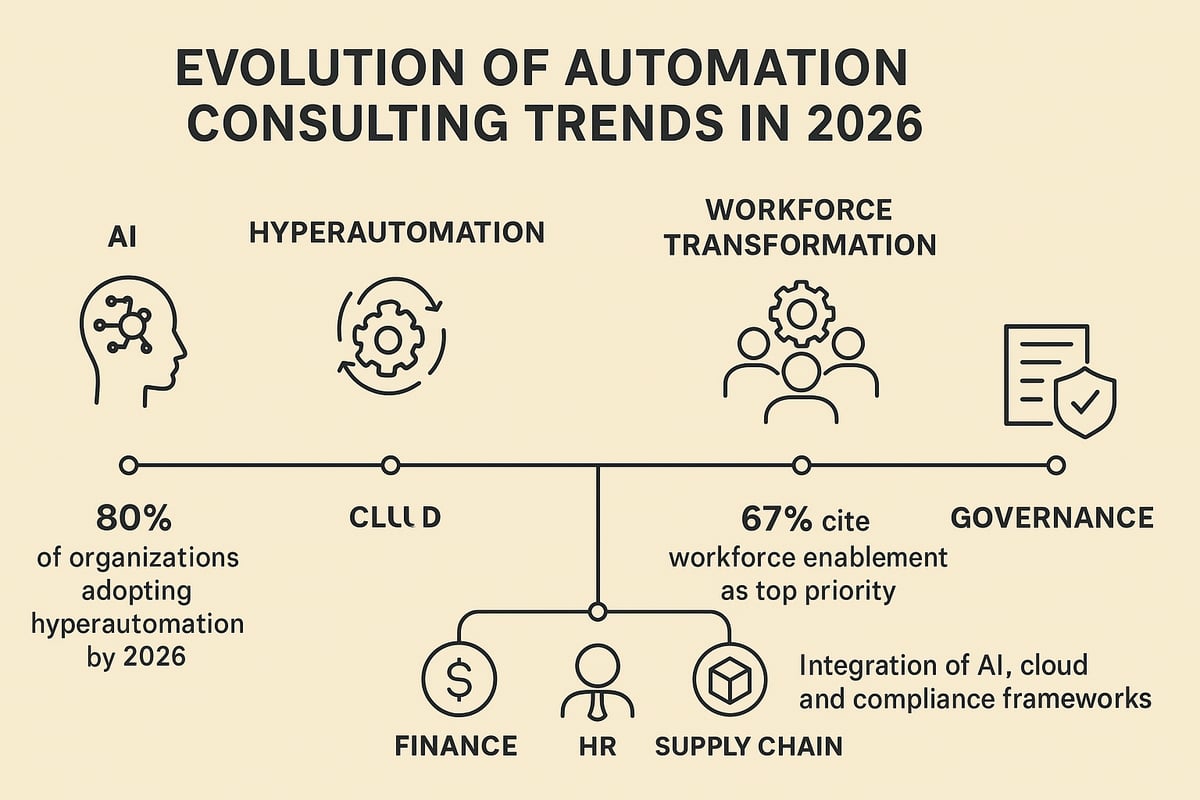
The landscape of automation consulting is evolving at an unprecedented pace. As organizations face mounting pressure to innovate, new trends are transforming how businesses approach automation. In this section, we explore the key forces shaping automation consulting in 2026, from intelligent automation to workforce transformation.
The Evolution of Automation Consulting: Trends Shaping 2026

The Rise of Intelligent Automation and Hyperautomation

Intelligent automation is redefining the core of automation consulting in 2026. By blending artificial intelligence, machine learning, and robotic process automation, businesses are moving beyond simple task automation to create adaptive and scalable systems. One major trend is hyperautomation, with industry analysts predicting that 80 percent of organizations will adopt this approach by 2026.

Consultants now integrate process mining and advanced analytics, enabling continuous improvement across departments like finance, HR, and supply chain. Leading organizations are deploying AI-powered bots to support complex decision-making, demonstrating the power of end-to-end automation. For a deeper dive into these developments, explore the top AI & automation trends for 2026.

The Impact of AI and Machine Learning on Consulting Services

The shift from rule-based systems to adaptive, learning solutions is a hallmark of modern automation consulting. Predictive analytics are now essential for optimizing business processes and anticipating future challenges. Consultants leverage AI-driven insights to help organizations design transformation roadmaps tailored to their needs.

A standout example is EY's use of digital twins in the utilities sector, where predictive maintenance has minimized downtime and improved operational efficiency. These innovations are setting new standards for automation consulting, as firms harness the full capabilities of AI and machine learning.

The Expanding Role of Data and Cloud

Cloud technology is at the forefront of automation consulting, offering scalability and flexibility for organizations of all sizes. Cloud-based automation platforms enable seamless integration of data from multiple sources, creating a strong foundation for successful automation projects.

Consultants emphasize the importance of robust data integration strategies to ensure long-term value. In healthcare, cloud migration has paved the way for secure, compliant, and scalable automation, demonstrating the critical role of cloud in automation consulting today.

Workforce Transformation and Change Management

Automation consulting is increasingly focused on workforce transformation. Automation is not just about technology, but also about empowering employees with new skills and opportunities. Upskilling and reskilling initiatives are vital, as 67 percent of organizations now cite workforce enablement as a top automation priority.

Consultants design change management strategies that enhance the employee experience and support adoption of new tools. Effective communication and training are central to successful automation consulting engagements, ensuring that teams remain engaged and productive throughout the transformation journey.

Sustainability, Compliance, and Governance in Automation

Sustainability and governance have become essential pillars of automation consulting. Automation is now used to streamline ESG reporting and maintain regulatory compliance. Consulting firms develop governance frameworks to promote ethical and responsible AI use, reducing risk for their clients.

For example, financial services organizations are leveraging automation to simplify regulatory reporting, improving accuracy and timeliness. These practices ensure that automation consulting delivers measurable value while upholding the highest standards of compliance and sustainability.

Core Services and Solutions Offered by Automation Consulting Firms

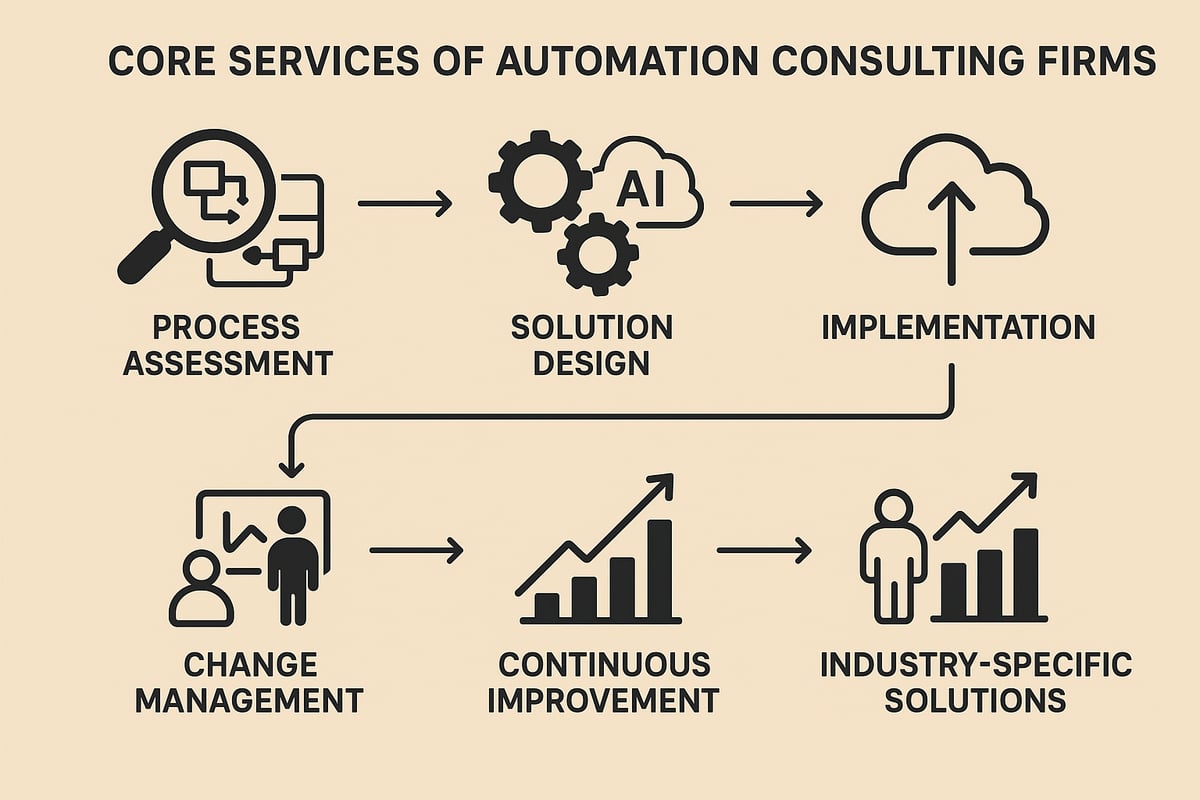
In 2026, automation consulting is the engine driving digital transformation for organizations across every industry. Firms provide a comprehensive suite of services that enable clients to identify, design, implement, and sustain automation at scale. Let’s explore these core offerings and how they help organizations future-proof their operations.
Core Services and Solutions Offered by Automation Consulting Firms

Process Assessment and Automation Readiness

A successful automation consulting engagement always begins with a thorough process assessment. Consultants map out current workflows, identify inefficiencies, and uncover automation opportunities using advanced tools like process mining.

These assessments go beyond surface-level analysis. Firms conduct maturity evaluations, helping organizations understand where they stand on the automation journey. ROI projections are developed to prioritize high-impact initiatives.

For example, leading consultants use diagnostic approaches to assess readiness across industries. This ensures organizations invest in the right automation solutions, maximizing value from day one.

Solution Design and Technology Selection

Once opportunities are identified, automation consulting focuses on crafting a tailored solution design. Consultants create custom strategies that align with business objectives and future growth.

Selecting the right technology is critical. Vendor-neutral recommendations cover RPA, AI, and workflow tools, ensuring solutions fit unique requirements. Consultants also guide clients through multi-vendor environments for flexibility and scalability.

To see how these strategies translate into real-world outcomes, explore AI, Automation, and Integration Solutions, which illustrate the breadth of platforms and approaches top consultants leverage for maximum impact.

Implementation and Integration

Automation consulting firms manage the end-to-end implementation process. This includes project management, agile delivery, and seamless integration with both legacy and cloud systems.

Security and compliance remain top priorities throughout deployment. Risk management protocols are embedded to safeguard data and meet regulatory standards.

A notable example is the integration of automation in banking back-office operations. Here, consultants ensure all systems work together, minimizing disruption and accelerating benefits realization.

Change Management and Workforce Enablement

True transformation through automation consulting goes beyond technology. Change management strategies are essential for employee adoption and long-term success.

Firms develop comprehensive training programs for both staff and leadership. Communication plans foster transparency, address concerns, and promote a culture of innovation.

Consultants also measure adoption rates and employee satisfaction, adapting strategies to maximize engagement. This holistic approach ensures organizations build an automation-ready workforce.

Continuous Improvement and Managed Services

Sustaining automation requires ongoing support and optimization. Automation consulting firms offer managed services that monitor performance, analyze results, and drive continuous improvement.

Analytics tools identify further opportunities for process enhancement. These services provide scalability and resilience, allowing organizations to adapt to changing business needs.

Consultants operate as long-term partners, ensuring automation investments deliver measurable ROI year after year.

Industry-Specific Automation Solutions

Every industry faces unique challenges, and automation consulting delivers tailored solutions to address them. In healthcare, revenue cycle automation reduces claim denials. In finance, consultants automate compliance and reporting. Manufacturing clients benefit from quality control and supply chain optimization.

Below is a table summarizing industry-specific automation examples:

Industry Automation Focus Example Outcome
Healthcare Revenue cycle management Fewer claim denials
Finance Regulatory reporting Improved compliance
Manufacturing Quality inspections Reduced defects
Retail Inventory and pricing Optimized stock, pricing

By providing industry-specific insights, automation consulting firms ensure solutions are practical, relevant, and results-driven.

The Automation Consulting Journey: Step-by-Step Implementation Roadmap

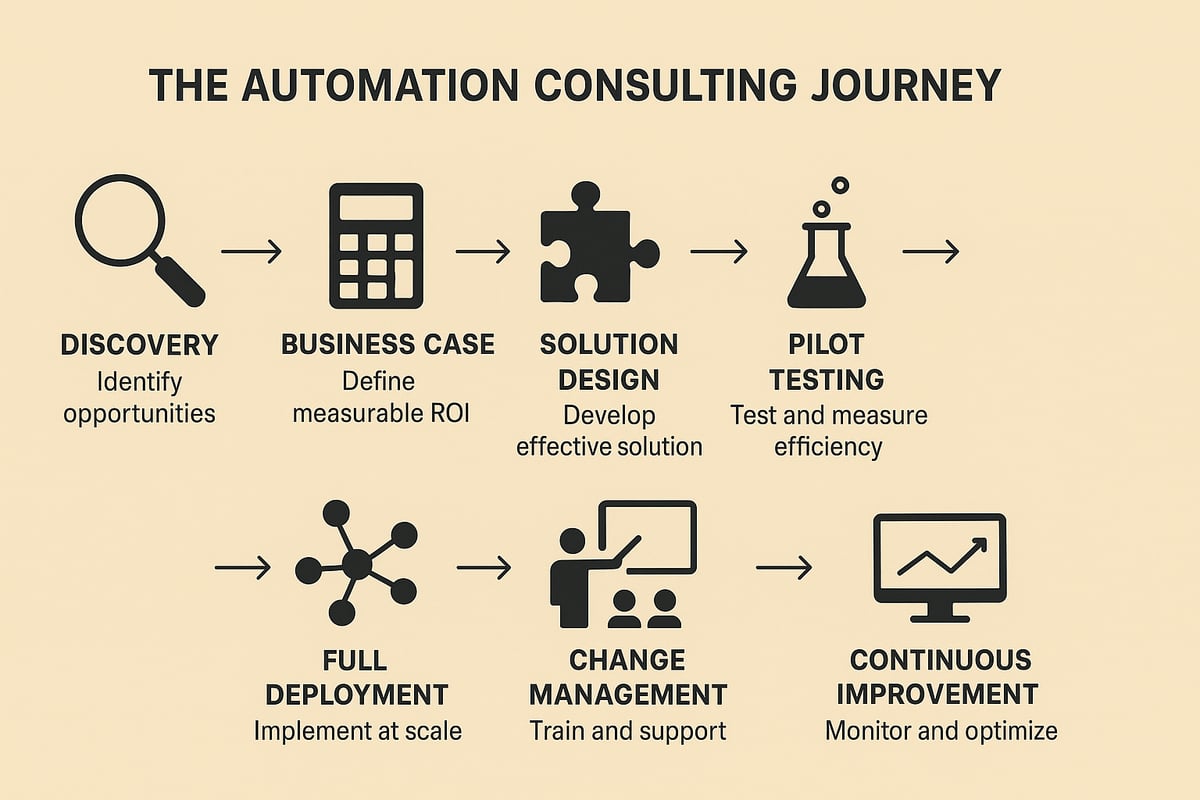
Embarking on an automation consulting journey is a transformative process that requires careful planning and execution. Each step builds upon the last, ensuring measurable gains in efficiency, cost savings, and innovation. Let’s explore the essential stages that guide organizations from initial assessment to continuous optimization.
The Automation Consulting Journey: Step-by-Step Implementation Roadmap

Step 1: Discovery and Opportunity Assessment

The automation consulting journey begins with a comprehensive discovery phase. Here, stakeholders align on business goals and set clear expectations for outcomes.

Consultants create a detailed inventory of existing processes, using data-driven tools to prioritize high-impact opportunities. For example, a financial services firm might identify manual, repetitive tasks in their back-office as prime candidates for automation.

By mapping current workflows, organizations gain a clear view of where automation consulting can deliver the greatest value.

Step 2: Business Case Development and ROI Analysis

Once opportunities are identified, the next step is to build a compelling business case. Automation consulting experts quantify potential cost savings, efficiency gains, and strategic benefits.

They conduct risk assessments and develop mitigation plans to ensure a smooth transition. For instance, projecting a 30 percent reduction in operational costs through robotic process automation provides a strong foundation for executive buy-in.

This stage ensures that every automation initiative is backed by data, aligning with organizational priorities.

Step 3: Solution Design and Technology Selection

With the business case in place, automation consulting teams map each opportunity to the most suitable technology solution.

They evaluate vendors, develop proofs-of-concept, and recommend platforms such as UiPath, Automation Anywhere, or custom AI models. The focus is on scalability, integration, and alignment with business objectives.

For example, retail organizations might compare multiple vendors to select a solution that enables seamless supply chain automation.

Step 4: Pilot Implementation and Iterative Testing

The pilot phase is where automation consulting delivers rapid results. Using agile sprints, consultants prototype solutions in controlled settings.

User feedback is gathered in real time, and performance metrics are tracked closely. For instance, a manufacturing company may run a pilot that reduces production cycle time by 40 percent.

This iterative approach allows organizations to refine solutions, build confidence, and minimize risk before full deployment.

Step 5: Full-Scale Deployment and Integration

After a successful pilot, automation consulting moves to full-scale deployment. Solutions are scaled across departments, integrated with enterprise systems, and connected to data sources.

Security and compliance checks are performed throughout. For example, banks might integrate automation into their back-office operations to streamline processes and enhance data security.

Thorough planning ensures a seamless transition and minimizes operational disruption.

Step 6: Change Management and Training

Effective change management is critical to automation consulting success. Consultants develop tailored training programs and resource materials for all users.

Communication strategies foster adoption, while ongoing support addresses concerns and builds confidence. For example, HR teams may receive targeted upskilling to adapt to new automation-enabled workflows.

Measuring adoption rates and employee satisfaction helps refine the change management approach and ensures long-term success.

Step 7: Monitoring, Optimization, and Continuous Improvement

The final step in the automation consulting journey is ongoing monitoring and optimization. Key performance indicators and real-time dashboards track progress and highlight areas for further improvement.

Analytics and process mining tools uncover new opportunities, driving continuous enhancement. For organizations seeking to maximize efficiency, resources like Efficiency Metrics in Accounts Payable Automation provide practical guidance on measuring impact and sustaining results.

This commitment to continuous improvement ensures that automation delivers lasting value.

Key Technologies and Platforms in Automation Consulting

Modern automation consulting is powered by a diverse technology landscape. These core platforms and tools drive transformation, enabling organizations to streamline processes, boost productivity, and remain competitive in 2026.
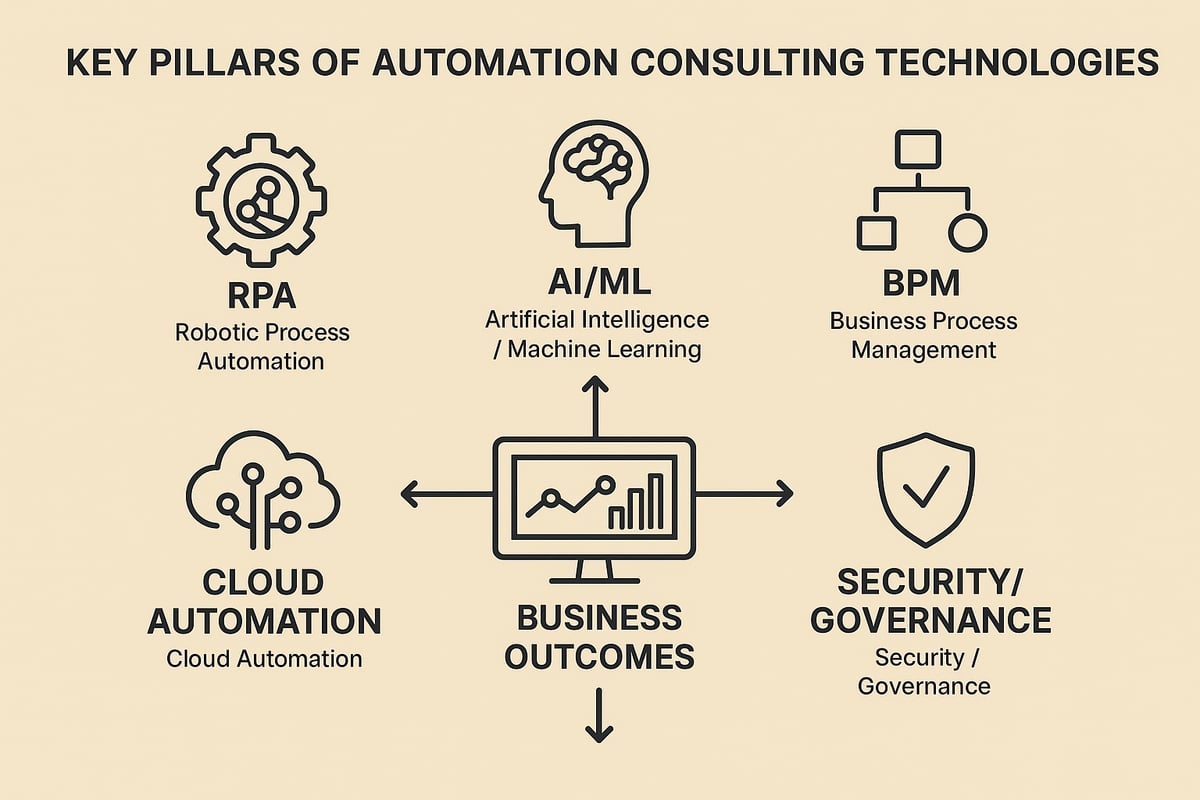
Key Technologies and Platforms in Automation Consulting

Robotic Process Automation (RPA)

Robotic Process Automation is a foundation of automation consulting, enabling organizations to automate repetitive tasks with software bots. Leading RPA tools include UiPath, Blue Prism, and Automation Anywhere.

Typical use cases:

  • Invoice processing in finance
  • Data migration between legacy systems
  • Report generation and reconciliation

RPA adoption is accelerating, with the Robotic Process Automation market growth forecast projecting significant expansion through 2026. Automation consulting leverages these platforms to deliver rapid ROI and scalable solutions.

Artificial Intelligence and Machine Learning

AI and machine learning are transforming automation consulting from rule-based actions to intelligent, adaptive systems. These technologies enable natural language processing, computer vision, and predictive analytics.

Key applications:

  • AI-powered chatbots for customer service
  • Automated document classification
  • Predictive maintenance in manufacturing

With automation consulting, organizations gain tailored AI solutions that enhance decision-making and personalize customer experiences.

Business Process Management (BPM) and Workflow Automation

Business Process Management platforms orchestrate complex workflows across departments. Integrated with RPA and AI, BPM tools streamline approvals, case management, and compliance tracking.

Popular BPM solutions:

  • Appian
  • Pega
  • IBM Business Automation Workflow

Automation consulting ensures that BPM deployments align with business objectives, optimizing end-to-end processes and driving consistent outcomes.

Cloud Automation and Integration Platforms

Cloud-native automation platforms offer scalability, flexibility, and seamless updates. Integration Platform as a Service (iPaaS) connects disparate systems, enabling unified workflows.

Benefits include:

  • Centralized control of automation initiatives
  • Fast deployment cycles
  • Secure data sharing

Automation consulting helps organizations migrate to cloud solutions, unlocking new efficiencies and supporting remote workforces.

Data Analytics and Process Mining

Process mining tools analyze event logs to uncover automation opportunities and monitor performance. Data analytics platforms measure ROI and identify bottlenecks.

Common platforms:

  • Celonis for process mining
  • Power BI and Tableau for analytics

With automation consulting, companies use real-time dashboards and insights to ensure continuous improvement and sustain value creation.

Security, Compliance, and Governance Tools

Secure, compliant automation is non-negotiable in regulated industries. Governance frameworks safeguard data privacy and ensure responsible AI deployment.

Key focus areas:

  • Access control and audit trails
  • Regulatory compliance (GDPR, HIPAA)
  • Transparent AI decision-making

Automation consulting integrates security from design through deployment, minimizing risk and building stakeholder trust.

Industry-Specific Use Cases and Success Stories

In 2026, automation consulting is transforming industries by addressing unique challenges and driving measurable results. Organizations are leveraging tailored automation consulting solutions to streamline workflows, boost accuracy, and enhance customer experiences. Here’s how leading sectors are achieving success.

Healthcare: Revenue Cycle Management and Patient Engagement

In healthcare, automation consulting is improving both financial performance and patient satisfaction. Hospitals and clinics are automating claims processing, billing, and communications to reduce manual errors and accelerate cash flow. For example, end-to-end revenue cycle management solutions help providers decrease claim denials and streamline payment cycles. This approach empowers staff to focus on patient care and regulatory compliance, making automation consulting a critical driver of operational excellence.

Financial Services: Regulatory Compliance and Customer Onboarding

Banks and financial institutions rely on automation consulting to address stringent regulatory requirements and enhance customer onboarding. By automating Know Your Customer (KYC), Anti-Money Laundering (AML), and reporting tasks, firms improve speed and accuracy while reducing compliance risks. Automation consulting also enables seamless customer journeys, supporting digital account opening and verification. These advancements help organizations remain competitive and responsive in a rapidly evolving financial landscape.

Manufacturing: Supply Chain and Quality Control Automation

Manufacturers are using automation consulting to optimize supply chain management and ensure product quality. Automated inventory tracking, order processing, and quality inspections powered by AI reduce errors and minimize delays. For instance, AI-driven vision systems detect defects in real time, leading to fewer recalls and higher customer satisfaction. Automation consulting solutions are essential for manufacturers seeking to scale operations and maintain high standards.

Retail: Inventory, Pricing, and Customer Experience

In retail, automation consulting is revolutionizing inventory management, pricing strategies, and personalized marketing. Retailers deploy AI to automate stock replenishment, implement dynamic pricing, and deliver targeted promotions. These initiatives improve inventory turnover and profit margins. Automation consulting also enhances customer experiences by enabling faster service and tailored recommendations, positioning retailers for success in a competitive market.

Public Sector: Digital Transformation and Citizen Services

Government agencies are embracing automation consulting to digitize workflows and improve citizen engagement. Automated permit processing, case management, and document handling significantly reduce wait times and errors. As a result, public sector organizations deliver more efficient services and build greater trust with citizens. Automation consulting is foundational for governments striving to modernize operations and meet public expectations.

Cross-Industry Insights

Across all sectors, organizations report substantial efficiency gains after implementing automation consulting solutions. According to EY, 70% of businesses experience improved productivity and reduced costs post-automation. Common best practices include starting with high-impact processes, investing in change management, and continuously monitoring outcomes. These success stories highlight the transformative power of automation consulting in driving sustainable growth and innovation.

Choosing the Right Automation Consulting Partner in 2026

Selecting the right automation consulting partner is a pivotal decision that can shape your organization’s digital transformation journey. With the global tech consulting market set to surpass $400bn in 2026, competition is fierce, and the stakes are high. A strategic, methodical approach ensures you maximize value and minimize risk throughout the engagement.

Defining Your Requirements and Success Metrics

Begin by aligning your automation consulting needs with your business objectives and industry landscape. Define the specific challenges you want to address, such as streamlining operations or enhancing compliance. Establish clear KPIs and measurable success criteria to track progress. By setting these parameters early, you ensure both your team and your consulting partner are focused on outcomes that matter most.

Evaluating Consulting Firms: Capabilities and Experience

Assess potential automation consulting partners based on their industry expertise, technology partnerships, and past performance. Look for firms with relevant case studies and a proven track record in your sector. Vendor-neutral recommendations are essential to avoid bias toward specific platforms. Compare multi-industry leaders and niche consultancies to find the best fit for your requirements.

Engagement Models and Pricing Structures

Understanding engagement models helps you select the right financial and operational approach. Common models include fixed-fee, performance-based, and managed services. Performance-based automation consulting often reduces upfront risk, as fees are tied to results. Use the table below for a quick comparison:

Model Description Pros Cons
Fixed-Fee Set price for scope Predictable costs Less flexibility
Performance-Based Pay for delivered results Lower risk upfront May limit scope
Managed Service Ongoing support/operations Scalable, flexible Ongoing costs

Assessing Change Management and Support Capabilities

Evaluate how each automation consulting firm approaches workforce enablement and change management. Effective partners offer robust training, clear communication strategies, and post-implementation support. For HR-focused transformations, explore solutions like Payroll and Human Capital Management Services to ensure your team adapts and thrives.

Ensuring Data Security, Compliance, and Ethical Standards

Prioritize partners with strong data privacy, security, and responsible AI practices. Ensure adherence to relevant regulations, such as GDPR or HIPAA. Ask about their governance frameworks for automation consulting, especially when handling sensitive information or deploying AI-driven solutions. This reduces risk and builds trust across your organization.

Questions to Ask Potential Partners

To make a well-informed choice, prepare targeted questions for your automation consulting candidates:

  • What is your experience in our industry?
  • Can you share references from similar projects?
  • How do you measure and report ROI?
  • What is your approach to change management and workforce enablement?
  • How do you ensure compliance and ethical AI use?

Thorough due diligence at this stage sets the foundation for a successful, future-proof partnership.

As you look ahead to automation consulting in 2026, it’s clear that choosing the right partner is about more than just technology—it’s about driving real results for your people and your bottom line. If you’re ready to cut manual work, boost efficiency, and help your team thrive—mentally, physically, and financially—let’s talk through your unique goals together. We’ll help you navigate the latest trends, map out a strategic roadmap, and deliver solutions that fit your business and industry. Ready to future proof your organization and see measurable ROI? Book a Consultation

The Essential Guide to Automation Consulting in 2026

In 2026, organizations that overlook automation consulting risk falling behind as digital transformation accelerates. Business leaders need a clear, actionable roadmap to harness automation consulting for greater efficiency, innovation, and measurable ROI. This essential guide demystifies automation consulting, offering expert insights for future-proofing your organization. Explore the latest trends, practical implementation steps, technology landscape, industry-specific approaches, and how to choose the right consulting partner—empowering you to drive lasting success in a rapidly evolving landscape.

The Evolution of Automation Consulting: Trends Shaping 2026

The landscape of automation consulting is evolving at an unprecedented pace. As organizations face mounting pressure to innovate, new trends are transforming how businesses approach automation. In this section, we explore the key forces shaping automation consulting in 2026, from intelligent automation to workforce transformation.

The Evolution of Automation Consulting: Trends Shaping 2026

The Rise of Intelligent Automation and Hyperautomation

Intelligent automation is redefining the core of automation consulting in 2026. By blending artificial intelligence, machine learning, and robotic process automation, businesses are moving beyond simple task automation to create adaptive and scalable systems. One major trend is hyperautomation, with industry analysts predicting that 80 percent of organizations will adopt this approach by 2026.

Consultants now integrate process mining and advanced analytics, enabling continuous improvement across departments like finance, HR, and supply chain. Leading organizations are deploying AI-powered bots to support complex decision-making, demonstrating the power of end-to-end automation. For a deeper dive into these developments, explore the top AI & automation trends for 2026.

The Impact of AI and Machine Learning on Consulting Services

The shift from rule-based systems to adaptive, learning solutions is a hallmark of modern automation consulting. Predictive analytics are now essential for optimizing business processes and anticipating future challenges. Consultants leverage AI-driven insights to help organizations design transformation roadmaps tailored to their needs.

A standout example is EY's use of digital twins in the utilities sector, where predictive maintenance has minimized downtime and improved operational efficiency. These innovations are setting new standards for automation consulting, as firms harness the full capabilities of AI and machine learning.

The Expanding Role of Data and Cloud

Cloud technology is at the forefront of automation consulting, offering scalability and flexibility for organizations of all sizes. Cloud-based automation platforms enable seamless integration of data from multiple sources, creating a strong foundation for successful automation projects.

Consultants emphasize the importance of robust data integration strategies to ensure long-term value. In healthcare, cloud migration has paved the way for secure, compliant, and scalable automation, demonstrating the critical role of cloud in automation consulting today.

Workforce Transformation and Change Management

Automation consulting is increasingly focused on workforce transformation. Automation is not just about technology, but also about empowering employees with new skills and opportunities. Upskilling and reskilling initiatives are vital, as 67 percent of organizations now cite workforce enablement as a top automation priority.

Consultants design change management strategies that enhance the employee experience and support adoption of new tools. Effective communication and training are central to successful automation consulting engagements, ensuring that teams remain engaged and productive throughout the transformation journey.

Sustainability, Compliance, and Governance in Automation

Sustainability and governance have become essential pillars of automation consulting. Automation is now used to streamline ESG reporting and maintain regulatory compliance. Consulting firms develop governance frameworks to promote ethical and responsible AI use, reducing risk for their clients.

For example, financial services organizations are leveraging automation to simplify regulatory reporting, improving accuracy and timeliness. These practices ensure that automation consulting delivers measurable value while upholding the highest standards of compliance and sustainability.

Core Services and Solutions Offered by Automation Consulting Firms

In 2026, automation consulting is the engine driving digital transformation for organizations across every industry. Firms provide a comprehensive suite of services that enable clients to identify, design, implement, and sustain automation at scale. Let’s explore these core offerings and how they help organizations future-proof their operations.

Core Services and Solutions Offered by Automation Consulting Firms

Process Assessment and Automation Readiness

A successful automation consulting engagement always begins with a thorough process assessment. Consultants map out current workflows, identify inefficiencies, and uncover automation opportunities using advanced tools like process mining.

These assessments go beyond surface-level analysis. Firms conduct maturity evaluations, helping organizations understand where they stand on the automation journey. ROI projections are developed to prioritize high-impact initiatives.

For example, leading consultants use diagnostic approaches to assess readiness across industries. This ensures organizations invest in the right automation solutions, maximizing value from day one.

Solution Design and Technology Selection

Once opportunities are identified, automation consulting focuses on crafting a tailored solution design. Consultants create custom strategies that align with business objectives and future growth.

Selecting the right technology is critical. Vendor-neutral recommendations cover RPA, AI, and workflow tools, ensuring solutions fit unique requirements. Consultants also guide clients through multi-vendor environments for flexibility and scalability.

To see how these strategies translate into real-world outcomes, explore AI, Automation, and Integration Solutions, which illustrate the breadth of platforms and approaches top consultants leverage for maximum impact.

Implementation and Integration

Automation consulting firms manage the end-to-end implementation process. This includes project management, agile delivery, and seamless integration with both legacy and cloud systems.

Security and compliance remain top priorities throughout deployment. Risk management protocols are embedded to safeguard data and meet regulatory standards.

A notable example is the integration of automation in banking back-office operations. Here, consultants ensure all systems work together, minimizing disruption and accelerating benefits realization.

Change Management and Workforce Enablement

True transformation through automation consulting goes beyond technology. Change management strategies are essential for employee adoption and long-term success.

Firms develop comprehensive training programs for both staff and leadership. Communication plans foster transparency, address concerns, and promote a culture of innovation.

Consultants also measure adoption rates and employee satisfaction, adapting strategies to maximize engagement. This holistic approach ensures organizations build an automation-ready workforce.

Continuous Improvement and Managed Services

Sustaining automation requires ongoing support and optimization. Automation consulting firms offer managed services that monitor performance, analyze results, and drive continuous improvement.

Analytics tools identify further opportunities for process enhancement. These services provide scalability and resilience, allowing organizations to adapt to changing business needs.

Consultants operate as long-term partners, ensuring automation investments deliver measurable ROI year after year.

Industry-Specific Automation Solutions

Every industry faces unique challenges, and automation consulting delivers tailored solutions to address them. In healthcare, revenue cycle automation reduces claim denials. In finance, consultants automate compliance and reporting. Manufacturing clients benefit from quality control and supply chain optimization.

Below is a table summarizing industry-specific automation examples:

Industry Automation Focus Example Outcome
Healthcare Revenue cycle management Fewer claim denials
Finance Regulatory reporting Improved compliance
Manufacturing Quality inspections Reduced defects
Retail Inventory and pricing Optimized stock, pricing

By providing industry-specific insights, automation consulting firms ensure solutions are practical, relevant, and results-driven.

The Automation Consulting Journey: Step-by-Step Implementation Roadmap

Embarking on an automation consulting journey is a transformative process that requires careful planning and execution. Each step builds upon the last, ensuring measurable gains in efficiency, cost savings, and innovation. Let’s explore the essential stages that guide organizations from initial assessment to continuous optimization.

The Automation Consulting Journey: Step-by-Step Implementation Roadmap

Step 1: Discovery and Opportunity Assessment

The automation consulting journey begins with a comprehensive discovery phase. Here, stakeholders align on business goals and set clear expectations for outcomes.

Consultants create a detailed inventory of existing processes, using data-driven tools to prioritize high-impact opportunities. For example, a financial services firm might identify manual, repetitive tasks in their back-office as prime candidates for automation.

By mapping current workflows, organizations gain a clear view of where automation consulting can deliver the greatest value.

Step 2: Business Case Development and ROI Analysis

Once opportunities are identified, the next step is to build a compelling business case. Automation consulting experts quantify potential cost savings, efficiency gains, and strategic benefits.

They conduct risk assessments and develop mitigation plans to ensure a smooth transition. For instance, projecting a 30 percent reduction in operational costs through robotic process automation provides a strong foundation for executive buy-in.

This stage ensures that every automation initiative is backed by data, aligning with organizational priorities.

Step 3: Solution Design and Technology Selection

With the business case in place, automation consulting teams map each opportunity to the most suitable technology solution.

They evaluate vendors, develop proofs-of-concept, and recommend platforms such as UiPath, Automation Anywhere, or custom AI models. The focus is on scalability, integration, and alignment with business objectives.

For example, retail organizations might compare multiple vendors to select a solution that enables seamless supply chain automation.

Step 4: Pilot Implementation and Iterative Testing

The pilot phase is where automation consulting delivers rapid results. Using agile sprints, consultants prototype solutions in controlled settings.

User feedback is gathered in real time, and performance metrics are tracked closely. For instance, a manufacturing company may run a pilot that reduces production cycle time by 40 percent.

This iterative approach allows organizations to refine solutions, build confidence, and minimize risk before full deployment.

Step 5: Full-Scale Deployment and Integration

After a successful pilot, automation consulting moves to full-scale deployment. Solutions are scaled across departments, integrated with enterprise systems, and connected to data sources.

Security and compliance checks are performed throughout. For example, banks might integrate automation into their back-office operations to streamline processes and enhance data security.

Thorough planning ensures a seamless transition and minimizes operational disruption.

Step 6: Change Management and Training

Effective change management is critical to automation consulting success. Consultants develop tailored training programs and resource materials for all users.

Communication strategies foster adoption, while ongoing support addresses concerns and builds confidence. For example, HR teams may receive targeted upskilling to adapt to new automation-enabled workflows.

Measuring adoption rates and employee satisfaction helps refine the change management approach and ensures long-term success.

Step 7: Monitoring, Optimization, and Continuous Improvement

The final step in the automation consulting journey is ongoing monitoring and optimization. Key performance indicators and real-time dashboards track progress and highlight areas for further improvement.

Analytics and process mining tools uncover new opportunities, driving continuous enhancement. For organizations seeking to maximize efficiency, resources like Efficiency Metrics in Accounts Payable Automation provide practical guidance on measuring impact and sustaining results.

This commitment to continuous improvement ensures that automation delivers lasting value.

Key Technologies and Platforms in Automation Consulting

Modern automation consulting is powered by a diverse technology landscape. These core platforms and tools drive transformation, enabling organizations to streamline processes, boost productivity, and remain competitive in 2026.

Key Technologies and Platforms in Automation Consulting

Robotic Process Automation (RPA)

Robotic Process Automation is a foundation of automation consulting, enabling organizations to automate repetitive tasks with software bots. Leading RPA tools include UiPath, Blue Prism, and Automation Anywhere.

Typical use cases:

  • Invoice processing in finance
  • Data migration between legacy systems
  • Report generation and reconciliation

RPA adoption is accelerating, with the Robotic Process Automation market growth forecast projecting significant expansion through 2026. Automation consulting leverages these platforms to deliver rapid ROI and scalable solutions.

Artificial Intelligence and Machine Learning

AI and machine learning are transforming automation consulting from rule-based actions to intelligent, adaptive systems. These technologies enable natural language processing, computer vision, and predictive analytics.

Key applications:

  • AI-powered chatbots for customer service
  • Automated document classification
  • Predictive maintenance in manufacturing

With automation consulting, organizations gain tailored AI solutions that enhance decision-making and personalize customer experiences.

Business Process Management (BPM) and Workflow Automation

Business Process Management platforms orchestrate complex workflows across departments. Integrated with RPA and AI, BPM tools streamline approvals, case management, and compliance tracking.

Popular BPM solutions:

  • Appian
  • Pega
  • IBM Business Automation Workflow

Automation consulting ensures that BPM deployments align with business objectives, optimizing end-to-end processes and driving consistent outcomes.

Cloud Automation and Integration Platforms

Cloud-native automation platforms offer scalability, flexibility, and seamless updates. Integration Platform as a Service (iPaaS) connects disparate systems, enabling unified workflows.

Benefits include:

  • Centralized control of automation initiatives
  • Fast deployment cycles
  • Secure data sharing

Automation consulting helps organizations migrate to cloud solutions, unlocking new efficiencies and supporting remote workforces.

Data Analytics and Process Mining

Process mining tools analyze event logs to uncover automation opportunities and monitor performance. Data analytics platforms measure ROI and identify bottlenecks.

Common platforms:

  • Celonis for process mining
  • Power BI and Tableau for analytics

With automation consulting, companies use real-time dashboards and insights to ensure continuous improvement and sustain value creation.

Security, Compliance, and Governance Tools

Secure, compliant automation is non-negotiable in regulated industries. Governance frameworks safeguard data privacy and ensure responsible AI deployment.

Key focus areas:

  • Access control and audit trails
  • Regulatory compliance (GDPR, HIPAA)
  • Transparent AI decision-making

Automation consulting integrates security from design through deployment, minimizing risk and building stakeholder trust.

Industry-Specific Use Cases and Success Stories

In 2026, automation consulting is transforming industries by addressing unique challenges and driving measurable results. Organizations are leveraging tailored automation consulting solutions to streamline workflows, boost accuracy, and enhance customer experiences. Here’s how leading sectors are achieving success.

Healthcare: Revenue Cycle Management and Patient Engagement

In healthcare, automation consulting is improving both financial performance and patient satisfaction. Hospitals and clinics are automating claims processing, billing, and communications to reduce manual errors and accelerate cash flow. For example, end-to-end revenue cycle management solutions help providers decrease claim denials and streamline payment cycles. This approach empowers staff to focus on patient care and regulatory compliance, making automation consulting a critical driver of operational excellence.

Financial Services: Regulatory Compliance and Customer Onboarding

Banks and financial institutions rely on automation consulting to address stringent regulatory requirements and enhance customer onboarding. By automating Know Your Customer (KYC), Anti-Money Laundering (AML), and reporting tasks, firms improve speed and accuracy while reducing compliance risks. Automation consulting also enables seamless customer journeys, supporting digital account opening and verification. These advancements help organizations remain competitive and responsive in a rapidly evolving financial landscape.

Manufacturing: Supply Chain and Quality Control Automation

Manufacturers are using automation consulting to optimize supply chain management and ensure product quality. Automated inventory tracking, order processing, and quality inspections powered by AI reduce errors and minimize delays. For instance, AI-driven vision systems detect defects in real time, leading to fewer recalls and higher customer satisfaction. Automation consulting solutions are essential for manufacturers seeking to scale operations and maintain high standards.

Retail: Inventory, Pricing, and Customer Experience

In retail, automation consulting is revolutionizing inventory management, pricing strategies, and personalized marketing. Retailers deploy AI to automate stock replenishment, implement dynamic pricing, and deliver targeted promotions. These initiatives improve inventory turnover and profit margins. Automation consulting also enhances customer experiences by enabling faster service and tailored recommendations, positioning retailers for success in a competitive market.

Public Sector: Digital Transformation and Citizen Services

Government agencies are embracing automation consulting to digitize workflows and improve citizen engagement. Automated permit processing, case management, and document handling significantly reduce wait times and errors. As a result, public sector organizations deliver more efficient services and build greater trust with citizens. Automation consulting is foundational for governments striving to modernize operations and meet public expectations.

Cross-Industry Insights

Across all sectors, organizations report substantial efficiency gains after implementing automation consulting solutions. According to EY, 70% of businesses experience improved productivity and reduced costs post-automation. Common best practices include starting with high-impact processes, investing in change management, and continuously monitoring outcomes. These success stories highlight the transformative power of automation consulting in driving sustainable growth and innovation.

Choosing the Right Automation Consulting Partner in 2026

Selecting the right automation consulting partner is a pivotal decision that can shape your organization’s digital transformation journey. With the global tech consulting market set to surpass $400bn in 2026, competition is fierce, and the stakes are high. A strategic, methodical approach ensures you maximize value and minimize risk throughout the engagement.

Defining Your Requirements and Success Metrics

Begin by aligning your automation consulting needs with your business objectives and industry landscape. Define the specific challenges you want to address, such as streamlining operations or enhancing compliance. Establish clear KPIs and measurable success criteria to track progress. By setting these parameters early, you ensure both your team and your consulting partner are focused on outcomes that matter most.

Evaluating Consulting Firms: Capabilities and Experience

Assess potential automation consulting partners based on their industry expertise, technology partnerships, and past performance. Look for firms with relevant case studies and a proven track record in your sector. Vendor-neutral recommendations are essential to avoid bias toward specific platforms. Compare multi-industry leaders and niche consultancies to find the best fit for your requirements.

Engagement Models and Pricing Structures

Understanding engagement models helps you select the right financial and operational approach. Common models include fixed-fee, performance-based, and managed services. Performance-based automation consulting often reduces upfront risk, as fees are tied to results. Use the table below for a quick comparison:

Model Description Pros Cons
Fixed-Fee Set price for scope Predictable costs Less flexibility
Performance-Based Pay for delivered results Lower risk upfront May limit scope
Managed Service Ongoing support/operations Scalable, flexible Ongoing costs

Assessing Change Management and Support Capabilities

Evaluate how each automation consulting firm approaches workforce enablement and change management. Effective partners offer robust training, clear communication strategies, and post-implementation support. For HR-focused transformations, explore solutions like Payroll and Human Capital Management Services to ensure your team adapts and thrives.

Ensuring Data Security, Compliance, and Ethical Standards

Prioritize partners with strong data privacy, security, and responsible AI practices. Ensure adherence to relevant regulations, such as GDPR or HIPAA. Ask about their governance frameworks for automation consulting, especially when handling sensitive information or deploying AI-driven solutions. This reduces risk and builds trust across your organization.

Questions to Ask Potential Partners

To make a well-informed choice, prepare targeted questions for your automation consulting candidates:

  • What is your experience in our industry?
  • Can you share references from similar projects?
  • How do you measure and report ROI?
  • What is your approach to change management and workforce enablement?
  • How do you ensure compliance and ethical AI use?

Thorough due diligence at this stage sets the foundation for a successful, future-proof partnership.

As you look ahead to automation consulting in 2026, it’s clear that choosing the right partner is about more than just technology—it’s about driving real results for your people and your bottom line. If you’re ready to cut manual work, boost efficiency, and help your team thrive—mentally, physically, and financially—let’s talk through your unique goals together. We’ll help you navigate the latest trends, map out a strategic roadmap, and deliver solutions that fit your business and industry. Ready to future proof your organization and see measurable ROI? Book a Consultation

Website developed in accordance with Web Content Accessibility Guidelines 2.2.
If you encounter any issues while using this site, please contact us: 215.526.5126