
The Ultimate Guide to Intelligence Solutions in 2026

Share on Facebook
Share on X
Share on LinkedIn

In 2026, intelligence solutions are transforming how organizations compete in the digital era. As data grows more complex and automation advances, businesses are reimagining operations and decision-making to stay ahead. This comprehensive guide reveals the latest intelligence solutions, innovative technologies, and actionable strategies that will define business success in 2026.

We will explore emerging trends, solution types, step-by-step implementation, industry-specific use cases, and proven best practices for maximizing return on investment. The urgency to adapt is clear—adopting intelligence solutions now means unlocking cost savings, greater efficiency, and a powerful competitive edge. Ready to discover how intelligence solutions can future-proof your organization? Dive in for insights you can act on today.

The Evolution of Intelligence Solutions: 2023 to 2026

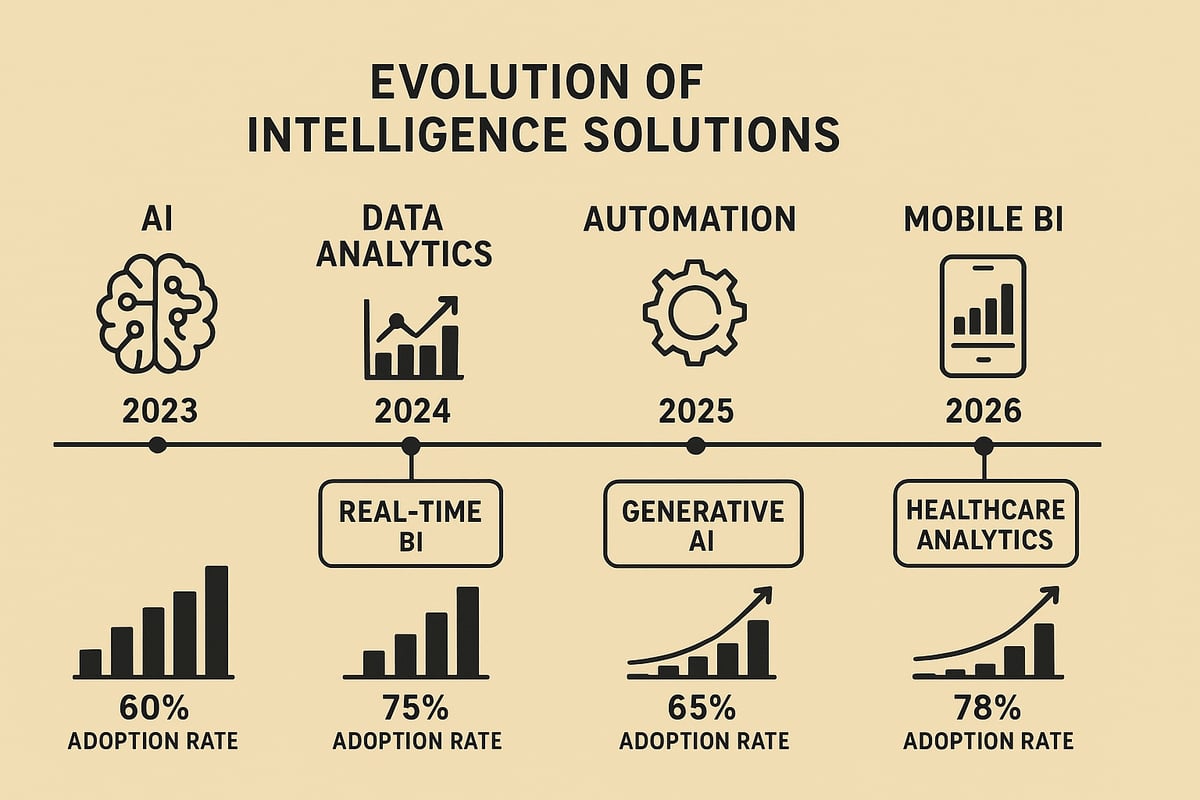
The rapid transformation from 2023 to 2026 marks a pivotal era for intelligence solutions. Organizations are experiencing a surge in data complexity and technological advancement, reshaping the way they extract value, automate processes, and gain strategic advantage.
The Evolution of Intelligence Solutions: 2023 to 2026

Key Drivers of Change

Several factors have accelerated the evolution of intelligence solutions. Rapid advancements in artificial intelligence, machine learning, and automation are at the forefront. As organizations collect more data, the need for smarter analytics becomes critical.

Companies are moving from simple descriptive analytics to real-time, prescriptive intelligence. The demand for actionable insights is growing, and solutions are now more accessible for both SMBs and large enterprises. Regulatory and privacy requirements are also shaping solution development.

One of the most significant shifts is the rise of generative AI and large language models in business intelligence. These technologies allow organizations to automate complex analysis and unlock new value from their data. For more on emerging trends, see AI and Machine Learning Trends in 2026.

Major Milestones and Breakthroughs

Between 2023 and 2026, there have been several key milestones in intelligence solutions. Real-time business intelligence and predictive analytics are now widely adopted. AI agents and agentic AI enable autonomous business processes, reducing manual intervention.

Self-service and mobile BI platforms have expanded, empowering users to access insights anywhere. Over 70% of Fortune 500 companies implemented advanced BI solutions by 2025, reflecting mainstream adoption. In healthcare, AI-driven analytics have improved patient outcomes by enabling faster, more accurate diagnoses and operational efficiencies.

These breakthroughs demonstrate the increasing maturity and impact of intelligence solutions across sectors.

Shifting Business Expectations

Business leaders now expect intelligence solutions to deliver faster, more accurate insights than ever before. The need for scalable and flexible solutions is paramount, as markets and data sources evolve quickly.

Industries such as healthcare, finance, and manufacturing are leading the adoption curve. They leverage intelligence solutions to enhance decision-making, improve efficiency, and maintain competitiveness. As more organizations invest in these technologies, the demand for innovation continues to rise.

Intelligence solutions are no longer optional. They are becoming essential tools for organizations that want to thrive in the digital age. The next phase will see even greater integration, adaptability, and business impact from intelligence solutions.

Core Types of Intelligence Solutions in 2026

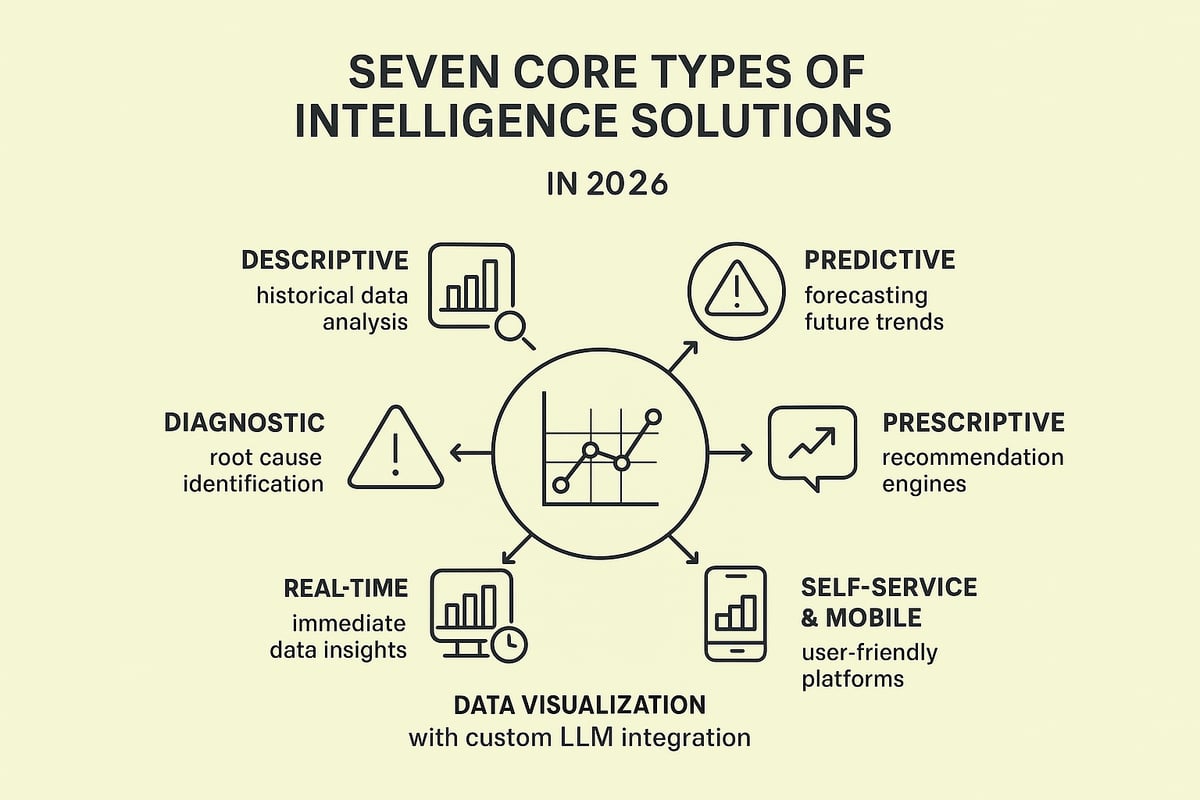
The landscape of intelligence solutions in 2026 is more diverse and sophisticated than ever. Organizations now have access to a range of tools that transform raw data into actionable insights, empowering smarter decisions at every level. Understanding each core type of intelligence solution is crucial for choosing the right fit for your business strategy.
Core Types of Intelligence Solutions in 2026

Descriptive Intelligence Solutions

Descriptive intelligence solutions focus on analyzing historical data to spot trends and patterns. These tools turn raw numbers into clear narratives, helping businesses understand what has happened over specific periods.

For example, retailers use descriptive intelligence solutions to review seasonal sales patterns. This allows them to identify high-performing products and optimize inventory levels.

Key applications include:

  • Sales and revenue reporting
  • Operational performance dashboards
  • Customer behavior analysis

Descriptive intelligence solutions provide the foundation for more advanced analytics by illuminating past business activities.

Diagnostic Intelligence Solutions

Diagnostic intelligence solutions go a step further by drilling into data to uncover the reasons behind certain outcomes. Rather than just showing what happened, these solutions explain why it happened.

Manufacturers often rely on diagnostic intelligence solutions to analyze production defects. By identifying root causes, teams can address issues quickly and prevent costly errors.

Other use cases include:

  • Investigating customer churn in service industries
  • Pinpointing financial anomalies in transaction data

With diagnostic intelligence solutions, organizations can make targeted improvements based on clear evidence.

Predictive Intelligence Solutions

Predictive intelligence solutions leverage AI and machine learning to forecast future trends and behaviors. These tools are essential for proactive decision-making and risk management.

In healthcare, predictive intelligence solutions help providers forecast patient admissions, allowing for better resource planning. Financial institutions use them to anticipate market fluctuations and adjust investment strategies.

Benefits include:

  • Improved risk assessment
  • Accurate demand forecasting
  • Enhanced resource allocation

For a deeper look at how these solutions automate complex processes, see AI automation integration solutions.

Prescriptive Intelligence Solutions

Prescriptive intelligence solutions recommend optimal actions based on data analysis. They use advanced algorithms and optimization engines to suggest the best course of action for any scenario.

Supply chain teams in manufacturing benefit from prescriptive intelligence solutions by receiving actionable recommendations to optimize logistics and reduce delays. These tools often integrate seamlessly with automation platforms to drive efficiency.

Common applications include:

  • Dynamic pricing adjustments
  • Automated resource scheduling
  • Personalized marketing offers

Prescriptive intelligence solutions move organizations from analysis to direct action, closing the loop between insight and implementation.

Real-Time Intelligence Solutions

Real-time intelligence solutions deliver insights instantly, enabling immediate responses to dynamic business conditions. These platforms are critical in environments where timing is everything.

Banks use real-time intelligence solutions to monitor transactions for compliance and detect fraudulent activities. Retailers track live sales and inventory levels, allowing them to react to trends as they emerge.

Key use cases:

  • Fraud detection and prevention
  • Live operational dashboards
  • Instant performance alerts

Real-time intelligence solutions empower organizations to stay agile and responsive in fast-paced markets.

Self-Service & Mobile Intelligence Solutions

Self-service intelligence solutions make data accessible to non-technical users, putting powerful analytics tools in the hands of decision-makers across the organization. Mobile intelligence solutions extend this accessibility, allowing users to access insights on the go.

Executives can view sales dashboards from their mobile devices, making data-driven decisions during meetings or travel. Self-service intelligence solutions eliminate bottlenecks and foster a culture of data-driven empowerment.

Features include:

  • Drag-and-drop analytics interfaces
  • Mobile-friendly dashboards
  • Democratized data access

These intelligence solutions accelerate decision-making by removing barriers to information.

Data Visualization and Custom LLM Integration

Data visualization solutions transform complex datasets into clear, interactive visuals. This makes insights easier to understand and act upon. Custom large language models (LLMs) are now being integrated to support advanced analytics and natural language queries.

For example, executive teams use visual dashboards to track key performance indicators at a glance. LLM-powered intelligence solutions enable conversational interactions, letting users ask questions and receive instant answers.

Key advantages:

  • Enhanced clarity and communication
  • Fast, intuitive data exploration
  • Scalable, AI-driven analytics

Data visualization and LLM integration ensure intelligence solutions remain user-friendly and future-ready.


Comparison Table: Core Intelligence Solutions in 2026

Type Main Function Key Benefit Example Use Case
Descriptive Analyze past data Trend identification Sales reporting
Diagnostic Identify root causes Issue resolution Manufacturing defect analysis
Predictive Forecast future trends Proactive planning Patient admission forecasting
Prescriptive Recommend best actions Automated optimization Supply chain management
Real-Time Instant insights Rapid response Fraud detection
Self-Service & Mobile User-driven analytics Empowerment, agility Mobile sales dashboards
Data Visualization & LLM Visual, AI-powered insights Clarity, advanced analytics Executive reporting

Each type of intelligence solution offers unique strengths. Selecting the right combination is key for maximizing business value in 2026.

Building a Modern Intelligence Solution: Key Components and Technologies

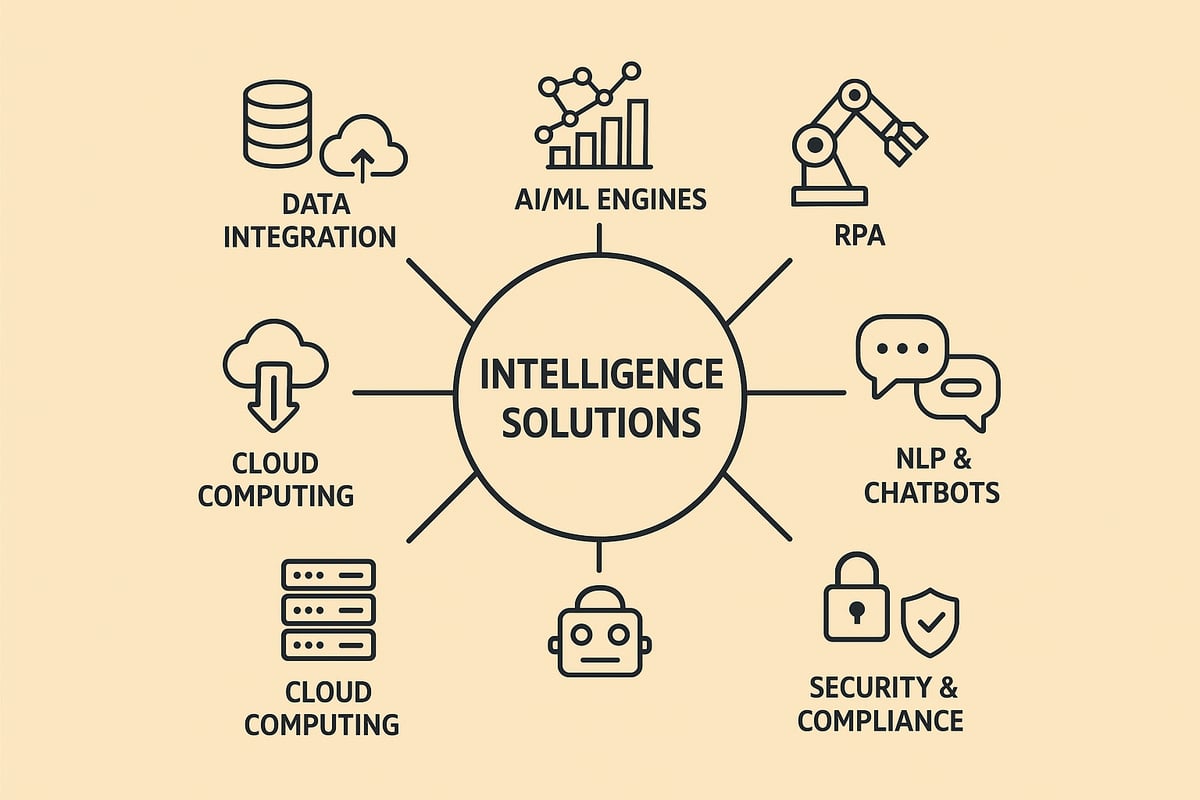
Building effective intelligence solutions in 2026 requires a blend of advanced technologies, robust architecture, and a focus on secure, scalable operations. Each component, from data integration to AI engines, plays a unique role in transforming raw data into actionable insights.
Building a Modern Intelligence Solution: Key Components and Technologies

Data Integration and Preparation

At the heart of intelligence solutions is seamless data integration. Organizations must aggregate information from diverse sources including ERP systems, CRM tools, and IoT devices. Data cleansing, normalization, and transformation are essential steps to ensure high quality analytics.

A well-structured data warehouse forms the backbone for advanced analytics. In healthcare, for instance, integrating clinical, financial, and operational data enables powerful insights. For more on industry-specific practices, see Healthcare data warehouse insights.

Key considerations for data integration:

  • Connect disparate data silos
  • Maintain data lineage and traceability
  • Automate data validation routines

Reliable data preparation ensures intelligence solutions deliver accurate, trustworthy results.

Artificial Intelligence and Machine Learning Engines

Artificial intelligence and machine learning engines are the analytical core of intelligence solutions. These engines process massive datasets, uncover patterns, and generate predictive or prescriptive insights.

Machine learning enables:

  • Pattern recognition for anomaly detection
  • Forecasting trends and behaviors
  • Adaptive algorithms that improve over time

For example, predictive maintenance in manufacturing relies on ML models to anticipate equipment failures. Embedding AI/ML into intelligence solutions provides organizations with a competitive edge, allowing for smarter, faster decisions.

Automation and Robotic Process Automation (RPA)

Automation is a driving force behind intelligence solutions. Robotic Process Automation (RPA) tools streamline repetitive, rules-based tasks, freeing up human resources for higher-value work.

Common RPA applications include:

  • Automating data entry and reconciliation
  • Generating recurring reports
  • Integrating workflows across software platforms

With intelligence solutions, automation extends beyond basic scripting to orchestrate complex business processes, ensuring efficiency and consistency throughout operations.

Natural Language Processing (NLP) and Chatbots

Natural Language Processing (NLP) and chatbots transform how users interact with intelligence solutions. NLP allows users to query data platforms conversationally, making analytics accessible to non-technical team members.

Benefits include:

  • Fast, intuitive data exploration
  • Automated report generation via chatbots
  • Multilingual support for global organizations

For instance, executives can ask a chatbot for sales trends or operational KPIs, receiving instant, clear answers. Integrating NLP into intelligence solutions bridges the gap between data complexity and user accessibility.

Cloud Computing and Scalability

Cloud computing underpins the scalability of intelligence solutions. Cloud-based BI platforms offer flexible infrastructure, allowing organizations to handle fluctuating workloads and expanding data volumes.

Advantages of cloud architectures:

  • On-demand resource allocation
  • Cost-efficient scaling
  • Support for hybrid and multi-cloud deployments

Migrating intelligence solutions to public clouds like AWS or Azure enhances agility, ensures business continuity, and reduces the burden of on-premises maintenance.

Security, Compliance, and Data Governance

Security and compliance are foundational to intelligence solutions. As organizations handle sensitive data, robust governance frameworks are essential to meet regulatory standards such as HIPAA and GDPR.

Critical components include:

  • Role-based access controls
  • Comprehensive audit trails
  • Automated compliance monitoring

By embedding security at every layer, intelligence solutions protect data integrity and build trust among users and stakeholders.

Step-by-Step Guide to Implementing Intelligence Solutions in 2026

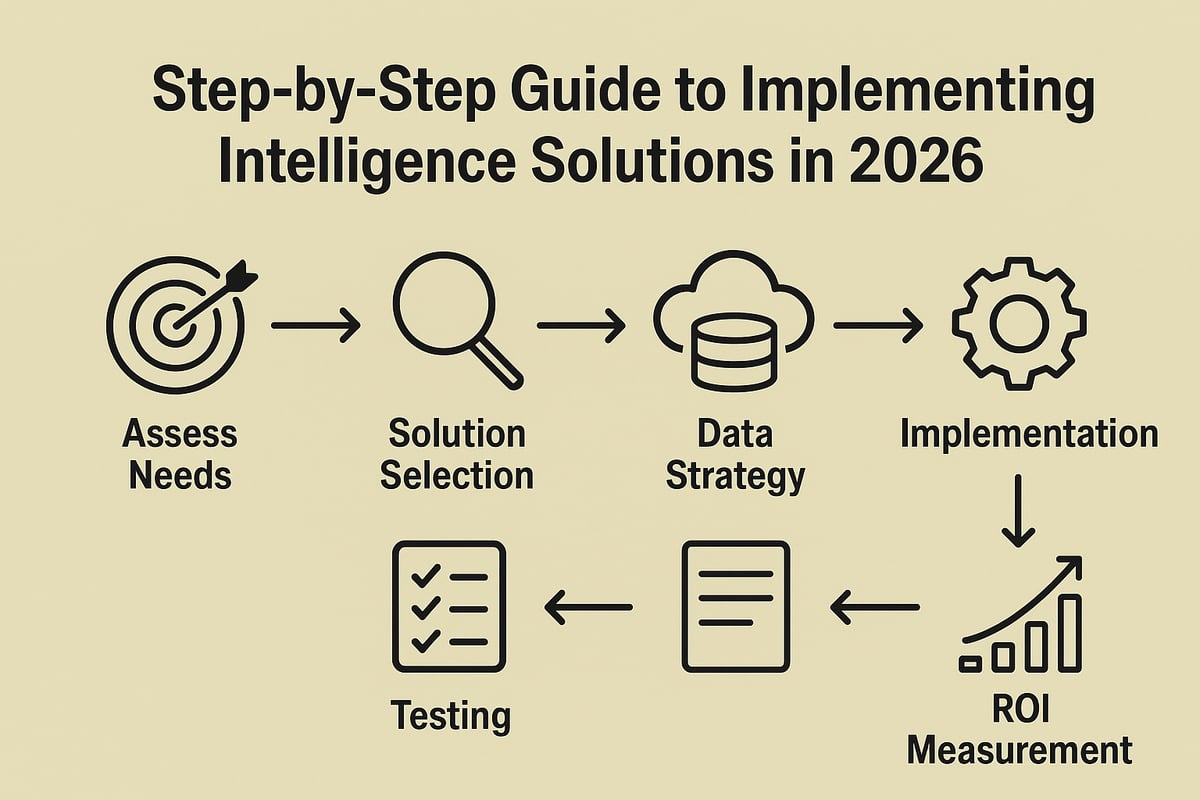
Implementing intelligence solutions in 2026 requires a structured approach to ensure maximum business value. By following a clear step-by-step process, organizations can harness data, automation, and AI to drive results. Here is a comprehensive guide to deploying intelligence solutions effectively.
Step-by-Step Guide to Implementing Intelligence Solutions in 2026

Step 1: Assess Business Needs and Objectives

The journey to adopting intelligence solutions starts with a thorough assessment of business needs. Identify pain points, define clear objectives, and determine key performance indicators (KPIs).

Engage all stakeholders early to align on priorities. For example, a retailer might focus on reducing stockouts or improving sales forecasts.

List your current challenges and desired outcomes. This clarity ensures intelligence solutions are tailored to your unique requirements.

Step 2: Select the Right Intelligence Solution

Selecting the right intelligence solutions involves evaluating various types, such as descriptive, predictive, or prescriptive analytics. Consider factors like scalability, integration capabilities, and ease of use.

Compare vendors based on your business requirements and long-term vision. For organizations seeking to optimize decision-making, exploring decision management strategies can guide this process.

Prioritize flexibility and future-proofing to ensure your intelligence solutions adapt as your business evolves.

Step 3: Data Strategy and Infrastructure Setup

A robust data strategy is vital for successful intelligence solutions. Start by centralizing your data using modern warehousing or cloud infrastructure.

Focus on data quality by cleansing, normalizing, and integrating information from various sources. For instance, combining sales, customer, and IoT data can provide richer insights.

Ensure your infrastructure supports secure, scalable, and accessible intelligence solutions for all users.

Step 4: Implementation and Customization

With the foundation in place, configure and customize intelligence solutions to fit your workflows. Automate repetitive tasks, set up dashboards, and design reports for different business units.

Provide comprehensive training to users, fostering adoption and reducing resistance to change. Involve end-users in customization for better alignment with day-to-day operations.

Iterative implementation helps intelligence solutions deliver immediate and sustained value.

Step 5: Testing, Deployment, and Continuous Improvement

Before full deployment, test intelligence solutions through pilot programs or phased rollouts. Monitor system performance, user adoption, and data accuracy.

Gather feedback to identify areas for improvement. Use agile methodologies to iterate quickly, making enhancements as needed.

Continuous improvement ensures intelligence solutions remain effective in dynamic business environments.

Step 6: Measuring ROI and Business Impact

Finally, measure the return on investment from intelligence solutions by tracking defined KPIs and business outcomes. Assess improvements in efficiency, cost savings, and decision quality.

Establish regular review cycles to identify new opportunities for optimization. For example, a small business may double its speed to market after implementing modern BI.

Consistent measurement guarantees your intelligence solutions drive ongoing business success.

Industry Applications: How Intelligence Solutions Transform Key Sectors

Intelligence solutions are rapidly transforming the landscape across all major industries. By integrating advanced analytics, automation, and AI, organizations unlock new levels of efficiency, innovation, and business value. In 2026, the adoption of intelligence solutions is no longer optional but essential for staying ahead in a competitive market.

Healthcare

Intelligence solutions are revolutionizing healthcare by enabling data-driven decision-making at every level. Hospitals and clinics now rely on AI-driven analytics to track patient outcomes, predict admission rates, and optimize resource allocation. Automated workflows reduce manual tasks, freeing up staff to focus on patient care.

Key benefits in healthcare include improved accuracy in diagnosis, faster treatment planning, and enhanced compliance with regulatory standards. Providers use intelligence solutions to analyze clinical data, uncovering insights that support personalized medicine and population health management.

For example, AI-powered analytics help hospitals identify high-risk patients and intervene early, reducing readmissions. This approach not only improves patient outcomes but also streamlines operations and cuts costs. Intelligence solutions are now critical for any healthcare organization seeking to thrive in a data-centric world.

Financial Services

The financial sector has become a leader in implementing intelligence solutions to manage risk, detect fraud, and boost operational efficiency. Banks and insurers deploy real-time analytics to monitor transactions, flag anomalies, and ensure regulatory compliance. Predictive models support smarter lending decisions and investment strategies.

Intelligence solutions also empower organizations to automate reporting, streamline onboarding, and personalize customer experiences. By leveraging these technologies, financial institutions reduce manual errors and accelerate response times.

Research shows that the financial impact of AI is now a top priority, with firms focusing on measurable ROI and tangible business outcomes. According to AI’s Financial Impact in 2026, the industry is shifting towards solutions that clearly demonstrate value. Intelligence solutions are the foundation of this transformation, driving agility and long-term growth.

Manufacturing

Manufacturers are embracing intelligence solutions to optimize production, improve quality, and minimize downtime. Predictive analytics and IoT integration allow factories to monitor equipment health in real time, enabling proactive maintenance and reducing costly breakdowns.

Automation plays a pivotal role, streamlining repetitive tasks and ensuring consistent output. Intelligence solutions also support quality control by analyzing sensor data and flagging defects early in the process.

Key use cases include supply chain optimization, demand forecasting, and inventory management. By leveraging intelligence solutions, manufacturers achieve greater agility and resilience in a volatile market. For more on how automation drives efficiency, see the Benefits of business automation. These advancements are shaping the future of manufacturing in 2026.

Retail and E-Commerce

Retailers and e-commerce leaders are transforming customer experiences with intelligence solutions. Data-driven insights allow businesses to analyze buying patterns, personalize marketing, and optimize inventory in real time. Mobile intelligence solutions empower store managers to make informed decisions on the go.

Examples include dynamic pricing engines, targeted promotions, and AI-powered recommendation systems. Intelligence solutions help retailers predict demand shifts, minimize stockouts, and maximize sales opportunities.

By integrating these tools, companies enhance customer satisfaction and streamline operations. Intelligence solutions are now the backbone of successful retail and e-commerce strategies, enabling brands to adapt quickly to changing consumer preferences.

Other Sectors (Construction, Automotive, Hospitality)

Beyond the major industries, intelligence solutions are driving transformation across sectors like construction, automotive, and hospitality. In construction, AI-powered forecasting tools help project managers optimize timelines and resource allocation. Automotive companies use intelligence solutions for predictive maintenance, fleet management, and advanced driver-assistance systems.

In hospitality, intelligence solutions streamline guest management, personalize services, and automate routine tasks. These technologies also support employee engagement and operational transparency.

Organizations in these sectors benefit from improved accuracy, reduced costs, and enhanced agility. Intelligence solutions are now essential for any business aiming to innovate and compete in 2026's fast-paced environment.

Best Practices and Future Trends in Intelligence Solutions

Staying ahead in the rapidly evolving landscape of intelligence solutions requires a proactive approach to strategy, technology, and governance. By following best practices and understanding future trends, organizations can unlock the full value of their data and analytics investments.

Maximizing ROI from Intelligence Investments

Achieving maximum return on investment from intelligence solutions demands clear alignment with business strategy. Successful organizations start by defining measurable goals and integrating analytics into everyday decision-making.

To foster a truly data-driven culture, ongoing training and user empowerment are essential. Leadership must encourage open data sharing and cross-departmental collaboration.

Key steps include:

  • Linking KPIs to intelligence solutions initiatives
  • Providing continuous education for all users
  • Regularly reviewing solution performance and adjusting strategies

For more insights on how businesses are using data-driven innovation to drive growth in 2026, see Data-Driven Innovation for Growth in 2026.

Emerging Technologies Shaping the Future

Several emerging technologies are redefining the capabilities of intelligence solutions. Generative AI, agentic AI, and custom large language models are enabling deeper insights and more adaptive analytics than ever before.

Edge computing brings analytics closer to data sources, supporting real-time decision-making even in remote or distributed environments. Self-service platforms are empowering non-technical users to conduct advanced analyses with ease.

A few transformative trends include:

  • Adoption of generative AI for personalized recommendations
  • Deployment of edge analytics for faster insights
  • Integration of custom LLMs for advanced business research

Explore how generative AI is revolutionizing workflows in AI and Data Analytics Trends in Business Research.

Overcoming Common Implementation Challenges

Despite rapid advances, organizations still face challenges when deploying intelligence solutions. Data silos, integration complexities, and resistance to change can hinder adoption.

To overcome these barriers:

  • Invest in robust data integration tools
  • Standardize data formats and governance policies
  • Communicate benefits clearly to all stakeholders

Effective change management ensures that all users understand the value of intelligence solutions and feel supported throughout the transition. Regular feedback loops can highlight pain points early and guide iterative improvements.

Security, Ethics, and Responsible AI Use

With the growing reliance on intelligence solutions, security and ethical considerations are paramount. Organizations must protect sensitive data, comply with regulations, and ensure transparency in AI-driven decisions.

Best practices include:

  • Implementing strong access controls and audit trails
  • Conducting regular risk assessments
  • Addressing algorithmic bias and maintaining explainability

By building trust in intelligence solutions, companies can drive adoption and mitigate risks associated with data breaches or unethical AI use.

The Road Ahead: What to Expect by 2027

Looking forward, intelligence solutions will continue to evolve, blending automation, AI, and human expertise. By 2027, expect to see greater convergence between analytics platforms and operational systems, leading to fully automated core business processes.

Predicted advancements include:

  • Seamless integration of intelligence solutions with IoT and cloud infrastructure
  • Increased adoption of agentic AI for autonomous operations
  • Enhanced regulatory frameworks shaping responsible AI practices

Staying agile and investing in emerging technologies will position organizations to capitalize on the next generation of intelligence solutions.

As we’ve explored, intelligence solutions are rapidly reshaping the way organizations operate, helping you unlock new efficiencies, empower your teams, and stay ahead in a data-driven world. If you’re ready to move from insights to action—whether that means streamlining processes, boosting revenue, or supporting employee well-being—let’s talk about how these strategies can work for you. I invite you to take the next step and Book a Consultation to discuss your unique goals and map out a tailored approach to intelligence solutions for 2026 and beyond.

The Ultimate Guide to Intelligence Solutions in 2026

In 2026, intelligence solutions are transforming how organizations compete in the digital era. As data grows more complex and automation advances, businesses are reimagining operations and decision-making to stay ahead. This comprehensive guide reveals the latest intelligence solutions, innovative technologies, and actionable strategies that will define business success in 2026.

We will explore emerging trends, solution types, step-by-step implementation, industry-specific use cases, and proven best practices for maximizing return on investment. The urgency to adapt is clear—adopting intelligence solutions now means unlocking cost savings, greater efficiency, and a powerful competitive edge. Ready to discover how intelligence solutions can future-proof your organization? Dive in for insights you can act on today.

The Evolution of Intelligence Solutions: 2023 to 2026

The rapid transformation from 2023 to 2026 marks a pivotal era for intelligence solutions. Organizations are experiencing a surge in data complexity and technological advancement, reshaping the way they extract value, automate processes, and gain strategic advantage.

The Evolution of Intelligence Solutions: 2023 to 2026

Key Drivers of Change

Several factors have accelerated the evolution of intelligence solutions. Rapid advancements in artificial intelligence, machine learning, and automation are at the forefront. As organizations collect more data, the need for smarter analytics becomes critical.

Companies are moving from simple descriptive analytics to real-time, prescriptive intelligence. The demand for actionable insights is growing, and solutions are now more accessible for both SMBs and large enterprises. Regulatory and privacy requirements are also shaping solution development.

One of the most significant shifts is the rise of generative AI and large language models in business intelligence. These technologies allow organizations to automate complex analysis and unlock new value from their data. For more on emerging trends, see AI and Machine Learning Trends in 2026.

Major Milestones and Breakthroughs

Between 2023 and 2026, there have been several key milestones in intelligence solutions. Real-time business intelligence and predictive analytics are now widely adopted. AI agents and agentic AI enable autonomous business processes, reducing manual intervention.

Self-service and mobile BI platforms have expanded, empowering users to access insights anywhere. Over 70% of Fortune 500 companies implemented advanced BI solutions by 2025, reflecting mainstream adoption. In healthcare, AI-driven analytics have improved patient outcomes by enabling faster, more accurate diagnoses and operational efficiencies.

These breakthroughs demonstrate the increasing maturity and impact of intelligence solutions across sectors.

Shifting Business Expectations

Business leaders now expect intelligence solutions to deliver faster, more accurate insights than ever before. The need for scalable and flexible solutions is paramount, as markets and data sources evolve quickly.

Industries such as healthcare, finance, and manufacturing are leading the adoption curve. They leverage intelligence solutions to enhance decision-making, improve efficiency, and maintain competitiveness. As more organizations invest in these technologies, the demand for innovation continues to rise.

Intelligence solutions are no longer optional. They are becoming essential tools for organizations that want to thrive in the digital age. The next phase will see even greater integration, adaptability, and business impact from intelligence solutions.

Core Types of Intelligence Solutions in 2026

The landscape of intelligence solutions in 2026 is more diverse and sophisticated than ever. Organizations now have access to a range of tools that transform raw data into actionable insights, empowering smarter decisions at every level. Understanding each core type of intelligence solution is crucial for choosing the right fit for your business strategy.

Core Types of Intelligence Solutions in 2026

Descriptive Intelligence Solutions

Descriptive intelligence solutions focus on analyzing historical data to spot trends and patterns. These tools turn raw numbers into clear narratives, helping businesses understand what has happened over specific periods.

For example, retailers use descriptive intelligence solutions to review seasonal sales patterns. This allows them to identify high-performing products and optimize inventory levels.

Key applications include:

  • Sales and revenue reporting
  • Operational performance dashboards
  • Customer behavior analysis

Descriptive intelligence solutions provide the foundation for more advanced analytics by illuminating past business activities.

Diagnostic Intelligence Solutions

Diagnostic intelligence solutions go a step further by drilling into data to uncover the reasons behind certain outcomes. Rather than just showing what happened, these solutions explain why it happened.

Manufacturers often rely on diagnostic intelligence solutions to analyze production defects. By identifying root causes, teams can address issues quickly and prevent costly errors.

Other use cases include:

  • Investigating customer churn in service industries
  • Pinpointing financial anomalies in transaction data

With diagnostic intelligence solutions, organizations can make targeted improvements based on clear evidence.

Predictive Intelligence Solutions

Predictive intelligence solutions leverage AI and machine learning to forecast future trends and behaviors. These tools are essential for proactive decision-making and risk management.

In healthcare, predictive intelligence solutions help providers forecast patient admissions, allowing for better resource planning. Financial institutions use them to anticipate market fluctuations and adjust investment strategies.

Benefits include:

  • Improved risk assessment
  • Accurate demand forecasting
  • Enhanced resource allocation

For a deeper look at how these solutions automate complex processes, see AI automation integration solutions.

Prescriptive Intelligence Solutions

Prescriptive intelligence solutions recommend optimal actions based on data analysis. They use advanced algorithms and optimization engines to suggest the best course of action for any scenario.

Supply chain teams in manufacturing benefit from prescriptive intelligence solutions by receiving actionable recommendations to optimize logistics and reduce delays. These tools often integrate seamlessly with automation platforms to drive efficiency.

Common applications include:

  • Dynamic pricing adjustments
  • Automated resource scheduling
  • Personalized marketing offers

Prescriptive intelligence solutions move organizations from analysis to direct action, closing the loop between insight and implementation.

Real-Time Intelligence Solutions

Real-time intelligence solutions deliver insights instantly, enabling immediate responses to dynamic business conditions. These platforms are critical in environments where timing is everything.

Banks use real-time intelligence solutions to monitor transactions for compliance and detect fraudulent activities. Retailers track live sales and inventory levels, allowing them to react to trends as they emerge.

Key use cases:

  • Fraud detection and prevention
  • Live operational dashboards
  • Instant performance alerts

Real-time intelligence solutions empower organizations to stay agile and responsive in fast-paced markets.

Self-Service & Mobile Intelligence Solutions

Self-service intelligence solutions make data accessible to non-technical users, putting powerful analytics tools in the hands of decision-makers across the organization. Mobile intelligence solutions extend this accessibility, allowing users to access insights on the go.

Executives can view sales dashboards from their mobile devices, making data-driven decisions during meetings or travel. Self-service intelligence solutions eliminate bottlenecks and foster a culture of data-driven empowerment.

Features include:

  • Drag-and-drop analytics interfaces
  • Mobile-friendly dashboards
  • Democratized data access

These intelligence solutions accelerate decision-making by removing barriers to information.

Data Visualization and Custom LLM Integration

Data visualization solutions transform complex datasets into clear, interactive visuals. This makes insights easier to understand and act upon. Custom large language models (LLMs) are now being integrated to support advanced analytics and natural language queries.

For example, executive teams use visual dashboards to track key performance indicators at a glance. LLM-powered intelligence solutions enable conversational interactions, letting users ask questions and receive instant answers.

Key advantages:

  • Enhanced clarity and communication
  • Fast, intuitive data exploration
  • Scalable, AI-driven analytics

Data visualization and LLM integration ensure intelligence solutions remain user-friendly and future-ready.


Comparison Table: Core Intelligence Solutions in 2026

Type Main Function Key Benefit Example Use Case
Descriptive Analyze past data Trend identification Sales reporting
Diagnostic Identify root causes Issue resolution Manufacturing defect analysis
Predictive Forecast future trends Proactive planning Patient admission forecasting
Prescriptive Recommend best actions Automated optimization Supply chain management
Real-Time Instant insights Rapid response Fraud detection
Self-Service & Mobile User-driven analytics Empowerment, agility Mobile sales dashboards
Data Visualization & LLM Visual, AI-powered insights Clarity, advanced analytics Executive reporting

Each type of intelligence solution offers unique strengths. Selecting the right combination is key for maximizing business value in 2026.

Building a Modern Intelligence Solution: Key Components and Technologies

Building effective intelligence solutions in 2026 requires a blend of advanced technologies, robust architecture, and a focus on secure, scalable operations. Each component, from data integration to AI engines, plays a unique role in transforming raw data into actionable insights.

Building a Modern Intelligence Solution: Key Components and Technologies

Data Integration and Preparation

At the heart of intelligence solutions is seamless data integration. Organizations must aggregate information from diverse sources including ERP systems, CRM tools, and IoT devices. Data cleansing, normalization, and transformation are essential steps to ensure high quality analytics.

A well-structured data warehouse forms the backbone for advanced analytics. In healthcare, for instance, integrating clinical, financial, and operational data enables powerful insights. For more on industry-specific practices, see Healthcare data warehouse insights.

Key considerations for data integration:

  • Connect disparate data silos
  • Maintain data lineage and traceability
  • Automate data validation routines

Reliable data preparation ensures intelligence solutions deliver accurate, trustworthy results.

Artificial Intelligence and Machine Learning Engines

Artificial intelligence and machine learning engines are the analytical core of intelligence solutions. These engines process massive datasets, uncover patterns, and generate predictive or prescriptive insights.

Machine learning enables:

  • Pattern recognition for anomaly detection
  • Forecasting trends and behaviors
  • Adaptive algorithms that improve over time

For example, predictive maintenance in manufacturing relies on ML models to anticipate equipment failures. Embedding AI/ML into intelligence solutions provides organizations with a competitive edge, allowing for smarter, faster decisions.

Automation and Robotic Process Automation (RPA)

Automation is a driving force behind intelligence solutions. Robotic Process Automation (RPA) tools streamline repetitive, rules-based tasks, freeing up human resources for higher-value work.

Common RPA applications include:

  • Automating data entry and reconciliation
  • Generating recurring reports
  • Integrating workflows across software platforms

With intelligence solutions, automation extends beyond basic scripting to orchestrate complex business processes, ensuring efficiency and consistency throughout operations.

Natural Language Processing (NLP) and Chatbots

Natural Language Processing (NLP) and chatbots transform how users interact with intelligence solutions. NLP allows users to query data platforms conversationally, making analytics accessible to non-technical team members.

Benefits include:

  • Fast, intuitive data exploration
  • Automated report generation via chatbots
  • Multilingual support for global organizations

For instance, executives can ask a chatbot for sales trends or operational KPIs, receiving instant, clear answers. Integrating NLP into intelligence solutions bridges the gap between data complexity and user accessibility.

Cloud Computing and Scalability

Cloud computing underpins the scalability of intelligence solutions. Cloud-based BI platforms offer flexible infrastructure, allowing organizations to handle fluctuating workloads and expanding data volumes.

Advantages of cloud architectures:

  • On-demand resource allocation
  • Cost-efficient scaling
  • Support for hybrid and multi-cloud deployments

Migrating intelligence solutions to public clouds like AWS or Azure enhances agility, ensures business continuity, and reduces the burden of on-premises maintenance.

Security, Compliance, and Data Governance

Security and compliance are foundational to intelligence solutions. As organizations handle sensitive data, robust governance frameworks are essential to meet regulatory standards such as HIPAA and GDPR.

Critical components include:

  • Role-based access controls
  • Comprehensive audit trails
  • Automated compliance monitoring

By embedding security at every layer, intelligence solutions protect data integrity and build trust among users and stakeholders.

Step-by-Step Guide to Implementing Intelligence Solutions in 2026

Implementing intelligence solutions in 2026 requires a structured approach to ensure maximum business value. By following a clear step-by-step process, organizations can harness data, automation, and AI to drive results. Here is a comprehensive guide to deploying intelligence solutions effectively.

Step-by-Step Guide to Implementing Intelligence Solutions in 2026

Step 1: Assess Business Needs and Objectives

The journey to adopting intelligence solutions starts with a thorough assessment of business needs. Identify pain points, define clear objectives, and determine key performance indicators (KPIs).

Engage all stakeholders early to align on priorities. For example, a retailer might focus on reducing stockouts or improving sales forecasts.

List your current challenges and desired outcomes. This clarity ensures intelligence solutions are tailored to your unique requirements.

Step 2: Select the Right Intelligence Solution

Selecting the right intelligence solutions involves evaluating various types, such as descriptive, predictive, or prescriptive analytics. Consider factors like scalability, integration capabilities, and ease of use.

Compare vendors based on your business requirements and long-term vision. For organizations seeking to optimize decision-making, exploring decision management strategies can guide this process.

Prioritize flexibility and future-proofing to ensure your intelligence solutions adapt as your business evolves.

Step 3: Data Strategy and Infrastructure Setup

A robust data strategy is vital for successful intelligence solutions. Start by centralizing your data using modern warehousing or cloud infrastructure.

Focus on data quality by cleansing, normalizing, and integrating information from various sources. For instance, combining sales, customer, and IoT data can provide richer insights.

Ensure your infrastructure supports secure, scalable, and accessible intelligence solutions for all users.

Step 4: Implementation and Customization

With the foundation in place, configure and customize intelligence solutions to fit your workflows. Automate repetitive tasks, set up dashboards, and design reports for different business units.

Provide comprehensive training to users, fostering adoption and reducing resistance to change. Involve end-users in customization for better alignment with day-to-day operations.

Iterative implementation helps intelligence solutions deliver immediate and sustained value.

Step 5: Testing, Deployment, and Continuous Improvement

Before full deployment, test intelligence solutions through pilot programs or phased rollouts. Monitor system performance, user adoption, and data accuracy.

Gather feedback to identify areas for improvement. Use agile methodologies to iterate quickly, making enhancements as needed.

Continuous improvement ensures intelligence solutions remain effective in dynamic business environments.

Step 6: Measuring ROI and Business Impact

Finally, measure the return on investment from intelligence solutions by tracking defined KPIs and business outcomes. Assess improvements in efficiency, cost savings, and decision quality.

Establish regular review cycles to identify new opportunities for optimization. For example, a small business may double its speed to market after implementing modern BI.

Consistent measurement guarantees your intelligence solutions drive ongoing business success.

Industry Applications: How Intelligence Solutions Transform Key Sectors

Intelligence solutions are rapidly transforming the landscape across all major industries. By integrating advanced analytics, automation, and AI, organizations unlock new levels of efficiency, innovation, and business value. In 2026, the adoption of intelligence solutions is no longer optional but essential for staying ahead in a competitive market.

Healthcare

Intelligence solutions are revolutionizing healthcare by enabling data-driven decision-making at every level. Hospitals and clinics now rely on AI-driven analytics to track patient outcomes, predict admission rates, and optimize resource allocation. Automated workflows reduce manual tasks, freeing up staff to focus on patient care.

Key benefits in healthcare include improved accuracy in diagnosis, faster treatment planning, and enhanced compliance with regulatory standards. Providers use intelligence solutions to analyze clinical data, uncovering insights that support personalized medicine and population health management.

For example, AI-powered analytics help hospitals identify high-risk patients and intervene early, reducing readmissions. This approach not only improves patient outcomes but also streamlines operations and cuts costs. Intelligence solutions are now critical for any healthcare organization seeking to thrive in a data-centric world.

Financial Services

The financial sector has become a leader in implementing intelligence solutions to manage risk, detect fraud, and boost operational efficiency. Banks and insurers deploy real-time analytics to monitor transactions, flag anomalies, and ensure regulatory compliance. Predictive models support smarter lending decisions and investment strategies.

Intelligence solutions also empower organizations to automate reporting, streamline onboarding, and personalize customer experiences. By leveraging these technologies, financial institutions reduce manual errors and accelerate response times.

Research shows that the financial impact of AI is now a top priority, with firms focusing on measurable ROI and tangible business outcomes. According to AI’s Financial Impact in 2026, the industry is shifting towards solutions that clearly demonstrate value. Intelligence solutions are the foundation of this transformation, driving agility and long-term growth.

Manufacturing

Manufacturers are embracing intelligence solutions to optimize production, improve quality, and minimize downtime. Predictive analytics and IoT integration allow factories to monitor equipment health in real time, enabling proactive maintenance and reducing costly breakdowns.

Automation plays a pivotal role, streamlining repetitive tasks and ensuring consistent output. Intelligence solutions also support quality control by analyzing sensor data and flagging defects early in the process.

Key use cases include supply chain optimization, demand forecasting, and inventory management. By leveraging intelligence solutions, manufacturers achieve greater agility and resilience in a volatile market. For more on how automation drives efficiency, see the Benefits of business automation. These advancements are shaping the future of manufacturing in 2026.

Retail and E-Commerce

Retailers and e-commerce leaders are transforming customer experiences with intelligence solutions. Data-driven insights allow businesses to analyze buying patterns, personalize marketing, and optimize inventory in real time. Mobile intelligence solutions empower store managers to make informed decisions on the go.

Examples include dynamic pricing engines, targeted promotions, and AI-powered recommendation systems. Intelligence solutions help retailers predict demand shifts, minimize stockouts, and maximize sales opportunities.

By integrating these tools, companies enhance customer satisfaction and streamline operations. Intelligence solutions are now the backbone of successful retail and e-commerce strategies, enabling brands to adapt quickly to changing consumer preferences.

Other Sectors (Construction, Automotive, Hospitality)

Beyond the major industries, intelligence solutions are driving transformation across sectors like construction, automotive, and hospitality. In construction, AI-powered forecasting tools help project managers optimize timelines and resource allocation. Automotive companies use intelligence solutions for predictive maintenance, fleet management, and advanced driver-assistance systems.

In hospitality, intelligence solutions streamline guest management, personalize services, and automate routine tasks. These technologies also support employee engagement and operational transparency.

Organizations in these sectors benefit from improved accuracy, reduced costs, and enhanced agility. Intelligence solutions are now essential for any business aiming to innovate and compete in 2026's fast-paced environment.

Best Practices and Future Trends in Intelligence Solutions

Staying ahead in the rapidly evolving landscape of intelligence solutions requires a proactive approach to strategy, technology, and governance. By following best practices and understanding future trends, organizations can unlock the full value of their data and analytics investments.

Maximizing ROI from Intelligence Investments

Achieving maximum return on investment from intelligence solutions demands clear alignment with business strategy. Successful organizations start by defining measurable goals and integrating analytics into everyday decision-making.

To foster a truly data-driven culture, ongoing training and user empowerment are essential. Leadership must encourage open data sharing and cross-departmental collaboration.

Key steps include:

  • Linking KPIs to intelligence solutions initiatives
  • Providing continuous education for all users
  • Regularly reviewing solution performance and adjusting strategies

For more insights on how businesses are using data-driven innovation to drive growth in 2026, see Data-Driven Innovation for Growth in 2026.

Emerging Technologies Shaping the Future

Several emerging technologies are redefining the capabilities of intelligence solutions. Generative AI, agentic AI, and custom large language models are enabling deeper insights and more adaptive analytics than ever before.

Edge computing brings analytics closer to data sources, supporting real-time decision-making even in remote or distributed environments. Self-service platforms are empowering non-technical users to conduct advanced analyses with ease.

A few transformative trends include:

  • Adoption of generative AI for personalized recommendations
  • Deployment of edge analytics for faster insights
  • Integration of custom LLMs for advanced business research

Explore how generative AI is revolutionizing workflows in AI and Data Analytics Trends in Business Research.

Overcoming Common Implementation Challenges

Despite rapid advances, organizations still face challenges when deploying intelligence solutions. Data silos, integration complexities, and resistance to change can hinder adoption.

To overcome these barriers:

  • Invest in robust data integration tools
  • Standardize data formats and governance policies
  • Communicate benefits clearly to all stakeholders

Effective change management ensures that all users understand the value of intelligence solutions and feel supported throughout the transition. Regular feedback loops can highlight pain points early and guide iterative improvements.

Security, Ethics, and Responsible AI Use

With the growing reliance on intelligence solutions, security and ethical considerations are paramount. Organizations must protect sensitive data, comply with regulations, and ensure transparency in AI-driven decisions.

Best practices include:

  • Implementing strong access controls and audit trails
  • Conducting regular risk assessments
  • Addressing algorithmic bias and maintaining explainability

By building trust in intelligence solutions, companies can drive adoption and mitigate risks associated with data breaches or unethical AI use.

The Road Ahead: What to Expect by 2027

Looking forward, intelligence solutions will continue to evolve, blending automation, AI, and human expertise. By 2027, expect to see greater convergence between analytics platforms and operational systems, leading to fully automated core business processes.

Predicted advancements include:

  • Seamless integration of intelligence solutions with IoT and cloud infrastructure
  • Increased adoption of agentic AI for autonomous operations
  • Enhanced regulatory frameworks shaping responsible AI practices

Staying agile and investing in emerging technologies will position organizations to capitalize on the next generation of intelligence solutions.

As we’ve explored, intelligence solutions are rapidly reshaping the way organizations operate, helping you unlock new efficiencies, empower your teams, and stay ahead in a data-driven world. If you’re ready to move from insights to action—whether that means streamlining processes, boosting revenue, or supporting employee well-being—let’s talk about how these strategies can work for you. I invite you to take the next step and Book a Consultation to discuss your unique goals and map out a tailored approach to intelligence solutions for 2026 and beyond.

Website developed in accordance with Web Content Accessibility Guidelines 2.2.
If you encounter any issues while using this site, please contact us: 215.526.5126