

In today's competitive business landscape, organizations face relentless pressure to do more with less. Every minute counts, and the difference between thriving and merely surviving often comes down to how efficiently teams use their time. Time savings represent more than just clock-watching; they embody strategic resource allocation, operational excellence, and the foundation for sustainable growth. For professional services firms and consulting practices, mastering time efficiency directly impacts profitability, client satisfaction, and employee wellbeing.
The Strategic Value of Time Savings in Professional Services
Organizations that prioritize time efficiency gain competitive advantages across multiple dimensions. Time savings directly translate to cost reduction, enabling businesses to reallocate resources toward revenue-generating activities rather than administrative overhead. When employees spend less time on repetitive tasks, they invest more energy in strategic thinking, client relationships, and innovation.
The financial impact extends beyond simple labor cost calculations. Consider how manual processes create cascading delays throughout an organization. A procurement approval that takes three days instead of three hours doesn't just waste those specific hours; it delays projects, frustrates stakeholders, and creates opportunity costs that ripple through quarterly results.
Measuring the True Impact of Time Efficiency
Many organizations struggle to quantify time savings accurately. Traditional metrics focus on hours saved, but comprehensive measurement requires examining multiple factors:
- Direct labor cost reduction from eliminated manual tasks
- Opportunity cost recovery when employees shift to higher-value work
- Error reduction savings from automated quality control
- Customer satisfaction improvements from faster response times
- Employee retention benefits from reduced burnout and frustration
| Metric Category | Traditional Measure | Comprehensive Measure |
|---|---|---|
| Labor Costs | Hours saved × hourly rate | Hours saved × hourly rate + opportunity cost |
| Quality Impact | Error count reduction | Error costs + rework time + reputation impact |
| Employee Impact | Overtime reduction | Overtime + turnover + engagement scores |
| Client Value | Response time | Response time + satisfaction + retention rate |
Research on trust in AI and perceived productivity demonstrates that organizations achieving meaningful time savings often see improvements across these interconnected metrics simultaneously, creating compound benefits that traditional ROI calculations miss.

Automation as a Time Savings Catalyst
Automation represents the most powerful lever for achieving substantial time savings in modern organizations. However, successful automation requires strategic thinking beyond simply replacing human actions with software. The most effective implementations identify processes where automation delivers disproportionate value relative to implementation effort.
Identifying High-Impact Automation Opportunities
Not all processes deserve automation. Priority candidates share specific characteristics that maximize time savings potential:
- High-volume repetitive tasks performed daily or weekly across multiple team members
- Rule-based decisions with clear inputs, logic, and outputs
- Data transfer activities moving information between systems
- Scheduling and coordination requiring multiple stakeholder alignment
- Reporting and analysis generating recurring insights from structured data
Organizations often overlook mid-complexity processes that consume significant collective time. While individual instances might take only 15-20 minutes, when performed by dozens of employees multiple times weekly, these activities represent substantial time savings opportunities.
For example, insurance verification processes in healthcare settings typically involve multiple manual steps: gathering patient information, contacting insurance providers, documenting coverage details, and updating multiple systems. Automating this workflow can reduce a 30-minute manual process to under two minutes, multiplying across thousands of patient encounters annually.
Implementing Automation for Maximum Time Savings
Successful automation implementation follows a structured approach:
Assessment Phase:
- Document current process workflows with precise time measurements
- Identify pain points, bottlenecks, and error-prone steps
- Calculate baseline metrics for time spent and costs incurred
Design Phase:
- Map desired future state with automated components
- Determine human oversight requirements and exception handling
- Select appropriate technology platforms and integration points
Deployment Phase:
- Pilot automation with limited scope before full rollout
- Train employees on new workflows and technology interfaces
- Monitor performance metrics against baseline measurements
Optimization Phase:
- Gather user feedback and identify refinement opportunities
- Expand automation scope to additional processes
- Continuously measure and report time savings achievements
The best productivity apps enable organizations to implement these automation strategies across various business functions, from project management to communication workflows.
Process Optimization Beyond Technology
While technology enables impressive time savings, process optimization delivers lasting efficiency improvements regardless of tools used. Many organizations discover their greatest time savings come from eliminating unnecessary steps rather than automating existing workflows.
The Time Audit Approach
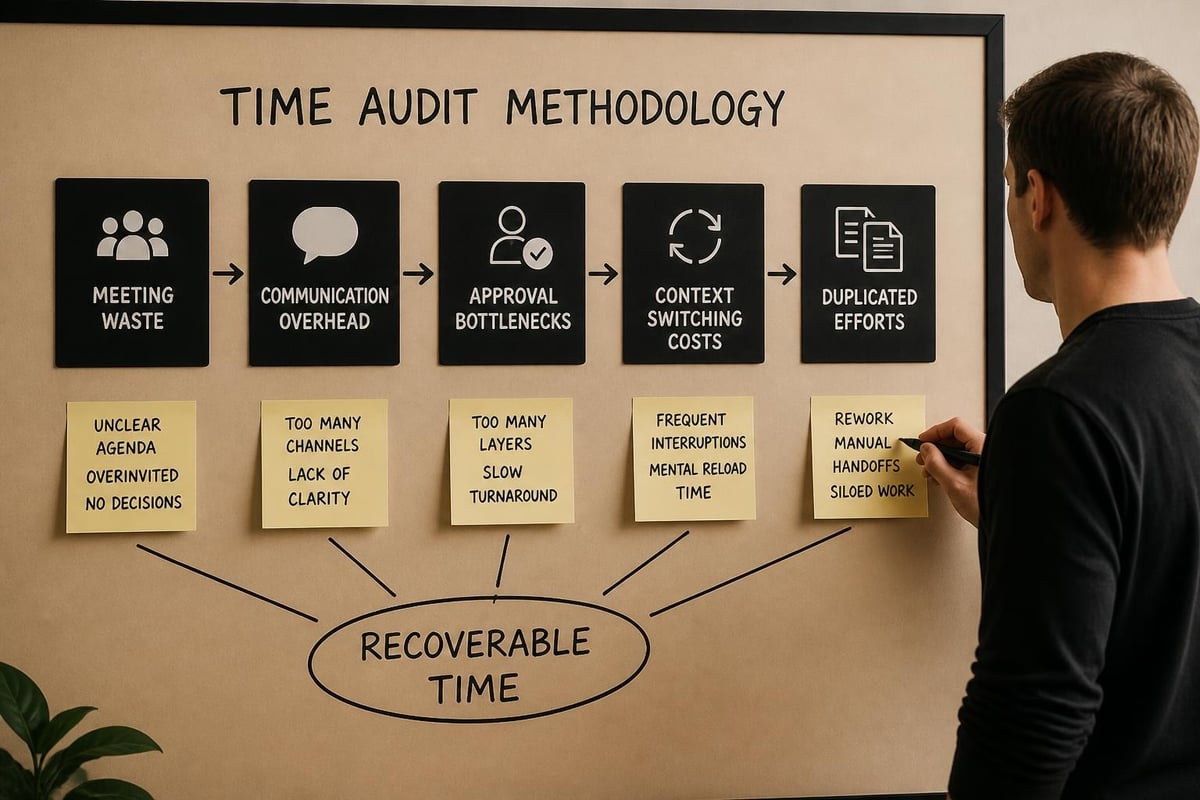
Conducting comprehensive time audits reveals hidden inefficiencies that accumulate into significant waste. This systematic approach examines how employees actually spend their time versus how they should allocate it strategically.
Time audits typically uncover several common patterns:
- Meeting proliferation: Gatherings that lack clear objectives or include unnecessary participants
- Communication overhead: Excessive email threads or chat messages replacing direct conversation
- Approval bottlenecks: Unnecessary sign-offs that delay decisions without adding value
- Context switching: Fragmented work sessions that reduce deep focus time
- Duplicated effort: Multiple people performing similar tasks without coordination
Organizations implementing employee benefits consulting often discover that streamlining benefits administration through process optimization delivers time savings comparable to technology investments, particularly when combined with automation.
Redesigning Workflows for Efficiency
Once time audits identify inefficiencies, workflow redesign focuses on three core principles:
| Principle | Application | Expected Time Savings |
|---|---|---|
| Elimination | Remove steps that don't add value | 20-40% of process time |
| Combination | Merge related tasks into single sessions | 15-25% through reduced setup |
| Simplification | Reduce complexity in remaining steps | 10-20% from clearer execution |
Elimination represents the most powerful strategy. Before automating or improving a process, question whether it needs to exist at all. Many reporting requirements, approval layers, and documentation steps persist long after their original purpose becomes obsolete.
Combination recognizes that task-switching carries cognitive costs. Batching similar activities reduces the mental overhead of context shifts. For instance, reviewing all contract modifications during a dedicated weekly session proves more efficient than addressing them individually as they arise.
Simplification removes unnecessary complexity from required processes. Clear templates, standardized formats, and decision trees help employees complete tasks faster with fewer errors.
Human Capital Management and Time Efficiency
Employee time allocation directly impacts organizational performance, making human capital management a critical dimension of time savings strategy. Research examining developers’ ideal versus actual workweeks reveals that misalignment between how employees want to spend time and how they actually do creates significant efficiency losses.
Empowering Productive Time Allocation
Organizations achieve sustainable time savings by empowering employees to work more effectively rather than simply working longer hours. This requires addressing both structural barriers and cultural norms that waste time.
Key enablers include:
- Clear priority frameworks that help employees distinguish urgent from important work
- Protected focus time blocking calendar periods for deep, uninterrupted work
- Delegation authority enabling decisions at appropriate organizational levels
- Resource accessibility providing tools and information when needed
- Skill development building capabilities that increase individual efficiency
For many professional services organizations, implementing effective SMB payroll solutions exemplifies how removing administrative burdens from managers creates time savings that cascade throughout teams. When supervisors spend less time on payroll processing, they invest more in coaching, planning, and client relationships.
The Role of Employee Wellbeing in Time Savings
Counterintuitively, time savings often increase when organizations invest in employee health and wellness. Healthier, more engaged employees work more efficiently during their scheduled hours, reducing the need for overtime while improving output quality.
Studies on generative AI’s impact on time allocation suggest that technology-enabled time savings create opportunities for employees to invest in wellness activities that further enhance productivity, creating a positive reinforcement cycle.
Organizations should consider:
- Mental health support reducing stress and improving focus
- Physical wellness programs increasing energy and reducing sick time
- Financial wellness initiatives decreasing distraction from money worries
- Flexible work arrangements enabling peak performance scheduling
- Professional development building skills that increase efficiency
Technology Selection for Sustainable Time Savings
Selecting the right technology tools determines whether time savings initiatives deliver lasting value or become short-lived productivity bumps. The technology landscape offers countless solutions promising efficiency gains, but strategic selection requires aligning tool capabilities with specific organizational needs.
Evaluation Framework for Time-Saving Technologies
Before investing in new platforms, organizations should assess candidates across multiple dimensions:
Functional Requirements:
- Does the solution address identified time-waste sources?
- Can it integrate with existing systems and workflows?
- Does it scale as the organization grows?
User Adoption Factors:
- How steep is the learning curve for typical users?
- Does the interface match employee work patterns?
- What training and support resources exist?
Total Cost Analysis:
- What are implementation costs beyond licensing fees?
- How much staff time will deployment require?
- What ongoing maintenance obligations exist?
Time Savings Potential:
- What measurable efficiency improvements can be documented?
- How quickly will the organization realize time savings?
- Can benefits compound through expanded usage?
Consulting resources like time tracking apps help organizations monitor where time goes, providing data-driven insights for technology selection decisions.
Integration as a Time Savings Multiplier
Individual tools deliver incremental improvements, but integrated technology ecosystems create exponential time savings through seamless data flow and reduced manual transfers. Organizations should prioritize solutions that communicate effectively with existing platforms.
Integration delivers time savings through:
- Automated data synchronization eliminating manual entry across systems
- Unified dashboards consolidating information from multiple sources
- Workflow automation triggering actions across platforms without human intervention
- Centralized reporting aggregating metrics without manual compilation
For healthcare organizations specifically, data normalization becomes essential for integration success, ensuring information flows accurately between clinical, administrative, and financial systems while preserving time savings through reduced error correction.
Measuring and Sustaining Time Savings Gains
Achieving initial time savings proves easier than sustaining improvements over time. Organizations often experience efficiency gains that gradually erode as processes drift back toward previous patterns or new inefficiencies emerge. Systematic measurement and continuous improvement prevent this regression.
Establishing Time Savings Baselines
Accurate measurement begins with establishing clear baselines before implementing changes. Document current state metrics including:
- Average time required for specific processes
- Frequency of task completion per period
- Number of employees involved in workflows
- Error rates and rework requirements
- Customer or stakeholder satisfaction levels
Baseline establishment requires honest assessment. Many organizations discover their initial time estimates significantly understate actual effort when comprehensive tracking reveals hidden activities.
Ongoing Monitoring and Reporting
Sustained time savings require regular measurement against established baselines. Monthly or quarterly reviews should examine:
| Metric | Baseline | Current | Change | Target |
|---|---|---|---|---|
| Process completion time | 45 minutes | 12 minutes | -73% | 10 minutes |
| Weekly volume handled | 120 tasks | 280 tasks | +133% | 300 tasks |
| Error rate | 8.5% | 2.1% | -75% | <2% |
| Employee satisfaction | 6.2/10 | 8.4/10 | +35% | >8.5/10 |
Transparent reporting keeps time savings visible to stakeholders and maintains organizational commitment to efficiency. When teams see measurable progress, they remain motivated to sustain improvements and identify additional opportunities.

Industry-Specific Time Savings Strategies
Different sectors face unique time management challenges requiring tailored approaches. Professional services organizations should adapt general time savings principles to their specific operational contexts.
Healthcare Time Efficiency
Healthcare providers face particular time pressures balancing patient care with administrative requirements. Time savings strategies in this sector focus on:
- Revenue cycle automation reducing claims processing time and accelerating reimbursement
- Patient intake optimization streamlining registration and information gathering
- Clinical documentation efficiency using templates and voice recognition to reduce charting time
- Appointment scheduling automation minimizing no-shows and optimizing provider utilization
Organizations implementing end-to-end revenue cycle management solutions often discover that time savings in billing and collections free clinical staff to focus on patient care rather than payment administration.
Professional Services Optimization
Consulting firms, legal practices, and other professional services organizations maximize time savings through:
- Client onboarding automation standardizing intake processes
- Project management platforms coordinating team efforts efficiently
- Knowledge management systems reducing research duplication
- Template libraries accelerating deliverable creation
- Time capture automation ensuring accurate billing without manual tracking
These strategies directly impact profitability in billable-hour business models where time savings translate immediately to increased capacity for revenue-generating client work.
Small Business Time Leverage
Small and mid-sized businesses often achieve proportionally greater time savings from efficiency improvements because limited staff means every hour carries more weight. Priority areas include:
- Financial process automation from invoicing to expense management
- Customer communication tools managing inquiries without constant interruption
- Inventory management systems reducing manual counting and ordering
- Marketing automation nurturing leads without continuous manual outreach
For organizations exploring what are the benefits of business automation, time savings often emerge as the most immediate and measurable advantage, creating capacity for growth without proportional staff increases.
Building a Time Savings Culture
Technology and process improvements deliver temporary gains without cultural commitment to ongoing efficiency. Organizations that sustain time savings cultivate workplace cultures where everyone actively identifies and eliminates waste.
Leadership's Role in Time Efficiency
Executive commitment makes or breaks time savings initiatives. Leaders demonstrate priority through:
Modeling efficient behaviors:
- Starting and ending meetings punctually
- Responding to communications within defined timeframes
- Delegating decisions to appropriate levels
- Protecting team focus time from unnecessary interruptions
Allocating resources:
- Investing in efficiency-enabling technology
- Providing training on productivity methods
- Staffing process improvement initiatives adequately
- Celebrating time savings achievements publicly
Setting expectations:
- Establishing clear priorities that guide time allocation
- Defining acceptable response times for various communication types
- Creating accountability for efficiency metrics
- Empowering employees to challenge time-wasting practices
Employee Engagement in Continuous Improvement
Frontline employees often identify the most impactful time savings opportunities because they experience inefficiencies directly. Organizations should create channels for:
- Suggestion programs capturing improvement ideas from all levels
- Cross-functional teams examining processes from multiple perspectives
- Experimentation permission allowing controlled trials of new approaches
- Recognition systems rewarding efficiency innovations
When employees feel empowered to optimize their own workflows, time savings become self-sustaining rather than requiring constant management intervention.
Future Trends in Time Savings
The landscape of time efficiency continues evolving as new technologies and methodologies emerge. Organizations planning long-term time savings strategies should monitor several developing trends:
Artificial Intelligence and Machine Learning
AI capabilities extend beyond simple automation into intelligent decision support and predictive assistance. Emerging applications include:
- Intelligent scheduling that optimizes calendars across multiple participants and constraints
- Predictive analytics identifying bottlenecks before they impact workflows
- Natural language processing automating communication drafting and summarization
- Intelligent document processing extracting information from unstructured sources
Organizations investing in AI and automation solutions position themselves to capture next-generation time savings as these technologies mature and become more accessible.
Remote and Hybrid Work Models
Flexible work arrangements create new time savings opportunities while introducing fresh challenges. Organizations optimize distributed work through:
- Asynchronous communication reducing meeting requirements across time zones
- Digital collaboration platforms enabling efficient remote teamwork
- Result-oriented management focusing on outcomes rather than hours worked
- Virtual workspace design creating efficient digital environments
Research on travel time savings valuation suggests that eliminating commutes represents one of remote work's most significant time benefits, but organizations must actively prevent meeting proliferation from consuming recaptured time.
Integrated Wellness and Productivity
Forward-thinking organizations recognize that employee wellbeing and time efficiency reinforce each other. Future strategies will increasingly integrate:
- Personalized work schedules aligned with individual peak performance times
- Wellness interventions targeted at reducing efficiency-limiting health issues
- Financial stress reduction through comprehensive benefits and planning support
- Mental health resources addressing focus and decision-making challenges
Companies offering comprehensive programs like employee benefits consulting understand that investing in whole-person wellness creates compounding time savings through improved focus, reduced absenteeism, and enhanced decision quality.
Time savings represent far more than operational efficiency; they create strategic capacity for innovation, growth, and competitive advantage. Organizations that systematically identify, implement, and sustain time efficiency improvements position themselves to thrive in increasingly demanding markets. When you're ready to transform time waste into strategic advantage, Nero and Associates, Inc. brings proven expertise in automation, process optimization, and human capital management to help your organization eliminate thousands of manual hours while empowering your team to focus on what matters most.