

Labor Compliance: Essential Guide for Modern Businesses

Share on Facebook
Share on X
Share on LinkedIn

Organizations across every industry face an increasingly complex web of federal, state, and local employment regulations. Labor compliance encompasses the policies, procedures, and practices that ensure businesses adhere to all applicable employment laws, from wage and hour requirements to workplace safety standards. For companies seeking to optimize operations while protecting their workforce, understanding and implementing robust labor compliance frameworks has become essential. The consequences of non-compliance extend far beyond financial penalties, affecting employee morale, operational efficiency, and long-term business sustainability.

Understanding the Foundations of Labor Compliance

Labor compliance refers to an organization's adherence to all employment-related laws and regulations governing the employer-employee relationship. This comprehensive framework includes federal statutes such as the Fair Labor Standards Act, the Family and Medical Leave Act, and regulations enforced by agencies like OSHA’s compliance assistance programs.

The scope of labor compliance extends across multiple domains:

  • Wage and hour regulations covering minimum wage, overtime, and payment schedules
  • Workplace safety standards mandating safe working conditions and hazard prevention
  • Anti-discrimination protections ensuring equal employment opportunities
  • Employee benefits administration including health insurance and retirement plans
  • Leave management encompassing FMLA, sick leave, and vacation policies
  • Immigration compliance verifying work authorization and maintaining I-9 documentation

Organizations must recognize that labor compliance requirements vary significantly based on company size, industry, geographic location, and workforce composition. A manufacturing facility faces different obligations than a professional services firm, while multi-state employers must navigate varying state-level requirements that often exceed federal minimums.

The Evolution of Compliance Requirements

Labor compliance has transformed dramatically over the past decade. Regulatory agencies have expanded enforcement activities, increased penalties for violations, and adopted more sophisticated detection methods. The Department of Energy’s labor law compliance resources illustrate the breadth of federal obligations that extend across various sectors.

Timeline of evolving labor compliance regulations

Technology has simultaneously complicated and streamlined compliance efforts. While remote work arrangements, gig economy classifications, and automated scheduling systems create new regulatory challenges, digital solutions now enable more efficient tracking, reporting, and documentation of compliance activities.

Critical Compliance Areas Every Organization Must Address

Wage and Hour Compliance

Proper classification of employees versus independent contractors represents one of the most common compliance failures. Misclassification can result in substantial back-pay obligations, tax penalties, and damage to organizational reputation. Companies must evaluate multiple factors including degree of control, permanency of relationship, investment in equipment, and opportunity for profit or loss.

Overtime calculations require meticulous attention. Non-exempt employees must receive one and a half times their regular rate for hours worked beyond 40 in a workweek. Organizations often stumble when calculating overtime for employees with multiple pay rates, bonuses, or shift differentials.

Compliance Challenge Common Pitfall Best Practice
Employee Classification Treating employees as contractors Apply IRS 20-factor test systematically
Overtime Calculation Excluding bonuses from regular rate Include all non-discretionary compensation
Time Tracking Relying on manual timesheets Implement automated time-capture systems
Pay Frequency Inconsistent payment schedules Establish clear payroll calendars

Anti-Discrimination and Equal Employment Practices

EEOC guidance provides comprehensive resources for understanding federal anti-discrimination requirements. Organizations must ensure hiring, promotion, compensation, and termination decisions remain free from bias based on protected characteristics.

Compliance in this area demands proactive measures beyond simply avoiding overt discrimination. Companies should implement structured interview processes, document decision-making rationale, conduct regular pay equity analyses, and provide comprehensive training to managers and HR personnel.

The intersection of labor compliance and employee wellness programs requires particular attention. While initiatives promoting physical and mental health can enhance organizational performance, they must be designed to avoid discrimination claims and protect employee privacy rights.

Building a Comprehensive Compliance Framework

Establishing effective labor compliance requires more than understanding regulations. Organizations need systematic approaches integrating policy development, training, monitoring, and continuous improvement.

Policy Development and Documentation

Written policies serve as the foundation of any compliance program. These documents should translate complex legal requirements into clear operational guidelines accessible to managers and employees alike. Essential policies include:

  1. Equal employment opportunity statements outlining commitment to non-discrimination
  2. Harassment prevention protocols defining prohibited conduct and reporting procedures
  3. Wage and hour policies explaining time-tracking, overtime, and meal break requirements
  4. Leave administration guidelines covering FMLA, ADA accommodations, and state-specific leave laws
  5. Safety procedures detailing hazard communication, injury reporting, and emergency protocols

Policies must be regularly reviewed and updated to reflect changing regulations. Annual compliance audits help identify gaps between documented policies and actual practices.

Components of labor compliance framework

Technology-Enabled Compliance Management

Manual compliance processes create substantial risk exposure. Human error in time tracking, inconsistent policy application, and inadequate documentation can trigger violations even when organizations intend to comply.

Modern Human Capital Management solutions integrate compliance functions across the employee lifecycle. These systems automatically apply complex overtime rules, track certification renewals, manage leave balances, and generate audit trails documenting compliance activities.

Automation delivers compliance advantages through:

  • Real-time monitoring of hours worked against overtime thresholds
  • Automated alerts for certification expirations or training renewals
  • Systematic documentation of performance discussions and disciplinary actions
  • Configurable workflows ensuring consistent policy application
  • Centralized repositories for compliance-related communications

Organizations leveraging automation to optimize processes can redirect thousands of manual hours toward strategic initiatives while simultaneously reducing compliance risk.

Training and Communication Strategies

Even sophisticated policies and systems fail without proper training. Labor compliance education must extend beyond HR departments to encompass every level of the organization.

Manager Development Programs

Front-line supervisors represent the primary compliance risk point. Their daily decisions regarding scheduling, performance management, leave requests, and workplace accommodations directly impact regulatory adherence. Learning and development consultants can design targeted training addressing specific compliance responsibilities.

Effective manager training covers:

  • Recognizing and responding to harassment complaints
  • Properly documenting performance issues
  • Administering leave requests and accommodations
  • Understanding overtime and meal break requirements
  • Identifying safety hazards and reporting protocols

Training should incorporate scenario-based learning, allowing managers to practice applying compliance principles to realistic workplace situations. Annual refresher courses help reinforce critical concepts and update managers on regulatory changes.

Employee Communication

Workers cannot comply with policies they don't understand. Organizations should communicate compliance expectations through multiple channels including orientation programs, employee handbooks, intranet resources, and regular reminders.

Accessibility matters significantly in compliance communication. Materials should be available in languages spoken by the workforce and formatted for different learning preferences. Video tutorials, infographics, and interactive modules often prove more effective than dense policy manuals.

Audit Procedures and Risk Assessment

Proactive compliance audits identify vulnerabilities before they escalate into violations or legal claims. Organizations should conduct both comprehensive annual reviews and targeted audits of high-risk areas.

Audit Focus Area Key Elements to Review Frequency
Wage and Hour Time records, overtime calculations, classification Quarterly
Safety Records Injury logs, training documentation, inspection reports Monthly
Personnel Files I-9 forms, performance documentation, leave records Semi-annually
Benefits Administration Enrollment records, COBRA notices, ACA reporting Annually

The audit process should include file reviews, employee interviews, observation of workplace practices, and comparison of documented policies against actual implementation. Findings must be documented with clear remediation plans and accountability assignments.

Risk assessment helps prioritize compliance investments. Organizations should evaluate likelihood and severity of potential violations across different regulatory areas. Factors influencing risk include industry sector, workforce demographics, geographic footprint, and historical compliance performance.

Responding to Compliance Challenges

Despite best efforts, compliance issues arise. How organizations respond determines whether isolated incidents become systemic problems.

Internal Complaint Investigation

Prompt, thorough investigation of employee complaints demonstrates commitment to compliance while limiting liability exposure. Investigation protocols should establish:

  • Immediate response timelines (typically 24-48 hours to acknowledge complaints)
  • Impartial investigators with appropriate training
  • Confidentiality protections balanced against investigation needs
  • Documentation standards for witness interviews and evidence collection
  • Fair remedial action proportionate to findings

Retaliation protection represents a critical compliance obligation. Employees who report violations or participate in investigations must be shielded from adverse employment actions.

Regulatory Interactions

When regulatory agencies initiate investigations, organizational response can significantly impact outcomes. Companies should designate compliance officers authorized to communicate with investigators, establish document production protocols, and engage legal counsel when appropriate.

Cooperative engagement typically yields better results than adversarial postures. However, cooperation doesn't mean accepting every investigator assertion. Organizations retain rights to explain context, present mitigating evidence, and negotiate reasonable remediation timelines.

Strategic Benefits Beyond Compliance

While avoiding penalties provides sufficient motivation for labor compliance, organizations that embrace compliance as a strategic advantage realize additional benefits.

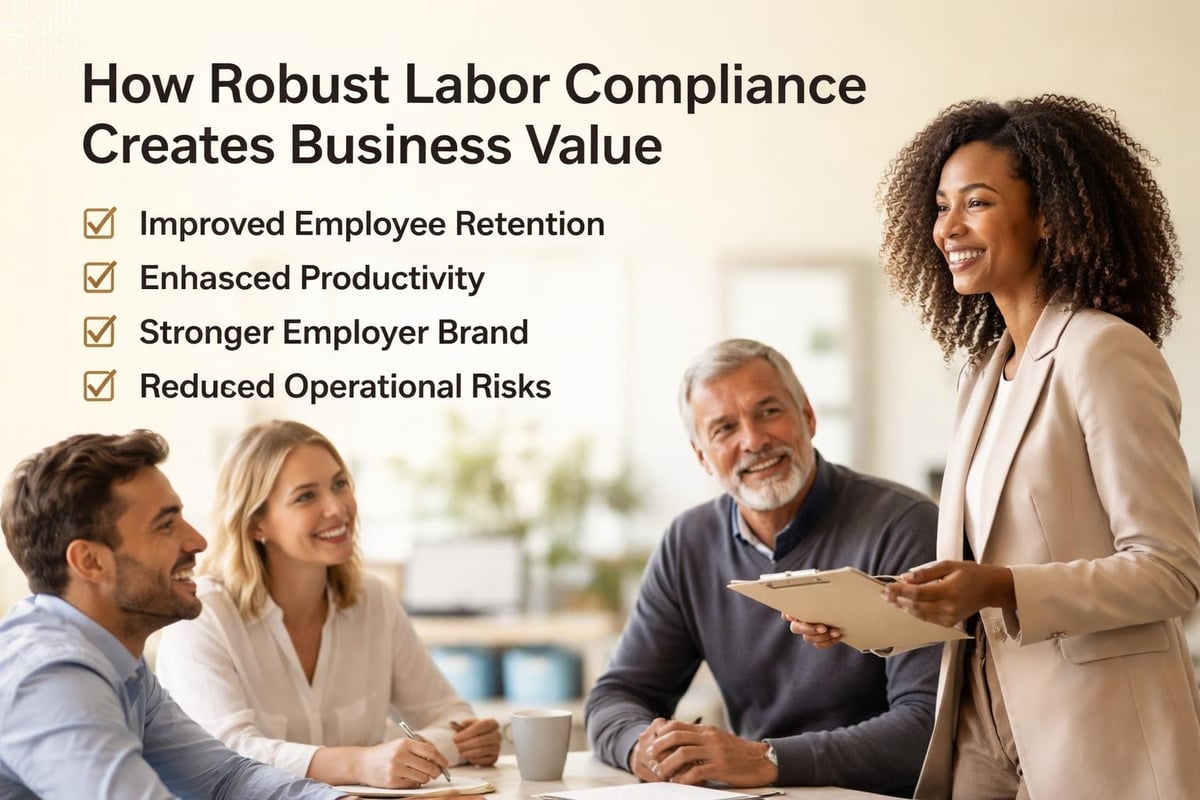
Strong compliance frameworks enhance employee retention. Workers who trust their employer respects their rights, pays fairly, and maintains safe conditions demonstrate higher engagement and loyalty. The cost savings from reduced turnover often exceed compliance program investments.
Strategic value of labor compliance

Operational efficiency improves when compliance becomes embedded in business processes rather than treated as separate obligation. Systematic approaches to scheduling, time tracking, and documentation serve both compliance and operational objectives. Succession planning tools that incorporate compliance considerations ensure leadership transitions don't create regulatory vulnerabilities.

Market reputation increasingly depends on compliance performance. Customers, investors, and prospective employees scrutinize organizational practices. Companies with strong compliance records enjoy competitive advantages in talent acquisition and customer relationships.

Future Trends Shaping Labor Compliance

The labor compliance landscape continues evolving. Organizations must anticipate emerging requirements rather than merely reacting to current obligations.

Regulatory developments on the horizon include:

  • Expanded pay transparency requirements mandating salary range disclosures
  • Strengthened protections for gig economy workers
  • Enhanced workplace safety standards addressing mental health and ergonomic risks
  • Increased enforcement of predictive scheduling laws
  • Greater scrutiny of algorithmic decision-making in employment

Technology will play an expanding role in both compliance obligations and solutions. Artificial intelligence applications in hiring, performance evaluation, and workforce management create new discrimination risks requiring careful oversight. Simultaneously, AI-powered compliance tools offer sophisticated monitoring and predictive capabilities.

The shift toward remote and hybrid work models necessitates compliance frameworks addressing multi-jurisdictional workforces. Organizations with employees across multiple states must navigate varying requirements for meal breaks, overtime exemptions, and leave entitlements.

Preparing for Regulatory Change

Proactive organizations monitor regulatory proposals, participate in industry associations, and build adaptive compliance systems. Rather than designing processes around current requirements, forward-thinking companies create flexible frameworks accommodating regulatory evolution.

Scenario planning helps organizations prepare for potential compliance changes. By modeling various regulatory scenarios and their operational implications, companies can develop contingency plans reducing implementation timelines when new requirements emerge.


Labor compliance represents both a critical risk management function and an opportunity for operational excellence. Organizations that implement comprehensive frameworks combining clear policies, robust training, technology-enabled monitoring, and continuous improvement processes protect themselves from regulatory penalties while building stronger, more efficient workplaces. Nero and Associates, Inc. helps organizations transform compliance obligations into strategic advantages through integrated Human Capital Management solutions that automate compliance processes, eliminate manual effort, and empower employees with the protections and benefits they deserve. Our performance-based approach ensures your compliance investments deliver measurable returns in reduced risk, improved efficiency, and enhanced employee satisfaction.
Labor Compliance: Essential Guide for Modern Businesses

Organizations across every industry face an increasingly complex web of federal, state, and local employment regulations. Labor compliance encompasses the policies, procedures, and practices that ensure businesses adhere to all applicable employment laws, from wage and hour requirements to workplace safety standards. For companies seeking to optimize operations while protecting their workforce, understanding and implementing robust labor compliance frameworks has become essential. The consequences of non-compliance extend far beyond financial penalties, affecting employee morale, operational efficiency, and long-term business sustainability.

Understanding the Foundations of Labor Compliance

Labor compliance refers to an organization's adherence to all employment-related laws and regulations governing the employer-employee relationship. This comprehensive framework includes federal statutes such as the Fair Labor Standards Act, the Family and Medical Leave Act, and regulations enforced by agencies like OSHA’s compliance assistance programs.

The scope of labor compliance extends across multiple domains:

  • Wage and hour regulations covering minimum wage, overtime, and payment schedules
  • Workplace safety standards mandating safe working conditions and hazard prevention
  • Anti-discrimination protections ensuring equal employment opportunities
  • Employee benefits administration including health insurance and retirement plans
  • Leave management encompassing FMLA, sick leave, and vacation policies
  • Immigration compliance verifying work authorization and maintaining I-9 documentation

Organizations must recognize that labor compliance requirements vary significantly based on company size, industry, geographic location, and workforce composition. A manufacturing facility faces different obligations than a professional services firm, while multi-state employers must navigate varying state-level requirements that often exceed federal minimums.

The Evolution of Compliance Requirements

Labor compliance has transformed dramatically over the past decade. Regulatory agencies have expanded enforcement activities, increased penalties for violations, and adopted more sophisticated detection methods. The Department of Energy’s labor law compliance resources illustrate the breadth of federal obligations that extend across various sectors.

Timeline of evolving labor compliance regulations

Technology has simultaneously complicated and streamlined compliance efforts. While remote work arrangements, gig economy classifications, and automated scheduling systems create new regulatory challenges, digital solutions now enable more efficient tracking, reporting, and documentation of compliance activities.

Critical Compliance Areas Every Organization Must Address

Wage and Hour Compliance

Proper classification of employees versus independent contractors represents one of the most common compliance failures. Misclassification can result in substantial back-pay obligations, tax penalties, and damage to organizational reputation. Companies must evaluate multiple factors including degree of control, permanency of relationship, investment in equipment, and opportunity for profit or loss.

Overtime calculations require meticulous attention. Non-exempt employees must receive one and a half times their regular rate for hours worked beyond 40 in a workweek. Organizations often stumble when calculating overtime for employees with multiple pay rates, bonuses, or shift differentials.

Compliance Challenge Common Pitfall Best Practice
Employee Classification Treating employees as contractors Apply IRS 20-factor test systematically
Overtime Calculation Excluding bonuses from regular rate Include all non-discretionary compensation
Time Tracking Relying on manual timesheets Implement automated time-capture systems
Pay Frequency Inconsistent payment schedules Establish clear payroll calendars

Anti-Discrimination and Equal Employment Practices

EEOC guidance provides comprehensive resources for understanding federal anti-discrimination requirements. Organizations must ensure hiring, promotion, compensation, and termination decisions remain free from bias based on protected characteristics.

Compliance in this area demands proactive measures beyond simply avoiding overt discrimination. Companies should implement structured interview processes, document decision-making rationale, conduct regular pay equity analyses, and provide comprehensive training to managers and HR personnel.

The intersection of labor compliance and employee wellness programs requires particular attention. While initiatives promoting physical and mental health can enhance organizational performance, they must be designed to avoid discrimination claims and protect employee privacy rights.

Building a Comprehensive Compliance Framework

Establishing effective labor compliance requires more than understanding regulations. Organizations need systematic approaches integrating policy development, training, monitoring, and continuous improvement.

Policy Development and Documentation

Written policies serve as the foundation of any compliance program. These documents should translate complex legal requirements into clear operational guidelines accessible to managers and employees alike. Essential policies include:

  1. Equal employment opportunity statements outlining commitment to non-discrimination
  2. Harassment prevention protocols defining prohibited conduct and reporting procedures
  3. Wage and hour policies explaining time-tracking, overtime, and meal break requirements
  4. Leave administration guidelines covering FMLA, ADA accommodations, and state-specific leave laws
  5. Safety procedures detailing hazard communication, injury reporting, and emergency protocols

Policies must be regularly reviewed and updated to reflect changing regulations. Annual compliance audits help identify gaps between documented policies and actual practices.

Components of labor compliance framework

Technology-Enabled Compliance Management

Manual compliance processes create substantial risk exposure. Human error in time tracking, inconsistent policy application, and inadequate documentation can trigger violations even when organizations intend to comply.

Modern Human Capital Management solutions integrate compliance functions across the employee lifecycle. These systems automatically apply complex overtime rules, track certification renewals, manage leave balances, and generate audit trails documenting compliance activities.

Automation delivers compliance advantages through:

  • Real-time monitoring of hours worked against overtime thresholds
  • Automated alerts for certification expirations or training renewals
  • Systematic documentation of performance discussions and disciplinary actions
  • Configurable workflows ensuring consistent policy application
  • Centralized repositories for compliance-related communications

Organizations leveraging automation to optimize processes can redirect thousands of manual hours toward strategic initiatives while simultaneously reducing compliance risk.

Training and Communication Strategies

Even sophisticated policies and systems fail without proper training. Labor compliance education must extend beyond HR departments to encompass every level of the organization.

Manager Development Programs

Front-line supervisors represent the primary compliance risk point. Their daily decisions regarding scheduling, performance management, leave requests, and workplace accommodations directly impact regulatory adherence. Learning and development consultants can design targeted training addressing specific compliance responsibilities.

Effective manager training covers:

  • Recognizing and responding to harassment complaints
  • Properly documenting performance issues
  • Administering leave requests and accommodations
  • Understanding overtime and meal break requirements
  • Identifying safety hazards and reporting protocols

Training should incorporate scenario-based learning, allowing managers to practice applying compliance principles to realistic workplace situations. Annual refresher courses help reinforce critical concepts and update managers on regulatory changes.

Employee Communication

Workers cannot comply with policies they don't understand. Organizations should communicate compliance expectations through multiple channels including orientation programs, employee handbooks, intranet resources, and regular reminders.

Accessibility matters significantly in compliance communication. Materials should be available in languages spoken by the workforce and formatted for different learning preferences. Video tutorials, infographics, and interactive modules often prove more effective than dense policy manuals.

Audit Procedures and Risk Assessment

Proactive compliance audits identify vulnerabilities before they escalate into violations or legal claims. Organizations should conduct both comprehensive annual reviews and targeted audits of high-risk areas.

Audit Focus Area Key Elements to Review Frequency
Wage and Hour Time records, overtime calculations, classification Quarterly
Safety Records Injury logs, training documentation, inspection reports Monthly
Personnel Files I-9 forms, performance documentation, leave records Semi-annually
Benefits Administration Enrollment records, COBRA notices, ACA reporting Annually

The audit process should include file reviews, employee interviews, observation of workplace practices, and comparison of documented policies against actual implementation. Findings must be documented with clear remediation plans and accountability assignments.

Risk assessment helps prioritize compliance investments. Organizations should evaluate likelihood and severity of potential violations across different regulatory areas. Factors influencing risk include industry sector, workforce demographics, geographic footprint, and historical compliance performance.

Responding to Compliance Challenges

Despite best efforts, compliance issues arise. How organizations respond determines whether isolated incidents become systemic problems.

Internal Complaint Investigation

Prompt, thorough investigation of employee complaints demonstrates commitment to compliance while limiting liability exposure. Investigation protocols should establish:

  • Immediate response timelines (typically 24-48 hours to acknowledge complaints)
  • Impartial investigators with appropriate training
  • Confidentiality protections balanced against investigation needs
  • Documentation standards for witness interviews and evidence collection
  • Fair remedial action proportionate to findings

Retaliation protection represents a critical compliance obligation. Employees who report violations or participate in investigations must be shielded from adverse employment actions.

Regulatory Interactions

When regulatory agencies initiate investigations, organizational response can significantly impact outcomes. Companies should designate compliance officers authorized to communicate with investigators, establish document production protocols, and engage legal counsel when appropriate.

Cooperative engagement typically yields better results than adversarial postures. However, cooperation doesn't mean accepting every investigator assertion. Organizations retain rights to explain context, present mitigating evidence, and negotiate reasonable remediation timelines.

Strategic Benefits Beyond Compliance

While avoiding penalties provides sufficient motivation for labor compliance, organizations that embrace compliance as a strategic advantage realize additional benefits.

Strong compliance frameworks enhance employee retention. Workers who trust their employer respects their rights, pays fairly, and maintains safe conditions demonstrate higher engagement and loyalty. The cost savings from reduced turnover often exceed compliance program investments.

Strategic value of labor compliance

Operational efficiency improves when compliance becomes embedded in business processes rather than treated as separate obligation. Systematic approaches to scheduling, time tracking, and documentation serve both compliance and operational objectives. Succession planning tools that incorporate compliance considerations ensure leadership transitions don't create regulatory vulnerabilities.

Market reputation increasingly depends on compliance performance. Customers, investors, and prospective employees scrutinize organizational practices. Companies with strong compliance records enjoy competitive advantages in talent acquisition and customer relationships.

Future Trends Shaping Labor Compliance

The labor compliance landscape continues evolving. Organizations must anticipate emerging requirements rather than merely reacting to current obligations.

Regulatory developments on the horizon include:

  • Expanded pay transparency requirements mandating salary range disclosures
  • Strengthened protections for gig economy workers
  • Enhanced workplace safety standards addressing mental health and ergonomic risks
  • Increased enforcement of predictive scheduling laws
  • Greater scrutiny of algorithmic decision-making in employment

Technology will play an expanding role in both compliance obligations and solutions. Artificial intelligence applications in hiring, performance evaluation, and workforce management create new discrimination risks requiring careful oversight. Simultaneously, AI-powered compliance tools offer sophisticated monitoring and predictive capabilities.

The shift toward remote and hybrid work models necessitates compliance frameworks addressing multi-jurisdictional workforces. Organizations with employees across multiple states must navigate varying requirements for meal breaks, overtime exemptions, and leave entitlements.

Preparing for Regulatory Change

Proactive organizations monitor regulatory proposals, participate in industry associations, and build adaptive compliance systems. Rather than designing processes around current requirements, forward-thinking companies create flexible frameworks accommodating regulatory evolution.

Scenario planning helps organizations prepare for potential compliance changes. By modeling various regulatory scenarios and their operational implications, companies can develop contingency plans reducing implementation timelines when new requirements emerge.


Labor compliance represents both a critical risk management function and an opportunity for operational excellence. Organizations that implement comprehensive frameworks combining clear policies, robust training, technology-enabled monitoring, and continuous improvement processes protect themselves from regulatory penalties while building stronger, more efficient workplaces. Nero and Associates, Inc. helps organizations transform compliance obligations into strategic advantages through integrated Human Capital Management solutions that automate compliance processes, eliminate manual effort, and empower employees with the protections and benefits they deserve. Our performance-based approach ensures your compliance investments deliver measurable returns in reduced risk, improved efficiency, and enhanced employee satisfaction.

Website developed in accordance with Web Content Accessibility Guidelines 2.2.
If you encounter any issues while using this site, please contact us: 215.526.5126