

Healthcare organizations face mounting pressure to optimize operations while delivering exceptional patient experiences. Effective patient scheduling serves as the foundation for clinical efficiency, revenue optimization, and patient satisfaction. With healthcare facilities managing thousands of appointments annually, the difference between streamlined scheduling and chaotic appointment management can translate into significant financial impact and clinical outcomes. Modern patient scheduling solutions combine automation, data analytics, and patient-centric design to address the complex challenges healthcare providers face in 2026.
The Strategic Value of Patient Scheduling Systems
Patient scheduling represents far more than administrative task management. It directly influences revenue cycle performance, staff productivity, and patient retention rates. Healthcare organizations lose an average of 18% of potential revenue due to inefficient scheduling practices, including no-shows, late cancellations, and underutilized appointment slots.
Implementing effective patient scheduling best practices creates measurable improvements across multiple operational metrics. Organizations report reduced wait times, improved provider utilization rates, and enhanced patient satisfaction scores when scheduling processes align with both clinical workflows and patient preferences.
Financial Impact and Revenue Protection
The connection between patient scheduling and revenue cycle management cannot be overstated. Every unfilled appointment slot represents lost revenue that compounds throughout the fiscal year. Healthcare providers must consider several financial dimensions:
- No-show rates typically range from 5% to 30%, depending on specialty and patient demographics
- Late cancellations create insufficient time to fill vacant slots
- Double-booking strategies can maximize revenue but risk patient dissatisfaction
- Insurance verification failures lead to claim denials and delayed payments
Verifying insurance eligibility at the time of scheduling prevents last-minute appointment cancellations and protects revenue streams. This proactive approach reduces administrative burden on staff who would otherwise spend hours resolving insurance issues after appointments are completed.

Modern Patient Scheduling Methods and Approaches
Healthcare organizations employ various scheduling methodologies, each suited to different clinical environments and patient populations. Understanding these approaches enables providers to select systems that align with operational goals and patient needs.
Traditional vs. Advanced Scheduling Models
| Scheduling Method | Best Use Case | Key Advantages | Primary Challenges |
|---|---|---|---|
| Fixed Interval | Predictable appointment types | Simple to manage | Inflexible for urgent needs |
| Wave Scheduling | High-volume primary care | Reduces idle time | Can create patient backlog |
| Modified Wave | Mixed appointment complexity | Balances efficiency and flexibility | Requires careful planning |
| Open Access | Same-day urgent care | Maximizes patient access | Difficult to implement |
| Cluster Scheduling | Specialized procedures | Optimizes resource allocation | Limited appointment availability |
Implementing buffer times between appointments provides flexibility to accommodate patients who require additional time while preventing cascading delays throughout the day. Strategic buffer placement helps providers maintain schedule integrity even when unexpected complications arise.
Self-Scheduling and Patient Empowerment
Patient self-scheduling represents one of the most transformative developments in healthcare access. Allowing patients to book, modify, and cancel appointments through online portals or mobile applications delivers multiple benefits:
For Patients:
- 24/7 appointment access without phone calls
- Real-time availability visibility
- Immediate confirmation and reminders
- Reduced wait times on hold
For Healthcare Organizations:
- Decreased staff workload for appointment management
- Reduced phone volume and administrative costs
- Improved appointment accuracy through direct patient input
- Enhanced patient satisfaction scores
Research indicates that organizations implementing patient self-scheduling experience up to 40% reduction in scheduling-related phone calls, freeing staff to focus on more complex patient needs and clinical support activities.
Technology Integration and Automation Strategies
Artificial intelligence and automation have revolutionized patient scheduling capabilities. Modern systems leverage predictive analytics, machine learning algorithms, and integration platforms to optimize scheduling decisions in real-time.
Predictive Analytics for Schedule Optimization
Advanced patient scheduling platforms analyze historical data to predict no-show probability, optimal appointment duration, and patient flow patterns. These insights enable healthcare organizations to:
- Identify high-risk appointments that may result in no-shows
- Adjust scheduling templates based on seasonal demand patterns
- Optimize provider calendars to match patient volume with clinical capacity
- Allocate resources efficiently across multiple locations and departments
Using predictive analytics to prioritize appointments helps healthcare organizations maximize revenue while maintaining high-quality patient care. Systems can automatically flag appointments requiring special attention, such as new patient visits or complex procedures requiring additional preparation.
Automated Communication and Reminder Systems
Automated reminder systems significantly reduce no-show rates and improve appointment adherence. Multi-channel communication strategies reach patients through their preferred methods:
- SMS text messages with confirmation links
- Email notifications with calendar integration
- Automated phone calls for patients without digital access
- Mobile app push notifications for engaged users
Organizations implementing comprehensive reminder protocols report no-show reductions of 20% to 50%, representing substantial revenue recovery and improved patient care continuity.

Operational Excellence in Patient Scheduling
Beyond technology implementation, operational excellence requires standardized processes, staff training, and continuous performance monitoring. Healthcare organizations must establish clear protocols that balance efficiency with patient-centered care.
Performance Metrics and KPI Tracking
Measuring patient scheduling effectiveness requires tracking multiple key performance indicators. Healthcare organizations should monitor schedule performance across various dimensions to identify improvement opportunities.
| Metric | Target Range | Impact Area |
|---|---|---|
| No-show rate | < 10% | Revenue and access |
| Average wait time | < 15 minutes | Patient satisfaction |
| Schedule utilization | 85-95% | Provider productivity |
| Same-day access rate | > 60% | Patient convenience |
| Appointment lead time | 3-7 days | Access to care |
| Cancellation rate | < 15% | Schedule stability |
Regular analysis of these metrics reveals patterns that inform scheduling policy adjustments. For example, consistently high no-show rates in specific time slots may indicate the need for targeted intervention strategies or schedule redesign.
Staff Training and Workflow Integration
Even the most sophisticated patient scheduling system fails without proper staff adoption and workflow integration. Healthcare organizations must invest in comprehensive training programs that address both technical competencies and patient interaction skills.
Scheduling staff should understand how their work connects to broader organizational goals, including revenue optimization, patient satisfaction, and clinical outcomes. This perspective encourages proactive problem-solving and continuous improvement mindsets.
Advanced Scheduling Strategies for Complex Healthcare Environments
Large healthcare systems and specialty practices face unique patient scheduling challenges that require sophisticated approaches. Multi-provider coordination, resource allocation, and patient routing present complex optimization problems.
Multi-Resource Scheduling and Coordination
Certain appointments require coordinating multiple resources simultaneously, including specialized equipment, multiple providers, and support staff. Healthcare scheduling best practices for complex procedures include:
- Create comprehensive resource inventories documenting all schedulable assets
- Establish priority hierarchies for conflicting resource requests
- Implement advance scheduling windows for complex procedures requiring extensive preparation
- Design contingency protocols for resource unavailability or emergencies
- Monitor resource utilization rates to identify bottlenecks and expansion needs
Organizations managing multiple locations benefit from centralized scheduling platforms that provide real-time visibility across the entire network. Patients can be directed to the most appropriate location based on availability, specialty requirements, and geographic convenience.
Patient Flow Optimization
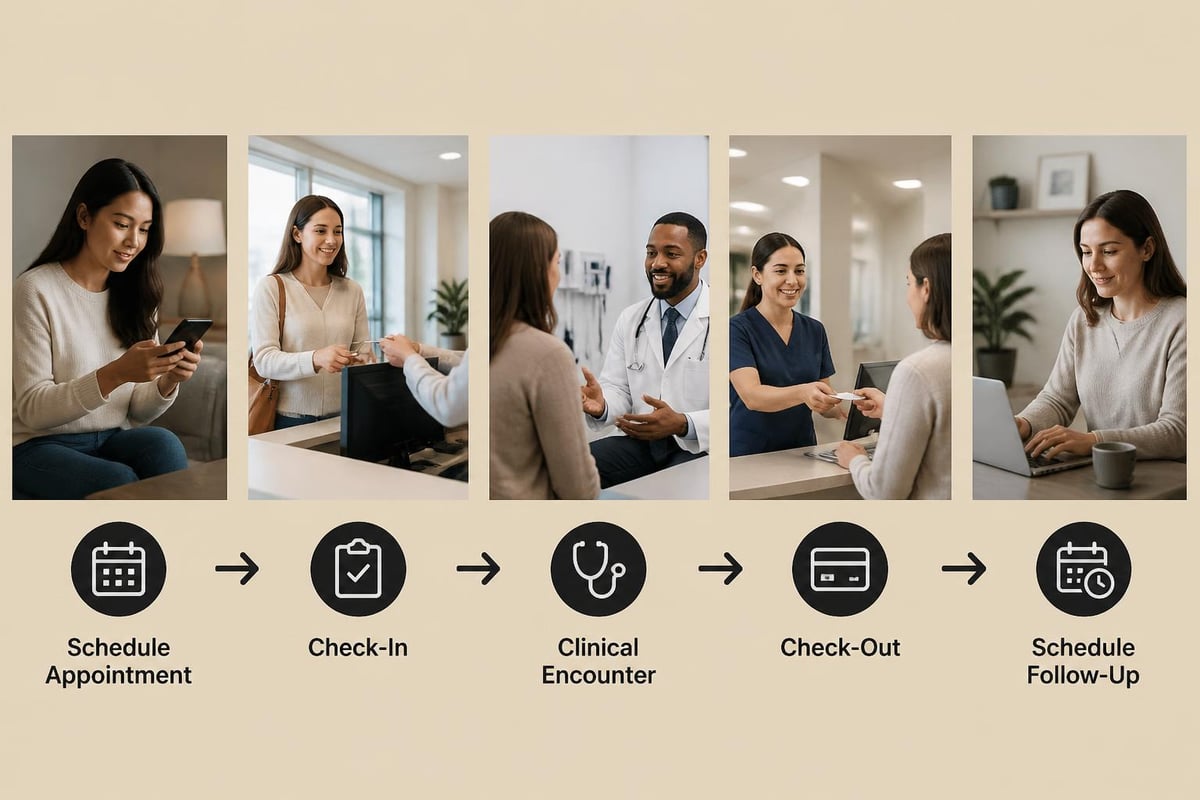
Effective patient scheduling extends beyond appointment booking to encompass the entire patient journey through the healthcare facility. Optimizing patient flow reduces congestion, minimizes wait times, and improves both patient satisfaction and clinical efficiency.
Key patient flow considerations:
- Arrival time instructions that distribute patient check-in throughout the day
- Registration process efficiency to prevent lobby congestion
- Exam room turnover protocols that maintain schedule momentum
- Check-out and follow-up scheduling integration
- Parking and facility navigation support for new patients
Research on adaptive scheduling strategies demonstrates that machine learning algorithms can dynamically adjust appointment timing based on real-time patient flow data, reducing wait times while maintaining high provider utilization rates.
Integration with Revenue Cycle Management
Patient scheduling serves as the entry point for the entire revenue cycle. Decisions made during the scheduling process directly impact claim accuracy, payment timing, and revenue realization. Healthcare organizations must view patient scheduling as a strategic revenue cycle function rather than a purely administrative task.
Insurance Verification and Authorization Management
Integrating insurance verification into the patient scheduling workflow prevents downstream revenue cycle problems. Automated eligibility checks performed at the time of scheduling identify coverage issues before patients arrive for appointments.
This proactive approach delivers multiple benefits:
- Reduced claim denials from coverage termination or eligibility issues
- Improved patient financial counseling before services are rendered
- Decreased administrative rework correcting preventable errors
- Enhanced patient satisfaction through transparent communication about financial responsibilities
Organizations should also incorporate prior authorization tracking into scheduling systems, automatically flagging appointments requiring authorization and initiating the approval process immediately upon scheduling.
Same-Day Scheduling and Urgent Access
Balancing scheduled appointments with urgent patient needs challenges many healthcare organizations. Prioritizing same-day access for urgent appointments improves patient outcomes while maintaining schedule efficiency.
Effective strategies include:
- Reserve protected slots specifically for same-day urgent visits
- Implement triage protocols to differentiate true urgency from convenience preferences
- Create flexible provider schedules with built-in capacity for unexpected needs
- Establish escalation pathways for patients requiring immediate care beyond practice capabilities
- Monitor same-day utilization patterns to adjust protected capacity appropriately
Organizations implementing open-access scheduling models report improved patient loyalty, reduced emergency department utilization, and enhanced provider satisfaction through more meaningful patient interactions.
Addressing Common Patient Scheduling Challenges
Despite technological advances and best practice adoption, healthcare organizations continue facing persistent patient scheduling challenges. Understanding these obstacles and implementing targeted solutions drives continuous improvement.
No-Show Prevention and Management
No-shows represent one of the most significant challenges in patient scheduling. Beyond automated reminders, organizations should implement multi-faceted approaches:
- Patient engagement campaigns emphasizing the importance of keeping appointments
- Flexible rescheduling policies that accommodate genuine patient needs
- Transportation assistance programs for patients with access barriers
- Telehealth alternatives for patients unable to travel to facilities
- No-show tracking and intervention for patients with repeated appointment failures
Some organizations implement graduated consequence policies for chronic no-show patients, though these must be carefully balanced against patient access considerations and potential discrimination concerns.
Technology Adoption and Digital Divide Considerations
While digital self-scheduling tools offer significant advantages, healthcare organizations must ensure equitable access for all patient populations. The benefits and considerations of online patient scheduling include both opportunities and potential barriers for certain demographics.
Organizations should maintain multiple scheduling channels to accommodate varying patient preferences and technological capabilities:
- Online portals and mobile apps for digitally engaged patients
- Traditional phone scheduling for patients preferring personal interaction
- In-person scheduling at the end of appointments for follow-up visits
- Assisted digital scheduling where staff help patients navigate online tools
This multi-channel approach maximizes access while encouraging gradual adoption of more efficient digital tools.
Workforce Optimization Through Intelligent Scheduling
Patient scheduling directly impacts healthcare workforce utilization and satisfaction. Poorly designed schedules create provider burnout, staff frustration, and inefficient resource allocation. Strategic patient scheduling considers human capital management alongside operational efficiency.
Provider Schedule Design and Work-Life Balance
Healthcare providers experience high burnout rates, partly driven by poorly designed clinical schedules that ignore work-life balance needs. Organizations must balance productivity targets with sustainable working conditions:
Schedule design principles:
- Limit consecutive clinical days to prevent exhaustion
- Incorporate administrative time for documentation and care coordination
- Provide schedule predictability for personal planning
- Distribute challenging patient appointments throughout the day
- Allow provider input into template design and personal preferences
Organizations prioritizing provider wellbeing through thoughtful patient scheduling report improved retention rates, reduced recruitment costs, and enhanced patient care quality.
Staff Scheduling Integration
Patient scheduling intersects with staff scheduling across multiple roles, including nurses, medical assistants, front desk personnel, and specialty technicians. Coordinating these schedules ensures adequate support for patient volume while preventing overstaffing during slow periods.
Advanced scheduling systems integrate patient appointments with staff scheduling, automatically adjusting staffing levels based on anticipated patient volume. Case studies of automated scheduling implementations demonstrate significant efficiency improvements and reduced patient waiting times when patient and staff schedules are optimized together.
Effective patient scheduling requires strategic integration of technology, process optimization, and human-centered design. Organizations that invest in modern scheduling systems, staff training, and continuous performance improvement realize substantial benefits across financial, operational, and patient satisfaction dimensions. Healthcare providers seeking to optimize their scheduling processes while addressing broader operational challenges can benefit from expert guidance. Nero and Associates, Inc. helps healthcare organizations implement automation and integration solutions that eliminate manual scheduling processes, improve revenue cycle performance, and enhance overall operational efficiency.