

Organizations across industries face recurring problems that drain resources, compromise quality, and frustrate employees. Rather than applying temporary fixes to symptoms, forward-thinking businesses are investing in root cause analysis to identify and eliminate the fundamental issues creating operational inefficiencies. This systematic approach has become essential for professional services firms, healthcare organizations, and companies committed to sustainable improvement and long-term performance optimization.
Understanding Root Cause Analysis Fundamentals
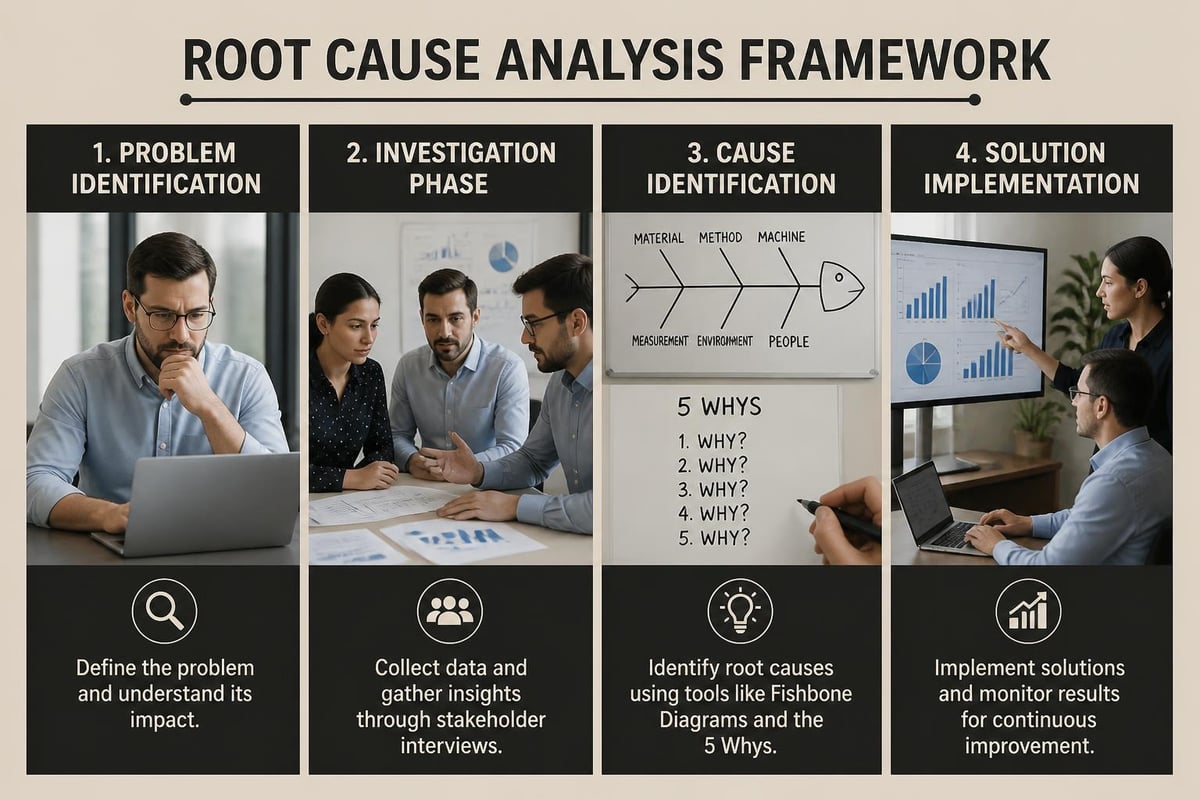
Root cause analysis represents a structured methodology for investigating incidents, failures, or inefficiencies to determine their underlying causes. Unlike surface-level problem-solving that addresses immediate symptoms, this approach digs deeper to uncover the systemic factors contributing to issues.
The core principle behind root cause analysis involves asking "why" repeatedly until reaching the fundamental cause of a problem. This technique prevents organizations from wasting resources on solutions that merely mask symptoms while the true problem persists. When implemented correctly, this methodology delivers measurable improvements in operational efficiency, cost reduction, and quality outcomes.
The Business Case for Systematic Investigation
Professional services firms and healthcare organizations face unique challenges that make root cause analysis particularly valuable. Manual processes prone to errors, revenue cycle bottlenecks, and employee productivity issues all stem from deeper systemic problems. According to various approaches to root cause analysis outlined by the U.S. Department of Education, successful implementations share common characteristics: clear problem definition, data-driven investigation, and commitment to systemic solutions.
Organizations that embrace this methodology typically experience:
- Reduced operational costs through elimination of recurring problems
- Improved employee satisfaction by removing frustrating inefficiencies
- Enhanced client outcomes resulting from higher quality service delivery
- Accelerated process automation opportunities identified through systematic analysis
- Better resource allocation focused on high-impact improvements
Core Methodologies and Practical Tools
Several established methodologies guide teams through the investigative process. Each offers distinct advantages depending on problem complexity, industry context, and organizational culture.
The Five Whys Technique
This straightforward approach involves asking "why" five times (or until reaching the root cause) to peel back layers of symptoms. For example, when analyzing why healthcare claims processing takes 45 days instead of the industry standard 30 days:
- Why are claims delayed? Staff members are overwhelmed with manual data entry.
- Why is manual data entry overwhelming? The current system lacks automated integration with payer portals.
- Why doesn't the system integrate automatically? Legacy software wasn't designed for modern API connections.
- Why hasn't the software been updated? Budget constraints and competing priorities delayed technology investments.
- Why did technology fall behind competing priorities? Leadership lacked visibility into the cost of manual processes versus automation investment.
This simple exercise reveals that the root cause isn't employee performance but rather strategic decision-making around technology investments. Solutions focused on employee training would fail to address the fundamental issue.
Fishbone Diagrams for Complex Problems
Also known as Ishikawa or cause-and-effect diagrams, this visual tool organizes potential causes into categories. For professional services firms, standard categories include People, Processes, Technology, Environment, Management, and Materials.
| Category | Example Causes | Investigation Questions |
|---|---|---|
| People | Insufficient training, high turnover, skill gaps | What competencies are missing? How does training impact outcomes? |
| Processes | Unclear procedures, redundant steps, bottlenecks | Where do workflows stall? Which steps add no value? |
| Technology | System incompatibility, outdated tools, poor integration | What manual workarounds exist? Where do errors originate? |
| Environment | Physical workspace, company culture, external factors | How does the setting affect performance? What constraints exist? |
| Management | Inadequate oversight, misaligned incentives, poor communication | Are expectations clear? Do metrics drive right behaviors? |
| Materials | Data quality, resource availability, vendor issues | Is information accurate and accessible? Are inputs reliable? |
This framework proves particularly effective when recovering underpayments for healthcare providers, where multiple factors across technology systems, staff capabilities, and process design contribute to revenue leakage.
Failure Mode and Effects Analysis
FMEA takes a proactive approach by identifying potential failure points before they occur. This methodology assigns risk priority numbers based on severity, occurrence likelihood, and detection difficulty. Organizations can then prioritize improvements based on quantified risk rather than intuition.
Implementing Root Cause Analysis in Professional Services
Successful implementation requires more than selecting the right tools. Organizations must create an environment where systematic investigation becomes part of operational culture rather than an occasional exercise.
Building Cross-Functional Investigation Teams
The Veterans Health Administration’s approach to root cause analysis emphasizes multidisciplinary teams that bring diverse perspectives to problem investigation. For consulting firms and healthcare organizations, this means including:
- Frontline staff who experience problems directly and understand operational realities
- Management representatives who can authorize changes and allocate resources
- Subject matter experts with technical knowledge relevant to the specific issue
- Data analysts capable of identifying patterns and validating hypotheses
- External facilitators who bring objectivity and prevent groupthink
Each team member contributes unique insights that surface causes others might overlook. A revenue cycle problem might appear to be a billing issue to finance staff but reveal itself as a documentation problem when clinicians join the investigation.

Data Collection and Analysis Standards
Effective root cause analysis depends on reliable data. Organizations should establish protocols for:
- Defining the problem scope with specific metrics, timeframes, and affected populations
- Gathering quantitative evidence from system logs, performance metrics, and financial reports
- Collecting qualitative insights through interviews, observations, and process walkthroughs
- Validating information accuracy by cross-referencing multiple sources
- Organizing findings systematically using standardized documentation templates
The importance of data analytics cannot be overstated in this process. Without accurate baseline measurements, organizations cannot determine whether implemented solutions actually resolve underlying problems.
Common Pitfalls to Avoid
Research examining limitations and challenges in root cause analysis highlights several mistakes that undermine effectiveness:
- Stopping at proximate causes rather than pursuing deeper systemic issues
- Blaming individuals instead of examining system design and organizational factors
- Jumping to solutions before completing thorough investigation
- Ignoring organizational culture that may perpetuate problematic patterns
- Failing to implement recommendations after investing in analysis
Organizations must resist the temptation to rush toward solutions. The investigation phase requires patience and discipline to ensure recommendations address genuine root causes.
Integrating Technology and Automation
Modern root cause analysis increasingly leverages artificial intelligence and automation to enhance investigation speed and accuracy. These technologies address traditional limitations while expanding analytical capabilities.
AI-Enhanced Pattern Recognition
Machine learning algorithms can identify correlations and patterns across vast datasets that human analysts might miss. Recent advances in root cause analysis using large language models demonstrate how AI can automate significant portions of the investigative process, particularly in complex technical environments.
For professional services firms, AI-powered analysis can:
- Detect anomalies in financial data suggesting process breakdowns
- Predict failure points before they result in service disruptions
- Correlate multiple variables to identify non-obvious causal relationships
- Generate hypotheses for human teams to investigate and validate
- Monitor solution effectiveness through continuous performance tracking
Automated Data Collection Systems
Manual data gathering introduces delays and potential errors into the investigation process. Integrated systems that automatically capture performance metrics, error logs, and process execution data provide investigation teams with real-time information.
When evaluating efficiency metrics in accounts payable automation, automated tracking reveals exactly where delays occur, which exceptions require manual intervention, and how frequently errors originate from specific sources. This granular visibility accelerates root cause identification.
Application Across Key Business Functions
Root cause analysis delivers value across multiple operational areas. Understanding application-specific considerations helps organizations maximize returns from their investigative investments.
Revenue Cycle Management
Healthcare organizations face persistent challenges with claim denials, payment delays, and revenue leakage. Systematic investigation often reveals root causes in:
- Incomplete documentation at point of service that triggers downstream rejections
- Coding accuracy issues stemming from inadequate training or unclear guidelines
- System integration failures preventing timely claim submission
- Verification process gaps leading to eligibility-related denials
- Follow-up protocol weaknesses allowing aged accounts receivable to accumulate
Solutions targeting these root causes typically generate rapid ROI through reduced days in accounts receivable and improved collection rates.
Human Capital Management
Employee turnover, engagement issues, and productivity challenges often share common underlying causes. Investigation might uncover:
| Problem Symptom | Common Root Causes | Effective Solutions |
|---|---|---|
| High turnover rates | Poor onboarding processes, misaligned expectations, lack of growth opportunities | Structured integration programs, career pathing, mentorship systems |
| Low productivity | Unclear priorities, inadequate tools, process inefficiencies | Goal-setting frameworks, technology upgrades, workflow redesign |
| Quality issues | Insufficient training, time pressure, unclear standards | Competency development, capacity planning, quality management systems |
| Poor engagement | Limited autonomy, weak recognition, cultural misalignment | Empowerment initiatives, feedback systems, values clarification |
Addressing these fundamental issues creates sustainable improvements in workforce performance and satisfaction.
Process Automation Initiatives
Organizations implementing automation sometimes experience disappointing results because they automate flawed processes. Root cause analysis before automation reveals:
- Unnecessary process steps that should be eliminated rather than automated
- Decision points requiring human judgment that automation cannot replicate effectively
- Data quality problems that will propagate through automated workflows
- Integration requirements not identified during initial planning
- Change management needs critical for user adoption
This upfront investigation ensures automation investments deliver expected returns. The management consulting approach to process optimization always begins with understanding current-state problems before designing future-state solutions.

Measuring Impact and Sustaining Improvements
Root cause analysis only delivers value when organizations implement recommendations and verify results. Measurement frameworks ensure accountability and continuous improvement.
Key Performance Indicators
Organizations should establish metrics that directly correlate with identified root causes:
- Process cycle time reduction when eliminating bottlenecks
- Error rates declining after addressing quality issues
- Cost per transaction improving following automation implementation
- Employee satisfaction scores increasing after workplace improvements
- Revenue capture rates rising when billing issues are resolved
Tracking these indicators over time demonstrates whether solutions actually addressed root causes or merely shifted problems elsewhere.
Continuous Improvement Culture
The most successful organizations integrate root cause analysis into daily operations rather than treating it as a special project. This requires:
- Training employees at all levels in basic investigative techniques
- Empowering teams to pause and investigate rather than implement quick fixes
- Rewarding systemic thinking that identifies and addresses fundamental issues
- Sharing learnings across departments to prevent similar problems elsewhere
- Allocating resources for implementation of validated recommendations
Studies on root cause analysis effectiveness in patient safety demonstrate that organizations achieving the greatest improvements treat systematic investigation as an ongoing discipline rather than isolated event responses.
Strategic Advantages for Forward-Thinking Organizations
Organizations that master root cause analysis gain competitive advantages extending beyond immediate problem resolution. This capability enables strategic benefits including:
Proactive risk management through early identification of emerging issues before they escalate into major problems. Teams trained in systematic investigation recognize warning signs and intervene preventively.
Knowledge retention as investigation documentation captures organizational learning. When employees leave, their insights about system weaknesses and improvement opportunities remain accessible.
Resource optimization by eliminating waste and focusing improvement efforts on high-impact opportunities. Rather than spreading resources across many small initiatives, organizations concentrate on changes addressing fundamental constraints.
Innovation capacity as teams develop deeper understanding of how systems actually function. This knowledge foundation supports more creative and effective solution design.
Organizations seeking to identify hidden growth opportunities find that root cause analysis reveals constraints limiting performance and expansion potential.
Advanced Considerations for Complex Organizations
Larger organizations with multiple locations, diverse service lines, and complex technology ecosystems face additional challenges in root cause investigation.
Multi-Site Problem Analysis
When problems appear across multiple locations, investigators must determine whether root causes are local or systemic:
- Local variations suggest issues with site-specific implementation, leadership, or resources
- Consistent patterns indicate organizational policies, systems, or culture driving problems
- Mixed results may reveal that solutions require customization for different contexts
Comparative analysis across sites helps distinguish these scenarios and inform appropriate responses.
Technology Stack Complexity
Modern organizations rely on interconnected systems where problems in one application cascade through dependent processes. Effective investigation requires:
- Architecture documentation showing system relationships and data flows
- Technical expertise to interpret error logs and performance metrics
- Testing environments for validating hypotheses without disrupting operations
- Vendor collaboration when issues originate in third-party platforms
The general overview of root cause analysis across industries highlights how methodology must adapt to technological complexity while maintaining core investigative principles.
Regulatory and Compliance Factors
Healthcare organizations and regulated industries face additional considerations:
- Documentation requirements for incident investigations and corrective actions
- Reporting obligations to oversight bodies when problems affect patient safety or data security
- Implementation timelines mandated by regulatory agencies or accreditation standards
- Privacy constraints limiting data access during investigation
These factors influence investigation design without changing fundamental analytical approaches. Organizations must balance thoroughness with regulatory deadlines while protecting sensitive information.
Root cause analysis transforms how organizations approach persistent problems, shifting focus from quick fixes to sustainable solutions that address fundamental issues. By implementing systematic investigation methodologies, leveraging data and technology, and building continuous improvement cultures, businesses eliminate inefficiencies, reduce costs, and enhance overall performance. Nero and Associates, Inc. helps organizations implement root cause analysis frameworks that identify opportunities to eliminate manual processes, optimize revenue cycles, and improve operational efficiency through AI-powered solutions and strategic consulting expertise.