

Data Integrity: Essential Strategies for Business Success

Share on Facebook
Share on X
Share on LinkedIn

Modern businesses generate and process enormous volumes of information daily. From employee records and financial transactions to customer interactions and operational metrics, organizations depend on this information to make critical decisions, automate processes, and serve their stakeholders effectively. However, the value of this information hinges entirely on one fundamental characteristic: its trustworthiness. When businesses can rely on their information to be accurate, consistent, and complete throughout its lifecycle, they unlock opportunities for efficiency gains, cost savings, and strategic advantages that transform their operations.

Understanding the Foundation of Trustworthy Business Information

Data integrity represents the accuracy, consistency, and reliability of information throughout its entire lifecycle. This concept encompasses multiple dimensions that work together to ensure organizations can trust the information they use for decision-making, automation, and reporting purposes.

At its core, maintaining accurate information means preserving its exactness from the moment of creation through every transformation, transfer, and storage operation. Data integrity differs from security in that while security protects information from unauthorized access, integrity ensures the information itself remains correct and unchanged except through authorized processes.

The Four Pillars of Information Accuracy

Organizations should understand the distinct types that govern their information systems:

  • Entity integrity ensures each record in a database has a unique identifier that prevents duplication and confusion
  • Referential integrity maintains consistent relationships between connected information sets
  • Domain integrity enforces valid values within specified ranges or categories for each field
  • User-defined integrity applies specific business rules and constraints unique to organizational requirements

These four types of data integrity work in concert to create a comprehensive framework that protects information quality across all systems. When one pillar weakens, the entire structure becomes vulnerable to errors that cascade through interconnected processes.
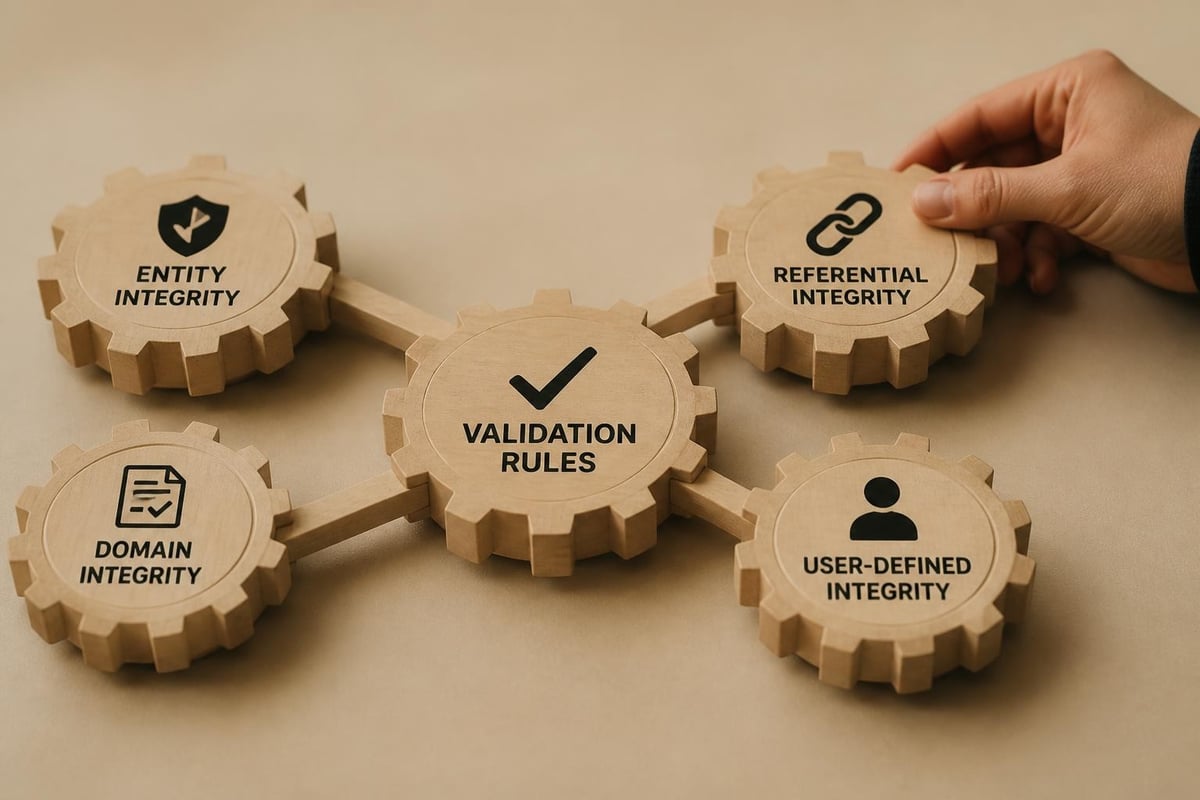
Four types of data integrity framework

Why Accurate Information Drives Business Performance

Organizations that prioritize information accuracy gain measurable advantages across their operations. The impact extends far beyond preventing errors-it fundamentally enables strategic initiatives and operational excellence.

Revenue Cycle Management Excellence

For healthcare organizations and professional services firms managing complex billing operations, information accuracy directly affects revenue capture. When patient records, insurance details, and billing codes maintain perfect accuracy, claims process faster with fewer denials. Our RCM consulting work consistently demonstrates that organizations with robust validation processes recover significantly more revenue than those with inconsistent information practices.

Consider a healthcare provider processing thousands of claims monthly. A single inconsistency in patient identifiers can trigger claim rejections, payment delays, and resource-intensive appeals processes. Multiply these issues across hundreds of records, and the revenue impact becomes substantial.

Automation and Integration Success

Artificial intelligence and automation systems depend absolutely on accurate input information. When organizations deploy automation to eliminate thousands of hours of manual processes, the quality of their underlying information determines success or failure.

Business Function Impact of Poor Information Quality Impact of High Information Quality
Payroll Processing Incorrect payments, compliance violations Accurate compensation, reduced audit risk
Benefits Administration Enrollment errors, coverage gaps Seamless enrollment, proper coverage
Accounts Payable Duplicate payments, vendor disputes Optimized cash flow, vendor relationships
Revenue Recognition Misstatements, audit findings Accurate reporting, stakeholder confidence

Automation systems process information at speeds impossible for human workers, but they cannot inherently detect accuracy issues. A payroll automation system will dutifully process incorrect salary information, an accounts payable system will pay duplicate invoices, and a benefits enrollment system will enroll employees in wrong plans if the underlying information contains errors.

Implementing Validation and Control Mechanisms

Organizations must establish systematic approaches to maintain information accuracy throughout the lifecycle. These mechanisms range from technical controls embedded in systems to procedural safeguards executed by personnel.

Technical Validation Strategies

Modern database systems and applications offer numerous built-in features that enforce accuracy constraints. Foreign key relationships prevent orphaned records, check constraints ensure values fall within acceptable ranges, and unique indexes prevent duplicate entries. However, technical controls alone prove insufficient.

Data integrity testing encompasses systematic verification that information remains accurate across all processes and transformations. Organizations should implement automated testing routines that validate information quality before it flows into critical systems. For instance, before importing employee records into an HRIS system, validation scripts should verify that all required fields contain properly formatted values, dates fall within logical ranges, and identifiers match existing records where appropriate.

Procedural Safeguards and Governance

Technology enables accuracy, but governance sustains it. Organizations need clearly defined policies governing how personnel create, modify, and delete information across all systems. These policies should specify:

  1. Authorization levels that determine who can perform various operations on different information types
  2. Validation requirements that mandate review and approval before critical changes take effect
  3. Audit procedures that regularly verify information accuracy through systematic sampling and testing
  4. Correction protocols that establish how organizations identify, investigate, and remediate accuracy issues

Strong governance frameworks embed accountability throughout the organization. When personnel understand their responsibilities for maintaining accurate information and face consequences for negligence, overall quality improves dramatically.
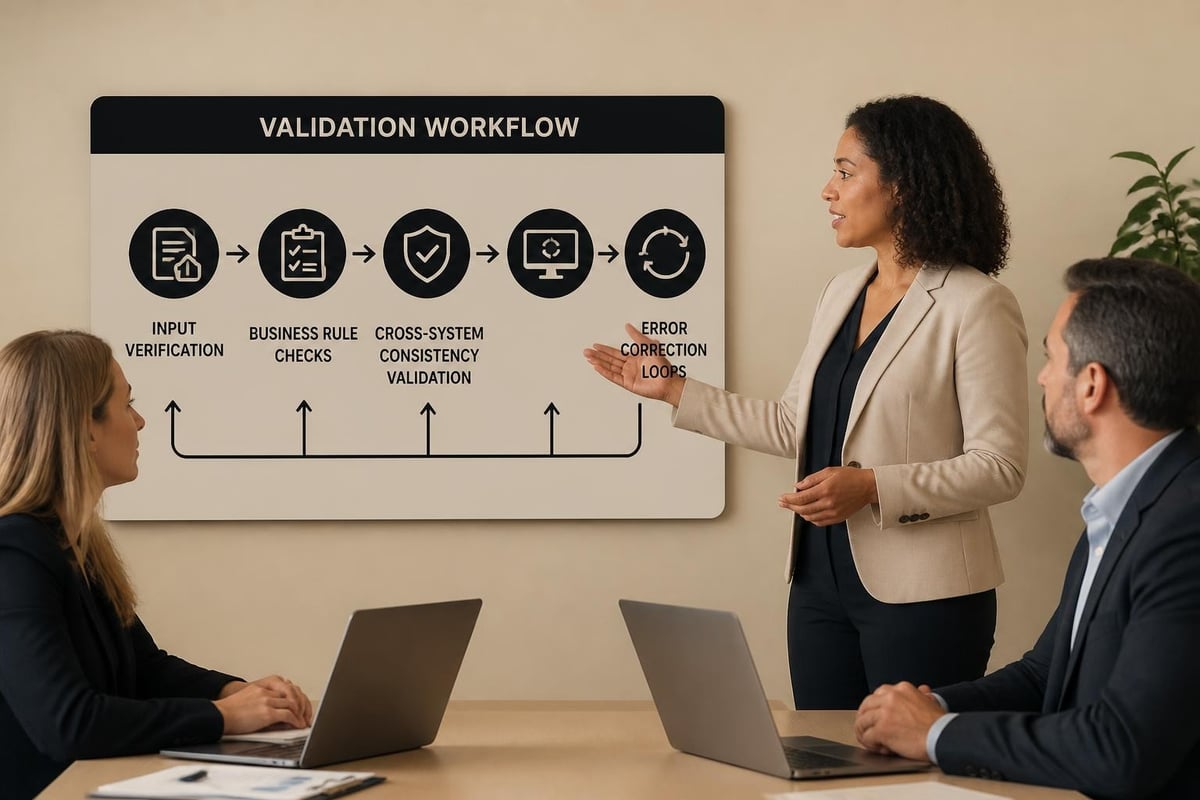
Data validation workflow

Addressing Common Challenges and Vulnerabilities

Even organizations with robust controls face ongoing challenges that threaten information accuracy. Understanding these vulnerabilities enables proactive risk management.

Integration Complexity

Modern enterprises operate dozens or hundreds of interconnected systems. Customer relationship management platforms connect to billing systems, which integrate with accounting software, which feeds business intelligence tools. Each integration point represents a potential source of accuracy degradation.

When information transfers between systems with different validation rules, formatting requirements, or business logic, inconsistencies emerge. A customer address that validates perfectly in a CRM system might fail validation rules in a shipping system due to different field length limits or formatting expectations. Organizations performing data normalization address these challenges by establishing consistent formats and standards across all systems.

Human Error and Process Gaps

Manual data entry remains necessary in many business processes, and humans inevitably make mistakes. Transposed digits, misread handwriting, incorrect selections from dropdown menus, and overlooked required fields all introduce inaccuracies that propagate through downstream processes.

Professional services organizations processing employee benefits must maintain particularly high accuracy standards. When benefits consultants work with employee benefits data, a single error in dependent information can result in coverage gaps, compliance violations, and significant financial exposure for both the employer and affected employees.

System Migrations and Upgrades

Organizations frequently migrate information between systems during technology upgrades, vendor changes, or platform consolidations. These migrations represent high-risk events where accuracy issues commonly emerge. Legacy systems often contain inconsistent information that accumulated over years, and migration processes may lack sufficient validation to detect these issues before transferring to new platforms.

Best practices for maintaining data integrity emphasize the importance of pre-migration data cleansing, validation during transfer, and post-migration verification to ensure accuracy survives the transition intact.

Establishing Continuous Monitoring and Improvement

Organizations cannot treat information accuracy as a one-time project with a completion date. Instead, they must establish continuous monitoring processes that detect emerging issues before they cause significant damage.

Automated Quality Metrics

Modern analytics platforms enable organizations to track information quality metrics in real-time dashboards. These metrics might include:

  • Completeness rates showing the percentage of required fields populated across records
  • Consistency scores measuring alignment between related information sets
  • Timeliness indicators tracking how current information remains relative to source updates
  • Accuracy percentages derived from systematic validation against authoritative sources

When these metrics decline below acceptable thresholds, automated alerts notify responsible personnel who can investigate and remediate issues promptly. This proactive approach prevents small accuracy problems from compounding into major operational disruptions.

Regular Audit Cycles

Systematic audits complement automated monitoring by providing deeper investigation into information quality across critical business processes. These audits should examine not only whether information appears accurate on the surface, but whether it properly supports business requirements and complies with regulatory standards.

For healthcare organizations managing revenue cycle operations, regular audits might examine whether patient demographic information matches insurance carrier records, whether diagnosis codes align with clinical documentation, and whether charge capture processes record all billable services. Organizations focused on recovering underpaid claims find that systematic audits frequently identify patterns of information inaccuracy that lead to revenue leakage.

Building Organizational Culture Around Accuracy

Technology and processes provide the framework for maintaining information quality, but organizational culture determines whether personnel actually follow established procedures and prioritize accuracy in their daily work.

Training and Awareness Programs

Personnel cannot maintain accurate information if they do not understand why it matters or how their actions affect overall quality. Comprehensive training programs should educate employees about:

  1. How their specific roles contribute to organizational information accuracy
  2. The downstream consequences of inaccurate information they create or modify
  3. Specific procedures and validation steps required for their responsibilities
  4. Tools and resources available to verify information accuracy before committing changes

Organizations should refresh this training regularly, particularly when implementing new systems or processes that change how personnel interact with critical information.

Accountability and Performance Management

When performance evaluations and compensation decisions reflect information quality metrics, personnel pay closer attention to accuracy in their daily work. Organizations might track individual error rates, require supervisory review of work with historical quality issues, or recognize employees who consistently demonstrate exceptional attention to accuracy.

Data integrity culture framework

Leveraging Technology for Enhanced Protection

Emerging technologies offer new capabilities for protecting and verifying information accuracy across complex enterprise environments. Organizations that adopt these tools gain significant advantages over competitors relying on traditional approaches.

Artificial Intelligence and Machine Learning

AI systems excel at identifying patterns that indicate potential accuracy issues. Machine learning algorithms can analyze millions of records to detect anomalies, flag suspicious transactions, identify duplicate entries with slight variations, and predict which records most likely contain errors based on historical patterns.

For instance, AI systems can learn that insurance verification processes typically yield certain patterns of approval rates, processing times, and denial reasons. When new batches of insurance verification requests deviate significantly from these patterns, the system alerts personnel to investigate potential information quality issues before they affect claim submissions.

Blockchain and Distributed Validation

Some organizations explore blockchain technology for maintaining tamper-proof audit trails that demonstrate information has not been altered since creation. While blockchain adoption remains limited outside specific use cases, the underlying principle of distributed validation offers valuable protection for critical information assets.

Organizations implementing strategies from sources like MongoDB’s guide to preserving data integrity find that distributed validation approaches significantly reduce the risk of undetected alterations to critical business information.

Advanced Analytics and Visualization

Modern analytics platforms transform raw information quality metrics into actionable insights through sophisticated visualizations and predictive models. Rather than simply reporting that 5% of customer records contain incomplete addresses, advanced analytics can predict which incomplete records most urgently require remediation based on their role in upcoming business processes, estimate the potential revenue impact of current quality levels, and recommend specific remediation priorities.

Regulatory Compliance and Standards

Many industries face regulatory requirements that mandate specific information accuracy standards. Healthcare organizations must comply with HIPAA requirements for patient information accuracy, financial services firms face stringent regulatory expectations for transaction records, and virtually all organizations must maintain accurate employee records for tax and benefits compliance.

The ALCOA+ framework, detailed in Agidens’ discussion of data integrity in life sciences, provides valuable guidance applicable beyond pharmaceutical environments. ALCOA+ stands for Attributable, Legible, Contemporaneous, Original, Accurate, Complete, Consistent, Enduring, and Available. Organizations implementing these principles create robust frameworks that satisfy regulatory requirements while supporting operational excellence.

Strategic Value Beyond Compliance

While regulatory compliance provides important motivation for maintaining information accuracy, forward-thinking organizations recognize that strategic value extends far beyond avoiding penalties. Accurate information enables competitive advantages that directly impact market position and financial performance.

Enhanced Decision-Making Capabilities

Executive teams making strategic decisions based on inaccurate information waste resources pursuing misguided initiatives while overlooking genuine opportunities. When leadership can trust that operational reports, financial statements, and performance metrics accurately reflect business reality, they make better decisions with greater confidence.

Organizations with superior information accuracy respond faster to market changes, identify emerging trends before competitors, and allocate resources more effectively across competing priorities.

Customer and Employee Trust

Stakeholders notice when organizations demonstrate commitment to accuracy. Customers appreciate receiving correct invoices, employees trust payroll systems that consistently deliver accurate compensation, and partners value working with organizations that maintain reliable information across all interactions.

This trust translates into measurable business value through improved customer retention, enhanced employee satisfaction, stronger partner relationships, and positive reputation effects that support growth initiatives.


Maintaining accurate, consistent, and reliable information across all business systems represents one of the most consequential operational priorities for modern organizations. The strategies and technologies discussed here provide a comprehensive framework for protecting this critical asset while extracting maximum value from information investments. At Nero and Associates, Inc., we help organizations implement the automation, integration, and human capital management solutions that depend on pristine information quality while establishing the governance frameworks that sustain accuracy over time. Our performance-based approach ensures your organization achieves measurable improvements in operational efficiency, revenue capture, and employee wellness through systematic attention to the information foundation supporting these outcomes.

Data Integrity: Essential Strategies for Business Success

Modern businesses generate and process enormous volumes of information daily. From employee records and financial transactions to customer interactions and operational metrics, organizations depend on this information to make critical decisions, automate processes, and serve their stakeholders effectively. However, the value of this information hinges entirely on one fundamental characteristic: its trustworthiness. When businesses can rely on their information to be accurate, consistent, and complete throughout its lifecycle, they unlock opportunities for efficiency gains, cost savings, and strategic advantages that transform their operations.

Understanding the Foundation of Trustworthy Business Information

Data integrity represents the accuracy, consistency, and reliability of information throughout its entire lifecycle. This concept encompasses multiple dimensions that work together to ensure organizations can trust the information they use for decision-making, automation, and reporting purposes.

At its core, maintaining accurate information means preserving its exactness from the moment of creation through every transformation, transfer, and storage operation. Data integrity differs from security in that while security protects information from unauthorized access, integrity ensures the information itself remains correct and unchanged except through authorized processes.

The Four Pillars of Information Accuracy

Organizations should understand the distinct types that govern their information systems:

  • Entity integrity ensures each record in a database has a unique identifier that prevents duplication and confusion
  • Referential integrity maintains consistent relationships between connected information sets
  • Domain integrity enforces valid values within specified ranges or categories for each field
  • User-defined integrity applies specific business rules and constraints unique to organizational requirements

These four types of data integrity work in concert to create a comprehensive framework that protects information quality across all systems. When one pillar weakens, the entire structure becomes vulnerable to errors that cascade through interconnected processes.

Four types of data integrity framework

Why Accurate Information Drives Business Performance

Organizations that prioritize information accuracy gain measurable advantages across their operations. The impact extends far beyond preventing errors-it fundamentally enables strategic initiatives and operational excellence.

Revenue Cycle Management Excellence

For healthcare organizations and professional services firms managing complex billing operations, information accuracy directly affects revenue capture. When patient records, insurance details, and billing codes maintain perfect accuracy, claims process faster with fewer denials. Our RCM consulting work consistently demonstrates that organizations with robust validation processes recover significantly more revenue than those with inconsistent information practices.

Consider a healthcare provider processing thousands of claims monthly. A single inconsistency in patient identifiers can trigger claim rejections, payment delays, and resource-intensive appeals processes. Multiply these issues across hundreds of records, and the revenue impact becomes substantial.

Automation and Integration Success

Artificial intelligence and automation systems depend absolutely on accurate input information. When organizations deploy automation to eliminate thousands of hours of manual processes, the quality of their underlying information determines success or failure.

Business Function Impact of Poor Information Quality Impact of High Information Quality
Payroll Processing Incorrect payments, compliance violations Accurate compensation, reduced audit risk
Benefits Administration Enrollment errors, coverage gaps Seamless enrollment, proper coverage
Accounts Payable Duplicate payments, vendor disputes Optimized cash flow, vendor relationships
Revenue Recognition Misstatements, audit findings Accurate reporting, stakeholder confidence

Automation systems process information at speeds impossible for human workers, but they cannot inherently detect accuracy issues. A payroll automation system will dutifully process incorrect salary information, an accounts payable system will pay duplicate invoices, and a benefits enrollment system will enroll employees in wrong plans if the underlying information contains errors.

Implementing Validation and Control Mechanisms

Organizations must establish systematic approaches to maintain information accuracy throughout the lifecycle. These mechanisms range from technical controls embedded in systems to procedural safeguards executed by personnel.

Technical Validation Strategies

Modern database systems and applications offer numerous built-in features that enforce accuracy constraints. Foreign key relationships prevent orphaned records, check constraints ensure values fall within acceptable ranges, and unique indexes prevent duplicate entries. However, technical controls alone prove insufficient.

Data integrity testing encompasses systematic verification that information remains accurate across all processes and transformations. Organizations should implement automated testing routines that validate information quality before it flows into critical systems. For instance, before importing employee records into an HRIS system, validation scripts should verify that all required fields contain properly formatted values, dates fall within logical ranges, and identifiers match existing records where appropriate.

Procedural Safeguards and Governance

Technology enables accuracy, but governance sustains it. Organizations need clearly defined policies governing how personnel create, modify, and delete information across all systems. These policies should specify:

  1. Authorization levels that determine who can perform various operations on different information types
  2. Validation requirements that mandate review and approval before critical changes take effect
  3. Audit procedures that regularly verify information accuracy through systematic sampling and testing
  4. Correction protocols that establish how organizations identify, investigate, and remediate accuracy issues

Strong governance frameworks embed accountability throughout the organization. When personnel understand their responsibilities for maintaining accurate information and face consequences for negligence, overall quality improves dramatically.

Data validation workflow

Addressing Common Challenges and Vulnerabilities

Even organizations with robust controls face ongoing challenges that threaten information accuracy. Understanding these vulnerabilities enables proactive risk management.

Integration Complexity

Modern enterprises operate dozens or hundreds of interconnected systems. Customer relationship management platforms connect to billing systems, which integrate with accounting software, which feeds business intelligence tools. Each integration point represents a potential source of accuracy degradation.

When information transfers between systems with different validation rules, formatting requirements, or business logic, inconsistencies emerge. A customer address that validates perfectly in a CRM system might fail validation rules in a shipping system due to different field length limits or formatting expectations. Organizations performing data normalization address these challenges by establishing consistent formats and standards across all systems.

Human Error and Process Gaps

Manual data entry remains necessary in many business processes, and humans inevitably make mistakes. Transposed digits, misread handwriting, incorrect selections from dropdown menus, and overlooked required fields all introduce inaccuracies that propagate through downstream processes.

Professional services organizations processing employee benefits must maintain particularly high accuracy standards. When benefits consultants work with employee benefits data, a single error in dependent information can result in coverage gaps, compliance violations, and significant financial exposure for both the employer and affected employees.

System Migrations and Upgrades

Organizations frequently migrate information between systems during technology upgrades, vendor changes, or platform consolidations. These migrations represent high-risk events where accuracy issues commonly emerge. Legacy systems often contain inconsistent information that accumulated over years, and migration processes may lack sufficient validation to detect these issues before transferring to new platforms.

Best practices for maintaining data integrity emphasize the importance of pre-migration data cleansing, validation during transfer, and post-migration verification to ensure accuracy survives the transition intact.

Establishing Continuous Monitoring and Improvement

Organizations cannot treat information accuracy as a one-time project with a completion date. Instead, they must establish continuous monitoring processes that detect emerging issues before they cause significant damage.

Automated Quality Metrics

Modern analytics platforms enable organizations to track information quality metrics in real-time dashboards. These metrics might include:

  • Completeness rates showing the percentage of required fields populated across records
  • Consistency scores measuring alignment between related information sets
  • Timeliness indicators tracking how current information remains relative to source updates
  • Accuracy percentages derived from systematic validation against authoritative sources

When these metrics decline below acceptable thresholds, automated alerts notify responsible personnel who can investigate and remediate issues promptly. This proactive approach prevents small accuracy problems from compounding into major operational disruptions.

Regular Audit Cycles

Systematic audits complement automated monitoring by providing deeper investigation into information quality across critical business processes. These audits should examine not only whether information appears accurate on the surface, but whether it properly supports business requirements and complies with regulatory standards.

For healthcare organizations managing revenue cycle operations, regular audits might examine whether patient demographic information matches insurance carrier records, whether diagnosis codes align with clinical documentation, and whether charge capture processes record all billable services. Organizations focused on recovering underpaid claims find that systematic audits frequently identify patterns of information inaccuracy that lead to revenue leakage.

Building Organizational Culture Around Accuracy

Technology and processes provide the framework for maintaining information quality, but organizational culture determines whether personnel actually follow established procedures and prioritize accuracy in their daily work.

Training and Awareness Programs

Personnel cannot maintain accurate information if they do not understand why it matters or how their actions affect overall quality. Comprehensive training programs should educate employees about:

  1. How their specific roles contribute to organizational information accuracy
  2. The downstream consequences of inaccurate information they create or modify
  3. Specific procedures and validation steps required for their responsibilities
  4. Tools and resources available to verify information accuracy before committing changes

Organizations should refresh this training regularly, particularly when implementing new systems or processes that change how personnel interact with critical information.

Accountability and Performance Management

When performance evaluations and compensation decisions reflect information quality metrics, personnel pay closer attention to accuracy in their daily work. Organizations might track individual error rates, require supervisory review of work with historical quality issues, or recognize employees who consistently demonstrate exceptional attention to accuracy.

Data integrity culture framework

Leveraging Technology for Enhanced Protection

Emerging technologies offer new capabilities for protecting and verifying information accuracy across complex enterprise environments. Organizations that adopt these tools gain significant advantages over competitors relying on traditional approaches.

Artificial Intelligence and Machine Learning

AI systems excel at identifying patterns that indicate potential accuracy issues. Machine learning algorithms can analyze millions of records to detect anomalies, flag suspicious transactions, identify duplicate entries with slight variations, and predict which records most likely contain errors based on historical patterns.

For instance, AI systems can learn that insurance verification processes typically yield certain patterns of approval rates, processing times, and denial reasons. When new batches of insurance verification requests deviate significantly from these patterns, the system alerts personnel to investigate potential information quality issues before they affect claim submissions.

Blockchain and Distributed Validation

Some organizations explore blockchain technology for maintaining tamper-proof audit trails that demonstrate information has not been altered since creation. While blockchain adoption remains limited outside specific use cases, the underlying principle of distributed validation offers valuable protection for critical information assets.

Organizations implementing strategies from sources like MongoDB’s guide to preserving data integrity find that distributed validation approaches significantly reduce the risk of undetected alterations to critical business information.

Advanced Analytics and Visualization

Modern analytics platforms transform raw information quality metrics into actionable insights through sophisticated visualizations and predictive models. Rather than simply reporting that 5% of customer records contain incomplete addresses, advanced analytics can predict which incomplete records most urgently require remediation based on their role in upcoming business processes, estimate the potential revenue impact of current quality levels, and recommend specific remediation priorities.

Regulatory Compliance and Standards

Many industries face regulatory requirements that mandate specific information accuracy standards. Healthcare organizations must comply with HIPAA requirements for patient information accuracy, financial services firms face stringent regulatory expectations for transaction records, and virtually all organizations must maintain accurate employee records for tax and benefits compliance.

The ALCOA+ framework, detailed in Agidens’ discussion of data integrity in life sciences, provides valuable guidance applicable beyond pharmaceutical environments. ALCOA+ stands for Attributable, Legible, Contemporaneous, Original, Accurate, Complete, Consistent, Enduring, and Available. Organizations implementing these principles create robust frameworks that satisfy regulatory requirements while supporting operational excellence.

Strategic Value Beyond Compliance

While regulatory compliance provides important motivation for maintaining information accuracy, forward-thinking organizations recognize that strategic value extends far beyond avoiding penalties. Accurate information enables competitive advantages that directly impact market position and financial performance.

Enhanced Decision-Making Capabilities

Executive teams making strategic decisions based on inaccurate information waste resources pursuing misguided initiatives while overlooking genuine opportunities. When leadership can trust that operational reports, financial statements, and performance metrics accurately reflect business reality, they make better decisions with greater confidence.

Organizations with superior information accuracy respond faster to market changes, identify emerging trends before competitors, and allocate resources more effectively across competing priorities.

Customer and Employee Trust

Stakeholders notice when organizations demonstrate commitment to accuracy. Customers appreciate receiving correct invoices, employees trust payroll systems that consistently deliver accurate compensation, and partners value working with organizations that maintain reliable information across all interactions.

This trust translates into measurable business value through improved customer retention, enhanced employee satisfaction, stronger partner relationships, and positive reputation effects that support growth initiatives.


Maintaining accurate, consistent, and reliable information across all business systems represents one of the most consequential operational priorities for modern organizations. The strategies and technologies discussed here provide a comprehensive framework for protecting this critical asset while extracting maximum value from information investments. At Nero and Associates, Inc., we help organizations implement the automation, integration, and human capital management solutions that depend on pristine information quality while establishing the governance frameworks that sustain accuracy over time. Our performance-based approach ensures your organization achieves measurable improvements in operational efficiency, revenue capture, and employee wellness through systematic attention to the information foundation supporting these outcomes.

Website developed in accordance with Web Content Accessibility Guidelines 2.2.
If you encounter any issues while using this site, please contact us: 215.526.5126